
A Parent's Guide to Wooden Building Blocks for Kids
In a world brimming with beeping gadgets and flashing screens, the humble wooden building block holds its own. It’s more than just a toy; it’s one of the most powerful and effective tools for a child's development. These simple, tactile pieces are a complete developmental toolkit, proven to build essential cognitive and motor skills right from the start. Let's explore why this timeless classic is often the smartest choice you can make for your child.
Why Wooden Blocks Are A Cornerstone of Child Development
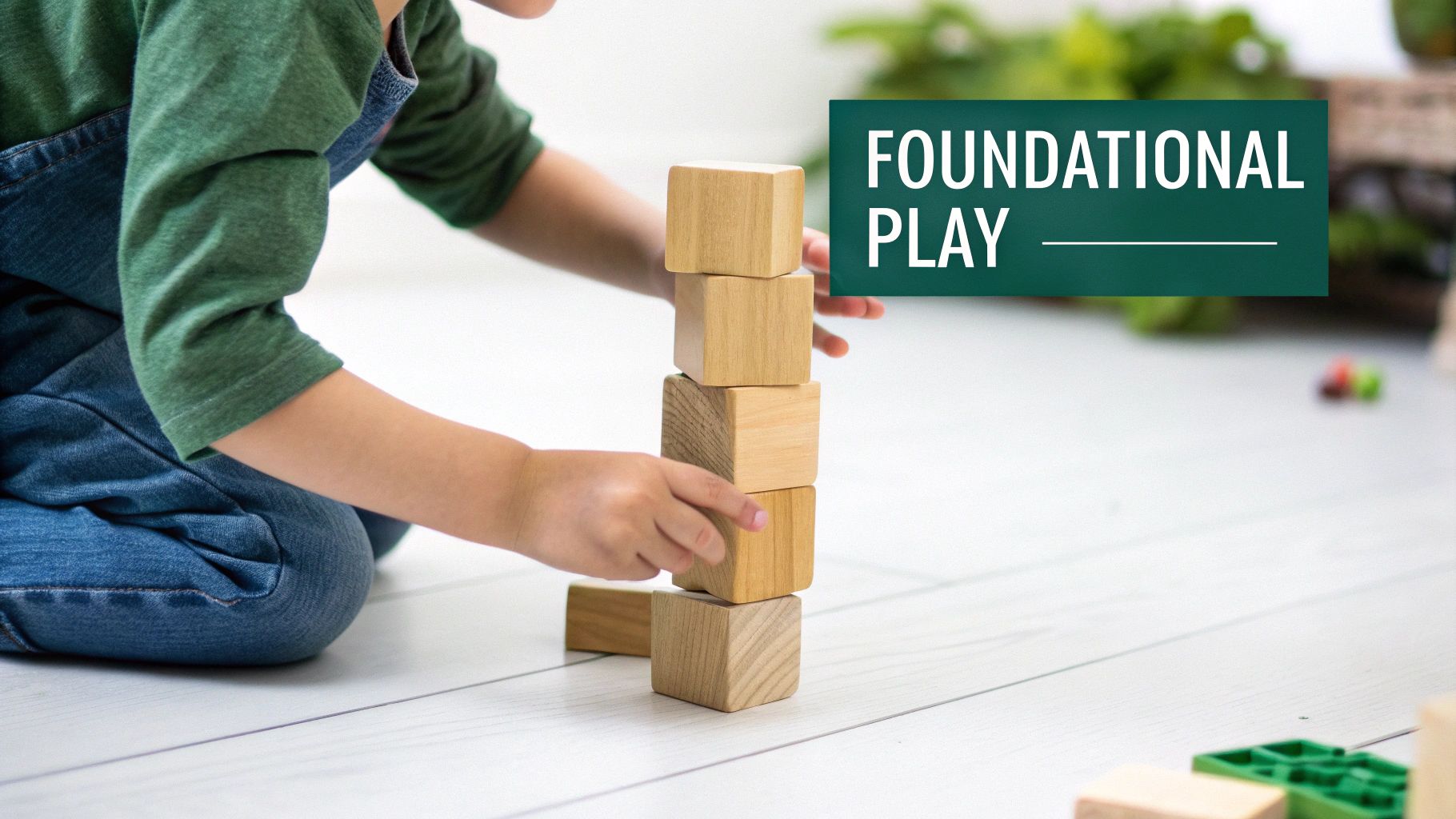
Think of a set of wooden blocks as a blank canvas for your child’s imagination. Unlike an electronic toy that tells a child how to play, a block has no buttons to press or pre-programmed sounds to follow. This beautiful simplicity is precisely where its power lies, inviting children to create, imagine, and solve problems without any limits.
Because they are so open-ended, a block can become anything. One minute it's a car, the next it’s a tree, a telephone, or part of a magnificent castle. This flexibility is crucial for nurturing creativity and independent thinking – skills that lay the groundwork for all future learning.
The Building Blocks of Essential Skills
As we'll see, the value of wooden blocks goes far beyond just having fun. Every time your child plays with them, they're building a strong foundation in several key areas:
- Cognitive Growth: Block play is a hands-on lesson in physics and maths. Children learn about cause and effect when a tower tumbles and begin to grasp spatial relationships as they fit pieces together.
- Motor Skill Mastery: The simple act of grasping, lifting, and placing a block refines fine motor skills and hand-eye coordination. It’s the perfect preparation for future tasks like learning to write.
- Safe, Sustainable Play: Made from natural materials, well-crafted wooden toys offer a safe and durable alternative to plastic, helping connect children with the natural world from a very young age.
Wooden toys provide a unique sensory experience that plastic just can't match. The weight, texture, and even the subtle scent of wood can have a wonderfully calming effect, helping children focus and engage more deeply in their play.
A Timeless Choice for Today’s Families
It's no accident that blocks have remained popular for generations; parents and educators consistently recognise their immense value. In fact, construction toys are the single largest category in the UK's toy market. In 2023, the sector generated USD 649.8 million in revenue, and bricks and blocks accounted for a massive 56.49% of that total. This shows that more than half of all spending on construction toys goes to block-based products, with classic wooden sets being a top choice for babies and toddlers.
Understanding the profound impact of these early developmental supports is key. You can learn more about the broader benefits of early intervention and see how simple, purposeful play contributes to a child's overall success.
As you’ll discover, these simple wooden shapes are far more than just playthings. They are tools for building better brains, stronger bodies, and boundless imaginations. For a deeper dive, you can explore the many benefits of wooden toys in our related article.
How Block Play Builds a Better Brain
When a child picks up a wooden block, they’re doing so much more than just playing. They're quite literally building their own brain. This simple, screen-free toy is one of the most powerful tools for cognitive development, turning what looks like simple fun into a profound learning experience.
The real magic is in the simplicity. A block has no prescribed purpose, which nudges a child’s brain to invent one. This creative process forges new neural pathways, laying the groundwork for problem-solving, abstract thought, and logical reasoning. Every tower they build, and every one that comes crashing down, is a hands-on experiment in physics and engineering.
Mastering Motor Skills and Coordination
Long before a child can hold a pencil or do up a zip, they need to master the basics of physical control. Wooden blocks are the perfect training ground for this. The simple act of reaching for, grasping, and carefully placing a block is a complex workout for developing minds and little hands.
This constant practice hones their fine motor skills, strengthening the tiny muscles in their fingers and hands. It also sharpens their hand-eye coordination as they learn to translate what their eyes see into a precise physical movement. It’s a delicate dance of intention and action, where they learn to command their bodies to bring an idea to life.
Think of each successfully placed block as a tiny victory. A baby’s clumsy fumbling slowly evolves into a toddler's steady, deliberate placement. This foundational control is absolutely essential for almost every practical skill they will ever learn.
And it’s not just about their hands. As they start to stack blocks high, they’re also using their gross motor skills. They learn to balance their own body as they lean over a creation, making careful, controlled movements to avoid sending it all tumbling down. It’s a tangible lesson in balance, stability, and spatial awareness.
Constructing Critical Thinking
A pile of wooden blocks is really just a collection of problems waiting to be solved. How high can this go before it falls? Which shape makes the best foundation? How can I build a bridge that connects those two towers? These aren't just playful questions; they're the very beginnings of scientific inquiry.
Through endless trial and error, children absorb fundamental principles of physics and geometry without ever realising it.
- Cause and Effect: They quickly learn that a wobbly base leads to a collapsed tower—a direct and unforgettable lesson.
- Spatial Reasoning: Fitting different shapes together teaches them how objects relate to one another in three-dimensional space, a skill that's vital for maths.
- Problem-Solving: When a design fails, they have to figure out why and try a new approach. This process builds resilience and creative thinking.
This hands-on experimentation is far more powerful than just being told how something works. The child isn't a passive observer; they are an active scientist in their own miniature laboratory.
To see how these skills develop over time, it's helpful to look at the stages of block play.
Developmental Milestones with Wooden Blocks
This table shows how children's skills evolve through block play as they grow, from simple grasping to complex, imaginative construction.
| Developmental Area | Skills Gained with Wooden Blocks | Example Play Activity |
|---|---|---|
| Fine & Gross Motor | Grasping, stacking, hand-eye coordination, balance, controlled movements. | A baby clutches and bangs blocks; a toddler carefully stacks a 3-4 block tower. |
| Cognitive & STEM | Cause and effect, spatial awareness, problem-solving, early maths concepts (sorting, matching). | A toddler learns that a round block won't stack well; a preschooler sorts blocks by colour or shape. |
| Language & Literacy | New vocabulary (on, under, next to), storytelling, descriptive language. | Narrating a story about the "castle" being built, describing its "tall, pointy roof." |
| Social & Emotional | Sharing, turn-taking, negotiation, teamwork, resilience when towers fall. | Two children negotiating who gets the last long block to finish their shared bridge. |
As you can see, the learning is layered and becomes more sophisticated as the child's abilities mature.
Designing Language and Social Skills
Block play is rarely a quiet affair. As children build, they're often narrating a story, giving a voice to their creations and the world they’re imagining. A simple stack of blocks can become a bustling city, a rocket ship, or a cosy home for their toys, complete with its own rich narrative.
This imaginative play is fertile ground for language. Kids practise new vocabulary, especially positional words like 'on top', 'under', 'next to', and 'behind', as they describe what they are building.
When children build together, the social benefits are enormous. Collaborative block play naturally encourages:
- Teamwork and Negotiation: They have to share the blocks, communicate their ideas, and cooperate to build something together. They learn to compromise when one wants to build a garage and the other wants to build a tower.
- Turn-Taking and Sharing: A limited set of blocks provides a perfect, low-stakes environment to practise these essential social skills.
- Empathy and Perspective: Working with friends helps them understand that other people have different ideas. They learn to listen, respect, and integrate another person's vision with their own.
From mastering physical control to navigating complex social dynamics, playing with wooden blocks is a full-spectrum developmental powerhouse. It’s proof that the best learning tools don't need batteries or screens—they just need to ignite a child's imagination.
Choosing the Perfect Blocks for Every Age
Stepping into the world of wooden building blocks can feel a bit overwhelming. You’re met with a huge range of shapes, sizes, and colours, and it’s hard to know which set is right for your child right now. The secret isn't finding one perfect set that lasts a lifetime. It’s about choosing blocks that meet your child where they are developmentally, offering just enough challenge to be exciting without tipping over into frustration.
Think of it like buying shoes. A set that’s too simple will be cast aside in no time, while one that’s too complex will just feel confusing. By matching the blocks to your child’s abilities, you create a brilliant foundation for them to play, learn, and feel a real sense of achievement. Let’s break down the best choices for each key stage of early childhood.
Blocks for Babies (6 to 12 Months)
At this stage, play is all about sensory discovery. Babies are learning about their world through touch, sight, and, of course, their mouths. Absolutely everything they can grab will probably end up being tasted and gummed, which makes your choice of blocks especially important.
The ideal wooden building blocks for this age are large, chunky, and wonderfully simple. We're talking basic cubes and cuboids that are far too big to be a choking hazard.
What to look for:
- Large, Simple Shapes: Make sure every block is big enough that it can't possibly be swallowed.
- Unfinished or Natural Finishes: Go for unpainted, natural wood or blocks finished with non-toxic, water-based paints that are certified safe for mouthing.
- Smoothly Sanded Edges: Run your hand over them. You want perfectly smooth surfaces with rounded corners to protect delicate hands and gums.
Your baby won't be building towers just yet. Instead, they'll be working on the crucial skill of grasping, holding, and banging blocks together to see what sounds they make. This sensory play is a fundamental building block (pun intended!) for their early brain development.
The journey of skill development with blocks is a progressive one, moving from simple physical actions to complex creative thought.
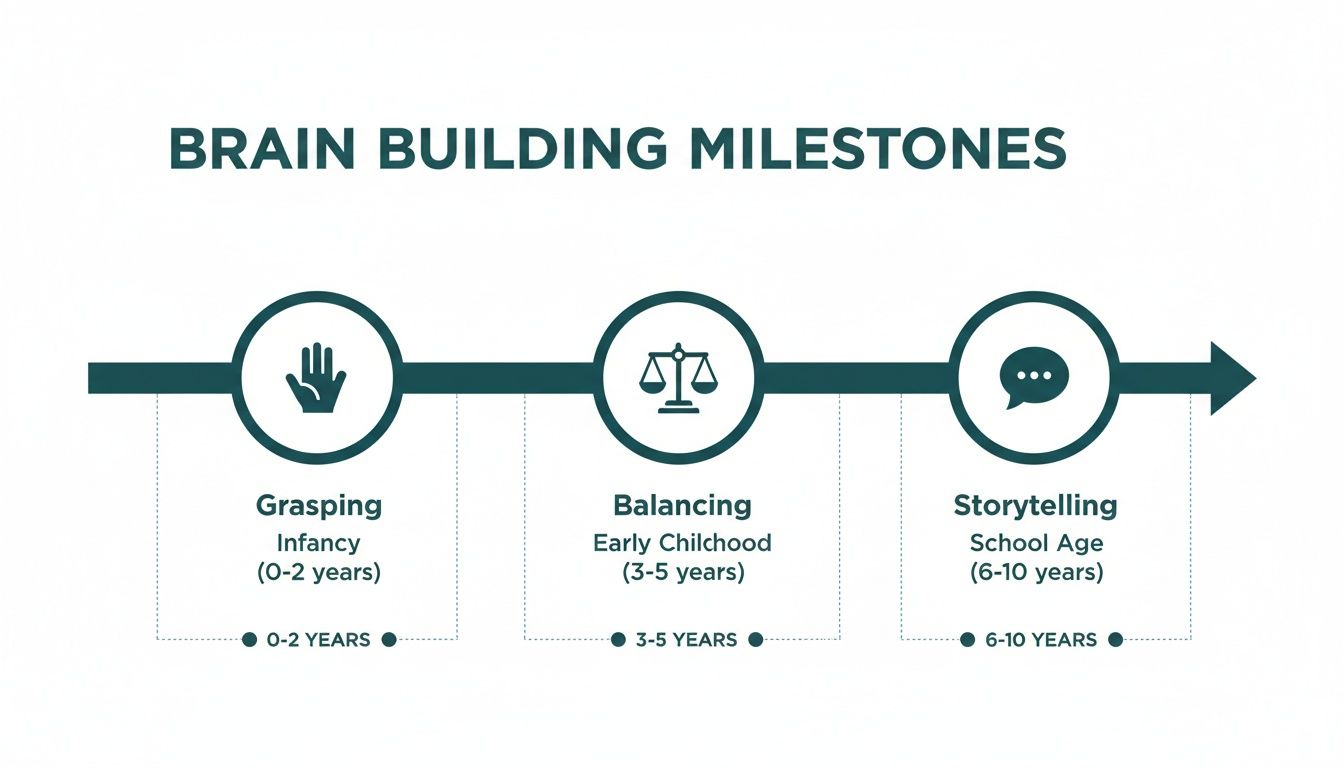
This timeline shows how a child's interaction with blocks evolves, starting with basic grasping and moving towards balancing structures and, eventually, rich, imaginative storytelling.
Blocks for Young Toddlers (1 to 2 Years)
As your baby moves into toddlerhood, their physical skills take a giant leap forward. Hand-eye coordination improves by the day, and they’re starting to get the hang of cause and effect. This is the classic tower-building phase, where stacking—and just as importantly, knocking things down—becomes a source of endless delight.
The focus shifts now from pure sensory exploration to intentional building. Your toddler is ready for a bit more variety, but simplicity is still the name of the game. A basic set of 20 to 40 classic blocks in different shapes like squares, rectangles, and triangles is absolutely perfect.
At this age, a falling tower isn’t a failure; it’s a science experiment. Each collapse is a valuable, hands-on lesson in gravity, balance, and stability that no app or video can replicate.
Look for sets that encourage this newfound desire to build. Coloured blocks are a great addition now, as long as they use non-toxic paints. The simple act of carefully placing one block on top of another helps refine the pincer grasp—that precise grip between the thumb and forefinger—which is a vital precursor to holding a pencil or crayon down the line. To learn more about how these simple toys support this crucial phase, you can explore our detailed guide to the best building blocks for toddlers.
Blocks for Older Toddlers and Preschoolers (2 to 3+ Years)
From the age of two onwards, a child's imagination truly takes flight. Their play becomes far more symbolic and story-driven. A block is no longer just a block; it’s a car, a telephone, an animal, or part of a magnificent castle. Their fine motor skills and cognitive abilities have developed enough to handle more complex building challenges.
This is the perfect time to expand their collection with more intricate and varied sets.
- Introduce More Complex Shapes: Add arches, cylinders, ramps, and half-circles to their collection. These open the door to more sophisticated designs like bridges and turrets.
- Increase the Quantity: A larger number of blocks (think 50 to 100+) allows for bigger, more ambitious projects that can support budding social skills as they start building with friends or siblings.
- Consider Themed Sets: While open-ended blocks are fantastic, themed sets (like castle or city blocks) can provide a great starting point for imaginative storytelling.
During this stage, you’ll start to see more advanced building techniques emerge. They’ll create enclosures, build bridges spanning two structures, and sort blocks by colour or shape before they even begin. This is where those early lessons in balance and gravity evolve into genuine problem-solving and creative expression. Choosing the right wooden building blocks for kids at this age means giving them the tools to bring their biggest ideas to life.
Of course. Here is the rewritten section with a more natural, human-written feel, following all your requirements.
What Makes a Quality Wooden Block Set?
When you’re choosing wooden building blocks, you're doing more than just buying a toy. You're investing in your child's creativity, their development, and even their health. But with a sea of options out there, how do you spot a truly brilliant set? It’s all about looking past the bright colours and understanding what makes a block safe, durable, and genuinely a joy to play with.
A great set of wooden blocks is built to last—not just through toddlerhood, but potentially for generations. That kind of longevity starts with the wood itself. It’s about finding toys that give you peace of mind, knowing they're safe for curious little mouths and gentle on the planet.
The Foundation: Safe Materials and Smooth Finishes
First things first, let’s talk about the wood. The best wooden blocks are almost always made from solid hardwoods. Think beech, maple, or rubberwood. These woods are dense and tough, so they won't splinter or dent easily, even after years of being dropped, stacked, and knocked over. Cheaper, softer woods like pine just can't take the same punishment and can develop rough, splintery edges over time.
Just as important is what goes on top of the wood. Babies and toddlers explore everything with their mouths, so any finish has to be completely non-toxic.
- Look for non-toxic paints: Ideally, you want sets that use water-based, non-toxic paints and stains. This means they’re free from nasty chemicals like lead and phthalates.
- Check for safety marks: Here in the UK and across Europe, the CE mark is your go-to indicator. It means the toy has passed rigorous safety standards. For me, this is a non-negotiable sign of quality.
- Consider natural finishes: You can’t go wrong with unfinished, natural wood blocks, especially for very young children. Wood has natural antibacterial properties, which is a lovely added bonus.
A simple trick I always use is to run my hand over every surface of a block. It should feel completely smooth, with no rough patches, sharp corners, or hidden splinters. That level of care in the craftsmanship tells you everything you need to know about the manufacturer's commitment to safety.
This focus on safe, natural materials is something more and more families are prioritising. In the UK, we're seeing a big shift towards toys that are not only safe but also sustainable, a trend echoed across Europe. Parents are increasingly choosing eco-friendly products over plastic, seeking out toys made from renewable resources with low-toxicity finishes. If you're interested in the data behind this, you can dig deeper into trends in the wooden toy market.
Sustainable Choices for a Healthier Planet
Beyond your child’s immediate safety, the toy's impact on the environment is a real consideration for many of us. Choosing sustainably sourced wooden blocks is a quiet way to teach our children about caring for the planet, right from the start. A well-made wooden toy is the very opposite of our throwaway culture; it's an heirloom in the making.
So, how can you check a toy's green credentials? There's one key certification to look for.
The FSC Certification
The most reliable stamp of approval is the Forest Stewardship Council (FSC) certification. When you see that logo, it guarantees the wood came from a responsibly managed forest. This means the forest’s biodiversity is protected, the rights of local communities are respected, and it's managed in a way that keeps it healthy for the long run. By choosing FSC-certified toys, you’re directly supporting the future of our world's forests.
Ultimately, investing in a high-quality, sustainably made set of blocks is a choice that pays off in every way. You get a safer, longer-lasting toy for your child, and you make a decision that aligns with a healthier future for them, too. These are the toys that get passed down, carrying stories and memories right along with them.
Creative Play Ideas to Spark Imagination
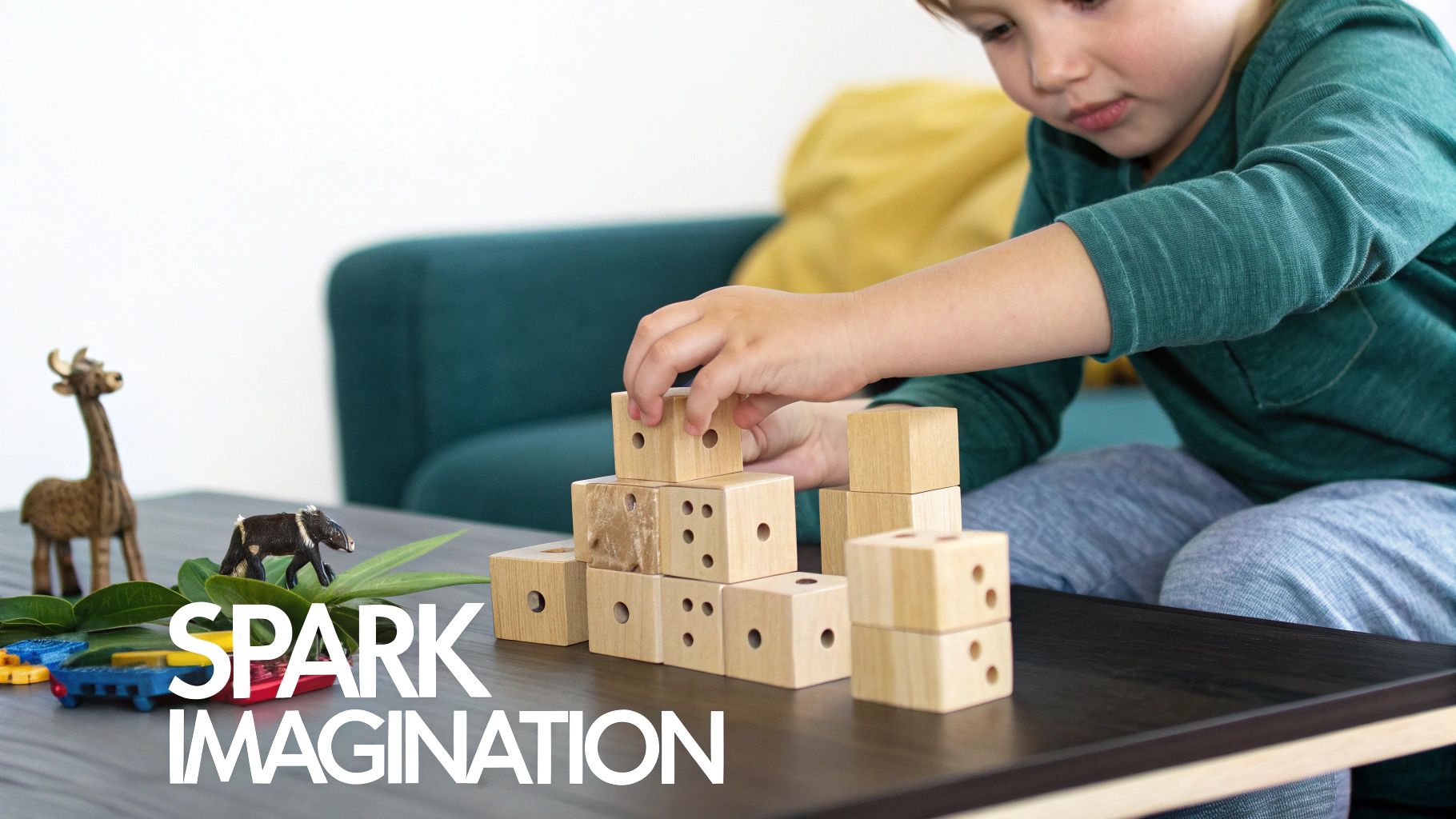
So, you’ve got a fantastic set of wooden blocks. The towers are getting taller, the crashes are getting louder… but what now? The real magic of open-ended toys like these is just how much you can do with them. With a little nudge of inspiration, that simple pile of wood can become a whole universe for imaginative play, taking your child way beyond basic stacking.
These ideas are all about making block play more exciting and helping your child explore new concepts while telling their own stories. By gently guiding their play without taking over, you’ll unlock a new level of learning and fun, making those blocks the true centrepiece of the playroom.
Building Small Worlds and Big Stories
One of the most powerful things you can do with wooden blocks is create miniature worlds. This is where a simple cube stops being just a cube and becomes a house, a car, or even a loaf of bread. This kind of play is brilliant for encouraging storytelling and symbolic thinking.
Start by setting a simple scene. A blue play-silk or a bit of fabric can become a river, and a green one a field. Suddenly, the blocks aren't just blocks anymore; they're vital parts of a landscape waiting for a story.
- Create a Busy City: Lay out long, rectangular blocks to map out roads. Cubes become houses, and taller blocks can be skyscrapers. Pop in a few small toy cars or peg dolls, and the city instantly comes to life.
- Construct a Cosy Farm: Use the blocks to build barns, fences, and little pens for animals. It’s a perfect way to bring in some toy animals and spark stories about what they get up to during the day.
- Design a Magical Kingdom: Arches transform into grand gateways for magnificent castles, and cylindrical blocks make perfect turrets. A few shiny gems or scraps of shimmery fabric can create a royal scene straight out of a fairy tale.
This kind of world-building is a fantastic workout for language development. As children build and move their little figures around, they can’t help but narrate what’s happening. They're practising new words and storytelling skills without even realising it.
Exploring Early Maths and Science
Blocks are brilliant for making abstract concepts real and tangible. Long before they see a maths worksheet, children can get a feel for the fundamentals of maths and physics just by playing. The trick is to turn these learning moments into playful challenges.
Instead of telling them what to do, try asking simple, open-ended questions to get them thinking. "I wonder how long we can make this snake?" or "Can we build a house big enough for this little bear?" These gentle prompts encourage them to solve problems for themselves.
For some more focused activities, you could try:
- Pattern Making: Start a simple pattern (e.g., red block, blue block, red block) and ask your child what they think comes next. This is a gentle introduction to sequencing.
- Sorting and Categorising: Ask your child to sort the blocks into different piles. They could sort by colour, shape, or size—all of which build early classification skills.
- Symmetry and Balance: Challenge them to build something that looks exactly the same on both sides. It’s a great hands-on way to explore symmetry and balance.
These simple games turn playtime into a mini science lab where every creation is an experiment. Figuring out how to build a stable base for a tall tower or how to bridge a gap between two structures is a real-life lesson in engineering. For more ideas on how block play supports these core skills, you might find our guide to the ultimate stacking blocks toy helpful.
Your Questions About Wooden Building Blocks Answered
It’s completely normal to have a few practical questions, even when you can see the benefits. Let's tackle some of the most common queries I hear from parents, so you can feel completely confident about bringing wooden blocks into your home.
When Is the Right Age to Introduce Blocks?
You can start earlier than you might think! Simple, chunky wooden blocks can be introduced from around six months old. At this age, it's all about sensory discovery—learning to grasp, feeling the texture, and, yes, even gumming them. Just make sure they are large, unpainted blocks with smooth, rounded edges, far too big to be a choking hazard.
Once your little one becomes a toddler (around 12-24 months), they’ll start experimenting with stacking. This is the ideal time for a basic set of classic cubes and rectangles. The real, imaginative building adventures typically kick off from age two onwards.
Are Coloured Blocks Safe for Babies?
This is such an important question, especially since babies explore everything with their mouths. The short answer is yes, but only if they’re finished correctly. Always look for reputable brands that use non-toxic, water-based paints and stains.
In the UK, the CE mark on the packaging is your best friend. It’s your guarantee that the toy has passed rigorous safety standards, including tests for any harmful chemicals in the finishes. If you see it, the blocks are safe for mouthing.
How Many Blocks Does My Child Really Need?
It really depends on their age and stage of play. A baby who is just exploring textures will be perfectly happy with a handful of large blocks. For a young toddler learning to stack, a set of 20-40 blocks is a fantastic starting point—enough to experiment with but not so many that it’s overwhelming.
As they grow into their preschool years (2.5+), a larger collection of 50-100+ blocks is where the magic happens. Adding more varied shapes like arches, triangles, and cylinders gives them the toolkit they need for bigger, more complex creations and even collaborative play with friends.
Are Wooden Blocks Truly Better Than Plastic?
While both can be fun, wooden blocks offer some unique developmental advantages. Their natural weight and texture give children a much richer sensory experience, which helps them develop a real-world sense of balance and stability as they build.
Their simple, open-ended design is also better at sparking imagination. A plain wooden cube can be a car, a piece of food, or a character in a story, whereas a specialised plastic brick often has a single, intended purpose. This naturally encourages more creative, child-led play.
Wood’s durability and eco-friendly credentials are also huge pluses. Investing in a quality wooden set is part of a wider trend; spending on classic toys remains strong in the UK, where the toy market is projected to reach USD 19,285.62 million by 2032. As more parents shop online for convenience, finding a curated selection you can trust is more valuable than ever. For a deeper dive into toy market trends, you can learn more about UK toy market trends. And for a broader range of parenting tips and discussions, you might find some great insights over on Everblog's Parenting blog.
Ready to give your child the perfect, stage-matched tools for learning through play? The Grow With Me subscription box takes all the guesswork out of choosing. We deliver beautiful, high-quality wooden toys and activities tailored right to your child’s developmental stage, straight to your door.