
Building blocks for toddlers: Safe, fun ways to boost early learning
That pile of colourful blocks in the corner isn't just another toy—it's one of the most powerful learning tools your toddler can have. The right set of building blocks for toddlers can lay a crucial foundation for their cognitive, physical, and even emotional growth. Let’s explore how to transform simple playtime into a rich developmental experience.
The Hidden Power of a Simple Toy
In a world filled with noisy, flashing gadgets, the humble building block more than holds its own. Its simplicity is its genius. Every time your little one stacks, sorts, or gleefully knocks down a tower, they’re quietly getting a lesson in physics, problem-solving, and resilience.
Think of each block as a small, tangible stepping stone to bigger skills.
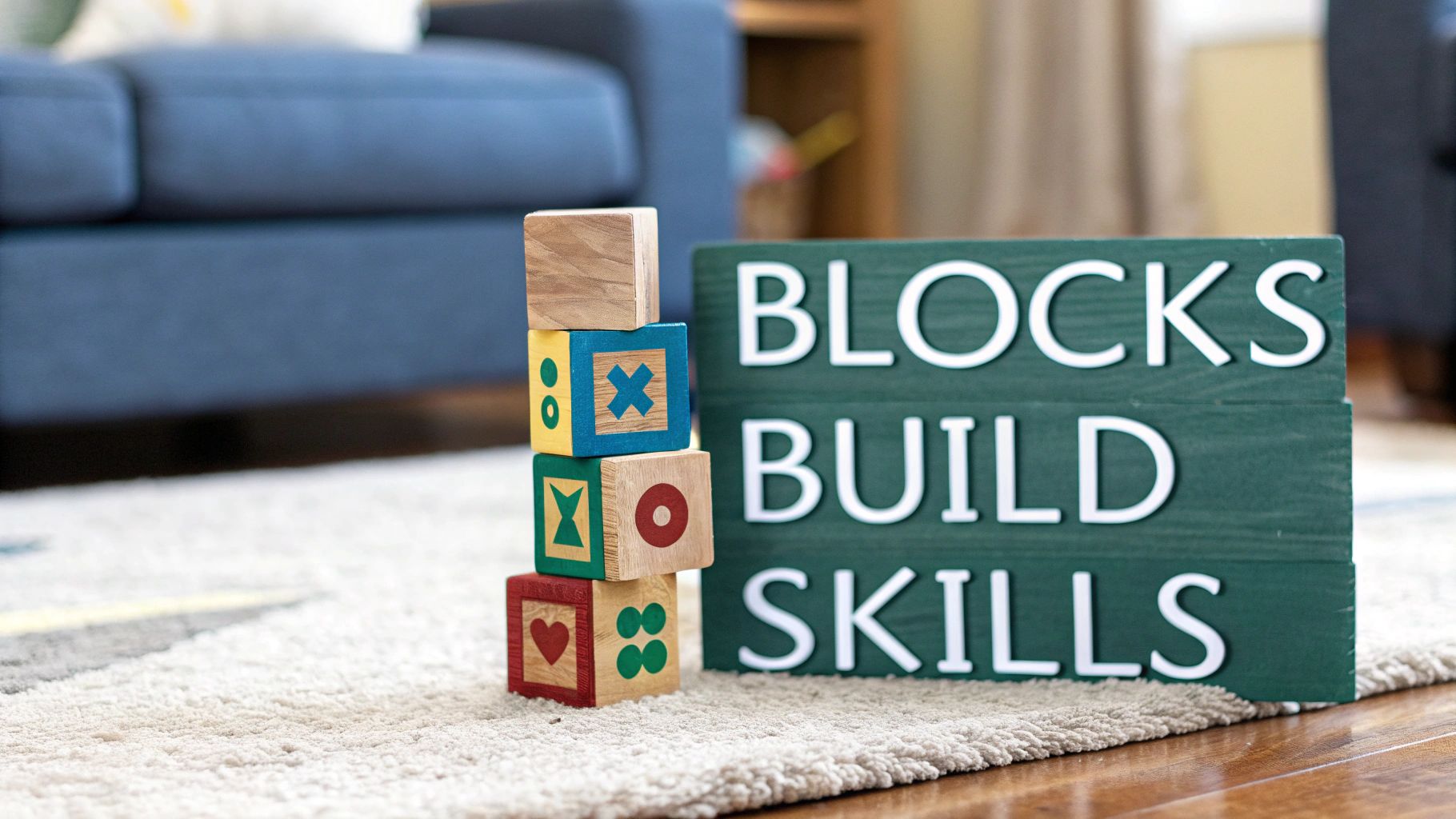
This kind of hands-on play directly nurtures the key milestones child development experts look for. In fact, recent data shows that 81.4% of children aged 2 to 2.5 years in England met the expected standard across five crucial developmental areas, including problem-solving and fine motor skills. Building blocks are instrumental in supporting this progress through the simple acts of grasping, placing, and building. You can read more about these child development outcomes on the official government statistics page.
More Than Just Play
The real magic of building blocks is how they weave different areas of learning together. A single play session can fire up multiple parts of your child’s brain and body all at once.
- Cognitive Growth: They figure out cause and effect ("if I put this big one on top, the tower falls over!").
- Motor Skills: Carefully picking up and placing blocks sharpens hand-eye coordination and finger strength.
- Emotional Resilience: They learn to try again when their magnificent creation inevitably tumbles down.
Each block is a miniature lesson in balance, gravity, and creativity. By exploring these concepts in a fun, low-pressure way, toddlers build a strong foundation for more complex thinking later on.
This journey from basic stacking to imaginative building is a vital part of cognitive development in early childhood, setting the stage for everything from maths to language. When you understand what’s happening behind the scenes, you realise that what looks like simple fun is actually a profound investment in their future.
Building More Than Just Towers
When your toddler stacks one block on top of another, they’re doing so much more than just building a tower. In that focused, playful moment, they are laying the very foundations for future learning. What we see as a simple game is actually a powerhouse of development for their growing mind and body.
This hands-on exploration is where the magic really happens, bridging the gap between physical movement and cognitive growth.
Developing Physical Precision
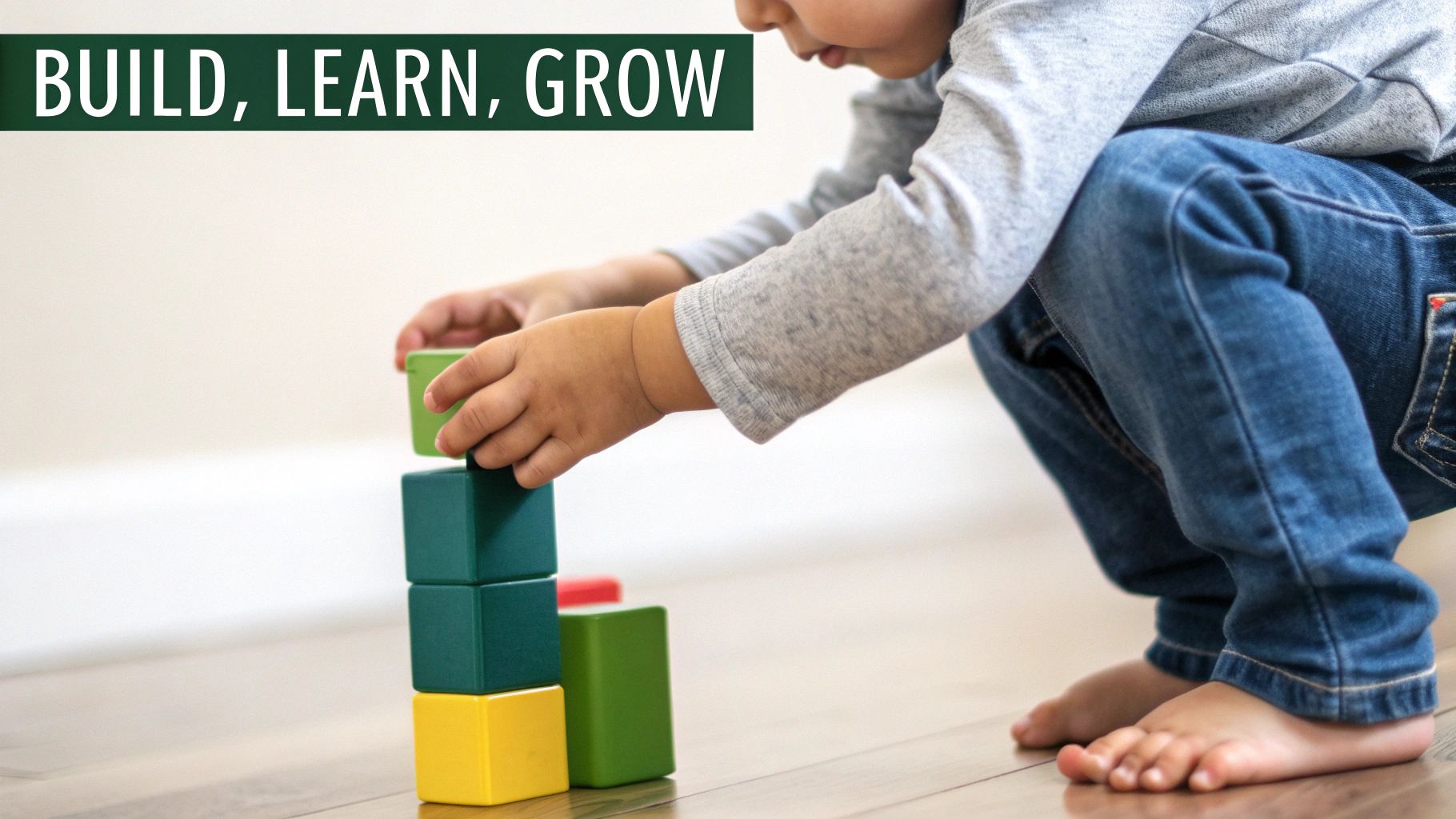
The simple act of picking up and placing a block is a brilliant workout for fine motor skills. That little pincer grasp they use to grab a block is strengthening the exact same muscles they’ll eventually need to hold a pencil or do up their own coat.
At the same time, they're developing their gross motor skills. Reaching high for the next piece or carefully leaning over a wobbly tower brings their larger muscles into play, improving their balance, coordination, and awareness of their own body in space.
Constructing Cognitive Connections
Believe it or not, a set of blocks is your toddler's first physics lab. Every time a tower comes crashing down, they get a hands-on lesson in gravity. When they manage to build a bridge between two blocks, they’re exploring principles of balance and support.
This constant cycle of trial and error is problem-solving at its purest.
- Early Maths Concepts: They start to grasp classification by sorting blocks by colour and shape. Counting the blocks in their creation is one of their first steps into the world of numbers.
- Cause and Effect: It doesn't take long for them to realise that a big block needs a solid foundation, teaching them about logical consequences.
- Spatial Reasoning: Figuring out how different shapes fit together is a fantastic way to develop their understanding of how objects relate to each other in 3D space.
Think of it this way: with every build, your toddler is a mini-engineer. They're forming a hypothesis, testing it out, and learning from the results, one colourful block at a time.
Of course, the fun doesn't stop with traditional blocks. There are many other fantastic building games that spark STEM skills that can perfectly complement this stage of their development.
Building Emotional and Social Skills
The power of building blocks for toddlers also stretches deep into their social and emotional world. The frustration of a toppling tower teaches them resilience, while the pride of a finished masterpiece gives their confidence a huge boost.
When they start building with friends, they learn to navigate the tricky waters of sharing, taking turns, and working together. Even when they're just playing alongside another child, they're engaging in a vital stage of social development. If you're curious about this, our guide explains more about what what parallel play is and why it’s so important.
This kind of learning through play is a cornerstone of early years education here in the UK. In 2025, a staggering 93.1% of 3- and 4-year-olds were registered for their early education entitlement, where blocks are a staple in almost every nursery and preschool. This highlights just how much value is placed on these simple toys for building crucial life skills. You can read more about these fascinating early education statistics.
Choosing the Right Building Blocks for Your Toddler
Walking into a toy shop can feel a bit overwhelming, can’t it? The shelves are stacked high with so many options. When you’re trying to choose the right building blocks for toddlers, the trick is to ignore the flashy packaging and focus on what really matters.
The best choice always comes down to three things: safety, the material they’re made from, and whether they suit your child's age. Getting this right means you’re bringing home a fantastic tool for their development, not just another toy that will be forgotten in a week.
What Are They Made Of? Materials Matter
The material a block is made from completely shapes how a child plays with it. Each type has its own feel, weight, and purpose, and they’re often suited to different stages of your little one's journey.
- Wooden Blocks: You just can't beat a classic. Wooden blocks are incredibly durable (they’ll last for generations!), have a lovely, satisfying weight, and are perfect for simple, creative stacking. If you're curious about why natural toys are so beneficial, you can learn more in our guide to wooden educational toys.
- Plastic Blocks: Think of interlocking sets like DUPLO. These are brilliant for helping little hands develop finer motor skills and for building structures that actually stay put. They're also wonderfully lightweight and a breeze to wipe clean.
- Foam or Silicone Blocks: These are the perfect starting point for babies and younger toddlers. They’re soft, light, and don’t make a massive crash when the tower topples (your ears will thank you!). They offer a completely safe way to explore building without any risk of bumps or bruises.
Honestly, there's no single "best" material. It’s all about what’s right for your child’s current stage. A one-year-old will get the most out of soft, safe foam, whereas a three-year-old is more than ready for the challenge of clicking plastic bricks together.
A Quick Comparison Guide
To help you decide, here’s a straightforward comparison of the most common materials. Think about where your toddler is right now, and this should point you in the right direction.
Comparison of Toddler Building Block Materials
| Material Type | Best For Ages | Pros | Cons |
|---|---|---|---|
| Wood | 18 months+ | Extremely durable, natural material, great for open-ended play, satisfying weight and feel. | Can be heavy, noisy when they fall, more expensive upfront. |
| Plastic | 2 years+ | Lightweight, easy to clean, interlocking design allows for stable structures, often colourful. | Can be less sustainable, small parts on some sets require supervision. |
| Foam/Silicone | 12 months+ | Very safe, soft and lightweight, quiet, great for teething babies and early stacking. | Less durable over time, not suitable for building tall or complex structures. |
Ultimately, this table helps match the right block to your toddler's needs and your family's preferences. There's a perfect fit for every little builder out there
From Stacking and Crashing to Building Worlds
Watching your toddler’s relationship with building blocks evolve is like getting a front-row seat to their cognitive development. It’s an amazing journey that starts with simple, curious exploration and blossoms into complex, imaginative worlds. Knowing what these stages look like helps you appreciate every small milestone and offer the right kind of support for their next leap forward.
It all begins with a lot of hands-on (and, let's be honest, mouth-on) discovery.
Stage One: The Sensory Explorer (12-18 Months)
For a one-year-old, a block isn't something to build with just yet. It’s an object that needs a full investigation. They’ll grab it, mouth it, bang it on the floor, and, of course, take immense joy in knocking over any tower you carefully construct.
This isn't them being naughty—it's pure, unadulterated science. They’re figuring out texture, weight, sound, and the wonderful concept of cause and effect. Your role here is wonderfully simple: provide big, safe blocks and share in the delight of the inevitable crash. Sensory exploration is the name of the game.
Stage Two: The First Tower (18-24 Months)
Then, one day, it clicks. Instead of just swiping the blocks away, your little one will very deliberately place one on top of another. That first wobbly tower, maybe only two or three blocks high, is a monumental achievement in their world.
This is a huge developmental leap. It shows their hand-eye coordination is sharpening, they’re getting a feel for balance, and they're starting to develop the patience to try, try again. These first towers are the earliest signs of intentional building, moving play from random to purposeful.
The image below gives a great overview of how block play typically progresses, matching different types of blocks to each developmental stage.
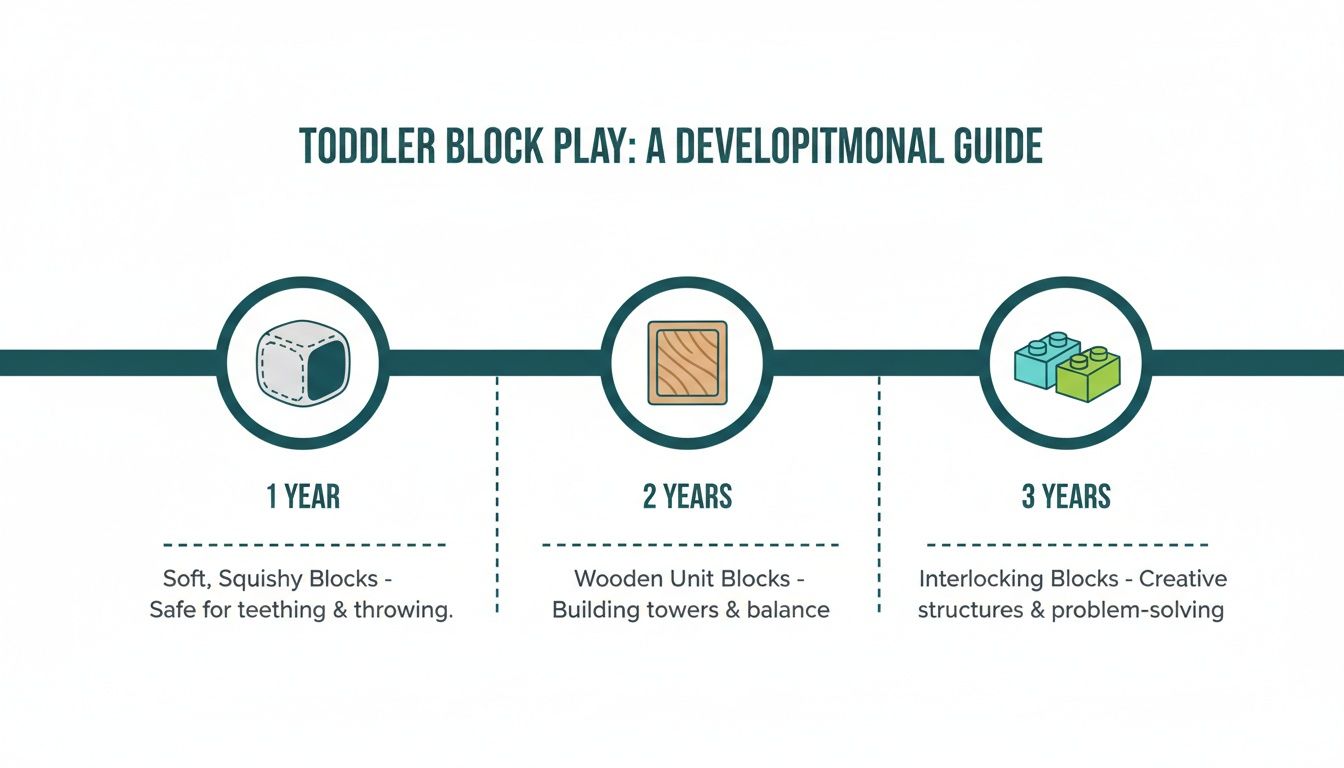
As you can see, play moves from simple sensory fun with soft blocks at age one to more intricate construction with interlocking pieces by age three.
Stage Three: The Horizontal Builder (2-3 Years)
Once they’ve got the hang of stacking up, toddlers often change direction—literally. They'll start laying building blocks for toddlers side-by-side on the floor, creating long, winding lines that stretch across the room.
You’ll probably hear them proudly announce they've built a "road" for their toy cars or a "fence" for their farm animals. This shift to horizontal building is a key step in understanding spatial relationships. They're starting to organise their play space and create environments for their other toys.
This transition from vertical towers to horizontal lines shows a real cognitive jump. Your child is no longer just balancing objects; they are now creating representations of things they see in the real world.
Stage Four: The Imaginative Architect (3+ Years)
Around age three, the real magic begins. Those simple wooden or plastic shapes are suddenly transformed. A rectangle isn't just a rectangle anymore; it’s a spaceship. A couple of triangles on top of a square becomes a grand castle. A whole pile of blocks becomes a bustling city for their little figures to explore.
This is the start of symbolic play, where one object stands in for something else entirely. They begin to weave stories into their creations, building elaborate worlds pulled straight from their incredible imaginations. This stage is absolutely vital for fuelling creativity, storytelling, and abstract thought. A simple toy becomes a gateway to infinite possibilities.
Creative Activities to Elevate Block Play
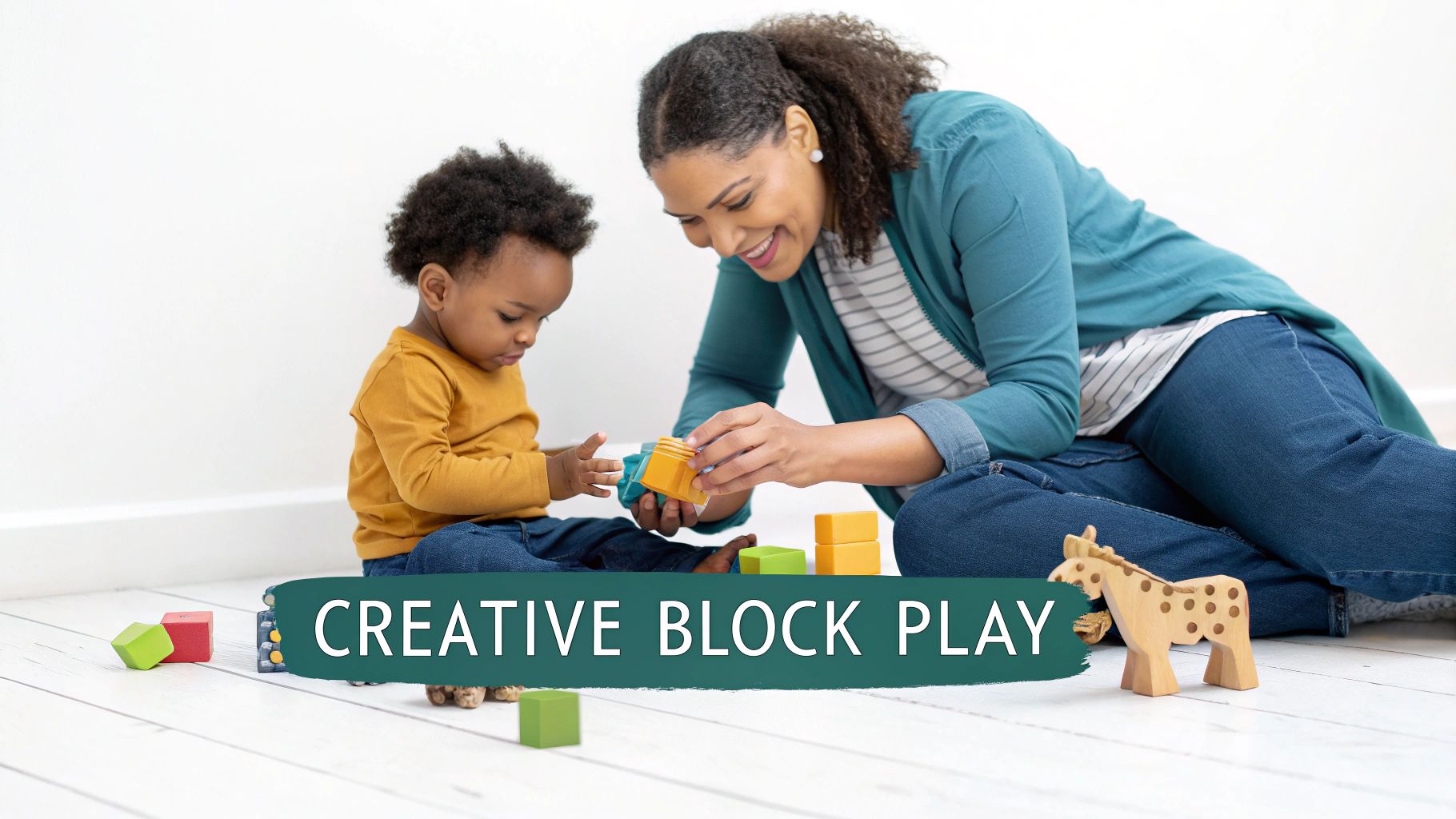
So, your little one has got the hang of stacking and balancing. What's next? This is where the real magic happens. We can start introducing simple activities that stretch their skills and make playtime even more engaging. Think of their building blocks for toddlers not just as a pile of wood, but as a toolkit for everything from colour recognition to their very first engineering challenges.
The trick is to keep things light and fun, always following their curiosity. These ideas aren't strict lessons; they're gentle nudges to spark their imagination. Honestly, the best thing you can do is get right down on the floor with them, showing them how to be creative and solve little problems along the way.
Simple Games to Spark Learning
You don't need anything fancy to get started. The blocks you have right now are perfect for introducing new concepts in a hands-on, playful way. These games take seconds to set up but pack a real developmental punch, turning a simple play session into a brilliant (and subtle) learning opportunity.
Here are a few easy ideas to try:
- Colour Sorting Challenge: Group a few blocks by colour—a little pile of reds here, a pile of blues there. Hand your toddler a block and ask, "Can you find this one's family?" It’s a wonderfully simple game that lays the foundation for sorting and categorisation.
- Build a Bridge for Toys: Take two chunky blocks and place them a few inches apart. Now, challenge your toddler to find a long, flat one to connect them. They’ll have a brilliant time marching their toy animals or driving a car across their new bridge, all while learning the basics of engineering.
- Follow the Pattern: Make a simple pattern, like red-blue-red. Point to each block as you go, then ask, "What colour do you think comes next?" This is a fantastic first step towards understanding patterns, which is a cornerstone of mathematical thinking.
The goal isn't perfection; it's participation. Celebrate their attempts, even if the bridge collapses or the pattern goes astray. Each try is a valuable learning experience in resilience and critical thinking.
Igniting Imagination with Story Prompts
Beyond the games, blocks are incredible fuel for storytelling. This is where you see their creativity really take flight, as a simple wooden shape becomes a character, a castle, or a car in one of their grand adventures.
This type of play is a huge focus in early years education. In fact, the UK’s pre-primary education sector has been growing at a rate of 7.8% each year between 2020 and 2025, driven by demand for quality childcare. You'll find that block play is a core component in almost all of these programmes because of its proven cognitive benefits. You can learn more about the growth of pre-primary education in the UK.
To get the stories started, try a few open-ended prompts:
- "Let's build a home for this teddy bear." This simple prompt gets them thinking about purpose and how to build a structure that works.
- "This tall tower looks like a castle! Who do you think lives inside?" This opens the door to creating characters and weaving a narrative.
- "Can we build a long train to take the animals to the zoo?" Here, you're mixing building with an exciting, imaginative journey.
When you join in their world, you’re showing them that a few simple blocks can become anything at all. It turns a classic toy into a true gateway for limitless creativity.
Got Questions About Building Blocks? We've Got Answers
Even with a toy as simple and classic as building blocks, questions always pop up. It’s only natural to want to make sure you’re giving your little one the right tools at the right time. Let's walk through some of the most common queries I hear from parents, so you can feel confident guiding your toddler’s playtime.
When Should I Introduce Building Blocks?
You can bring in simple, large, and soft blocks from around the 12-month mark. At this age, it's all about sensory discovery—grasping, mouthing (so make sure they're safe!), and feeling different textures.
As they edge towards 18 to 24 months, you'll see their coordination and focus really take off. This is the sweet spot where they start to get the hang of stacking and building with a bit more purpose. The trick is to match the blocks to where they are right now.
The right time isn't a strict date on the calendar. It’s about watching your child. When they start showing an interest in picking things up and trying to fit them together, they’re telling you they're ready.
How Many Blocks Does My Toddler Actually Need?
You really don't need a mountain of blocks to get started. In fact, for a young toddler, a huge pile can be more overwhelming than inspiring.
A good quality starter set of around 20 to 50 pieces is perfect. It’s more than enough for them to explore the basics like stacking, balancing, sorting, and making simple creations. This amount encourages focus without creating a chaotic mess.
You can always add more as their skills grow and their imagination starts running wild. Always choose quality over quantity. A well-made, versatile set of building blocks for toddlers will see far more action than a giant tub of flimsy ones.
Which Are Better: Wooden or Plastic Blocks?
Ah, the great debate! Honestly, both are brilliant, but they offer different things. It’s less about one being "better" and more about what purpose they serve.
Here’s a quick way to think about it:
- Classic Wooden Blocks: These are the originals for a reason. They’re incredibly durable, have a satisfying weight, and are perfect for open-ended play. A simple square can be a house, a car, or a sandwich—it’s entirely up to your child's imagination.
- Interlocking Plastic Blocks: Think of brands like DUPLO. These are fantastic for building hand strength and fine motor skills as little fingers learn to push them together and pull them apart. They also let kids build more complex, stable structures that don't topple over quite so easily.
Often, the best solution is to have a set of each. This gives your child a wonderfully well-rounded building experience, letting them switch between different types of play.
Help! My Toddler Just Throws the Blocks. What Do I Do?
First off, take a deep breath. This is completely normal! In fact, from a developmental point of view, it’s actually a sign of a curious mind at work. They're running their very first physics experiment: "What happens when I let this go? Does it make a cool sound?"
Instead of telling them off, the best approach is gentle redirection.
- Show, Don't Just Tell: Get down on the floor with them and start building. Show them how to make a tower and, just as importantly, how much fun it is to knock it down on purpose.
- Create a "Crash Zone": Designate a soft rug or a cushion as the official spot for tumbling towers. This gives them a safe and acceptable outlet for their desire to see things fall.
- Offer an Alternative: Use simple, clear language. "Blocks are for building, but this soft ball is for throwing." Then hand them the ball. This helps them learn that different objects have different jobs.
Trust me, this phase won't last forever. By redirecting the behaviour instead of just stopping it, you’re teaching them important lessons without shutting down their natural curiosity.
At Grow With Me, our play kits are designed to take the guesswork out of all this. We include the right kind of toys, like building blocks, at the exact stage your child is ready to get the most out of them. Each box delivers high-quality, developmentally appropriate learning tools straight to your door.
Discover how our curated kits can support your toddler’s building journey at https://shop.growwithmesubscriptionbox.co.uk.