
The Real Benefits of Wooden Toys and Why They Matter
In a world of flashing lights and beeping gadgets, it's easy to see why so many parents are turning back to classic wooden toys. It isn’t just about nostalgia; it’s a conscious choice for play that’s safer, more sustainable, and far richer for a child’s development. Wooden toys offer a quiet, tactile alternative that invites creativity instead of dictating it.
Why Modern Parents Are Choosing Wooden Toys Again
The comeback of wooden toys is hardly a surprise. It’s a natural reaction to the often overwhelming and overstimulating nature of many plastic, battery-powered playthings. Parents are deliberately looking for ways to create a calmer, more focused environment for their kids.
Unlike a toy with a single button and a single function, a simple set of wooden blocks is a blank canvas. It empowers children to take the lead, invent their own stories, and figure things out for themselves. This kind of open-ended play is absolutely crucial for building imagination, problem-solving skills, and a healthy attention span.
This mindful approach to parenting is also showing up in how we shop. There’s a growing desire for products that are not only safe for our children but also kind to the planet. High-quality wooden toys tick both boxes, often crafted from responsibly sourced timber and finished with non-toxic paints. Their sheer durability also means they’re an investment—a toy to be passed down, not thrown away.
"Wood is a familiar and poetic substance, which does not sever the child from close contact with the tree, the table, the floor. Wood does not wound or break down; it does not shatter, it wears out, it can last a long time." - Roland Barthes, French philosopher
This shift towards sustainable, long-lasting goods is making a real impact. The UK toy market has seen consumer spending on toys and hobby items jump from roughly £6.7 billion to around £12.5 billion between 2015 and 2024. Industry experts point to the rising demand for eco-friendly and ethically made items, like wooden toys, as a key driver behind this near-doubling in value. You can dig into the numbers in this report on the UK toy industry.
At the end of the day, choosing wood is about choosing a more meaningful way to play. It's about getting back to basics with simple, high-quality tools that support the most important work of childhood: learning through imagination.
How Wooden Toys Nurture Imagination and Key Skills
The magic of wooden toys is really in their beautiful simplicity. Think about it: a noisy, flashing plastic toy often has just one job – push a button, hear a sound. It tells your child how to play. But a wooden toy? It’s a blank canvas. It doesn’t come with built-in instructions or sound effects, which means your child gets to invent the whole story.
This open-ended quality is what really sparks genuine, imaginative play. A simple wooden block isn't just a block. In your child’s hands, it can become a car, a telephone, a piece of cake, or even a magical stone. This is a crucial cognitive leap, where one object is used to represent another. To get a better handle on this milestone, you can explore our guide on what is symbolic play.
This diagram gives a great overview of how the core benefits of wooden toys all connect, fuelling creativity, development, and even sustainability.
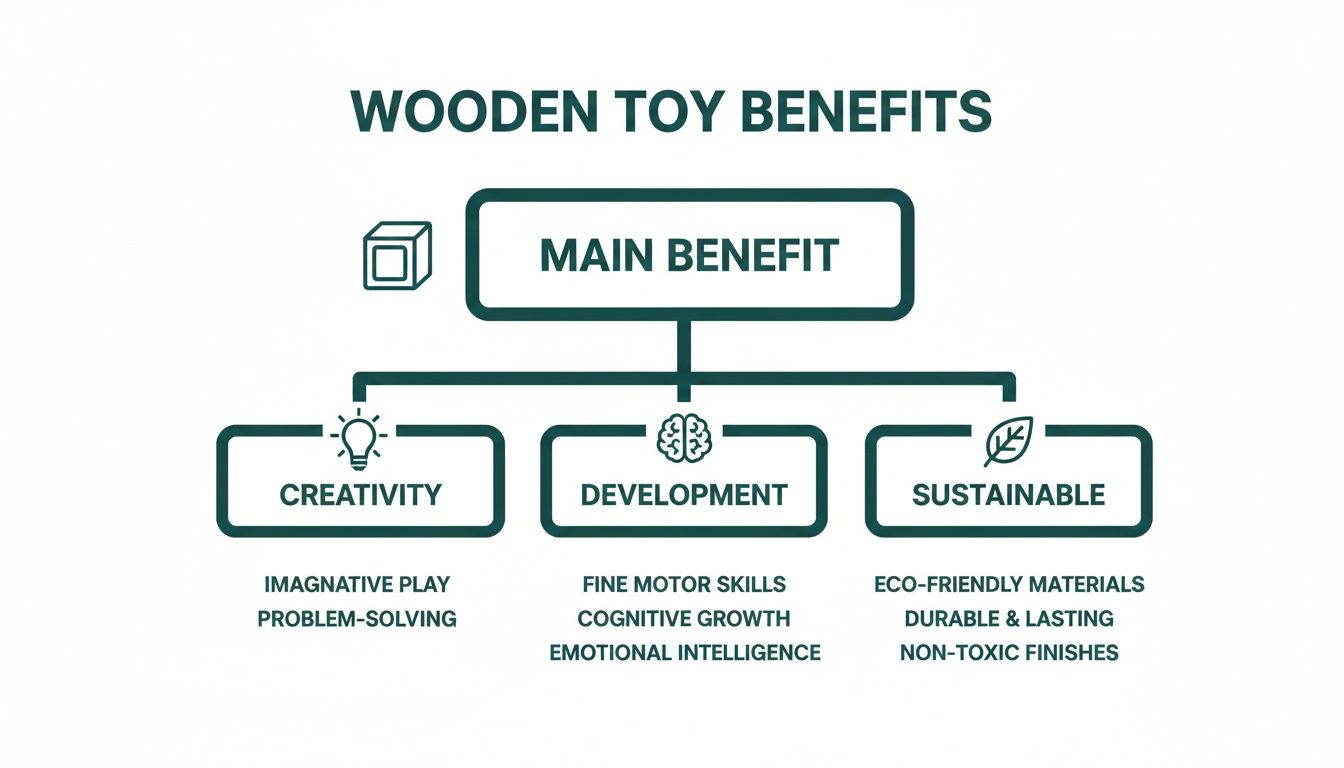
As you can see, it all starts with the toy's simplicity. This one feature directly leads to creative, developmental, and even environmental advantages for your little one.
Building Foundational Motor Skills
Beyond firing up the imagination, wooden toys are fantastic tools for physical development. Every time your child grasps a chunky wooden puzzle piece or carefully stacks a set of blocks, they're building essential skills. These are the very skills that will one day help them hold a pencil to write their name.
Picture a toddler determined to fit a shape into a sorter. They aren't just playing; they're getting a workout in several key areas:
- Fine Motor Skills: They’re using those small, precise muscles in their hands and fingers to grip and manoeuvre the shape.
- Hand-Eye Coordination: Their brain is busy aligning what their eyes see with what their hands need to do.
- Spatial Reasoning: They’re mentally twisting and turning the shape, figuring out exactly how it will slot into place.
These aren't just idle movements. They are tiny neurological exercises happening over and over again. The satisfying weight and natural texture of wood give brilliant sensory feedback, helping a child get a real, tangible feel for concepts like balance, gravity, and structure.
To help you visualise this, here’s a quick look at how different wooden toys support development as your child grows.
Developmental Milestones Supported by Wooden Toys
This table illustrates how specific types of wooden toys support key developmental skills at different age ranges, aligning with early years learning goals.
| Age Range | Type of Wooden Toy | Primary Skill Developed |
|---|---|---|
| 0-12 Months | Simple grasping toys, rattles, mobiles | Sensory exploration, grasping reflex, hand-eye coordination |
| 1-2 Years | Stacking rings, shape sorters, blocks | Fine motor skills, problem-solving, cause and effect |
| 2-3 Years | Puzzles, threading beads, play food | Spatial awareness, dexterity, early symbolic play |
| 3-4 Years | Building blocks, train sets, dollhouses | Imaginative play, social skills, complex problem-solving |
These toys aren't just passing fads; they are carefully designed tools that meet your child exactly where they are on their developmental journey.
Supporting Cognitive Growth and Problem Solving
Because wooden toys don't "do" the work for them, they naturally encourage children to become active problem-solvers. If a block tower keeps toppling over, your child has to figure out why. Is the base too small? Are the blocks placed unevenly? This is real-world engineering and physics, just in its purest, most playful form.
This hands-on, trial-and-error process is absolutely vital for building resilience and critical thinking. Instead of being passively entertained, children are fully engaged—thinking, planning, and bringing their ideas to life.
Wooden toys quietly and effectively support the most important work of childhood: play.
The Long-Term Value of Durability

It’s true, a high-quality wooden toy often has a bigger price tag upfront. But its real value isn't measured in the moments after you buy it—it's measured over years of play. Think of it less like a fleeting purchase and more like an investment.
These toys are built to last. Their solid construction can handle the enthusiastic, sometimes chaotic, reality of childhood play, far outlasting their plastic counterparts that so often crack and break.
This durability makes them a genuinely smart, economical choice for families. Instead of constantly replacing broken items, a well-crafted wooden toy set becomes a reliable friend in the playroom. It’s this resilience that turns them from disposable fun into cherished family possessions.
Creating Heirloom Quality Toys
This brings us to one of the most wonderful things about wooden toys: their potential to become heirlooms. A beloved set of building blocks or a classic pull-along duck isn’t just for one child. It’s a legacy in the making.
You pack it away not because it’s broken, but because your little one has moved on, leaving it ready for a younger sibling, a cousin, or maybe even your own grandchildren to discover one day. This is a world away from the throwaway culture of many modern toys destined for the landfill. Wooden toys carry stories with them, gathering memories as they're passed down. In some cases, like with the timeless investment and appreciating value of authentic Swedish Dala Horses, they can become even more valuable over time.
The Rich Sensory Experience
Let’s not forget how they feel. The physical experience of playing with wood is so much richer. There's a satisfying weight, a smooth-but-not-slippery texture, and a warmth that plastic simply can't mimic.
This tactile feedback is grounding for a child, offering a direct, calming connection to a natural material. It's more than just pleasant; it’s a crucial part of play. The simple, organic feel helps children focus on the activity itself, free from the overstimulation of flashing lights and electronic sounds.
The natural textures and properties of wood engage children's senses, providing a sensory-rich play experience that is both calming and engaging. This connection to a natural material helps ground a child's play in the real world.
Choosing a Safer and More Sustainable Playtime
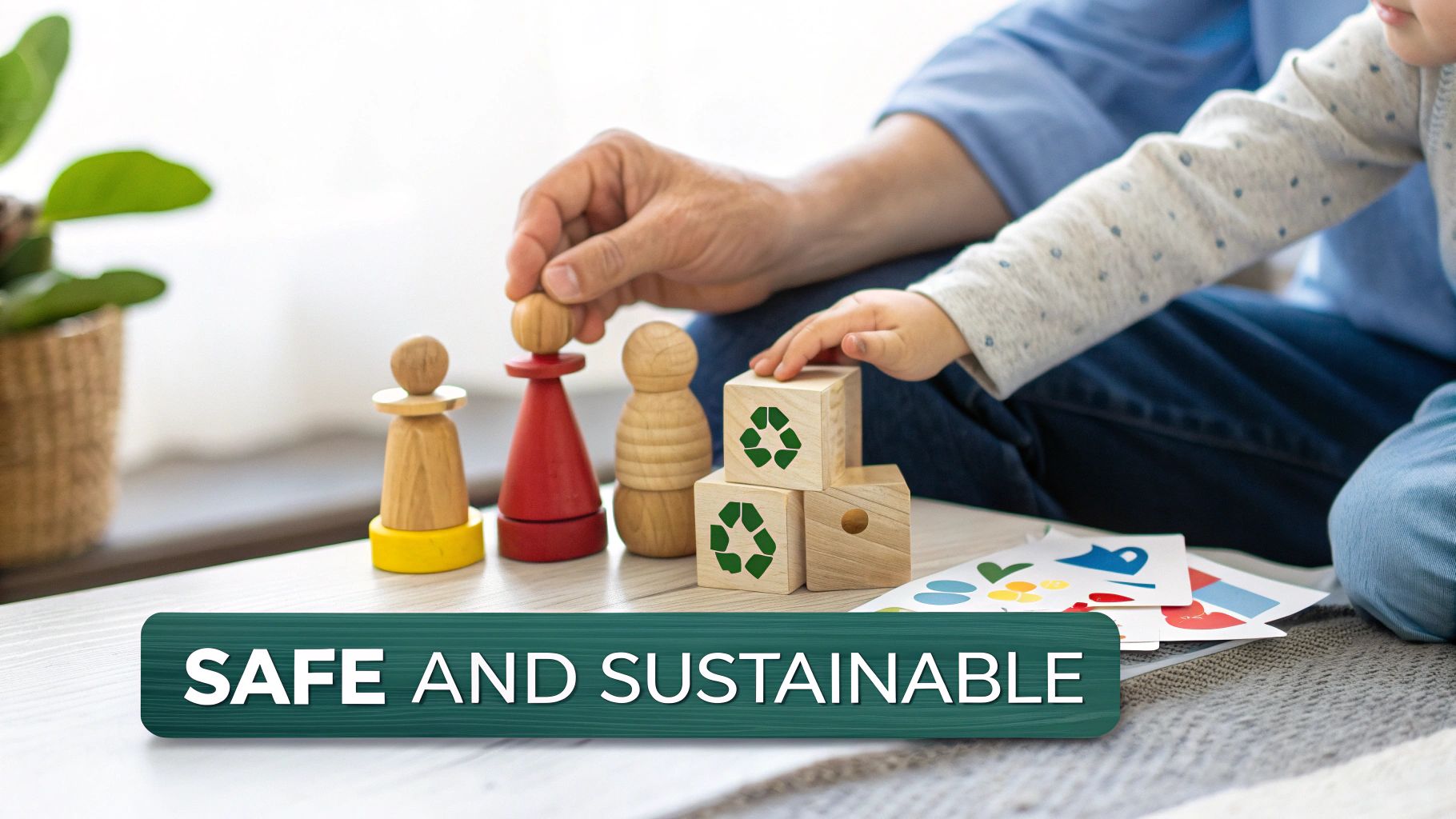
As parents, we're more conscious than ever about creating a safe and healthy home for our little ones. This care naturally extends to the toy box, where the choices we make can have a real impact. This is where wooden toys truly come into their own, offering a brilliant solution for both physical safety and environmental responsibility.
Well-made wooden toys give parents incredible peace of mind. Unlike so many plastic toys on the market, they are typically finished with non-toxic, water-based paints. That means no worrying about nasty chemicals like BPA or phthalates, especially when toys inevitably end up in a curious baby’s mouth.
Built for Safer Play
It's not just the materials; the very nature of a wooden toy makes it safer. They are solid and sturdy, which means they’re far less likely to shatter into small, sharp pieces that could pose a choking hazard. This simple durability is a huge relief, particularly when you have very young children exploring the world.
When a toy's job is to support a child's development, safety has to be the top priority. It’s no surprise that curated services, like a well-thought-out baby subscription box in the UK, often feature high-quality wooden toys. They know that a safe toy is the bedrock of confident, carefree play.
An interesting little bonus? Wood's porous surface is naturally resistant to bacteria build-up. Unlike smooth plastic, where germs can multiply quite happily, wood has inherent antibacterial qualities that add an extra layer of hygiene to the playroom.
Of course, all toys need a good clean now and then. Getting to grips with how to sanitize toys, including those made of wood, plastic, and fabric helps ensure your child’s play space stays healthy, complementing the natural benefits of wood.
An Eco-Conscious Choice for the Future
Opting for wooden toys is also a powerful vote for a healthier planet. Wood, when sourced from properly managed forests, is a completely renewable and sustainable material. This is a world away from plastic toys, which rely on non-renewable fossil fuels and add to the growing problem of global pollution.
- Renewable Materials: Always keep an eye out for toys with FSC (Forest Stewardship Council) certification. This is your guarantee that the wood comes from forests managed to the highest environmental and social standards.
- Biodegradable Nature: At the end of its long and well-loved life, a wooden toy can break down and return to the earth, leaving behind a tiny environmental footprint.
- Reduced Plastic Waste: Think about it this way: every wooden toy you bring home is one less piece of plastic destined for a landfill or, worse, our oceans.
By choosing wood, you’re doing more than just giving your child a toy. You’re planting a small seed of understanding about respecting our planet and making choices that help protect it for their future. It's a gentle, hands-on first lesson in sustainability.
How to Choose the Right Wooden Toys for Your Child
Walking down a toy aisle can feel like navigating a maze. With so many options, how do you pick the right one? When it comes to wooden toys, the secret is surprisingly simple: match the toy to where your child is right now in their development. A great toy meets them at their level, offering a gentle challenge that sparks their interest without tipping into frustration.
The trick is to think about the main skills your child is focused on at their current age. For a baby, the whole world is a sensory playground. A toddler, on the other hand, is busy mastering movement and figuring out cause and effect. And a preschooler? They’re busy building incredible worlds fuelled by their growing imagination.
Matching Toys to Developmental Stages
Getting the age-appropriateness right is what makes playtime click. It turns it from just a bit of fun into something truly purposeful. A toy that’s too simple will be cast aside in minutes, while one that’s too advanced can leave a child feeling discouraged. What you're looking for is that perfect middle ground—the sweet spot that invites curiosity and gives them the confidence to explore their new skills.
Here’s a quick guide to help you find that sweet spot:
-
For Infants (0-12 months): Life at this stage is all about exploring through the senses. Babies are learning to grasp, touch, and see the world around them. Think simple, smooth wooden grasping toys, rattles that make a gentle noise, or a beautifully crafted wooden mobile. These are perfect for developing that all-important grasping reflex and early hand-eye coordination.
-
For Toddlers (1-3 years): Welcome to the age of action! Toddlers are laser-focused on refining their fine motor skills and getting to grips with basic concepts like colours and shapes. Chunky puzzles with big, easy-to-hold knobs, classic stacking rings, and shape sorters are brilliant choices. They directly support problem-solving skills and dexterity.
-
For Preschoolers (3-5 years): For the 3-5 year old crowd, imagination is king. Their play becomes much more elaborate, weaving in stories and role-playing scenarios. This is the prime time to introduce open-ended toys like building blocks, wooden train sets, play kitchens, and little figures for small world play.
By aligning toys with developmental milestones, you transform playtime from a simple activity into a powerful learning experience. The right toy at the right time acts as a tool that helps a child make sense of their world and master new abilities.
Quality and Safety Checks
Once you’ve got the age right, the next non-negotiable is quality. When you’re looking at a toy, run your hand over it. It should feel completely smooth, with no rough patches or splinters in sight. Check that any paints or finishes are clearly labelled as non-toxic and child-safe—any reputable brand will make this clear.
Next, look for certifications. The FSC (Forest Stewardship Council) logo is the one to watch for; it’s your guarantee that the wood comes from a sustainably managed forest. Here in the UK, the UKCA mark (or the CE mark for European toys) shows that the toy meets strict safety, health, and environmental standards. These little logos give you peace of mind that you're bringing something genuinely safe into your home.
For a deeper look into selecting the best items, our guide to choosing wooden educational toys offers even more helpful tips.
Finally, just use a bit of common sense. For babies and toddlers, toys need to be big enough that they can't be a choking hazard. They also need to be sturdy enough to handle being dropped, banged, and probably chewed on! Taking a moment to check these things ensures your child can enjoy all the wonderful benefits of their wooden toys safely.
Wooden Toys vs Plastic Toys: A Quick Comparison
To help you see the differences at a glance, here’s a simple table comparing the typical qualities of wooden and plastic toys. While both have their place, this highlights why so many parents are drawn to the timeless appeal of wood.
| Feature | Wooden Toys | Plastic Toys |
|---|---|---|
| Durability | Highly durable, often lasting for generations. Can be repaired. | Can become brittle and break, creating sharp edges. Often difficult to repair. |
| Safety | Generally safer, made from natural materials with non-toxic finishes. | May contain BPA, phthalates, or other chemicals. Risk of small, broken parts. |
| Sustainability | Biodegradable and made from a renewable resource (especially FSC-certified). | Made from petroleum, a non-renewable resource. Contributes to plastic pollution. |
| Sensory Feel | Offers a warm, tactile, and natural texture that connects children to nature. | Can feel cold, hard, and artificial. Lacks natural sensory feedback. |
| Play Value | Often open-ended, encouraging creativity, problem-solving, and imagination. | Often single-purpose (e.g., press a button for a sound), limiting imaginative play. |
| Aesthetics | Classic, timeless look that is visually appealing and calming in a play space. | Can be overly bright and visually cluttered, contributing to overstimulation. |
Ultimately, choosing high-quality wooden toys is an investment not just in your child's play, but in their safety and our planet's future.
Answering Your Questions About Wooden Toys
Even when you know all the good things about wooden toys, it’s completely normal to have a few practical questions pop up. Choosing what comes into your child's playroom is a big deal, and feeling good about those choices is what matters most. Let's walk through some of the things parents often wonder about when they're thinking of bringing wooden toys home.
Getting these questions answered helps connect the dots between the ideas of durability and developmental benefits and what that actually looks like day-to-day. It’s all about moving from theory to the practical reality of building a toy collection you can feel proud of.
Are Wooden Toys Really Worth the Higher Price Tag?
It’s true that a quality wooden toy often has a higher price upfront, but it helps to think of it less as a purchase and more as an investment in play. Their sheer durability means they can easily stand up to years of enthusiastic fun, often becoming treasured heirlooms that get passed down to younger siblings or even the next generation.
This incredible longevity means you’re not constantly buying replacements for broken plastic toys, which makes them far more economical in the long run. When you think about how many years of play they offer, their cost-per-use often works out to be much lower.
How Do I Clean and Look After Them?
One of the best things about wooden toys is how simple they are to keep clean. All you really need is a damp cloth and a gentle, non-toxic cleaner – even a little white vinegar mixed with water does the trick beautifully. Just give the toy a quick wipe-down and let it air dry completely.
One golden rule: never soak wooden toys in water. Submerging them can make the wood swell and warp, which can spoil the finish and even crack the toy. A gentle wipe is all it takes to keep them hygienic and ready for the next adventure.
If you have toys made from unfinished wood, you can occasionally rub them with a bit of food-safe oil, like coconut oil. This stops the wood from drying out and keeps that lovely, natural feel.
Are All Wooden Toys Safe and Eco-Friendly by Default?
That's a fantastic question, and the short answer is no, not always. To make sure you're getting a toy that’s both safe and sustainable, it’s worth choosing brands that are open about where their materials come from and how their toys are made. Here are a few things to keep an eye out for:
- FSC Certification: Look for the FSC (Forest Stewardship Council) logo on the packaging. This is your guarantee that the wood comes from a responsibly managed forest.
- Non-Toxic Finishes: Check that the paints are water-based and the finishes are certified as non-toxic and child-safe. This is especially important for babies and toddlers who explore everything with their mouths!
- Reputable Brands: Brands with a long-standing reputation usually stick to strict safety standards and are often proud to share their commitment to sustainability.
Can Simple Wooden Toys Really Compete with Flashing Electronic Ones?
They don’t really compete; they offer something completely different. Electronic toys are often about passive entertainment—a child pushes a button, and the toy delivers lights and sounds. Simple, open-ended wooden toys, on the other hand, require your child to be an active participant.
A set of wooden blocks won’t make noises or tell a story on its own. It quietly invites a child to build, to create their own sound effects, and to imagine their own worlds. This process is absolutely essential for nurturing imagination, building focus, and developing problem-solving skills. The quiet, tactile experience of wood fosters a deeper, more creative kind of play.
Ready to introduce stage-based play with high-quality, sustainable toys? The Grow With Me subscription box delivers beautiful, age-appropriate play kits right to your door, taking the guesswork out of choosing the right toys for every milestone.