
A Parent's Guide to the Stacking Blocks Toy
A stacking blocks toy is so much more than a classic plaything you remember from your own childhood. It’s one of the first and most fundamental tools for learning, laying the groundwork for skills your child will use for the rest of their life. Think of them as a smart, lasting investment in your child's future.
Why Stacking Blocks Are a Developmental Powerhouse
In a world overflowing with flashy, battery-operated toys, the humble stacking block holds its own, and for good reason. It just works. While toy trends come and go, these timeless educational items have incredible staying power, and their simplicity is precisely what makes them so brilliant. They’re a blank canvas for a child's growing imagination and developmental needs.
This isn’t just nostalgia talking; the numbers back it up. In 2024, even as the UK toy market saw an overall dip of 3.7%, the Building Sets category—which includes our beloved stacking blocks—actually grew by a hefty 6%. It’s a clear sign that when parents have to make careful choices, they're picking toys with real, lasting developmental value.
The Foundations of Skill Building
Every single time a child reaches for a block, wraps their little hand around it, and carefully places it on another, they’re getting a mini-workout. This simple-looking action is a masterclass in developing hand-eye coordination and strengthening all the small, intricate muscles in their hands and fingers.
But the magic doesn't stop with the physical. These toys are absolute gems for sparking cognitive growth. Without any formal lessons, a child starts to grasp big concepts. They learn about cause and effect when a wobbly tower comes crashing down, spatial awareness as they figure out how to fit two blocks together, and even the basics of physics as they try to create a balanced structure.
A stacking blocks toy is one of the first times a child gets to be both a scientist and an engineer. They form a hypothesis ("Can I put this block on top?"), test it out, and learn from the results—whether that's a towering success or a pile of rubble.
More Than Just a Toy
The benefits ripple out far beyond motor skills and logic. Block play is a launchpad for creativity and expressing big feelings. A simple pile of blocks can be transformed into anything: a majestic castle, a rocket ship blasting into space, or a cosy house for their favourite little figures. This kind of imaginative play is absolutely vital for building language and storytelling skills.
For babies and toddlers, finally mastering the art of stacking is a huge confidence booster. It teaches them that it's okay to try again after a "failure," nurturing a healthy dose of determination. These aren't just the building blocks for towers; they're the building blocks for a strong, capable, and resilient mind. You can see how this all connects by exploring our guide on https://shop.growwithmesubscriptionbox.co.uk/blogs/blog/fine-motor-skills-infants.
Beyond the sheer fun of it, stacking blocks are exceptional for nurturing these crucial developmental areas. You can also discover more specific activities to improve fine motor skills through play.
Mapping Milestones at Every Age
A set of stacking blocks isn't a static toy; it grows and changes right alongside your child. The real magic is how the same collection of wooden shapes can offer completely different lessons and challenges as a baby becomes a toddler, and then a curious preschooler. When you understand this progression, you can really see the incredible learning packed into what looks like simple playtime.
From those first wobbly attempts to build, these toys create a clear map of skill development. The journey starts with basic sensory discovery and slowly builds towards complex problem-solving, perfectly mirroring your child's own cognitive and physical growth.
Even in a fluctuating market, the value of core developmental toys like stacking blocks remains constant. The timeline of the UK toy industry below shows a dip in 2023 followed by a renewed focus on foundational play in 2024, which is projected to drive future growth—a testament to the enduring power of these simple, effective toys.
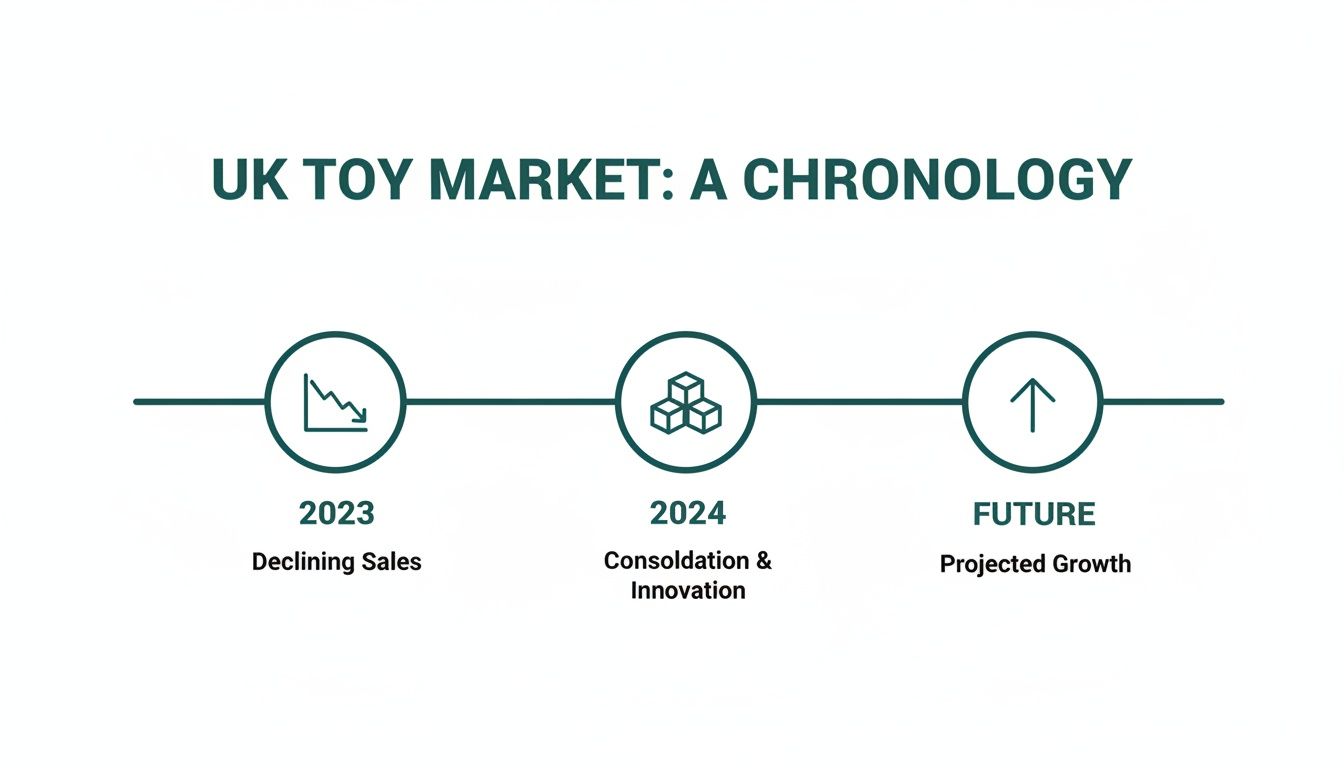
This chart really drives home how foundational toys provide stability and a platform for growth, even when the wider market is consolidating.
Babyhood Beginnings (6-12 Months)
For a baby, a stacking block is less about 'stacking' and all about pure discovery. At this stage, play is a full-body, multi-sensory experience. They are working hard just to coordinate their eyes and hands to reach for and clutch a block.
What does this look like in practice?
- Mouthing and exploring textures: This is how babies gather data about the world—learning an object's shape, hardness, and even its taste.
- Banging blocks together: It might sound like just noise to us, but for them, it's a fantastic early lesson in cause and effect.
- Knocking over towers: The absolute joy they get from toppling a small tower you've built is them reinforcing that same crucial cognitive connection. I do something, and something happens!
Every one of these seemingly simple actions helps to build fundamental neural pathways, laying the groundwork for more complex skills to come.
The Toddler Tower Builder (1-3 Years)
This is the age where the "stacking" in stacking blocks really comes alive. As their fine motor skills and hand-eye coordination sharpen, toddlers graduate from clumsy placements to deliberate construction. They might start with a tower of just two or three blocks—a huge achievement that requires immense focus and precision for their developing brain and body.
Around this time, a child’s play becomes much more purposeful. They are no longer just exploring an object; they are beginning to manipulate it to achieve a specific goal. This shift from pure discovery to intentional action is a massive cognitive leap.
As they near their third birthday, you'll start to see them experimenting with building horizontally as well as vertically, maybe lining blocks up to create simple "trains" or enclosures. This shows they're starting to grasp spatial relationships and the basics of planning. For a deeper look into what to expect stage-by-stage, our guide explains more about what are developmental milestones in detail.
Preschool Problem-Solving (3-5 Years)
By the time they reach preschool, stacking blocks transform into sophisticated tools for imagination and engineering. Their towers get taller and more elaborate, forcing them to grapple with early physics concepts like balance, stability, and gravity. They might try to build a bridge and test its strength, or construct a detailed castle with distinct walls and rooms.
This stage is also marked by a huge surge in creativity and symbolic play. A block is no longer just a block; it can be a car, a piece of food, or a telephone. This type of imaginative play is absolutely essential for developing language, storytelling, and social skills, especially as they begin building with friends, negotiating roles, and sharing their grand ideas.
Here's a quick look at how these skills build on each other as your child grows.
Developmental Milestones with Stacking Blocks
| Age Range | Primary Physical Skills | Primary Cognitive Skills | Social/Emotional Growth |
|---|---|---|---|
| 6-12 Months | Grasping, mouthing, reaching, developing pincer grip | Cause and effect (banging, dropping), object permanence | Sensory exploration, expressing joy, interaction with caregiver |
| 1-3 Years | Stacking 2-6 blocks, improved hand-eye coordination | Early problem-solving, sorting by colour/shape, purposeful play | Sense of achievement, turn-taking, independent play |
| 3-5 Years | Building complex structures (bridges, towers), fine-tuned motor control | Planning, symbolic play, understanding balance and gravity | Collaborative building, storytelling, negotiation, sharing ideas |
Ultimately, watching a child play with blocks is like getting a window into their developing mind. Each stage brings new abilities and fresh ways to see the world, all through the simple act of putting one block on top of another.
How to Choose Safe and Engaging Blocks
Picking out the right set of stacking blocks can feel like a big decision, but it doesn't need to be overwhelming. If you focus on a few key things—what they're made of, safety marks, and whether they're right for your child's age—you can find a set that’s not only fun but also completely safe for your little one.
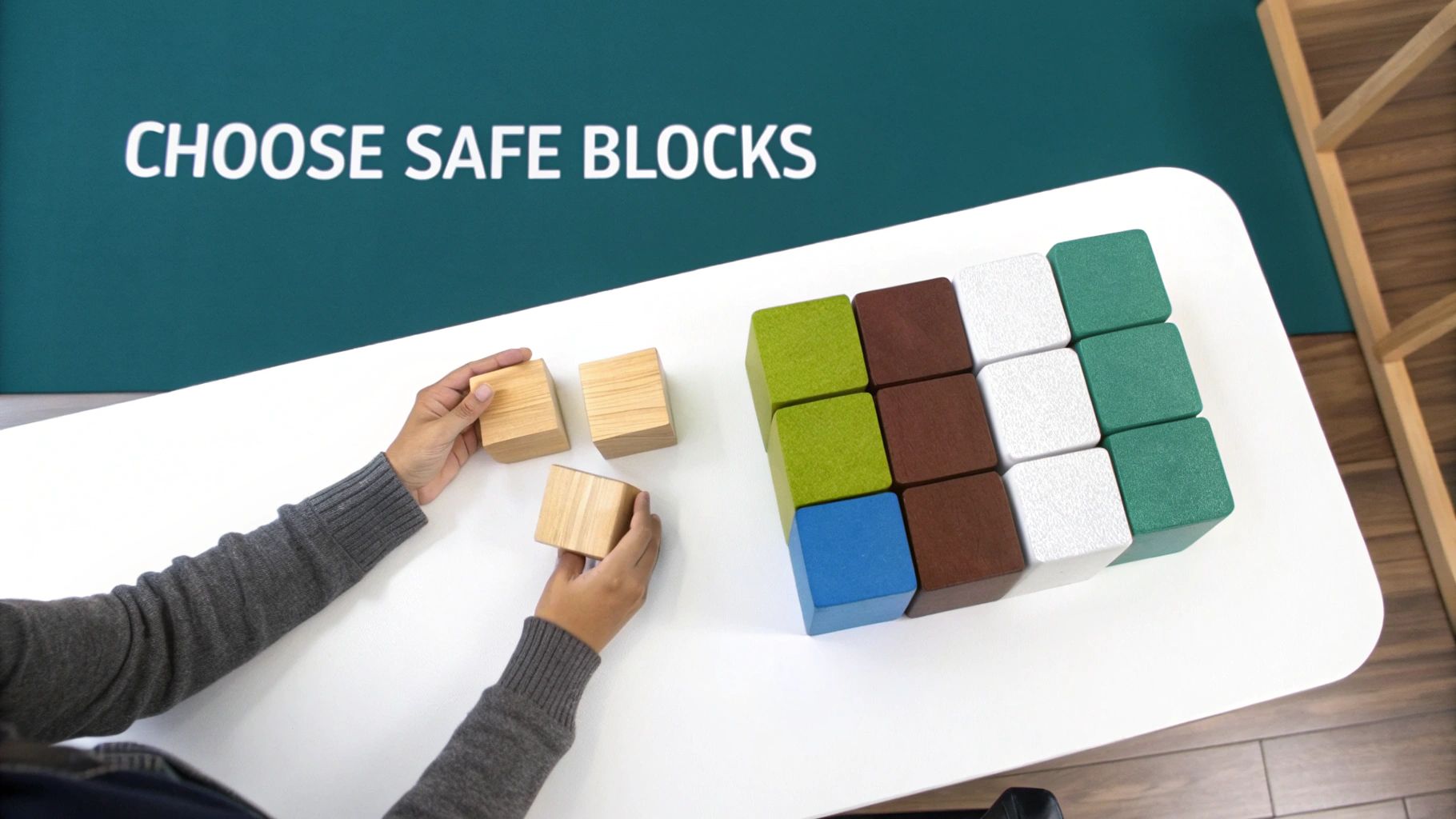
The material is usually the first thing parents think about, and for good reason. It shapes how the blocks feel, how long they last, and ultimately, how safe they are. Each material brings something different to the table, suiting different stages of your child's journey.
Understanding Block Materials
The trick is to match the material to where your child is at developmentally. What’s perfect for a baby who explores with their mouth is very different from what will challenge a preschooler ready to build a masterpiece.
- Classic Wood: You can't go wrong with wooden blocks. They are incredibly durable and feel lovely and solid in little hands. Their natural weight helps children get a feel for balance and precision. Just make sure to look for sets made from sustainably sourced wood with non-toxic, water-based paints, so they’re safe for the inevitable mouthing stage.
- Versatile Plastic: Think of LEGO DUPLO. Plastic blocks are lightweight, a breeze to clean, and usually come in bright, eye-catching colours. The way they interlock introduces a new type of problem-solving, perfect for building bigger and more stable creations.
- Soft Foam or Silicone: For the youngest builders, soft blocks are the way to go. They’re lightweight, completely chewable, and have no sharp corners. This makes them ideal for babies who are still getting the hang of their motor skills and are prone to a tumble or two.
This preference for sturdy, timeless toys isn't just a hunch; it's a growing trend. In the UK, toy blocks represent a USD 420 million market segment and are growing at a rate of 7.1% each year. This is largely driven by parents choosing sustainable play that lasts over disposable fads. You can read more about the toy blocks market on 360researchreports.com.
Prioritising Safety Above All
While the material is important, safety is the one thing you can't compromise on. Thankfully, all toys sold in the UK must meet strict safety standards, so you just need to know what to look for.
The most important symbol to find on the packaging is the UKCA (UK Conformity Assessed) mark. This is the manufacturer's promise that the toy meets all the necessary UK safety rules. Think of it as your first and best guarantee of quality.
Beyond official marks, a bit of common sense goes a long way. Have a good look at the toy yourself. Check for any small parts that could be a choking hazard for children under three, run your hand over it to feel for sharp edges or splinters, and double-check that any paints are certified non-toxic.
Wondering what’s best for the very beginning? We have a guide that offers more specific advice on choosing the best building blocks for babies.
At the end of the day, the perfect stacking toy is one that is safe, suits your child’s age, and sparks their imagination to build, create, and learn through the simple joy of play.
Sparking Creativity with Purposeful Play
So, your little one has mastered the art of building a tower and, just as importantly, knocking it down with a triumphant giggle. What’s next? This is where the real magic of a stacking blocks toy comes alive. We move beyond simple stacking into a world of purposeful play, turning those colourful blocks into tools for imagination, early maths, and problem-solving.
With a few gentle nudges, you can help transform a simple play session into a fantastic learning opportunity, all without your child even realising it.
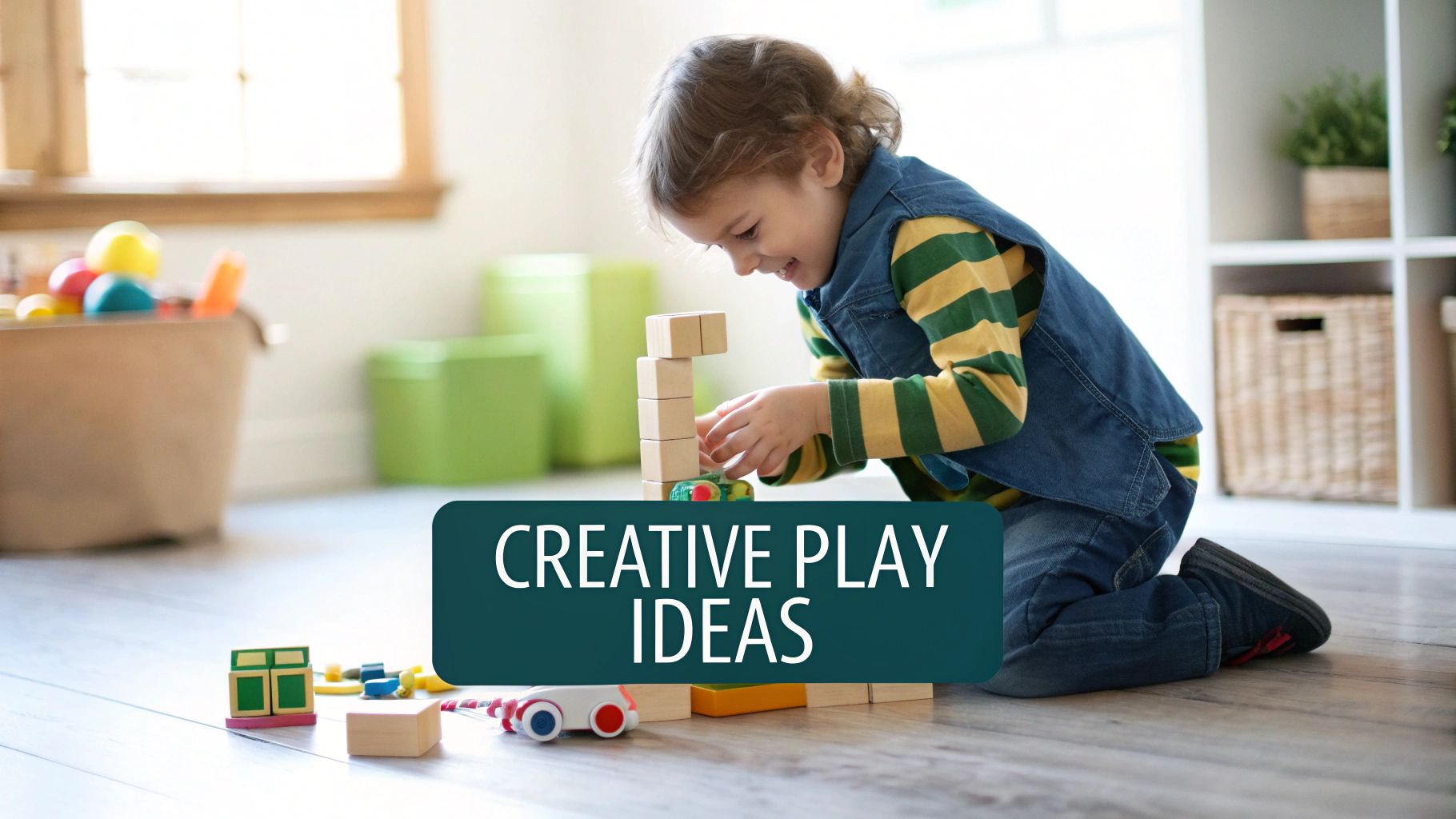
The trick is to see yourself as a play partner, not a teacher. Your job isn't to instruct, but to spark ideas and ask questions that guide your child to discover new ways to play. This keeps things fun, light, and totally child-led, which is the secret to keeping them engaged and eager to explore.
Weaving in Early Maths Concepts
Blocks are brilliant for making abstract maths concepts feel real and tangible for little hands and minds. Forget flashcards and formal lessons; you can introduce these ideas through simple games that just feel like fun.
Here are a few easy ways to get started:
- Counting Games: It's as simple as it sounds. As you build a tower together, count each block out loud. "One block... two blocks... look, three blocks!" That simple repetition is a powerful way to reinforce number recognition.
- Pattern Making: Create a simple sequence with different colours or shapes—maybe red, blue, red, blue. Then, hold up the next block and ask, "What do you think comes next?" This is their first introduction to sequencing.
- Size and Comparison: Build a couple of towers next to each other. Ask simple questions like, "Which tower is taller?" or "Can you make a shorter one?" This helps them physically grasp concepts of measurement and comparison.
These little activities lay the groundwork for a solid understanding of numbers, all through play. It’s about creating a positive, playful relationship with maths right from the start.
Purposeful play doesn't mean structured lessons or taking the fun out of toys. It means gently guiding a child's natural curiosity to help them discover the learning that is already inherent in the act of building, sorting, and creating.
Fostering Literacy and Imagination
Beyond numbers, a stacking blocks toy is a fantastic prop for storytelling and growing your child’s vocabulary. Because they are so open-ended, blocks can become absolutely anything. A castle, a car, a zoo—they are the perfect stage for creating stories.
You can get their creative gears turning with a few simple prompts.
- Build a Home: Suggest making a house for a favourite small toy or animal. You can expand the story by asking, "Who lives in this house? Are they having their tea? Where do they sleep?"
- Create a Zoo: Work together to build different enclosures for toy animals. You can make all the animal sounds and talk about what each animal likes to eat.
- Construct a Castle: Build a magnificent castle and then make up a story about the brave knight who lives there, or perhaps the friendly dragon who guards it. This is a great way to encourage descriptive language.
Each of these scenarios is packed with opportunities to introduce new words and practise putting sentences together. By connecting the physical act of building with the fun of telling a story, you help your child build a strong foundation for literacy. That simple stacking blocks toy becomes a powerful tool for communication and imagination.
The Evolution of the Modern Stacking Toy
You might think a wooden block is just a wooden block, but even this classic toy isn't standing still. The simple, satisfying act of stacking things up is still at the heart of it all, but today's toys are pushing the boundaries of what's possible, inspiring a whole new generation of little builders. The humble stacking blocks toy is getting a serious upgrade, mixing old-school charm with fresh ideas.
This isn't just about making toys look different for the sake of it. It’s part of a bigger shift we’re seeing everywhere. Parents are looking for toys that do more than just entertain; they want something with real, lasting educational value. And that demand is fuelling some serious growth in the world of construction toys.
In the UK alone, the construction toys market—which is where stacking blocks sit—pulled in a massive USD 649.8 million in 2-23. And it's not slowing down. That figure is expected to more than double to USD 1,444.5 million by 2030, driven by parents who are happy to invest in toys that support those crucial early years. You can discover more insights about the construction toys market growth on grandviewresearch.com.
Blending Physical and Digital Worlds
One of the most exciting new frontiers is how technology is being woven into physical play. I'm not talking about swapping blocks for screens. It's about using tech to make the hands-on experience even richer. Imagine your child building a castle, then pointing a tablet at it, and an augmented reality (AR) app makes dragons fly around the towers.
It's a brilliant combination that really offers the best of both worlds. Your child is still developing fine motor skills and spatial awareness by building with their hands, but the digital layer adds a magical element of storytelling and interaction. It’s a clever way of meeting children in their world, using the tech they love to encourage more creative, physical play.
Innovations in Design and Materials
Back in the physical world, the blocks themselves are getting smarter. Magnetic connectors, for instance, have been a total game-changer. They allow kids to build amazing structures that seem to defy gravity. For younger toddlers, this means less frustration, and for older preschoolers, it opens up a whole new world of engineering possibilities. They start learning about polarity and attraction without even realising it.
Today’s stacking toy is designed with both play and pedagogy in mind. Innovations like magnetic connections or STEM-aligned kits aren’t just gimmicks; they are thoughtful additions that deepen the learning potential already present in classic block play.
Themed sets are also a huge hit. Whether it’s building a famous landmark or recreating a scene from a favourite book, these kits give children a story to start with, which can be just the spark their imagination needs. You'll also find specialised STEM (Science, Technology, Engineering, and Maths) kits designed to teach early engineering principles through guided activities. These modern takes on the classic stacking blocks toy prove that even the simplest forms of play can keep evolving for generations to come.
A Solid Foundation, One Block at a Time
When you get right down to it, the humble stacking block reveals a simple, powerful truth. In a world full of fleeting toy trends and high-tech gadgets, this classic plaything remains one of the most profound investments you can make in your child's development. It's about building essential skills from the ground up.
Every single tower they build—and gleefully knock down—is a hands-on lesson. They're learning about resilience, getting a gut feeling for physics, and figuring out how to solve problems in real-time.
From strengthening the tiny muscles in their hands that they’ll one day use to write, to sparking the imaginative stories that grow their vocabulary, these blocks do so much more than just keep a toddler busy. They are fundamental tools for building a solid foundation for all future learning. When you choose a safe, age-appropriate set, you're essentially handing your child a blank canvas for their incredible creativity.
The timeless power of block play is one of the best ways to nurture a curious, confident, and capable child. The skills they pick up building towers today are the very same ones that will help them build their own future tomorrow.
By understanding the developmental milestones and joining in on the fun, you unlock the true potential hidden in these simple shapes. You’re not just buying another toy; you’re providing the essential building blocks for a lifetime of growth and discovery.
A Few Common Questions
Even with a toy as simple and classic as a set of stacking blocks, it’s natural for parents to have a few questions. Getting the right information helps you feel confident you're choosing the best tools to support your little one's journey. Let's tackle some of the most common queries we hear from families.
When Should I Introduce Stacking Blocks to My Child?
The best time really depends on the type of block. For babies around six months old, think big, soft, and chewable. Large fabric or silicone blocks are perfect for this sensory stage, as they’re safe for mouthing and easy for tiny hands to grab and explore.
Then, as your child’s fine motor skills start to sharpen—usually between 12 and 18 months—it’s the perfect moment to introduce a more classic wooden or plastic stacking blocks toy. This is when they move beyond just holding and tasting, and start intentionally trying to build. You’ll see the little sparks of concentration as they figure out how to place one block on top of another.
How Can Stacking Blocks Help Prepare My Child for School?
Don't be fooled by their simplicity; block play is one of the best ways to build a solid foundation for school. It’s learning through play, without any of the pressure.
- Early Maths Concepts: As children play, they're naturally counting, sorting by colour and size, and noticing patterns. They're comparing which tower is taller or shorter—all foundational maths skills.
- Problem-Solving & Science: Trying to balance a wobbly tower is a child’s first lesson in physics! They are literally testing hypotheses about gravity, weight, and stability with every structure they build.
- Language & Social Skills: Listen in as they play. That tower might become a castle, and that line of blocks a zoo. They’re building stories, expanding their vocabulary, and if they’re playing with friends, learning to share ideas and cooperate.
A child playing with blocks is figuring out how to think critically, solve problems, and bring their ideas to life. These are three of the most crucial skills they'll ever need, for the classroom and for everything that comes after.
Are Pricier Stacking Blocks Actually Better?
A higher price tag often points to higher-quality materials, like solid, sustainably sourced wood versus hollow plastic. But more expensive doesn't automatically mean more developmental benefits. The real magic happens in the playing, not in the price.
What truly matters are safety and durability. A well-made, non-toxic set that can handle years of enthusiastic tumbles and towers is worth its weight in gold, no matter the cost. It's much better to focus on finding a quality stacking blocks toy that is safe and will spark your child's imagination, rather than just reaching for the priciest box on the shelf.
At Grow With Me, we're all about the power of purposeful play. Our curated subscription kits are filled with high-quality, age-perfect toys designed to support every single stage of your child's development. Take a look at our boxes at https://shop.growwithmesubscriptionbox.co.uk.