
Your Guide to Developmental Milestones at 16 Months
Hitting the 16-month mark with your toddler feels like turning a page into a whole new story. Suddenly, their personality is front and centre, their curiosity is unstoppable, and their energy seems to have no end.
This is that wonderful, slightly chaotic bridge between babyhood and full-blown toddler life. You'll likely see them walking with more confidence, trying out a few words, and making it very clear they want to do things their way. It's a time of delightful discovery for both of you.
Your Toddler's Remarkable Journey at 16 Months
Welcome to one of the most exciting phases of your child's early years. At sixteen months, your little one is no longer a baby. They're a determined toddler on a mission to explore, communicate, and figure out how everything works.
This period is marked by a huge burst of growth in every single area of development, turning ordinary moments into powerful learning opportunities. You can almost picture their brain as a busy building site, with new connections being made at a breathtaking speed.
This guide is a friendly, reassuring companion for parents, grandparents, and anyone caring for a 16-month-old. We’ll explore the amazing progress your little one is making—how they move, think, talk, and connect with the world around them. You’ll see their unique personality shine as they test limits, express some very big feelings, and start to puzzle out simple problems all by themselves.
To help you get the most out of this time, we’ll introduce you to the idea of stage-based play. When you understand the different stages of child development by age, you can offer activities that are just right for their current skills, nurturing their growth in a natural way. It takes the guesswork out of playtime, making every interaction count.
At 16 months, play isn't just for fun; it's the most important work your toddler does. Each block they stack, every line they scribble, and all those games of peekaboo are building a solid foundation for future learning and emotional well-being.
Our aim is to help you celebrate every little achievement and feel confident as you navigate this journey. We’ll cover:
- Key developmental domains: What to expect from their physical, cognitive, and social-emotional skills.
- Purposeful play ideas: Simple activities and toy suggestions that support each milestone.
- Navigating challenges: Guidance on common behaviours like tantrums and separation anxiety.
- When to seek support: Clear, non-alarming advice on developmental timelines.
A Quick Look at Your 16-Month-Old Toddler
Here’s a snapshot of the typical advancements you can expect to see across different areas of your toddler's development at 16 months.
| Developmental Area | What You Might Notice | Simple Ways to Encourage Growth |
|---|---|---|
| Physical | Walking more confidently, maybe even trying to run. Can squat to pick up a toy. Likes to climb on furniture. | Create safe spaces for climbing, like a small slide or cushions on the floor. Play with balls to practise throwing. |
| Cognitive | Points to body parts when you name them. Starts to scribble with a crayon. Can follow simple, one-step instructions. | Read board books together and ask, "Where is the dog?" Use chunky crayons for their first masterpieces. |
| Language | Says between 3 and 20 recognisable words. Shakes their head for "no." Tries to "sing" along to familiar songs. | Narrate your day ("I'm putting on your red shoes"). Sing simple, repetitive songs like "Wheels on the Bus." |
| Social-Emotional | Shows affection with hugs and kisses. Might have tantrums when frustrated. Experiences some separation anxiety. | Acknowledge their big feelings ("You are sad the blocks fell down"). Offer cuddles and reassurance when you leave and return. |
Remember, this table is just a guide. Every child develops at their own unique pace, and that’s perfectly okay
Exploring The World On Two Feet: Motor Skill Milestones
At 16 months old, your toddler is less of a baby and more of a tiny explorer on a grand mission. Their physical skills are finally catching up with their boundless curiosity, and this stage is all about motion. They’re mastering walking and starting to experiment with all the incredible things their body can do next.
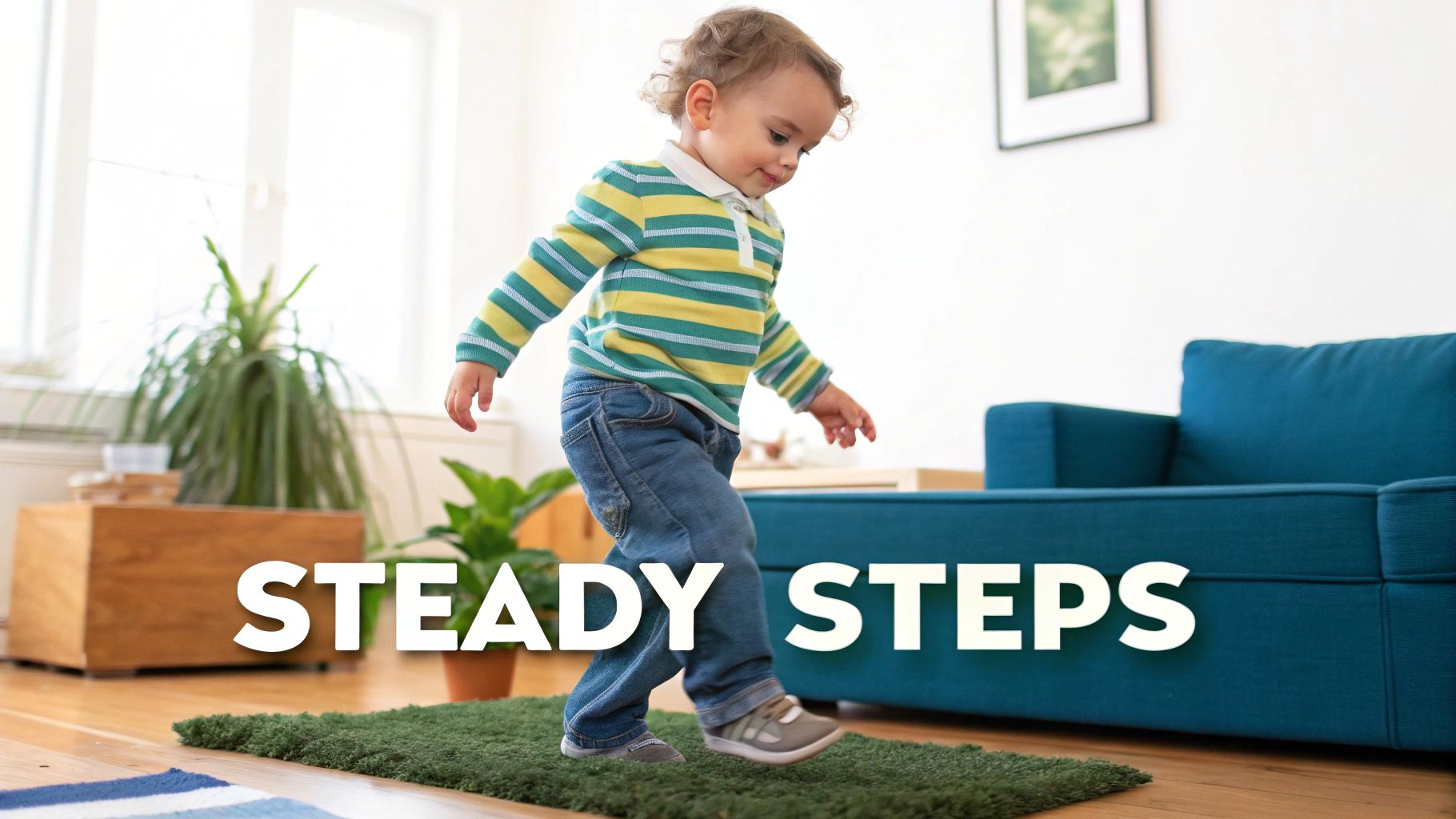
This is the age where those wobbly first steps transform into confident toddling. It’s a huge leap, moving from cruising along the furniture to boldly striding across a room. In fact, here in the UK, around 90% of toddlers are walking independently by now—a key milestone that opens up a whole new world of discovery.
Gross Motor Skills Gaining Ground
Gross motor skills are all about the big muscles in the arms, legs, and torso. For your 16-month-old, these skills are powering their biggest adventures yet.
- Confident Walking: You’ll notice their gait is steadier, and they no longer need to hold their arms out for balance. They can stop, squat to pick up a toy, and pop back up without holding onto anything.
- Early Running: That fast walk is morphing into a charming, slightly off-balance run. It's more of a hurried toddle, really, but it’s a clear sign their coordination and strength are on the up.
- The Joy of Climbing: Suddenly, low sofas, stools, and even cushions become irresistible mountains to conquer. This climbing craze is fantastic for building strength, balance, and spatial awareness.
- Kicking and Throwing: While their aim might be a bit wild, they’ll probably start trying to kick a ball forwards and might even throw one underhand.
These aren't just physical feats; they are the building blocks for independence. As your toddler becomes more mobile, introducing structured movement can be incredibly beneficial. Channelling that energy by looking into some of the best dance classes for toddlers can be a wonderful next step.
Think of your toddler as a little scientist testing the laws of physics. Every step, stumble, and climb is an experiment in balance, gravity, and momentum, teaching them how their body moves through the world.
Fine Motor Skills Getting Sharper
While all those big movements take centre stage, the smaller, more precise actions are also developing rapidly. Fine motor skills involve the small muscles in their hands and fingers, which lay the groundwork for everything from writing to getting dressed.
You’ll likely notice their hand-eye coordination improving almost daily. They might now be able to:
- Stack Two or Three Blocks: Building a small tower takes focus and a surprisingly steady hand.
- Scribble with a Crayon: Their marks are becoming more deliberate. They’re starting to connect the dots—realising their action creates a result on the paper.
- Use a Spoon: Mealtimes are about to get messy! But they’re learning to scoop food and get it somewhere near their mouth.
- Turn Pages in a Board Book: They can now handle turning one or two thick pages at a time, which is a huge step for little hands.
Supporting these emerging skills is simple and fun. A Grow With Me subscription box, for instance, often includes items like chunky puzzles or stacking toys, with handy description cards explaining exactly how they support these specific milestones at 16 months. For more ideas, check out our guide on gross motor activities for kids to keep your little one happily moving and learning.
First Words and Big Feelings: Language and Social Growth
At 16 months, your toddler's world is bursting with new discoveries, and so are their ways of connecting with you. While they might only have a handful of spoken words, don't be fooled – their understanding is growing at a lightning pace. This is a really exciting time for language and social-emotional growth, where little gestures and big feelings take centre stage.
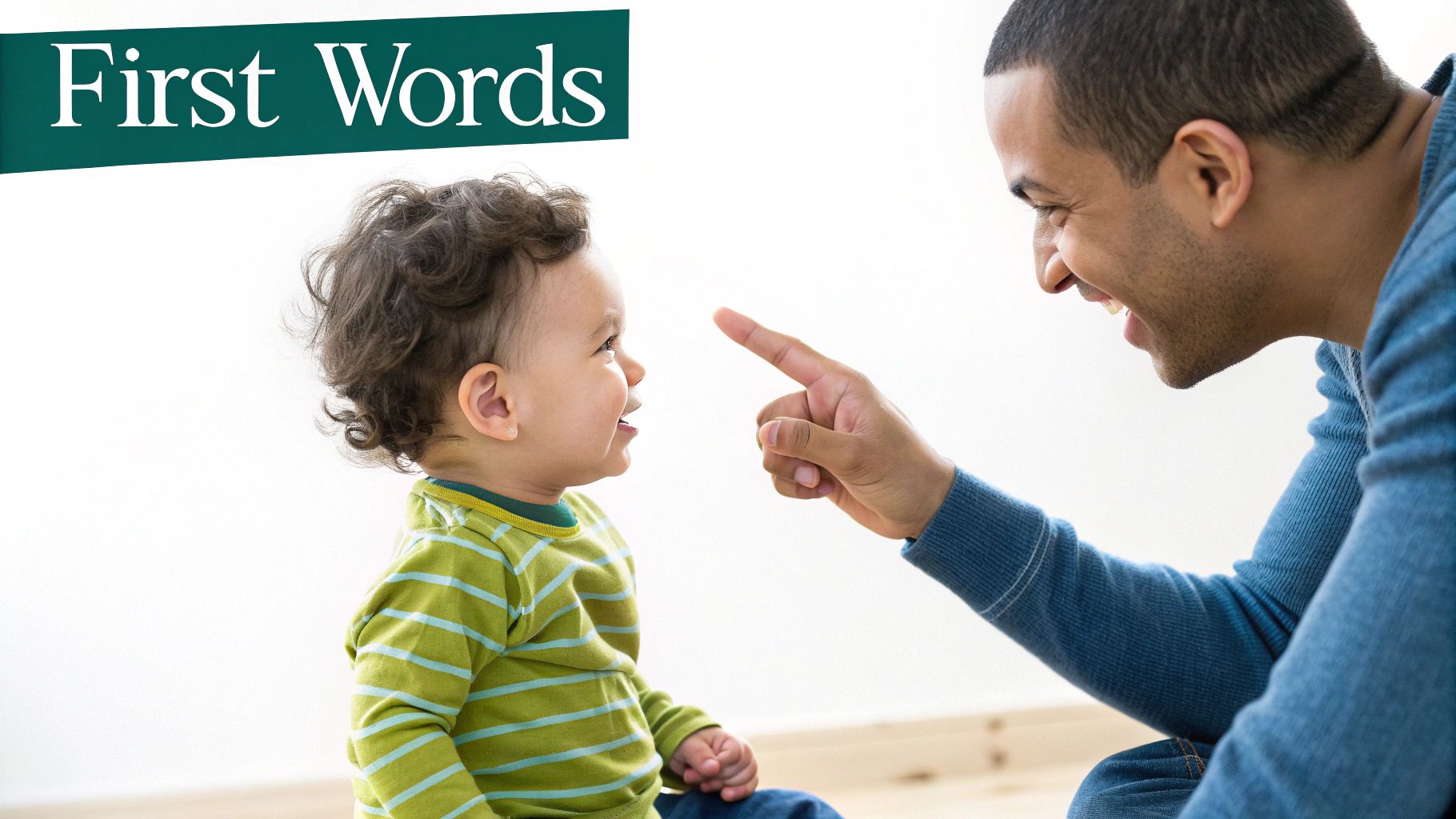
Think of their communication skills like an iceberg. The few words you hear are just the very tip. Underneath the surface lies a huge, rapidly developing understanding of everything you say. They're soaking it all in, learning the rhythm and melody of conversation long before they can string a sentence together.
Finding Their Voice
The journey to talking is full of charming and meaningful little steps. Right now, your toddler is a master of mixing gestures with sounds to get their point across, creating their own unique way of chatting with you.
Here’s what you might be noticing around 16 months:
- A budding vocabulary: Most toddlers this age can say between 3 and 10 words, though some have more. These are usually the greatest hits: "mama," "dada," or "ball."
- Pointing power: Pointing is their superpower! They'll point to a toy they want, something interesting they've spotted, or the right picture in a book when you name it.
- The mighty headshake: Shaking their head 'no' is a massive leap forward in showing you what they want (and what they don't want!).
- Conversational babble: You'll hear them babbling away with all the ups and downs of a real conversation. It’s their way of practising.
In the UK, it’s common for toddlers to understand as many as 50 simple instructions, even if they can only say a few words themselves. This comprehension is the bedrock of their future vocabulary. You can read more about this in the developmental guides from sources like Bucks Healthcare NHS.
At this stage, every "uh-oh" when a toy is dropped or a "vroom vroom" for a car counts as a word. Celebrate these early attempts—they're the building blocks for everything to come.
Navigating Big Emotions
Alongside their budding language skills, your 16-month-old is riding a rollercoaster of social and emotional awareness. This can be a bit tricky, as their feelings are often much bigger than their ability to express them with words.
You might be seeing:
- Separation anxiety: This often hits a peak right about now. Your little one understands you still exist when you're gone, and they are not happy about it!
- Frustration and tantrums: When they can't quite tell you what they need or do something themselves, that frustration can easily bubble over. This is a completely normal part of their development.
- First glimmers of empathy: You might catch them showing concern if another child is upset, maybe by patting their back or offering a favourite toy.
Supporting these milestones at 16 months is all about patience and connection. Acknowledge their big feelings ("I can see you're sad that playtime is over") and offer plenty of cuddles and reassurance. For some fun and targeted ways to boost their communication, have a look at our guide on language development activities for toddlers.
How Your Toddler's Curious Mind Is Working
Welcome to the wonderfully chaotic world of a 16-month-old’s brain. It's working overtime, piecing together how everything fits and functions. You're not just looking after a baby anymore; you’re living with a tiny scientist who is constantly running experiments to figure out big ideas like cause and effect.
One of the biggest cognitive leaps around this age is a much firmer grasp of object permanence. This is that lightbulb moment when they really get it – just because you’ve hidden their favourite teddy under a blanket, it hasn’t vanished into thin air. This is why peekaboo is still a smash hit and why they’ll now properly search for something they saw you hide.
Their memory is also getting a serious upgrade. You might notice them remembering where a particular toy lives or getting excited for the next line in a familiar song. This is the bedrock for the more complex problem-solving that's just around the corner.
From Imitation to Problem-Solving
You'll probably start to see your little one copying your everyday actions with surprising detail. This imitation is one of their most powerful learning tools, helping them practise grown-up tasks and figure out how different objects work.
- Pretend Play: Don’t be surprised to see them pick up a block and hold it to their ear like a phone, or try to "help" you sweep with their own little broom.
- Following Simple Instructions: When they follow a one-step command, like "please pass me the ball," it shows their understanding and cognitive processing are clicking into place.
This is also the time when you’ll spot their first real attempts at problem-solving. If a toy is just out of reach, you might see them pause, have a think, and then pull the blanket it's sitting on to drag it closer. It’s a huge step, showing they are starting to understand how to use one object to manipulate another to get what they want.
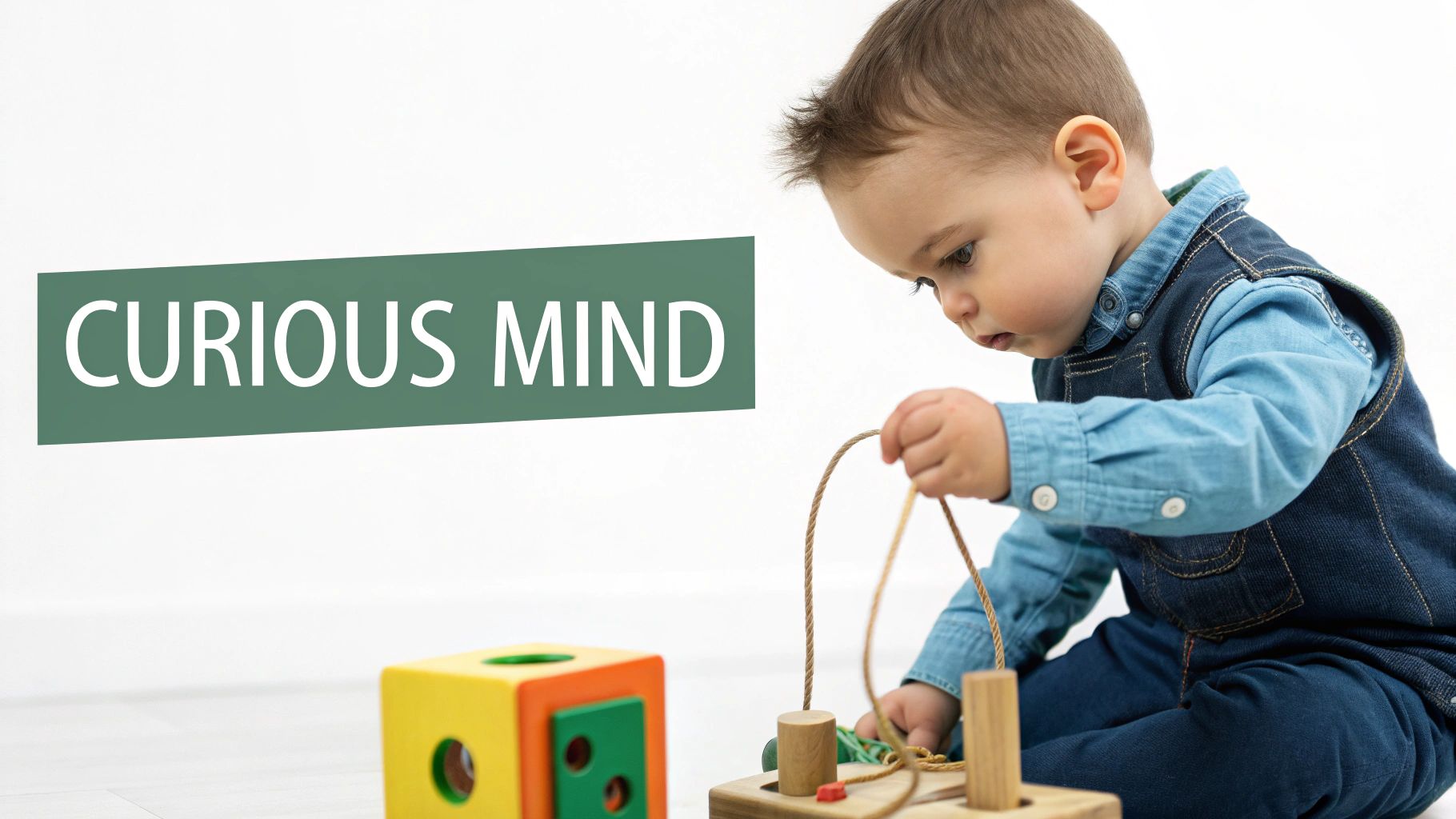
Think of your toddler's brain as a puzzle-solving machine. They are constantly testing theories: "If I push this button, what happens?" or "If I pull this string, will that toy come to me?" Every action is a mini-experiment.
Nurturing a Curious Mind with Play
The best way you can support all this incredible cognitive growth is simply through purposeful play. The right toys and activities can make a huge difference in building those foundational brain connections.
Take a shape sorter, for instance. It’s so much more than just putting blocks in holes. It teaches your toddler to recognise different shapes, experiment with turning them until they fit (hello, trial and error!), and feel that little spark of satisfaction when they solve the puzzle. Stacking rings do something similar, introducing early concepts like size, order, and sequence.
A Grow With Me kit is built around this very idea. The toys selected for this age, like chunky puzzles or nesting cups, are specifically designed to challenge their developing cognitive skills. Better yet, the description cards that come with the kit explain the ‘why’ behind the play. They show you exactly how sorting shapes is laying the groundwork for mathematical thinking later on, and how stacking blocks builds crucial spatial awareness, connecting their fun directly to their brain development.
Nurturing Development Through Purposeful Play
For a toddler, play is serious business. It’s far more than just a way to pass the time; it's how they learn, experiment, and figure out their place in the world. By understanding the 'why' behind what they're doing, you can transform simple, everyday interactions into rich learning moments that support all those exciting 16-month milestones.
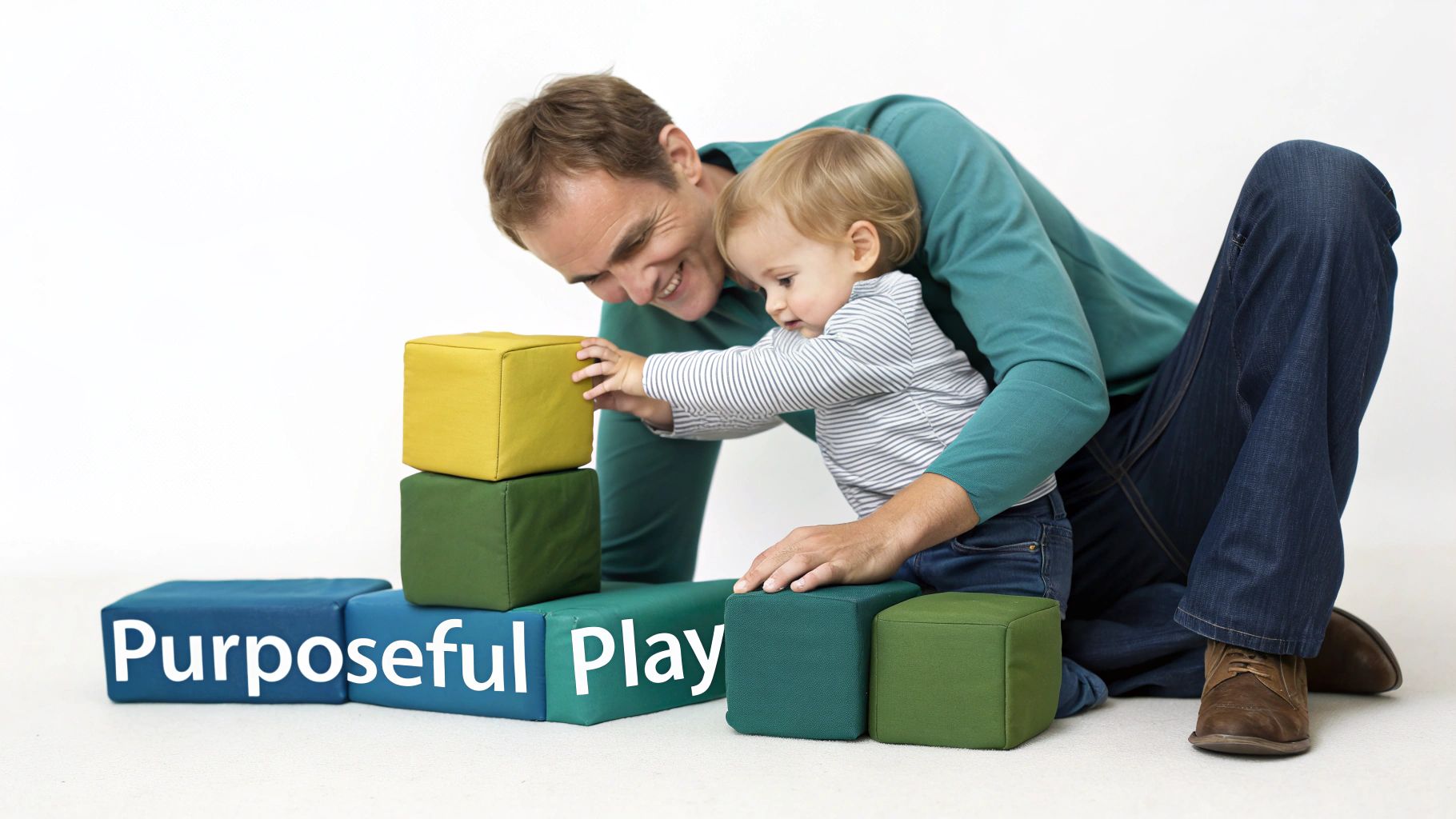
We often call this approach stage-based play. It’s a simple concept: matching toys and activities to what your child is ready to learn right now. You wouldn't hand a novel to a toddler just learning their first words, and it's the same idea with play. Tuning into their current abilities keeps them happily engaged, sidesteps frustration, and makes learning feel like pure fun.
Simple Activities for Big Growth
You really don't need a room full of fancy, expensive toys. Some of the best developmental activities use everyday items you probably already have lying around the house.
Here are a few simple ideas to get you started:
- Build a Cushion Fort: Just drape a blanket over a couple of chairs and you've created a whole new world. This classic game gets them using their gross motor skills as they crawl in and out, while also sparking their budding imagination and problem-solving abilities.
- Create a Sensory Bin: Grab a shallow tub and fill it with something like dry pasta, oats, or even just water (with close supervision, of course!). Add a few scoops and cups. This is a fantastic workout for their senses and really helps fine-tune the motor control they'll need for self-feeding.
- Sing Action Songs: Don't underestimate the power of "Wheels on the Bus" or "Heads, Shoulders, Knees, and Toes". These songs are brilliant for language development because they link words directly to actions, introduce new vocabulary, and teach them how to follow simple instructions.
Play is the brain's favourite way of learning. When a toddler stacks blocks, they aren't just building a tower; they're experimenting with balance, gravity, and cause and effect, laying the foundations for future scientific thinking.
The Role of Stage-Based Toys
This is where the idea of stage-based play really shines. A well-chosen toy can target several different skills at once. For example, a simple set of stacking blocks isn't just about building high towers. As your toddler figures out how to grasp, lift, and place each block, they are sharpening their hand-eye coordination and perfecting that all-important pincer grasp.
It’s this very philosophy that we pour into our Grow With Me subscription box. Every single item is selected to be just right for your 16-month-old’s developmental window. So, when you unbox something like a wooden pegboard, the included description cards explain exactly what’s going on. They’ll show you how fitting those little pegs into holes is building fine motor skills and even introducing early maths concepts like sorting.
It takes all the guesswork out of it. This way, you can be confident that every playtime is a chance to connect with your child and support their incredible journey of growth.
When to Talk to a Professional About Development
It’s completely normal to find yourself wondering if your toddler is on track. First things first: remember that every child is wonderfully unique and develops at their own pace. Think of milestones less as a strict checklist and more as a general guide to what’s typical for this age.
Your instinct as a parent is one of your most powerful tools. If you have a nagging feeling that something isn’t quite right with your little one’s development, it is always worth seeking reassurance. Being proactive is a sign of great parenting, not over-anxiety.
Trusting that feeling and speaking up early can either put your mind at ease or connect you with valuable support if it turns out you need it.
Signs That May Warrant a Chat
While a bit of variation is perfectly normal, child development experts suggest it's a good idea to talk to a professional if you notice your 16-month-old isn't consistently showing certain skills.
Consider reaching out if your toddler:
- Is not yet walking on their own or even attempting to pull up to stand.
- Doesn’t point to objects to show you something interesting.
- Doesn't seem to make eye contact or respond when you call their name.
- Hasn't said any single words yet, not even "mama" or "dada".
- Seems to have lost skills they once had, like babbling or waving bye-bye.
Your health visitor is your go-to resource in the UK. They are specially trained in child development and can offer a professional assessment, practical advice, and compassionate support without any judgement.
Your first step is simply to schedule a chat with your local health visitor or book an appointment with your GP. They are there to support you and your child every step of the way.
Common Questions About 16-Month Milestones
As you navigate the whirlwind of toddlerhood, questions are bound to pop up. Let's tackle some of the most common ones parents have about the big changes happening around the 16-month mark, from sleep wobbles to those surprisingly big feelings.
Why Is My Toddler So Clingy All of a Sudden?
If your little one has suddenly become your personal shadow, you’re definitely not alone. This is often the peak of separation anxiety, and it’s a completely normal part of their emotional growth. They've just mastered walking and are exploring their independence, but that newfound freedom can also feel a bit overwhelming, sending them right back to you for security.
Emotional development at this age is a real rollercoaster. In fact, research shows that 60-70% of toddlers go through a seriously clingy phase, which often ties back to their growing self-awareness bumping up against their deep need for attachment. It’s also worth noting that any disruption to their sleep can make this behaviour even more pronounced. For more insights, Pampers UK has a great guide on toddler development.
How Should I Handle Toddler Tantrums?
Ah, tantrums. They’re practically a 16-month-old’s signature move. The problem is simple: their feelings are huge, but their vocabulary is still tiny. That gap between intense emotions and the words to express them is the perfect recipe for a meltdown.
The best thing you can do is stay as calm as possible and acknowledge how they're feeling, without giving in to whatever sparked the tantrum. A simple, "You are feeling very cross that playtime is over. I understand," shows them you see their struggle while still holding the boundary.
What Should I Do About Picky Eating?
It’s incredibly common for toddlers to become fussy eaters around this age. Their growth rate starts to slow down a little, which can mean their appetite dips too. Their budding desire for independence is also a huge factor—refusing that piece of broccoli is one of the few ways they can exert some control over their world.
A few tips to help you ride out this phase:
- Keep offering variety: Don't give up! Continue to put different healthy foods on their plate without any pressure to eat them.
- Eat together: Let them see you enjoying a wide range of foods. Your example is more powerful than you think.
- Stick to a routine: Regular meal and snack times help them know what to expect.
As your toddler gets older, you'll naturally start thinking about what’s next. When the time comes, a good potty training readiness checklist can help you spot the signs that they're ready for that big step.
At Grow With Me, our stage-based play kits are thoughtfully designed to support every part of your toddler’s development, turning simple play into powerful learning. Find out how our curated boxes can help you celebrate each and every milestone with confidence. https://shop.growwithmesubscriptionbox.co.uk