
Stages of Child Development by Age A Parent Guide
Welcome to the incredible journey of watching your little one grow. This guide is your companion for understanding the amazing stages of child development by age. We'll walk through the key areas of growth—physical, cognitive, social, and language—not as a strict set of rules, but as a friendly map for their unique adventure.
Your Child's Unique Developmental Journey
Think of developmental milestones as signposts, not deadlines. Every child truly does follow their own path and timeline. Our hope is to swap any feelings of uncertainty with confidence, so you can joyfully support every step of your child's amazing transformation from a tiny, dependent newborn into a curious and capable little person.
Knowing what to expect helps you provide the right kind of support at just the right time, fostering their natural curiosity and building a solid foundation for a lifetime of learning. It's a journey filled with incredible progress, especially in those first five years when over 85% of brain development occurs.
The Four Core Areas of Development
When we talk about child development, it's about so much more than just getting bigger. It's a rich, interconnected process that happens across four main areas. Understanding how they all weave together gives you a much fuller picture of how your child is getting on.
-
Physical Development: This is all about movement. It covers the big stuff like gaining head control and learning to walk (gross motor skills) and the smaller, more precise actions like picking up a pea or scribbling with a crayon (fine motor skills).
-
Cognitive Development: This is how their amazing brain figures out the world. It includes problem-solving, memory, and grasping big ideas like object permanence—the realisation that teddy still exists even when it's hidden under a blanket!
-
Social and Emotional Development: Here's where they learn to connect with others, manage big feelings, show empathy, and build relationships. That first real smile or learning to share a toy are huge steps on this path.
-
Language and Communication: This area tracks how your child understands and uses language. It starts with their first coos and babbles, moves on to gestures, and eventually blossoms into full sentences and those endless "why?" questions.
Development is a continuous process from conception right through to maturity. While every child's path is unique, understanding these predictable patterns helps parents provide the right kind of nurturing environment for them to flourish.
For parents who might wonder if different beginnings affect this journey, it’s reassuring to know that fundamental development tends to follow very similar patterns. For instance, recent findings show that IVF does not affect the development of a child, which is a comfort to many families.
Each stage builds on the last, creating a strong foundation for future learning and happiness. By recognising these key milestones, you can better support their growth with activities and interactions that are just right for their age. To dig a little deeper, you can explore our guide on what developmental milestones are and why they matter so much.
Now, let's dive into that incredible first year.
The First Year: From Newborn to First Steps
The first 12 months of your baby's life are an absolute whirlwind of change. It feels like you blink, and suddenly your tiny, helpless newborn has transformed into a curious, mobile infant who's just about ready to become a toddler. This incredible year is packed with developmental milestones, laying the foundation for everything to come.
To get a handle on this rapid growth, it helps to look at the first year in four key phases. Each one ushers in a new set of amazing skills and discoveries, from that heart-melting first real smile to those wobbly, determined first steps.
This timeline gives you a bird's-eye view of how the core areas of development—physical, cognitive, and social—all progress and weave together during this foundational first year.
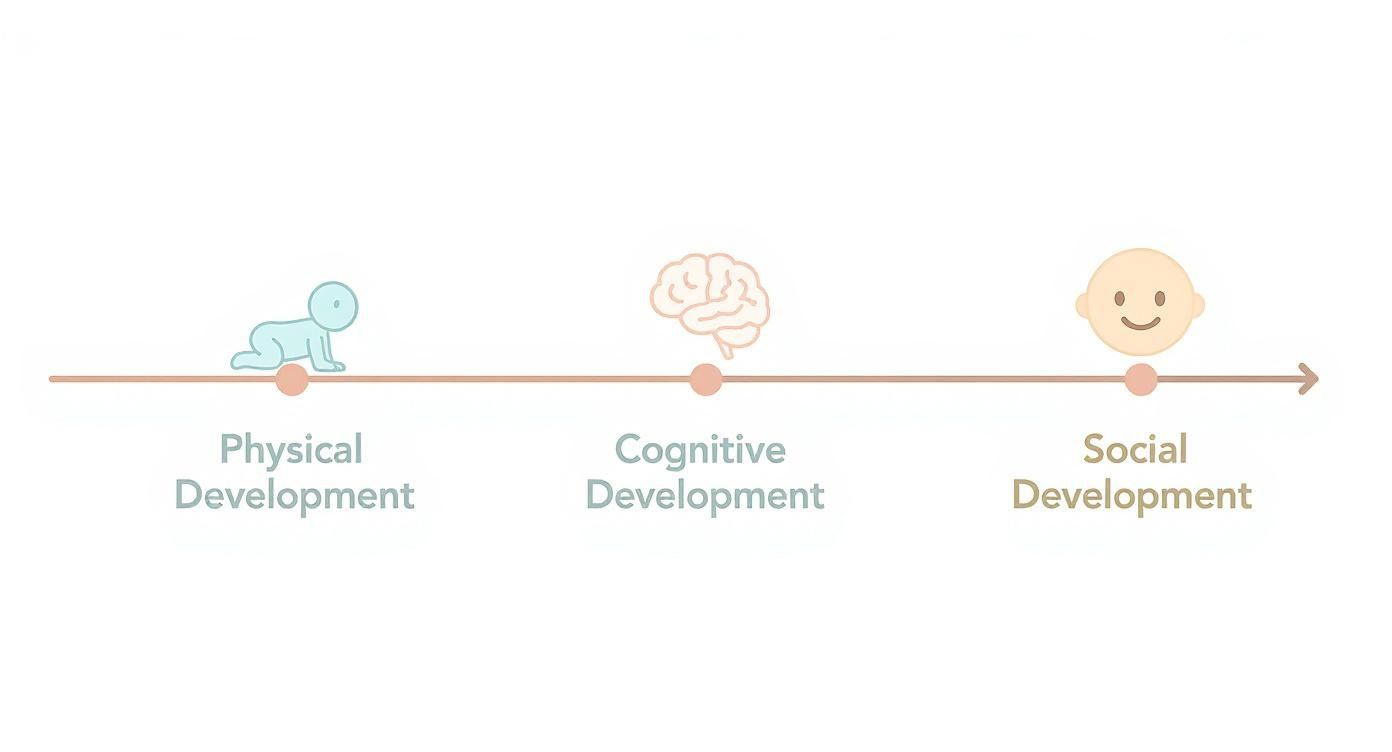
As you can see, these areas don't develop in isolation. A physical win, like finally reaching for a toy, is sparked by cognitive curiosity and often rewarded with a big social grin from you.
To help you track these changes, here's a quick summary of the key milestones you can expect to see during this incredible first year.
First Year Developmental Milestones at a Glance
| Age Range | Physical Milestones | Cognitive Milestones | Social and Emotional Milestones |
|---|---|---|---|
| 0-3 Months | Lifts head during tummy time, follows objects with eyes, brings hands to mouth. | Recognises familiar faces and sounds, starts to focus on high-contrast patterns. | Begins to smile socially, makes cooing sounds, enjoys interacting with caregivers. |
| 4-6 Months | Rolls from tummy to back (and later, back to tummy), sits with support, pushes up on arms. | Reaches for toys with purpose, explores objects by mouthing them, gets excited by familiar people. | Laughs out loud, babbles and imitates sounds, shows clear signs of enjoyment. |
| 7-9 Months | Sits without support, starts to crawl or scoot, pulls up to stand. | Understands "no," finds partially hidden objects (early object permanence), develops pincer grasp. | May show separation anxiety, plays games like peek-a-boo, responds to their own name. |
| 10-12 Months | "Cruises" along furniture, may take first independent steps, feeds self with fingers. | Understands simple commands, imitates gestures (like waving), puts objects into containers. | Says "mama" or "dada," shows definite preferences for certain people and toys. |
This table is just a guide, of course. Every baby develops at their own unique pace, but it gives you a great snapshot of the journey ahead.
The First Quarter: Birth to Three Months
In those first few weeks, your baby is running on pure instinct. Reflexes like sucking and grasping are in charge of their movements as they start to figure out this big new world outside the womb. Their vision is still a bit blurry, which is why they're so captivated by high-contrast images and, most of all, the sight of your face.
A huge physical achievement during this period is gaining head control. This is why supervised tummy time is so important, even just for a few minutes at a time. It works wonders for strengthening their neck, back, and arm muscles, which are the building blocks for rolling and crawling down the line.
Your baby's brain is forging connections at an incredible speed. Simple, loving interactions—talking, singing, and just looking into their eyes—are the most powerful things you can do to support their growth.
Crying is their main form of communication right now, but soon you'll start hearing those adorable coos and gurgles. The real magic moment, though, is the arrival of the social smile around six to eight weeks—a genuine, beaming smile just for you.
The Second Quarter: Four to Six Months
Get ready for a much more interactive and playful phase! Your baby is stronger, more coordinated, and is starting to explore their world with real intention. They're mastering the art of rolling over, usually from tummy to back first, and then the other way around.
They’ll also begin sitting up with a bit of support, giving them a fantastic new vantage point. This is the perfect time to introduce toys they can easily grab, shake, and, inevitably, pop into their mouths for a good chew.
Cognitively, they're making some serious leaps:
- Recognising Familiar Faces: They now know you from a stranger and will light up when they see their favourite people.
- Developing Hand-Eye Coordination: You'll see them purposefully reaching for and grasping objects, a skill they'll practise over and over.
- Imitating Sounds: Listen closely, and you'll hear them trying to copy your babbles and sounds. It's the very beginning of language!
Their world has become a sensory playground. Toys that make gentle noises, have interesting textures, or are safe for teething are ideal for this age. A Grow With Me kit for this stage is designed to hit all these developmental sweet spots.
The Third Quarter: Seven to Nine Months
Mobility is the name of the game in these months. Many babies start to crawl—whether it’s the classic hands-and-knees style, a cute bum-shuffle, or an army-style tummy crawl. Their intense curiosity is driving them to explore every nook and cranny.
A major cognitive milestone that appears now is object permanence. Your baby is starting to grasp that things still exist even when they can't see them. This new understanding is why they suddenly find peek-a-boo hilarious and might start to show signs of separation anxiety when you pop out of the room.
Their fine motor skills are getting a lot more precise, too. They can now pass a toy from one hand to the other and are working on their pincer grasp—using their thumb and forefinger to pick up smaller things.
The Final Quarter: Ten to Twelve Months
The journey towards walking truly begins. Your baby will likely be pulling themselves up to stand using the furniture and might start "cruising" by shuffling sideways while holding on. It's a time of incredible physical practice and sheer determination. For a closer look at this exciting milestone, you might want to read our guide on when babies start walking.
Communication is also getting much more sophisticated. They can follow simple instructions like "wave bye-bye" and will use gestures to show you what they want. Their babbling is even starting to mimic the rhythm and intonation of real speech.
By their first birthday, many babies have said their first proper words, like "mama" or "dada," and actually know what they mean. They're also becoming little problem-solvers, enjoying games like putting blocks into a cup or turning the pages of a board book. This last quarter of the first year is a beautiful celebration of all the skills they've worked so hard to build.
Navigating the Toddler Years: One to Two
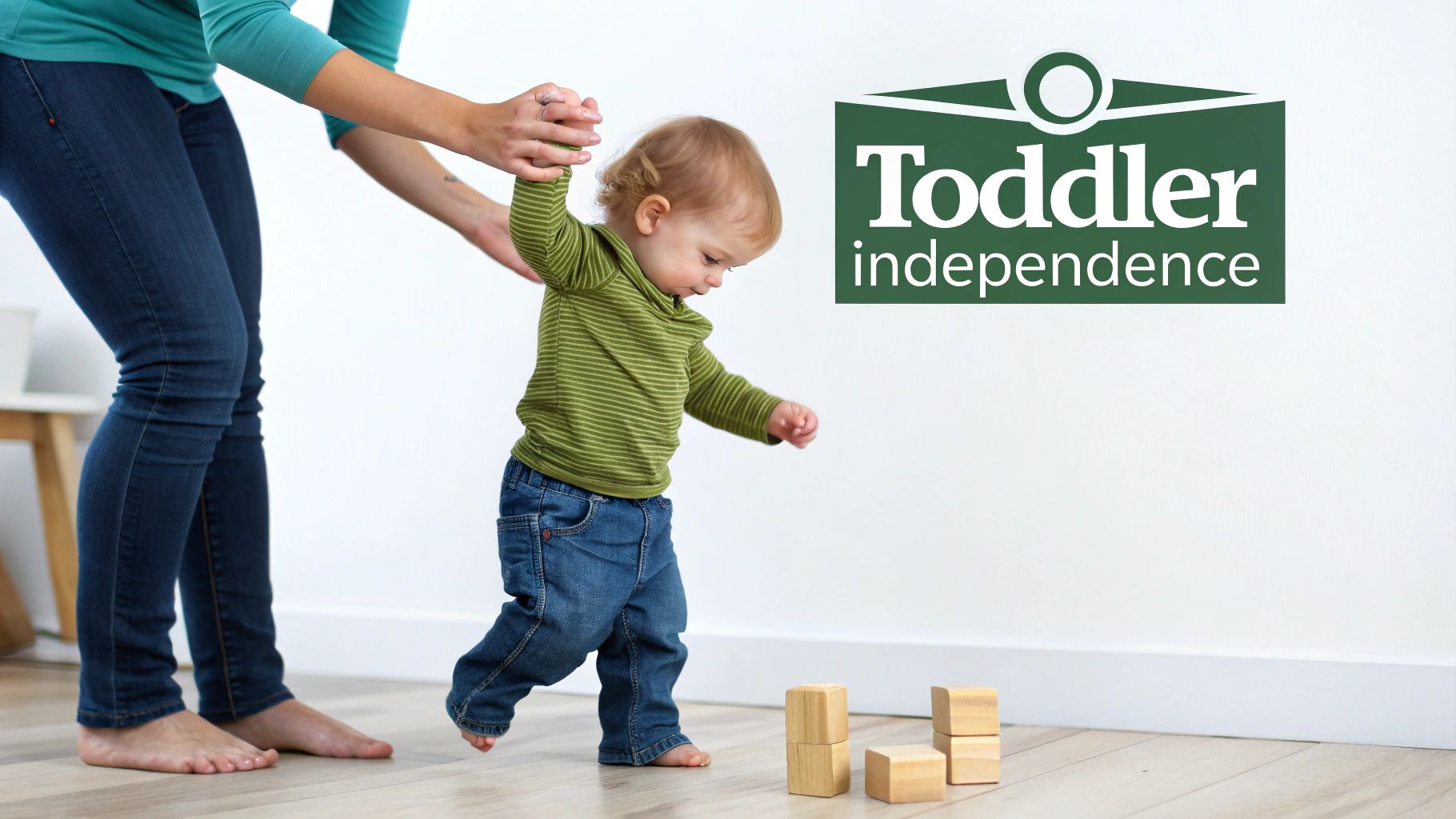
Once your baby blows out that first birthday candle, you're officially in for the ride of your life. Welcome to the toddler years! This stage, from one to two, is a whirlwind of action, budding independence, and a personality that seems to get bigger every single day. Those first wobbly steps quickly give way to confident walking, then running, and before you know it, climbing.
This newfound mobility changes everything. Suddenly, your little one is an unstoppable explorer, driven by a deep need to touch, taste, and test absolutely everything they can get their hands on. When you understand the stages of child development by age, you start to see that their constant motion isn't just chaos; it’s the powerful engine driving how they learn about their world.
Physical Powerhouses in the Making
Between ages one and two, gross motor skills absolutely take centre stage. A child who was just recently cruising along the furniture is now practising walking backwards, bopping along to music, and making brave attempts to conquer the stairs. Their balance and coordination are sharpening with every move they make.
At the same time, their fine motor skills are getting a serious upgrade. Just think about the sheer concentration it takes for a one-year-old to stack a couple of blocks or turn the thick pages of a board book. These aren't just simple games; they're complex exercises that build crucial hand-eye coordination.
You'll likely spot these key physical milestones:
- Improving Dexterity: Their clumsy grasp evolves, allowing them to scribble with a crayon, pick up tiny bits of food, and get the hang of turning knobs and handles.
- Stacking and Building: Simple block towers become an obsession, teaching them vital lessons about balance and cause and effect (and the joy of knocking it all down!).
- Problem-Solving with Hands: A shape sorter or a simple puzzle isn't just for fun. It’s a full-on cognitive workout that strengthens their fine motor control.
The Great Language Leap
The explosion in communication during this year is nothing short of incredible. At the start of this stage, their vocabulary might just be a few key words like "mama" or "dada." Fast forward to their second birthday, and many toddlers are starting to string two-word phrases together, like "more milk" or "bye-bye car."
This jump represents a huge cognitive leap forward. They're moving beyond just naming things to actually expressing their needs, wants, and what they see. This is when they really begin to grasp the power of language as a tool for interacting with their world.
A one-year-old's brain is working overtime to connect words to objects and actions. Pointing to things and naming them as you go about your day is one of the most powerful ways to build their vocabulary and strengthen these vital neural connections.
Sharing picture books and singing songs are fantastic, easy ways to fuel this language burst. A Grow With Me subscription box for this age group is brilliant, as it often includes colourful board books and toys that encourage them to copy sounds and actions, hitting this developmental area right on target.
Navigating Big Emotions and Growing Independence
With a growing sense of self comes a whole wave of big, powerful emotions. This is the age where the classic "toddler tantrum" often makes its grand entrance. It's important to remember these outbursts aren't your child being naughty—they're a raw expression of frustration. Their ideas and desires are often miles ahead of their ability to communicate them or control their impulses.
They're also figuring out that they are a separate person from you, with their own unique likes and dislikes. You'll see this drive for independence when they insist on trying to put on their own shoes or feed themselves, no matter how messy it gets.
Here’s how you can support their emotional growth:
- Acknowledge Feelings: Give their emotion a name. "You feel angry because the blocks fell down" helps them build an emotional vocabulary.
- Offer Simple Choices: Giving them a bit of control with choices like "Do you want the red cup or the blue cup?" can head off a lot of power struggles.
- Maintain Consistent Routines: Predictable daily schedules help toddlers feel safe and secure, which can go a long way in reducing anxiety and tantrums.
This stage is a thrilling—and let's be honest, sometimes challenging—mix of rapid physical progress, blossoming language, and those first determined steps towards independence. Your role is to be their safe harbour, encouraging their exploration while providing the loving guidance they need to make sense of it all.
The World of a Two-Year-Old
As your child hurtles towards their third birthday, you'll notice a shift. The whirlwind of changes from their first year gives way to something more focused and powerful. Those early skills are now being refined, becoming sharper and more complex, and their unique personality is truly starting to shine through in everything they do.
It’s an amazing time to watch them. From their determined attempts to solve a puzzle to their ever-growing vocabulary, you can almost see the cogs turning. To get a clearer picture of what's happening behind their sometimes-chaotic play, it helps to look at the key developmental areas for this age. In England, progress is often tracked across five core domains, giving us a fantastic framework for understanding their incredible growth.
The Five Key Developmental Domains
Think of these five areas as interconnected. A leap forward in one area, like communication, often unlocks new abilities in another, like social skills.
-
Communication Skills: You'll start hearing more than just single words. Simple two or three-word sentences like "more milk please" or "teddy go sleep" become common. They can also grasp two-part instructions, like "Find your shoes and bring them to mummy."
-
Gross Motor Skills: Their physical confidence is sky-high! They aren't just walking anymore; they're running, attempting to jump with both feet leaving the ground, and kicking a ball with real intention. Climbing furniture also becomes a favourite, if slightly nerve-wracking, new hobby.
-
Fine Motor Skills: The small muscles in their hands and fingers are getting a serious workout. You'll see this in their ability to stack a tower of six or more blocks, carefully turn the pages of a book one at a time, and hold a crayon with their fingers instead of a clenched fist.
-
Problem-Solving Skills: Their little minds are making huge leaps. This is when early imaginative play really kicks in—they might pretend to feed a doll or have a chat on a toy phone. They're also starting to sort objects by shape and colour, figuring things out through good old-fashioned trial and error.
-
Personal-Social Skills: This is a fascinating stage for social development. They're becoming much more aware of other children, but they aren't quite ready to play with them. Instead, you'll see a lot of parallel play, where they happily play alongside a friend, each absorbed in their own world. This is a vital first step towards building friendships.
These five domains are actually the foundation of the Ages and Stages Questionnaire (ASQ-3) that health visitors often use. It's reassuring to know that recent data shows 81.4% of children in England are reaching the expected level across all five areas by this age. While every child develops at their own pace, it shows a wonderfully positive and common path of growth. You can see the full picture on these child development outcomes on GOV.UK.
Fostering Growth Through Play
The brilliant thing is, you don't need a formal lesson plan to support all this learning. It happens naturally through play and everyday moments. The right kinds of toys and activities simply give them more opportunities to practise.
A simple shape-sorter, for instance, isn't just a bit of fun. It’s a powerful tool for honing their problem-solving and fine motor skills at the same time. Kicking a ball in the garden builds up their gross motor coordination while also teaching them about cause and effect.
At this age, play isn't just a pastime—it's how a child does their most important work. It’s their laboratory for testing theories, their studio for solving problems, and their training ground for building the physical, social, and cognitive foundations they'll need for life.
A Grow With Me kit for a two-year-old is curated with exactly these five domains in mind, giving you tools that are perfectly matched to what they can do now and what they'll be ready for next. For more inspiration, check out our guide on learning toys for 2-3-year-olds, which is full of ideas to support these crucial stages of child development by age. This is all about building a strong, well-rounded foundation for the preschool years just around the corner.
Preparing for Preschool: Three to Five Years
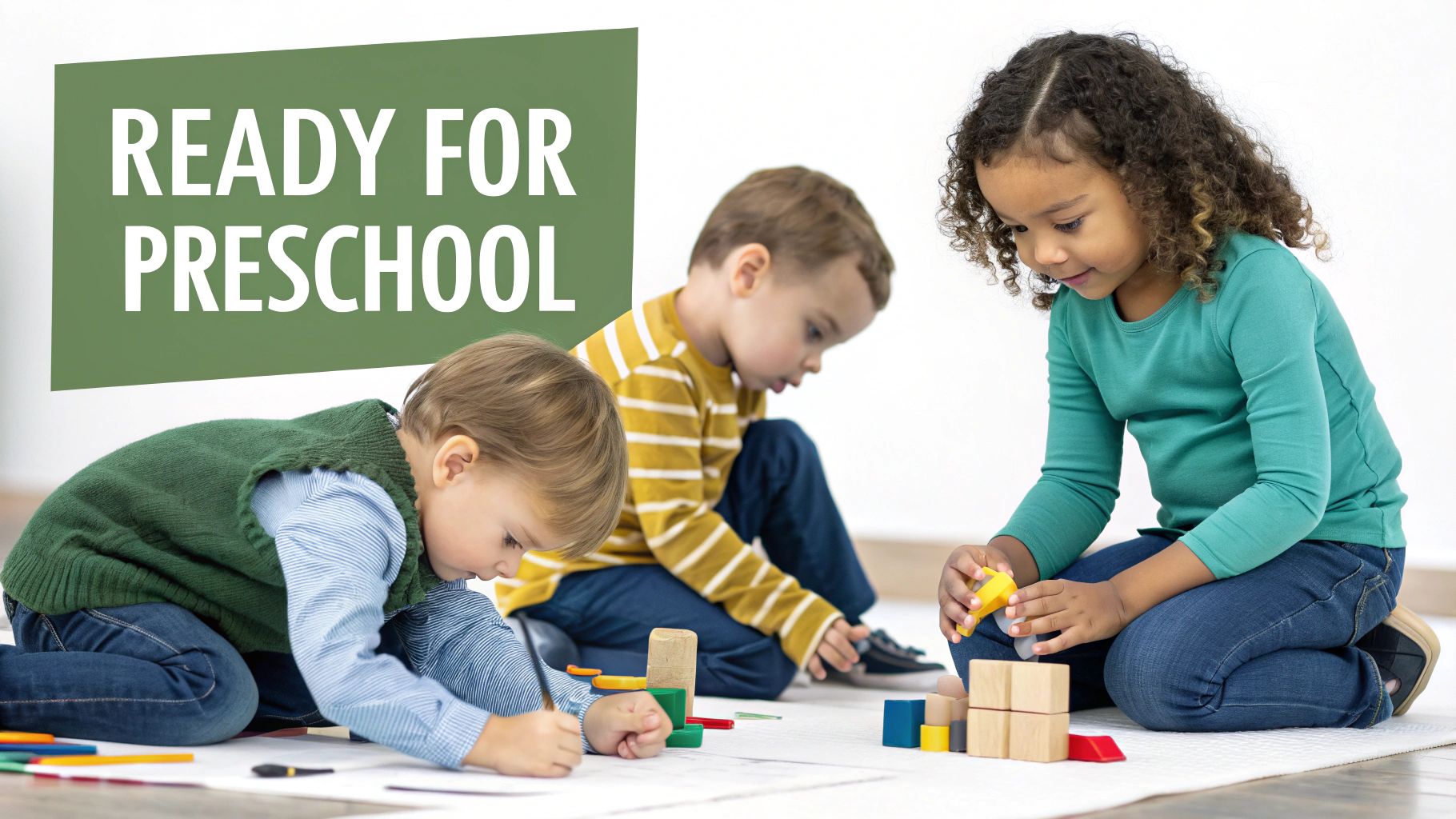
As your child leaves the toddler years behind, they step into the wonderfully expansive world of a preschooler. This period, from three to five, is a remarkable time of refinement. Their physical skills become more polished, their thinking grows far more complex, and their social world genuinely begins to blossom. The chaotic energy of toddlerhood starts to channel into more focused and imaginative adventures.
Think of this stage as the crucial bridge between the free-form exploration of their earliest years and the more structured learning of school. You'll witness a dramatic shift as they move from simply playing alongside friends to actively playing with them—a huge milestone in their social journey. Understanding the stages of child development by age for this group helps you appreciate just how much incredible work is happening behind all the fun and games.
A World Built on Imagination and Friendship
One of the most magical transformations you’ll see is in the quality of their play. Where a two-year-old might pretend to feed a doll, a four-year-old will create an elaborate backstory for that doll, complete with a family, a home, and a dramatic quest they're about to embark on.
This leap into complex imaginative play is a massive cognitive workout. It helps them make sense of their world, try on different roles, and sharpen their problem-solving skills. When you see them turn a cardboard box into a spaceship or a pile of cushions into a secret fort, you're watching their brain forge powerful new connections.
At the same time, their social skills take a giant leap forward:
- Cooperative Play: They start to negotiate roles, share ideas, and work together toward a common goal in their games.
- Developing Empathy: They begin to realise that other people have feelings, too. You might spot them comforting a friend who is upset or trying to make someone laugh.
- Learning to Share and Take Turns: While still a work in progress, the concept of sharing becomes more manageable as they learn the social rewards of cooperation.
The Cognitive Explosion
The preschool years are famously marked by one little question: "Why?" This relentless curiosity is the engine of their cognitive growth. They are no longer just observing the world; they are actively trying to piece together how it all works.
Their minds are like sponges, soaking up information and starting to organise it in more logical ways. This is when foundational academic skills begin to emerge, not through formal lessons, but through playful, everyday activities. For example, counting the steps as you walk up them or pointing out the first letter of their name on a cereal box are powerful learning moments.
By the time a child reaches five, their brain has already completed about 85% of its development. The rich experiences and interactions of the preschool years create the essential architecture for all future learning, making this a period of incredible opportunity.
This cognitive readiness is what educators look for as children get ready for school. In England, the Early Years Foundation Stage Profile assesses whether five-year-olds have reached a 'good level of development' across key domains. In the 2022-2023 school year, 67% of children achieved this level, a figure that underscores how vital continued support is during these foundational years. You can explore more in the government's data on school-age development/level_of_development_at_age_5).
To give you a clearer picture of what this looks like, here's a quick checklist of the skills that are blossoming during this time.
Preschool Skills Development Checklist
| Skill Area | Age 3-4 Examples | Age 4-5 Examples |
|---|---|---|
| Social & Emotional | Starts to take turns in games, shows affection for friends, expresses a wide range of emotions. | Wants to please friends, shows more empathy, can be more cooperative with rules. |
| Language & Communication | Speaks in sentences of 5-6 words, tells stories, sings songs from memory. | Speaks very clearly, can tell a longer, more detailed story, uses future tense ("We will go to the park"). |
| Cognitive | Correctly names some colours and can count a few objects, understands the idea of 'same' and 'different'. | Can count 10 or more objects, knows basic shapes and letters, understands concepts like time better. |
| Physical & Motor | Hops and stands on one foot for up to two seconds, uses scissors, can draw a person with 2-4 body parts. | Hops, somersaults, swings, and climbs. Can print some letters and draw a person with at least 6 body parts. |
This checklist isn't a test, but rather a guide to the wonderful progress your child is making as they prepare for the next big step.
Gaining Independence and Emotional Control
Alongside all this social and cognitive growth, preschoolers are on a steady march towards independence. They take immense pride in doing things for themselves, and mastering these self-care skills is a huge boost to their confidence.
Encouraging this independence is vital for school readiness. Simple tasks that build their sense of capability include:
- Getting dressed on their own (even if the clothes are backwards!).
- Pouring their own drink from a small jug.
- Helping with simple chores like setting the table.
- Following multi-step instructions, such as, "Please put your toys away and then wash your hands for dinner."
This is also a key time for emotional regulation. They are starting to develop the tools to manage their big feelings without resorting to a tantrum every time. You can support this by helping them name their emotions ("I can see you're feeling frustrated") and talking through simple solutions. This journey from three to five is all about preparing them to step confidently into the wider world, equipped with the social, emotional, and cognitive skills they need to truly thrive.
When to Seek Developmental Support
It’s completely normal to have moments of worry about your child's growth. We’ve been talking about the stages of child development by age as a helpful map, but it’s crucial to remember it’s not a rigid timetable. Small detours and unique timelines are all part of the journey.
One toddler might be an early chatterbox but take their time with walking. Another might be climbing the furniture long before they can string a sentence together. This is what makes them wonderfully individual. As their parent, you're their biggest cheerleader, and that also means being their best advocate.
Trust Your Instincts
Honestly, you know your child better than anyone. If you’ve got that nagging feeling that something just isn't quite clicking with their development, it's always worth listening to that little voice. Acting on a concern is never an overreaction; it’s just you being a proactive, caring parent.
Often, what looks like a delay is just your child pouring all their energy into mastering a different skill. But if that little worry persists, or you start to notice a really significant gap between your child and their friends, getting a professional opinion is a great next step.
Knowing the Difference Between Variations and Red Flags
So, how do you tell the difference? It can be tricky, but a few signs might suggest it’s time for a chat with an expert. These aren't reasons to panic—think of them more as gentle nudges to gather a bit more information.
Consider reaching out if you notice:
- A loss of skills: Your child could babble, wave, or walk, but now they’ve stopped.
- Significant delays in several areas: They seem to be behind across a few of the developmental domains we’ve covered, not just in one specific skill.
- A lack of social connection: For instance, by 18 months, they aren’t making much eye contact, don't respond to their name, or don't point to show you interesting things.
- Really intense emotional reactions: Their tantrums feel much more frequent, severe, or harder to soothe than other children their age.
For specific concerns, like the possibility of autism, there is fantastic, specialised support available. Getting professional guidance can make a world of difference, and resources like Autism counselling services can be an excellent first port of call for families looking for help.
Who to Talk To
Your GP or health visitor is the perfect place to start. They’re trained to understand the wide spectrum of child development and can offer reassurance, do an initial check, or point you toward a specialist if needed.
When you go to an appointment, try to have a few specific examples of what you've been seeing. The more detail you can share, the clearer the picture becomes, helping them give you the best advice.
Remember, asking for support is a sign of strength. It’s about opening a door to resources that can help your child shine, not about putting a label on them. You're taking a positive, loving step on their unique journey.
It’s also helpful to know that developmental timelines can be influenced by all sorts of things. Recent data, for example, showed a slight dip in the proportion of two-year-olds in England meeting expected levels in all five key areas of development—down from 81.1% to 79.2% between 2022 and 2023. You can read more about these child development findings on GOV.UK. This just goes to show that small variations across the board are common and not always a reason for alarm.
At Grow With Me, we're all about empowering parents with the knowledge and tools to champion their child’s unique path. Our stage-based play kits are designed to meet your little one exactly where they are, offering joyful activities that build skills and confidence every step of the way.