
language development activities for toddlers: simple ideas
Hearing your toddler say a new word is one of those moments you’ll never forget. It’s pure magic. But these early steps in language are so much more than just cute milestones—they are the very bedrock of your child's ability to think, connect with others, and even succeed at school later on.
The amazing thing is that simple, everyday interactions can be turned into joyful opportunities to build this foundation and strengthen your bond.
Why Early Language Activities Are So Important

There’s a reason experts call the period between one and three the 'language explosion'. A toddler's brain is forming connections faster than at any other point in their life. Every single word they hear, every little chat you have, helps forge the neural pathways they need for communication.
These early interactions go far beyond just teaching new words. They also lay the groundwork for:
- Cognitive Skills: Language is the tool we use to think. When a toddler learns to name and categorise things, they're literally organising their world, which is a huge step in problem-solving and memory.
- Social and Emotional Growth: Imagine how frustrating it is not to be understood! Language gives toddlers the power to express their wants, needs, and feelings, which cuts down on tantrums and builds their confidence.
- Future School Success: It’s true—strong early language skills are one of the best predictors of how well a child will read and perform in school down the line.
The Link Between Early Words and Later Learning
The connection between a toddler’s early vocabulary and their future achievements is incredibly strong. When you consistently make time for language-building activities, you’re giving them a genuine head start, long before they ever see the inside of a classroom. This isn't about flashcards or formal lessons; it's about creating a rich, chatty, and interactive environment.
UK research backs this up, showing that children with weaker language skills at age five often face ongoing challenges. For example, a startling 36% of these children didn't meet the expected standard in maths by the time they were seven. That really shows how fundamental language is for all types of learning, not just reading.
This brief window for language acquisition is precious. That's why playful, intentional communication is so powerful. You're not just teaching words; you are building the very architecture for your child's future.
Building a Foundation Through Play
Above all, these activities should be fun. They should feel like a game, not a lesson. Simple things like reading books together, singing songs, or even just narrating what you’re doing as you make lunch are incredibly powerful tools.
This playful approach supports their overall cognitive development in early childhood, not just their language. By turning everyday moments into little conversations, you create a warm, encouraging space where your toddler’s language skills can blossom naturally.
Weaving Language Into Your Everyday Routine
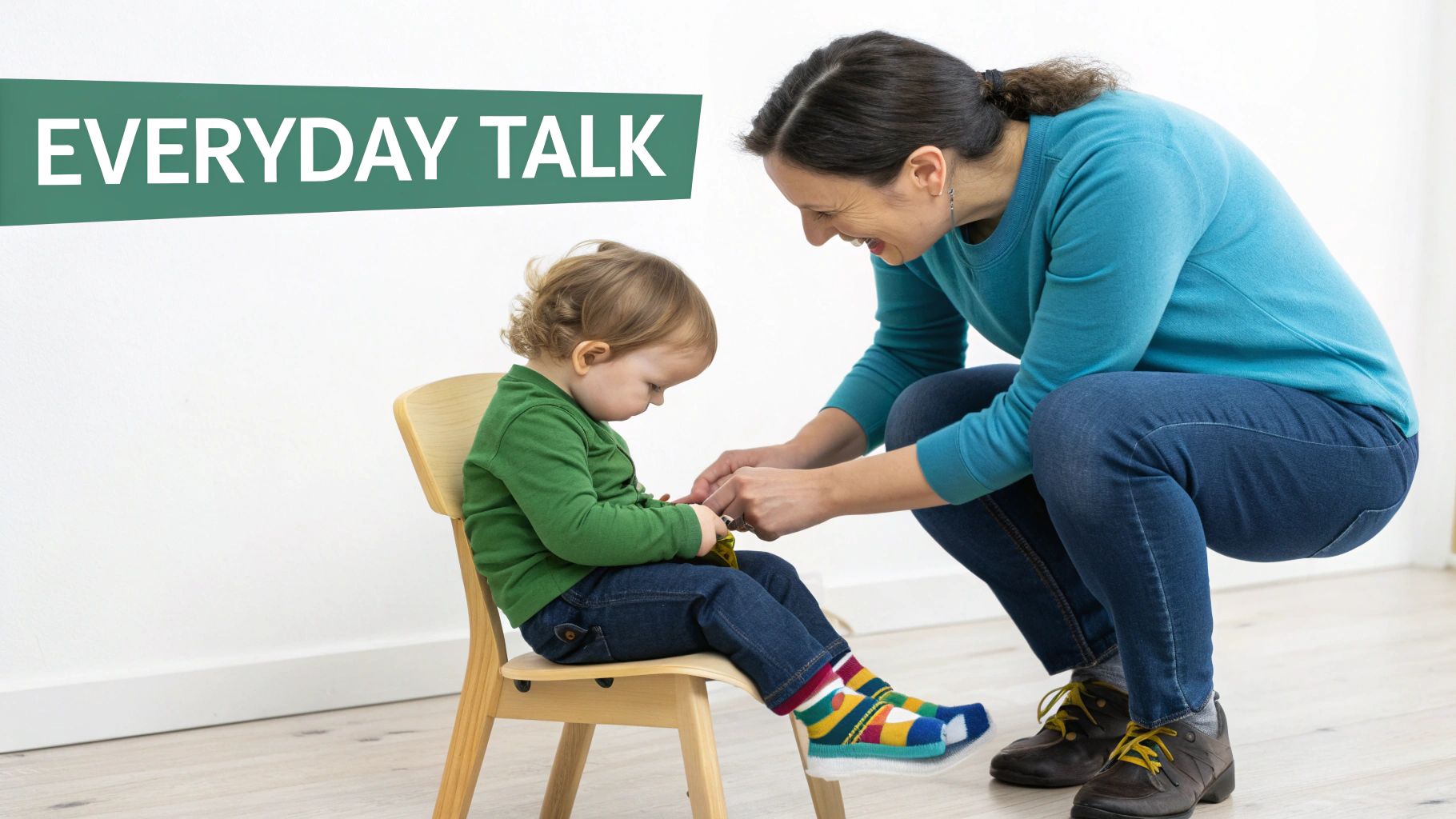
You don’t need special flashcards or dedicated "learning time" to boost your toddler's language. The best opportunities are already woven into your day, hiding in plain sight during nappy changes, dinner prep, and trips to the park.
It’s all about turning these ordinary moments into rich, chatty experiences.
Become Their Personal Narrator
Think of yourself as the narrator of your child’s world. By simply talking about what you’re doing and seeing together, you give them a running commentary that connects words to their everyday life. This is often called self-talk, and it’s a game-changer.
While you're getting them dressed, for instance, you can chat through the process. "Let's find your cosy blue jumper. Okay, one arm in... pop! Now the other one. There we go!" You're not just getting a task done; you're linking the word "jumper" to the real thing and the action of putting it on.
The Magic of 'Parentese'
You're probably already doing this instinctively. It's that higher-pitched, sing-song voice with big, expressive facial expressions that just comes naturally when talking to a little one. Far from being silly 'baby talk', it's a powerful, scientifically-backed tool known as 'parentese'.
Research consistently shows that this melodic way of speaking really does capture a toddler's attention. The slower pace and exaggerated tones help their developing ears pick out individual sounds and words, making it easier for them to start cracking the language code.
So, embrace it! That expressive voice is one of your best tools for helping your toddler tune in and absorb new words.
From Babble to Proper Chats
When your toddler points at the cat and lets out an excited "ba-ba!", how you respond is incredibly important. Answering with, "Yes, that's the fluffy cat! She's swishing her tail," does more than just teach them the word "cat". It validates their attempt to communicate.
This back-and-forth, even when their side is just babble, is the very first step towards a real conversation.
It shows them that their sounds have power and meaning, which encourages them to keep trying. Over time, those babbles will start to take the shape of their first real words. This responsive style is a core part of what’s known as sustained shared thinking, where you and your child build on an idea together.
By treating every gurgle and point as a turn in a conversation, you're laying the foundation for all their future communication. You’re teaching them the rhythm of a proper chat.
Spotting Language Opportunities in Your Day
Let’s get practical. Here’s what this can look like during a typical day. The trick is to use lots of descriptive, interesting words.
- Meal Times: Don't just serve the food. Talk about it! "Here’s some yummy banana. It's so yellow and squishy." Describe the sensations. "Mmm, this yoghurt is cold and creamy in your mouth."
- Bath Time: This is a fantastic sensory playground for words. You can chat about the warm water, the slippery soap, and the floating toys. "Splash! The water is going up, up, up! Can you see the big bubbles?"
- The Weekly Shop: A supermarket trip is a goldmine for new vocabulary. Point things out as you walk the aisles. "Look at those big, red apples. Let's count them into the bag. One... two... three!"
By weaving these simple narrations into your day-to-day life, you create a language-rich environment where learning is constant, natural, and genuinely fun. You’re not just ticking chores off a list; you’re building your child's brain, one word at a time.
Language Games for Young Toddlers: 12 to 24 Months
That magical window between your toddler’s first and second birthday is an explosion of communication. You’ll notice them shifting from simple points and babbles to really understanding you and, excitingly, trying out their very first words. Now is the perfect time to dive into some simple language games that feel less like a lesson and more like pure, joyful play.
The idea isn't to put them on the spot, but to build connection through fun. We're aiming to gently boost both their receptive language (what they understand) and their expressive language (what they're able to say).
Become a Narrator: Point and Name Everything
This sounds almost too simple to work, but honestly, it’s one of the most powerful things you can do. Your toddler is a little sponge, soaking up the vocabulary of their world. Your job is to be their personal tour guide.
As you go about your day, simply point to things and name them clearly. "Oh, look, a dog!" "Here's your soft blanket." "Can you see that big, green bus?" Keep your tone light and animated to hold their interest, and don't be afraid to repeat the word a few times.
Let's Hear the Animals: Making Sounds Together
Animal sounds are brilliant "first words." Why? They're fun, silly, and often much easier for little mouths to form than the actual animal name. Grab a colourful picture book (like the ones you often find in Grow With Me kits) and get ready to make some noise.
Point to the picture of a sheep and say, "The sheep goes baa-baa!" Then, turn to your toddler with a big, encouraging grin and give them a moment to try. It doesn't matter if their "baa" sounds more like "da"—every attempt is a win! It’s a playful way to practise the back-and-forth of conversation.
Where's It Gone?: Simple Hiding Games
You can’t go wrong with a classic game of peek-a-boo or hiding a favourite toy under a cushion. These games aren't just for giggles; they teach fundamental concepts like object permanence and give you the perfect excuse to use simple, repetitive phrases.
When you hide their teddy, ask with a playful, curious voice, "Where's teddy gone?" When you pull back the cushion, celebrate with a big, "There he is!" This helps them grasp simple questions. You can also start giving one-step directions, like "Pass the ball to Daddy," which is fantastic for building up their understanding.
The secret ingredient at this age is repetition. Hearing you say the same playful words over and over in a fun, loving context is exactly what makes those new words click and stick in their amazing, fast-growing brain.
Here's a snapshot of simple, effective activities for younger toddlers and the core skill each one targets.
Quick Activities for Toddlers 12-24 Months
| Activity Idea | Primary Language Skill Targeted | What You'll Need |
|---|---|---|
| Singing Nursery Rhymes | Rhythm, vocabulary, repetition | Just your voice! (Actions are a bonus) |
| "What's in the Box?" | Naming objects, receptive language | A box and familiar items (e.g., spoon, sock) |
| Blowing Bubbles | Oral motor skills, simple requests ("more!") | Bubble mix and a wand |
| Looking at Photo Albums | Naming familiar people ("Mama," "Dada") | A family photo album |
These activities are all about keeping things light and pressure-free. The goal is connection and fun, with language development being a natural, happy side effect.
This period is known for a massive vocabulary boom. According to UK health experts, a one-year-old might have just three clear words, but by their second birthday, this can leap to 100 to 200 words. What's fascinating is that they typically understand about five times more words than they can actually say, which is why all your chatting and naming is so crucial for building their internal word bank. For a deeper dive, you can explore more about these speech and language milestones at GOSH.nhs.uk.
Engaging Activities for Older Toddlers 24 to 36 Months
As your toddler approaches their third birthday, you'll start to see an amazing leap in how they communicate. They're moving beyond just naming things; now they're linking ideas, asking a million questions, and even telling their first little stories. It's the perfect time to bring in activities that spark real back-and-forth chats.
This is where your role shifts from being a simple narrator to a proper conversation partner. The focus now is on encouraging them to express their own thoughts and ideas, giving them the confidence to share that wonderful world inside their head.
What's in the Mystery Bag?
This has to be one of my favourite games for building descriptive language and thinking skills. All you need is a bag or even just a pillowcase, plus a few familiar objects you can grab from around the house.
Pop an item inside the bag without your little one seeing what it is. Now, invite them to have a feel through the fabric and guess what’s hidden inside. You can guide them with a few open-ended questions.
- "What does it feel like? Is it hard or soft?"
- "Can you feel any pointy bits? Is it round?"
- "What do you think we use it for?"
After they've had a good guess, pull the item out with a bit of a flourish! The point of the game isn’t just naming the object, but getting them to describe its features—a brilliant step towards building more complex sentences.
The real magic here is the suspense and the chat it creates. You’re teaching your toddler to think critically and use a wider range of words to explain their reasoning, moving far beyond simple nouns.
The activities we use with younger toddlers, like playing 'I Spy' or making animal sounds, really lay the groundwork for these more advanced games.
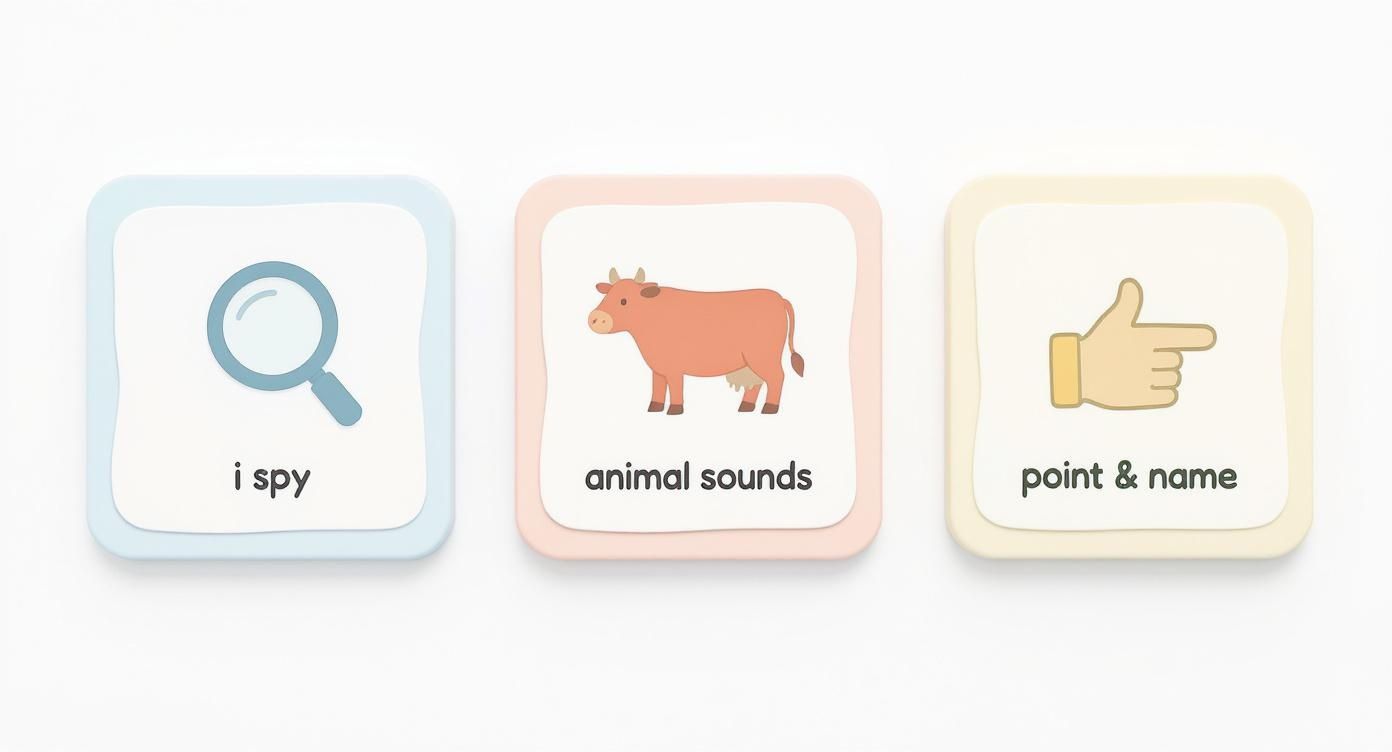
This visual shows how those foundational games build the core skills that you're now ready to expand on with your older toddler.
Acting Out Simple Stories
Imaginative play is an absolute goldmine for language development. Using small toys, like the little wooden figures you often get in Grow With Me kits, you can act out simple situations and get your toddler to join in the fun.
Start with something they know well, like the bedtime routine or a trip to the park. Move the figures around as you tell the story. "The little bear is very sleepy. It's time to get into bed. Goodnight, bear!"
Then, pause and ask, "What happens next?" This is a simple invitation for them to add their own ideas to the story. They might say the bear needs to read a book or have a drink of water, adding their own creative flair while practising their storytelling. It’s this kind of teamwork in play that is so important for their communication skills.
Recent UK government statistics show that progress in this area is steady, with 86.6% of children between two and two-and-a-half meeting their expected communication milestones. While this is an improvement, it really underlines how vital it is to keep providing a rich language environment at home. You can read more about these child development outcomes on GOV.UK.
Making Story Time an Interactive Conversation
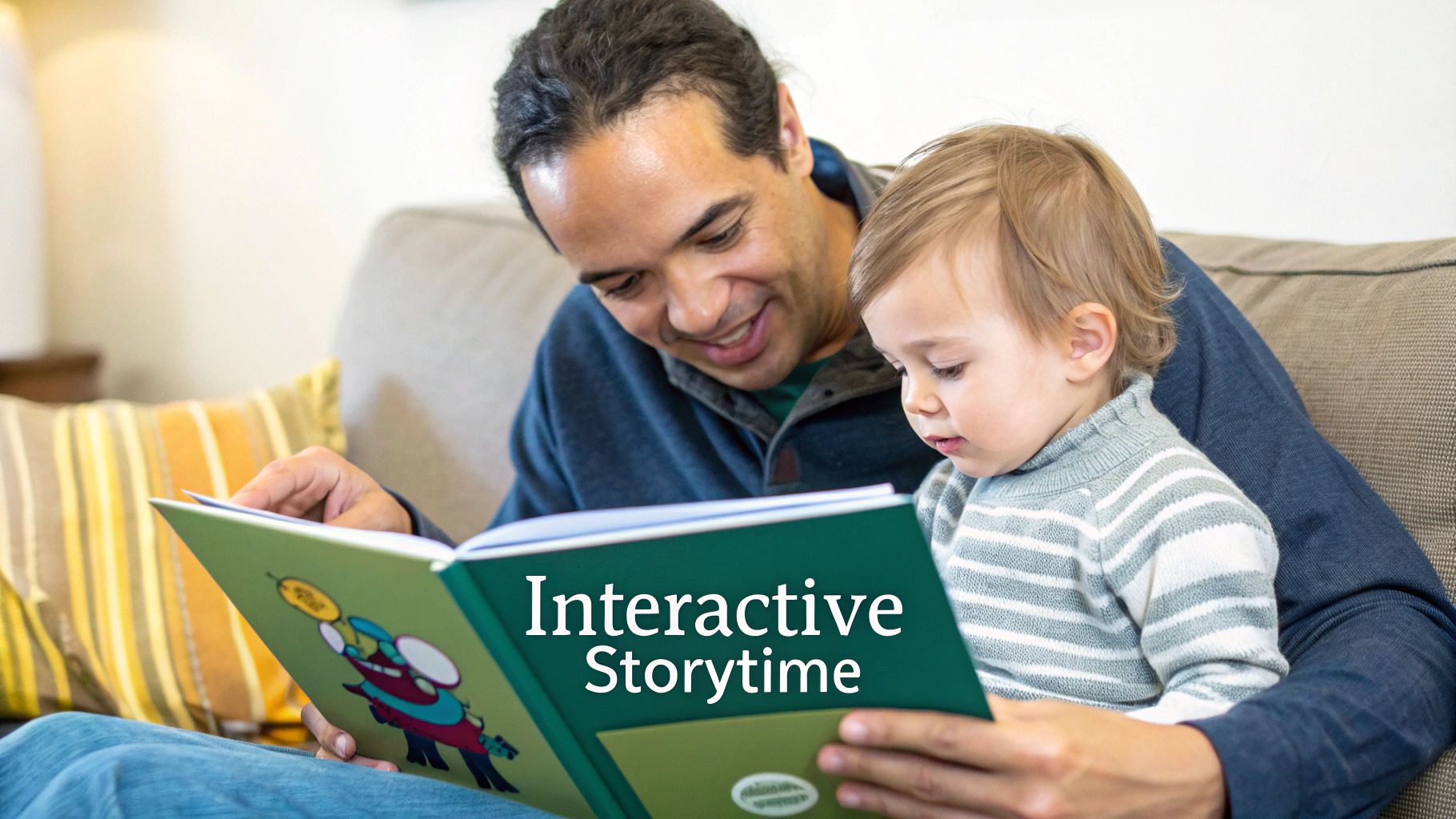
Snuggling up with a book is one of the best things you can do to support your toddler's language. It's a lovely, focused time to introduce them to new words, concepts, and the magic of stories. But what if you could make it even more powerful? The secret is to turn story time from a one-way performance into a lively, two-way chat.
The idea is to shift from passively reading to them, to actively reading with them. Experts often call this dialogic reading, and it’s all about making story time a real conversation. It lets your toddler become a co-storyteller, turning them from a quiet listener into an active participant.
Choosing the Right Books
For this to work well, the book itself really matters. Simple board books with big, clear pictures and just a few words per page are your best friends here. I've always found that stories about familiar things—like bedtime, getting dressed, or a trip to the park—really click with little ones. The same goes for books about their current obsession, whether that's dinosaurs, diggers, or dogs!
Books with different textures, sounds, or lift-the-flaps are brilliant because they give you an instant, natural reason to start talking. The colourful books in our Grow With Me kits are chosen with exactly this in mind; they're designed to grab a toddler's attention and make them curious. If you're looking for more inspiration, we've put together a guide to the best board books for babies and toddlers.
How to Start the Conversation
As you turn the pages, take your time. Point things out. Instead of just reading the words, "The cat sat on the mat," you could point and say, "Ooh, look! Who's this? It's a fluffy cat! What does a cat say?"
Use a fun, animated voice—it makes a huge difference in keeping them engaged. Don't worry about reading every single word perfectly. The book is just the starting point for your chat.
By asking simple questions, you're inviting your toddler to join in. Even if they just point or make a sound, you're building the back-and-forth rhythm of a real conversation and showing them their contributions are important.
As they grow, you can start to vary your questions. Here are a few ideas to try:
- "Wh" Questions: These are the classics. Point to something and ask, "What's that?" or "Who is hiding there?"
- Open-Ended Questions: To encourage a bit more thought, try something like, "What do you think will happen next?"
- Connecting to Their Life: This is my favourite. Help them see the link between the book and their own world. "Look, the rabbit is eating a carrot. Do you like carrots?"
This simple change turns every story into a shared adventure, building their brain and your bond, one page at a time.
Got Questions About Your Toddler's Language?
Watching your little one figure out how to communicate is one of the most amazing parts of being a parent. But let's be honest, it can also be a source of worry. It's completely normal to wonder if your child is on the right track, especially when every toddler seems to follow their own unique schedule.
This is your go-to guide for those "is this normal?" moments we all have.
What If My Toddler Isn’t Talking Yet?
First things first, take a deep breath. The 'normal' range for hitting language milestones is massive. Some toddlers are chattering away by 18 months, while others are more observant and have a sudden word explosion closer to two and a half.
Remember that language is so much more than just the words they can say (expressive language). It's also about what they can understand (receptive language). If your toddler can follow a simple direction like, "Can you pass me your cup?", points to things they want, and babbles back and forth with you, those are all brilliant signs. They show that the foundations for language are being built, even if the words aren't flowing just yet.
Is It Normal for My Toddler to Get Frustrated When Trying to Talk?
Oh, absolutely. Can you imagine knowing exactly what you want but not having the physical ability to say it? It would be infuriating! This is a classic, and very common, part of the language learning journey.
When this happens, try to stay calm and play detective. Get down on their level, acknowledge their feelings ("I can see you're feeling cross because you want the red car"), and then give them the words. This simple act shows them you understand, which can defuse the situation, and it also models the exact language they need for next time.
One of the kindest things we can do is give our toddlers the words for their big feelings. It helps them feel seen and understood, which reduces frustration and builds their emotional vocabulary right alongside their spoken one.
How Can I Tell if There Is a Real Problem?
While every child's timeline is different, there are a few things to keep an eye on. It's generally a good idea to have a chat with your health visitor or GP if you notice your toddler isn't using any single words by around 18 months, or if they aren't trying to string two words together by the time they are two.
Other signs that might warrant a conversation with a professional include:
- Not responding to their name or to simple sounds.
- Not pointing to objects to share their interest with you.
- A sudden loss of words they used to say.
Always trust your gut. You know your child better than anyone. Seeking a professional opinion is never a bad idea—it’s just a positive, proactive step you can take if you have any concerns.
At Grow With Me, we believe play is the most powerful tool for nurturing your child’s growth. Our stage-based play kits are thoughtfully designed to support your toddler's developing language skills with beautiful, engaging toys and books that naturally spark curiosity and conversation.