

10 Essential Gross Motor Activities for Kids (0–3 Years) for 2025
Welcome to your complete guide to nurturing your child's physical development from their very first wriggles to their first confident steps. Gross motor skills, the large movements made with arms, legs, feet, or the entire body, are the bedrock of a child's ability to explore and interact with their world. Mastering these abilities, from lifting their head to running across a park, builds physical strength, coordination, and spatial awareness.
This comprehensive guide provides a detailed look at 10 essential gross motor activities for kids aged 0 to 3 years. We will break down each activity by age, explain the crucial developmental benefits, and show you exactly how to set them up safely and effectively. You will find practical, step-by-step instructions designed for busy parents, ensuring you can create enriching play experiences with minimal fuss.
We will also highlight how items from developmental play kits, like those from Grow With Me, can be seamlessly integrated to enhance these experiences. As your child grows and their movements become more complex, introducing new challenges is key. To further encourage active play and the development of varied movements, exploring the best soccer training equipment for kids can provide structured and engaging options for toddlers ready for more advanced coordination.
This listicle is designed to be your go-to resource, filled with actionable ideas that support your child's physical journey. Let’s get moving and lay the groundwork for a lifetime of confident movement and discovery.
1. Tummy Time with Sensory Exploration
Tummy time is a foundational gross motor activity for infants, involving placing them on their stomach while awake and supervised. This simple position is a powerhouse for development, strengthening the neck, shoulder, back, and core muscles. These are the very muscles your baby will rely on for future milestones like rolling, sitting up, crawling, and eventually walking.
Adding sensory elements transforms this essential exercise into an engaging discovery session. By incorporating interesting textures, sounds, and visuals, you encourage your baby to lift their head, push up on their arms, and interact with their surroundings. This makes tummy time more enjoyable and extends its duration, maximising the developmental benefits. This is one of the most crucial early-stage gross motor activities for kids as it lays the groundwork for all subsequent movement.
How to Implement Sensory Tummy Time
Estimated Setup Time: 1-2 minutes
Materials Needed:
- A soft, firm surface like a play mat or carpet.
- Sensory toys or items.
- Grow With Me Kit Spotlight: The high-contrast flashcards and wooden sensory toys from the newborn kits are perfect for this.
Step-by-Step Guide:
- Choose a time when your baby is calm, alert, and not immediately after a feed.
- Lay a comfortable play mat on the floor.
- Gently place your baby on their tummy.
- Arrange sensory items at their eye level, just within reach. Place high-contrast cards in their line of sight or a gentle-sounding wooden rattle nearby to spark their curiosity.
- Get down on the floor with them, offering encouragement and making eye contact.
Developmental Benefits & Tips
This activity directly supports head control, strengthens the upper body, and helps prevent flat head syndrome (plagiocephaly).
- Start Small: Begin with sessions of just 2-3 minutes, a few times a day. Gradually increase the time as your baby gets stronger and more comfortable.
- Make it Engaging: Use a non-breakable mirror to capture their attention or lie down facing them to make it a social activity.
- Stay Consistent: Incorporate sensory tummy time into your daily routine to build strength consistently.
- Progression: As they get stronger, encourage reaching for toys, which helps develop coordination and prepares them for crawling.
For a more detailed guide on timing and techniques, you can learn more about when to start tummy time on growwithmesubscriptionbox.co.uk.
2. Crawling and Creeping Courses
Creating a crawling and creeping course involves setting up a safe, stimulating pathway with low obstacles that encourage your baby to move and explore. This activity is a fantastic way to support their journey towards independent mobility, building on the strength they developed during tummy time. It challenges them to navigate different surfaces and heights, which is crucial for developing coordination, balance, and spatial awareness.
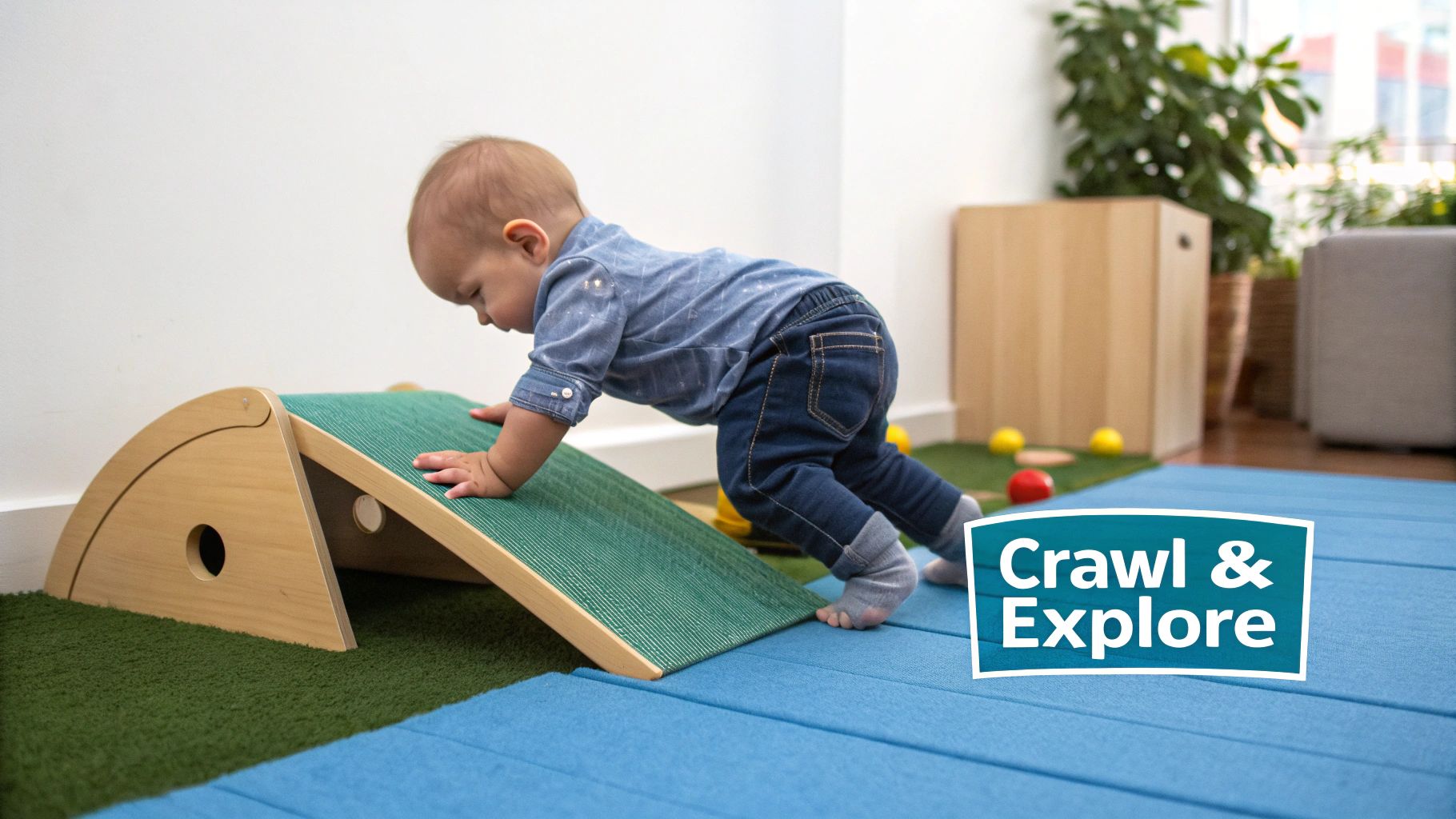
By arranging cushions, tunnels, and gentle inclines, you transform your living room into an adventure zone. This type of purposeful play strengthens the arm, leg, and core muscles needed for pulling up to stand and eventually walking. These homemade obstacle courses are excellent gross motor activities for kids because they promote problem-solving skills as your baby figures out how to get over, under, or around each new challenge.
How to Implement a Crawling Course
Estimated Setup Time: 2-5 minutes
Materials Needed:
- A clear, baby-proofed floor space.
- Soft obstacles like cushions, pillows, or rolled-up blankets.
- A play tunnel (optional).
- Grow With Me Kit Spotlight: The large wooden blocks and nesting bowls from the toddler kits can be used to create small, sturdy barriers to navigate around.
Step-by-Step Guide:
- Ensure the area is completely safe and free from hazards.
- Arrange your soft obstacles in a path across the floor. Create a simple course at first, perhaps with just a few cushions to crawl over.
- Place an enticing toy or one of the kit's colourful wooden objects at the end of the course to motivate them.
- Demonstrate how to move through the course, showing them it's a fun game.
- Encourage your baby as they explore, offering verbal praise and support.
Developmental Benefits & Tips
This activity builds full-body strength, enhances bilateral coordination (using both sides of the body together), and develops crucial problem-solving abilities.
- Safety First: Only use soft, stable items that won't topple over. Supervise your child at all times during this activity.
- Vary the Terrain: Use different textures like a fluffy blanket, a smooth mat, and a slightly rougher rug to provide sensory input.
- Keep it Fresh: Change the layout of the course regularly to keep your baby engaged and challenged as they grow more confident.
- Progression: As they become proficient crawlers, introduce a low, stable ramp or a play tunnel to make the course more complex and exciting.
For more information on your baby's crawling journey, you can learn more about the different crawling stages on growwithmesubscriptionbox.co.uk.
3. Water Play and Splashing Activities
Water play involves supervised interaction with water in various forms, such as splash pads, shallow tubs, or water tables. The natural resistance of water provides a unique environment for building strength and coordination. As children kick, splash, and move, they engage their leg, arm, and core muscles, enhancing their balance and physical confidence in a fun, sensory-rich setting.
This activity is exceptionally effective for developing proprioception, which is the body's ability to sense its own position in space. The gentle pressure and movement of the water offer constant feedback to your child's muscles and joints. Engaging in these types of gross motor activities for kids not only strengthens their lower body but also fosters a positive relationship with new sensory experiences, making it a fantastic and adaptable activity for various ages.
How to Implement Water Play
Estimated Setup Time: 2-5 minutes
Materials Needed:
- A shallow tub, baby splash pad, or water table.
- A non-slip mat.
- Towels.
- Water-safe toys.
- Grow With Me Kit Spotlight: The colourful wooden stacking rings or animal figures from various kits are perfect as floating or pouring toys.
Step-by-Step Guide:
- Choose a warm, safe area, either indoors on a waterproof mat or outdoors.
- Place a non-slip mat in the bottom of the tub or play area.
- Fill the container with a small amount of lukewarm water (around 30-32°C), ensuring it is shallow (ankle-deep for sitting babies, no higher than the knee for standing toddlers).
- Gently introduce your child to the water, allowing them to acclimate at their own pace.
- Add some engaging, water-safe toys to encourage splashing, reaching, and pouring.
Developmental Benefits & Tips
Water play directly supports lower body strength, balance, coordination, and sensory integration. Crucially, never leave a child unattended near water, not even for a second.
- Constant Supervision: Always maintain "touch supervision," meaning you are close enough to reach your child at all times.
- Start Shallow: Begin with just a few centimetres of water to build your child's comfort and confidence.
- Encourage Movement: Prompt them to kick their feet, splash with their hands, and reach for floating toys to maximise muscle engagement.
- Progression: As they grow more confident, introduce activities like pouring from one cup to another or using a toy watering can, which helps refine coordination and motor planning.
4. Climbing Structures and Low-Height Play Equipment
Climbing is an instinctive and powerful gross motor activity for toddlers, allowing them to develop strength, coordination, balance, and crucial problem-solving skills. Using child-safe structures like soft play climbers, low ramps, or wooden climbing frames encourages them to gauge heights, test their physical limits safely, and build immense confidence with each successful ascent.
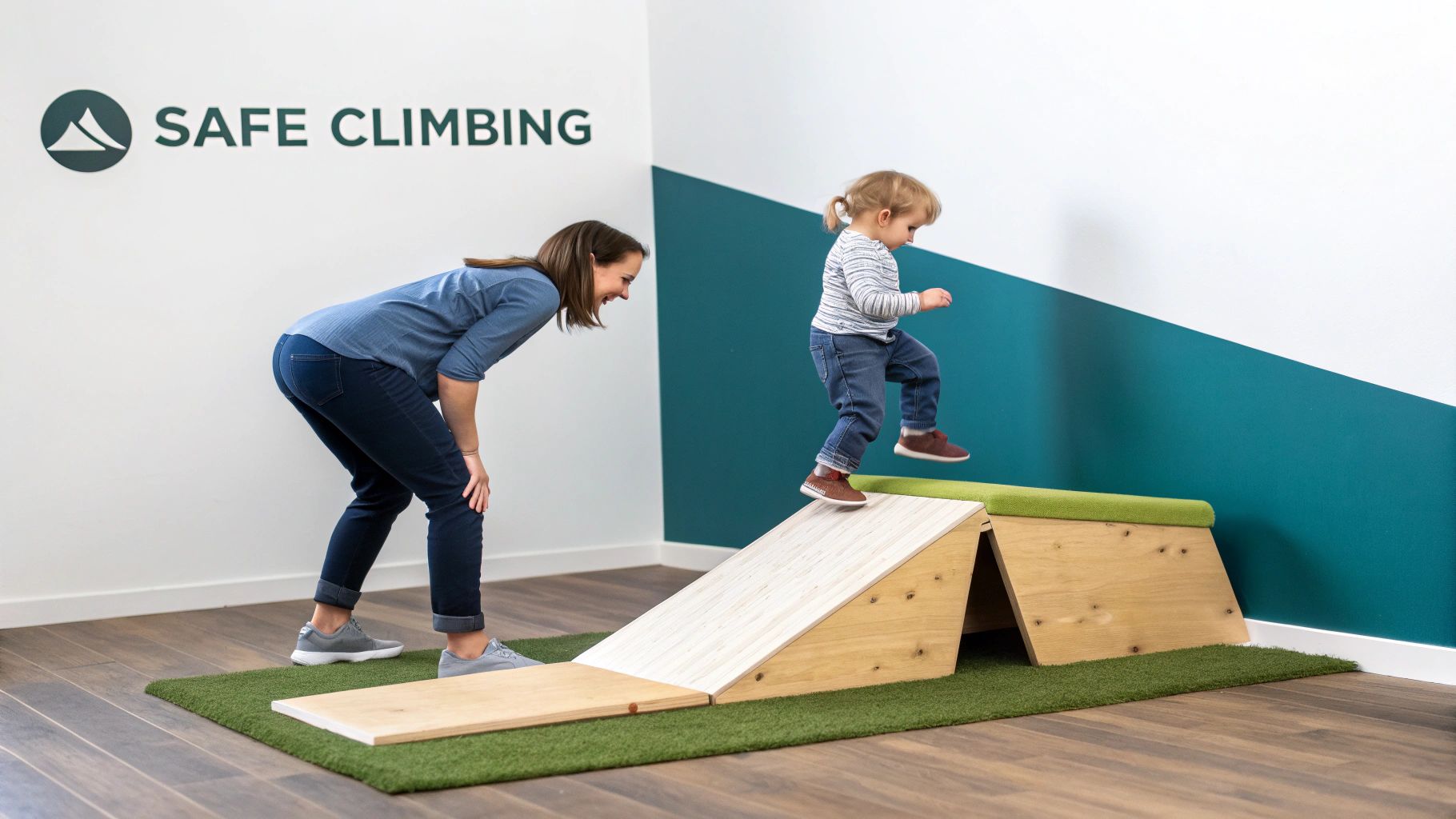
These activities challenge children to use their entire body in a coordinated effort, engaging muscles in their arms, legs, back, and core. As they navigate a Pikler triangle or a set of foam steps, they are also enhancing their spatial awareness and motor planning. This makes climbing one of the most comprehensive gross motor activities for kids in the toddler years, supporting both physical and cognitive development simultaneously.
How to Implement Safe Climbing
Estimated Setup Time: 2-5 minutes
Materials Needed:
- An age-appropriate climbing structure (e.g., wooden Pikler triangle, soft foam blocks, low slide).
- A soft landing surface like a padded play mat or thick rug.
- Grow With Me Kit Spotlight: Our toddler kits sometimes include items like wooden stepping blocks or low ramps that are perfect for creating an introductory climbing challenge.
Step-by-Step Guide:
- Choose a clear, open area away from hard furniture or sharp corners.
- Place a soft mat or rug underneath the climbing structure to cushion any potential tumbles.
- Ensure the climbing equipment is stable, securely assembled, and appropriate for your child's age and ability.
- Introduce the structure and allow your child to explore it at their own pace, offering verbal encouragement.
- Stay close by to supervise but avoid physically assisting unless necessary. Let them problem-solve their own movements.
Developmental Benefits & Tips
This activity excels at building full-body strength, improving balance, and fostering self-confidence and risk-assessment skills.
- Start Low: Begin with very low structures, like a few sturdy cushions or foam blocks, before moving on to taller frames.
- Supervise, Don't Interfere: Close supervision is essential for safety, but allowing your child to navigate challenges independently builds resilience and competence.
- Ensure Stability: Regularly check that all play equipment is stable and not at risk of tipping over during use.
- Progression: As your child becomes more confident, you can reconfigure modular climbers or introduce slightly more challenging structures to keep them engaged.
5. Ball Play and Kicking Activities
Ball play involves a wide range of activities like rolling, kicking, throwing, and catching using soft, age-appropriate balls. This seemingly simple fun is a dynamic way to develop crucial gross motor skills, including foot-eye coordination, balance, and leg strength. As children engage with a ball, they learn to control their bodies, judge distance, and understand basic concepts of force and trajectory.
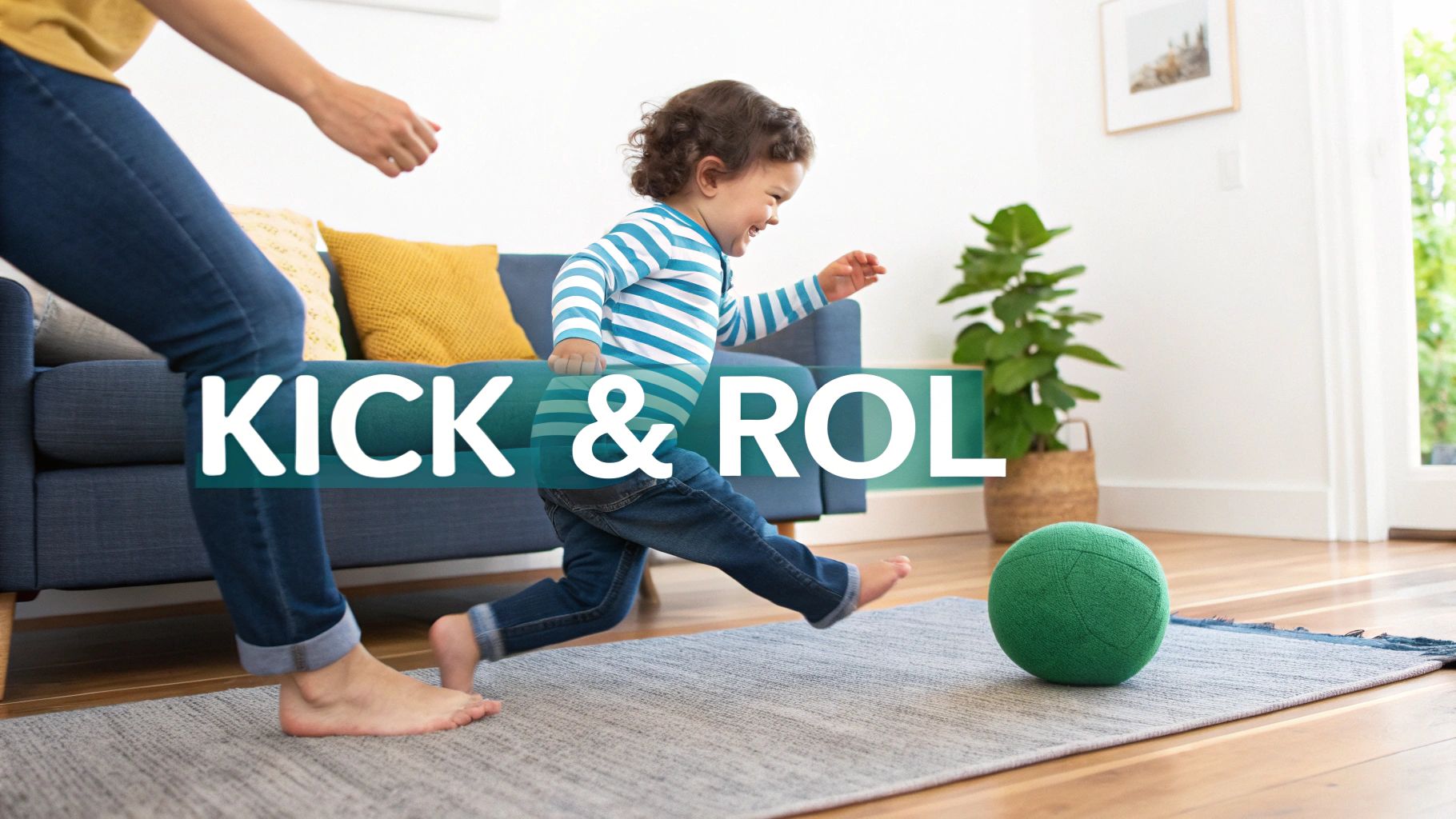
Starting with simple rolling games for infants and progressing to kicking with toddlers, ball play adapts to your child’s growing abilities. It provides immediate sensory feedback and encourages interaction, making it one of the most versatile gross motor activities for kids. Using balls made from different materials, like soft fabric or natural rubber, also adds a valuable sensory dimension to the play.
How to Implement Ball Play
Estimated Setup Time: Less than 1 minute
Materials Needed:
- A clear, safe space for play.
- An age-appropriate ball (soft fabric, textured, or lightweight rubber).
- Grow With Me Kit Spotlight: The natural rubber or soft fabric balls included in our toddler kits are perfectly sized for small hands and feet.
Step-by-Step Guide:
- Clear an area of any hard or sharp objects. Playing on a soft rug or grass is ideal.
- Sit on the floor with your child, legs apart, and gently roll the ball back and forth to them. This helps them practise tracking a moving object.
- For kicking, start by placing the ball in a stationary position in front of your toddler and encourage them to kick it.
- As they gain confidence, you can gently roll the ball towards them and ask them to kick it back.
- Always use positive encouragement and make it a fun, pressure-free game.
Developmental Benefits & Tips
This activity builds lower body strength, improves balance and coordination, and enhances spatial awareness.
- Choose the Right Ball: Use a ball that is lightweight and appropriately sized for your child, typically around 15-20cm in diameter for a toddler.
- Start Simple: Begin with stationary ball kicking before introducing a moving target. This builds foundational skills without overwhelming them.
- Vary the Surface: Playing on grass, carpet, and even a smooth floor offers different sensory feedback and challenges their balance in new ways.
- Progression: As they master kicking, you can introduce simple catching and throwing games. Set up a large box as a target to help them practise aiming and controlling their force.
6. Dancing and Movement to Music
Dancing and moving to music is a joyful and incredibly effective way to develop gross motor skills, balance, and body awareness. This activity taps into a child's natural love for rhythm, encouraging spontaneous movement, emotional expression, and bilateral coordination. It’s a wonderful way to get the whole body moving, from big stomps and jumps to delicate twirls and arm waves.
Music-based movement is particularly beneficial because it naturally motivates sustained activity and can be adapted to any mood or energy level. By exploring different genres, tempos, and cultural styles, you expose your child to new sounds while they build physical confidence. This makes dancing one of the most versatile and engaging gross motor activities for kids, seamlessly blending physical development with creative expression.
How to Implement Dancing and Movement
Estimated Setup Time: Less than 1 minute
Materials Needed:
- A music source (phone, speaker, radio).
- An open, safe space.
- Optional props like colourful scarves or ribbons.
- Grow With Me Kit Spotlight: The colourful sensory scarves from the 3-month-old kit are perfect for adding a visual and tactile element to your dance sessions.
Step-by-Step Guide:
- Clear a safe space in a room, ensuring there are no sharp corners or tripping hazards.
- Choose some music. Start with familiar action songs or something with a strong, clear beat.
- Play the music and begin moving yourself. Your enthusiasm is contagious!
- Invite your child to join in, but don’t force them. Model simple actions like clapping, swaying, or stomping your feet.
- Introduce props like scarves to wave in the air, which encourages reaching and large arm movements.
Developmental Benefits & Tips
This activity enhances coordination, balance, spatial awareness, and rhythm. It also provides a fantastic outlet for self-expression and emotional release.
- Action Songs: Start with songs that have built-in actions, such as “Heads, Shoulders, Knees, and Toes” or “The Hokey Cokey.”
- Variety is Key: Create playlists with different tempos. Use slow music for graceful swaying and fast music for energetic jumping to challenge different muscle groups.
- Encourage, Don't Correct: Celebrate all movement attempts. The goal is free expression, not perfect choreography.
- Progression: As your child grows, you can introduce more complex movements like hopping on one foot, spinning, or trying to copy a short sequence of dance moves.
7. Stair Climbing and Step Navigation
Stair climbing is a significant milestone activity that builds tremendous leg strength, balance, coordination, and spatial awareness. For a toddler, a set of stairs represents a natural, built-in climbing frame that challenges their developing muscles and problem-solving skills. The process of navigating steps teaches them about cause-and-effect (lifting a leg leads to upward movement) and helps them begin to assess risk under careful supervision.
This everyday feature of a home or playground provides a perfect, graduated challenge for developing crucial movement patterns. From crawling up backwards to eventually walking up and down independently, mastering stairs is a powerful confidence booster. As one of the more advanced gross motor activities for kids in their early years, it integrates strength, coordination, and cognitive planning, preparing them for more complex physical challenges.
How to Implement Safe Stair Practice
Estimated Setup Time: 1 minute (for safety checks)
Materials Needed:
- A set of stairs (indoor or outdoor).
- Properly installed safety gates for top and bottom.
- Non-slip socks or bare feet for better grip.
Step-by-Step Guide:
- Ensure the area is safe. Install sturdy safety gates at both the top and bottom of any household staircase to prevent unsupervised access.
- Start on the floor at the bottom of the stairs when your child is mobile and showing interest.
- Supervise closely, staying within arm's reach at all times. Allow them to explore, which often begins with crawling up forwards or backwards.
- Gently guide their hands and feet, showing them how to place them securely on each step.
- Teach them how to come down safely, which is usually backwards on their tummy, feet first. This is a critical skill to master before they attempt walking down.
Developmental Benefits & Tips
This activity strengthens the entire lower body, core, and arms, while also enhancing bilateral coordination (using both sides of the body together) and depth perception.
- Patience is Key: Every child progresses at their own pace. Never rush or pressure them; let their confidence guide the learning process.
- Constant Supervision: Never leave a child unattended near stairs, even if they seem proficient. Accidents can happen in a split second.
- Vary the Environment: Practice on different types of steps, like those at a park or a low kerb. This helps them adapt to different heights and textures. For those with outdoor space, creating a small, safe stepped area can be a fantastic project. You can find a helpful DIY guide on creating outdoor steps to get started.
- Progression: As they become confident crawlers, they may start to pull up and "cruise" up the stairs holding the bannister. Later, you can hold their hand as they practise walking up one step at a time.
8. Pushing and Pulling Toys on Wheels
Pushing and pulling toys on wheels are classic companions for toddlers mastering the art of walking. These toys offer crucial support as a child transitions from cruising along furniture to taking independent steps. They provide a stable, mobile base that boosts confidence, helping to develop balance, coordination, and leg strength.
This activity is more than just a walking aid; it’s an interactive lesson in cause and effect and spatial awareness. As a toddler pushes a toy, they learn to navigate around obstacles, judge distances, and understand directional movement. This makes it one of the most effective gross motor activities for kids in the early walking stage, turning mobility practice into purposeful play.
How to Implement Pushing and Pulling Play
Estimated Setup Time: Less than 1 minute
Materials Needed:
- A sturdy push or pull toy with wheels.
- An open, safe space for movement.
- Grow With Me Kit Spotlight: The natural material wheeled toys included in our toddler kits are designed for stability and smooth movement, perfect for little hands.
Step-by-Step Guide:
- Choose a clear, flat area in your home, free from clutter, rugs with raised edges, or other tripping hazards. Ensure the space is away from stairs.
- Present the push toy to your toddler, placing it in front of them. You can demonstrate how to hold the handle and move it forward.
- For pull toys, show them how to hold the string and walk, encouraging them to look where they are going.
- Allow your child to explore at their own pace, moving the toy around the room.
- Incorporate a goal, like pushing the toy to a specific person or pulling it to collect other small toys in a wagon.
Developmental Benefits & Tips
This activity builds lower body strength, enhances balance and coordination, and develops spatial reasoning.
- Choose Wisely: Select a toy with appropriate weight and resistance. It should be sturdy enough to support your child but not so heavy that it’s difficult to move. The wheels should turn smoothly but not so fast that the toy runs away from them.
- Safety First: Always supervise this activity. Check that the toy is in good condition, with no loose parts or sharp edges.
- Encourage Purposeful Play: Turn the activity into a game. Suggest they are "mowing the lawn" or "taking their pet for a walk" to keep them engaged.
- Progression: As their walking becomes more stable, introduce pull toys that require more coordination. Challenge them to navigate simple obstacle courses made of cushions.
9. Running, Jumping, and Hopping Games
Running, jumping, and hopping are exhilarating milestones that showcase a toddler's growing strength, coordination, and confidence. These dynamic movements are more than just play; they are complex gross motor activities for kids that build powerful leg muscles, improve balance, and enhance cardiovascular fitness. As children master walking, they naturally progress to these more advanced skills, turning simple movements into imaginative games.
Engaging in activities like chase, obstacle jumping, or hopscotch channels a child's boundless energy into purposeful practice. These games not only refine physical abilities but also teach spatial awareness, rhythm, and social skills like turn-taking and following rules. They represent a significant leap in a child's physical development, laying the groundwork for future athletic pursuits and a lifelong love of movement.
How to Implement Running, Jumping, and Hopping Games
Estimated Setup Time: 1-2 minutes
Materials Needed:
- A safe, open space (a garden, park, or clear indoor area).
- Soft obstacles like cushions or pillows.
- Chalk for outdoor games like hopscotch.
- Grow With Me Kit Spotlight: While our kits focus on foundational skills, the confidence and coordination built prepare children for these advanced activities.
Step-by-Step Guide:
- Ensure the play area is flat, open, and free from hazards like sharp corners or clutter.
- Start with simple chase games where you are "it," encouraging your child to run away from you playfully.
- Set up a small "obstacle course" with cushions or rolled-up blankets for them to practice jumping over.
- For hopping, demonstrate how to hop on one foot and then encourage them to try. Use chalk to draw a simple hopscotch grid outside.
- Always participate enthusiastically to model the movements and make the games more fun.
Developmental Benefits & Tips
These activities are fantastic for building lower body strength, improving dynamic balance, and developing coordination. They also provide excellent cardiovascular exercise.
- Safety First: Always supervise and ensure the play surface is safe. Grass or rubber matting is ideal for reducing the impact of falls.
- Start Simple: Begin with walking or marching games before progressing to running. Practice jumping on the spot before attempting to jump over objects.
- Keep it Fun: Focus on participation and effort rather than perfect execution. Celebrate every attempt to build their confidence.
- Incorporate Variety: Mix up the games to keep them engaging. Try animal walks (like frog jumps or bunny hops) to work different muscle groups.
To support the underlying coordination needed for these actions, you can discover more about developmental toys for toddlers on growwithmesubscriptionbox.co.uk.
10. Sandbox and Loose Parts Play
Sandbox play is a classic childhood activity that provides rich opportunities for gross motor development. It involves unstructured play with natural materials like sand, allowing children to dig, scoop, lift, carry, and pour. This type of play naturally strengthens the muscles in their arms, shoulders, back, and legs as they manipulate heavy sand and move their bodies around the play area.
Engaging with loose parts such as sticks, stones, and shells alongside the sand enhances the experience. Children build, create, and problem-solve, developing coordination and spatial awareness. This child-led, open-ended exploration is fundamental to forest school principles and offers a powerful way to practise a wide range of movements, making it one of the most versatile gross motor activities for kids.
How to Implement Sandbox and Loose Parts Play
Estimated Setup Time: 5-10 minutes
Materials Needed:
- A sandbox or a designated outdoor play area.
- Child-safe sand.
- A variety of tools like shovels, buckets, spoons, and cups.
- Natural loose parts (e.g., smooth stones, sticks, leaves, shells).
- Grow With Me Kit Spotlight: The durable wooden scoop and stacking cups from the toddler kits are perfect for digging and pouring in the sand.
Step-by-Step Guide:
- Ensure the sandbox is clean, free from hazards, and filled with clean, child-safe sand.
- Place a collection of digging tools and containers inside or near the sandbox.
- Introduce a small collection of natural loose parts for creative exploration.
- Allow your child to explore freely, giving them space to lead their own play.
- Supervise from a close distance to ensure safety, especially with younger toddlers who may put items in their mouths.
Developmental Benefits & Tips
This activity strengthens the entire body, improves hand-eye coordination, and enhances sensory processing skills.
- Follow Their Lead: Resist the urge to direct the play. Let your child's curiosity guide their actions, whether it's filling a bucket or simply running their hands through the sand.
- Introduce Water: Adding a small amount of water changes the texture of the sand and introduces new challenges, encouraging different types of movements like mixing and moulding.
- Vary the Tools: Regularly rotate the tools and containers available to keep the play engaging and challenge different muscle groups. Spoons require finer motor control, while large shovels build greater arm strength.
- Safety First: Always check the sand for foreign objects before play and ensure the area is secure. Cover the sandbox when not in use to keep it clean.
Gross Motor Activities: 10-Item Comparison
| Activity | Implementation (🔄) | Resources & Supervision (⚡) | Expected outcomes (📊⭐) | Ideal use cases (💡) | Key advantages (⭐) |
|---|---|---|---|---|---|
| Tummy Time with Sensory Exploration | Low — simple positioning and props | Minimal equipment (mat, toys); constant short-session supervision | Head control, upper-body/core strength, motor milestones; ⭐⭐⭐⭐ | 6 weeks–12 months, daily home routine, short frequent sessions | Fundamental motor foundation; prevents positional flat head |
| Crawling and Creeping Courses | Medium — design progressive obstacle paths | Low-cost materials but needs clear space and careful setup/supervision | Crawling mechanics, coordination, spatial awareness; ⭐⭐⭐⭐ | 6–18 months, indoor/outdoor exploratory play and guided practice | Engaging, builds independence and problem-solving |
| Water Play and Splashing Activities | Medium — water set-up and safety planning | Requires water space, non-slip surfaces, constant supervision, temp control | Balance, leg strength, sensory processing, water confidence; ⭐⭐⭐⭐ | 6 months–3 years, seasonal outdoor or supervised indoor play | Low-impact resistance training; highly engaging sensory play |
| Climbing Structures & Low-Height Equipment | High — purchase/assembly and safety checks | Significant space, durable materials, ongoing inspection and supervision | Upper & lower body strength, balance, risk assessment; ⭐⭐⭐⭐ | 9 months–4 years, preschools, indoor playrooms, dedicated areas | Progressive challenge, builds confidence, durable (wood options) |
| Ball Play and Kicking Activities | Low — simple rules and progression | Minimal equipment (soft balls); needs open space and supervision | Foot/hand-eye coordination, leg strength, trajectory understanding; ⭐⭐⭐ | 6 months–3+ years, indoor/outdoor play, caregiver interaction | Scalable skills, low cost, encourages social play |
| Dancing & Movement to Music | Low — no special setup required | Needs open space; minimal supervision; adaptable playlists | Coordination, rhythm, body awareness, cardio fitness; ⭐⭐⭐⭐ | Birth–4+ years, group classes, home movement sessions | High engagement, emotional expression, no equipment needed |
| Stair Climbing & Step Navigation | Medium — gradual practice and safety measures | Requires stairs, safety gates, constant close supervision | Leg strength, balance, spatial planning, independence; ⭐⭐⭐⭐ | 6 months–3 years learning phase, home and playground steps | Everyday functional skill, naturally progressive, available at home |
| Pushing & Pulling Toys on Wheels | Low — choose appropriate toy weight/wheels | Flat, obstacle-free surfaces; supervise near hazards (stairs) | Balance, walking coordination, leg strength; ⭐⭐⭐ | 9–18 months, walking practice indoors/outdoors | Supports independent walking, confidence-building aid |
| Running, Jumping & Hopping Games | Medium — prepare safe open area and rules | Open soft surfaces, vigilant supervision, weather dependent | Explosive leg power, cardiovascular fitness, balance; ⭐⭐⭐⭐ | 18 months–4+ years, playgrounds, active outdoor play | High-energy, foundation for sports, promotes social play |
| Sandbox & Loose Parts Play | Low–Medium — create and maintain play area | Outdoor space or sandbox, material rotation, close supervision | Arm/leg strength, core stability, coordination, creativity; ⭐⭐⭐⭐ | 12 months–4+ years, outdoor/forest-school settings, free play | Low-cost natural materials, sensory-rich, fosters problem-solving |
Your Next Steps in Playful Development
We have journeyed through a comprehensive collection of gross motor activities for kids, from the foundational strength-building of tummy time for infants to the dynamic energy of running and jumping games for toddlers. Each activity, whether it's navigating a crawling course or simply dancing to a favourite song, serves as a crucial building block in your child’s physical development. The underlying message is clear: fostering these skills isn't about rigid training or expensive equipment; it's about weaving purposeful, playful movement into the fabric of your daily life.
By embracing these ideas, you are doing more than just helping your child learn to walk, run, and climb. You are laying the groundwork for a lifetime of physical confidence, body awareness, and a love for being active. Remember, the goal is not perfection or hitting milestones ahead of schedule. The true value lies in the process, the exploration, and the joy shared between you and your little one.
Key Insights to Carry Forward
As you move forward, keep these core principles at the forefront of your playtime planning. They are the essential threads that connect all the successful gross motor activities for kids we've discussed.
- Follow Your Child's Lead: The most effective activities are those that capture your child’s interest. Observe what they are naturally drawn to, whether it's climbing, throwing, or splashing, and build upon that innate curiosity. A child-led approach ensures engagement and makes learning feel like pure fun.
- Safety is the Foundation: A secure environment is a prerequisite for confident exploration. Simple measures, like clearing a space of hazards, using non-slip mats, and providing close supervision, empower your child to test their limits safely. This sense of security is what allows them to take those brave first steps, or first climbs.
- Consistency Over Intensity: Small, regular doses of active play are far more beneficial than infrequent, lengthy sessions. Just ten to fifteen minutes of focused activity, like rolling a ball back and forth or building a simple cushion obstacle course, can have a significant impact when done consistently. It’s about creating a daily habit of movement.
Making It Your Own: Actionable Next Steps
Feeling inspired but not sure where to start? Here is a simple, actionable plan to integrate these activities into your routine starting today.
- Choose One Activity to Try This Week: Don’t feel pressured to do everything at once. Look through the list and pick one activity that seems most suitable for your child's current stage and your home environment. Perhaps it's setting up a sensory tummy time station or introducing a soft ball for kicking.
- Assess Your Play Space: Take a five-minute walk around your primary play area. Can you create a small, open space for movement? Are there low, stable pieces of furniture your child could safely pull up on? Making minor adjustments can open up a world of developmental opportunities.
- Incorporate Movement into Routines: Think about your existing daily schedule. Can you add a short dance session after nappy changes? Can you encourage crawling to the high chair for mealtime? Integrating these actions into what you already do is the easiest way to ensure they happen regularly.
Ultimately, nurturing your child’s gross motor skills is one of the most rewarding aspects of early parenting. It is a tangible, visible journey of growth where you can witness your baby’s first roll transform into a toddler's confident leap. By providing varied opportunities, celebrating every small effort, and focusing on the fun, you are giving your child an incredible gift. You are equipping them with the strength, coordination, and self-belief to navigate their world with capability and joy. Keep exploring, keep moving, and treasure these moments of playful discovery.
Ready to enhance your playtime with thoughtfully curated, age-appropriate toys that support every developmental stage? The Grow With Me play kits are designed to complement these gross motor activities for kids, providing the perfect tools to inspire movement and learning. Discover how our kits can grow with your child by visiting our website. Grow With Me