
A Parent's Guide to 16 Months Developmental Milestones
Sixteen months old. It's an age that feels like a beautiful whirlwind, a real turning point where the wobbly first steps of babyhood start to give way to the determined stride of a toddler. The 16-month developmental milestones are less a checklist and more a celebration of your little one’s growing independence, from their physical coordination and first attempts at problem-solving to how they understand language and connect with you.
Your 16-Month-Old's World of Discovery
Welcome to the wonderfully chaotic world of a 16-month-old. This phase is absolutely buzzing with new skills, a blossoming personality, and an almost unbelievable amount of energy. Things change so quickly at this age, and it’s completely normal to feel like you're meeting a slightly new version of your child each week. While every toddler follows their own unique timeline, you’ll start to see common threads of development that tie this exciting age together.
Think of your toddler as a tiny scientist, constantly running experiments to figure out how everything works. Their brain is a hive of activity, forging new connections that fuel their curiosity about the world. This is why purposeful play is so crucial right now. It's not just about keeping them busy; it’s the main way they learn, grow, and build the foundations for everything that comes next.
Key Areas of Growth
A toddler’s development isn’t a series of separate events but a rich tapestry where everything is interconnected. A leap in physical confidence might encourage them to be more social, just as growing cognitive skills support their budding language.
- Cognitive Leaps: You'll see more sophisticated thinking in action. They might try turning a puzzle piece different ways to make it fit or realise that flipping a switch makes the light turn on. This is cause and effect in its earliest form.
- Physical Feats: Many toddlers are now walking with more confidence, able to squat down to pick up a toy without toppling over. You might even see the first wobbly attempts at running or climbing. Their hand-eye coordination is also getting much better, making them more skilled at stacking blocks or using a spoon.
- Language Explosion: Don't be fooled if their spoken vocabulary is still small. Their understanding of words is growing by the day. They'll use a clever mix of single words, gestures, and sounds to get their point across loud and clear.
- Emotional Waves: This age is full of big, complex feelings. Your toddler will fiercely demand independence one minute and cling to you with separation anxiety the next. You'll also see the first glimmers of empathy, even if tantrums are still a go-to method for expressing frustration.
To help you visualise what's happening, here's a quick overview of what you can typically expect around this age.
A Snapshot of 16-Month Milestones
This table offers a high-level summary of the typical skills emerging across the main developmental domains for a 16-month-old.
| Developmental Area | What You Might Observe |
|---|---|
| Cognitive | Imitating your chores, like wiping a surface or trying to sweep. |
| Physical | Walking independently and beginning to walk up stairs with help. |
| Language | Pointing to objects when you name them and using at least 3-5 words. |
| Social-Emotional | Showing affection with hugs and kisses and having temper tantrums. |
Remember, this is just a general guide. Development is a journey, not a race, and every child will get there in their own time.
This visual summary breaks down some of the key milestones in more detail.
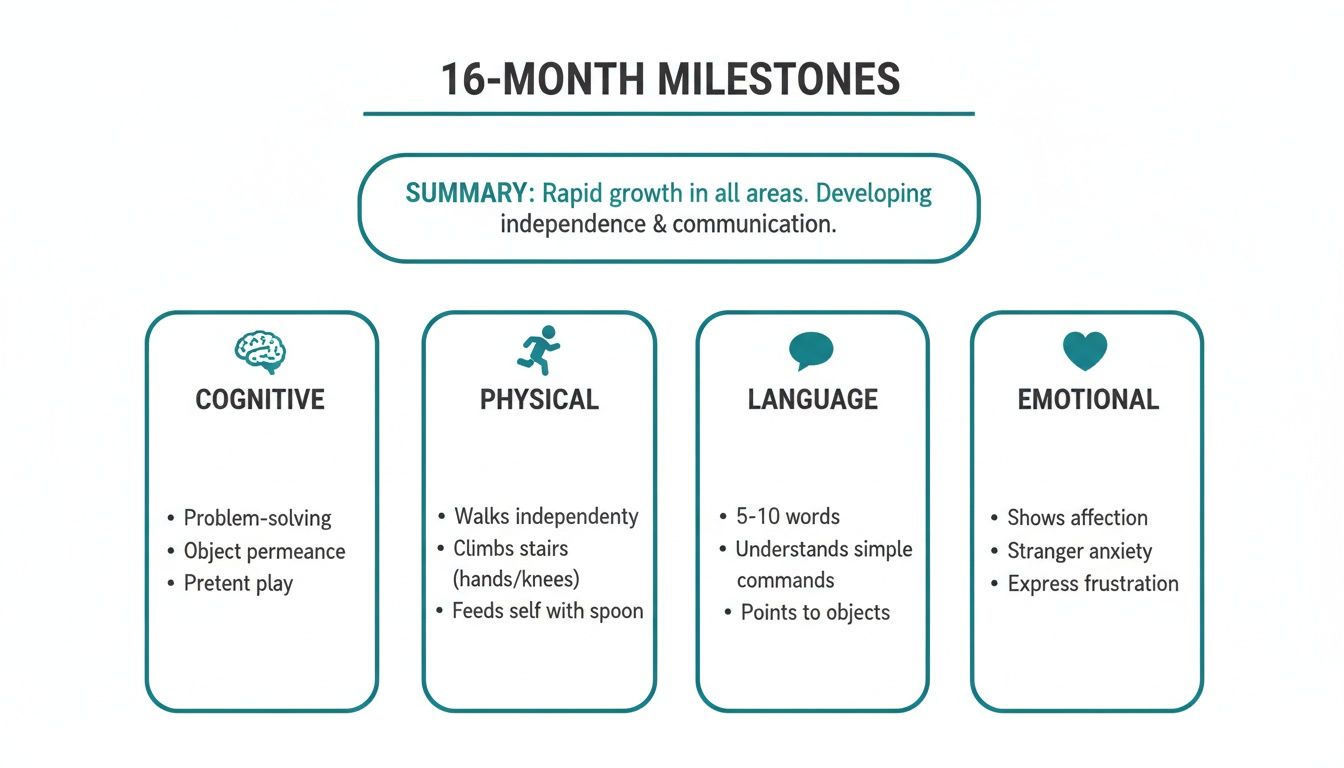
The infographic really shows how thinking, moving, talking, and feeling are all happening at once. As your 16-month-old discovers their world, many parents find a lot of joy in capturing these fleeting moments. This is a perfect time to create a first year of baby book to hold onto these precious memories.
The Hidden Workings of a Toddler's Brain
While you’re marvelling at your toddler’s new physical skills—the walking, the climbing, the impressive speed they can cross a room—their brain is going through its own incredible, unseen transformation. It’s like a major software update running in the background. This update is rewiring their mind, paving the way for more complex thoughts and a much deeper understanding of the world. This cognitive leap is the very foundation of all their future learning.
This period is marked by an explosion of curiosity. Your toddler isn't just a passive observer anymore; they're an active scientist testing theories. This explains why they might relentlessly drop a spoon from their highchair or spend ages opening and closing a cupboard door. They're gathering data, figuring out cause and effect, and learning how their actions change the environment around them.
What’s fascinating is that while their performance on a task might look similar to a few months ago, their brain is working much harder and using more regions to get the job done. Recent research shows that at 16 months, toddlers activate key brain areas like the prefrontal cortex far more than they did at 10 months, even when their outward actions seem the same. It’s a powerful reminder of the immense internal progress your child is making. You can read the full research about these neurological changes.
From Simple Actions to Complex Thoughts
The real magic of cognitive growth at 16 months is how your toddler starts connecting ideas. They're moving beyond simple, single-step thinking and are beginning to grasp sequences. This blossoming ability is what allows them to follow simple, two-step instructions and start solving basic problems all on their own.
Here’s how you might see this playing out in your everyday life:
- Following Commands: You could say, "Please get your teddy and put it in the basket." A few months ago, they might have just stared at the teddy. Now, their brain can process both parts of the command and act on it.
- Early Problem-Solving: If a favourite toy rolls under the sofa, they won’t just give up. You’ll likely see them get down on the floor, peer underneath, and try to reach for it. This shows they understand object permanence—that crucial concept of knowing something exists even when they can’t see it.
- Imitation and Pretend Play: You'll spot them mimicking your daily routines with amazing accuracy. They might pick up a block and hold it to their ear like a phone, or try to "feed" their favourite stuffed animal. This isn't just adorable; it's a huge sign of advanced abstract thinking.
This newfound ability to pretend is a massive cognitive milestone. It shows your toddler can hold an idea in their mind and act it out, which is a foundational skill for creativity, social skills, and language development down the road.
Fuelling Brain Development Through Play
This "software update" in your toddler's brain isn't a passive process—it's actively fuelled by their experiences, especially through play. The right kind of play strengthens their neural pathways, much like exercising a muscle. It provides the perfect, low-stakes environment for them to test out their new thinking skills.
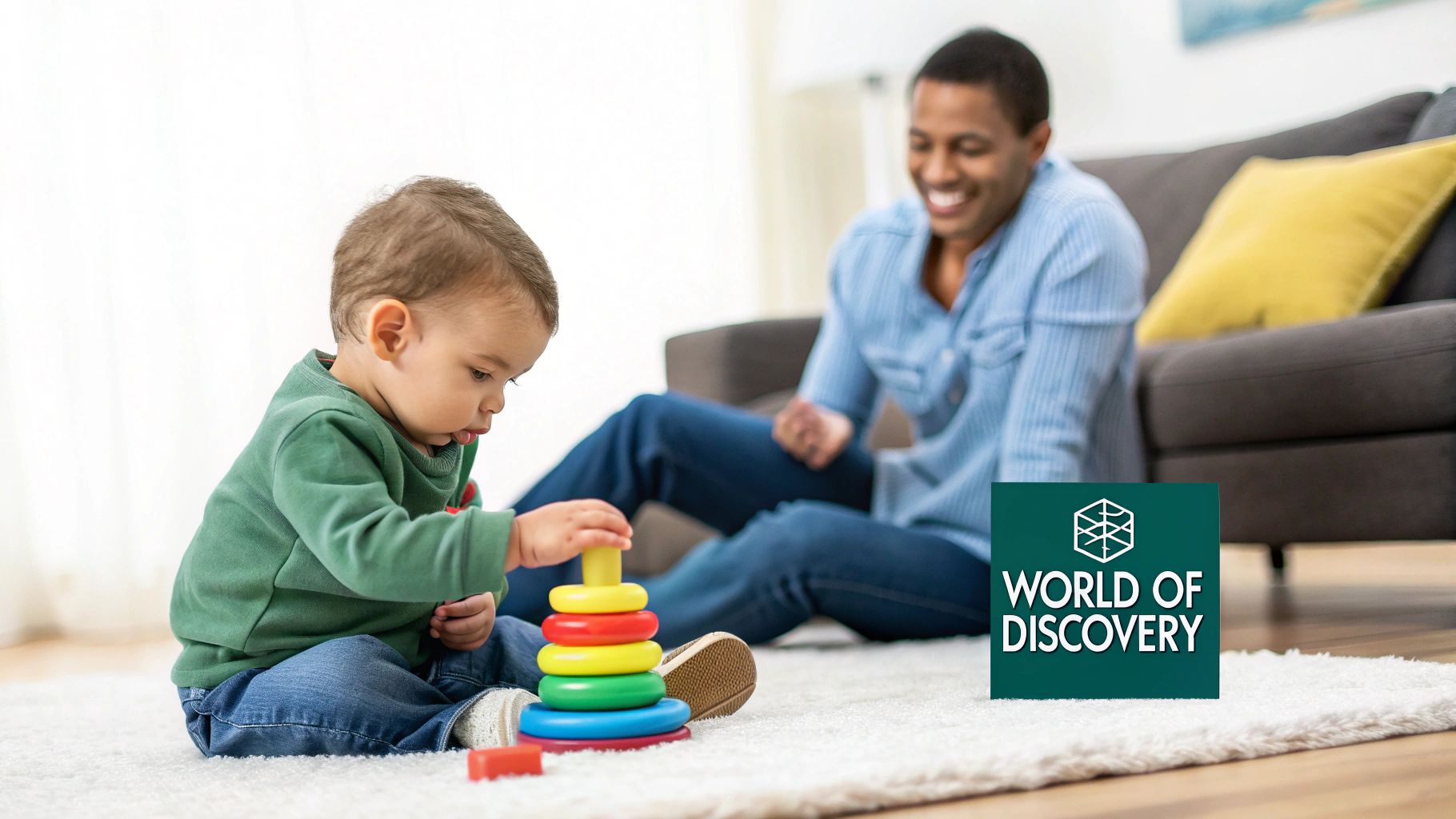
Purposeful, stage-based toys are incredibly effective tools during this period. A simple shape-sorter, for example, isn't just a toy; it's a hands-on lesson in logic, spatial awareness, and problem-solving. Each time they try to fit a square peg into a round hole and fail, they’re learning and adapting their strategy. To better understand how these skills build on each other, you might find our guide on cognitive development in early childhood helpful.
Curated play kits, like those from Grow With Me, are specifically designed to meet these 16 months developmental milestones. They provide just the right level of challenge to keep your toddler engaged without them getting frustrated. Stacking rings, simple puzzles, and nesting cups are perfect for exploring concepts like size, order, and how things fit together. These toys turn playtime into a powerful brain-building exercise, creating a strong architecture for all the learning yet to come. Every interaction and every game is an investment in their cognitive future.
Exploring Their New Physical Powers
At sixteen months old, your toddler’s world is literally opening up before their eyes, and it’s all down to their incredible new physical skills. This stage is a blur of constant motion. They’re leaving those wobbly first steps behind and starting to move with more confidence and purpose.
It’s a journey full of tumbles, bumps, and triumphant little victories. Remember, every child follows their own unique timeline. Whether your little one is still cautiously cruising around the furniture or has already started a wobbly dash across the living room, they are building vital strength and self-belief. This isn't just about getting from A to B; it's about exploring their world, interacting with it in new ways, and discovering just what their amazing body can do.
The Big Picture: Gross Motor Skills
Gross motor skills are the big ones. They use the large muscle groups in the arms, legs, and torso to power movements like walking, climbing, and squatting. Think of these as the building blocks for your toddler’s physical independence. You’ll probably notice they practise these skills with a fierce, almost relentless, determination.
You might see your 16-month-old:
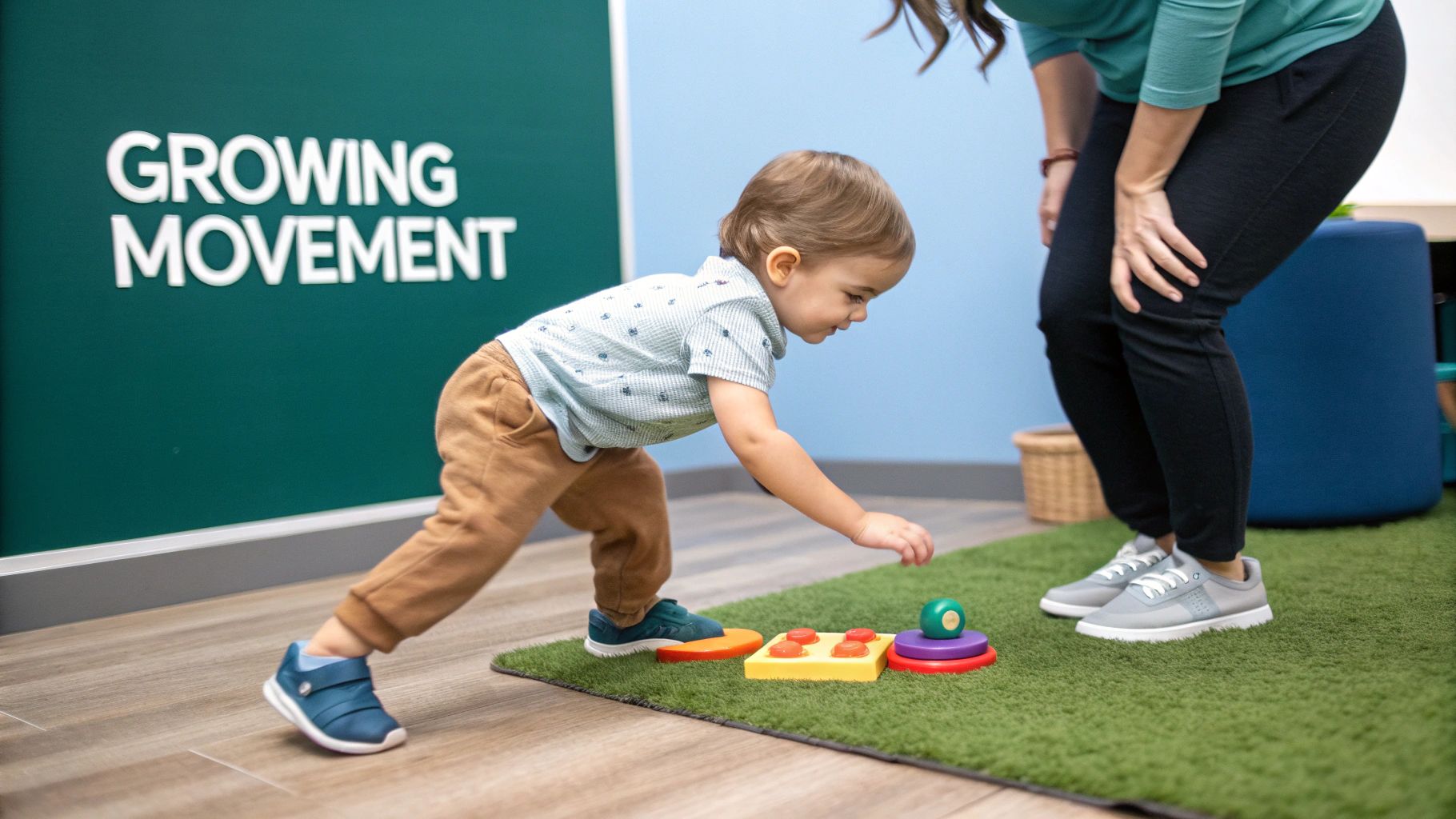
- Squatting to pick things up: Instead of that stiff-legged bend at the waist, they can now squat down to grab a toy and pop back up again without toppling over. It’s a huge sign of improving leg strength and balance.
- Attempting to climb everything: Suddenly, the sofa, the stairs, and even small chairs look like mountains just waiting to be conquered. This is their natural curiosity and physical drive working in perfect harmony.
- Walking backwards: It might look like a funny party trick, but walking backwards actually takes a surprising amount of balance and body awareness.
- Trying to kick a ball: Their first few attempts might be more of a clumsy shuffle than a proper kick, but it’s a brilliant early sign of developing leg-eye coordination.
The timeline for these skills can vary massively from one child to another. While many toddlers are walking well by now, it’s completely normal for others to still be getting the hang of it. Across the UK, development data shows that while most 16-month-olds are confident walkers, the range for hitting this milestone is broad, stretching anywhere from 10 months to well beyond 16 months. You can read more insights on toddler development at Huckleberrycare.com.
Mastering Fine Motor Precision
While the big movements tend to get all the attention, equally amazing things are happening on a much smaller scale. Fine motor skills, which involve the small, precise muscles in the hands and fingers, are becoming much more refined. It’s like they’re trading in a clumsy shovel for a delicate pair of tweezers.
This new dexterity is what allows your toddler to engage with their surroundings in more detailed and complex ways. Their pincer grasp—that ability to pick up small objects between their thumb and forefinger—is becoming much more accurate. This skill alone opens up a whole new world of play and learning.
The improvement in fine motor skills is a real game-changer for play. It transforms your toddler from a simple observer into an active participant who can build, manipulate, and create.
You’ll see this newfound precision when they are:
- Stacking blocks: They might manage a tower of two or three blocks before it all comes crashing down. That simple act requires immense concentration and a surprisingly steady hand.
- Turning pages: When you read together, they can now turn the thick pages of a board book themselves, showing so much more control than they had just a few months ago.
- Using a spoon: Mealtimes are almost certainly still messy affairs, but they're getting better at scooping up food and attempting to guide it into their mouth.
The best way to encourage these skills is often through simple, everyday play. Building towers with chunky blocks or scribbling with easy-to-grip crayons are fantastic for strengthening those little hand muscles. For more inspiration, have a look at our guide on gross motor activities for kids. Every single attempt, whether it works out or not, is laying the groundwork for more advanced skills down the line, like writing their name or dressing themselves.
Decoding Your Toddler's First Words
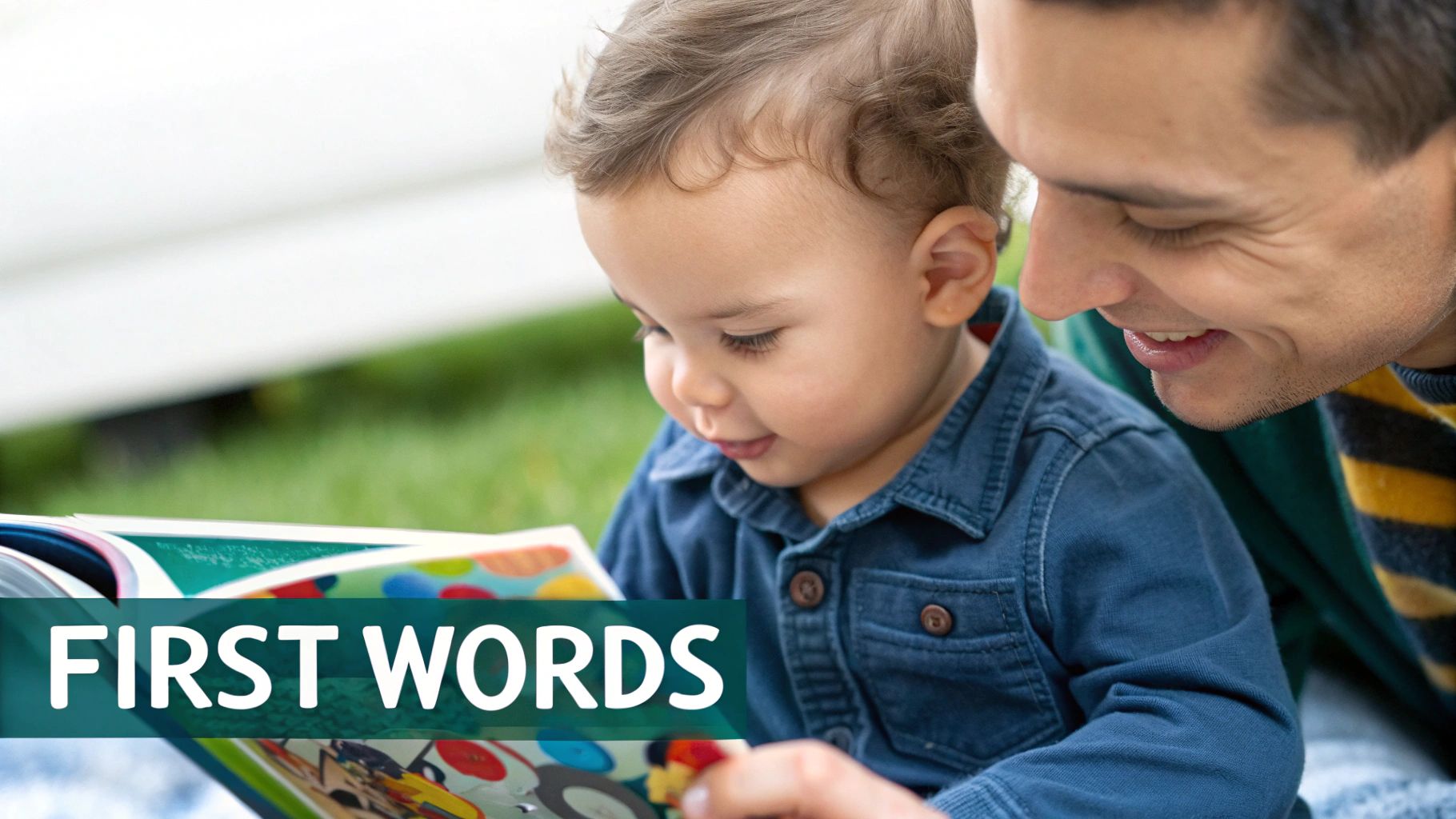
Welcome to one of the most exciting—and varied—parts of your toddler's journey: the explosion of language at sixteen months. This is when communication starts to properly blossom, but it’s so important to realise that language is much more than just the words they can say. It’s a rich, complex tapestry woven from gestures, sounds, and a rapidly growing understanding of everything you say to them.
Think of it like building a house. The words you actually hear are like the bricks appearing on the outside. But underneath, there's a huge amount of foundational work going on that you can't see. This is their receptive language—their ability to understand what's being said—which is often miles ahead of their expressive language at this age.
So, when your toddler can find their shoes when you ask, or point to the dog when you say its name, they're showing off some seriously impressive language skills. It doesn't matter if they aren't saying "shoes" or "dog" out loud just yet. This understanding is the bedrock on which their future vocabulary will be built.
More Than Just Words
One of the biggest worries for parents is the classic "word count." How many words should my toddler be saying? Honestly, the range of what's typical for 16 months developmental milestones is incredibly wide. Some toddlers might have a vocabulary of 10-20 words, while others are just getting started with a handful. Both are perfectly normal.
The real key is to look at their communication as a whole picture. Language development is a hugely variable area. While around half of UK toddlers at this age can say at least three words on their own, many more are communicating brilliantly using a whole range of non-verbal cues. They might bounce with excitement or tug on your shirt to get your attention. It all counts. You can discover more insights about this on TheBump.com.
Your toddler is a master of getting their point across, using a clever mix of tools:
- Pointing and Gesturing: Pointing is a massive leap forward. It shows they can connect an object with a thought and, crucially, that they want to share that thought with you.
- Vocalisations: Don't dismiss the grunts, squeals, and babbles! They use different tones to express different needs, from an urgent "uh-uh!" for "I want that" to a happy shriek of delight.
- Body Language: A determined toddler trying to climb into their highchair is clearly communicating "I'm hungry" or "It's dinner time!" without needing a single word.
How to Nurture Their Budding Vocabulary
Your toddler’s brain is like a linguistic sponge, soaking up every word and conversation going on around them. This means your daily chats are the most powerful language-learning tools you have. You don’t need flashcards or formal lessons; you just need to talk, read, and play.
Your enthusiasm is the secret ingredient. When you respond to their babbles and gestures as if they've just spoken a full sentence, you're teaching them the power of communication and motivating them to keep trying.
Here are a few simple, effective ways to encourage their language skills:
- Narrate Your Day: Talk about what you're doing, even the mundane stuff. "I'm washing the dishes now. Look at all the big, soapy bubbles!" This surrounds them with rich vocabulary in a completely natural way.
- Share Board Books Daily: Point to the colourful pictures and name what you see. Use silly, expressive voices for different characters to make it fun and keep them engaged.
- Expand on Their Words: If they point to a car and say "car," you can build on that. "Yes, that's a big, red car! The car goes vroom, vroom!"
- Sing Songs and Rhymes: The rhythm and repetition in songs like "Wheels on the Bus" are absolutely brilliant for helping them learn language patterns and build memory.
By creating a language-rich environment, you’re giving them all the raw materials they need to build their communication skills. For more great ideas, check out our helpful guide on language development activities for toddlers. Every chat and every story is another step towards their world of words.
Understanding Your Toddler's Big Emotions
Navigating the emotional world of a 16-month-old can feel a bit like trying to predict the weather—sunny one moment, stormy the next. This period is often defined by huge, intense feelings that your toddler is only just beginning to understand, let alone manage. Their inner world is becoming incredibly rich and complex, which can be overwhelming for their little minds.
One of the biggest drivers behind these emotional waves is a powerful new desire for independence. You’ll likely start hearing the determined cry of "me do it!" more and more as they insist on feeding themselves or putting on their own shoes. This isn't defiance for defiance's sake; it's a crucial developmental step toward self-awareness and feeling capable.
At the same time, this fierce independence often clashes with equally strong feelings of separation anxiety. They want to be their own person, but they also desperately need the safety and comfort of having you nearby. This internal push-and-pull is confusing for them and can be exhausting for you, but it’s a perfectly normal part of their journey.
The Truth About Toddler Tantrums
Let's reframe the dreaded tantrum. It’s so easy to see it as a moment of "bad behaviour," but it's far more helpful to view it as communication. Your toddler’s brain is experiencing massive emotions—frustration, anger, disappointment—but their vocabulary is still tiny.
A tantrum is what happens when those huge feelings completely short-circuit their limited ability to express them with words. It's a distress signal, not a deliberate act of manipulation. Understanding this can shift your perspective from one of frustration to one of empathy and support.
Think of a tantrum as an emotional power surge in a system that hasn't had its wiring fully upgraded yet. Your calm, steady presence acts as the surge protector, helping them feel safe until the overload passes.
Gentle Ways to Support Emotional Growth
Your role isn't to stop the emotions from happening, but to guide your toddler through them. By helping them navigate their feelings now, you're building the foundations for emotional regulation that will last a lifetime. This process strengthens your bond and teaches them that all feelings are acceptable, even the big, scary ones.
Simple, consistent strategies can make a world of difference:
- Name Their Feelings: When they're upset, give their emotion a label. Saying, "You feel so frustrated that the blocks fell down," helps them connect a word to their internal state. This is the very first step towards emotional intelligence.
- Offer Comfort, Not Solutions: In the middle of a meltdown, logic won't work. Instead of trying to fix the problem, just offer a hug or sit quietly with them. Your calm presence is often the most powerful tool you have.
- Stay Consistent with Routines: Predictable daily routines provide a sense of security in a world that can feel chaotic to a toddler. Knowing what comes next helps reduce anxiety and emotional outbursts.
Navigating this new stage is all about understanding what's happening behind the behaviour. The following table breaks down some common scenarios you might be facing and offers supportive ways to respond, reframing them as key 16 months developmental milestones.
Supporting Your Toddler's Emotional Growth
| Common Behavior | What It Means Developmentally | How You Can Help |
|---|---|---|
| Tantrums over small things | They are overwhelmed by big emotions but have limited language to express them. | Acknowledge their feeling: "You're so angry the toy isn't working." Offer comfort and a safe space. |
| Separation anxiety | They are developing a stronger sense of self and a deeper attachment to you. | Keep goodbyes short and positive. Reassure them you will be back and create a fun reunion ritual. |
| Saying "No!" to everything | They are practising their newfound independence and realising they have their own will. | Offer limited choices: "Do you want the red cup or the blue cup?" This gives them a sense of control. |
Remember, your consistent and empathetic responses are teaching your child invaluable lessons about managing their feelings. It’s a marathon, not a sprint, and you're giving them the best possible start.
Knowing When to Seek Professional Advice
Every toddler’s journey is wonderfully unique, and it’s important to remember that development isn't a race to the finish line. Celebrating your little one’s individual pace is key. But just as crucial is feeling confident and informed. Trust your gut—that parental intuition is an incredibly powerful tool. If you have a nagging feeling that something isn’t quite right, it’s always worth looking into.
Think of milestones less as a strict checklist and more as a friendly roadmap. It's completely normal for children to be a little ahead in one area and taking their time in another. However, there are a few signs, often called "red flags," that suggest a chat with your GP or health visitor might be a helpful next step.
Key Signs to Watch For
It's rarely about one single missed milestone. Instead, consider reaching out for a professional opinion if you notice a consistent pattern where your 16-month-old isn't meeting several of the foundational 16-month developmental milestones.
- Physical and Motor Skills: Is your toddler not yet trying to put weight on their legs or stand up, even when holding onto furniture? Do they show little interest in trying to move towards walking?
- Communication and Language: Are they not using simple gestures like pointing to what they want, waving bye-bye, or shaking their head? Is their babbling still very limited, or have they not yet said their first meaningful word?
- Social and Emotional Connection: Do they consistently struggle to make eye contact with you or other close family members? Do they seem completely uninterested in simple back-and-forth games like peek-a-boo?
One of the most important things to act on is the loss of skills. If your child was previously able to wave, babble, or stand and has suddenly stopped, this is a clear reason to seek professional advice straight away.
Taking the Next Step
Spotting a potential delay isn’t about putting a label on your child. It's all about getting them the right support at the right time. Catching things early can make a world of difference, opening the door to targeted help that allows your child to build new skills and truly thrive.
Reaching out to a health professional is one of the most loving and responsible things you can do. It’s you being their biggest champion, making sure they have every opportunity to reach their amazing potential. You know your child better than anyone. Never, ever hesitate to voice your concerns and ask those questions. It's a brave and vital part of being a parent.
Your Top Questions About 16-Month Milestones
As you watch your 16-month-old explore the world, it’s only natural to have a few questions pop up. Am I doing enough? Is this normal? We get it. Let’s tackle some of the most common queries we hear from parents, offering some clarity and reassurance along the way.
How Many Words Should My 16-Month-Old Say?
This is the big one, isn't it? But honestly, there's no magic number. Some toddlers are chattering away with ten or more words, while others might just be saying "Mama," "Dada," and not much else. Both ends of this spectrum are completely normal.
Instead of counting words, try to look at the bigger picture of their communication. Are they pointing at the cat? Waving "bye-bye"? Are they able to follow a simple instruction like, "Can you pass me the ball?" This shows their understanding of language is growing, which is the crucial foundation for everything else. The spoken words will follow.
Should I Worry If My Toddler Is Not Walking Yet?
The age range for walking is huge. While many toddlers are toddling around by sixteen months, it’s just as common for others to be happily cruising along the sofa or only just taking those first wobbly, independent steps. Remember, development is a journey, not a race.
Look for all the amazing pre-walking skills they’ve mastered. Can they pull themselves up to a standing position? Can they stand on their own, even for a few seconds? These are all fantastic signs that they're building the strength and balance they need. Of course, if you’re concerned, especially if they aren’t putting weight on their legs, a quick chat with your health visitor can offer great peace of mind.
How Can I Best Handle My Toddler's Tantrums?
Ah, tantrums. They’re a classic feature of this age, and they can be completely draining. The best way to get through them is to see them for what they are: communication. Your toddler is feeling enormous, complicated emotions but doesn't yet have the words to express them. A tantrum is often just their way of saying, "I'm completely overwhelmed!"
Your job is to be their calm in the storm. Try to stay patient and acknowledge their feelings ("I know you're so cross that the tower fell over"). You don't have to give in to whatever caused the tantrum, but offering a hug or simply sitting quietly nearby gives them the security they need to ride out the emotional wave.
What Are the Best Activities for This Age?
You don't need a house full of fancy gadgets to support your toddler's development. Often, the simplest, most classic forms of play are the most effective. Here are a few ideas that brilliantly support 16-month developmental milestones:
- Stacking Blocks: A brilliant workout for fine motor skills, hand-eye coordination, and that budding understanding of cause and effect.
- Reading Board Books: Point to the pictures as you say the words. It’s a wonderful way to build their vocabulary and foster a lifelong love of reading.
- Sensory Play: Getting their hands into sand, water, or even some playdough is fantastic for stimulating their senses and sparking their natural curiosity.
These activities aren't just about keeping them busy; they are the fundamental work of being a toddler, laying strong foundations for all the learning that's yet to come.
At Grow With Me, we know that dreaming up the right activities day after day can be a challenge. Our curated play kits are designed by experts to perfectly match your child's developmental stage, delivering high-quality, age-appropriate toys and play ideas straight to your door. Let us take the guesswork out of playtime so you can focus on enjoying this incredible journey with your 16-month-old.