
Cognitive Development in Early Childhood: Stages & Tips
When we talk about cognitive development in early childhood, what we're really talking about is how a child starts to think, explore, and figure things out. It's the slow and steady build-up of knowledge, skills, and problem-solving abilities that helps them make sense of the world. Think of it as constructing the mental toolkit they'll rely on for the rest of their lives.
The Foundations of a Brilliant Mind

Picture your child's brain as a new garden. Every song you sing, every cuddle you share, and every game of peek-a-boo you play is like a seed being planted for future growth. Cognitive development isn't a race towards school readiness; it’s the beautiful, natural unfolding of how a child learns to understand and interact with their surroundings.
This entire process is about the progressive building of core mental skills. In the first three years of life, a child's brain forms more than one million new neural connections every single second. It’s an astonishing rate of growth that lays the foundation for all their future learning, behaviour, and even their health.
What Does Cognitive Growth Involve?
At its heart, cognitive development in early childhood is about making connections. This growth happens across several key areas that all work together to help your child process new information. These foundational skills include:
- Memory: The ability to store and retrieve information, whether it's recognising a grandparent's face or remembering where they left their favourite teddy.
- Attention: The capacity to focus on something specific. This starts with fleeting moments of concentration in babies and gradually develops into the more sustained focus we see in toddlers.
- Problem-Solving: The hands-on process of figuring out how to reach a goal. Think of a toddler carefully stacking blocks to stop them from toppling, or trying to fit a puzzle piece into the right slot.
- Symbolic Thinking: This is a huge leap forward! It’s when a child understands that one thing can stand for another, like using a banana as a telephone during pretend play.
"Early cognitive development is not a passive process. It is built, not born, and shaped by the day-to-day experiences and interactions a child has with their caregivers and their environment."
This journey is also deeply connected to other areas of development. For instance, as a child’s language skills grow, so does their ability to sort objects into categories and express more complex ideas. Their emotional well-being is just as crucial, giving them the security they need to explore with confidence. Understanding concepts like Social Emotional Learning (SEL) really highlights how all these pieces fit together, showing you that your everyday interactions are the most powerful tool you have for nurturing a brilliant, thriving mind.
The Science Behind Your Child's Developing Brain
To really get what's happening during these incredible early years, it helps to peek behind the curtain at the brain itself. From the moment they're born, your child's mind isn't a blank slate; it's a buzzing, fast-growing network. And the most amazing part? Your everyday interactions are the chief architects building it.
This period, especially from birth to age three, is a time of truly mind-boggling growth. The brain is busy forming millions of new connections, called synapses, every single second. You can think of these as tiny information superhighways. The more a particular highway gets used—through repetition, new experiences, and your interactions—the stronger and faster it becomes.
Pruning the Garden of the Mind
Imagine your baby’s brain is a vast, untamed garden. In the beginning, it sprouts connections everywhere, creating a dense, tangled web of potential. As your child starts to experience the world, certain connections get used over and over again. When you sing that same silly song every day, the neural pathway for sound, rhythm, and emotional connection gets a workout. This strengthens it, turning it from a faint trail into a well-trodden path.
But the brain has a clever way of managing all this growth: a clean-up process called synaptic pruning. Just like a wise gardener, the brain starts trimming away the connections that aren't being used. This isn't a bad thing; it's essential for efficiency. By clearing out the overgrown, unused trails, the brain frees up resources for the important pathways, making thinking quicker and more organised.
Every time you respond to your baby's cry, play peek-a-boo, or read a story, you are reinforcing crucial neural pathways. Your loving, responsive care is literally sculpting the architecture of their brain for a lifetime of learning and resilience.
This "use it or lose it" system is exactly why those small, consistent, positive moments are so powerful. They build a strong, well-organised brain structure—the very foundation for all the skills that will come later.
The Building Blocks of Early Thinking
As these brain connections strengthen and organise, you'll start to see key thinking skills emerge. Two of the biggest building blocks you'll notice are working memory and an understanding of cause and effect.
- Working Memory: Your Child’s Mental Sticky Note. This is the ability to hold a small bit of information in mind just long enough to use it. When your toddler remembers you hid a toy under a blanket and goes looking for it, that's their working memory in action. It's the mental 'sticky note' that helps them follow simple instructions and connect ideas.
- Cause and Effect: The 'Aha!' Moment. This is the thrilling discovery that their actions make things happen. When your baby gleefully drops their spoon from the highchair again and again, they aren't just making a mess. They are running a brilliant little experiment, learning the fundamental rule: "When I do this, that happens." This is the very beginning of problem-solving.
These early years are absolutely critical. Research shows that significant differences in cognitive development among UK children can appear as early as age three, often tied to their social and emotional wellbeing. Children who are struggling with their emotions or behaviour often have lower cognitive scores. You can explore the research on early childhood inequalities to see just how closely these are linked.
This makes it crystal clear: nurturing your child’s emotional security is one of the best things you can do for their cognitive growth. When you understand the science, you realise that the simplest, most loving moments are also the most powerful learning opportunities.
Key Cognitive Milestones From Birth to Age Three
Watching your child’s cognitive development unfold is one of the most incredible parts of being a parent. Every new skill, every “aha!” moment, is a tiny chapter in their amazing story of figuring out the world. While it’s true that every child has their own unique timeline, it can be really helpful to know what key cognitive milestones to look out for.
Think of these milestones less as a strict checklist and more as a guide to the wonderful leaps you can expect to see. They’re simply signs that your child’s brilliant brain is building new connections and getting more organised. For a bit more background, our guide on what developmental milestones are offers some extra context.
The timeline below gives you a powerful visual of just how fast brain growth happens in these first few years, which really sets the stage for all the milestones that follow.
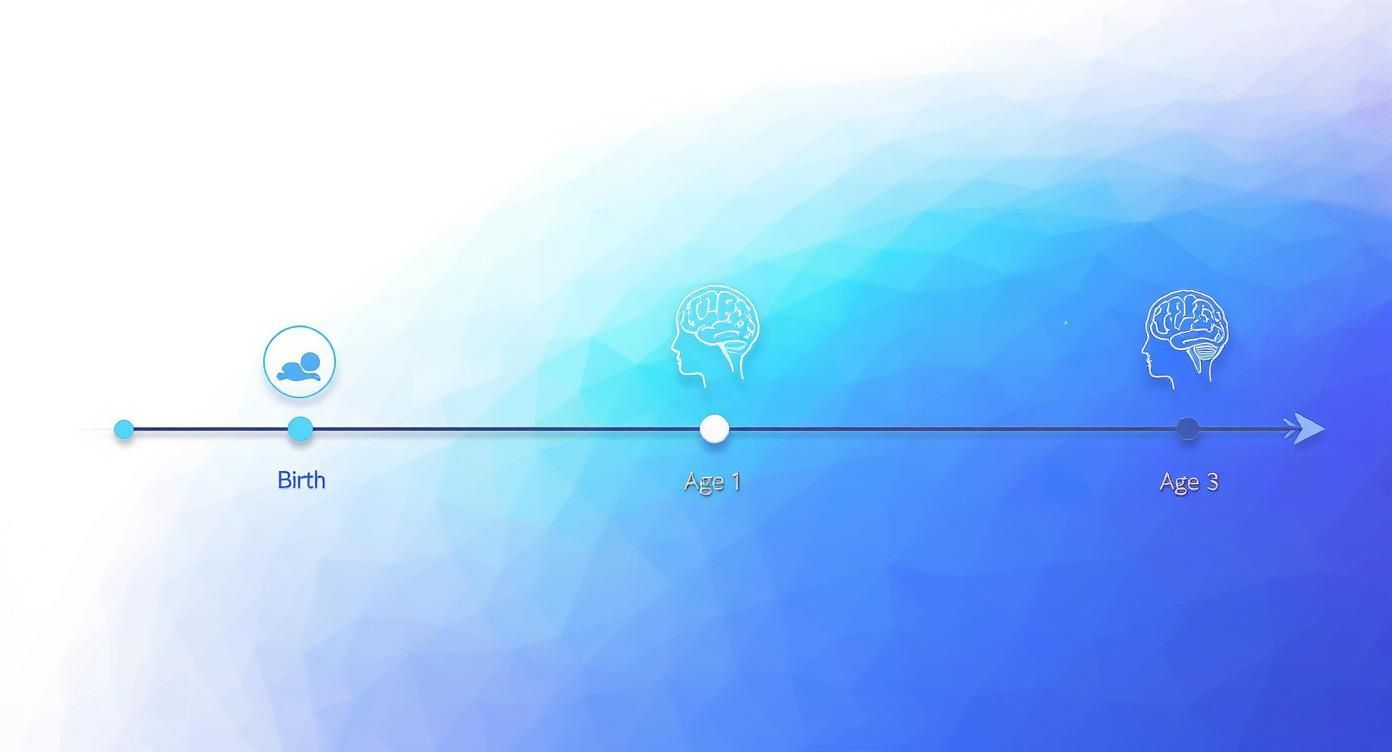
This incredible growth—the brain nearly triples in size by age three—is down to the mind-boggling speed at which new neural connections are forming. These connections are the very foundation of every cognitive step forward.
The First Six Months: A World of Senses
Right at the beginning, a baby’s world is all about their senses. Learning is a physical experience, driven entirely by what they can see, hear, touch, and taste.
- Tracking Objects: You’ll notice their little eyes starting to follow you as you move across the room. This is a big deal! It shows their vision and attention are starting to work together.
- Recognising Faces: That first moment they truly recognise you is pure magic. It’s also an early sign that their memory is beginning to form.
- Anticipating Events: Soon enough, they might start wiggling with excitement when they hear the bathwater running. This shows they’re making connections between cause and effect.
Six to Twelve Months: Becoming an Explorer
This is where things get really interesting. Your baby is no longer just a passive observer—they’re an active experimenter, keen to figure out how everything works.
The biggest cognitive breakthrough during this time is object permanence. This is the game-changing realisation that things still exist even when they can’t be seen. It’s the secret sauce behind why a simple game of peek-a-boo is so utterly thrilling for them.
You’ll probably see these key developments pop up:
- Searching for Hidden Toys: If you hide their favourite rattle under a blanket, they’ll now lift it up to look for it. That’s object permanence in action!
- Exploring Cause and Effect: Welcome to the ‘drop everything from the highchair’ phase. It’s not about winding you up; they’re little scientists testing gravity, over and over again.
- Imitating Gestures: They’ll start copying simple actions like waving "bye-bye" or clapping their hands. This shows they can watch what you do and make their own body do the same.
One to Two Years: The Little Problem-Solver
As your little one toddles into their second year, their cognitive skills become much more obvious. They’re starting to think with real intention and are capable of solving simple problems.
Their memory is getting stronger, too. They can now follow a simple, one-step instruction like, "Please get your shoes." This is a huge leap in their ability to process language and hold information in their head.
- Finding Objects in Different Locations: Their grasp of object permanence is more solid. They can find a toy even if you’ve hidden it in a couple of different spots.
- Engaging in Pretend Play: You might catch them "feeding" their teddy or chatting away on a toy phone. This is the start of symbolic thought—the amazing ability to make one thing stand in for something else.
- Identifying Body Parts: When you ask, "Where's your nose?" they can point right to it. This shows a growing self-awareness and the ability to link words with objects.
Two to Three Years: The Budding Thinker
This year is an absolute explosion of language and more complex thinking. Your toddler's mind can now sort information, understand more complicated requests, and even show the first flickers of reasoning.
They’re shifting from purely physical discovery to mental problem-solving. You might see them trying different ways to finish a puzzle or build a block tower, showing off their growing persistence and thinking skills.
- Sorting Objects: They can now sort toys by shape or colour. This is a foundational skill for later maths and logical thinking.
- Following Two-Step Commands: You can ask them to "pick up your teddy and put it in the box," and they can actually follow both parts of the instruction.
- Engaging in More Complex Pretend Play: Their imaginative games become richer, filled with little storylines and pretend scenarios. This creativity is a powerful engine for their cognitive growth.
Practical Activities to Nurture Your Child's Developing Brain
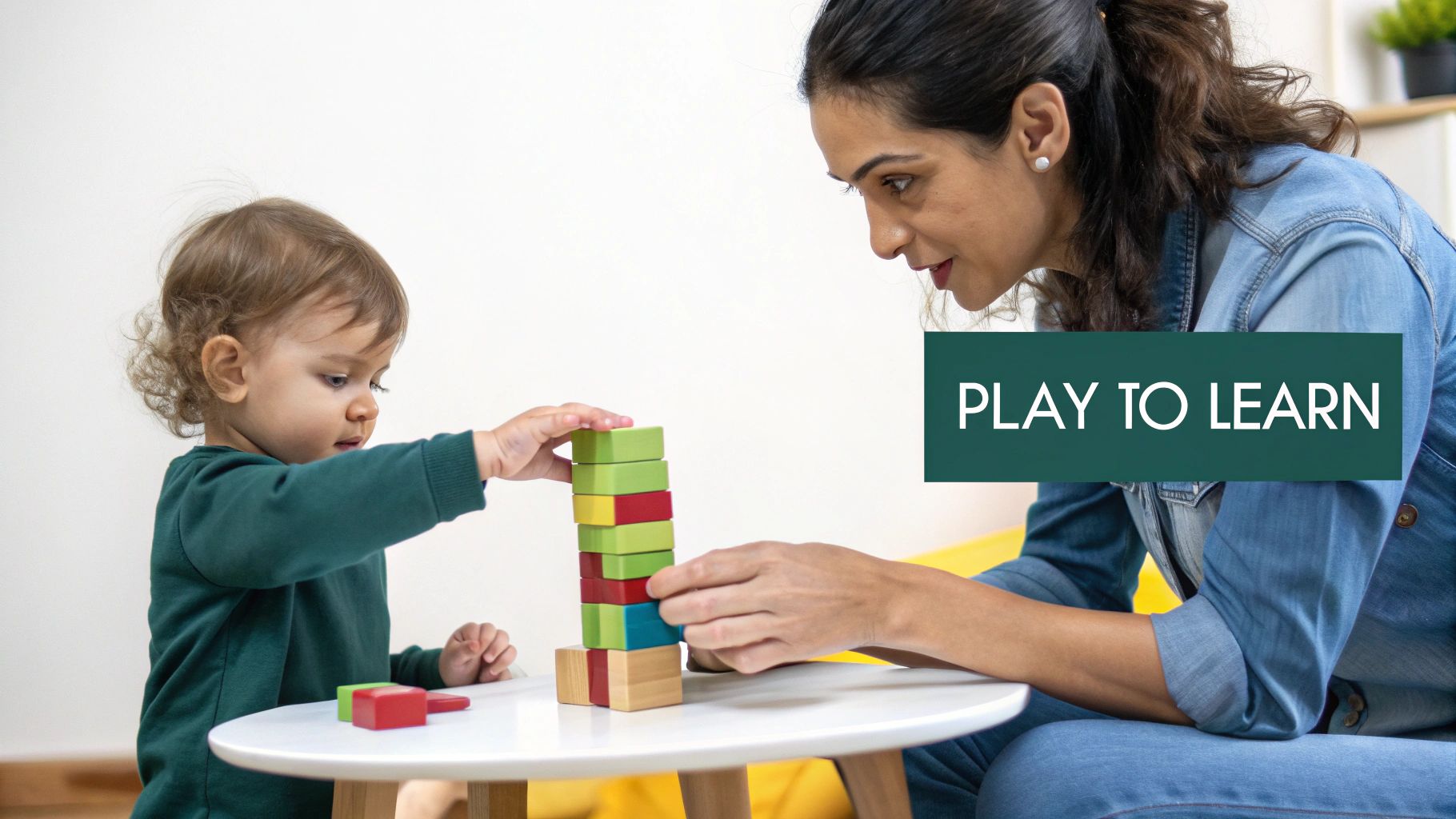
Knowing the science is one thing, but figuring out how to apply it in your day-to-day life is what really counts. The great news? Supporting your little one’s cognitive development in early childhood isn't about expensive gadgets or structured lessons. It’s all about weaving brain-building moments into your ordinary routines through the simple power of play.
The secret ingredient is meaningful interaction. Everyday objects and simple activities can become incredible learning tools that strengthen your child’s thinking skills. Your job is simply to connect with them and feed their natural curiosity, turning everyday play into a powerful catalyst for growth.
And it’s working. Recent figures from England show that 80.4% of children are reaching their expected developmental milestones in areas like problem-solving and communication by age two-and-a-half. It's a small but encouraging increase from the previous year, showing just how much engaged parenting really matters. You can see more details in the government's child development report.
Fostering Problem-Solving Skills
Children are born problem-solvers. From the first time they reach for a toy just out of grasp, they're already thinking and experimenting. All you need to do is offer simple, safe challenges that get their little cogs turning.
- Stacking and Building: Grab some wooden blocks, empty cardboard boxes, or even Tupperware. Stacking teaches them the basics of physics, like balance and gravity. And when the tower inevitably tumbles? That’s a brilliant lesson in cause and effect.
- Simple Puzzles: Start with chunky knob puzzles for tiny hands and slowly introduce more complex jigsaws. Puzzles are fantastic for developing spatial awareness, shape recognition, and hand-eye coordination as they figure out which piece goes where.
- Container Play: A collection of jars, tubs, and boxes with different lids is a goldmine for a toddler. Figuring out how to open and close them, or how to fit smaller things inside bigger ones, is a top-tier problem-solving workout.
These aren't just skill-building exercises; they're confidence boosters. Every time your child solves a small puzzle, they're wiring their brain to believe, "I can do this."
Strengthening Memory and Recall
Think of your child’s memory as a muscle—the more they use it, the stronger it gets. You can give it a great workout through fun, repetitive games that easily fit into your day.
Memory is so much more than just remembering names and faces. It’s about understanding sequences, predicting what comes next, and feeling secure in a routine. Simple, consistent games build the foundations for all of it.
Here are a few easy wins for boosting memory:
- Sing Repetitive Songs: Classics like "Wheels on the Bus" or "Old MacDonald," especially with actions, are memory magic. The repetition helps them anticipate the next line or movement, strengthening those neural pathways.
- Read Familiar Books: Don't worry about reading the same story for the tenth time! It’s actually helping them memorise the flow of the story. Before you know it, they'll be "reading" it back to you.
- Play "Where Did It Go?": A simple game of hide-and-seek with a toy. Pop it under one of three cups, shuffle them around, and ask your child to find it. This is a direct challenge to their working memory.
If you’re looking for more ideas, we’ve put together a guide filled with fun and effective play-based learning activities you can try at home.
Encouraging Symbolic and Imaginative Play
When a toddler picks up a banana and pretends it's a telephone, it's a huge cognitive leap. This is symbolic play—the ability to make one thing stand for another—and it’s the bedrock of creativity, language, and abstract thought. A great way to nurture this is with hands-on sensory play, and there are lots of brilliant and engaging sensory activities for preschoolers to spark their imagination.
- Pretend Household Chores: Let them "help" you tidy up or cook. A toy broom next to you while you sweep or a bowl and spoon while you prepare dinner lets them imitate your world, which is a core part of symbolic thinking.
- Create a Prop Box: Gather a few simple things in a box—old hats, scarves, cardboard tubes, and empty yoghurt pots. These open-ended items are invitations for imagination. A tube becomes a telescope; a scarf becomes a superhero's cape.
- Give Toys New Jobs: Show them that a building block doesn't always have to be part of a tower. Maybe today it’s a car, or a piece of food, or a phone. This kind of flexible thinking is a sign of a creative mind in action.
By leaning into these simple, playful moments, you're not just killing time. You're actively building your child's brain, one game at a time.
Recognising When to Seek Professional Guidance
One of the most important things to remember on this journey is that every child develops at their own unique pace. Milestone charts are a helpful guide, but they are not a strict rulebook. A slight variation from the timeline is completely normal and is usually no cause for concern.
Your intuition as a parent is an incredibly powerful tool. You know your child better than anyone, so if you have a nagging feeling that something isn’t quite right, it’s always worth paying attention to. Trusting your gut is often the first step toward getting clarity and support.
Look for Patterns, Not Single Events
When thinking about your child’s cognitive development in early childhood, it’s far more helpful to look for consistent patterns rather than isolated incidents. Any child might have an off day or take a little longer to grasp a specific skill, and that’s perfectly fine. Real concerns typically arise when a child consistently isn't meeting milestones across several areas over a period of time.
So, instead of worrying about one missed milestone, try to see the bigger picture. Is your child generally engaged, curious, and interactive in their own way? True developmental delays often show up as a cluster of signs, not just one.
The goal is not to compare your child to others, but to ensure they have the right support for their individual journey. Seeking advice is a proactive, loving step to give your child everything they need to thrive.
It’s also crucial to recognise how external factors can influence development. Research in the UK has shown that persistent poverty can significantly impact a child's cognitive growth. Children in these circumstances scored almost 20 percentile ranks lower on cognitive tests by age seven, with gaps appearing as early as age three. To understand this connection better, you can explore the research on child development and poverty.
Taking the Next Steps
If your concerns persist, the best course of action is to speak with a healthcare professional. Your GP or health visitor is the ideal starting point. They are trained to understand the wide spectrum of typical development and can offer reassurance or guide you towards further assessment if needed.
When you book an appointment, it helps to be prepared. Before you go, jot down a few notes.
- List Specific Examples: Instead of saying "I'm worried about their development," try to provide concrete examples like, "He doesn't respond to his name," or "She isn't pointing to objects she wants."
- Mention Key Milestones: Note any specific milestones for their age range that you haven't seen them consistently achieve.
- Ask Clear Questions: Prepare questions such as, "What are the next steps if there is a concern?" or "Are there any local resources or support groups you can recommend?"
Remember, reaching out for guidance is a sign of strength. It’s about ensuring your child has access to every possible tool for success, and you have the peace of mind you deserve.
How Stage-Based Play Kits Support Learning
Knowing all about your child’s cognitive development is one thing. Actually finding the right activities day in and day out to support it? That’s a whole different challenge. For busy parents, trying to keep up with a little one's ever-changing brain can feel completely overwhelming.
This is where expertly curated, stage-based play kits come in. They offer a brilliantly simple solution, taking all the guesswork out of nurturing your child’s learning journey.
These kits are thoughtfully put together by child development experts who know exactly which skills are emerging at each age. They pair toys and activities with specific cognitive milestones, making sure everything your child plays with is perfectly timed to both challenge and captivate them. This targeted approach makes supporting cognitive development in early childhood feel less like a chore and more like an intuitive, joyful experience.
The Right Tools at the Right Time
Think of it like this: you wouldn't hand a six-month-old a 50-piece jigsaw puzzle, and you wouldn't expect a three-year-old to be fascinated by a simple black-and-white contrast card for long. Every stage of growth needs different tools to spark curiosity and build new skills. Stage-based kits deliver precisely what’s needed, right when it's needed.
- For a baby, a kit might focus on sensory exploration. Think high-contrast images to stimulate their developing vision, different textures to touch, and simple toys they can easily grasp. These items are specifically chosen to help build those foundational neural connections.
- For a toddler, a kit would likely shift to include things like shape sorters, simple puzzles, or props for pretend play. These activities are fantastic for encouraging early problem-solving, spatial awareness, and the development of symbolic thinking—a huge cognitive leap!
The real value of a stage-based play kit isn't just in the toys themselves. It's in the confidence it gives you as a parent. Each box usually comes with a guide that explains the 'why' behind every item, empowering you to understand and feel more connected to your child’s developmental process.
By providing high-quality, safe, and developmentally spot-on tools, these kits become a trusted partner on your parenting journey. They help ensure that the playtime happening in your home isn't just fun, but is also purposefully building your child’s brilliant, growing mind.
Exploring a well-designed kids subscription box is a great way to see how this stage-based approach works in practice. It simplifies everything, freeing you up to focus on what truly matters: connecting with your child through meaningful, brain-building play.
Got Questions? We’ve Got Answers
It’s only natural to have a million questions when you’re navigating your child’s early years. It’s a time of incredible growth and change! Here, we’ll tackle some of the most common queries we hear from parents, offering clear, reassuring advice to help you feel more confident on this amazing journey.
When Should I Actually Start Teaching My Child?
Here’s the wonderful truth: you already are. Learning isn't about flashcards or formal lessons at this age; it starts from day one, woven into every cuddle, coo, and conversation you share.
The most powerful "teaching" you can do for your baby or toddler happens through simple, everyday connection. Every time you chat about what you're seeing on a walk, sing a silly song, or play a game of peek-a-boo, you're literally building their brain. These moments are the richest learning experiences they can have, creating a foundation for future skills that is far stronger than any structured programme.
How Worried Should I Be About Screen Time?
This is a big one for parents today, and for good reason. The advice from experts is pretty clear: it's best to have very limited or no screen time at all for children under two. Their brains are in a period of explosive growth, and that growth is fuelled by real-world, hands-on experiences.
Too much screen time in these crucial early years can get in the way of developing important skills. It can make it harder for them to focus and can even slow down language development, simply because it replaces the vital back-and-forth "serve and return" conversations that help them learn to talk.
The best bet? Prioritise screen-free play that encourages connection and exploration. Building a tower with blocks, scribbling with crayons, or simply reading a book together offers infinitely more developmental goodness.
Developmental milestones are a guide, not a race. There is a huge range of 'normal', and every single child develops on their own unique schedule. Celebrating their individual progress is what truly matters.
What If My Child Misses a Milestone?
It's so easy to feel a knot of worry in your stomach when you see your child isn't hitting a milestone right on schedule. The first thing to remember is that these charts are just averages—they’re not strict deadlines. A little delay in one area is often balanced out by them being way ahead in another.
Try to look at the bigger picture of their development. Are they generally curious and engaged? Are they making steady progress overall? If the answer is yes, then being slightly off the "average" timeline is rarely a cause for concern.
Real developmental issues usually show up as a consistent pattern of missed milestones across several different areas. If you have that nagging gut feeling that something isn’t quite right, always trust your instincts. Have a chat with your health visitor or GP—they can offer professional guidance and, most importantly, peace of mind.
Ready to take the guesswork out of playtime? The Grow With Me subscription delivers expertly curated, stage-based play kits right to your door, giving you the right toys at the right time to support your child's cognitive journey. Discover how our kits make brain-building play easy and joyful by exploring the Grow With Me subscription box.