
Wooden Educational Toys: Boost Growth & Creativity
In a world seemingly dominated by flashing screens and noisy plastic gadgets, wooden educational toys are making a quiet but powerful comeback. These classic playthings aren’t just a nod to nostalgia; for many parents, they represent a deliberate choice—a shift towards play that is sustainable, safe, and truly enriching for a child's development.
The Enduring Appeal of Wooden Toys
So, why are modern parents looking past the latest fads and returning to the simplicity of wood? It’s really about choosing quality over quantity. There's a growing realisation that the simplest tools can spark the most profound learning. This isn't just about buying a toy; it's about investing in something that’s better for your child and kinder to the planet.
This isn't just a gut feeling, either. The trend is real. Here in the United Kingdom, we've seen a significant rise in demand for wooden educational toys. It's part of a much larger cultural shift towards eco-conscious living. Within the UK’s massive £5.4 billion toys and games market, recent surveys reveal that over 60% of parents now say they prefer toys made from natural materials. That’s a huge indicator of changing values. If you're interested in the numbers, the full UK market analysis on Statista offers a deep dive.
A Focus on Sustainability and Safety
One of the biggest drivers behind this return to wood is a growing environmental awareness. Parents are more conscious than ever of the problems with single-use plastics and are actively seeking out alternatives that are biodegradable and come from renewable sources. A beautifully crafted wooden toy isn't disposable—it’s an heirloom, something to be cherished and passed down, which helps reduce waste and teaches a valuable lesson in mindful consumption.
Of course, alongside the eco-friendly benefits, safety is always top of mind for any parent. High-quality wooden toys are typically finished with non-toxic, water-based paints and are far less likely to break into sharp or hazardous little pieces. Their solid, straightforward construction provides real peace of mind, making playtime both engaging and secure.
Fostering Deeper Cognitive Growth
Here’s where wooden toys truly shine. Unlike many electronic toys that have a single, pre-programmed function, wooden educational toys are brilliantly open-ended. A simple set of wooden blocks can be anything a child imagines: a soaring skyscraper, a bustling city, or a fairy-tale castle. Their lack of a defined purpose is precisely what makes them so powerful.
Open-ended play encourages children to flex their imagination, figure out problems on their own, and think creatively. They aren't just passively consuming entertainment; they become active creators in their own little worlds.
This kind of play is absolutely fundamental for building cognitive skills. When you're looking for toys, exploring a diverse collection of kids' toys can give you a better sense of the possibilities. Wooden toys, in particular, are fantastic for developing spatial awareness, fine motor skills, and logical thinking in a way that feels completely natural and unforced. They lay the groundwork for a lifetime of learning.
How Wooden Toys Nurture Your Child's Development
Wooden educational toys are so much more than simple playthings. They are the foundational tools that help build your child's cognitive and physical abilities from the ground up. Unlike many modern toys that have a single, prescribed way to be played with, the beauty of wooden toys lies in their open-ended nature. They spark curiosity, encourage problem-solving, and ignite the imagination, adapting as your child grows.
From those first few months of life right through to the bustling toddler years, these toys meet children exactly where they are. They offer just the right amount of challenge to nurture emerging skills, acting almost like a developmental partner that encourages growth in a way that feels natural, intuitive, and, most importantly, fun.
The Infant Stage: Birth to 12 Months
In the very beginning, a baby’s world is a whirlwind of new sights, sounds, and textures. Their main job is simply making sense of it all. Wooden educational toys are perfect for this early exploration, offering rich, tactile feedback that engages their senses without overwhelming them.
Think about a simple wooden rattle. It's a little masterpiece of early learning. When a baby learns to grasp it, they're not just holding a toy; they're strengthening their fine motor skills and developing that crucial pincer grasp. The gentle, organic sound it makes also teaches a fundamental lesson in cause and effect—"When I shake this, it makes a noise!"—which is a huge cognitive milestone.
This diagram shows just how these core values—development, safety, and sustainability—are all interlinked.

As you can see, the benefits branch out from the central choice of wood, creating a well-rounded foundation for play that supports both the child and the planet.
The Young Toddler Stage: 1 to 2 Years
As your baby grows into a toddler, their play becomes much more purposeful. This is the age of experimentation, where they are driven by a deep need to understand how different objects relate to one another. Wooden toys provide the perfect canvas for these early scientific explorations.
Take the classic wooden shape sorter. It’s not just a puzzle; it’s a hands-on lesson in logic and spatial awareness. Your child has to identify a shape, figure out how to orient it, and then match it to the correct hole. This simple act builds several crucial skills at once:
- Problem-Solving: They face a challenge ("This square doesn't fit in the circle hole") and have to work out a solution.
- Hand-Eye Coordination: Their eyes guide their hands to precisely manipulate and place each shape.
- Shape Recognition: They start to learn the names and properties of basic geometric forms.
Wooden stacking rings and simple puzzles work in a similar way, encouraging toddlers to experiment with size, order, and sequence. Every successful placement is a small victory that builds their confidence and teaches them that a bit of persistence really pays off. This is a vital part of early cognitive development in early childhood, laying the groundwork for more complex thinking later on.
The Older Toddler Stage: 2 to 3 Years Plus
By age two and beyond, a child's imagination truly takes flight. This is where the open-ended design of wooden educational toys really shines. A set of plain wooden building blocks isn't just a pile of wood; it's the raw material for creating entire worlds.
One day, those blocks might become a towering castle. The next, they could be a garage for toy cars or a cosy house for animal figures. This kind of imaginative play is far from trivial—it's a serious developmental workout.
Through this kind of pretend play, children build their vocabulary, practise social skills by creating stories, and develop sophisticated spatial reasoning as they figure out how to balance their structures.
This link between block play and cognitive skills is incredibly well-documented. UK educators have long recognised their benefits, with studies showing that children who play with blocks and puzzles develop stronger spatial reasoning and problem-solving abilities. In fact, one survey of UK primary schools found that 85% of teachers use wooden educational toys in their classrooms to support early learning, praising their power to promote creativity and hands-on discovery.
This active, creative process fosters an engaged mind. Instead of just passively receiving entertainment, your child becomes the architect, the storyteller, and the problem-solver—all thanks to a simple, timeless set of wooden toys.
Matching Wooden Toys to Your Child's Developmental Stage
Choosing the right toy for the right time can make all the difference. This guide will help you select wooden toys that perfectly align with key developmental milestones, ensuring your child gets the most out of their playtime.
| Age Group | Recommended Wooden Toys | Key Skills Nurtured |
|---|---|---|
| Infant (0-12 months) | Rattles, grasping toys, simple puzzles with large knobs, sensory blocks with different textures. | Fine motor skills (grasping), sensory exploration, cause and effect, hand-eye coordination. |
| Young Toddler (1-2 years) | Shape sorters, stacking rings, simple building blocks, pull-along toys, chunky puzzles. | Problem-solving, shape/colour recognition, spatial awareness, balance, gross motor skills. |
| Older Toddler (2-3+ years) | More complex block sets, lacing beads, basic construction sets, play food and kitchen items. | Imaginative and pretend play, storytelling, advanced fine motor skills, sequencing, social skills. |
By matching the toy to their current abilities and curiosities, you create a supportive and engaging environment where they can thrive. A well-chosen toy feels less like a lesson and more like a joyful discovery.
Your Checklist for Choosing Safe and Durable Wooden Toys
Choosing the right wooden educational toys can feel like a pretty big deal. You’re not just picking out another plaything; you’re investing in a tool for your child's growth, their safety, and even a more sustainable future. With a sea of options out there, it really helps to know what to look for.
After all, not all wooden toys are made equal. Taking a moment to be thoughtful means your child gets all the goodness of natural play without any of the hidden risks. This checklist will walk you through the most important things to consider, so you can feel confident in what you bring home.
Prioritise Safety Certifications
First things first: before you even look at the design or colour, check for safety certifications. Here in the United Kingdom, that means keeping an eye out for the UKCA mark. This little symbol is your guarantee that the toy has passed the UK’s strict safety standards, covering everything from flammability and chemical content to its physical construction.
Think of the UKCA mark as a toy’s passport. It shows the product has gone through all the proper checks and is legally allowed to be sold, giving you that instant peace of mind. Without it, there’s simply no way to know if a toy is free from harmful substances or potential choking hazards.
Scrutinise the Materials and Finishes
The quality of a wooden toy starts with, you guessed it, the wood. Hardwoods like beech, birch, and maple are fantastic choices because they’re incredibly durable and far less likely to splinter or dent, even with the most enthusiastic play. These woods have a naturally dense grain that stands up to years of love.
Next, have a close look at the finishes. Your safest and most eco-friendly bet is always non-toxic, water-based paint or natural oils. These finishes are free from nasty chemicals like lead, phthalates, and volatile organic compounds (VOCs). If a toy has a strong, chemical-like smell, that’s a definite red flag.
A truly high-quality wooden toy should feel good to hold. You’re looking for:
- Smoothly Sanded Edges: Run your fingers over every surface. There shouldn’t be any sharp corners, rough patches, or splintery bits.
- Securely Attached Parts: If the toy is made of multiple components, give them a gentle wiggle. Wobbly wheels or loose pegs can quickly become dangerous.
- Solid Construction: It should feel substantial and sturdy in your hands, not flimsy or feather-light.
When you choose a well-made toy from sustainable wood, you're not just buying a product; you're investing in an heirloom. A durable toy reduces waste and can be passed down, creating a beautiful legacy of play.
Match the Toy to the Child
Beyond the physical checks, the best wooden educational toys are the ones that are right for your child’s stage of development. A toy that’s too simple will quickly lead to boredom, but one that’s too complex can just cause frustration. The sweet spot is a toy that challenges and delights them in equal measure.
For example, a one-year-old will get so much from a simple wooden stacker that helps build their hand-eye coordination. A three-year-old, on the other hand, would be far more absorbed by a set of building blocks that sparks imaginative construction and storytelling. If you need a little more help, our detailed guide to Montessori toys by age can help you match toys to specific developmental milestones.
By keeping safety marks, materials, craftsmanship, and your child's age in mind, you can confidently pick out wooden toys that will provide countless hours of safe, enriching, and joyful play.
Sparking Creativity with Open-Ended Play Ideas
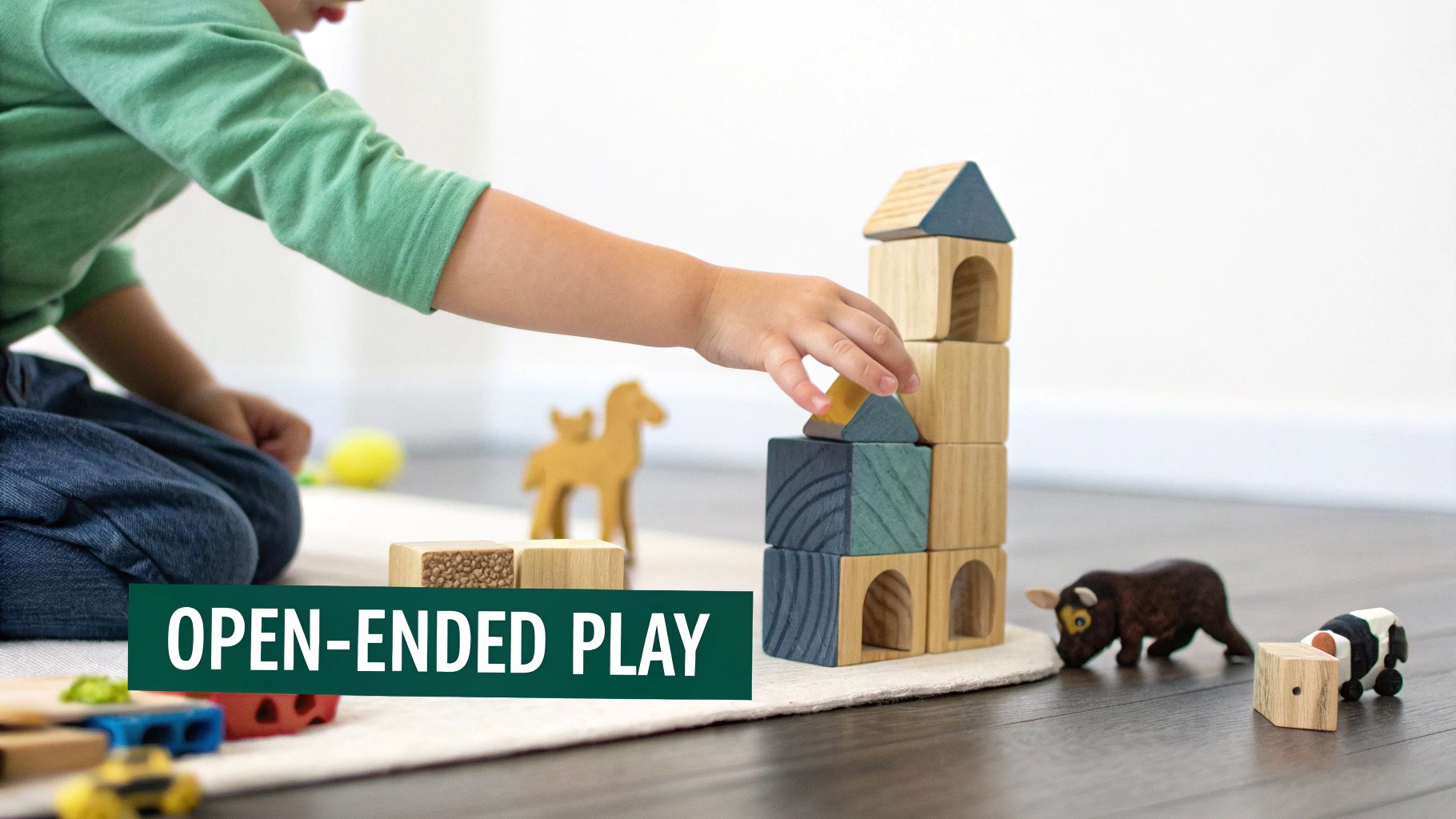
The real magic of wooden educational toys isn’t hidden in a battery compartment or laid out in an instruction manual. It’s in their beautiful simplicity. They’re a blank canvas just waiting for a child’s imagination to run wild. While many modern toys tell a child how to play, wooden toys invite them to become the creators, storytellers, and architects of their own little worlds.
This is the essence of open-ended play—play without a script or a set outcome. It’s where the journey of discovery matters far more than reaching a specific goal. So, how can you help your child unlock all that creative potential? The secret is to provide the right tools and then gently step back, offering inspiration instead of instruction.
From Simple Blocks to Sprawling Cities
A humble set of wooden blocks might just be the ultimate open-ended toy. The possibilities are infinite, limited only by your child's vision. The trick is to encourage them to think beyond just stacking a tower.
You can get things rolling with simple 'story starters'. For instance, lay a blue play-silk on the floor. Is it a river? A lake? Suddenly, the blocks aren't just blocks anymore; they’re bridges, boats, or cosy homes for riverside animals.
Here are a few simple prompts to get you started:
- Create a Zoo: Use the blocks to build enclosures for wooden animal figures. This naturally encourages sorting (which animals live together?) and spatial reasoning (how big does the lion's cage need to be?).
- Design a Bustling City: Add some toy cars and peg dolls to the mix. The blocks can become skyscrapers, shops, and houses, sparking all kinds of imaginative social scenarios.
- Build a Magical Castle: Drape a piece of fabric over a tall tower and, just like that, you have a fortress. This simple act can inspire epic tales of dragons, knights, and royalty.
This style of play, known as heuristic play, is fundamental to learning. To get a better grasp of the theory behind it, you can find out more by reading our guide on what is heuristic play.
Weaving Stories with Characters and Creatures
Wooden animal figures and peg dolls are perfect for nurturing storytelling skills. Their neutral expressions mean a child can project any feeling onto them, making them wonderfully versatile characters for any narrative. Encourage your little one to give them names, voices, and personalities.
Try setting up a 'small world' scene in a tray or on a rug. A handful of pebbles can become a rocky mountain range for a goat, while a small mirror can serve as a watering hole for safari animals.
By crafting these miniature worlds, children aren't just playing; they are practising empathy, developing vocabulary, and learning to structure a narrative with a beginning, middle, and end.
Combining this kind of hands-on play with verbal activities is a fantastic way to boost creativity. You can explore interactive storytelling ideas for toddlers to find new ways to blend physical toys with spoken narratives, creating a rich, multi-sensory experience that strengthens both creative and language skills.
Play Food and Early Numeracy
Wooden play food offers a delightful way to introduce early maths concepts without any pressure. A pretend market stall or a little café is a brilliant setting for this kind of playful learning.
Your child can be the shopkeeper while you play the customer. This simple bit of role-play naturally brings in several key skills:
- Counting: "I'd like to buy three red apples, please."
- Sorting: Grouping the food into categories—fruits, vegetables, baked goods.
- Patterning: Arranging items in a sequence, like apple, banana, apple, banana.
- Simple Sums: "If you have five carrots and I buy two, how many will be left?"
This hands-on approach makes abstract numbers feel real and relevant. It connects maths to everyday life, showing your child that numbers aren't just symbols on a page but useful tools for making sense of the world. By encouraging these open-ended scenarios, you empower them to see the limitless potential in their toys—and, more importantly, in themselves.
How to Care for Wooden Toys So They Last Forever
When you choose wooden educational toys, you're investing in quality that's meant to last. Unlike so many plastic toys that come and go, these are the kind of treasures you can imagine passing down through the family. A bit of simple care is all it takes to keep them safe, beautiful, and ready for playtime for years and years.
Keeping them in good shape isn’t just about aesthetics; it’s about making sure they remain a safe and integral part of your child’s world. The good news is that looking after wood is surprisingly straightforward and doesn't involve any harsh chemicals or fussy routines.
Your Simple Cleaning Routine
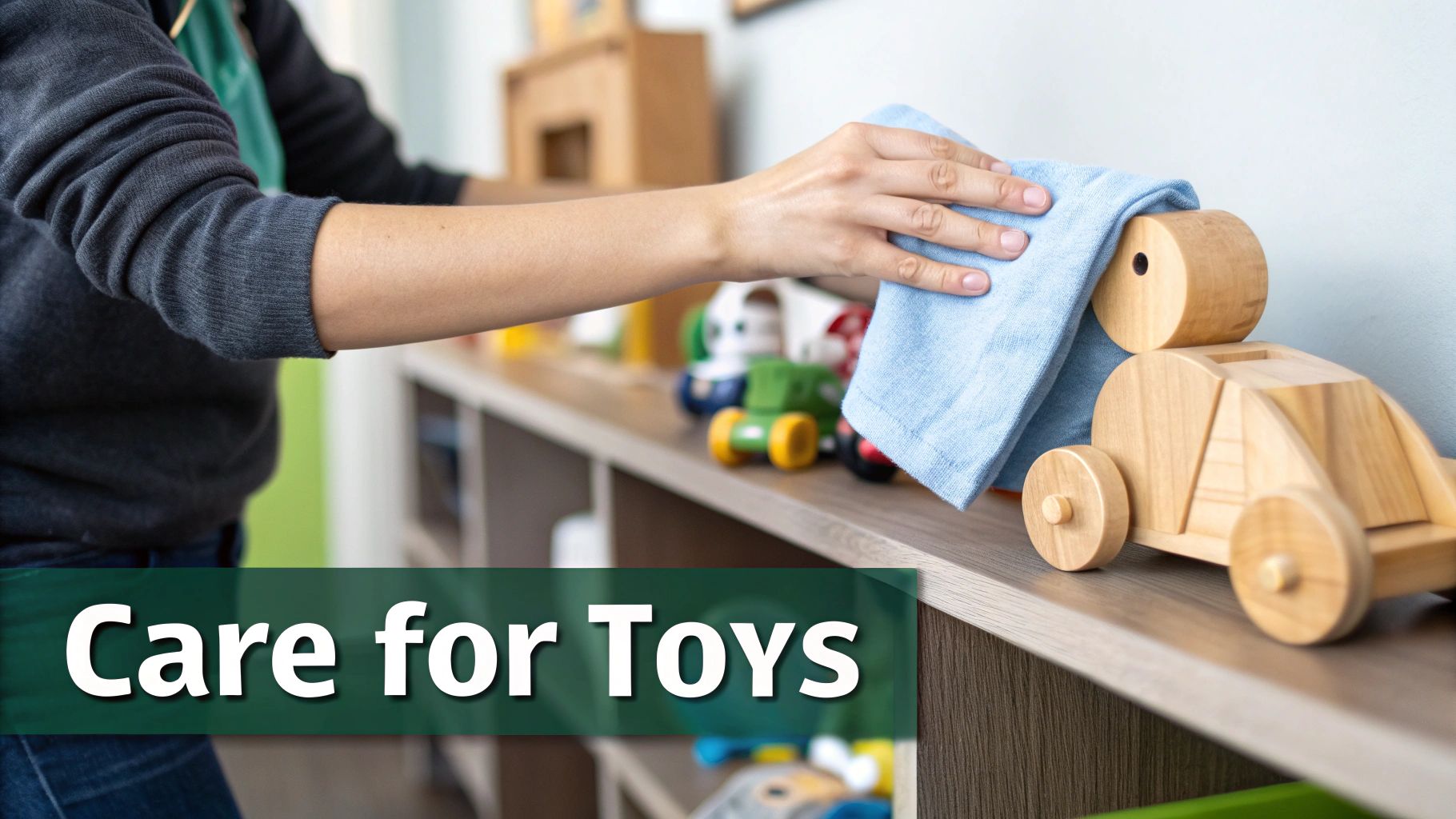
When it comes to cleaning, less is definitely more. Wood has natural antimicrobial properties, which means it doesn't hang onto germs the way plastic does. For day-to-day dust and grime, a quick wipe-down with a dry or slightly damp microfibre cloth is usually all you need.
If you're dealing with something a bit stickier, a gentle, natural solution is your best bet. Just follow these simple steps for a clean that’s both safe and effective:
- Mix a mild cleaning solution. A splash of white vinegar or a tiny bit of mild, child-safe soap in warm water works perfectly.
- Dampen, don't soak. Dip a clean cloth in the solution, then wring it out completely. You want it just damp, not wet.
- Wipe the surface. Gently clean the messy spot on the toy, being careful not to use too much water.
- Air dry completely. Let the toy dry fully in the open air before it goes back into the toy box. This stops any chance of mould.
It's absolutely crucial to never soak or submerge wooden toys in water. Wood is porous and will act like a sponge, absorbing water and causing it to swell, warp, or even crack as it dries. This can completely ruin the toy's shape and make it unsafe to play with.
Keeping Them Beautiful
Over time, even the sturdiest wooden toys can show signs of a well-loved life, like minor scuffs or a dull finish. Bringing back their natural glow is an easy and satisfying little job.
If you spot any small rough patches or scratches, you can gently smooth them away with a piece of very fine-grit sandpaper. A light touch is all it takes to smooth the surface without changing the toy's shape.
To restore that lovely sheen and protect the wood, try applying a natural, food-safe finish. A small amount of beeswax polish or even coconut oil, rubbed in with a soft cloth, will nourish the wood and add a protective layer. This simple step can make an old favourite look like new again.
Smart Storage for a Long Life
How you store your wooden educational toys is just as important as how you clean them. The right storage protects them from damage and keeps them organised and inviting for your little one.
Try to avoid keeping wooden toys in damp places like basements or in direct sunlight, as this can cause the wood to fade or warp. The ideal spot is a breathable fabric basket, a low shelf, or a wooden toy chest in a dry, temperature-controlled room. By following these simple tips, you’ll protect your investment and the countless memories that come with every piece.
Your Top Questions About Wooden Educational Toys, Answered
Making the switch to wooden educational toys is a thoughtful decision, so it’s completely natural to have a few questions. From safety and sustainability to simply keeping your little one engaged, parents often wonder if they’re making the right choice. Here, I’ll give you some clear, straightforward answers to the most common queries, helping you feel confident as you invest in meaningful, lasting play.
We'll look at everything from safety marks to how these timeless toys fit with modern learning philosophies, giving you the insights you need to build a toy box that truly supports your child's growth.
Are Wooden Toys Genuinely Safer Than Plastic Toys?
This is usually the first question on every parent's mind, and for good reason. High-quality wooden toys are often seen as a safer choice because they’re made from natural materials. That means no BPA, phthalates, or other plasticisers you might find lurking in some plastic toys. Their solid, sturdy construction also makes them far less likely to break into the small, sharp, or hazardous pieces that can pose a choking risk.
But safety isn’t guaranteed just by the material. The most important thing to check is that any toy, whether it's wood or plastic, has been properly tested and certified. Always look for the UKCA mark on the packaging. This is your guarantee that the toy meets the UK's strict safety standards, which cover everything from the chemicals used to its physical durability. A certified toy is a safe toy, no matter what it’s made of.
How Can I Tell If a Wooden Toy Is Truly Eco-Friendly?
The term "eco-friendly" gets thrown around a lot, so it pays to know what you’re looking for. A genuinely sustainable wooden toy starts at its source. Look for products made from wood certified by the Forest Stewardship Council (FSC). This certification is a promise that the wood comes from responsibly managed forests where environmental and social wellbeing are top priorities.
Beyond the wood itself, think about these other factors:
- Finishes: The toy should be finished with non-toxic, water-based paints or natural oils. These are much safer for your child and have a smaller environmental footprint than chemical-heavy lacquers.
- Packaging: Truly sustainable brands keep packaging to a minimum, choosing recyclable or compostable materials like cardboard and paper instead of single-use plastics.
- Durability: This is an often-overlooked part of sustainability. A toy built to last for generations is inherently more eco-friendly than one that’s essentially disposable.
A brand's transparency is also a great sign. Companies that are open about their supply chain and manufacturing process usually have a much stronger commitment to genuine sustainability.
Do Wooden Toys Fit with Montessori Learning Principles?
Yes, they align perfectly. In fact, you could say wooden toys are a cornerstone of the Montessori approach to education. The philosophy, developed by Dr. Maria Montessori, is all about learning through simple, natural, and purposeful materials that let children explore and discover at their own pace.
The Montessori method favours toys that isolate a single skill or concept. A wooden shape sorter, for example, has one clear purpose: to teach shape recognition and spatial reasoning. This focus helps children build concentration and achieve mastery without distraction.
Wooden educational toys fit this model beautifully because they are:
- Simple and Realistic: Their design is often straightforward, representing real-world objects and allowing a child to focus on the task at hand without getting overwhelmed.
- Made from Natural Materials: Montessori education values connecting children with the natural world. The tactile feel, weight, and even smell of wood provide rich sensory feedback.
- Purposeful and Open-Ended: Many wooden toys, like building blocks, encourage self-directed, creative exploration. This is fundamental to fostering independence and problem-solving skills in a Montessori environment.
Their uncomplicated nature allows children to engage their senses and learn foundational concepts through hands-on play, making them a staple in Montessori classrooms and homes alike.
My Child Gets Bored with Simple Toys. How Do I Keep Them Engaged?
This is a really common concern, especially when children are used to toys that do all the work with flashing lights and sounds. The trick with simple, open-ended toys is to shift the focus from what the toy does to what the child can do with the toy. Their incredible versatility is their greatest strength.
If you find your child's interest is starting to fade, here are a few practical things you can try to reignite their curiosity:
- Introduce Toy Rotation: This is a game-changer for so many families. Put some of their toys away for a few weeks. When you bring them back out, they feel brand new and exciting, sparking a fresh wave of interest.
- Combine Different Toy Sets: Don't be afraid to mix things up! Combine a set of wooden blocks with animal figures to build a zoo, or use wooden food with play-dough to create a pretend bakery. Blending sets opens up a world of new stories.
- Model Creative Play: The most powerful tool you have is your own imagination. Get down on the floor and play with them. Show them how a simple block can be a phone, a boat, or a piece of cake. Your engagement will show them how to think creatively and reveal the endless possibilities hidden in their toys.
By facilitating their play, rather than directing it, you help them build the creative muscles they need to find joy and engagement in simplicity. It teaches them to be active creators, not just passive consumers of entertainment.
Are you tired of searching for the perfect toys and feeling unsure if they’re right for your child's developmental stage? Grow With Me takes the guesswork out of playtime. Our curated subscription boxes deliver age-appropriate, high-quality wooden and sensory toys directly to your door, each one selected to support your child's growth. Discover how our stage-based play kits can make learning joyful and easy for your family.