

A Parent’s Guide to Montessori Toys by Age
Choosing the right Montessori toys for your child’s age isn't about chasing the latest trend. It’s about carefully matching their natural developmental stage with simple, purposeful tools that genuinely support their growth. We prioritise materials made from natural elements like wood, which align beautifully with specific learning windows—from a baby’s first sensory explorations to a toddler's budding practical life skills.
What Makes a Toy Montessori?
Before we jump into specific age recommendations, let's get to the heart of what makes a toy truly "Montessori." It’s a common misconception that any wooden toy fits the bill. In reality, these are carefully designed tools for learning. Think of them less as sources of entertainment and more as keys, each one crafted to unlock a specific developmental door just when your child is ready to push it open.
A toy earns its Montessori label by following a few core principles. First, they are beautifully simple and often made from natural materials like wood, metal, or cotton. This provides a rich sensory experience that connects a child to the real world. They are also purposeful, meaning they are designed to isolate and teach one specific skill at a time.
Fostering Independent Thinkers
Ultimately, the goal of these materials is to nurture independence. Unlike a plastic, battery-operated toy that entertains passively with flashing lights and sounds, a Montessori toy requires your child to be an active participant. They have to physically manipulate the parts, discover the cause-and-effect for themselves, and solve the inherent puzzle. This hands-on process is what builds deep concentration and a powerful sense of accomplishment.
"The greatest sign of success for a teacher... is to be able to say, 'The children are now working as if I did not exist.'" - Maria Montessori
This famous quote perfectly captures the spirit of these toys. They are designed for a child to use and master without constant adult help. This self-directed play is the foundation for building true confidence and a lifelong love of learning.
The Core Characteristics
To help you spot these purposeful playthings out in the wild, here are the main qualities that define a genuine Montessori toy:
-
Rooted in Reality: Toys should represent the real world, helping children make sense of their environment. For very young learners, this means realistic animal figures rather than cartoonish or mythical creatures.
-
Single-Purpose Design: Each toy is intentionally focused on teaching a single, specific concept. A stacking tower teaches size discrimination; an object permanence box demonstrates that things still exist even when you can’t see them. It's all about clarity and focus.
-
Hands-On Engagement: These toys demand active manipulation and exploration, which is absolutely essential for cognitive growth and understanding key what are developmental milestones. They invite the child to do rather than just watch.
Choosing Toys for Babies: 0 to 12 Months
The first year of a baby's life is just an incredible period of discovery. Their brain is a whirlwind of activity, forging new connections as they take in the sights, sounds, and textures of the world around them. When we talk about choosing Montessori toys for this age, it's not about finding the most complex or flashy gadget. It's about offering simple, beautiful, and purposeful tools that meet your baby exactly where they are on their developmental journey—from a tiny newborn observer to a crawling, curious explorer.
This foundational stage is so critical, and it’s something more and more parents are tuning into. In the United Kingdom, a huge portion of Montessori toy sales are for children under three. In fact, the market for educational toys for this age group is set to grow at a rate of 4.5% each year, with Montessori-inspired items leading the way.
Birth to 3 Months: Nurturing a New Sense of Sight
In those first few weeks, a baby’s world is a beautiful, gentle blur. Their vision is just coming into focus, which is why high-contrast images are so captivating for them. Simple black and white shapes are far more engaging than a riot of colour.
This is where classic Montessori mobiles, like the black-and-white Munari mobile, really shine. They're designed to be perfectly suited for this stage. These lightweight mobiles drift gently with the natural air currents in a room, encouraging your baby to follow them with their eyes. This simple act of tracking is a powerful workout for their developing vision, building the foundations for focus and concentration from day one.
4 to 6 Months: A World of Grasping and Feeling
Around this time, your baby starts to gain more control over their little body, and their hands become their number one tool for learning. You'll see them begin to purposefully reach out, grasp, and bring everything to their mouth for further investigation.
Simple wooden rattles, balls with interesting textures, and smooth grasping beads are perfect for this phase. These toys offer rich sensory feedback, helping your baby make sense of different shapes, weights, and surfaces. The key here is to choose materials that are safe for mouthing and easy for tiny hands to hold, which helps strengthen their grip and fine-tune their hand-eye coordination. You can find more specific ideas in our guide to the best sensory toys for babies.
This infographic shows just how Montessori toys support core developmental areas like independence, concentration, and problem-solving skills.
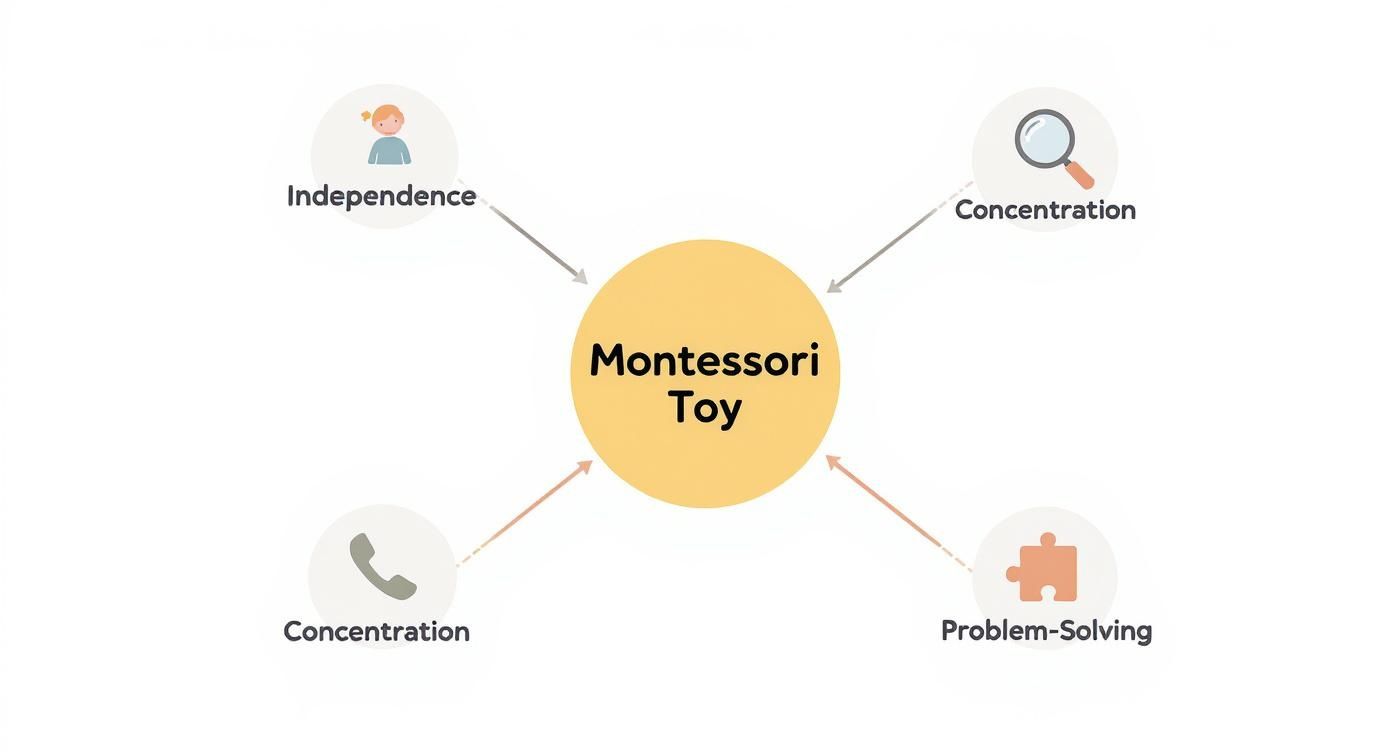
As you can see, each toy isn't just for play; it’s carefully designed to nurture a specific skill, building a strong foundation for a lifetime of learning.
7 to 12 Months: Figuring Out Cause and Effect
Once your baby is on the move—sitting up confidently, crawling, and pulling up on furniture—their understanding of the world takes a massive leap forward. They are now little scientists, constantly running experiments to figure out cause and effect. Their every action is driven by the question, "What happens if I do this?"
A classic toy for this age is the object permanence box. When a baby pushes a ball into the hole, it vanishes for a moment before rolling out into the tray. This simple game teaches a profound concept: things still exist even when you can't see them.
This is a huge milestone. It not only builds memory and problem-solving skills but can also help ease separation anxiety. Other brilliant toys for this stage include simple puzzles with big, chunky knobs and classic stacking rings. These activities help older babies refine their pincer grasp, learn about size and order, and feel that wonderful sense of satisfaction that comes from mastering a task all by themselves.
Toys for Toddlers: Ages 1 to 3 Years
Welcome to the whirlwind of the toddler years! This stage, from roughly one to three, is fuelled by a single, powerful phrase: "I can do it myself!" This isn't just a phase; it's the very engine of their development. The right Montessori toys for this age group won't just distract them—they will honour and support this incredible drive for independence.
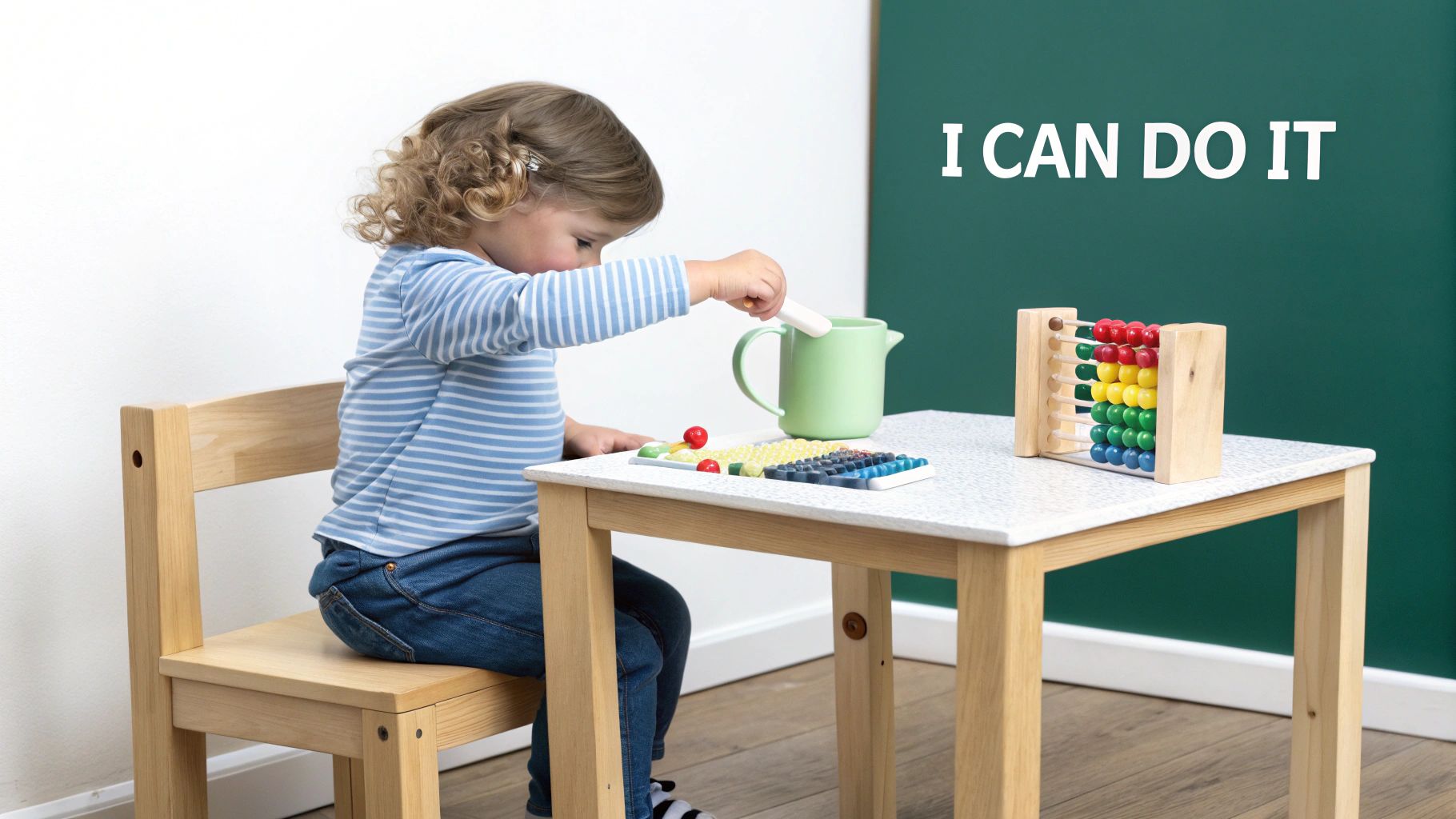
During this time, your child's physical skills are taking a giant leap forward. Gross motor skills—the big movements—are being refined through whole-body play. Think of a climbing triangle or a balance board. These aren't just for burning off toddler energy; they are brilliantly designed challenges that teach children what their bodies can do, building strength, coordination, and confidence along the way.
At the same time, their fine motor skills are becoming much more precise. Their little hands are suddenly capable of more intricate, delicate work. Activities that would have been impossible just a few months ago now become fascinating puzzles they are determined to solve.
Honing Fine Motor Precision
To support this newfound dexterity, Montessori materials for toddlers are all about control and coordination. These toys are designed to be repeated, inviting your child to practise a movement over and over until they feel that wonderful sense of mastery.
- Knobbed Puzzles: A classic for a reason! These are a big step up from simple baby puzzles. Each piece has a small knob, which encourages the use of the pincer grasp—the very same grip they'll need later for holding a pencil.
- Threading Activities: Offering large wooden beads and a thick lace presents a brilliant, yet achievable, challenge for their hand-eye coordination. It’s a simple activity that builds patience and the ability to concentrate.
- Posting and Sorting: A box with different-shaped holes and matching blocks is fantastic for teaching shape discrimination and developing early problem-solving skills.
Embracing Practical Life Activities
Perhaps the most important and unique part of a Montessori approach for toddlers is the introduction to practical life activities. These aren't really 'toys' at all; they are real, child-sized tools that allow toddlers to take part in the everyday work they see happening around them.
Giving your child a small jug to pour their own water, a wavy chopper to slice a soft banana, or a miniature dustpan and brush to sweep up crumbs is incredibly empowering. It sends them a clear and profound message: "You are capable. You are an important contributor to our family."
These practical tools do more than just build skills. They cultivate a deep sense of confidence, purpose, and self-esteem. When a child successfully pours their own drink or helps prepare a snack, they are learning real-world competence.
This focus on real-world tasks is a cornerstone of the Montessori method for this age group. If you'd like to see more ideas, you can explore a wider range of age-appropriate materials in our detailed guide to the best Montessori toys for toddlers.
To help you choose the most purposeful materials, here's a quick breakdown of some top recommendations categorised by the primary skill they support.
Montessori Toy Recommendations for Toddlers (1-3 Years)
This table breaks down recommended Montessori toys for toddlers, categorised by the primary developmental skill they support.
| Developmental Skill | Toy Example | What It Teaches |
|---|---|---|
| Gross Motor Skills | Climbing Triangle | Body awareness, balance, and physical confidence |
| Fine Motor Skills | Threading Beads | Hand-eye coordination and pincer grasp |
| Problem-Solving | Shape Sorter | Shape recognition and logical thinking |
| Practical Life Skills | Child-Sized Jug | Coordination, control, and independence |
Choosing toys that align with these developmental areas gives your toddler the tools they need to explore their world with confidence and joy.
Finding Toys for Preschoolers: 3 to 5 Years
Once a child hits the preschool years, something incredible happens. Between the ages of three and five, you can almost see the gears turning as they move beyond simple cause-and-effect. This is when their world explodes with abstract ideas, elaborate stories, and the ability to tackle multi-step problems. The best Montessori toys for this stage meet them right there, ready for this exciting new leap in their development.
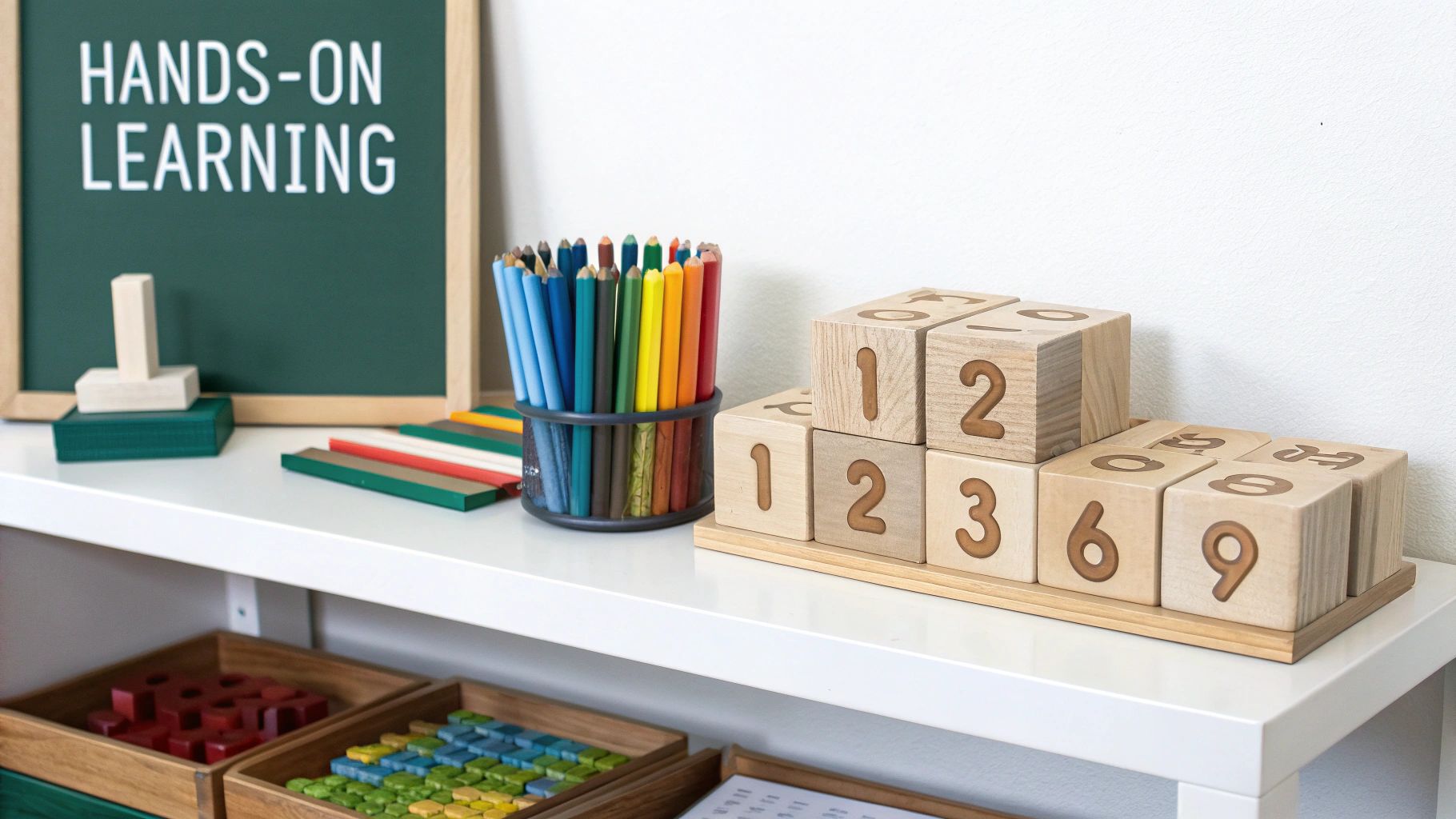
We're now building on the foundations laid in toddlerhood. The toys and activities become a bit more complex but stay true to that core Montessori principle of hands-on, purposeful play. Think of it like this: if the toddler years were about learning what flour and sugar are, the preschool years are about starting to follow a simple recipe. The play becomes more intricate, calling for longer periods of focus and more sophisticated thinking.
Making Abstract Concepts Concrete
One of the biggest cognitive shifts during this period is the blossoming of symbolic thought. This is the amazing ability to understand that a shape, a symbol, or a sound can stand for something else entirely. Montessori materials for this age are brilliant at bridging that gap between the physical and the abstract, especially when it comes to early maths and literacy.
- Sandpaper Letters: These are simple but genius. Each card has a sandpaper letter on a smooth board. As a child traces its shape with their finger, they build muscle memory for how the letter is formed. At the same time, they hear its sound, creating a powerful link between the physical feeling and the abstract symbol.
- Number Rods: This set of ten wooden rods gets longer with each number, with segments painted in alternating red and blue. It's a fantastic, concrete way to understand quantity. The rod for "three" isn't just a symbol; it's physically three times longer than the rod for "one," helping children truly internalise what numbers mean.
These aren't just teaching aids. They are carefully designed experiences that make learning feel as natural and intuitive as picking up a stone.
Building Complexity and Creativity
While those early academic skills are starting to take root, so is a child's imagination and their capacity to handle bigger challenges. The toys for this age need to grow with them, offering new layers of engagement every time they play. This is where more complex building sets and puzzles really come into their own.
Montessori toys for preschoolers are designed to challenge their growing intellect and patience. The goal is to present a task that is just difficult enough to be engaging, fostering persistence and the immense satisfaction of achieving a goal on their own.
Those open-ended wooden blocks, for instance, are no longer just for stacking into a wobbly tower. A three-year-old might build a simple wall, but a five-year-old is busy constructing elaborate cities, detailed bridges, and sprawling castles. These blocks are a powerhouse for creative thinking, spatial reasoning, and even collaborative play, making them a cornerstone of any Montessori playroom.
Mastering Real-World Skills
That fierce drive for independence we see in toddlers doesn't go away; it just evolves. Now, it’s about a desire for genuine competence. Practical life activities become more involved, mirroring the multi-step tasks we do every day and gently preparing children for the structure of school.
Take the dressing frames, for example. These are simple wooden frames, each featuring a different type of clothing fastener—buttons, zips, buckles, or bows. By practising on these frames, children develop the fine motor skills they need to get dressed by themselves. But more than that, they learn patience, concentration, and the deep satisfaction of seeing a task through from beginning to end. This hands-on practice builds a quiet confidence and a problem-solving mindset that will serve them for a lifetime.
Creating a Montessori Play Environment at Home
https://www.youtube.com/embed/E_OTVRRSYDQ
Having the right Montessori toys for your child’s age is a fantastic start, but it's only half the story. The real magic unfolds when you create a space that genuinely invites them to play and explore. This is what we call the ‘prepared environment’ in the Montessori world—a calm, orderly, and accessible space designed completely around your child.
Think of it like setting the stage for deep, meaningful play. Instead of a chaotic toy box spilling over with plastic, the Montessori approach favours low, open shelves. This one simple change empowers your child to see all their choices, select something that calls to them, and—just as importantly—put it back when they’re done.
An environment like this naturally fosters a sense of order and respect for their things. It also prevents that classic overwhelm we’ve all seen, where a child just flits from one toy to the next without ever really settling into anything. A simple, beautiful space encourages focus.
The Power of Toy Rotation
One of the best-kept secrets to keeping this prepared environment fresh and engaging is toy rotation. This isn't about buying more stuff. It's about being clever with what you already have. By putting out just a small, curated selection of toys—maybe six to ten items at a time—you make each one feel special and important.
When a toy that’s been tucked away for a few weeks makes a comeback, it feels brand new again. This simple cycle keeps your child genuinely interested in their materials, often inspiring them to discover new ways to play with old favourites. It’s a brilliant strategy for nurturing concentration and appreciation.
Observing Your Child’s Interests
The real key to making all of this work—the shelves, the rotation, everything—is simple observation. Your child gives you clues every single day about what their brain is busy working on. Dr. Montessori called these phases ‘sensitive periods’, which are essentially windows of intense fascination for a specific skill, whether it’s pouring, sorting, or climbing over the sofa for the tenth time.
By watching your child closely, you can tailor their environment to match their current developmental drive. If they are constantly trying to fit objects into containers, it’s the perfect time to introduce a shape sorter or an object permanence box. This alignment makes learning feel effortless and joyful.
A well-prepared environment is also, crucially, a safe one. For your child to explore with true independence, they need to be able to do so securely. This is where childproofing comes in. Taking the time to properly secure their space is fundamental. For a detailed walkthrough, check out this practical room-by-room guide to childproofing your home.
Ultimately, this approach helps you turn your home into a place where learning isn't a scheduled activity. It’s just a natural part of everyday life, led by your child’s amazing, built-in curiosity.
Your Montessori Questions Answered
Dipping your toes into the Montessori world often brings up a few questions. As you start swapping out noisy, flashing plastic for simpler, more thoughtful materials, it’s completely normal to wonder about the practical side of it all. We get it.
Let's clear up some of the most common queries we hear from parents. Think of this as a friendly chat to help you feel confident as you choose the best Montessori toys for your child’s unique journey.
Are Montessori Toys Only Made of Wood?
This is probably the biggest myth out there! While it's true you'll see a lot of beautiful wooden toys, the Montessori philosophy isn't about being a wood purist. The real focus is on using natural materials that give a child a rich sensory experience and a connection to the world around them.
Wood is fantastic—it’s sturdy, warm, and has a satisfying weight. But true Montessori materials come in all shapes and sizes, using a variety of natural elements:
- Metal: Think of tiny pitchers for pouring practice or a set of bells for exploring sound.
- Cotton and Fabric: Dressing frames are a classic example, helping little hands master buttons, zips, and bows.
- Glass: Small, child-sized glasses for drinking teach children to handle fragile items with care and respect.
The guiding idea is that the material should feel real and its purpose should be clear. It’s always about the quality and developmental value, never a strict "wood-only" rule.
How Many Toys Should My Child Have?
In a world that constantly tells us "more is more," the Montessori approach is a breath of fresh air. It champions a "less is more" philosophy, creating a calm, uncluttered space that invites deep focus rather than overwhelming a child with a sea of choices.
So, instead of a playroom overflowing with toys, the idea is to have a small, carefully chosen selection out at any one time.
A good rule of thumb is to have between 6 and 10 toys or activities available on a low, open shelf. This limited choice encourages your child to truly engage with each item, discover its full potential, and master the skill it offers.
You then rotate these toys every week or two, based on what your child is drawn to. This keeps their play space feeling fresh and exciting, helping them build amazing concentration without the chaos.
Can I Mix Montessori Toys with Others?
Absolutely! Bringing Montessori principles into your home doesn't have to be an all-or-nothing decision. Most families find a happy medium that works for them. You can prioritise Montessori-style materials for focused, skill-building activities while still making room for other much-loved toys.
Open-ended toys like LEGOs for building or dolls for imaginative play can sit happily alongside a Montessori shelf. The key is to be mindful of the overall feeling of the space. It’s a good idea to limit the toys with lots of flashing lights and loud sounds, as they often lead to passive watching rather than active, child-led discovery. The goal is to create an environment that, first and foremost, nurtures your child’s natural curiosity and ability to concentrate.
At Grow With Me, we take the guesswork out of finding the perfect stage-based toys. Our curated play kits are designed to support your child’s development at every step, delivering high-quality, purposeful toys right to your door. Explore our subscription boxes today at https://shop.growwithmesubscriptionbox.co.uk.