

What Is Heuristic Play? A Guide to Child-Led Discovery
Ever watched a toddler excitedly unwrap a fancy new toy, only to spend the next hour playing with the cardboard box it came in? Or perhaps they’ve completely ignored their colourful plastic rattles in favour of your house keys. That right there, in a nutshell, is the magic of heuristic play.
It's a beautifully simple, child-led approach that’s all about giving little ones a collection of safe, everyday objects to explore on their own terms, without any adult instructions getting in the way.
The Simple Power of Child-Led Discovery
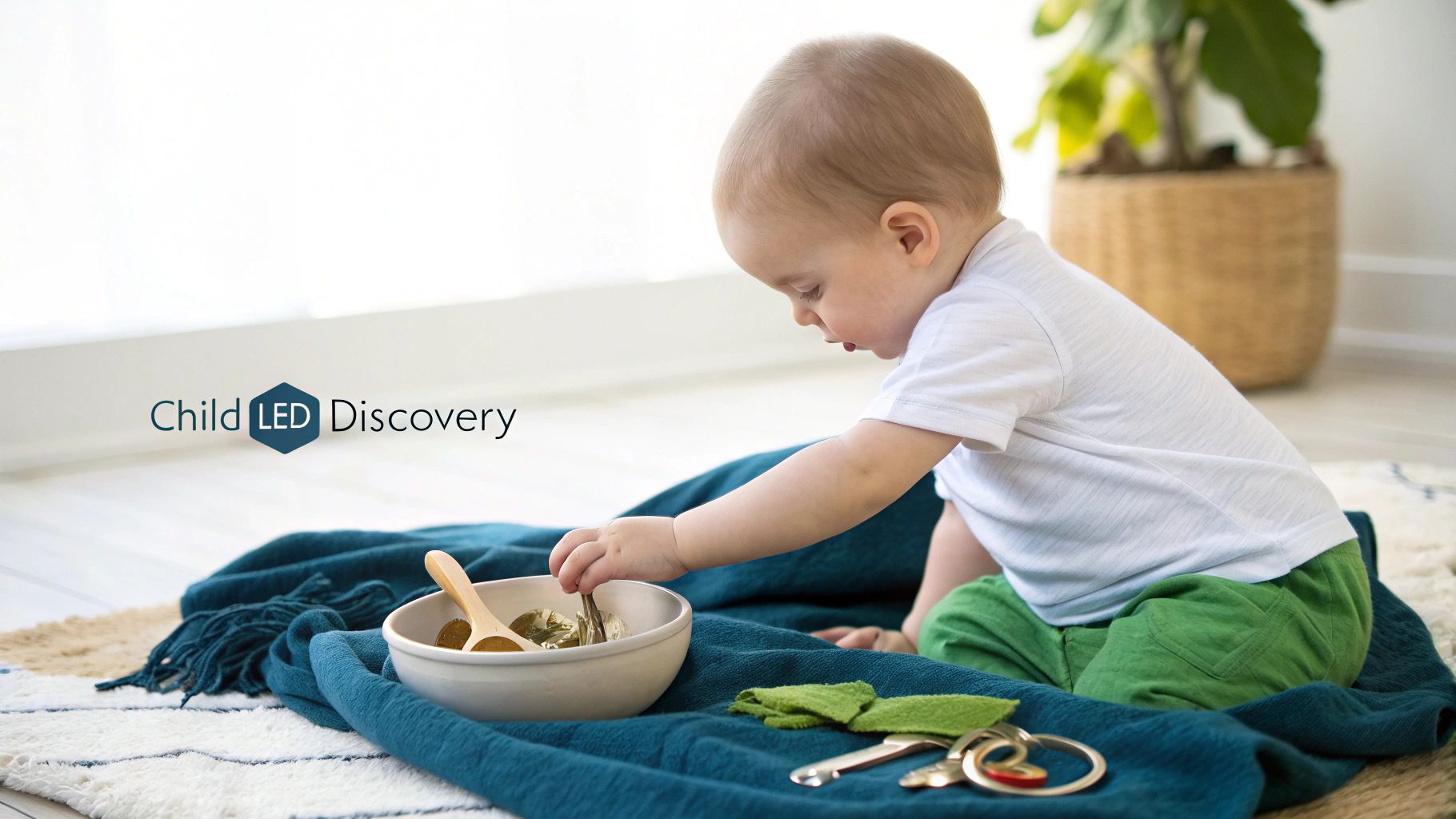
Unlike a toy designed for a single purpose, like a shape-sorter or a puzzle, heuristic play uses a treasure trove of items with different textures, shapes, and materials. Think wooden spoons, metal bowls, and silky scarves. This variety is what sparks a child's natural curiosity.
The adult's role isn't to show them what to do, but to simply sit back and observe. As your child explores, they're discovering big concepts like weight, texture, sound, and gravity entirely for themselves. It’s a wonderful way to nurture their innate problem-solving skills and sensory development, no expensive toys required.
This philosophy fits perfectly with many positive parenting approaches, as it empowers children to become confident learners through their own discoveries.
So, Where Did the Idea Come From?
The term 'heuristic play' was first introduced back in the 1980s by the brilliant child psychologist and educator, Elinor Goldschmied. It comes from the Greek word 'eurisko', which means 'to discover' or 'to find out'. It’s the perfect name for this wonderfully exploratory style of learning.
At its core, heuristic play is all about letting children discover the properties of everyday objects through their own free play. The experience is about the process of exploring, not creating a finished product.
This hands-off approach is so powerful because it’s built on a few key principles:
- Child-Led Exploration: Your child is in the driver's seat. They decide what to touch, how to combine things, and when to move on, which builds their independence and self-confidence.
- Rich Sensory Engagement: Offering a mix of materials—smooth wood, cool metal, soft fabric—gives them a wealth of sensory information to process.
- Cognitive Growth: As they bang, stack, roll, and sort the items, they're learning fundamental lessons about cause and effect. It's science in its purest form!
- Quiet Observation: By providing a safe space and simply watching without interfering, you help your child build incredible focus and concentration.
By putting together a simple basket of interesting bits and bobs from around the house, you're not just keeping them busy; you're setting the stage for deep, meaningful learning. This forms a fantastic foundation for all sorts of play-based learning activities that support your child's development for years to come.
Unpacking the Core Ideas Behind Heuristic Play
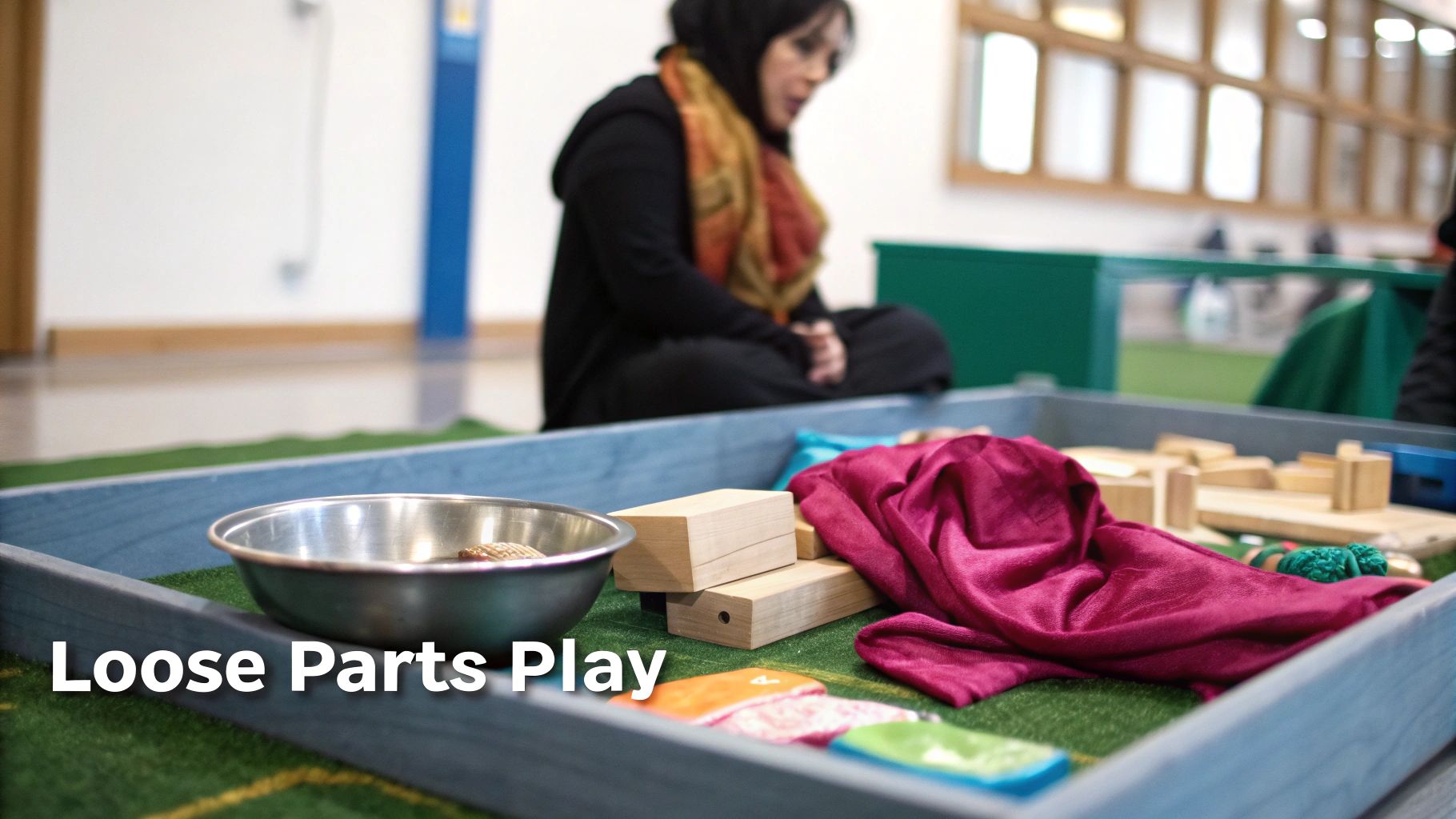
Heuristic play isn't simply about tipping a box of random bits onto the floor; it’s a really thoughtful approach to learning, built on a few powerful ideas. When you grasp the "why" behind it, you can truly unlock its magic. The best way to think of your role is not as a play director, but as a careful curator of curiosity.
Your job is to create a safe, calm space and offer up a treasure trove of different items that just beg to be explored. This brings us to the heart of it all: loose parts. These are simply open-ended objects with no fixed purpose—things like wooden spoons, metal tins, smooth pebbles, and scraps of fabric.
A plastic toy car is always a car, but a pinecone can be anything. This is the freedom that makes heuristic play such a powerhouse for developing creativity, problem-solving, and focus.
The Power of a Focused Environment
Setting aside a specific time and place for this kind of play is another key ingredient. Heuristic play thrives in a calm, focused session, away from the usual distractions of flashing toys, screens, or even a noisy television in the background.
Carving out a dedicated slot, maybe on a simple mat in the corner of a room, sends a clear signal to your child: this is a special time for deep, uninterrupted discovery. This structured quiet time is fantastic for helping children build an amazing capacity for concentration.
By providing a curated collection of objects within a calm environment, you give your child the mental space to make their own connections and discoveries without feeling overwhelmed.
Child-Led Discovery Is Key
Perhaps the most important principle of all is letting your child take the lead. Completely. Your role is simply to be a quiet, reassuring presence, observing from nearby without jumping in. It can be hard, but you have to resist the urge to show them what to do with a whisk or suggest they put one thing inside another.
This hands-off approach builds incredible self-confidence and a sense of independence. When a child figures out for themselves that a wooden ring makes a satisfying clunk inside a metal bowl, the learning sticks in a way that being told never could. This philosophy has a lot in common with other play-based learning, and you can see similar ideas in Montessori toys by age that also champion independent discovery.
Ultimately, by trusting them to explore, you empower them to become confident, capable learners who aren't afraid to try things out for themselves.
How Heuristic Play Fuels Your Child’s Growth
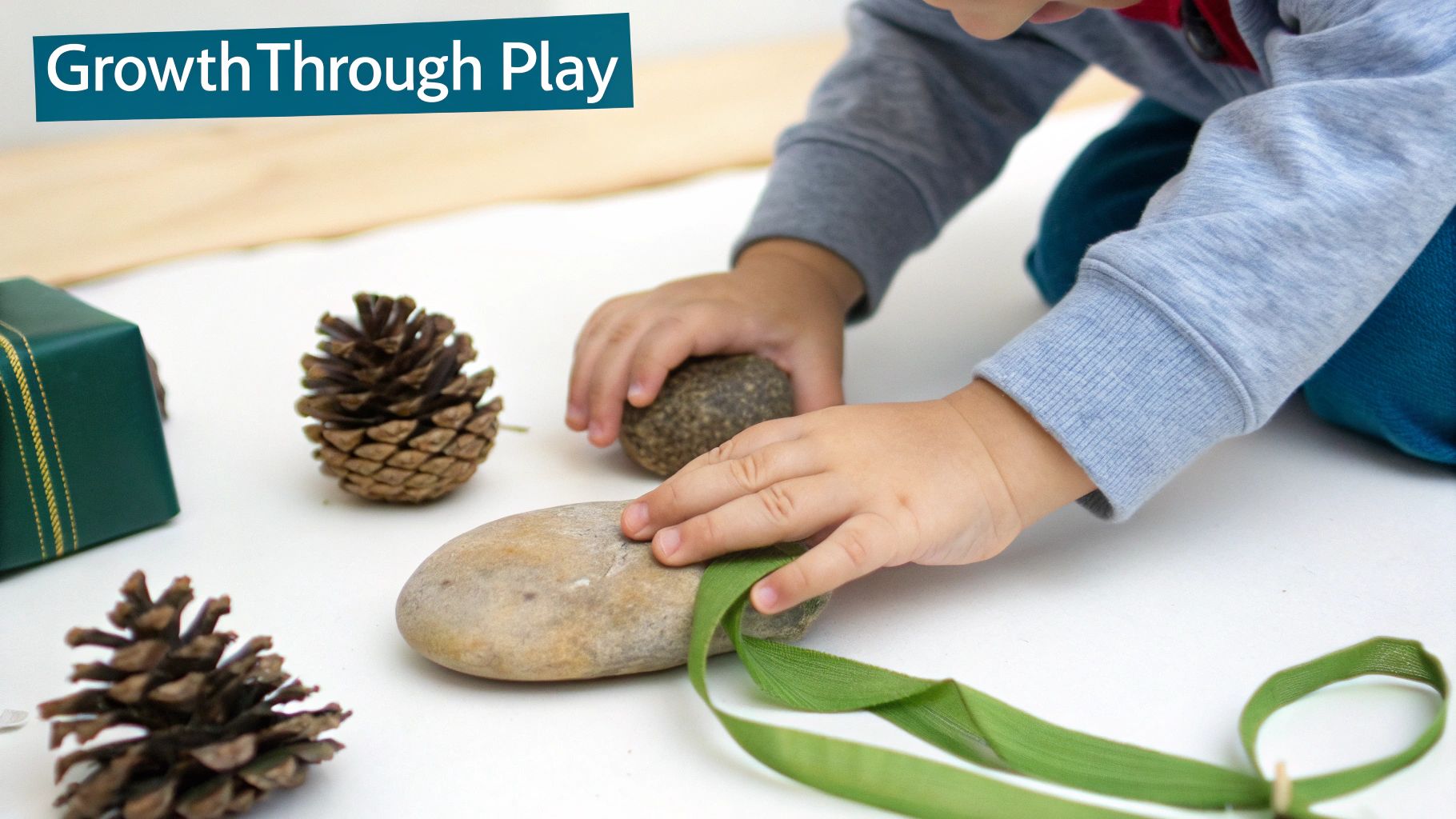
Heuristic play might just look like a child making a mess with a bunch of random objects, but there’s so much more going on. Beneath the surface, this simple, hands-on exploration is a powerhouse for development. Every time your little one picks up, bangs, or drops something, they’re forging vital connections in their brain and building skills for life.
Think of them as tiny scientists in their own lab. When they try to stack a smooth stone on a wobbly pinecone, they're not just playing—they're running an experiment on gravity and balance. This is how they start to grasp foundational concepts of physics and sharpen their natural problem-solving skills, all on their own terms.
Each interaction teaches a mini-lesson in cause and effect. They quickly figure out which objects roll, which ones stack, and which can be nested inside one another. This independent discovery builds a deep, practical understanding of how the world really works, far better than any explanation could.
Building Strong Bodies and Minds
The physical benefits are just as impressive. Grasping a chunky wooden ring, a rough piece of bark, or a silky ribbon strengthens all the small muscles in their hands and fingers. This is a huge step in developing the fine motor skills they’ll eventually need for writing, drawing, and buttoning a coat.
This focused play is also fantastic for honing hand-eye coordination as they learn to handle different objects with more and more precision.
Heuristic play is a sensory feast. By exploring a wide variety of textures, weights, and temperatures, children learn to process and organise sensory information—a fundamental skill for navigating their environment.
Fostering Emotional Confidence
Perhaps one of the most powerful outcomes is the boost to a child’s emotional wellbeing. Because this kind of play is completely self-directed, every single discovery is theirs. That sense of achievement is a massive builder of self-confidence and independence.
They learn to trust their instincts and enjoy their own company, which naturally improves focus and concentration. By figuring things out for themselves, they aren't just playing with stuff; they’re building a strong sense of self as a capable, curious, and clever little person.
Building Your First Heuristic Play Treasure Basket
Ready to create your first heuristic play experience? A Treasure Basket is the perfect place to begin. It's a brilliantly simple idea, designed for babies who are able to sit up confidently but aren't crawling just yet.
At its core, a Treasure Basket is a low, shallow, and sturdy basket filled with a hand-picked collection of safe, everyday objects. The idea isn't to just throw random bits and bobs in there. Instead, you're curating a selection of items that offer a whole world of sensory feedback – different textures, weights, temperatures, sounds, and smells.
Choosing Your Treasures
The most captivating items are often the ones you can find right in your own home. When you’re gathering objects, try thinking in categories. This helps you create a really varied and stimulating collection for your little one.
A well-rounded treasure basket offers a rich mix of materials. Here’s a quick look at how you could categorise items to get you started.
Sample Heuristic Play Treasure Basket Items
| Object Category | Example Items |
|---|---|
| From Nature | Large, smooth pebbles (too big to be a choking hazard), pinecones, large seashells, a lemon or a lime. |
| Wooden Items | A wooden spoon, a coaster, a napkin ring, smooth curtain rings, a small peg doll (unpainted). |
| Metal Objects | A set of measuring spoons on a ring, a small whisk, a tea strainer, a sealed tin with rice inside for a shaker. |
| Textiles & Brushes | A scrap of silk or velvet, a new nail brush, a clean make-up brush, a square of hessian fabric. |
The magic lies in variety and novelty. Over time, you can build up a collection of 50-80 different items, swapping them in and out to keep the basket exciting. If you're looking for more ideas, our guide to sensory toys for babies has some wonderful suggestions that fit this exploratory style of play perfectly.
Safety Is Your Top Priority
While the basket should be full of fascinating things, your number one job is to make sure everything is completely safe. You are the curator, and that means checking that every single item is suitable for your baby to explore with their hands and mouth.
Before every single play session, check each object thoroughly. Your quiet observation during play is not just about letting your child lead; it's also your most important safety tool.
Always be on the lookout for potential hazards:
- Choking Hazards: A good rule of thumb is that nothing should be small enough to fit through a toilet roll tube.
- Sharp Edges or Splinters: Run your hands over everything. Check for rough patches on wooden items or sharp edges on metal ones.
- Toxic Materials: Steer clear of anything with flaking paint, batteries, or unknown plastics. Natural and food-grade materials are always your best bet.
- Cleanliness: Give everything a good wipe-down before it goes into the basket.
Taking these simple steps ensures you're creating a safe and wonderfully engaging Treasure Basket. It's an open invitation for your baby to touch, feel, and discover the world on their own terms.
Addressing Common Misconceptions About Heuristic Play
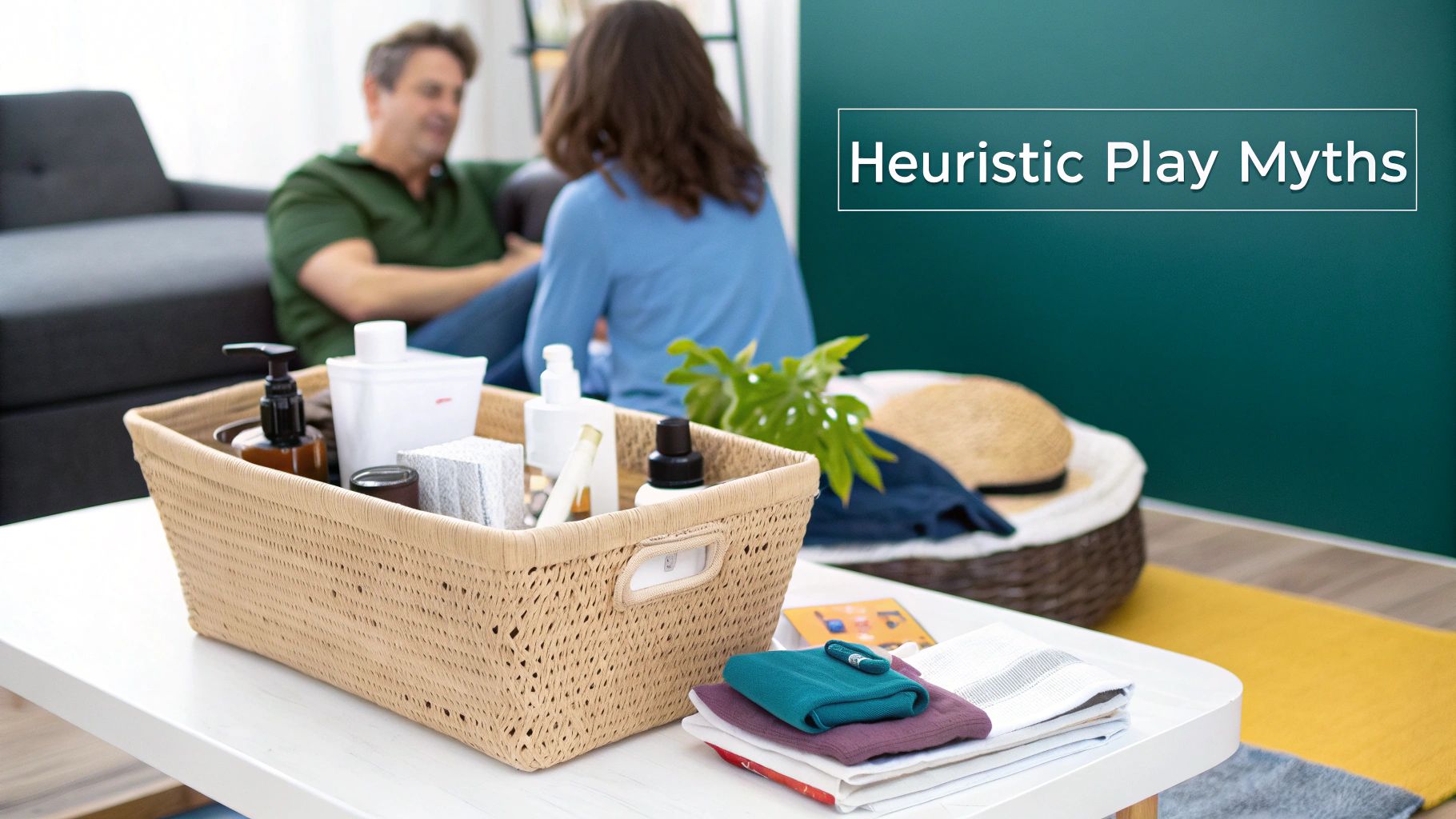
When you first hear about what is heuristic play, it's completely normal for a few questions and even some doubts to pop up. Let's tackle some of the common myths that can sometimes prevent parents from trying out this beautifully simple way of playing.
One of the biggest worries is that it’s just “letting kids play with junk.” Honestly, that couldn’t be further from the truth. Heuristic play isn't about handing over random bits of household clutter. It’s a very deliberate process of curating a collection of safe, clean, and stimulating objects chosen specifically to spark a child’s natural curiosity.
Another frequent thought is that it looks messy and a bit chaotic. And while exploration can certainly get busy, a Treasure Basket session is surprisingly contained. This kind of focused play, usually within a defined space, actually helps children build incredible concentration skills. They learn to engage deeply with the materials right in front of them.
Shifting Your Perspective on Play
There's a deep-seated belief that children need special "educational toys" to learn properly, and this is a major hurdle for many. But the reality is, the most profound learning often happens with the simplest, most open-ended items. Think about it: a plastic toy that sings one song has one purpose. A wooden spoon, on the other hand, can become a thousand different things in a child’s imagination.
The role of the adult in heuristic play is not one of passive neglect, but of active trust. Your quiet, observant presence is a powerful act of support that empowers your child to become a confident, independent learner.
Finally, we need to rethink what the adult's job is during this playtime. It can feel really strange to just sit back and watch, almost like you're not doing enough. But this isn't neglect; it's a huge act of trust. By resisting the urge to jump in and direct the play, you’re sending a powerful message to your child: "I trust you to explore, discover, and learn all by yourself."
Your Questions About Heuristic Play Answered
Dipping your toes into the world of heuristic play can bring up a few questions. It’s a bit different from the kind of playtime we might be used to, but once you get the hang of it, you’ll see just how rewarding it is.
Let's walk through some of the most common queries that pop up for parents and caregivers. Getting these practicalities sorted will help make every session a smooth, safe, and joyful experience for you both.
What Is the Best Age to Start Heuristic Play?
The magic window for introducing a Treasure Basket is right when your baby can sit up confidently but isn't quite on the move yet. This is usually somewhere between 6 to 10 months old. At this stage, they can fully focus on the collection of objects in front of them without being tempted to crawl off and explore the rest of the room.
This allows them to get completely absorbed in feeling, tasting, and listening to the items. As they grow into toddlers, the spirit of heuristic play simply evolves. It becomes ‘discovery play,’ using larger items spread out across a safe space, but it’s all built on the same foundation of curiosity-led learning.
How Should I Clean and Maintain the Play Objects?
Making sure everything is clean and safe is, of course, the top priority. Before any play session, give every item a quick once-over to check for any potential hazards, like splinters on a wooden ring or any small parts that might have come loose.
When it comes to cleaning, simple is always best:
- Wooden, metal, and plastic items can be wiped down with a bit of mild soap and water. A diluted white vinegar solution also works well.
- Natural objects like pinecones or big shells just need a good brush to get rid of any dirt.
- Fabric scraps can just be thrown in with your regular laundry.
Steer clear of harsh chemical cleaners. And remember, the most important safety tool is you. Always supervise your little one closely while they’re exploring.
How Often Do I Need to Rotate the Items?
Keeping the collection feeling fresh is what maintains your child's interest and opens up new avenues for learning. The trick is not to swap everything out at once, as that can be a bit too much for a little one to take in.
A good rule of thumb is to change just a handful of items—maybe five to ten things—every week or two. This small change introduces novelty without taking away the comfort of their favourite, familiar objects.
Pay attention to what your child is drawn to. If you notice they’re starting to ignore a particular item, that’s your cue to swap it for something new. This will reignite their curiosity and offer a completely different sensory puzzle to solve.
What Is My Role During a Play Session?
This is probably one of the most important—and sometimes hardest—parts of heuristic play. Your job is to be a quiet, watchful guardian. Nothing more.
You need to be physically present, sitting close enough to ensure they are completely safe, but you have to resist the urge to jump in. That means no guiding, no suggesting, and not even any praising. Your calm, reassuring presence is all the encouragement they need to explore with confidence.
By stepping back, you’re giving your child an incredible gift: the freedom to develop deep concentration, figure things out for themselves, and build real confidence in their own abilities. Your role is simply to watch the magic unfold.
At Grow With Me, we believe in the power of play to shape bright futures. Our curated subscription boxes are filled with high-quality, stage-based toys designed to support your child’s developmental journey, from their first sensory explorations to more complex imaginative play. Discover our play kits and give your child the tools to learn and grow. Explore the collection at https://shop.growwithmesubscriptionbox.co.uk.