
What Is the Reggio Emilia Approach? what is the reggio emilia approach explained
The Reggio Emilia approach isn’t just another educational buzzword; it’s a way of seeing children for who they truly are: competent, curious, and creative little people, perfectly capable of shaping their own learning journey. Think of it less as a strict curriculum and more as a collaborative partnership between children, educators, and parents, where every discovery is celebrated.
Unpacking the Reggio Emilia Philosophy
Picture a community in post-war Italy, determined to build a better future for their children. That’s where the Reggio Emilia philosophy began. It’s an approach born from hope, built on the revolutionary idea that children aren’t empty vessels waiting to be filled with facts. Instead, they are active participants in their own development, already full of potential and ideas.
At its heart, this philosophy is less concerned with what children should learn and far more interested in how they learn. It trusts in a child's natural curiosity and their incredible capacity to make sense of the world, as long as they have the right support and tools to do so. It’s an approach grounded in profound respect for the child as a capable citizen from the moment they are born.
Key Ideas You Will Discover
This guide will walk you through the core components that make this approach so special and effective. You'll learn about:
- The Child as a Protagonist: Seeing your child as the main character and driver of their own learning adventure.
- The Environment as the Third Teacher: How a thoughtfully arranged space can spark curiosity and invite discovery all on its own.
- The Power of Documentation: Making learning visible by capturing your child’s process through photos, notes, and their own amazing creations.
- The Hundred Languages of Children: Recognising that children express their knowledge in countless ways—from painting and building to dancing and storytelling.
The Reggio Emilia approach is built upon the constructivist learning theory, which essentially means children build their own understanding of the world by doing and experiencing, not by passively listening. This core idea shapes every part of the philosophy.
This child-led, relationship-driven model flips traditional learning on its head. Instead of top-down instruction, it becomes a collaborative dance of discovery. The goal is deep, meaningful engagement, which is also a cornerstone of effective play-based learning activities. It’s all about creating a rich, stimulating environment where your child feels safe and empowered to ask big questions, test their theories, and share their unique view of the world.
Core Principles of the Reggio Emilia Approach at a Glance
To help you get your head around these foundational ideas, the table below provides a simple summary. Think of it as a quick reference guide to what the Reggio Emilia approach truly means for you and your child.
| Principle | What It Means for Your Child |
|---|---|
| The Image of the Child | Your child is seen as strong, capable, and full of potential from birth. |
| The Role of the Teacher | The adult is a co-learner and researcher, guiding discovery rather than directing it. |
| The Environment as the Third Teacher | The physical space is intentionally designed to be inspiring, inviting, and rich with possibilities. |
| The Hundred Languages | Your child has countless ways to express their thoughts, and all are valued and encouraged. |
| The Importance of Documentation | Your child’s work and words are documented to make their learning visible and celebrated. |
Now that we have a bird’s-eye view, let’s dive deeper into what makes each of these principles so powerful for your child's development.
The Inspiring Story Behind This Philosophy
To really get to the heart of what the Reggio Emilia approach is, you have to go back to where it all began. This isn't a story from a dusty old textbook; it's a story of resilience and hope born from the rubble of post-war Italy, in a town called Reggio Emilia.
The city had been devastated by World War II, but the spirit of the community was anything but broken. The parents there shared a deep, powerful belief: they would not allow their children's education to be shaped by the same rigid, authoritarian thinking that had led to the war. They envisioned something new, a school built on respect, democracy, and an unwavering belief in a child's potential.
Rebuilding with Hope and Bricks
This wasn't some grand plan handed down by academics or politicians. It was a true grassroots movement, started by ordinary families who wanted better for their children. In a story that's now legendary, the parents quite literally built the first preschool themselves. They sold a leftover German tank to raise money, and the women of the village gathered bricks from bombed-out buildings, carrying them on their bicycles to build a new place of learning.
This history is the very soul of the philosophy. It wasn't just about putting up a building; it was about creating a community where children's ideas mattered and their voices were heard. It was a radical act of hope, a statement that education could be a force for building a more peaceful, democratic world.
The Vision of Loris Malaguzzi
At the centre of this incredible effort was a young teacher and psychologist named Loris Malaguzzi. When he heard what the parents were doing, he rode his bicycle out to see it for himself. He was so moved by their determination that he dedicated the rest of his life to their vision, becoming the guiding force who helped shape their passion into a clear educational philosophy.
"Stand aside for a while and leave room for learning, observe carefully what children do, and then, if you have understood well, perhaps teaching will be different from what you imagined." - Loris Malaguzzi
Malaguzzi didn't arrive with a set curriculum in hand. Instead, he listened. He worked shoulder-to-shoulder with parents and teachers to develop an approach that responded directly to the children, celebrating their natural curiosity and what he famously called their "hundred languages" for understanding and expressing the world.
That collaborative, community-driven spirit is still a cornerstone of the approach today. Its influence has spread across the globe, inspiring early years settings here in the UK since the early 1990s. Back in Reggio Emilia, the legacy continues, with over 90% of pre-school-age children enrolled in these exceptional municipal programmes. To get a feel for this influential model, you can read this insightful report from the Sightlines Initiative.
Understanding the Three Teachers in Your Child's World
One of the most powerful and beautiful ideas from the Reggio Emilia approach is the concept of the “three teachers.” This isn’t about having lots of adults in the room; it’s a whole new way of looking at learning as a rich, collaborative relationship between your child, you, and the world around them.
Getting to grips with these three teachers can completely shift how you see your role as a parent and even how you view your own home. It reframes learning from something that is done to a child to something that grows organically from within them and their surroundings. It's a true partnership, where each ‘teacher’ plays a vital and respected part in the journey of discovery.
The First Teacher: The Child
The first, and most important, teacher is the child themselves. Reggio Emilia philosophy sees every child, right from birth, as a competent, capable, and deeply curious person who is the main character in their own learning story. They aren't empty buckets waiting for us to pour knowledge into them; they are brimming with potential, ideas, and theories about how the world works.
Your child’s natural curiosity is the engine driving their education. When they repeatedly drop a spoon from their highchair, they aren't just making a mess; they're a tiny physicist exploring gravity. When they're mesmerised by a shadow dancing on the wall, they are both an artist and a scientist observing light and form.
This perspective invites us to trust in our children’s innate drive to learn. It means stepping back, watching what fascinates them, and realising that their play is serious, meaningful work.
By honouring the child as the first teacher, we learn to listen to their "hundred languages"—all the incredible ways they express their thoughts through play, art, movement, and sound. This respect builds the foundation for their confidence as a lifelong learner.
The Second Teacher: The Adult
The second teacher is the adult—that’s you, the parent, or their nursery teacher. In the Reggio approach, your role isn't that of a traditional instructor who simply hands out information. Instead, you are a co-learner, a researcher, and a guide on this shared adventure.
Your job is to listen carefully, observe what your child is exploring, and then offer the resources and encouragement they need to dig deeper. If your toddler is suddenly obsessed with stacking blocks, you might bring in different types of blocks or even natural materials like smooth stones to extend their investigation.
It's a delicate balance of being actively involved while also knowing when to stand back and watch patiently. You’re there to spark new ideas, ask open-ended questions (“I wonder why that tower fell?”), and document their learning to make it visible. This partnership strengthens your bond and shows your child that their ideas are truly valued.
The Third Teacher: The Environment
Finally, we come to the third teacher: the environment. This is perhaps the most unique aspect of the Reggio Emilia approach and one you can start influencing at home right away. The physical space your child lives and plays in is seen as a powerful educator in its own right, fully capable of sparking curiosity, encouraging teamwork, and fostering independence.
A cluttered, overstimulating room filled with flashing plastic toys can feel like trying to have a conversation in a noisy, crowded room. In contrast, an environment that is calm, organised, and filled with interesting, open-ended materials invites deep focus and exploration. Think of your home not just as a place to live, but as a living, breathing learning landscape.
The flowchart below shows how the community-focused beginnings of this philosophy helped cement the value of the environment from day one.
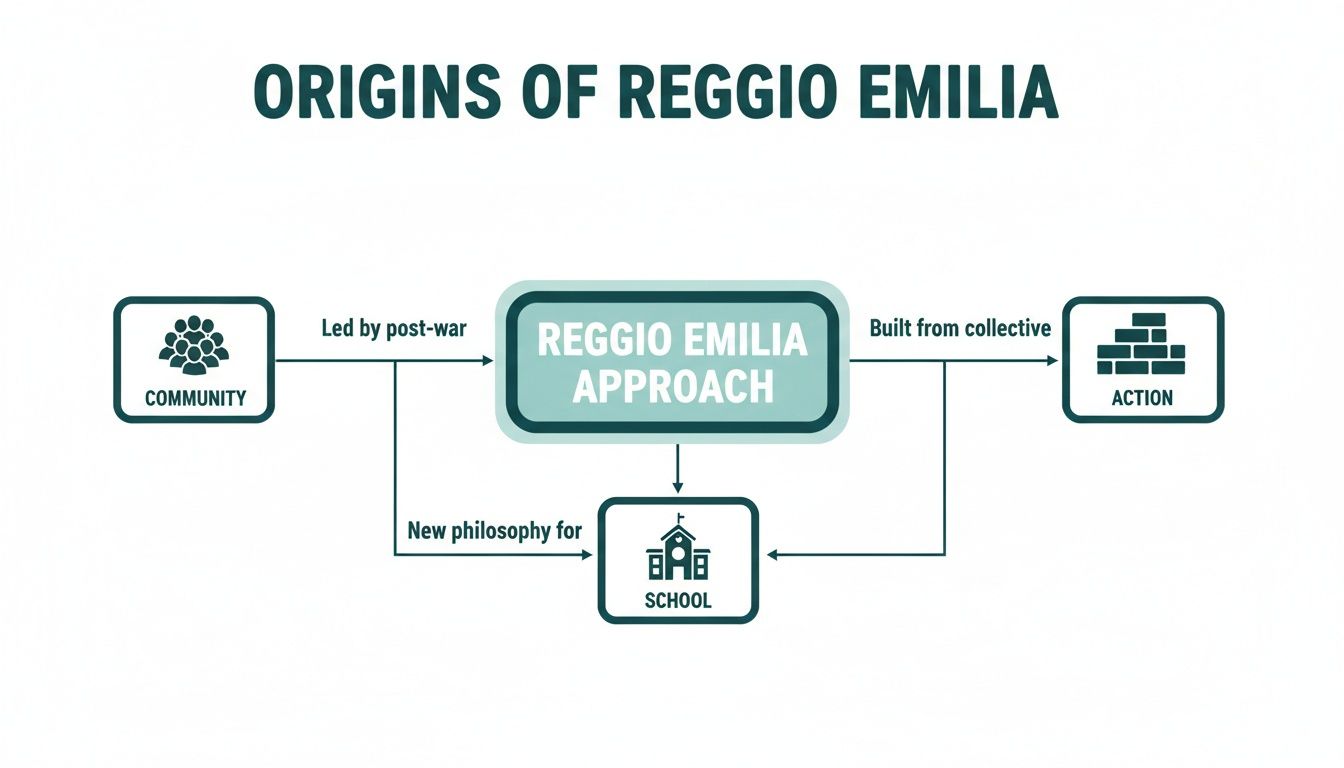
As you can see, the whole approach was born from a community taking action to build a better school, which shows just how central the physical space has always been.
Focusing on the environment as the 'third teacher' has led to some incredible results in early years settings. In the UK, it has been linked to a reported 30% increase in creative outputs since 2000. The idea has caught on, too; by 2015, over 500 nurseries across England had brought Reggio-inspired art studios, or ateliers, into their spaces. You can learn more about these UK findings and the real-world impact on early education.
How to Bring Reggio Principles into Your Home
Understanding the theory behind the Reggio Emilia approach is one thing, but bringing its spirit into your home is where the real magic begins. You don’t need to transform your house into a formal classroom. Instead, think of it as making small, intentional shifts that honour your child’s natural curiosity and celebrate their unique way of seeing the world.
Creating a Reggio-inspired home is really about viewing your space through your child’s eyes. It’s about slowing down, observing what sparks their interest, and offering simple tools to help them explore those ideas further. This simple shift turns everyday moments into rich learning opportunities and deepens your connection as you become a co-explorer on their journey.
Create an Inviting Play Space
The Reggio philosophy sees the environment as the “third teacher,” a powerful force in a child’s development. An inviting play space doesn’t need to be huge or expensive; it just needs to be thoughtful. The goal is to create a calm, organised area that encourages independence and deep focus.
Start by decluttering. Too many toys can be overwhelming, causing children to flit from one thing to the next without ever settling. Instead, try rotating a smaller selection of toys on low, accessible shelves. This simple change empowers your child to make their own choices and gently encourages them to care for their belongings.
Think about the atmosphere of the space.
- Natural Light: If you can, position their play area near a window. Natural light creates a calming, warm environment that’s much easier on young eyes.
- Neutral Tones: Using a calm, neutral colour palette for walls and storage allows the colourful toys and your child’s vibrant creations to become the real focal point.
- Comfort: Add a soft rug, some cushions, or a child-sized chair to create a cosy and welcoming nook where they can comfortably play or look at books.
Follow Your Child's Lead
This is probably one of the most important principles: letting your child's own interests drive their learning. Your role isn’t to direct their play but to become a careful observer and responsive guide. Pay close attention to what truly captivates them. Is it posting items through slots, lining up their toys, or splashing in every puddle they see?
These fascinations are called schemas—repeated patterns of behaviour through which children explore complex ideas. They are the essential building blocks of their understanding. Once you spot a schema, you can support it with simple materials.
For example, if your toddler is fascinated with transporting things from one place to another, you could provide a few baskets, some small bags, and a collection of smooth stones or wooden blocks. This simple act validates their interest and gives them the tools to investigate their theory more deeply.
This kind of open-ended play, where children lead the exploration with simple objects, is an incredibly powerful learning tool. To explore this idea further, you can discover more about what is heuristic play in our detailed guide and how it nurtures a child's natural curiosity.
Document Their Learning Journey
In the Reggio world, documentation is a beautiful way to make learning visible. This isn’t about assessment or testing; it’s about honouring your child’s process and showing them that their thoughts and creations are valued. It can be as simple as taking a photo of an impressive block tower or jotting down a curious question they asked.
Displaying their work is a powerful form of documentation. Hang their artwork at their eye level. This sends a clear message: “What you do here is important and respected.” You could also create a small scrapbook or journal with photos of their projects and little notes about what they said or did. This becomes a cherished record of their thinking and a wonderful tool to look back on together, revisiting past ideas and sparking new ones.
A key tenet of Reggio Emilia is the 'hundred languages of children,' which recognises their many different ways of expressing themselves. You can foster this by exploring methods for engaging K1 K2 children with multisensory play and educational activities at home.
Using Play Kits in a Reggio-Inspired Way
Subscription boxes, like the Grow With Me kits, are perfectly suited for a Reggio-inspired approach because they provide high-quality, open-ended materials. The description cards included with each kit can act as your guide, explaining the developmental purpose behind each toy and offering gentle prompts.
Instead of presenting the whole box at once, which can be a bit much, try introducing just one or two items that seem to align with what your child is interested in at that moment. This simple trick encourages much deeper engagement with each object.
Here are a few ideas for using items from your play kit in a way that truly follows your child's lead.
Reggio-Inspired Activities with Your Play Kit
| Toy Type | Reggio-Inspired Play Idea | Developmental Skill Supported |
|---|---|---|
| Wooden Blocks | Offer the blocks alongside natural items like shells or leaves. Watch to see how they combine them in their structures. | Creativity and problem-solving |
| Sensory Balls | Set up a "discovery basket" with balls of different textures, some soft fabrics, and a wooden spoon for exploration. | Sensory processing and fine motor skills |
| Stacking Rings | Forget just stacking. See if they roll them, line them up, or use them as bracelets. Follow their lead and their imagination. | Hand-eye coordination and object permanence |
By using these toys as invitations rather than instructions, you open up endless possibilities for discovery. This shift in perspective makes your child the true director of their own play, which is exactly what Reggio is all about.
Your Role as a Partner in Their Learning Journey
In the world of Reggio Emilia, you’re not a spectator watching from the sidelines. You are a vital, active partner in your child's education. This beautiful philosophy sees learning not as a solo mission for your little one, but as a collaborative dance between the child, the family, and the educator. It’s all about building a strong community around them, where everyone learns together.
This means gently shifting your perspective. Instead of being a ‘teacher’ who has all the answers, you become a ‘co-learner’ and a fellow researcher, discovering the world right alongside your child. It's a role that’s far less about instruction and much more about connection, observation, and shared wonder.
Becoming a Co-Learner and Researcher
Stepping into the role of a co-learner is incredibly freeing. It takes away the pressure to know everything and instead invites you to just be curious. When your child is completely absorbed in mixing paint colours or figuring out how to build a taller tower, you don’t need to jump in with the solution. Your role is to simply be present, to wonder aloud, and to ask gentle, open-ended questions.
Little acts of listening and watching can transform your daily interactions.
- Observe their play: What really fascinates them? Is it the way light casts shadows on the floor? Or the sound water makes when it splashes?
- Listen to their theories: When they tell you the sky is blue because a giant painted it, your job isn't to correct them, but to listen and explore their idea.
- Ask curious questions: Try using phrases like, "I wonder what would happen if..." or "Tell me more about what you’ve made."
This approach helps you understand the ‘why’ behind their play. You start to see their actions not as random, but as tiny experiments driven by a genuine need to understand the world. This shared investigation is the very heart of a powerful learning partnership. The goal here is to engage in what's known as sustained shared thinking, where you and your child solve problems and build ideas together. To dive deeper, you can learn more about sustained shared thinking in our article.
The Power of Community and Relationships
The Reggio Emilia approach was born from a deep sense of community. This collaborative spirit naturally extends to the relationship between home and school, weaving a strong, supportive network for your child. Parental involvement is at the very core of the philosophy, creating a seamless and consistent learning experience.
In a Reggio-inspired setting, the relationship is a two-way street. You share insights about your child's interests at home, and the educators share observations from their day. Together, you build a complete picture of your child's world.
This partnership has a real, measurable impact. UK adaptations of the philosophy show that families in Reggio-inspired settings are 35% more engaged in their child’s learning. This community focus has deep roots in Italy, where parent contributions and council funding help achieve over 90% enrolment in municipal programmes. This collaborative model is mirrored in the UK, where in 2020, voluntary groups saw 28% higher attendance in settings using a Reggio-style approach.
By being an active partner, you reinforce the powerful message that learning is a valuable and joyful part of life—both at home and at nursery. It’s this collaborative spirit that builds a solid and supportive foundation for a lifelong love of learning.
Starting Your Family's Reggio Emilia Journey
As we've explored the beautiful world of Reggio Emilia, it’s easy to get caught up in the details. But let's bring it back to what truly matters. Embracing this philosophy isn’t about perfectly recreating a Reggio-inspired classroom in your living room or ticking off a checklist. It's about a simple, yet profound, shift in how you see your child: as the competent, curious, and creative individual they already are.
We've seen how the core ideas—the capable child, the collaborative adult, and the environment as the third teacher—all weave together. They create a wonderfully rich world where learning isn't forced, but naturally unfolds. The whole idea is to trust your child's incredible, built-in drive to explore, to ask questions, and to make their own discoveries, with you right there beside them as a guide and partner.
Your First Meaningful Step
So, what's next? Your first step is wonderfully small but powerful. You don’t need to rush out and buy anything new or overhaul your home. Just find a moment today to simply watch your child play. Pause, take a breath, and observe without jumping in to direct or correct.
- What really seems to grab their interest?
- Can you see the story they're telling through their play?
- Try to imagine the world from their perspective, even for just a minute.
This simple act of observation is the true beginning. Your Reggio-inspired journey starts not with new things, but with a new way of seeing the wonder that’s already there—in your child and in your home.
When you nurture this spirit of discovery and show genuine respect for your child's curiosity, you're giving them the best gift imaginable. You’re building a foundation for a lifetime of joyful learning, and more importantly, you're showing them that their ideas have value and their voice deserves to be heard.
Got Questions About Reggio Emilia? We've Got Answers
It’s only natural to have questions when you’re looking into a new way of thinking about your child’s development. The Reggio Emilia philosophy is so rich and layered, it’s common for parents to wonder how its beautiful, big-picture ideas actually work in the day-to-day reality of family life.
This section is all about clearing things up. We'll tackle some of the most common questions and misconceptions, offering straightforward answers to help you feel more confident and excited about bringing these ideas into your home.
"So, Is Reggio Emilia Just a Free-for-All Playtime?"
This is probably the biggest myth out there! While play and child-led discovery are at the very heart of the philosophy, it's a world away from being unstructured. The structure just looks different from what you might expect.
Instead of a rigid, adult-led lesson plan, the structure flows directly from the children’s own curiosity. A teacher or parent's job is to be a keen observer, noticing what sparks a child's interest and then thoughtfully preparing an environment that lets them dive deeper. A simple fascination with shadows, for instance, could grow into a week-long project exploring light tables, making shadow puppets, and tracing shapes outside on a sunny day. The learning is deep and intentional—it’s just guided by the child.
The structure in a Reggio-inspired setting isn't imposed; it emerges from within. It follows the child’s natural lines of inquiry, which makes the learning stick in a way that rote memorisation never could.
How Is It Different from Montessori?
Many parents are familiar with both Reggio Emilia and Montessori, and it's easy to see why they're often compared. Both are celebrated, child-centred philosophies that were born in Italy. But while they share a deep respect for the child, they have some key differences in their approach, especially when it comes to the learning environment.
Here’s a simple way to think about it:
- The Toys and Materials: Montessori classrooms feature specific, self-correcting materials designed to teach one particular skill. Think of a puzzle where only the correct piece will fit. Reggio Emilia, on the other hand, embraces open-ended materials—things like clay, leaves, fabrics, and mirrors that can be used in a million different ways, fired by a child's imagination.
- The Role of the Adult: In Montessori, the teacher often acts as a guide, preparing the space and showing the child the proper way to use the materials. In Reggio, the adult is more of a co-researcher, learning and discovering right alongside the child without a fixed outcome in mind. It's a true partnership.
- The Curriculum: The Montessori curriculum is more defined, with specific learning areas. The Reggio curriculum is emergent, meaning it grows organically from the children's interests and is often explored through collaborative, long-term projects.
Both are incredible approaches, but they foster different kinds of experiences. The real magic of Reggio Emilia lies in its flexibility and its powerful emphasis on creative expression and working together.
Will My Child Learn to Read and Count?
Absolutely. In a Reggio-inspired setting, academic skills aren't taught as separate, standalone subjects. Instead, they are naturally woven into the hands-on projects that children are already passionate about.
Think about it this way: a group of children building an elaborate fort with blocks isn't just playing. They're learning about measurement, geometry, and basic physics. They might draw up "blueprints" for their creation (hello, pre-writing skills!) or tell stories about who lives in the fort, which an adult can write down to build early literacy connections.
By embedding skills like reading and maths into experiences that are genuinely meaningful to them, children don't just learn what to do, they understand why it’s useful. This fosters a much deeper, more authentic love of learning.
At Grow With Me, we believe in the power of child-led discovery. Our curated play kits provide the beautiful, open-ended toys that invite your child to explore their own ideas, perfectly aligning with the Reggio Emilia spirit. See how our stage-based kits can support your family's learning journey at https://shop.growwithmesubscriptionbox.co.uk.