

What Is Sustained Shared Thinking at Home
Have you ever found yourself truly lost in a conversation with your little one, where you’re both exploring an idea together? That’s the magic of Sustained Shared Thinking (SST). It’s more than just talking; it’s a genuine, back-and-forth partnership where you and your child team up to solve a puzzle, ponder a question, or create something new.
Think of it as a collaborative dance of minds, not a simple quiz with right or wrong answers.
Unpacking Sustained Shared Thinking
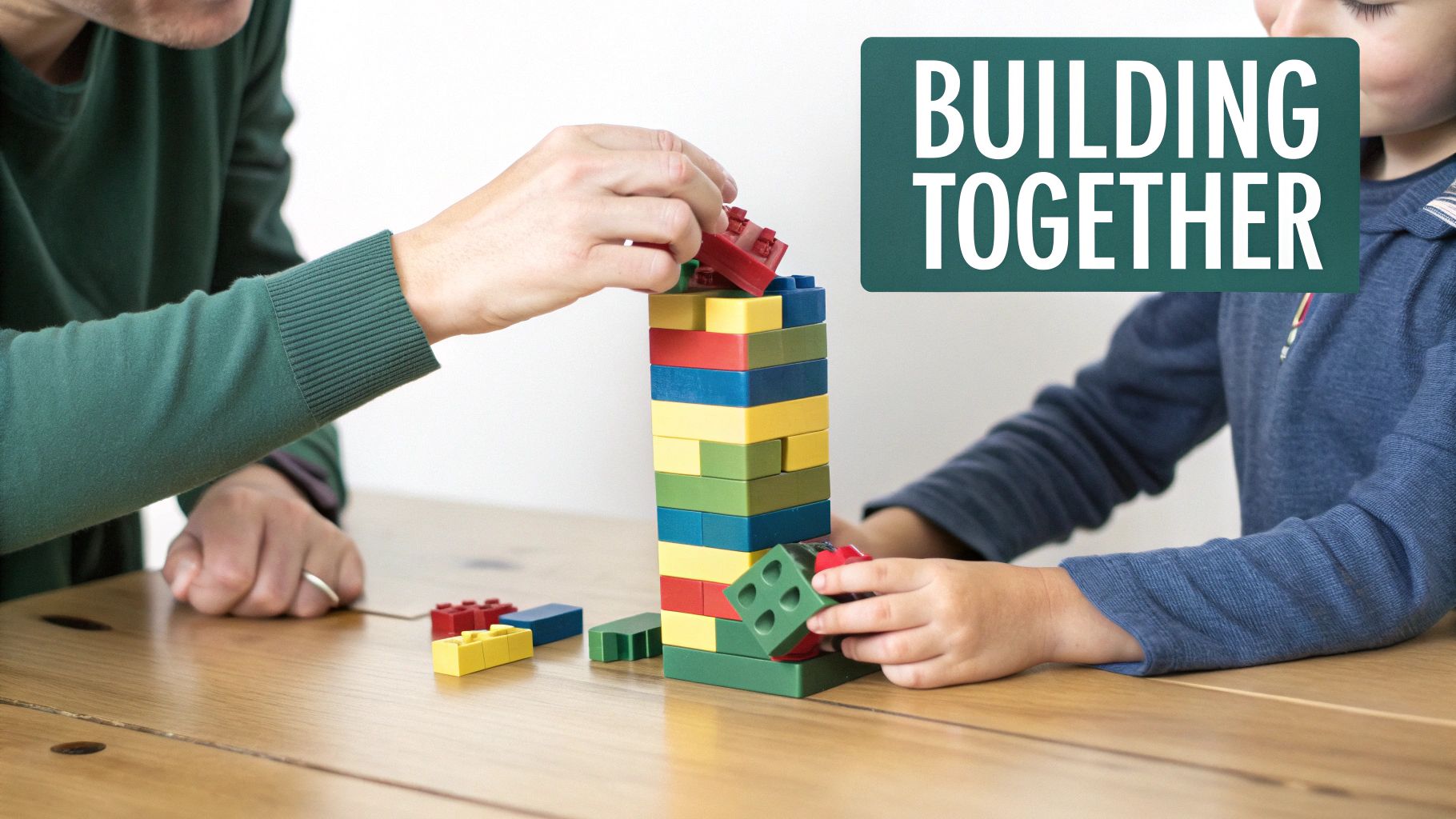
Picture this: you and your toddler are building a tower with blocks. It gets a bit wobbly. Instead of swooping in to fix it, you pause and wonder aloud, "Hmm, why do you think it’s wobbling like that?" Your child might tap the tiny block at the bottom, and just like that, you’ve started a shared investigation.
This collaborative problem-solving is the very heart of Sustained Shared Thinking. It’s an extended, active conversation where you are both “working together in an intellectual way.” The focus isn’t just on finishing the tower but on exploring the why and how together. You become co-adventurers, sharing theories and building understanding side-by-side.
This isn’t just a passing parenting fad, either. The concept has solid roots in early years research, first identified in the UK’s landmark Effective Provision of Pre-School Education (EPPE) study in the late 1990s. This huge project, which followed around 3,000 children, pinpointed SST as a key practice in high-quality early years settings, directly linked to better cognitive and social skills. If you’re keen to dive deeper, you can explore the research on the TLRI website.
How It Differs From Everyday Chat
It's easy to think any chat with your child counts as SST, but there's a subtle yet important distinction. Most of our day-to-day talk is fleeting or instructional, whereas Sustained Shared Thinking is all about collaborative exploration.
This table breaks down the difference.
| Interaction Type | Everyday Chat | Sustained Shared Thinking (SST) |
|---|---|---|
| Goal | To get a quick, correct answer or give an instruction. | To explore an idea, solve a problem, or think creatively together. |
| Structure | A simple question-and-answer format. Often starts and ends quickly. | A back-and-forth dialogue that can last several turns. |
| Example | "What colour is this brick?" "Red." "Good job." | "I wonder what would happen if we put this big, heavy brick on top?" |
| Outcome | Child learns a fact (e.g., the colour red). | Child develops critical thinking, reasoning, and problem-solving skills. |
The key is moving from a dynamic where you are the teacher to one where you are a curious learning partner.
Sustained Shared Thinking turns simple, everyday moments into powerful learning opportunities. It’s about staying curious together and valuing the journey of discovery, not just rushing to find the 'right' answer.
This small shift in how you interact can do wonders, fostering a deeper connection and nurturing your child's thinking skills right from the very beginning.
Why This Method Is a Game-Changer for Development
Sustained Shared Thinking isn't just about having a nice chat with your little one. It's a powerhouse for their developing brain. Think of it as actively laying the groundwork for critical thinking, a love of learning, and the kind of problem-solving skills they'll use for the rest of their lives.
When you're both on the floor wondering aloud why the block tower keeps toppling over, you're doing more than just playing. You’re sparking a real understanding of cause and effect, turning a simple moment of frustration into a shared puzzle to solve.
It's the same when you’re reading a storybook and pause to talk about why a character might be feeling sad. This helps to build genuine empathy and emotional intelligence. You're giving your child a safe space to explore complex feelings, helping them make sense of their own emotions and those of others.
Connecting Thinking to Milestones
These benefits aren't just vague concepts; they tie directly into hitting key developmental milestones. Every single one of these shared "thinking moments" helps to shape a more confident and capable learner. A brilliant concept that helps explain this is scaffolding in child development, where your guidance helps your child reach new heights they couldn't manage alone.
And the research backs this up. The UK's landmark EPPE project found that children who had lots of these shared thinking interactions showed better intellectual and social development all the way through primary school. It’s clear proof that this kind of engagement really matters for their long-term learning.
The real magic of Sustained Shared Thinking is its ability to turn everyday interactions into powerful learning opportunities. It’s about building a thinker, not just teaching facts.
By making this a part of your daily routine, you’re helping your child build the skills they need to thrive. These aren't just conversations; they are the very building blocks of a curious, capable, and resilient mind.
The Three Pillars of Shared Thinking
To really get to grips with Sustained Shared Thinking, it helps to break it down into three simple, practical pillars. This framework takes it from being an abstract theory to something you can actually do in those everyday moments with your child. Think of it as a simple roadmap for building those wonderful, brain-boosting connections.
The idea isn’t to follow a rigid script. It's about naturally weaving these elements into your playtime and conversations.
Tuning In: The Detective
The first, and arguably most important, pillar is all about tuning in. This is your chance to become a bit of a gentle detective, carefully watching and listening to figure out what’s genuinely sparked your child’s interest. Instead of steering them towards what you think is interesting, you meet them in their world.
Is it the funny way the water splashes in the bath? The determined march of an ant across the patio? Tuning in means noticing these little fascinations and using them as the launchpad for your shared exploration.
The following infographic shows just how these moments support key developmental skills.
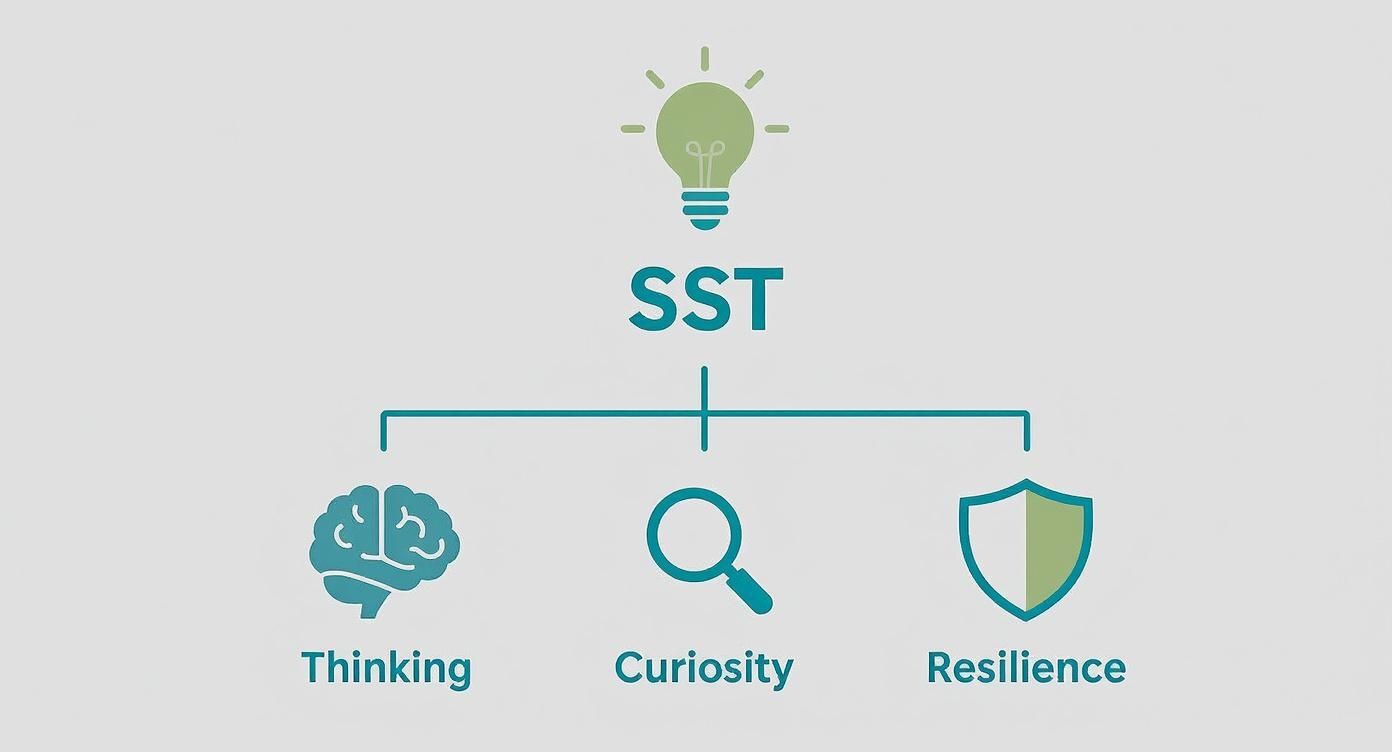
As you can see, this practice directly helps grow critical thinking, fuels natural curiosity, and builds emotional resilience.
Encouraging: The Cheerleader
Once you’ve tuned into their world, it’s time to encourage. This is where you become your child’s biggest cheerleader—not for what they achieve, but for how they think. You can do this by praising their effort and asking open-ended questions that gently nudge them to think a little deeper.
Simple phrases can make all the difference:
- "That's a really interesting way to look at it."
- "I love how carefully you're thinking about that."
- "Tell me more about what you're thinking."
Extending: The Co-Adventurer
The final pillar is about extending the conversation. Here, you step in as a co-adventurer, gently adding a new idea, offering a bit of information, or suggesting what you could try next. It's not about taking over the game; it's about building on the thought process you’ve started together.
One of the best ways to extend their thinking is simply to wonder aloud. Saying something like, "I wonder what would happen if we tried…?" or "What else could we use for this?" invites your little one to problem-solve and explore possibilities right alongside you.
Putting Shared Thinking into Practice at Home

Weaving sustained shared thinking into your daily life doesn't mean you need a special timetable or a mountain of expensive toys. It’s all about the little moments you already have—transforming them from routine interactions into genuine opportunities for connection and discovery. The real magic happens when it becomes a natural, joyful part of your day.
Think about the things you already do together. Story time, a walk in the garden, building with blocks, or even just getting a snack ready are all perfect backdrops. The key is to shift your mindset from simply giving answers to asking curious, open-ended questions. This little change invites your child to become a co-investigator right alongside you. It's a fundamental principle behind so many powerful play-based learning activities because it taps directly into a child’s innate curiosity.
Turning Routines into Adventures
Let's look at a few simple ways to bring this to life. These prompts are designed to open up a conversation, rather than shut it down with a simple one-word answer.
-
In the garden: Instead of just pointing and naming, "That's a snail," try wondering aloud. "I wonder what that snail is looking for over there?" or "Why do you think this leaf is all crunchy but that one is still soft?"
-
While building: The block tower tumbles down. Your first instinct might be to fix it, but hold back! Try asking, "Hmm, what do you think made it wobble?" or "How could we build it differently to make it super strong this time?"
-
At the dinner table: As your little one munches away, you could ask, "That carrot makes such a loud crunch! Why do you think it sounds like that when you bite it?" This turns a simple observation into a sensory adventure.
This approach is all about offering 'just-right' challenges and using a technique known as scaffolding in education. You're not doing the work for them, but you are providing just enough support to help them reach the next step in their understanding.
The most powerful moments of sustained shared thinking happen when you are genuinely curious alongside your child. It’s not a test; it's a shared adventure where you don't need to have all the answers.
From Closed Questions to Open Conversations
One of the biggest, yet simplest, shifts you can make is moving away from "test" questions that have a single correct answer. These simple swaps can turn a conversational dead-end into a real opportunity for shared discovery.
Here are a few examples to show you what a difference it can make.
| From Closed Questions to Open Conversations |
|---|
| Simple swaps to turn conversational dead-ends into opportunities for sustained shared thinking. |
| Instead of This (Closed Question) |
| What colour is that block? |
| Did you see that bird? |
| Is the water cold? |
| Did the tower fall over? |
| Try This (Open-Ended Alternative) |
| I wonder which colour we should use next for our tower? |
| What do you think that bird is doing in the grass? |
| How does the water feel on your hands? |
| Oh dear! What do you think happened to our tower? |
By asking open-ended questions, you show your child that their thoughts, ideas, and theories are truly valuable.
This small change gets right to the heart of what sustained shared thinking is all about. It sends a powerful message: you are interested in their unique thought process, not just their ability to recall a fact. It’s a wonderful way to build their confidence as a thinker and a problem-solver, laying a brilliant foundation for a lifetime of learning.
How Nurseries Support Your Child's Thinking
Sustained shared thinking isn't just something you can do at home; it’s a cornerstone of high-quality early education all across the UK. The very best nurseries don't simply look after your child—they are actively nurturing these crucial thinking skills, and it's a key part of the official Early Years Foundation Stage (EYFS) framework.
Early years educators are trained to recognise and create opportunities for these rich, back-and-forth conversations. You might see them gently stepping into a disagreement over a toy, not to solve it for the children, but to ask something like, “I wonder how we could make sure everyone gets a turn?”
This simple question can completely transform a potential conflict. Suddenly, it’s not a fight but a shared problem that needs a solution, nurturing both social and thinking skills at the same time.
A Mark of Quality in Early Years Settings
When a nursery actively encourages sustained shared thinking, it's widely seen as a key indicator of an excellent learning environment. It’s so important, in fact, that it’s formally measured.
In the UK, the quality of early years settings is often assessed using a special scale called SSTEW (Sustained Shared Thinking and Emotional Well-being). The major Study of Early Education and Development (SEED) used this very measure to evaluate around 1,000 different settings.
The results were crystal clear: higher scores in shared thinking were directly linked to better emotional well-being in children and improved school readiness. You can dig deeper into the official SEED study findings to see the data for yourself.
When you see educators getting down on a child's level, listening intently, and wondering aloud with them, you're witnessing the EYFS framework in action. It’s a sure sign that the setting genuinely values your child’s own thoughts and ideas.
Knowing that nurseries champion this approach means you can feel confident that the skills you’re building at home are being powerfully reinforced. You and your child’s educators become partners, creating a wonderfully consistent and supportive developmental journey from your home to their nursery.
If you're looking for inspiration, we have some fantastic nursery activity ideas that are perfect for trying at home, too.
Got Questions About Sustained Shared Thinking?
When you first hear about a concept like sustained shared thinking, it's completely normal for a few questions to bubble up. The idea of adding another thing to your plate can feel overwhelming, but here's the good news: this isn't about scheduling more activities. It’s a way of thinking that slots right into the life you're already living.
Let's walk through some of the most common queries I hear from parents.
Lots of parents ask, "Isn't this just asking my child lots of questions?" It's a fair point, as questions are definitely part of it. But the real magic is in the shared part. Think of it less like a quiz, where you're waiting for the right answer, and more like a shared investigation. You're both detectives on the same case, puzzling over a problem together. The goal isn’t to get it right; it’s the thrill of the chase.
"What If My Child Doesn't Respond?"
Ah, the classic scenario. You pose a brilliant, thought-provoking question, only to be met with a shrug, a one-word answer, or just… silence. This is so common, especially with toddlers who live completely in the moment. Don't push it. The trick is to join them in their world first.
If your little one is mesmerised by rolling a toy car back and forth, a big question about something else will just bounce off them. Instead, get on their level and 'tune in' to what they're doing. You could try wondering aloud, almost to yourself, "Wow, that car is going so fast! I wonder where it's off to in such a hurry?" You’re respecting their play while gently cracking open a door to a shared story.
Patience is your superpower here. The aim isn't always an immediate, chatty reply. It's about creating a space where your child feels seen and knows their fascinations are your fascinations, too. Sometimes the best conversations start with simply watching alongside them.
"How Do I Find the Time? And What If I Don't Know the Answers?"
This is probably the biggest hurdle for most parents. But here’s the secret: sustained shared thinking doesn't need its own spot on the calendar. It thrives in the little gaps and routines of your day.
- During bath time: As they splash around, you could wonder, "Hmm, why does the rubber duck float but this little car sinks?"
- While getting dressed: "Your socks are so stretchy! I wonder what makes them do that?"
- On the walk to the park: "Look at that huge crack in the pavement! How do you think that got there?"
And the best part? You absolutely do not need to have all the answers. In fact, it’s better if you don’t! When your child stumps you with a question, it's a golden opportunity. Saying, “That’s such a brilliant question. I actually don’t know. How could we find out together?” is incredibly powerful. It shows them that learning is a lifelong adventure, and you’re on the journey right beside them.
At Grow With Me, we believe these small, shared moments are where the real learning happens. Our stage-based play kits are designed to spark that natural curiosity, creating easy opportunities for you and your child to explore, discover, and think together. Explore our subscription boxes and find the perfect tools for your next adventure.