

11 Essential Play Based Learning Activities for 2025
Welcome to the vibrant world of early childhood development, where learning isn't about flashcards and drills, but about curiosity, exploration, and joy. For babies and toddlers, every interaction is a chance to understand their environment, and play is their primary language for making sense of it all.
Meaningful play based learning activities are the cornerstone of building a strong foundation for cognitive, social, and emotional growth. They transform everyday moments into powerful learning opportunities, nurturing a lifelong love for discovery. At the heart of this approach is a deep understanding of the critical link between play and child development, which allows us to create enriching experiences that support natural curiosity. This comprehensive guide explores various proven approaches to play, offering actionable ideas to help you support your little one's journey.
From the focused calm of Montessori-inspired setups to the collaborative spirit of Reggio Emilia and the sensory-rich world of messy play, you will find a wealth of practical strategies. We will delve into specific, age-appropriate activities designed to spark creativity, enhance problem-solving skills, and encourage physical coordination. Each section provides clear implementation tips and highlights the developmental benefits, helping you turn simple playtime into a powerful engine for your child’s growth.
1. Montessori Play-Based Learning
The Montessori method is a unique, child-centred approach to education developed by Dr. Maria Montessori. It frames learning as a natural, self-directed process. In this model, adults prepare an environment with specific, hands-on materials, and children are free to choose their own activities, fostering independence and deep concentration. This is one of the most structured yet child-led play based learning activities you can introduce.
Why It Works
This method respects a child’s individual developmental timeline. Rather than a one-size-fits-all curriculum, the environment is tailored to the child's current interests and abilities. This fosters an intrinsic love for learning, as children engage with materials that are both challenging and achievable. The focus on practical life skills, such as pouring or dressing, also builds confidence and fine motor skills.
How to Implement It
- Create an Organised Space: Designate a specific, uncluttered area with low shelves where your child can easily see and access their toys and materials.
- Rotate Materials: Offer a limited number of high-quality, purposeful toys at a time. Rotate them based on your child's engagement to maintain interest.
- Observe and Guide: Watch your child closely to understand their interests. Gently guide them towards new challenges without interfering with their exploration.
Key Insight: The adult's role is not to teach, but to observe and connect the child to the prepared environment, allowing for organic discovery.
This approach is ideal for fostering independence, focus, and problem-solving skills from an early age. By providing the right tools and a supportive environment, you empower your child to become a curious and self-sufficient learner. For more ideas on specific materials, you can learn more about Montessori toys for toddlers.
2. Reggio Emilia Approach
The Reggio Emilia approach is an educational philosophy centred on the belief that children are powerful, competent individuals with a natural curiosity to learn and explore. Originating in the villages around Reggio Emilia, Italy, after World War II, this model views learning as a collaborative journey between children, teachers, and parents. The environment itself is considered the "third teacher," intentionally designed to provoke interest and support in-depth, project-based explorations.
Why It Works
This philosophy honours the child’s voice and perspective, treating their questions and interests as the foundation for the curriculum. Learning isn't pre-planned but emerges organically from their explorations. This emergent curriculum makes education deeply personal and meaningful, fostering critical thinking, creativity, and problem-solving skills. The emphasis on documenting the learning process through photos, notes, and artwork makes children's thinking visible and valued.
How to Implement It
- Listen and Observe: Pay close attention to your child's questions and fascinations. Use these as a starting point for deeper explorations or projects.
- Prepare an Inviting Environment: Offer open-ended materials like clay, paint, loose parts, and natural objects that encourage creativity and experimentation.
- Document Their Journey: Take photos or jot down quotes as your child plays. Displaying this documentation shows them their ideas are important.
Key Insight: The Reggio Emilia approach sees children as protagonists in their own learning, capable of constructing knowledge through their interactions with the world.
This approach is perfect for nurturing a child’s innate creativity and collaborative spirit. By co-learning alongside your child, you create a rich, responsive environment that celebrates their unique way of seeing the world. To dive deeper into its principles, you can explore resources from Reggio Children.
3. Constructivism & Hands-On Exploration
Constructivism is a theory that views children as active builders of their own knowledge. Popularised by theorists like Jean Piaget, it suggests learning isn’t about passively absorbing information, but about actively constructing mental models through direct experience. Children learn by doing, experimenting, and reflecting on the outcomes, making it a cornerstone of effective play based learning activities.
Why It Works
This approach capitalises on a child's natural curiosity. When a child stacks blocks and they tumble, they are conducting a mini-physics experiment, learning about gravity and balance firsthand. This direct engagement creates stronger, more memorable neural connections than simply being told a fact. It empowers children to become problem-solvers who learn to think critically by testing their own theories about how the world works.
How to Implement It
- Provide Open-Ended Materials: Offer materials like building blocks, clay, water, and sand that can be used in countless ways without a predetermined outcome.
- Ask Guiding Questions: Instead of giving answers, ask open-ended questions like, "What do you think will happen if...?" or "Why did that fall down?".
- Embrace Trial and Error: Create a safe space where mistakes are seen as learning opportunities. Allow plenty of time for children to experiment and try again.
Key Insight: Learning is not the result of teaching, but the product of the child's own activity. The adult’s role is to facilitate this exploration, not direct it.
This method is perfect for developing critical thinking and scientific reasoning. By encouraging hands-on exploration, you help your child build a deep, personal understanding of complex concepts, laying a foundation for a lifelong love of discovery.
4. Outdoor & Nature-Based Play
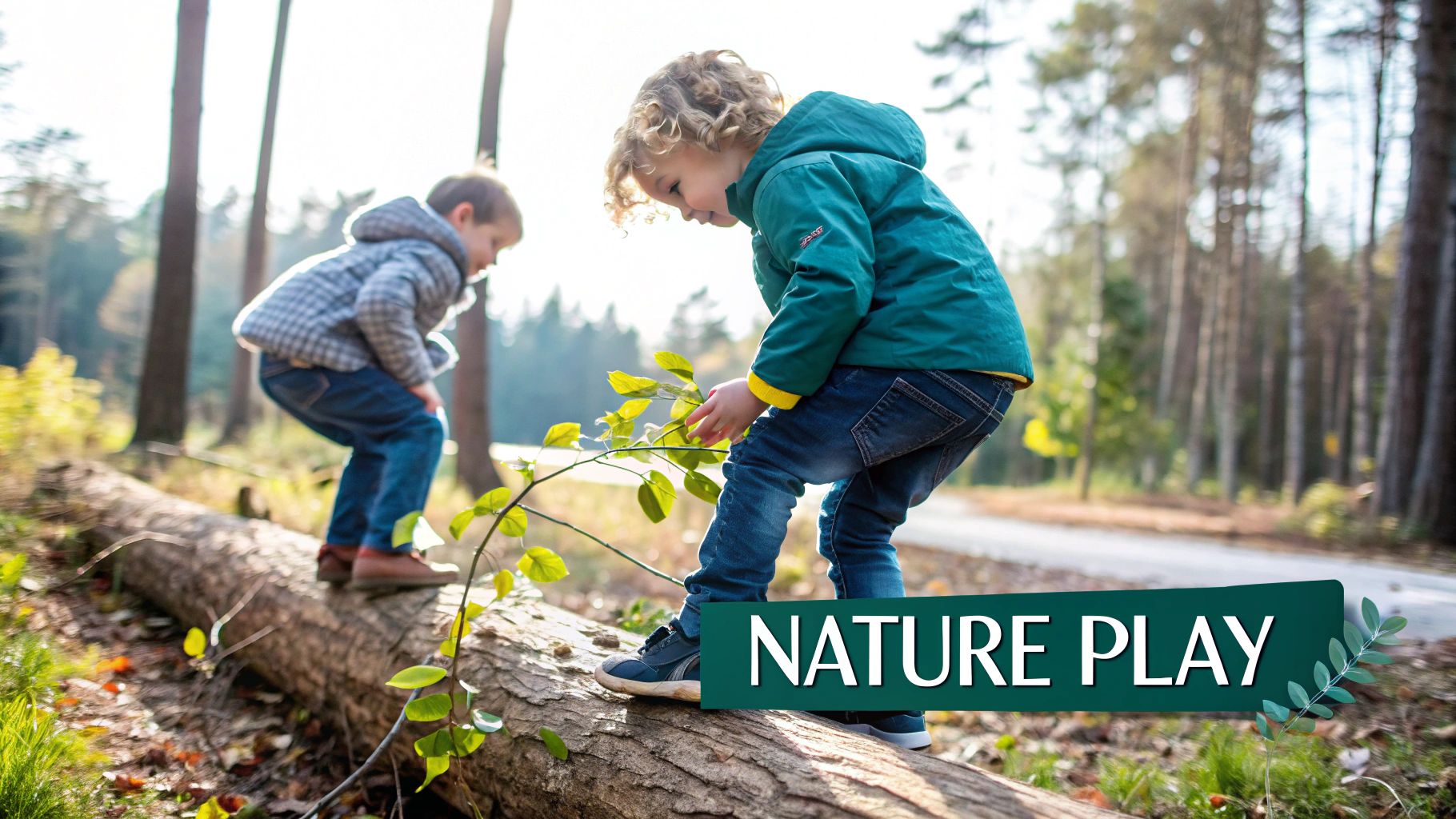
Nature-based play uses the outdoor environment as a living classroom, where children engage directly with natural elements. Popularised by the Forest School movement in Scandinavia, this approach champions unstructured play in nature, recognising it as a primary resource for learning. These play based learning activities foster ecological awareness, physical resilience, and a deep connection to the environment.
Why It Works
This method stimulates all the senses and promotes robust physical development, from gross motor skills used in climbing to fine motor skills used when examining a leaf. Engaging with nature's unpredictability builds problem-solving abilities, resilience, and creativity. Children learn to assess risk and understand natural cycles, which cultivates respect for their environment.
How to Implement It
- Embrace All Weathers: Don't let rain or cold stop you. Dress appropriately and use different weather conditions as a new opportunity for discovery.
- Provide Loose Parts: Offer natural, open-ended materials like sticks, stones, mud, and leaves instead of structured toys to inspire imaginative play.
- Set Clear Boundaries: Establish safe exploration areas and rules, then step back to allow for child-led discovery and supervised risk-taking.
Key Insight: Nature itself is the teacher. The adult’s role is to facilitate a safe connection, allowing children to learn directly from the natural world's rich, sensory feedback.
This approach is perfect for building confidence, coordination, and an appreciation for the outdoors. To extend these activities at home, consider using a guide to creating a thriving native garden to create a personal, nature-rich play space.
5. Dramatic Play & Role-Playing
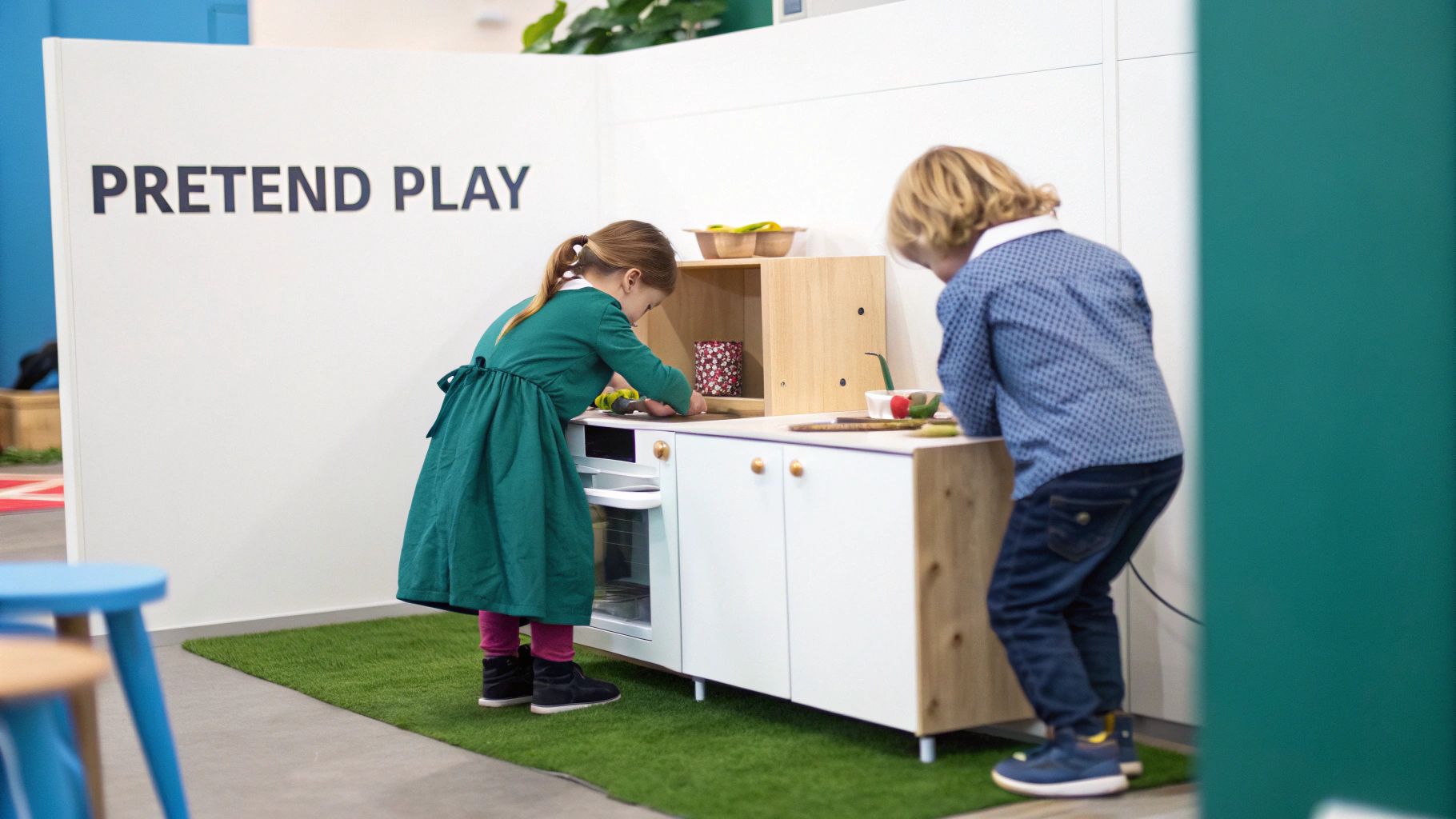
Dramatic play involves children taking on roles and acting out real-world or imaginary scenarios. From running a pretend café to caring for a doll, this type of imaginative play is a cornerstone of early childhood development. It provides a safe space for children to explore complex social rules, express emotions, and practise language skills in a meaningful context. These are some of the most dynamic play based learning activities for toddlers.
Why It Works
Role-playing allows children to process and make sense of the world around them. By stepping into someone else's shoes, they develop empathy, cooperation, and negotiation skills. It also builds vocabulary and narrative abilities as they create stories and interact with others. This form of play bridges the gap between concrete understanding and abstract thought, laying a foundation for more complex learning.
How to Implement It
- Create Themed Centres: Set up a dedicated area with a specific theme, like a doctor’s surgery, a construction site, or a grocery shop.
- Provide Authentic Props: Use real-world items when safe (empty food boxes, old keyboards, dress-up clothes) to make the experience more immersive.
- Rotate and Refresh: Change the theme and props every few weeks to maintain high levels of engagement and introduce new vocabulary and concepts.
Key Insight: The goal is not to direct the play but to provide a rich, inviting environment where children can freely explore different roles and narratives.
This method is brilliant for nurturing social-emotional intelligence, problem-solving, and creativity. By encouraging children to act out stories, you are helping them build a deeper understanding of themselves and others. For a deeper dive into how this works, you can learn more about symbolic play.
6. STEM/STEAM Play Activities
STEM/STEAM activities integrate Science, Technology, Engineering, Arts, and Mathematics into cohesive learning experiences. This approach transforms complex subjects into engaging, hands-on challenges. By encouraging children to build, design, experiment, and solve problems, these play based learning activities nurture critical thinking and creativity from a young age. It’s about exploring how things work in a fun, practical way.
Why It Works
This method connects abstract concepts to the real world, making learning relevant and exciting. Children develop resilience as they test ideas, fail, and try again, learning that mistakes are a vital part of the discovery process. Adding 'Arts' to STEM (making it STEAM) emphasises creativity and design thinking, ensuring a well-rounded approach that fosters both analytical and innovative skills.
How to Implement It
- Start with Simple Challenges: Offer age-appropriate tasks like building the tallest tower possible with blocks or creating a bridge to span a gap between two cushions.
- Combine Tools: Mix hands-on materials like LEGOs or recycled cardboard with simple digital tools or coding toys like Bee-Bot to introduce basic technology concepts.
- Encourage Experimentation: Ask open-ended questions like, "What do you think will happen if...?" rather than giving direct instructions. Let them lead the exploration.
Key Insight: The goal is not to find the 'right' answer, but to foster a process of inquiry, experimentation, and iteration. The learning happens in the trying, not just the succeeding.
This approach is perfect for developing problem-solving skills and a foundational understanding of how the world works. It prepares children for future learning by building a strong sense of curiosity and confidence in tackling complex challenges.
7. Musical & Movement Play
Musical and movement play uses rhythm, sound, and dance as powerful tools for learning. It taps into a child's natural inclination to move and make noise, transforming these instincts into expressive and educational experiences. This approach views music and physical expression as fundamental languages, allowing children to explore concepts, communicate feelings, and develop crucial cognitive and physical skills. These are some of the most joyful play based learning activities you can do with your little one.
Why It Works
This method works because it engages the whole child: body and mind. Rhythmic activities support brain development, improving memory, pattern recognition, and even early maths skills. Movement enhances gross motor skills, balance, and spatial awareness. When combined, music and movement build neural pathways that support language acquisition and emotional regulation, offering a rich, multi-sensory way to understand the world.
How to Implement It
- Offer a Variety of Instruments: Provide access to simple instruments like shakers, drums, and xylophones. You don’t need anything expensive; pots, pans, and wooden spoons work wonderfully.
- Integrate Movement Props: Use scarves, ribbons, or even bubbles to encourage expressive, free-flowing dance and movement that responds to different types of music.
- Create Simple Rhythms: Clap or tap simple patterns for your child to copy. This builds listening skills and an understanding of sequence and repetition.
Key Insight: The goal is not performance, but participation. Focus on the joy of exploration and self-expression through sound and movement, rather than getting the rhythm or notes "right."
This approach is perfect for developing body awareness, coordination, and emotional expression. By creating a playful soundscape, you help your child build a strong foundation for both creative and academic learning.
8. Block Play & Construction
Block play is a classic childhood activity that involves unstructured or semi-structured building with materials like wooden blocks, LEGO, or even recycled cardboard boxes. It serves as a foundational experience, allowing children to experiment with balance, gravity, and design. This type of hands-on engagement is one of the most effective play based learning activities for developing early STEM skills.
Why It Works
This activity naturally integrates physics, engineering, and maths into play. As children stack, balance, and build, they are conducting mini-experiments, learning about cause and effect, and developing spatial awareness. It also nurtures creativity and problem-solving, as they figure out how to make their envisioned structures a reality. Collaborative building projects further enhance communication and teamwork skills.
How to Implement It
- Offer Variety and Volume: Provide a large quantity and a wide range of building materials, from traditional wooden blocks to magnetic tiles and recycled items.
- Allow for Time: Give children long, uninterrupted periods for building. Complex projects require time to plan, execute, and modify.
- Integrate Loose Parts: Enhance the play by adding loose parts like fabric scraps, small figures, or natural materials like pebbles and twigs to inspire more imaginative creations.
Key Insight: The process of building and rebuilding is more important than the final product. Encourage experimentation and celebrate "failed" attempts as learning opportunities.
Block play is perfect for nurturing a child's inner architect and engineer. By providing simple materials and the freedom to explore, you are laying the groundwork for complex problem-solving and creative thinking that will benefit them for years to come.
9. Sensory Play & Exploration
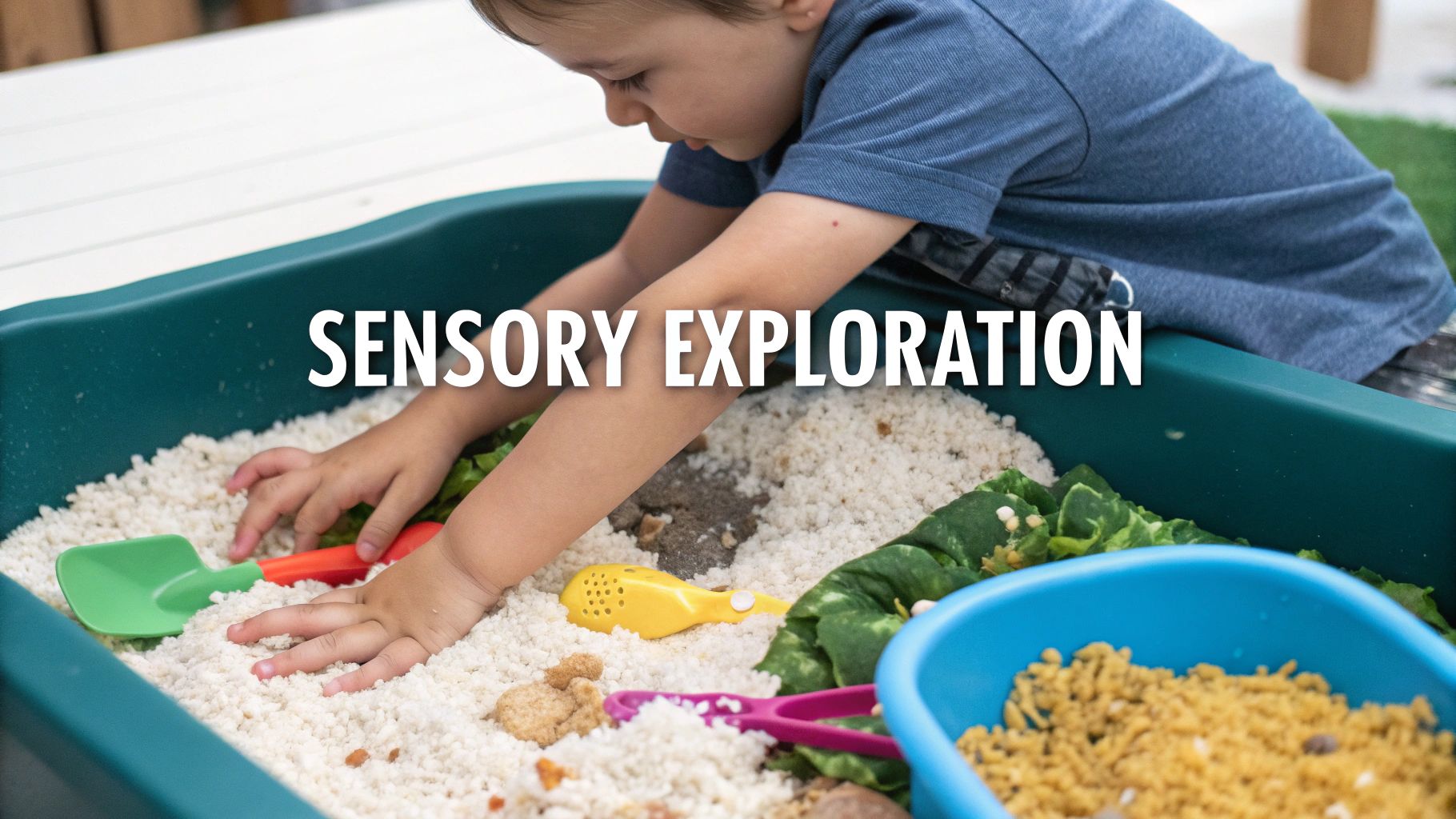
Sensory play focuses on activities that stimulate a child’s senses: touch, sight, sound, smell, and even taste. It involves children exploring materials like water, sand, or playdough in a low-pressure environment. This type of engagement is fundamental to how young children learn about the world, making it one of the most essential play based learning activities for early development.
Why It Works
This method helps build crucial nerve connections in the brain’s pathways, which supports more complex learning tasks later on. Engaging with different textures, temperatures, and properties helps children develop sensory awareness, fine motor skills, and even self-regulation. When a child explores a sensory bin, they are conducting their own scientific experiments: observing, hypothesising, and discovering outcomes.
How to Implement It
- Set Up Sensory Bins: Fill a shallow container with child-safe materials like rice, cooked pasta, or water. Add scoops, cups, and small toys to encourage exploration.
- Embrace the Mess: Designate a specific area, like a tuff tray or an easy-to-clean floor space, where your child can explore freely without worry.
- Vary the Materials: Keep the experience fresh by regularly changing the contents of your sensory setups. Try themed bins, such as a "beach" with sand and shells, or an "autumn" bin with leaves and conkers.
Key Insight: Sensory play is not about creating a finished product; it's about the process of exploration. The learning happens through touching, pouring, mixing, and discovering.
This approach is perfect for developing cognitive growth, language skills, and motor abilities. By providing varied sensory experiences, you support your child's natural curiosity and ability to process new information. For more inspiration, you can find more sensory play ideas for toddlers.
10. Games & Play-Based Learning Activities
Integrating structured and unstructured games into a child's routine turns learning into a dynamic and enjoyable experience. From classic board games and card games to active pursuits like chase, these activities use rules, strategy, and social interaction to teach valuable skills. This approach is one of the most versatile play based learning activities, as it can be adapted to almost any learning goal.
Why It Works
Games inherently motivate children through clear objectives and the thrill of participation. They provide a structured context for developing crucial abilities like turn-taking, following directions, and strategic thinking. Mathematical concepts, literacy skills, and social-emotional intelligence are reinforced naturally through gameplay, making abstract ideas tangible and engaging.
How to Implement It
- Choose Age-Appropriate Games: Select games that match your child's developmental stage. Simple options like alphabet Bingo or cooperative board games like Hoot Owl Hoot are great starting points.
- Model Good Sportsmanship: Teach children how to win and lose gracefully by modelling positive behaviour yourself. Emphasise the fun of playing together over the outcome.
- Adapt the Rules: Feel free to modify game rules to make them simpler for younger children or more challenging as their skills grow.
Key Insight: The goal of game-based learning is not just to win, but to participate, think critically, and collaborate, building both cognitive and social skills in a low-pressure setting.
This method is perfect for reinforcing specific academic concepts or developing social skills in a fun, interactive way. By playing alongside your child, you create a supportive environment where they can practise new abilities and build lasting memories.
11. Scaffolding Play
Scaffolding is a teaching method that involves providing just the right amount of support to help a child accomplish a task they couldn't quite do on their own. It’s a core concept in many play based learning activities, where the adult acts as a guide, building on the child’s existing skills to help them reach the next level of understanding or ability. The goal is to offer temporary support that is gradually removed as the child gains confidence.
Why It Works
This approach works because it meets children exactly where they are. It avoids the frustration of a task being too difficult and the boredom of it being too easy, keeping them in a state of engaged, productive challenge. Scaffolding builds resilience and problem-solving skills, as children learn to tackle challenges incrementally. It also strengthens the parent-child bond through collaborative effort.
How to Implement It
- Model First: If your toddler is struggling with a puzzle, you might fit one piece in yourself while verbalising your thought process ("I see this piece has a straight edge, so it must go on the side").
- Offer Cues: Provide simple hints or ask leading questions. For a shape sorter, you could ask, "Which hole looks like a circle?" instead of just handing them the correct piece.
- Break It Down: Divide a larger task, like building a tall tower, into smaller steps. Start by showing them how to make a stable base of two blocks.
Key Insight: Scaffolding is about providing a supportive framework, not giving the answers. The aim is to empower the child to build their own knowledge and skills.
This technique is invaluable for turning potential moments of frustration into powerful learning opportunities. By providing minimal, targeted assistance, you help your child build the confidence and competence to eventually complete the task independently.
Play-Based Learning: 11-Approach Comparison
| Approach | Implementation Complexity (🔄) | Resource Requirements (⚡) | Expected Outcomes (⭐📊) | Ideal Use Cases (💡) | Key Advantages (⭐) |
|---|---|---|---|---|---|
| Montessori Play-Based Learning | High 🔄🔄🔄 — certified training, prepared environment | High ⚡⚡⚡ — specialized materials and setup | High ⭐⭐⭐ / 📊 Independence, concentration, long-term academic gains | Early childhood programs emphasizing self-direction and routine | Promotes autonomy, individualized pacing, deep focus |
| Reggio Emilia Approach | Very high 🔄🔄🔄 — teacher expertise, emergent planning | Very high ⚡⚡⚡ — aesthetic spaces, documentation, PD | High ⭐⭐⭐ / 📊 Creativity, critical thinking, strong community ties | Project-based preschool settings with family/community involvement | Deep responsiveness to child interests; rich documentation |
| Constructivism & Hands-On Exploration | Medium 🔄🔄 — facilitator-led inquiry cycles | Medium ⚡⚡ — varied materials and teacher guidance | High ⭐⭐⭐ / 📊 Scientific thinking, transferable problem-solving skills | STEM activities, science centers, inquiry-driven lessons | Builds deep conceptual understanding via active experimentation |
| Outdoor & Nature-Based Play | Medium 🔄🔄 — logistics, safety and supervision | Low–Medium ⚡⚡ — natural settings often low-cost but need supervision | High ⭐⭐⭐ / 📊 Physical health, creativity, resilience, environmental stewardship | Forest schools, outdoor sessions, ecological education | Strong physical and mental health benefits; accessible resources |
| Dramatic Play & Role-Playing | Low–Medium 🔄🔄 — space and facilitation needed | Low ⚡ — props and dress-up items (relatively inexpensive) | High ⭐⭐⭐ / 📊 Social-emotional growth, language, perspective-taking | Social-emotional learning, language development, early years | Enhances communication, empathy, and imaginative skills |
| STEM/STEAM Play Activities | Medium–High 🔄🔄🔄 — curriculum design and facilitation | High ⚡⚡⚡ — tech, kits, maker equipment | High ⭐⭐⭐ / 📊 Technical literacy, problem-solving, design thinking | Maker spaces, coding clubs, school STEM initiatives | Integrates disciplines; prepares for future technical skills |
| Musical & Movement Play | Low 🔄 — easy to implement with basic planning | Low–Medium ⚡⚡ — instruments, open space, props | High ⭐⭐⭐ / 📊 Motor coordination, auditory skills, memory, emotion regulation | Inclusive classrooms, early childhood, cross-curricular activities | Inclusive, boosts coordination, language, and memory via rhythm |
| Block Play & Construction | Low–Medium 🔄🔄 — setup, storage and facilitation | Medium ⚡⚡ — blocks, space, organization systems | High ⭐⭐⭐ / 📊 Spatial reasoning, math concepts, collaboration | Math foundations, engineering precursors, collaborative projects | Flexible, promotes spatial and engineering thinking |
| Sensory Play & Exploration | Low 🔄 — simple setup; requires safety checks | Low–Medium ⚡⚡ — consumable materials and replacements | High ⭐⭐⭐ / 📊 Sensory discrimination, self-regulation, early learning | Infants, toddlers, children with sensory processing differences | Calming, foundational for development, highly adaptable |
| Games & Play-Based Learning Activities | Medium 🔄🔄 — rule design and scaffolding | Low ⚡ — boards, cards, minimal equipment | High ⭐⭐⭐ / 📊 Strategic thinking, social skills, targeted academic practice | Reinforcing curriculum, social skills groups, PE and recess | Highly engaging; adaptable to specific learning objectives |
Bringing Purposeful Play Into Your Home
Navigating the world of early childhood development can feel overwhelming, but as we have explored, the solution is beautifully simple: play. The diverse range of play based learning activities covered in this guide, from the child-led discovery of the Reggio Emilia approach to the structured freedom of Montessori-inspired setups, all share a common, powerful thread. They honour your child's innate curiosity as the driving force behind their learning and development.
You do not need to become an expert in every philosophy or purchase every toy on the market. Instead, the real magic happens when you become a keen observer of your own child. Notice what captures their attention. Is it the texture of mud in the garden, the challenge of stacking blocks as high as they can, or the imaginative world they create with their favourite figures? Your role is not to direct, but to facilitate and gently guide their exploration.
Key Takeaways for Intentional Play
The most impactful takeaway is that meaningful play is about quality, not quantity. A few thoughtfully chosen, open-ended materials will always offer more developmental value than a room full of single-purpose, battery-operated toys. Remember these core principles as you move forward:
- Follow Your Child's Lead: Their interests are a direct window into their developmental needs. By supporting their current fascinations, you make learning feel effortless and joyful.
- Create an Inviting Environment: A 'yes' space, where your child is free to touch, explore, and experiment safely, fosters independence and confidence. Organise toys in low, accessible baskets to empower them to make their own choices.
- Embrace the Process, Not the Product: The goal of stacking blocks is not a perfect tower; it is the problem-solving, fine motor skill practice, and understanding of physics that happens along the way. Celebrate the effort and experimentation above all else.
- Your Presence is Paramount: The most valuable resource you can offer is your engaged attention. Getting on the floor to play alongside your child, asking open-ended questions like "I wonder what would happen if...?", and showing genuine interest in their discoveries builds connection and deepens their learning.
By incorporating these play based learning activities into your daily rhythm, you are doing more than just keeping your little one busy. You are building a robust foundation for a lifetime of learning. You are nurturing a curious mind, a resilient spirit, and a confident problem-solver who understands that the world is a fascinating place, ripe for discovery. The laughter, the messes, and the 'aha!' moments are all part of this incredible journey.
Ready to bring purposeful, developmentally-aligned play into your home without the guesswork? Discover how Grow With Me delivers beautifully crafted, eco-friendly toys and activity guides tailored to your child's exact stage, right to your door. Explore our curated play kits and start your journey today at Grow With Me.