
A Parent's Guide to Toys 6 to 12 Months for Baby Development
Picking the right toys for 6 to 12 months old babies is all about choosing tools that support them through an incredible period of growth. Forget the flashy gadgets; the best options are often the simplest. Think stacking rings, soft blocks, textured sensory balls, and chunky board books that invite little hands and minds to explore.
The Great Leap: Understanding Your Baby From 6 to 12 Months
Welcome to one of the most exciting and fast-paced chapters of your baby's first year. Between six and twelve months, your little one goes from a relatively still observer to a determined explorer on the move. Their world is expanding by the day, and the right toys are their most important tools for figuring it all out.
This stage is a true developmental explosion. Every interaction with a toy is a small lesson. When they drop a block, they’re learning about gravity. When they shake a rattle, they’re discovering cause and effect—"I did that!" Simple, thoughtful play helps them build crucial motor skills and begin to make sense of the world around them.
It's this explosion in learning that has parents so focused on finding high-quality playthings. In fact, the UK baby toys market was valued at a massive $1030.0 million in 2024. This figure shows just how much we value early development, and it's a number that's expected to keep climbing.
The chart below shows just how much the market is set to grow, underlining the increasing focus parents are placing on toys that really aid development.
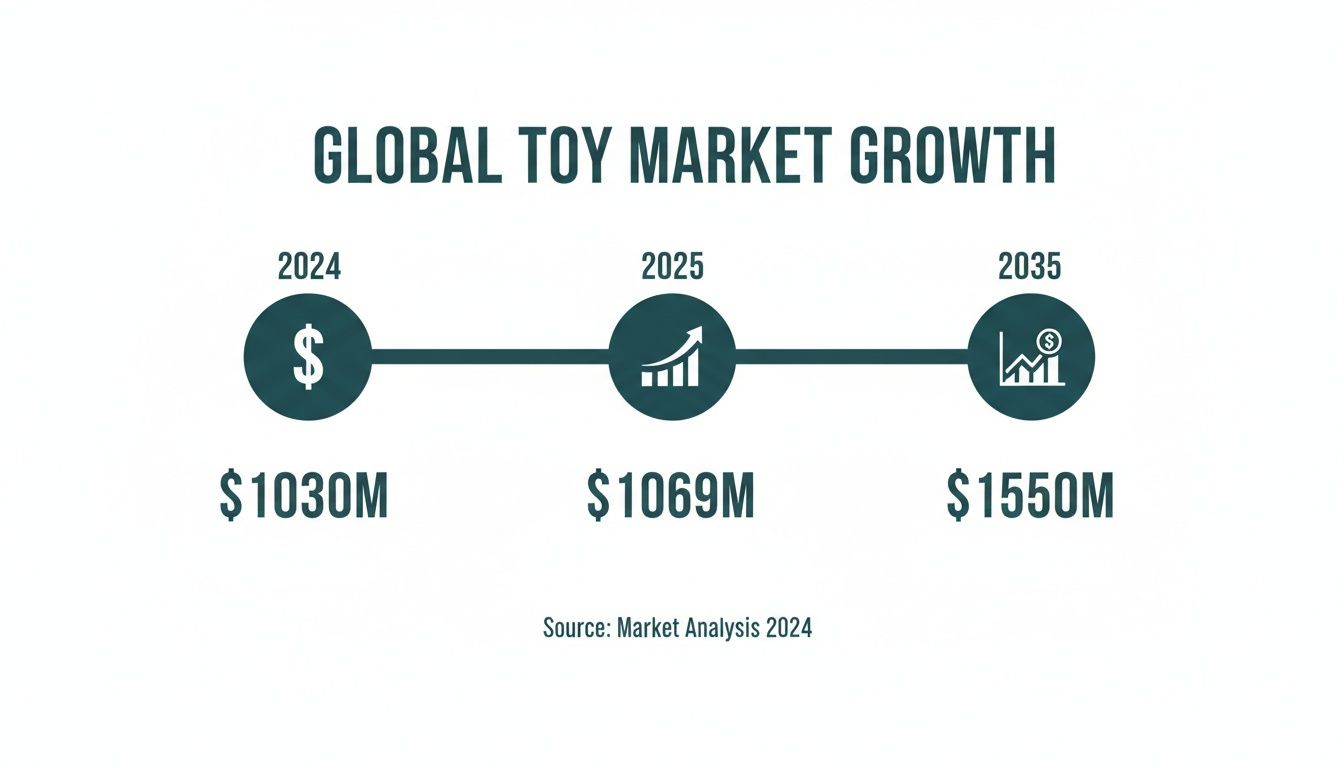
This clear upward trend tells us that more and more families are seeing the wisdom in investing in toys that match key growth stages.
To get a clearer picture of what’s happening and when, this table matches key milestones with the toys that help your baby master them.
Developmental Milestones and Corresponding Toy Types 6-12 Months
| Age Range (Months) | Key Milestone | Recommended Toy Category |
|---|---|---|
| 6-7 Months | Sitting up, reaching for objects | Sensory balls, soft blocks, rattles |
| 7-9 Months | Developing pincer grasp, exploring with mouth | Teething toys, board books |
| 9-10 Months | Pulling up to stand, understanding object permanence | Stacking rings, simple puzzles |
| 10-12 Months | Cruising, clapping, first steps | Push walkers, shape sorters |
Seeing these milestones laid out makes it easier to understand that the right toy at the right time is more than just a bit of fun—it's a developmental partner.
Navigating the Toy Overload
Walk into any toy shop and the sheer number of options can feel overwhelming. How do you know which toy is right for your baby right now? The key is to connect the dots between their developmental stage and the toys you offer. You can learn more about the different stages of child development by age in our guide.
The goal isn't just to entertain but to empower. A good toy for a 9-month-old isn't simply a distraction; it's a perfectly designed challenge that meets them exactly where they are, helping them practise a new skill until they master it.
This is where stage-based play kits come in. They take out all the guesswork. By delivering expertly chosen toys that match your baby’s evolving skills, these kits ensure your little one always has the right tools for their next big leap. They’re designed to provide a balanced "play diet," with items that support:
- Fine and Gross Motor Skills
- Sensory Exploration
- Problem-Solving Abilities
- Early Language Development
Getting to Grips with Your Baby's Development
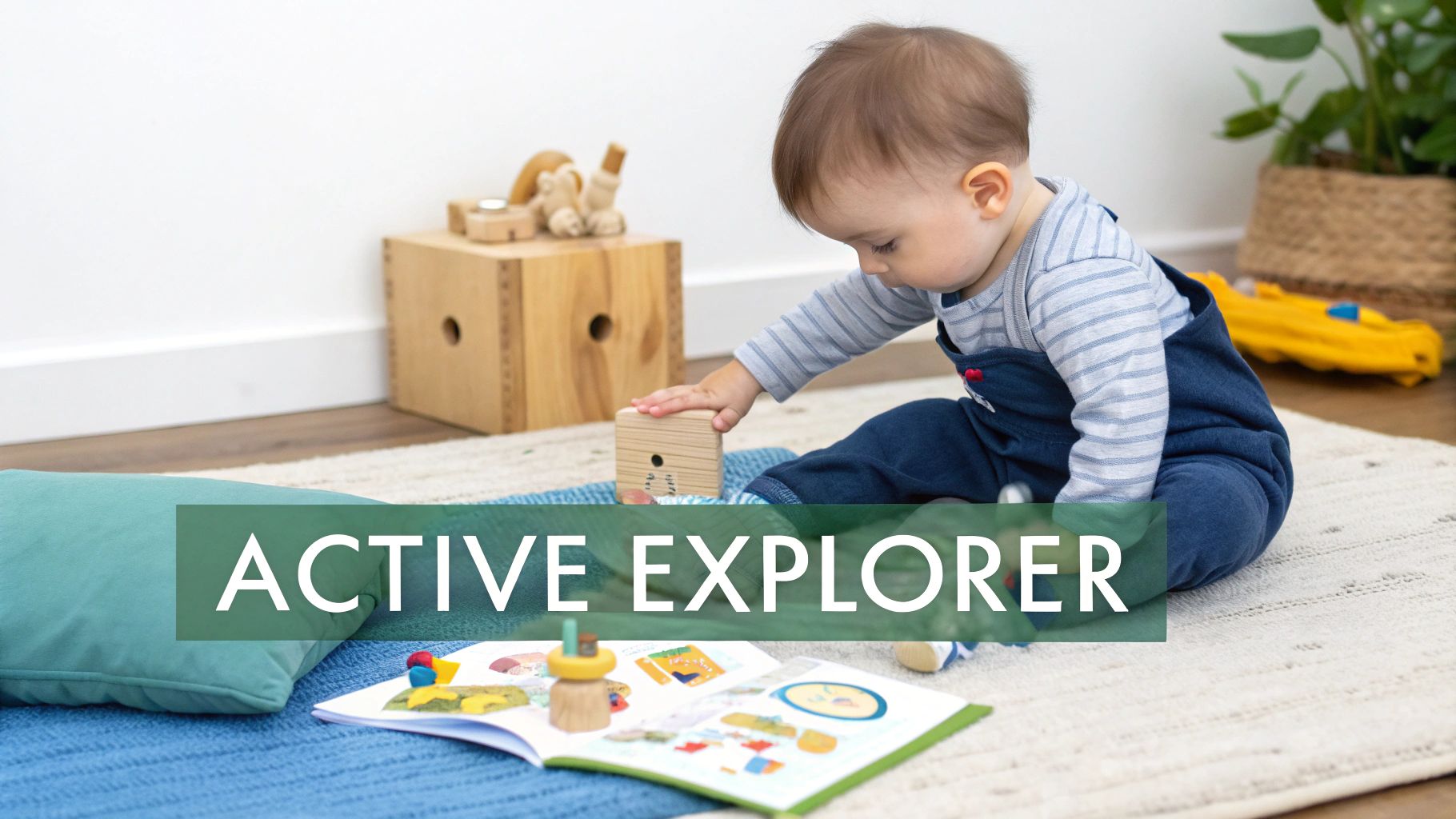
From six to twelve months, your baby's brain isn't just growing; it's exploding with new connections. Think of it like a supercomputer firing up for the first time, making millions of links every single second. This period is less about hitting milestones on a checklist and more about understanding the incredible "why" behind each new skill they master.
When your baby finally manages to sit up on their own, it's a game-changer. It’s far more than just a physical achievement—it’s like they’ve just been upgraded to a front-row seat for everything. Suddenly, their hands are free to explore, pass a toy from one hand to the other, and really start to play. This simple shift in perspective is what unlocks the next level of their learning.
From Big Movements to Tiny Tweaks
You’ll first notice the big stuff: the gross motor skills. These are the large, coordinated movements of their arms, legs, and torso that lead to sitting, crawling, and eventually pulling themselves up to stand. Each new skill gives them a fresh sense of independence and a completely different way to interact with the world around them.
But while that's all happening, something much more subtle is taking place. Their fine motor skills—the small, precise movements of their hands and fingers—are being refined at an amazing speed. This whole stage is basically a masterclass in hand-eye coordination.
- Palmar Grasp: At the start of this period, your baby will use their whole hand in a raking motion to grab an object, clutching it in their palm.
- Pincer Grasp: By the end, they'll be mastering the delicate pincer grasp, using just their thumb and forefinger to pick up small things. This is a massive leap forward, setting the stage for future skills like holding a spoon or turning the pages of a book.
The right toys for 6 to 12 months are made specifically to support this journey from clumsy grabbing to careful, deliberate actions. A simple set of stacking rings is a perfect example. At first, they might just bang them around, but over time, they learn to carefully guide a ring over the post, honing those crucial fine motor skills.
The Little Scientist at Work
Ever noticed your baby's fascination with dropping things from their high chair over and over again? It might test your patience, but you're actually witnessing one of their first physics experiments. They aren’t just making a mess; they're testing gravity and learning about cause and effect.
Every time a toy clatters to the floor, your baby is a tiny scientist confirming a hypothesis: "When I let this go, it falls." This repetition is how they build a solid understanding of how the world works, one drop at a time.
This powerful curiosity is what drives their learning. They have an innate need to figure things out, and their toys are the equipment in their lab. A shape sorter isn't just a puzzle; it's a hands-on lesson in spatial awareness and problem-solving. An activity cube presents a series of challenges that introduce them to object permanence—the idea that something still exists even when they can’t see it.
Building the Foundations of Thinking
As your baby touches, tastes, and listens to everything, they’re cataloguing information. The smooth feel of a wooden block, the crinkly sound of a soft book, and the jingle of a rattle all provide vital sensory input. This is what helps their brain grow and learn to organise the world.
Through play, they're making some huge cognitive leaps:
- Object Permanence: Playing peek-a-boo or hiding a toy under a blanket helps them grasp that things don't just vanish when they're out of sight.
- Cause and Effect: Shaking a rattle to make a sound or pressing a button to see a light are their very first lessons in action and reaction.
- Problem-Solving: Figuring out how to get rings off a stacker or push a block through the right hole builds the foundations for critical thinking.
Understanding this journey helps you see play for what it really is: the most important work your baby does. The toys you choose are the very tools they use to build their brain, one fascinating discovery at a time.
Building the Perfect Toy Box for Your Growing Baby
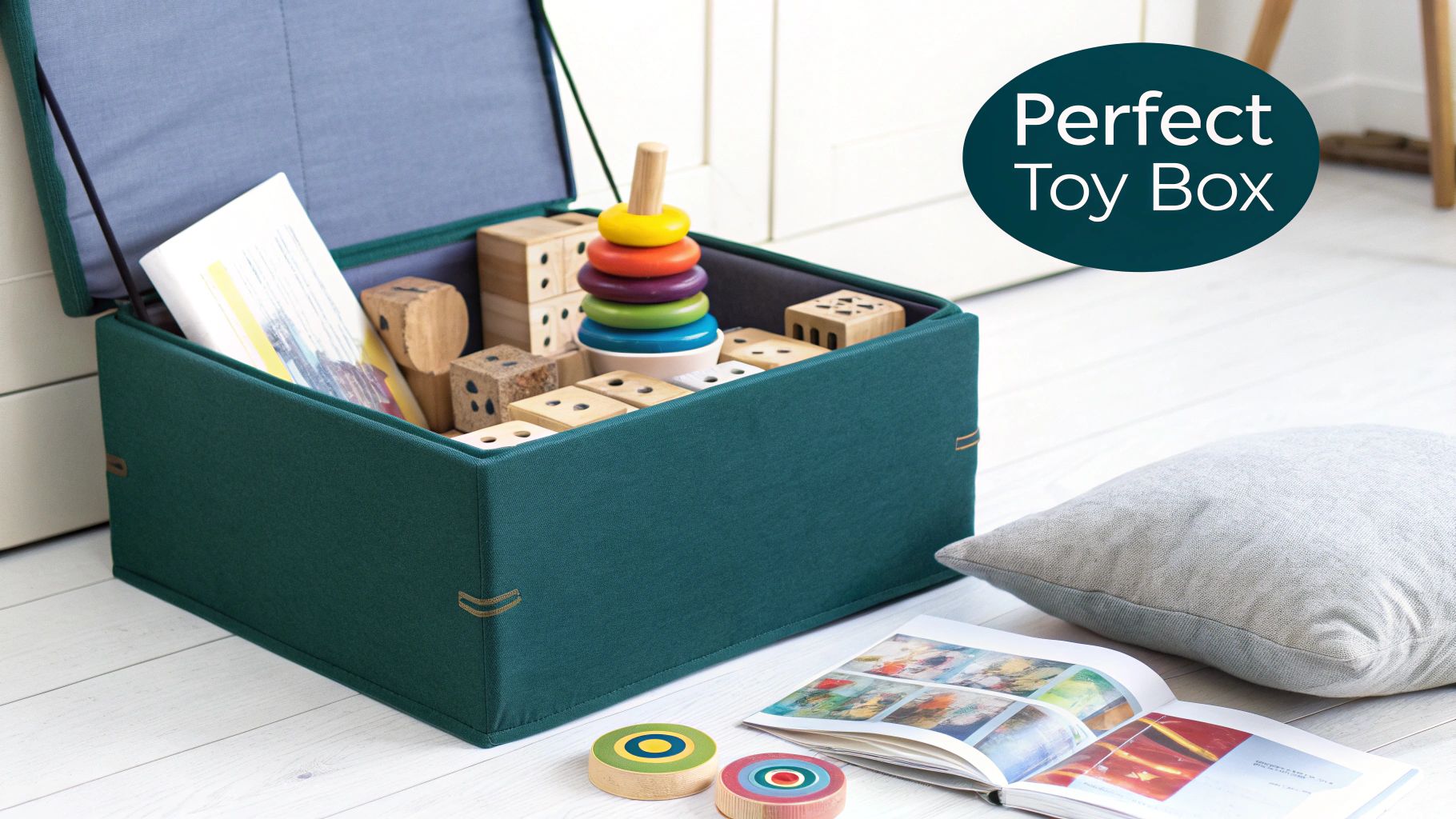
So, what makes a simple object one of the best toys for 6 to 12 months? It all comes down to matching the toy to what your baby is trying to master at that very moment. Building the perfect toy box isn't about piling it high; it's about choosing a small, mighty collection where every item plays a part in their incredible journey of discovery.
Think of it like putting together a healthy meal. You need a mix of different food groups, and the same idea applies to play. A thoughtful selection of toys gives your baby a rich "diet" of sensory, motor, and thinking challenges.
This balanced approach is exactly why certain classic toys are favourites for a reason. In fact, toys for infants and preschoolers, including developmental powerhouses like activity cubes and shape sorters, took the largest slice of the UK's entire toy market in 2024. Parents are actively looking for them, too—'stacking toys' alone get 14,800 monthly UK searches, which shows how much we value these fundamental playthings.
Let's break down the essential categories that every well-rounded toy box needs.
Awakening the Senses with Sensory Toys
At this age, your baby is a little detective, learning about the world mainly through touch, sight, and sound. Sensory toys are designed to fire up these senses, helping to build strong connections in their rapidly developing brain. A simple textured ball isn't just a ball; it's a hands-on lesson in different surfaces.
These toys give fascinating feedback that answers all of your baby’s unspoken questions: "What does this feel like?" or "What noise will it make if I shake it?"
- Textured Balls: Offering different surfaces—bumpy, smooth, ridged—for curious hands to explore.
- Crinkle Books: The perfect combination of soft textures and satisfying sounds to engage both touch and hearing.
- Wooden Rattles: A gentle, natural sound and a smooth, safe surface for mouthing.
A great sensory toy does more than just entertain. It helps your baby process new information and make sense of everything around them. If you want to dive deeper, you can learn more about the benefits of sensory toys for babies in our detailed guide.
Refining Coordination with Motor Skill Toys
Welcome to the golden age of motor skills! Toys that encourage your baby to grasp, stack, and move objects are absolutely vital right now. They help refine both fine motor skills (like that all-important pincer grasp) and gross motor skills (like sitting up and crawling).
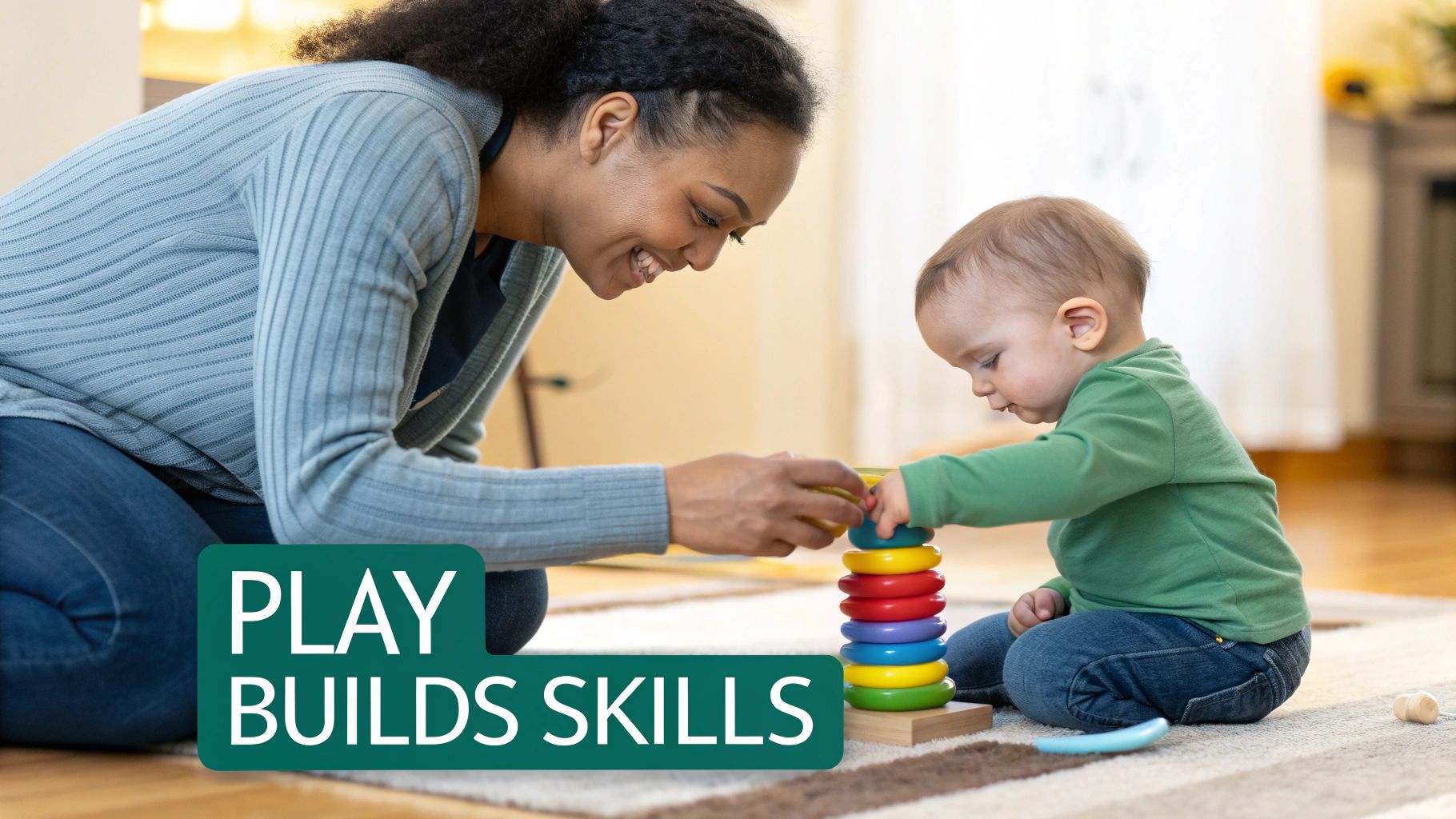
A set of stacking rings is a perfect example. At first, your baby might just love banging them together. But slowly, they start to develop the hand-eye coordination needed to place the rings on the post—a huge problem-solving win for a little one.
A simple wooden block is a developmental powerhouse. It's a tool for understanding gravity when dropped, balance when stacked, and spatial awareness when sorted. It does very little on its own, which forces your baby to do all the learning.
Key motor skill toys include:
- Stacking Rings or Cups: Teaches about size, order, and how to make hands and eyes work together.
- Simple Shape Sorters: The first step into problem-solving as they try to match a shape to its hole.
- Soft Blocks: Perfect for early attempts at building, grabbing, and stacking without any sharp corners.
Laying the Foundation with First Books
It is never too early to introduce the magic of reading. For a 6 to 12-month-old, books are wonderfully tactile and interactive toys. Sturdy board books or soft fabric books with simple, high-contrast pictures are absolutely ideal.
The simple act of turning a chunky page is a fantastic workout for their little fingers. Pointing to pictures as you name them helps build their vocabulary and introduces the idea that pictures stand for things in the real world. This early start creates a foundation for a lifelong love of stories.
As that big first birthday approaches, exploring unforgettable first year birthday gift ideas that include unique toys and books can help you build a truly special collection for this exciting new stage.
Curated play kits, like the ones from Grow With Me, are built on this very idea of a balanced "play diet." They bring an expert-picked mix of sensory, motor, and cognitive toys right to your door. This takes the guesswork out of it, ensuring your baby gets a well-rounded experience and that their toy box grows right alongside them.
Choosing Safe and Sustainable Toys You Can Trust
As a parent, your baby's safety is non-negotiable. When you're looking for toys for 6 to 12 months, you need complete peace of mind that every item is safe, durable, and healthy for them to explore—especially since everything inevitably ends up in their mouth!
Sifting through safety standards and materials can feel overwhelming, but it doesn't have to be. With a few key things to look for, you can go from being a worried shopper to a confident curator of your baby’s playroom.
Decoding Safety Labels
When you pick up a toy in a UK shop, the first thing to look for is the UKCA (UK Conformity Assessed) or CE mark. Think of these as a toy's passport; they certify that it has met stringent safety standards covering everything from its chemical makeup to how well it stands up to being dropped and chewed.
These aren't just fancy stickers. They're a legal requirement and your first line of defence, confirming the toy has been tested and is considered safe for its intended age group. It’s a baseline of assurance before you even bring it home.
The Choking Hazard Check
Between six and twelve months, babies are masters of the ‘grab and mouth’ technique. This makes choking a very real concern, so it’s vital to check that every toy, and every part of that toy, is large enough to be safe.
There's a simple test you can do right now. Grab an empty toilet roll tube—its diameter is roughly 4.4 cm, which is about the size of a young child’s windpipe. If a toy or any piece that could break off it can fit completely inside that tube, it’s a potential choking hazard and isn't suitable for your baby.
A toy's safety isn't just about how it looks on the shelf, but how it holds up to enthusiastic play. Make a habit of checking toys for loose parts, splintering wood, or peeling paint to make sure they stay safe over time.
Why Materials Matter More Than Ever
Beyond the immediate safety checks, the materials toys are made from have a massive impact on your baby's health and the planet. We’re seeing a real shift towards natural, sustainable options, and for very good reason.
The UK toy industry is huge, projected to hit £2.0 billion in revenue by 2025-26. Within that market, sustainability is now a key factor for a growing number of parents. It influences around 20% of buyers, who are actively choosing natural wood over plastic alternatives. This trend shows why services that focus on high-quality, eco-friendly toys are becoming so popular. You can discover more insights about the UK toy market on ibisworld.com.
Let's break down why natural materials are becoming the top choice for mindful parents:
- Natural Wood: Solid wood from sustainable sources is incredibly durable, naturally antibacterial, and offers a wonderful sensory experience with its texture and weight.
- Organic Cotton: For soft toys and comforters, GOTS-certified organic cotton is the gold standard. It’s free from harsh pesticides and chemicals, making it gentle on sensitive skin.
- Food-Grade Silicone: This is an excellent material for teething toys. It’s flexible, tough, and completely free from BPA, phthalates, and other nasties.
Choosing toys made from natural materials, like the ones you'll find in the Grow With Me play kits, offers invaluable reassurance. You know that every item has been carefully vetted not just for its developmental value, but for its safety and sustainability too. To learn more, you might be interested in the benefits of wooden toys for your child.
How to Use Play to Nurture Your Baby's Growing Mind
Having a great set of toys for 6 to 12 months is a brilliant start, but the real magic happens when you get down on the floor and play too. Suddenly, simple objects become powerful tools for connection and learning. This isn’t about formal lessons; it’s about sharing moments of pure, joyful discovery.
You don't need a special plan or any training to engage with your baby during playtime. It's really just about being present and responsive. The simplest interactions—the ones you might not even think about—are often the most powerful for building your baby's brain.
Be the Narrator of Their World
One of the best things you can do is simply talk about what’s happening around you. When your baby grabs a colourful block, you could say, "Oh, you found the red block! That one feels so smooth, doesn't it?" This simple act of narrating what they’re doing gives their language development a massive boost.
It’s a bit like a gentle game of conversational tennis, sometimes called serve and return. Your baby "serves" by showing interest in something—a toy, a sound, your face—and you "return" by responding to it. Every little exchange strengthens the connections in their brain responsible for communication and social skills.
Show Them the Ropes
Babies are master observers; they figure out how the world works by watching you. So, when you introduce a new toy, like a set of stacking rings, spend a minute showing them how it’s done. Slowly place one ring over the post, letting them see the cause and effect of the action.
This isn’t about pressuring them to copy you right away. Think of it as planting a seed of an idea. You’re showing them what’s possible, giving them a gentle nudge towards figuring out the puzzle on their own. They might start by just exploring the rings with their mouth, but your demonstration gives them a mental map to follow when they're ready.
Here are a few easy ways to model play:
- Stacking: Build a small tower of two or three blocks, then knock it down with a big grin. It’s a hilarious lesson in cause and effect.
- Rolling: Gently roll a sensory ball back and forth. This introduces turn-taking and helps them learn to track moving objects with their eyes.
- Reading: As you read a board book, point to the pictures and name them. This is how you start connecting spoken words to images, a vital pre-reading skill.
The goal isn't a perfectly stacked tower. It’s to celebrate the process of trying, exploring, and discovering together. Every clumsy attempt is a huge learning success.
The Power of Prompts and Connection
Let's be honest, life with a baby is hectic. It can be tough to come up with new, engaging play ideas on the spot. This is where guided prompts, like the ones that come with curated play kits, can be a real game-changer for parents. They offer creative, age-appropriate suggestions to help you make every interaction count.
For example, say your kit comes with a classic shape sorter. A play guide might suggest:
- Focus on one shape: Start by just giving them the round block. It’s the easiest shape to post and a great confidence-builder.
- Use descriptive words: Talk about the "round circle" and how it "rolls," connecting words to what they're seeing and feeling.
- Celebrate the effort: Cheer them on when they try, not just when they get it right. This encourages them to keep trying.
These simple prompts take the mental load off your shoulders, so you can stop worrying about how to play and just focus on the joy of connecting. It means that even on the most exhausting days, you have easy ways to support your baby’s development. Because at the end of the day, the best "toy" your baby will ever have is you.
Making Smart Choices for Your Family's Needs
As a parent, you’re faced with more choices than ever before. It can feel wonderfully liberating one minute and completely overwhelming the next. When it comes to building a collection of toys for 6 to 12 months, you generally have two paths: hitting the shops yourself or opting for a curated subscription service. Each has its own appeal, but one is specifically designed to give you back your most precious resource—time.
Ever walked into a massive toy shop and felt your senses go into overdrive? Aisles piled high with flashing, beeping plastic toys, all screaming for attention. While the variety seems great at first, it creates a huge mental load. Suddenly, you're the one who has to research safety standards, figure out what the age labels really mean, and try to recall which developmental milestone your baby is working on this week.
The Pitfalls of Endless Choice
This is what’s known as "choice overload," and it often leads to decision fatigue. You might find yourself grabbing a few brightly coloured things that look appealing on the box, only to discover they have very little lasting play value. Or worse, you buy toys that are either too advanced or far too simple, which just leads to frustration for your baby and more clutter for you. It’s a familiar cycle for many parents: feeling like you’re constantly buying things but never quite getting it right.
This reactive approach often leaves you with a pile of impulse buys and mismatched items that are outgrown in a flash. You end up feeling like you’re always one step behind, trying to catch up to your baby’s latest developmental leap.
The Subscription Model: A Smarter Path
A curated subscription service, like our Grow With Me kits, completely flips this script. Instead of you spending hours on research, the experts have already done all the hard work. Each play kit is thoughtfully put together by people who live and breathe child development. It’s a bit like having a personal shopper for your baby’s brain.
Think of it this way: traditional toy shopping is like trying to cook a gourmet meal by wandering through a giant supermarket without a recipe. A subscription box is the meal kit—all the high-quality, perfectly-portioned ingredients arrive at your door with a simple guide, ensuring a brilliant result every time.
This approach is proactive, not reactive. The right toys land on your doorstep just as your baby is ready for that next challenge. This prevents the dreaded toy clutter and makes sure every single item is a valuable tool for learning. As you consider all the essential gear for this stage, a comfortable and secure baby wrap carrier is another smart choice, offering a wonderful way to keep your little one close while on the move.
By choosing a subscription, you’re not just buying toys. You’re investing in a system that supports your child’s growth and gives you back your peace of mind. It’s a conscious decision to reclaim your time and energy, freeing you from endless research so you can focus on what truly matters: enjoying those moments of joyful, connected play with your baby.
Your Questions About Baby Toys, Answered
As you navigate this exciting stage, you're bound to have questions about what toys are right for your little one. Let's tackle some of the most common queries from parents.
How Many Toys Should My 6–12-Month-Old Have?
It's tempting to want to give your baby everything, but when it comes to toys, less is definitely more. Quality beats quantity every single time. A curated collection of five to eight high-quality, versatile toys will do far more for your baby's development than a playroom overflowing with stuff. Too many options can actually be overwhelming for them.
A great way to keep playtime engaging is to try a toy rotation system. Just hide a few toys away and reintroduce them every week or two. This is the simple but brilliant idea behind curated play kits – you get exactly what your baby needs for their current stage, right when they need it. It keeps clutter down and engagement high.
What About Electronic Toys with all the Lights and Sounds?
They certainly look flashy, and they grab a baby’s attention, but electronic toys often encourage a baby to be a passive observer rather than an active participant. True learning at this age comes from hands-on exploration.
Think of it this way: toys that do less, encourage your baby to do more.
Simple, open-ended toys like wooden blocks, textured balls, and stacking rings require your baby to use their own imagination and motor skills, leading to much deeper, more meaningful play.
When Is a Good Time to Introduce Puzzles and Sorters?
You can start thinking about simple "puzzles" as soon as your baby can sit up confidently on their own, usually around 6–8 months. A set of stacking rings is the perfect starting point. At first, they'll probably just love grabbing, banging, and mouthing the rings, and that's exactly what they should be doing!
As they get closer to their first birthday, you'll see them start to figure out how to actually stack them. Around 10–12 months, when their hand-eye coordination is getting sharper, you can introduce a basic shape sorter with just one or two simple shapes, like a circle. This slow and steady introduction builds their confidence and turns learning into a rewarding game.
Ready to take the guesswork out of playtime? Discover expertly curated, stage-based play kits from Grow With Me that grow with your baby. Explore our subscription boxes today.