
A Parent's Guide to Infant Developmental Toys
Infant developmental toys aren't just things to keep your baby busy; they are carefully designed essential tools that spark their senses, fine-tune their motor skills, and get their little minds working. Think of them as the first building blocks for learning, turning simple play into powerful moments of discovery.
How Play Unlocks Your Baby's Potential
Welcome to your baby’s first classroom: the play mat. It’s easy to dismiss playtime as just a bit of fun, but for an infant, it’s the most important work they do. Every rattle they shake and every time their eyes fix on a high-contrast card, they're forging critical connections in their rapidly developing brain.
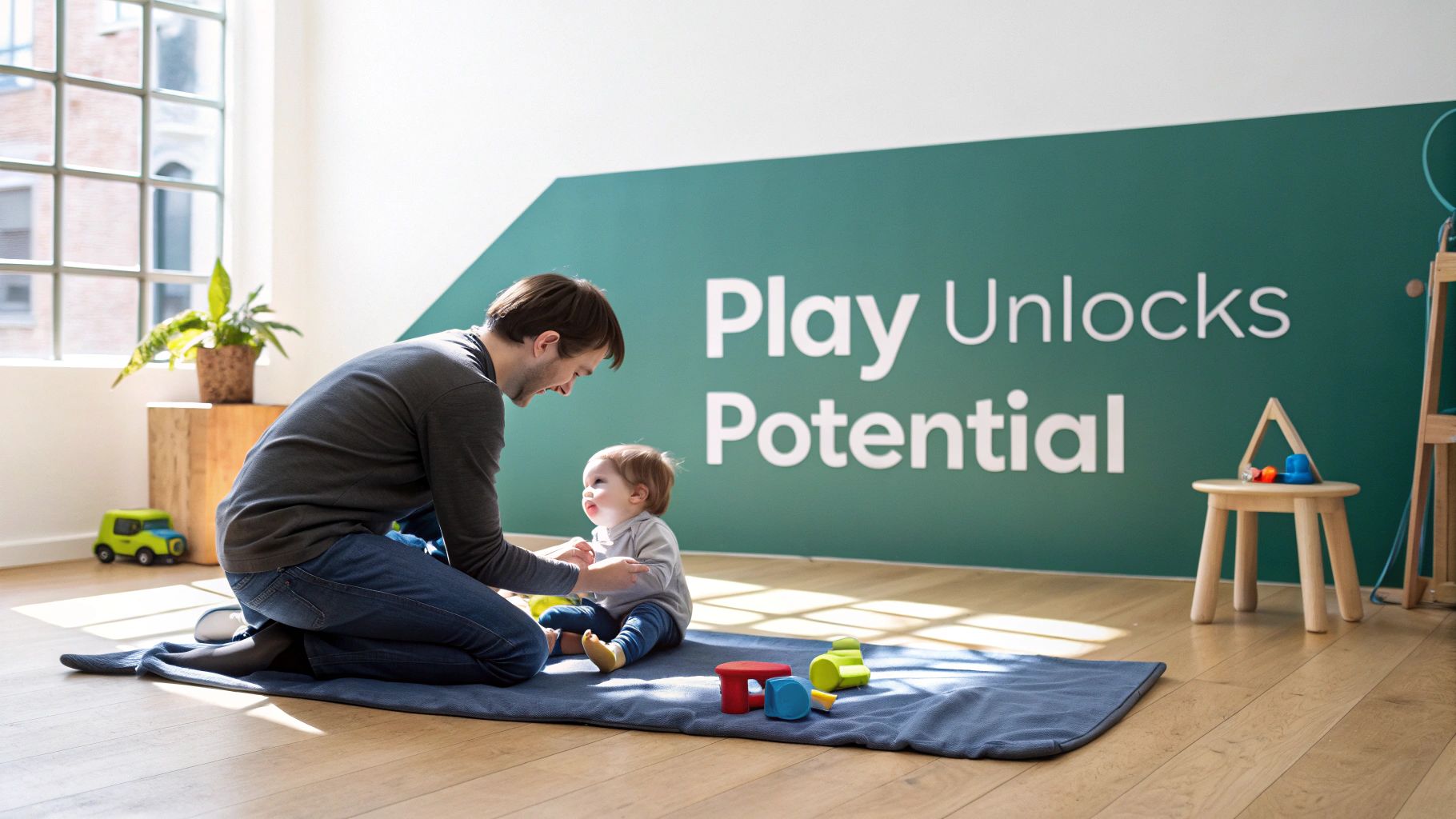
Imagine each toy as a key, perfectly crafted to unlock a new skill. These aren't complicated gadgets with flashing lights. Instead, they are simple, purposeful items designed to support the natural stages of development, helping your baby build foundational skills in a few key areas.
The Core Pillars of Developmental Play
Play isn't just about entertainment; it’s education perfectly tailored to how a baby learns. The right developmental toys are designed to nurture specific areas of growth.
- Cognitive Skills: Toys that introduce simple problems, like stacking rings or a basic puzzle, are teaching cause and effect. Even a game of peek-a-boo helps a baby grasp object permanence—the idea that you’re still there even when they can’t see you.
- Motor Skills: Reaching for a dangling mobile, grasping a smooth wooden block, or pushing a wobbly toy all help to build both fine motor skills (like hand-eye coordination) and gross motor skills (larger movements). These simple actions are strengthening muscles and refining their control.
- Sensory Exploration: A baby makes sense of the world through taste, touch, sight, sound, and smell. Toys with interesting textures, gentle sounds, and engaging colours provide a rich stream of sensory information that helps their brain process and categorise everything around them.
The real magic of developmental play is in its simplicity. It’s not about owning a mountain of toys, but about having the right tools at the right time to create joyful and meaningful connections.
The Power of Stage-Based Support
This journey of discovery happens in stages. A two-month-old's needs are completely different from those of a ten-month-old. This is where stage-based play really shines. When you offer toys that match your baby’s current developmental window, you meet them exactly where they are, which keeps them engaged and avoids frustration.
This guide will walk you through the process, helping you choose effective toys that make playtime a wonderful bonding experience. To get a head start, you can see how introducing things like personalized books for infants can have a profound impact from the very beginning. By making play meaningful, you’re not just having fun; you’re building a foundation for a lifetime of learning.
The Science Behind How Toys Shape Your Infant's Brain
Have you ever watched your baby completely captivated by a simple wooden block and wondered what’s really going on in that little head? It’s so much more than just idle fun. In those moments of intense focus, their brain is firing on all cylinders, building the very architecture that will support a lifetime of learning, problem-solving, and creativity.
This incredible process all comes down to something called neuroplasticity. The easiest way to think of it is to picture your baby's brain as a brand-new city just waiting to be built. At birth, it has millions of potential pathways, but hardly any paved roads. Every single interaction—every sight, sound, and touch—helps to construct this city.
When your baby bats at a dangling toy, they aren't just flailing their arms. They're forging and strengthening a neural pathway connecting their eyes, brain, and muscles. The more they do it, the more that dirt track becomes a solid, paved road, making the connection faster and more efficient next time. This is learning in its purest form.
Paving Pathways Through Play
Different types of infant developmental toys act like specialised construction crews, each tasked with developing a specific neighbourhood in your baby’s neural city. They don't just entertain; they stimulate targeted brain regions responsible for different skills.
- Motor Skill Toys: Things like rattles, soft balls, and activity gyms are brilliant for encouraging reaching, grasping, and kicking. These actions build up the cerebellum and motor cortex, which are the brain's command centres for coordination and movement.
- Sensory Toys: Toys with interesting textures, crinkly sounds, or high-contrast patterns send a flood of information to the sensory cortex. This helps the brain learn to interpret and categorise the world around it, laying a foundation for everything from recognising faces to enjoying different foods.
- Problem-Solving Toys: Even a simple shape sorter or a set of stacking rings challenges the prefrontal cortex. Think of this as the brain's CEO, responsible for reasoning, planning, and critical thinking. Every time your baby figures out which block fits where, they’re laying the groundwork for future academic and life skills. You can read more about how these activities boost your child's thinking in our article on cognitive development in early childhood.
The Feedback Loop of Learning
A really important idea here is the ‘serve and return’ interaction. When your baby coos or reaches for a toy (the ‘serve’), and you respond by talking to them or handing it over (the ‘return’), you’re reinforcing a powerful learning loop. This back-and-forth strengthens the neural connections crucial for social and emotional development.
Developmental toys are fantastic catalysts for these interactions. Shaking a rattle to make a sound teaches a fundamental lesson in cause and effect. "When I do this, that happens." It might seem small to us, but this discovery is a huge cognitive leap, empowering your baby to see themselves as an active participant in their world.
The most effective toys are the ones that respond to a baby's actions. This feedback—whether it's a gentle chime from a rattle or the satisfying clatter of stacked blocks tumbling down—confirms their ability to make an impact, which is a huge motivator for more exploration.
A better understanding of this science has really shifted how we all approach playtime. Today's parents are more informed than ever, and this awareness is reshaping the toy industry. In fact, parents' focus on child development has made infant and preschool toys the largest segment of the UK’s £3.3 billion toy market. With 55% of parents now choosing toys for their learning benefits over simple fun, the demand for truly effective developmental toys is at an all-time high. To discover more about these market trends, you can explore the full insights on the UK toy market. This data really shows that investing in purposeful play is a priority for modern families.
Ultimately, every moment of play is a moment of profound brain development. By providing the right infant developmental toys, you are giving your baby the tools they need to build a strong, resilient, and well-connected brain, setting them up for success long after they’ve outgrown the play mat.
A Milestone Map for Choosing the Right Toys
Knowing what developmental toys are is one thing, but knowing when to introduce them is where the real magic happens. A baby’s brain and body develop at a frankly astonishing pace, with different skills popping up in distinct windows. Giving them the right toy at the right time meets them exactly where they are, which means less frustration and way more fun and learning.
Think of this as your practical playbook for their first twelve months. We’ll break down this incredible journey into four key stages, highlighting the milestones to watch for and the specific types of toys that will give your little one the best support.
This timeline gives you a great visual for how skills build on each other—from those basic sensory discoveries to more complex movements and thinking.
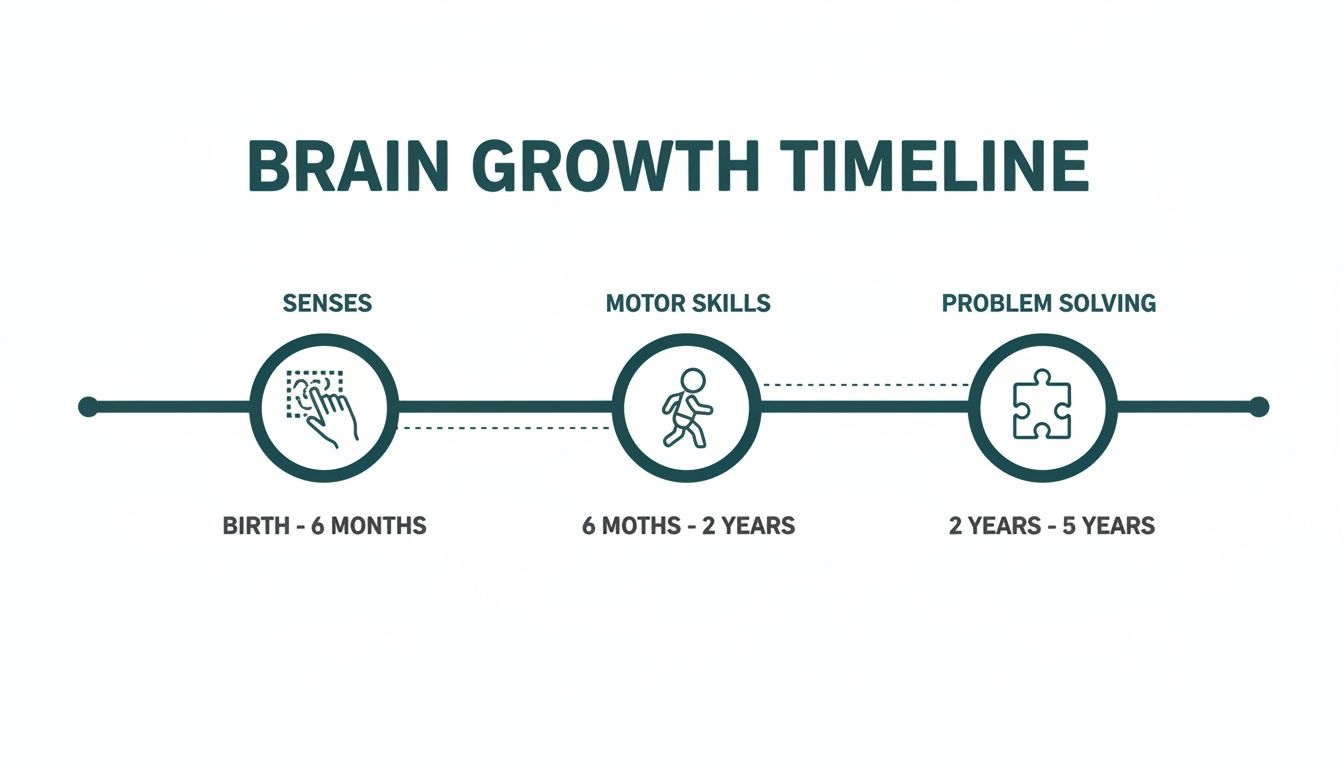
As you can see, those early sensory skills create the foundation for everything that comes later.
To help you match the perfect toy to your baby's current stage, here's a quick guide.
Developmental Toy Guide by Age and Milestone
| Age Range | Key Milestones | Recommended Developmental Toys |
|---|---|---|
| 0-3 Months | Developing vision, tracking objects, turning towards sounds. | High-contrast flashcards, soft rattles, textured play mats. |
| 4-6 Months | Reaching, grasping, exploring with their mouth, rolling over. | Activity gyms, teethers with varied textures, lightweight O-balls. |
| 7-9 Months | Sitting up, transferring objects between hands, crawling. | Stacking rings, nesting cups, soft balls, cause-and-effect toys. |
| 10-12 Months | Pulling to stand, developing the pincer grasp, solving simple problems. | Shape sorters, simple puzzles, chunky board books, push walkers. |
This table is just a starting point, of course. Every baby develops at their own unique pace, so observing your little one is always the best way to know what they're ready for.
0-3 Months: The Sensory Explorer
For the first three months, your baby is basically a tiny detective, taking in the world through sight, sound, and touch. Their vision is still a bit blurry, which is why they respond best to simple, high-contrast patterns. Their movements are mostly reflexive at this point, but they’re slowly starting to figure out how to control their little bodies.
The name of the game here is gentle sensory stimulation. You’re helping their brand-new brain make sense of all this information.
Key Emerging Skills:
- Focusing on objects up to 12 inches away
- Tracking a slow-moving object with their eyes
- Responding to sounds by turning their head
- Starting to lift their head during tummy time
Ideal Toys for This Stage: High-contrast flashcards are perfect for their developing eyesight. A soft wrist rattle helps them make that amazing connection: "When I move, it makes a sound!" This is their first lesson in cause and effect. A soft, textured play mat can also make tummy time a little more interesting, encouraging them to build that crucial neck and core strength.
4-6 Months: The Master of Reach and Grasp
This stage is a huge leap for motor skills. Your baby goes from being a passive observer to an active participant in their own life. They've discovered their hands and are learning how to use them to interact with absolutely everything.
It’s all about hand-eye coordination. And yes, everything they grab will probably end up in their mouth—that’s just how they explore different textures and shapes.
This is a critical window for introducing toys that encourage reaching and grasping. Every time they successfully grab a toy, they are strengthening neural pathways for intentional movement and refining their fine motor skills.
Key Emerging Skills:
- Purposefully reaching for and grasping objects
- Bringing things to their mouth to explore
- Beginning to roll from their tummy to their back
- Babbling and experimenting with new sounds
Ideal Toys for This Stage: An activity gym with dangling toys is fantastic motivation for them to reach, bat, and grab. Lightweight toys like an O-ball or soft blocks are ideal for their little hands. Teethers with interesting textures not only soothe sore gums but also provide valuable sensory feedback.
7-9 Months: The Little Scientist in Motion
Get ready for the age of curiosity and movement! Your baby is likely sitting up on their own, giving them a whole new perspective on the world. They might also be starting to crawl, scoot, or pull themselves up on furniture.
Cognitively, they've become little scientists, constantly running experiments. The "what happens if I drop this?" experiment is a particular favourite, and you can expect to see it repeated... a lot. This is also when they start to grasp object permanence—the idea that something still exists even when they can’t see it. It’s a huge mental leap, and you can learn more about tracking these changes by understanding what developmental milestones are.
Key Emerging Skills:
- Sitting up without any support
- Passing toys from one hand to the other
- Developing the pincer grasp (using their thumb and forefinger)
- Understanding simple cause and effect
Ideal Toys for This Stage: Stacking rings and nesting cups are classics for a reason; they're brilliant for practising fine motor skills and exploring spatial relationships. Toys that make a sound when shaken or pushed, like a wobble toy, reinforce that cause-and-effect lesson. Soft balls are great for encouraging crawling when they roll just out of reach.
10-12 Months: The Confident Problem-Solver
As they get closer to their first birthday, their play becomes much more coordinated and purposeful. They're perfecting their pincer grasp, allowing them to pick up smaller items with surprising precision. They’re also starting to imitate you and understand simple requests.
Now is the time for toys that challenge their emerging problem-solving skills. They’re moving beyond just exploring objects to actually figuring out how they work.
Key Emerging Skills:
- Pulling up to stand and "cruising" along furniture
- Picking up small things with a precise pincer grasp
- Imitating gestures like clapping or waving
- Solving simple problems, like finding a hidden toy
Ideal Toys for This Stage: A shape sorter or a simple peg puzzle offers a fantastic challenge for both their fine motor and cognitive skills. Chunky board books with flaps or different textures encourage an early love of reading and help with finger dexterity. A push walker can offer just the right support to build confidence as they take those first wobbly steps.
Why Safe and Natural Materials Matter Most
When you're choosing toys for your baby, what they're made of is every bit as important as what they do. As a parent, your little one’s safety is your number one priority, and since babies explore absolutely everything with their hands and mouths, you need to know their toys are free from anything harmful.
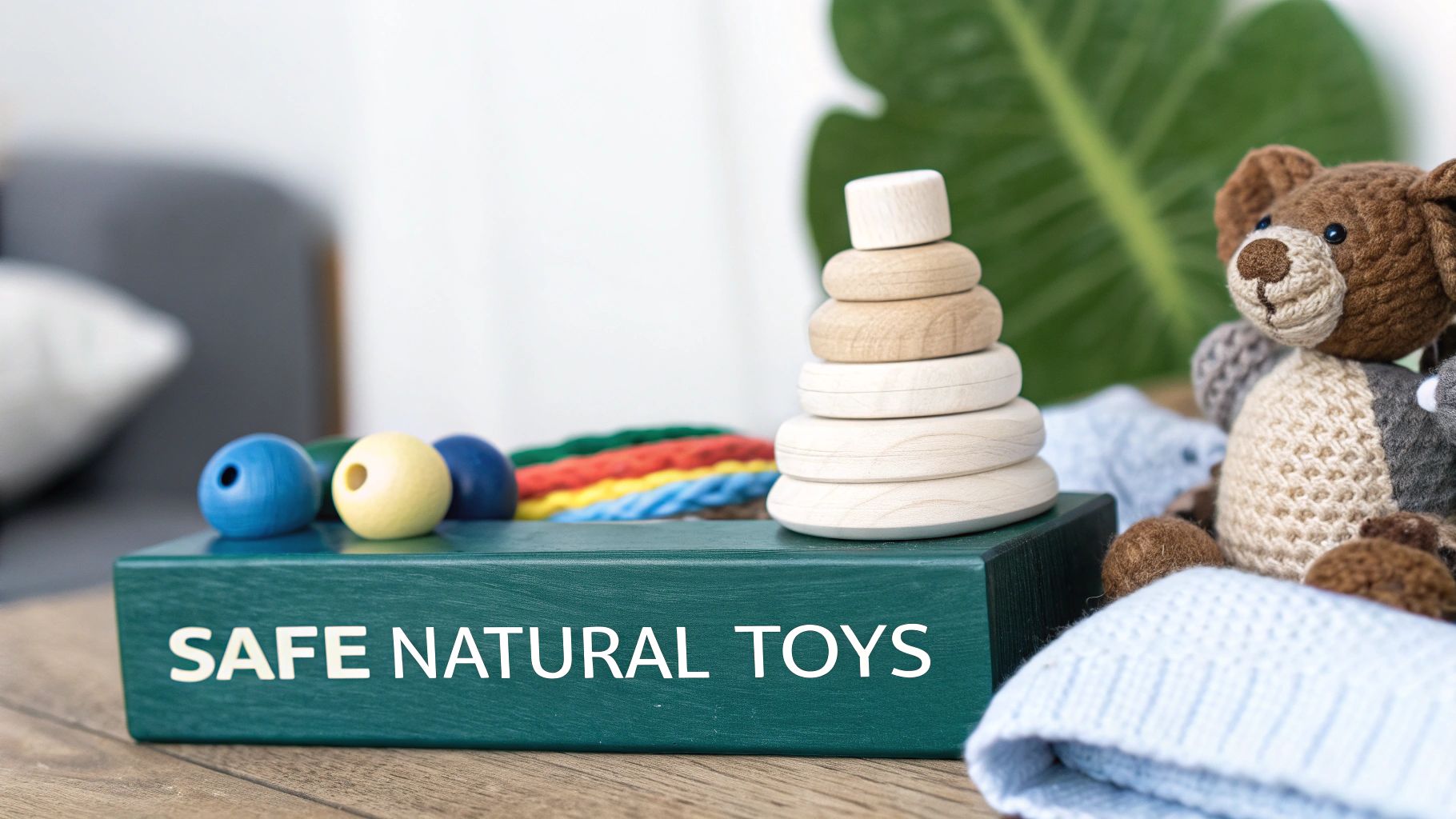
This is why so many of us are turning back to toys made from natural materials. Things crafted from solid wood, organic cotton, or natural rubber just give you that extra peace of mind. They tend to be more durable, better for the planet, and offer a much richer sensory experience without the worries that can come with some plastics.
The Clear Advantages of Wooden Toys
Wooden toys have been loved for generations, and there's a good reason for that. They aren't just a nostalgic choice; they offer real, tangible benefits for healthy development while being incredibly safe and built to last. Their simple, open-ended design fires up a child's imagination in a way many modern, prescriptive toys simply can't.
A well-made wooden toy is tough enough to withstand years of enthusiastic play, often becoming a treasured item passed down through the family. Unlike plastic toys that can crack and leave sharp edges, wooden toys are robust and resilient. We dive much deeper into how they support learning in our guide on the benefits of wooden toys.
A key benefit of natural materials is the unique sensory feedback they provide. The weight, texture, and even the subtle scent of a wooden block offer a rich, multi-sensory experience that helps a baby connect with the natural world around them.
This focus from parents on safety and sustainability is really changing the toy industry. Within the UK's massive £3.3 billion toy market, it's infant and preschool toys that are leading the way. This growth is being driven by parents who prioritise early milestones, with over 40% now actively choosing eco-friendly wooden toys over plastic ones.
Your Safety Checklist for Choosing Toys
Feeling confident about the toys you bring into your home is crucial. While safety standards can seem a bit overwhelming at first, a few key checks can make all the difference. Always give a toy a quick once-over before handing it to your baby.
Here is a practical checklist to help you evaluate any new toy:
- Look for the UKCA Mark: This is your first port of call. This mark (which replaced the CE mark) shows that the toy meets the UK’s strict safety standards.
- Check for Small Parts: A handy rule of thumb is that if a part can fit inside a toilet paper tube, it's a potential choking hazard for a child under three. Make sure no bits can easily break off.
- Inspect the Finishes: Ensure any paints or finishes are non-toxic, water-based, and lead-free. Natural, unpainted wood is often a fantastic choice.
- Avoid Sharp Edges: Run your hands over the toy. Are there any sharp points or rough patches that could cause splinters or cuts? A quality toy should be sanded perfectly smooth.
- Ensure No Cords or Long Strings: Cords longer than 22 cm can pose a strangulation risk for babies. Be extra careful when checking mobiles and pull-along toys.
By making toys from safe, natural materials a priority and running through these simple checks, you can create a play environment that is not just stimulating and educational, but fundamentally secure. That peace of mind lets you focus on what really matters: connecting with your baby through the simple joy of play.
Making Meaningful Play Simple and Stress-Free
Knowing which toys are right for your baby is one thing, but actually finding them is another challenge altogether. For most parents, life is a constant juggle. The thought of spending hours researching every toy, trawling through shops, and trying to predict what your baby will be ready for next can feel completely exhausting—like taking on a second job.
It’s a familiar story. You end up feeling overwhelmed by the sheer number of choices, or worse, with a house full of toys your baby has no interest in yet. You want playtime to be special and enriching, but the effort involved can quickly turn it into another source of stress. What if you could take out all the guesswork?
A Modern Solution for Busy Parents
Imagine the perfect, expertly chosen toys arriving on your doorstep, right at the exact moment your baby is ready to explore them. That’s the simple brilliance behind a stage-based toy subscription. It’s a modern approach designed to help you skip the research fatigue and decision paralysis that so often comes with buying baby toys.
Instead of you having to track every single milestone and match it to the right product, a team of experts does all the heavy lifting. Each kit is put together to align perfectly with your baby's current developmental window, making sure every item is engaging, safe, and genuinely useful.
The whole idea is to shift playtime from being another task on your to-do list into a simple, joyful bonding experience. It’s about freeing up your time and mental energy so you can focus on what really matters: connecting with your little one.
How a Curated Approach Takes the Guesswork Out of Play
A stage-based service like Grow With Me offers a really thoughtful, evidence-based approach to play. Each box isn’t just a random collection of toys; it's a carefully designed toolkit for development.
Here’s how it makes life simpler:
- Expert Curation: Each toy is hand-picked by paediatric experts and child development specialists. They choose items specifically for their ability to support emerging skills, whether that’s the pincer grasp, sensory exploration, or early problem-solving.
- Reduced Clutter: You get a small, considered selection of high-quality items, which helps you avoid the dreaded pile-up of unused or outgrown plastic. This ‘less is more’ approach keeps playtime focused and prevents your baby from feeling overstimulated.
- High-Quality, Safe Materials: There’s no need to spend hours deciphering labels or worrying about safety. These services prioritise premium, natural materials, with over 80% of toys typically made from sustainable wood and other sensory-rich fabrics.
- Built-in Guidance: This might be the best part. The kits come with handy guide cards that explain the ‘why’ behind each toy. They offer simple, practical play ideas, giving you the confidence to lead meaningful interactions.
This kind of curated model is a perfect fit for today's families. The UK baby toys market is set to grow from USD 1,069.04 million to USD 1,550 million by 2035, a trend largely fuelled by busy, dual-income households looking for effective learning tools. These parents want to invest in toys that genuinely foster cognitive and motor skills, making expert-led subscription services an ideal solution. You can learn more about the UK baby toys market findings to see the full picture.
By taking this simple, stress-free route, you can feel confident you’re giving your baby the very best for their development. It lets you step away from the pressure of endless research and step into more moments of pure, connected play, knowing the right tools for learning and discovery are always at your fingertips.
Common Questions About Infant Developmental Toys
Walking into the world of baby toys can feel a bit overwhelming. As parents, we all want to give our little ones the very best, but it’s easy to get lost in a sea of options and second-guess our choices. Let's clear up some of the most common questions to help you feel confident that playtime is both joyful and genuinely helpful for your baby's development.
How Many Developmental Toys Does My Baby Really Need?
This is probably the number one question on every new parent's mind. The answer is simpler than you might think: it’s all about quality and rotation, not quantity. You don't need a nursery that looks like a toy shop to support your baby's growth. In fact, too many choices at once can be overstimulating and actually get in the way of meaningful play.
A thoughtfully chosen collection of just 5-8 age-appropriate, open-ended toys is far more powerful than a room overflowing with stuff. Think about versatile items that can be used in lots of different ways—things like simple wooden blocks, sensory balls, or nesting cups. The real magic happens when you rotate a few of these toys in and out of their playspace each week. This keeps your baby curious and engaged without overwhelming them.
This 'less is more' approach gives your baby exactly what they need to explore and learn at their own pace, encouraging deeper, more focused play.
Are Expensive Electronic Toys Better for Development?
Not at all. While the flashing lights and electronic jingles on some toys are great at grabbing a baby's attention, they often put your baby in a passive role. They're watching a show, not driving the action. Real, brain-building developmental play is powered by your baby's own curiosity and imagination—not by a set of batteries.
Simple, classic toys like shape sorters, stacking rings, and puzzles invite a child to experiment, solve problems, and use their hands. These hands-on actions are what build crucial neural connections in their developing brain. Always try to choose toys that let your baby be the one in charge of the play; these are the ones that offer the most profound and lasting benefits.
When Should I Start Using Developmental Toys with My Newborn?
You can start from day one! Development kicks off the moment they arrive, and even the tiniest infants benefit hugely from gentle, appropriate stimulation that engages their brand-new senses. Play at this tender age is all about short, simple, and sensory-rich moments that help them begin to make sense of the world around them.
For a newborn, focus on toys that speak to their primary senses:
- Vision: A newborn's eyesight is still coming into focus. High-contrast flashcards with bold black-and-white patterns are perfect for helping them practise focusing and tracking objects.
- Hearing: A soft rattle or a gentle chime ball helps them connect the sound they hear with the movement they make, teaching an early lesson in cause and effect.
- Touch: Gentle tummy time on a textured play mat not only stimulates their sense of touch but also starts building that all-important neck and core strength.
How Do I Know I'm Using the Toys Correctly?
Here’s the secret: the most important ingredient for brilliant playtime is you. The best way to use any developmental toy is to simply get down on the floor and engage with your baby. You can show them how a toy works—shake the rattle or stack a block—but then step back and give them the space to explore it in their own unique way.
Talk to them about what they’re doing. Narrate their play by describing the colours, textures, and sounds ("Feel how smooth this wooden ring is!"). This interaction is just as vital as the toy itself because it builds language skills and, most importantly, strengthens your bond. If you need a little more guidance, look for toys that come with simple play ideas or guide cards. These often explain the developmental purpose of each item, empowering you to make the most of every moment you share.
As you navigate the exciting journey of parenthood and toy selection, you might also be looking for the right words to share with others celebrating their new arrival. You can find some lovely inspiration in these new baby congratulations messages.
Ready to take the guesswork out of playtime? The Grow With Me subscription delivers expert-curated, stage-based play kits right to your door. Each box is filled with beautiful, safe, and effective developmental toys made from natural materials, complete with guides to help you make every moment meaningful. Start your Grow With Me journey today!