

Guide: what is solitary play and how to encourage independent play
When a child is happily playing by themselves, completely lost in their own little world, they’re not being lonely. They're actually hitting a massive developmental milestone. This is solitary play, and it's the first major step in learning how to be an independent, creative, and capable person.
Understanding The Magic Of Playing Alone
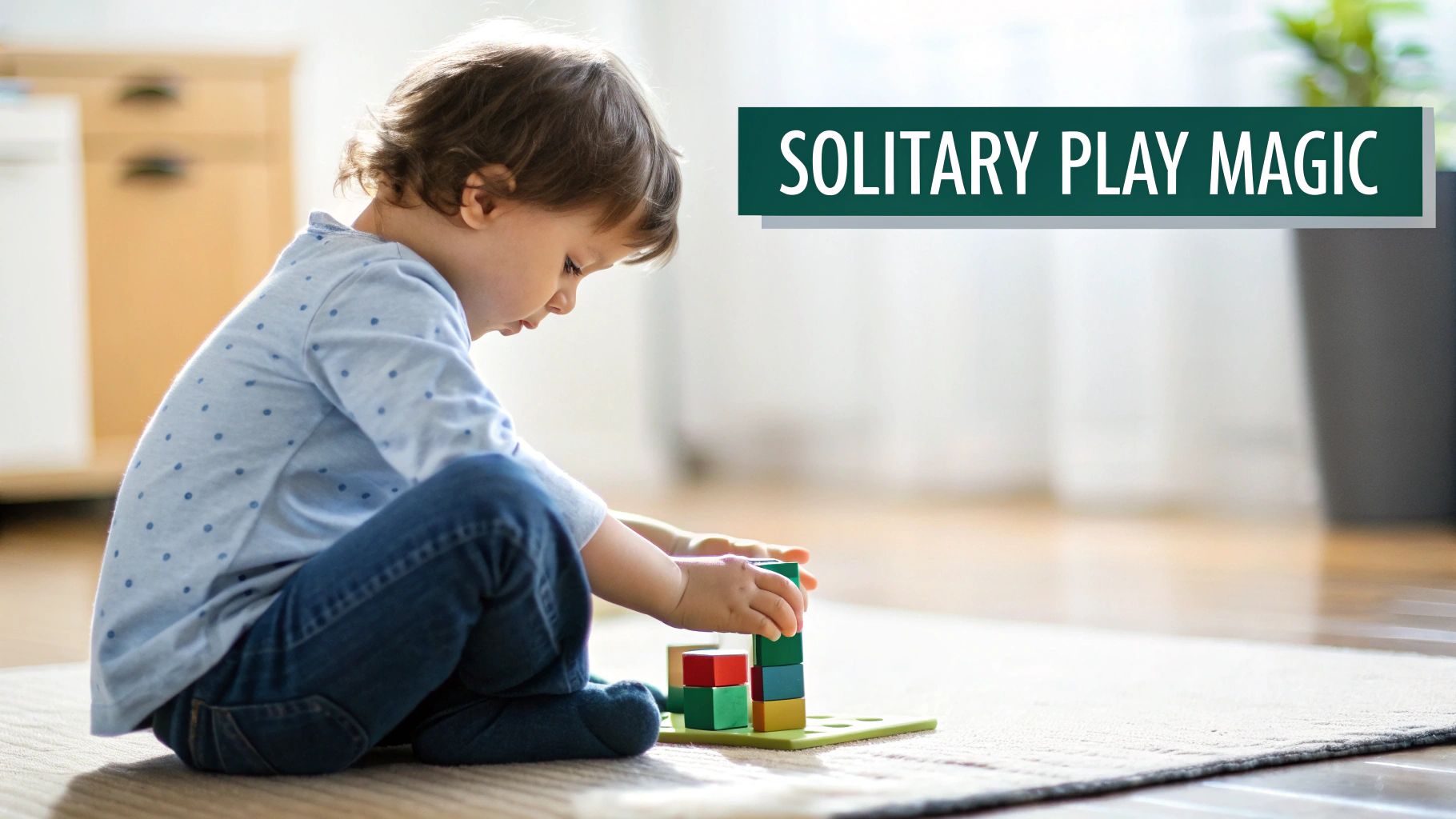
It’s a magical thing to witness: your little one so deeply focused on a toy that the rest of the world just fades away. This is solitary play in its purest form, and it's a completely natural and healthy stage of development. Instead of being a sign that they need company, these quiet moments show that their focus, imagination, and self-reliance are blooming.
You can think of it like watching a little inventor in their workshop, totally absorbed in figuring things out. This independent playtime is where some of the most profound developmental work gets done.
Why Playing Alone Matters
Solitary play isn't just a phase; it's the bedrock for so many skills to come. It’s the very first step on the path towards more complex social play, like the side-by-side action you see in what is parallel play. During these moments, your child is actively building their mental and emotional toolkit for life.
So, what’s really going on when they’re happily playing alone?
- Fostering Independence: They’re learning to entertain themselves, figuring out what they like and how things work without needing someone else to guide them.
- Building Concentration: Zeroing in on one activity, whether it’s stacking blocks or simply turning the pages of a board book, strengthens their ability to focus.
- Sparking Creativity: With no one else to direct the narrative, their imagination takes flight. A cardboard box becomes a castle, and a teddy bear turns into a trusted confidant.
- Developing Problem-Solving Skills: Working out how to get that puzzle piece to fit or how to stop their block tower from toppling over teaches resilience and critical thinking.
Solitary play is a child's first laboratory. It’s where they experiment with cause and effect, test their own limits, and learn to enjoy their own company—a skill that will serve them for a lifetime.
Ultimately, these solo adventures lay a vital foundation for emotional regulation and self-belief. When we provide them with the right age-appropriate toys, like those in the Grow With Me kits, we’re giving them the perfect tools for these essential moments of independent discovery.
The Hidden Benefits Of Independent Play
When you see your little one playing alone, it might look like they're just killing time. But those quiet moments are actually a hotbed of developmental activity, building the foundations for some of life's most important skills. Giving your child the space to play by themselves is one of the best ways to help them grow into a resilient, imaginative, and capable person.
Far from being a sign of loneliness, independent play is like a personal training session for your child's brain. It's their chance to build entire worlds and dream up elaborate stories without any help from grown-ups. A simple stack of blocks can become a towering city, and a well-loved teddy bear can turn into a trusted sidekick on an epic quest.
Building A Foundation For The Future
The skills your child hones during solitary play aren't just for the playroom; they're the building blocks for success at school and in friendships down the line. Every minute they spend focused on their own activity is an investment in becoming a well-rounded and confident child.
Here are some of the most powerful advantages:
- Boosts Creativity and Imagination: Without anyone else to guide them, a child’s imagination can truly run wild. They invent their own rules, create their own stories, and explore endless possibilities, which is a fantastic workout for their creative thinking.
- Sharpens Problem-Solving Skills: Figuring out how to stop a block tower from wobbling or which puzzle piece fits where teaches them to keep trying and think logically. These little wins build a real sense of confidence in their ability to tackle challenges on their own.
- Develops Concentration and Focus: When a child gets lost in a single toy or activity for a good chunk of time, they’re strengthening their attention span. This ability to concentrate is absolutely vital for learning when they start school.
By learning to entertain themselves and navigate challenges alone, children build a strong sense of self. They discover their own interests and preferences, which is a critical step in forming their unique identity.
Fostering Emotional Strength and Independence
Beyond all the brain-boosting benefits, solitary play is incredibly important for your child’s emotional growth. It teaches them how to find comfort, joy, and entertainment in their own company—a skill that builds amazing resilience and self-sufficiency for life.
When children play by themselves, they learn to manage their feelings without immediately running to a parent for a distraction or a cuddle. They figure out how to handle the frustration of a toy not working the way they want and feel the quiet pride of solving a problem all by themselves. This whole process builds emotional maturity and a healthy sense of self-reliance.
This journey of independent discovery is a cornerstone of a child's early years. Understanding the stages of their mental growth can really help you appreciate why these solo moments are so powerful. You can explore more about this connection in our guide to cognitive development in early childhood.
Ultimately, solitary play is a gift of independence. It shows children that they are capable, creative, and can be perfectly happy in their own imaginative world. This foundation prepares them not just for the next stages of play, but for a lifetime of confident learning and exploration.
Mapping Your Child’s Journey Through Play
To really get to grips with what is solitary play, it helps to see it not as a standalone event, but as one important stop on a much bigger journey. A child's social world doesn't just switch on one day; it’s built up, piece by piece, through a series of predictable stages.
Think of it like learning a language. First, a child learns individual sounds and words before they can ever hope to string a sentence together. Solitary play is one of those crucial first "words" in their social vocabulary. It's where they learn the absolute basics on their own terms, long before they're ready to start a "conversation" with other children.
This progression was brilliantly observed by sociologist Mildred Parten, who identified six key stages of play that nearly all children move through as they grow and develop.
A Parent's Guide To The Six Stages Of Play
Before we dive in, it’s really important to remember that these stages aren't a rigid timetable or a race to the finish line. Every child develops at their own unique pace, and they might even hop back and forth between stages depending on their mood, the environment, or who they’re with. This framework is simply a guide to help you understand and celebrate where your child is right now.
Here’s a snapshot of how that journey typically unfolds.
| Stage Of Play | Typical Age Range | What It Looks Like |
|---|---|---|
| Unoccupied Play | Birth to 3 months | A baby is just figuring things out—watching the world and making seemingly random movements with their arms and legs. |
| Solitary Play | 3 months to 2 years | A child plays alone, completely absorbed in their own world. They haven't yet developed an interest in others' play. |
| Onlooker Play | 2 to 3.5 years | A child watches other children play with great interest but doesn't join in. They're learning social rules from afar. |
| Parallel Play | 2 to 4 years | Two children play side-by-side, often with similar toys, but with little to no interaction. They're aware but separate. |
| Associative Play | 3 to 4 years | Children start interacting, sharing toys and talking, but they aren't working towards a shared goal or plan. |
| Cooperative Play | 4+ years | The final stage where children actively play together, taking on roles and working as a team to achieve a common goal. |
Seeing the stages laid out like this really helps put solitary play into context. It’s not just a phase to get through; it’s the foundation for everything that follows.
The skills your little one hones while playing alone—imagination, focus, and problem-solving—are the bedrock of their entire development.
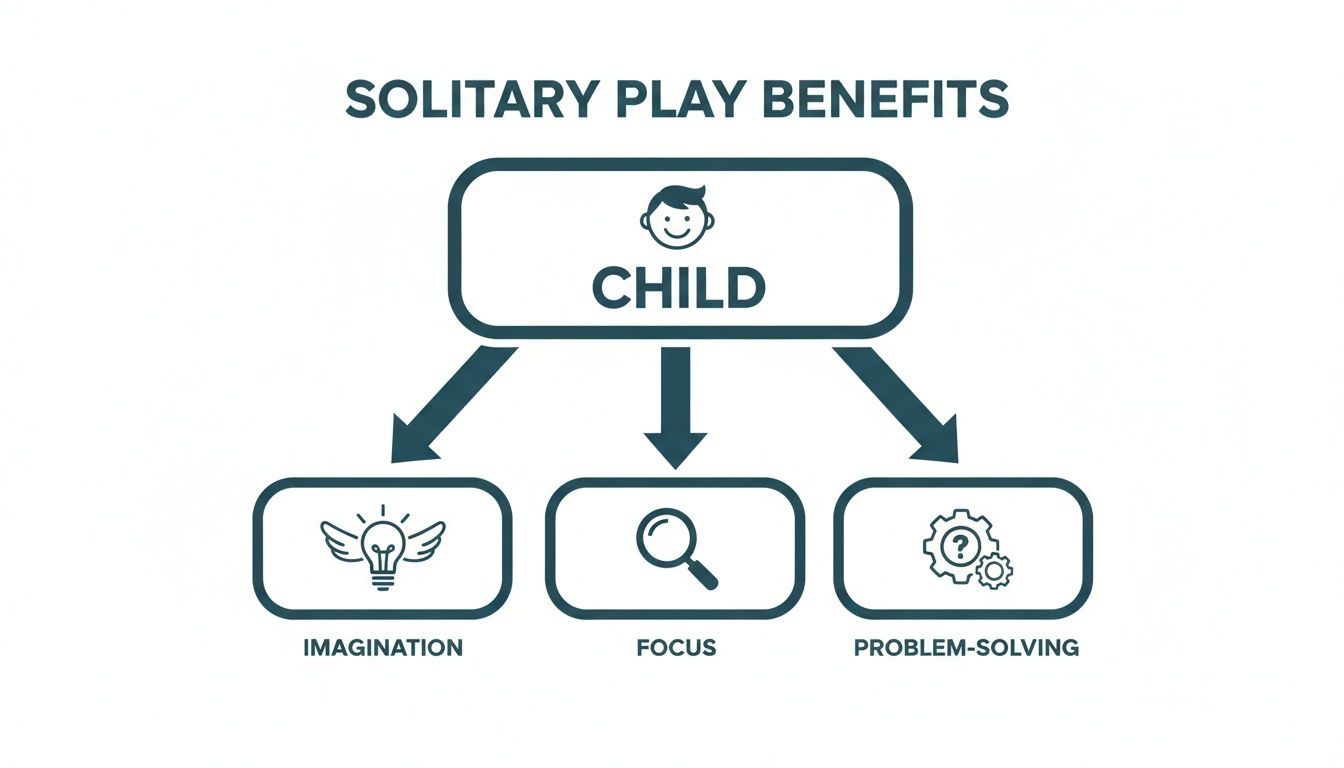
As the visual shows, these core abilities aren’t just abstract concepts; they are the direct and tangible outcomes of healthy, independent play.
Why This Progression Matters
Understanding this natural flow helps us as parents to reframe what we’re seeing. Solitary play isn’t a sign of shyness or a social delay. Quite the opposite—it’s the essential groundwork being laid for all future friendships and collaborative efforts.
When you see your child playing alone, you are witnessing the construction of their social foundation. Each block they stack and each puzzle they solve on their own is a victory that builds the confidence needed to eventually play with others.
By first becoming the master of their own little world, they build the skills and self-assurance required to step into the more complex, shared worlds of associative and cooperative play later on. It's a beautiful process, and it all starts here.
Choosing The Right Toys For Solo Adventures
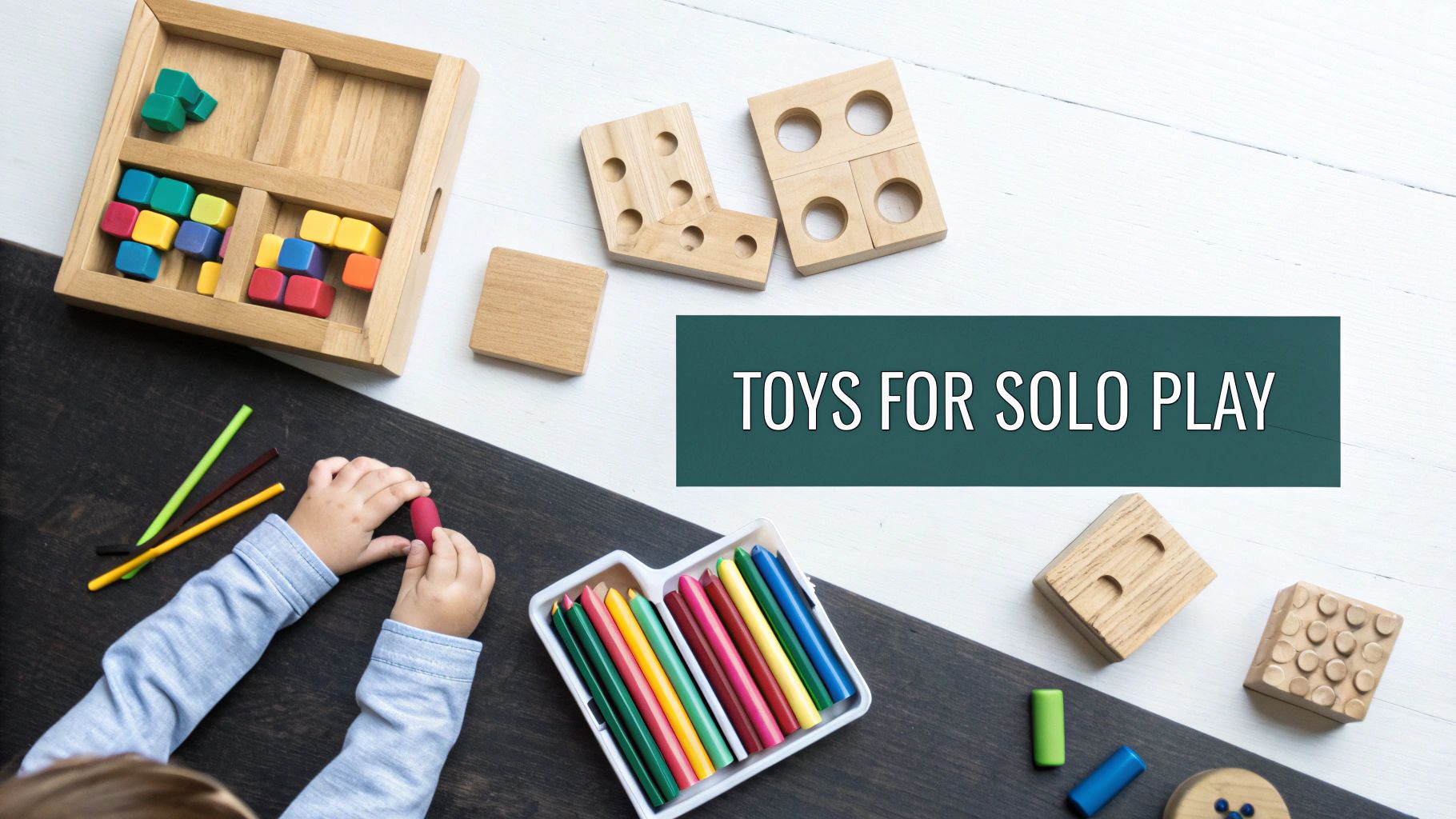
Picking the right toys can make all the difference, turning solo playtime from a simple distraction into a genuinely powerful learning experience. The best tools for independent exploration are often the simplest ones, the kind that spark a child's imagination rather than just entertaining them passively. Think of a toy as a question, not an answer; it should make them curious and eager to experiment.
For these solo adventures, the key is to offer open-ended toys. These are the gems that can be used in countless ways, putting your child firmly in the director's chair of their own playtime. This freedom is what supports those longer, focused periods of play that are so beneficial.
Sparking Curiosity For Babies (0-12 Months)
In their first year, a baby’s world is a whirlwind of sensory discovery. Toys that catch their eye, make interesting sounds, or feel fascinating to touch are perfect for solo exploration. The goal here is to give them safe, stimulating things they can interact with on their own terms, whether they're on their play mat or having some tummy time.
Here are a few great choices for this age group:
- Sensory Balls: With different textures, bright colours, and gentle sounds, these are fantastic for developing their sense of touch. They also teach a simple lesson in cause and effect when they’re squeezed or rolled.
- Unbreakable Mirrors: Babies are captivated by faces, especially their own! A baby-safe mirror is a brilliant way to encourage self-awareness and offers endless visual fun.
- Crinkle Books: The mix of soft textures, high-contrast images, and that oh-so-satisfying crinkling sound engages multiple senses at once. They're perfect for tiny hands to explore.
At this stage, it’s all about the sensory input. Every new texture they feel and every sound they create helps to build crucial neural connections in their brain, laying the groundwork for all future learning.
Nurturing Imagination For Toddlers (1-3 Years)
As babies blossom into toddlers, their play becomes much more intentional and imaginative. This is the perfect time for toys that get them problem-solving, thinking creatively, and honing their fine motor skills. The best toys for toddlers are the ones that can be built up, sorted, taken apart, and reimagined over and over again.
Think about adding these essentials to your toddler’s solo play toolkit:
- Building Blocks: Whether they’re classic wood or colourful plastic, blocks are the ultimate open-ended toy. They teach important lessons about gravity, balance, and spatial awareness, all while letting their creativity run wild.
- Simple Puzzles: Those chunky wooden puzzles with large knobs are brilliant for helping toddlers practise their pincer grasp and develop problem-solving skills as they figure out where each piece fits.
- Art Supplies: A set of chunky crayons, some washable paint, and big sheets of paper can open up a whole new world. This is where their imagination can truly take flight.
Choosing toys that align with where your child is at developmentally is so important. For more ideas on fostering this kind of purposeful play, you can find a wealth of information in our guide to Montessori toys for toddlers. When you provide the right tools, you create an environment where your child's independent spirit can truly thrive.
How to Nurture Healthy Independent Play
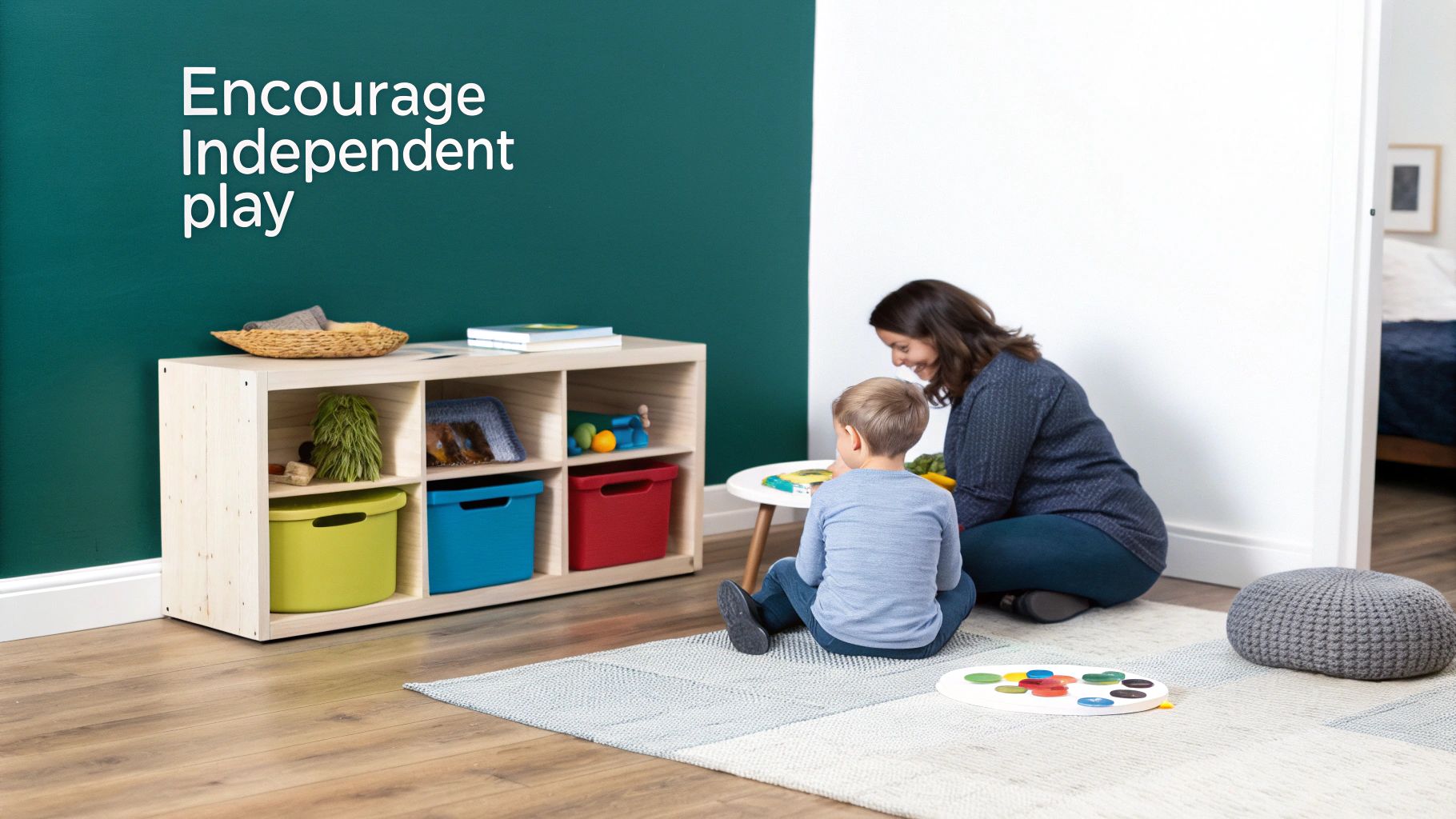
Knowing solitary play is good for your little one is one thing, but actually creating the right environment for it to happen is another. Fostering independence isn't about leaving your child to their own devices. It’s about thoughtfully setting up a space and a routine that makes them feel secure enough to start exploring all by themselves.
A brilliant way to get started is by creating a ‘yes space’. Think of it as a corner of your home that is completely child-proofed and stocked with engaging, age-appropriate toys. In this little haven, your child is free to touch, explore, and play without constantly hearing "no," which gives them a wonderful sense of autonomy.
Starting Small and Building Confidence
If your child is used to you being their constant playmate, you can’t expect them to suddenly dive into long stretches of solo play. The trick is to start small, building their confidence and comfort with being alone one step at a time.
- Begin with just five minutes. Set a timer and stay nearby, but try not to jump in unless they really need you. This reassures them that they're safe and that you're close.
- Tell them what you’re doing. Instead of just slipping away, say something like, "Mummy is just going to put the kettle on while you play with your blocks." This simple narration builds so much trust.
- Slowly stretch the time. Once five minutes feels easy, try for seven, then ten. Let your child's cues guide you and celebrate these little wins.
The goal isn't to create distance. It's about giving your child the gift of self-reliance, so they have the confidence to entertain themselves, solve little problems, and find joy in their own company.
This whole process is really an exercise in mindful observation. You have to learn to step back and resist that powerful urge to swoop in and "fix" things. Letting them struggle for a moment with a tricky puzzle piece or a wobbly tower is precisely how they build resilience and problem-solving skills. If you're looking for more guidance, exploring practical strategies for encouraging independence in toddlers can be a huge help.
Letting Go of the Guilt
It's completely normal to feel a pang of guilt when you first step away. We've all been there. The key is to reframe what this time really means. You aren't ignoring your child; you're giving them a vital opportunity to grow.
This time is a gift of autonomy for them, and honestly, a much-needed moment of respite for you. That breather helps support a healthier, more balanced family dynamic for everyone.
Sadly, spaces for children to explore freely are shrinking. Research has found that only 10% of UK children's outdoor play now happens in natural settings like woodlands. That’s a massive drop from the 40% their parents' generation enjoyed, which means fewer chances for unstructured discovery. Creating these pockets of independence at home is more important than ever.
Got Questions About Solitary Play? Let's Unpack Them
It’s completely normal to have questions when you see your little one playing all by themselves. We get it. While it’s a crucial part of their development, understanding the ins and outs can offer some much-needed peace of mind. Here are some straightforward answers to the questions we hear most often from parents.
Is It Okay That My Toddler Actually Prefers Playing Alone?
Absolutely. Not only is it okay, but it's also a fantastic sign of healthy development. Many toddlers go through a phase where they are completely absorbed in their own little world of discovery. A preference for playing alone shows that they feel secure, can happily entertain themselves, and are busy building vital skills like concentration and imagination.
Think of this stage as the foundation for their future social life. By first mastering their own world, they build the confidence they'll need to eventually play alongside, and then with, other children. It’s less about avoiding others and much more about being happily engaged in the very important work of being a toddler.
How Much Solitary Play Is Too Much?
There's no magic number here, because every child is wonderfully different. The real thing to watch isn't the clock, but the quality of their play and their general mood. If your child is happy, engaged, and hitting their developmental milestones, the amount of time they spend playing alone is almost certainly just right for them.
The real red flag isn't a child who enjoys playing alone. It's a persistent disinterest in any type of play or interaction, whether that's solo or social, especially if it’s paired with other developmental worries.
However, if your child consistently shies away from all social contact, seems genuinely distressed, or shows no interest in other children (not even as an observer), it might be worth a chat with your paediatrician or health visitor, just for reassurance.
My Child Gets So Frustrated Playing Alone. What Should I Do?
This is such a common scenario! Frustration is a normal, and even productive, part of learning. When a toddler gets annoyed that their block tower keeps toppling over, they are right on the edge of a breakthrough in problem-solving. Your role isn't to swoop in and fix it for them, but to be their gentle, supportive coach from the sidelines.
Here’s how you can help without taking over:
- Acknowledge their feelings: A simple, "Oh, it can be so tricky when the blocks fall down, can't it?" shows you understand and validates their emotion.
- Offer a tiny hint, not the solution: You could try wondering aloud, "I wonder what would happen if a bigger block was at the bottom?"
- Make sure the toys are right for their age: Sometimes, constant frustration is a sign that a toy is just a bit too advanced. Swapping it for something better suited to their current abilities can make all the difference.
What’s The Difference Between Solitary Play And Shyness?
That’s a brilliant question, and the distinction is a really important one. At its core, solitary play is an action, while shyness is more of a personality trait linked to social anxiety.
A child deep in solitary play is often confident and focused, simply lost in what they're doing. A shy child, on the other hand, might desperately want to join in with others but feels too anxious or intimidated to try. They might hover at the edge of a group, watching wistfully. The child enjoying solitary play? They’re perfectly content in their own happy bubble.
At Grow With Me, we believe in giving parents the right tools for every single stage of development. Our curated play kits are specifically designed to make those solo adventures meaningful and fun, providing your little one with the perfect building blocks for a lifetime of learning.
Explore our stage-based play kits and support your child's independent journey today.