
A Parent's Guide to Milestones for 16 Months
Welcome to the wonderfully chaotic world of a 16-month-old! This age is pure magic, a whirlwind of newfound confidence, emerging words, and a seemingly endless drive to explore. Your little one is rapidly transforming from a wobbly baby into a determined toddler with a mind of their own. You're likely seeing them move with more purpose, perhaps even attempting a run, and definitely making their wants and needs known.
Your Toddler's Incredible Journey at 16 Months
Watching your toddler navigate their world is like witnessing a tiny explorer mapping out new territory every single day. The milestones for a 16-month-old aren't a strict checklist to tick off, but rather a guide to help you celebrate their unique personality as it blossoms. It’s a time defined by huge leaps in how they move, how they communicate, and how they connect with you and everything around them.
Each small step forward is a monumental achievement in their eyes. One day they might point to their nose when you ask, and the next they’re trying to scale the sofa like a seasoned mountaineer. Around this age, many UK toddlers hit exciting milestones, like saying their first clear words beyond 'mama' or 'dada'. In fact, research shows that around 75% of children at this stage can point to at least one body part when asked and can follow simple one-step instructions like 'give me the ball'.
This chart gives you a quick visual on the key areas of growth—Movement, Communication, and Connection—that are so central to your toddler's world right now.
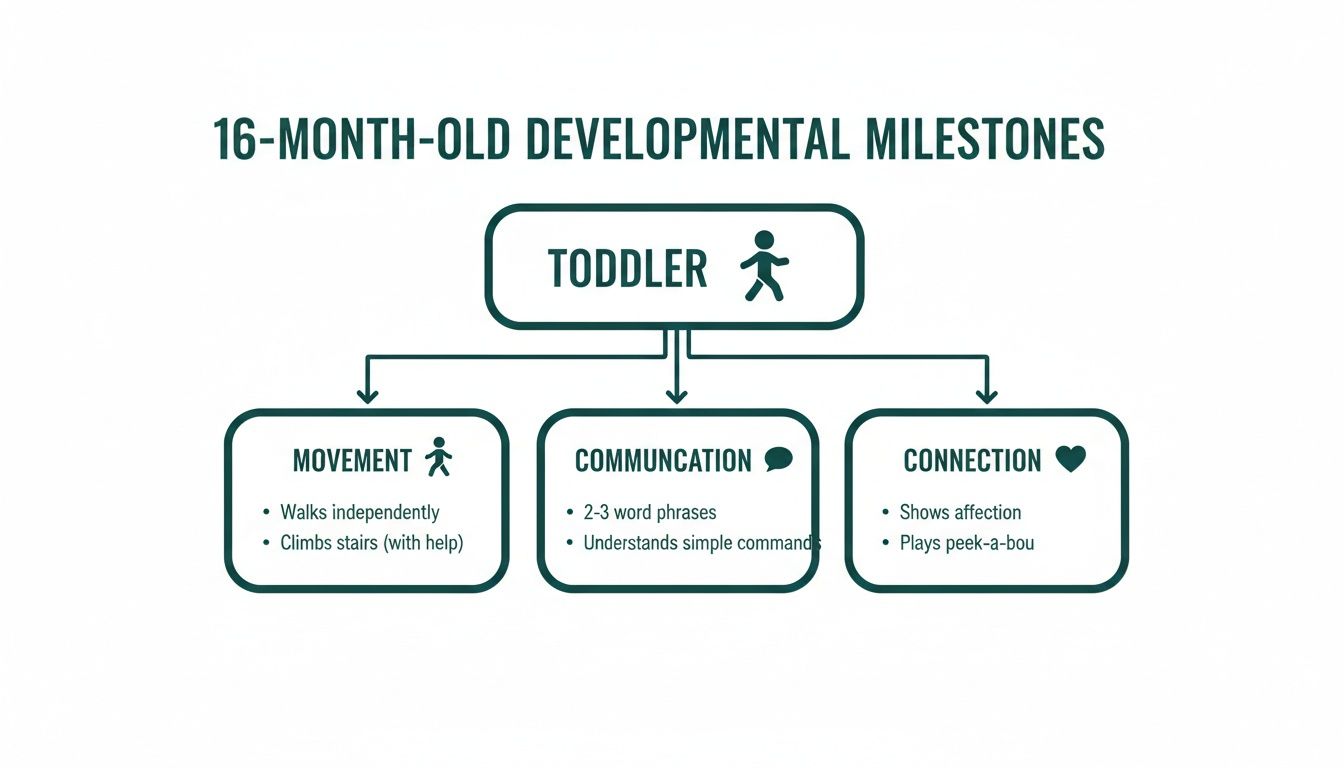
As you can see, these domains are all beautifully interconnected. As your toddler's physical skills improve, it opens up brand new ways for them to communicate and form deeper social bonds with you.
Key Milestones at a Glance for 16 Months
To give you a clearer picture, it helps to see these skills broken down by developmental area. This table provides a quick reference for the kinds of things you might be seeing your 16-month-old do.
| Developmental Area | What You Might See at 16 Months |
|---|---|
| Gross Motor | Walking independently, maybe even trying to run. Can squat to pick up a toy. |
| Fine Motor | Stacks two or three blocks. Scribbles with a crayon. Turns pages in a book. |
| Language | Says several single words. Shakes head for "no". Points to show you something. |
| Cognitive | Imitates your gestures and sounds. Follows simple, one-step directions. |
| Social & Emotional | Shows affection with hugs and kisses. May have temper tantrums. |
| Self-Care | Tries to use a spoon. Helps with dressing by pushing an arm through a sleeve. |
Remember, this is just a general guide. Every child develops at their own pace, and there's a wide range of what's considered typical.
Embracing Purposeful Play
Knowing what are developmental milestones isn't about creating pressure; it’s about understanding how to turn everyday moments into powerful learning opportunities. Your role isn't to be a formal teacher, but a playful partner, creating an environment that sparks their natural curiosity. This is where purposeful, stage-based play really shines.
Simple activities, from stacking blocks to pointing out pictures in a book together, build crucial foundations for future learning. For more brilliant ideas on how to support your toddler's growth, check out these 5 things parents can do to help their children thrive.
Mastering Movement and Motor Skills
Your 16-month-old is a whirlwind of activity, isn't he? It feels like one minute they’re just figuring out how to stand, and the next, your living room has become their personal obstacle course. This incredible explosion of energy is all down to their amazing progress in motor skills.
It helps to think of these skills in two different ways: the big, powerful movements and the small, delicate ones.
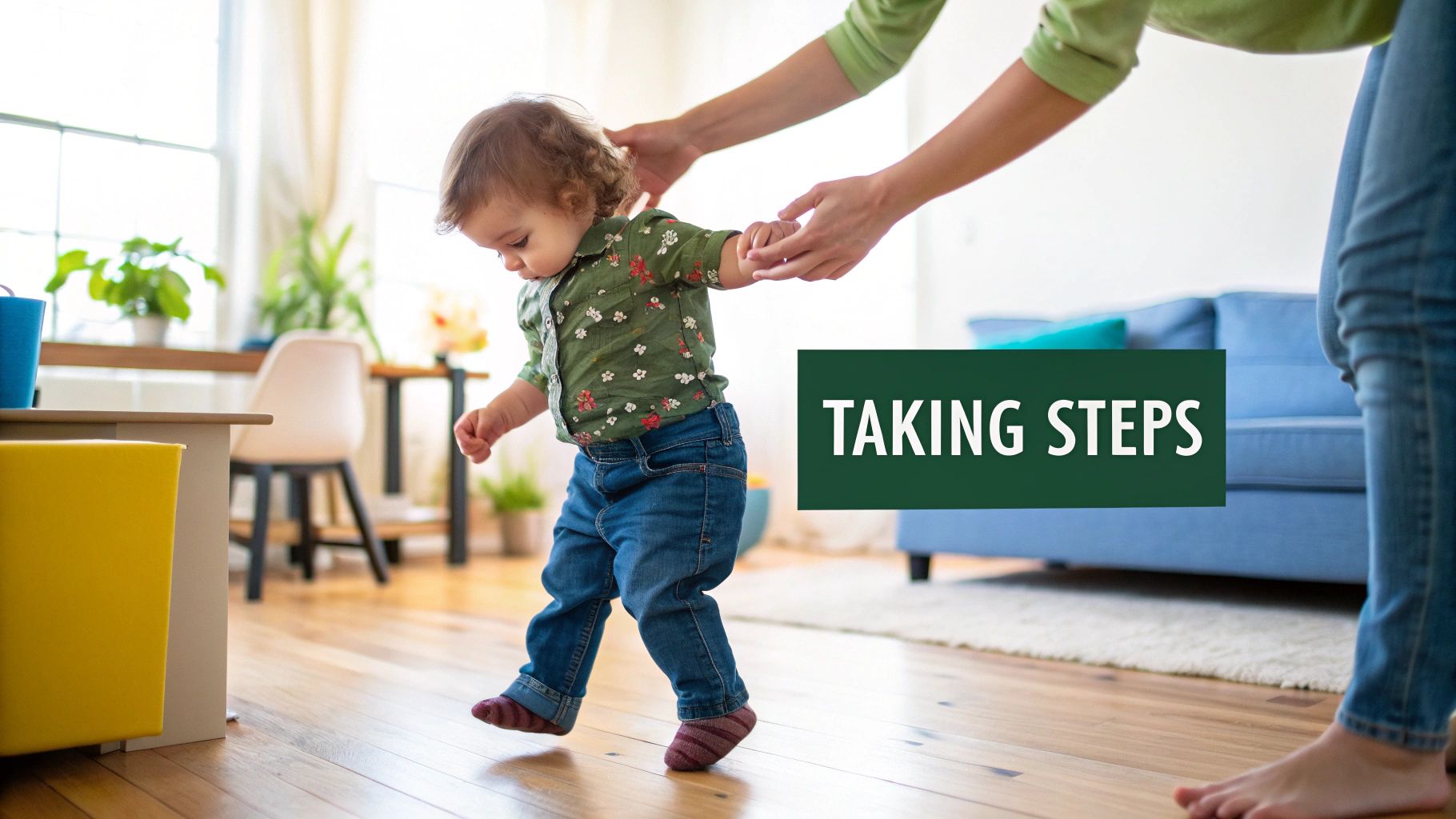
First, you have the gross motor skills. These are the skills that use the large muscle groups in their arms, legs, and torso. Just a few months ago, they might have been taking those wobbly, tentative first steps. By now, many toddlers are walking with real confidence, no longer needing to hold their arms out wide for balance.
This newfound stability is the launchpad for their next big adventures. You’ll probably start to see them attempting a charmingly clumsy run, squatting down to inspect a toy without tumbling over, and maybe even trying to walk backwards a few steps.
From Waddles to Walking and Climbing
Don't mistake all this movement for just random energy – it's your toddler meticulously building a foundation of strength, balance, and coordination. Every new physical feat is a surprisingly complex achievement.
- Confident Walking: Their steps are becoming more even, and they can navigate around the coffee table like a pro.
- Early Climbing: The sofa, a low chair, and especially the stairs suddenly present an irresistible challenge. They’re figuring out how to use their arms and legs together to pull themselves up.
- Carrying Objects: Walking while clutching a favourite teddy requires a whole new level of coordination, a skill many toddlers are just beginning to master.
Now, let's zoom in on the delicate work happening with their hands. These are their fine motor skills, which involve the small, precise muscles in their fingers and wrists. These skills are every bit as important as the big movements, as they're paving the way for future tasks like writing, drawing, and dressing themselves.
At this age, a toddler's brain is like a construction site for coordination. Every time they stack a block or scribble with a crayon, they are strengthening the neural pathways that connect what their eyes see with what their hands do.
Simple, everyday play is the best practice there is. Just turning the thick pages of a board book helps to strengthen their pincer grasp. If you're looking for more ideas, you can explore these fantastic fine motor skills development activities that turn playtime into powerful learning.
The Power of Playful Practice
Honestly, the best way to support these milestones for 16 months is simply through play. You don't need fancy, complicated setups; your toddler's natural curiosity is the only guide you need.
Activities like stacking a tower of two or three blocks or making spontaneous scribbles on a piece of paper are classic signs of their developing hand-eye coordination. In a Grow With Me kit, for example, the toys are specifically chosen to encourage exactly this. A simple wooden puzzle or some chunky stacking rings aren't just toys; they are carefully designed tools for building dexterity, problem-solving skills, and that wonderful sense of "I did it!"
First Words and Early Communication
Your living room probably has a new soundtrack these days. It’s no longer just cries and giggles; you’re likely hearing expressive babbling that sounds astonishingly like a real conversation, complete with different tones and natural pauses. These are the first incredible signs of a language explosion, one of the most exciting milestones for 16 months.
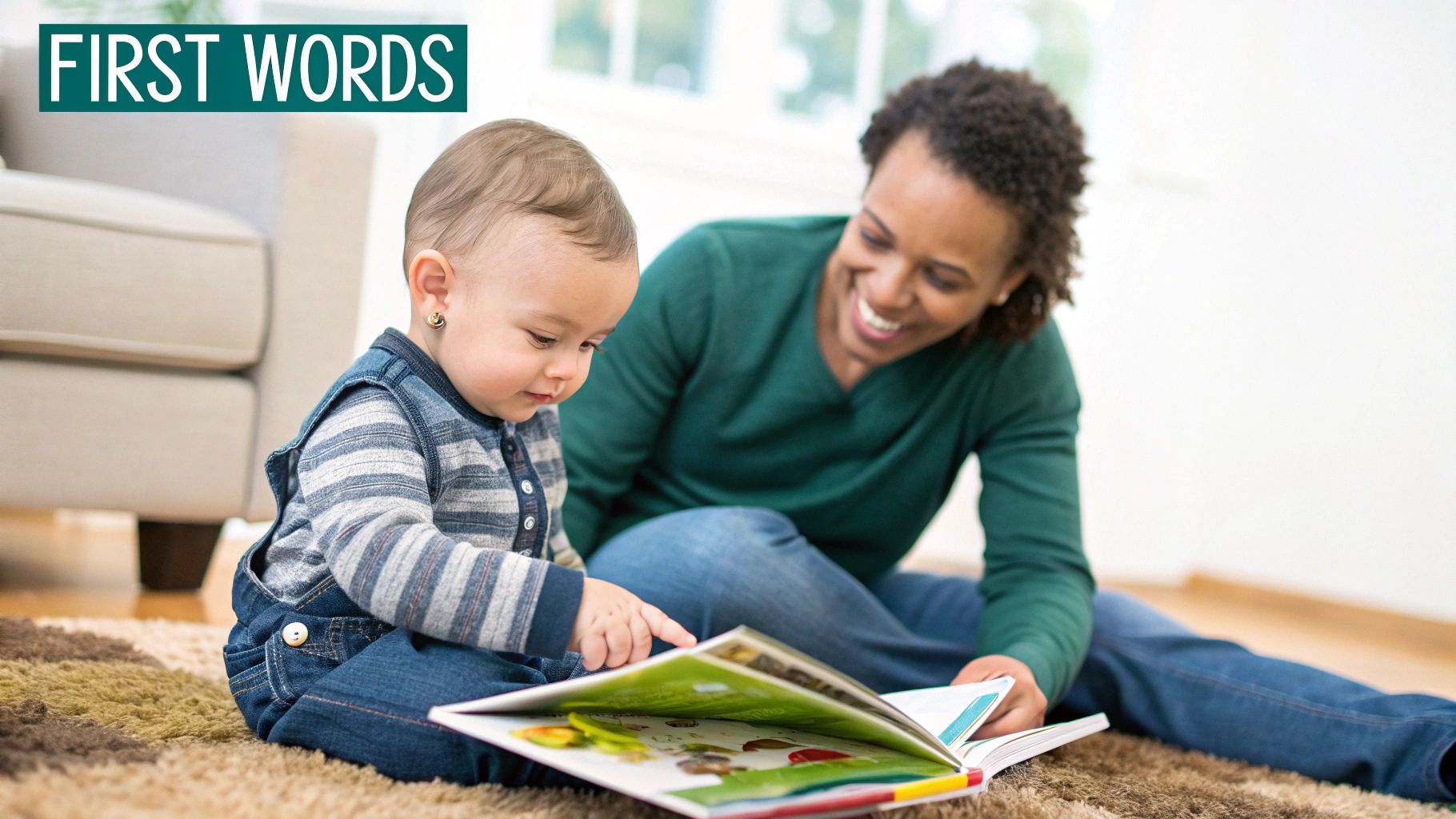
This is a time of huge growth in how your little one understands and starts to use language. They might only have a few clear, recognisable words like "mama," "cup," or "dog," but don't be fooled. Their receptive language—everything they understand—is often miles ahead of what they can actually say. They really are like little sponges, soaking up every word you speak.
You’ll probably notice they can follow simple, one-step instructions. Ask them to "pass me your cup," and watch as they process the request and respond. It’s a brilliant sign that their cognitive and language skills are starting to work together.
Decoding Their Communication Style
At this age, communication is a fascinating mix of words, sounds, and gestures. Even without a big vocabulary, your toddler is getting very good at making their needs and wants known.
Keep an eye out for these classic forms of communication:
- Pointing Power: This is a massive leap forward! Instead of just crying in the general direction of what they want, they can now point directly at the biscuit on the counter or the cat in the garden. They’re sharing their world with you.
- Gestures and Sounds: A vigorous head shake for "no," arms stretched up high to be picked up, or making a "moo" sound when they see a cow in a book are all powerful communication tools.
- Expressive Jargon: This is that wonderful stream of babble that perfectly mimics the rhythm and intonation of adult speech. It's their way of practising for the real deal.
Every single attempt to communicate is a crucial building block. When you respond with enthusiasm, you’re teaching them that their voice is important and heard.
Think of your toddler's brain as a language garden. Every word you say, every book you read, and every song you sing is like planting a seed. Your consistent, positive interactions are the sunshine and water that help those seeds sprout into words and sentences.
How to Nurture Their Budding Vocabulary
The best way to encourage their language is to simply make it a fun and natural part of your everyday life. You don't need flashcards or formal lessons; your daily chats are the most powerful tool you have.
Simply narrating what you’re doing works wonders. "I'm putting on your red socks now" exposes them to a constant stream of words used in context. This kind of guided interaction is incredibly effective. In fact, studies from the UK Department of Education show that toddlers who engage in this sort of guided play show a 20-30% faster progression in their expressive language skills compared to unstructured play alone.
Toys from a Grow With Me kit, like the illustrated board books or character figures, are designed to spark this kind of back-and-forth "chat." Pointing to a picture and saying, "Look, a duck!" gives them a new word and connects it to an image, strengthening that connection in their brain. For more brilliant ideas, have a look at our guide to language development activities for toddlers. And remember to celebrate every little "quack" or "moo"—it's a sign they’re learning, trying, and connecting with you.
How Your Toddler's Mind Is Growing
At 16 months, your toddler's brain isn't just growing – it's practically buzzing with activity. Imagine a tiny detective on a mission, constantly gathering clues, testing out little theories, and piecing together how their world works. This is that magical stage where their cognitive skills—how they think, learn, and remember—really start to shine.
One of the biggest cognitive leaps for a 16-month-old is getting a firm grasp on object permanence. It might sound like a complicated term, but it describes a simple yet profound concept: your toddler finally understands that things still exist even when they can't see them.
So, when you hide their favourite teddy under a blanket, they don't think it has vanished into thin air. They know to lift the blanket to find it, which is exactly why games like peekaboo suddenly become endlessly fascinating.
The Little Scientist at Work
Their mind is also busy making connections about cause and effect. They push a toy car, it rolls. They drop a spoon from their highchair, and it makes a satisfyingly loud clatter on the floor (much to their delight and, let's be honest, your growing frustration!). This isn't them being naughty; it's pure, unadulterated experimentation.
You'll spot this budding scientific curiosity in all sorts of ways:
- Imitation: They are becoming expert mimics. You'll catch them trying to sweep with a dustpan, babbling into a toy phone, or stirring their "tea" with a spoon, copying all the everyday things they see you do.
- Following Simple Instructions: Their ability to connect words to actions is really taking off. When you say, "Can you find your shoes?" they can now process that request and toddle off to find them.
- Problem-Solving: You can almost see the gears turning as they try to fit a square shape into the matching hole in a sorter, twisting it around until it finally clicks into place. This is problem-solving in its earliest and purest form.
Your toddler's brain is currently building the foundational architecture for all future learning. Every puzzle piece they place and every instruction they follow is strengthening vital neural pathways, creating a blueprint for more complex thinking down the line.
Toys that encourage this kind of exploration are fantastic tools at this age. A simple set of stacking rings teaches early concepts like size and order, while a shape sorter from a Grow With Me kit helps build spatial awareness and logic. These aren't just playthings; they are instruments for discovery.
Activities to Boost Your Toddler's Development
Turning everyday moments into learning opportunities is easier than you think. To help you get started, here’s a quick table linking specific skills to fun, simple activities you can try at home.
| Milestone Area | Simple At-Home Activity | Skill It Supports |
|---|---|---|
| Object Permanence | Hide a toy under one of two cups and ask, "Where did it go?" | Memory and problem-solving. |
| Cause and Effect | Provide stacking rings or a simple knob puzzle. | Hand-eye coordination and logic. |
| Imitation | Pretend to talk on the phone or sweep the floor and give them a toy version. | Social learning and understanding roles. |
| Following Directions | Play "Simon Says" with simple actions like "touch your nose" or "clap your hands." | Listening skills and receptive language. |
These small, playful interactions are incredibly powerful. You're not just playing; you are helping your little detective piece together the grand puzzle of the world around them, one fascinating discovery at a time.
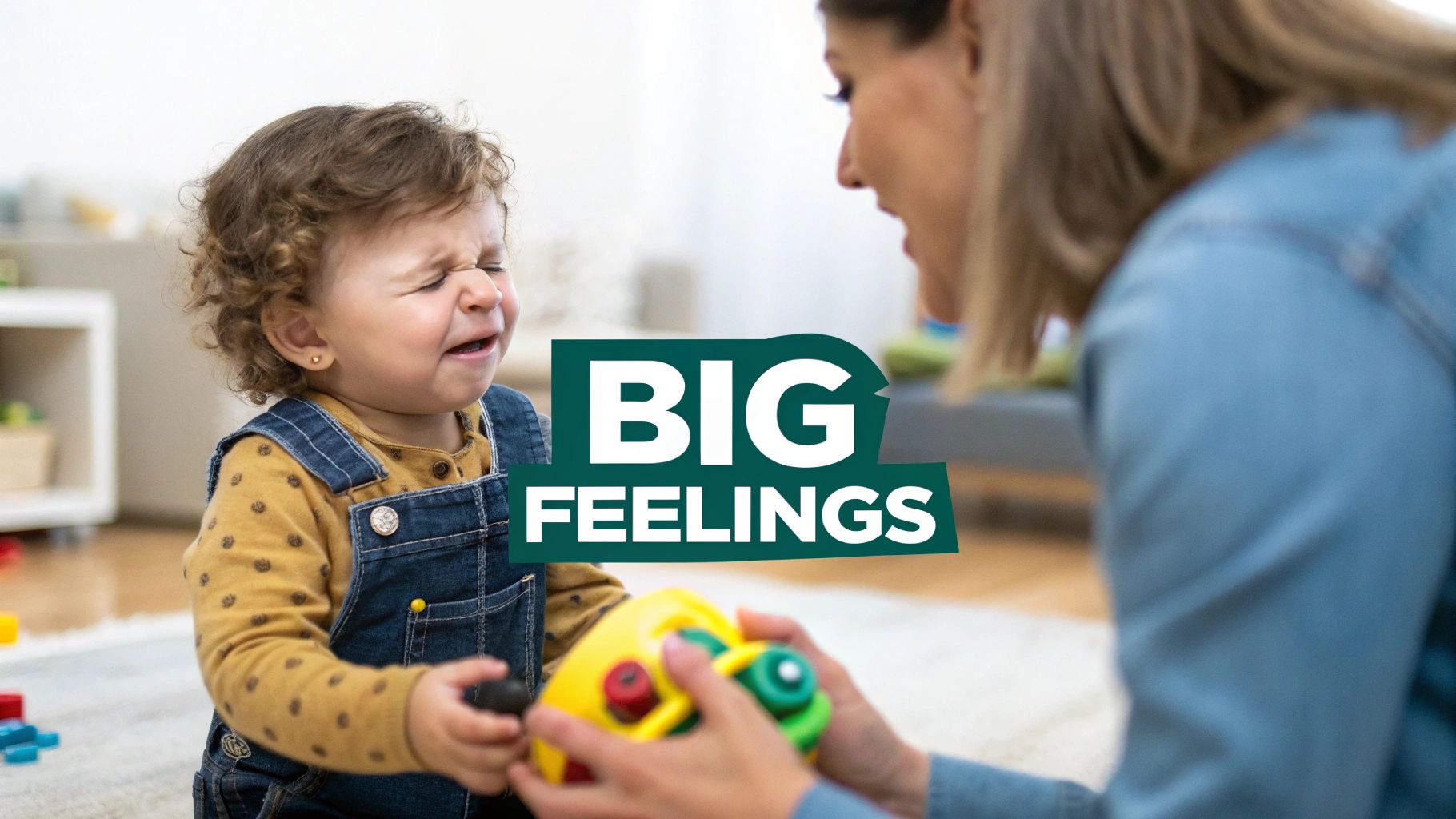
Big Feelings and Budding Friendships
While your toddler is busy figuring out how to run and stack blocks, their inner world is also exploding with new, complex feelings. Getting to grips with the social and emotional milestones at 16 months is all about supporting their unique personality and making them feel safe as they ride this exciting, and often overwhelming, emotional rollercoaster.
You’ve probably noticed the affection levels have been dialled right up. Spontaneous, clumsy hugs and sloppy, open-mouthed kisses are a beautiful sign that your little one is forming secure, loving bonds and learning how to show you just how much you mean to them.
But on the flip side, this is often the age where tantrums make their dramatic debut. It’s important to remember these intense outbursts aren’t your toddler being naughty; they're a completely normal part of growing up. Their wants and frustrations are simply outpacing their ability to use words, leading to a meltdown when they can’t make themselves understood.
Making Sense of Their Social World
As your toddler's sense of self starts to blossom, so does their awareness of other people. They're still very much the star of their own show, but you’ll begin to see the first little seeds of social interaction being planted.
Right now, this mostly looks like parallel play. Picture two toddlers in a playroom with a pile of blocks. Instead of building a tower together, they’ll probably sit near each other, happily absorbed in their own separate projects. They’re aware of the other child and enjoying the company, but they just aren't ready to cooperate yet. This is a crucial step towards learning how to share and play with others down the line.
Your job isn't to be a social director, but rather a calm, compassionate guide for their feelings. When you acknowledge their frustration and show them what kindness looks like, you’re laying the foundations for emotional intelligence and future friendships.
How to Handle Those Big Emotions
Helping your toddler navigate these new emotional tides takes a huge amount of patience and empathy. When a tantrum hits, the most powerful thing you can do is stay calm yourself.
Here are a few gentle strategies to try in the heat of the moment:
- Name the Feeling: Instead of trying to stop the crying, put a name to the emotion. Simply saying, "You are so cross that we have to leave the park," helps them connect a word to the huge feeling they’re experiencing.
- Hold a Safe Space: Let them know you’re there for them. Sometimes, just sitting quietly nearby is all they need to feel secure as the emotional storm rages and eventually passes.
- Model Kindness: They are watching everything you do. When you use "please" and "thank you," or gently comfort a pet or a sibling, you're giving them a real-life lesson in what empathy looks like.
Responding with understanding teaches your toddler that all their feelings are okay, even the big, messy, uncomfortable ones. You’re giving them their very first lessons in managing their emotions – a skill that will serve them for the rest of their life.
When to Talk to Your Doctor
First things first, it's so important to remember that developmental milestones aren't a race. They're simply averages based on observations of thousands of children, which means there's a wonderfully wide range of what's considered 'typical'. Think of the milestones for 16 months less as strict deadlines and more as helpful signposts on your child's unique journey.
Some toddlers are walking confidently at ten months, while others are perfectly happy to wait until they're eighteen months old. One might have a dozen words, while their friend is still perfecting the art of pointing. This kind of variation is completely normal and expected.
Trusting Your Parental Instincts
At the end of the day, you are the world's leading expert on your child. If you have that niggling feeling that something isn't quite right, that's always worth listening to. Your daily observations are incredibly valuable.
The goal here isn’t to create worry, but to empower you with information so you know when a quick chat with your health visitor or GP might be a good idea. It’s all about being proactive and supportive, making sure your little one has everything they need to thrive.
Your parental intuition is a powerful tool. It’s built from thousands of tiny observations you make every single day. Trusting that instinct is one of the most important things you can do.
There are, however, a few specific areas where a consistent pattern might warrant a professional opinion. These aren't immediate causes for alarm, but rather gentle nudges to check in.
A Few Signs to Keep in Mind
Consider reaching out to a health professional if, by 16 months, your toddler:
- Isn't attempting to walk at all, not even by cruising along the furniture.
- Doesn't use gestures like pointing to show you something they want or find interesting.
- Has not yet said their first words, like 'mama' or 'dada'.
- Doesn't seem to respond to their name or react to loud, surprising sounds.
- Avoids making eye contact when you're playing together or talking to them.
- Loses skills they once had – for instance, if they stop babbling or using gestures they previously knew.
These points are just a guide to help you feel confident in what you're seeing. To build on this, you might find it helpful to explore resources on understanding child emotional development. Seeking advice early is always a positive step, ensuring your child gets the right support at the right time.
Got Questions About Your 16-Month-Old? We’ve Got Answers
It's completely normal to have a long list of questions when you have a 16-month-old. This stage is a whirlwind of new skills and surprising behaviours, and it often feels like just when you figure one thing out, something else changes! Let’s tackle some of the most common queries parents have at this age.
What’s Going on With My Suddenly Fussy Eater?
If your once-adventurous eater is now turning their nose up at everything, you're not alone. It’s incredibly common for toddlers to become selective around this age. Part of this is because their rapid growth is starting to slow down, so their appetite naturally dips.
They're also exploring their independence, and saying "no" to food is a powerful way to do that. The best thing you can do is keep your cool. Continue to offer a variety of healthy foods at mealtimes, but without any pressure. Remember, your job is to provide the good food; their job is to decide how much of it to eat. This phase almost always passes.
How Much Screen Time Is Really Okay?
This is a big question for modern parents. While every family has to find what works for them, the general advice from experts is to keep screen time for children under two years old to a minimum. At this age, their brains are wired for real-world, hands-on play – that’s how they learn best.
If you do decide to introduce screens, think of it as a shared activity. Choose high-quality, educational content and watch it with them. By talking about what you’re both seeing, you can turn a passive experience into an interactive one.
It's so important to remember that every child follows their own unique path. If your toddler is excelling in some areas but taking their time in another, it’s usually just their individual timeline at play. Try to focus on their overall happiness and progress.
What if My Toddler Seems Ahead in Some Things but Behind in Others?
Child development is rarely a straight, even line; it's more like a series of leaps and bounds in different directions. You might have a chatterbox who took a little longer to start walking, or a mini-gymnast who isn't saying many words just yet. This is perfectly normal.
The best approach is to celebrate their individual strengths while gently encouraging them in the areas they're still working on. It’s all part of their amazing, one-of-a-kind journey.
Ready to transform playtime into a powerful learning experience? The Grow With Me kits are designed to perfectly match the developmental needs of your 16-month-old. Explore our play kits and see how the right tools can make all the difference.