
A Parent's Guide to High Contrast Pictures for Babies
Step into your newborn’s world for a moment. It’s a soft, blurry place where colours haven’t quite popped yet and everything is a gentle mix of light and shadow. Their vision is still a work in progress, with eye muscles learning to coordinate and the ability to see colour slowly developing.
In this hazy new world, high contrast pictures are like lighthouses in the fog.
How High Contrast Pictures Spark Your Baby's Brain
The sharp, clean difference between black and white sends the strongest possible signals to a baby’s developing brain. While soft pastels or busy, colourful scenes can get lost in the blur, the bold edge of a black shape on a white background is something their brand-new retinas can easily pick up on.
This isn’t just about keeping them entertained; it's a fundamental lesson for their entire visual system.
Building the Brain, One Pattern at a Time
When you see your baby staring intently at a high-contrast card, you're watching their brain get a fantastic workout. That intense focus is stimulating their optic nerves, encouraging vital neural connections to form and grow. It’s like a gentle gym session for their eyes and brain, strengthening their power to see and understand what they're looking at.
This simple act of gazing at bold patterns helps to kickstart several key skills:
- Visual Tracking: Following the lines and shapes helps tone their eye muscles, improving their ability to follow moving objects later on.
- Focus and Attention Span: These captivating images encourage them to concentrate for longer stretches, laying the groundwork for future learning.
- Cognitive Development: By figuring out these simple visual puzzles, babies start to make sense of shapes and patterns – a crucial first step in their cognitive journey.
High contrast pictures are far more than just a fleeting distraction. They are a foundational tool for building a baby’s visual pathways, literally teaching their eyes how to see and their brain how to process the incredible world around them.
Ultimately, these simple, striking images offer the perfect amount of stimulation. They cut through the visual noise of a blurry world, giving your baby something clear and meaningful to focus on. It’s the very first step on their amazing journey of discovery, and it all starts with the simple power of black and white.
Your Baby's Vision From Newborn to First Birthday
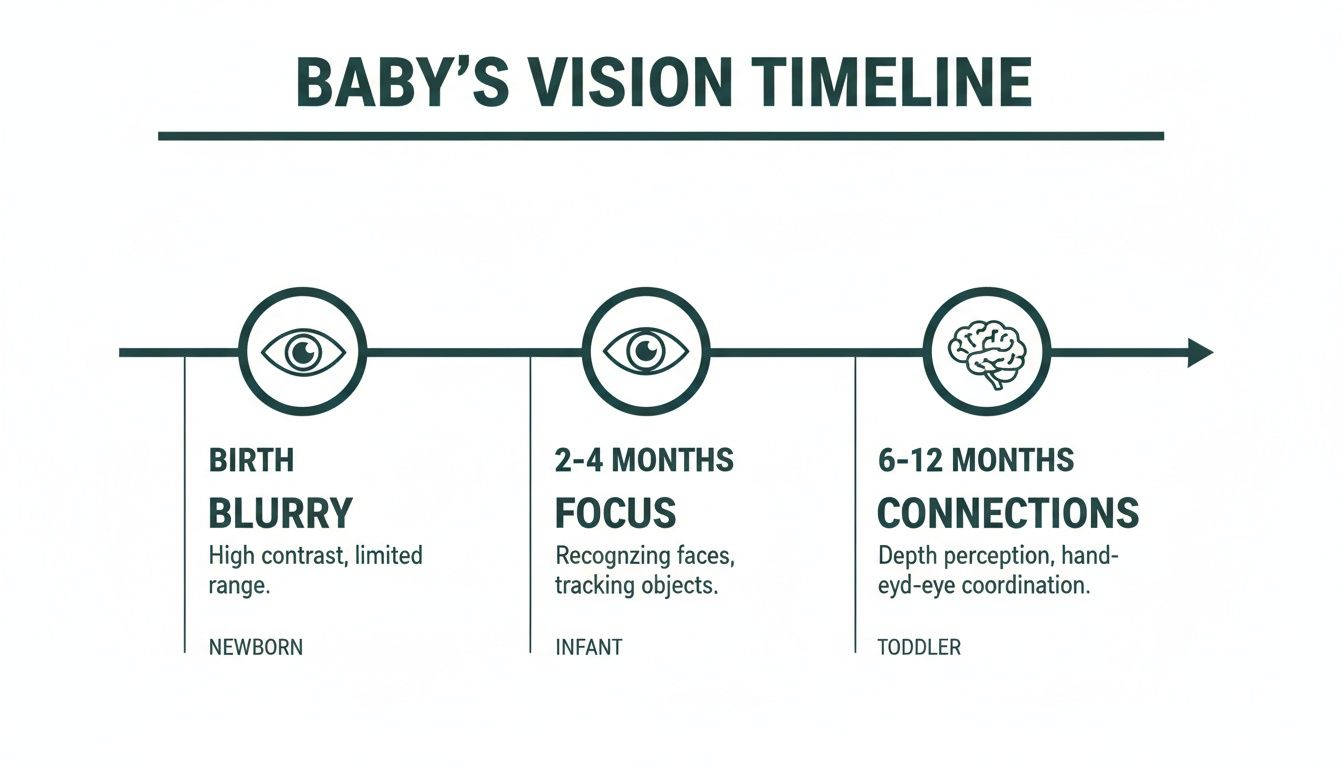
One of the most incredible parts of your baby's first year is watching their vision develop. They start in a soft, blurry world and gradually progress to seeing in full, vibrant detail. Understanding this timeline really brings home why certain visuals, like high-contrast pictures, are so powerful at different stages.
This journey isn't just about their eyes; it's about building and strengthening the vital connections between what they see and how their brain interprets it all.
The First Three Months: A World of Black and White
When your baby first arrives, they see the world mostly in shades of grey, black, and white. The parts of their retina that detect colour (the cone cells) are still maturing. Their vision is sharpest at about 20-30 centimetres away—just about the distance from their eyes to your face when you’re holding them for a cuddle.
This is why simple, bold, black-and-white patterns are so captivating for them. The stark contrast sends the strongest possible signals to their developing brain. This visual stimulation is a workout for their eyes, helping to strengthen the eye muscles and encourage the growth of the optic nerve.
At this stage, less is truly more. A simple checkerboard or a set of bold stripes provides a powerful developmental workout, cutting through the blur and teaching their eyes how to focus.
Three to Six Months: The Introduction of Colour
Around the three-month mark, something amazing happens. Your baby’s cone cells have developed enough to start seeing colour, and the very first one they usually register is red. Suddenly, their world starts to gain a new layer of vibrancy. You'll also notice they get much better at tracking moving objects with their eyes.
This is the perfect time to introduce high-contrast pictures that feature bold primary colours alongside the classic black and white. Think simple shapes in bright red, yellow, or blue. These new additions keep their visual exploration exciting and challenging, prompting their brain to process this new stream of information. You can find out more about the best kinds of newborn development toys that support this crucial phase.
Six to Twelve Months: Seeing in a 3D World
During the second half of their first year, your baby's vision takes a massive leap forward. They begin to develop depth perception, which is the ability to judge how near or far objects are. This new skill is absolutely essential for big milestones like reaching, grasping, and eventually, crawling.
Their colour vision also becomes much more sophisticated, allowing them to appreciate more complex patterns, detailed images, and a wider variety of shapes.
To help you match the right visuals with your baby's development, here’s a quick guide.
Matching High Contrast Visuals to Your Baby's Age
This table breaks down the key visual milestones and suggests the best types of high-contrast images to use at each stage.
| Age Range | Visual Development Milestone | Recommended High Contrast Visuals |
|---|---|---|
| 0-3 Months | Sees in black, white, and grey. Focus is limited to 20-30 cm. | Simple, high-contrast black and white geometric shapes and bold lines. |
| 3-6 Months | Begins to perceive primary colours, especially red. Improved tracking. | Black and white images with bold pops of primary colours like red or yellow. |
| 6-12 Months | Develops depth perception and can see a full spectrum of colours. | More complex patterns, varied shapes, and a wider range of bright colours. |
By tailoring the visual input to what their developing eyes and brain can process, you’re giving them the best possible support for this amazing journey.
Simple Ways to Use High-Contrast Pictures Every Day
Weaving high-contrast pictures into your baby’s day is far simpler than you might think. It’s all about turning everyday moments into little sparks of connection and learning. Forget the idea of formally flashing cards; the real magic happens when you place these striking visuals right where your baby naturally spends their time.
This approach makes visual stimulation a gentle, seamless part of their world. It encourages them to focus and become curious without ever feeling overwhelming. You're essentially creating small, engaging pockets of learning that fit perfectly into your daily rhythm.
Making Everyday Activities Engaging
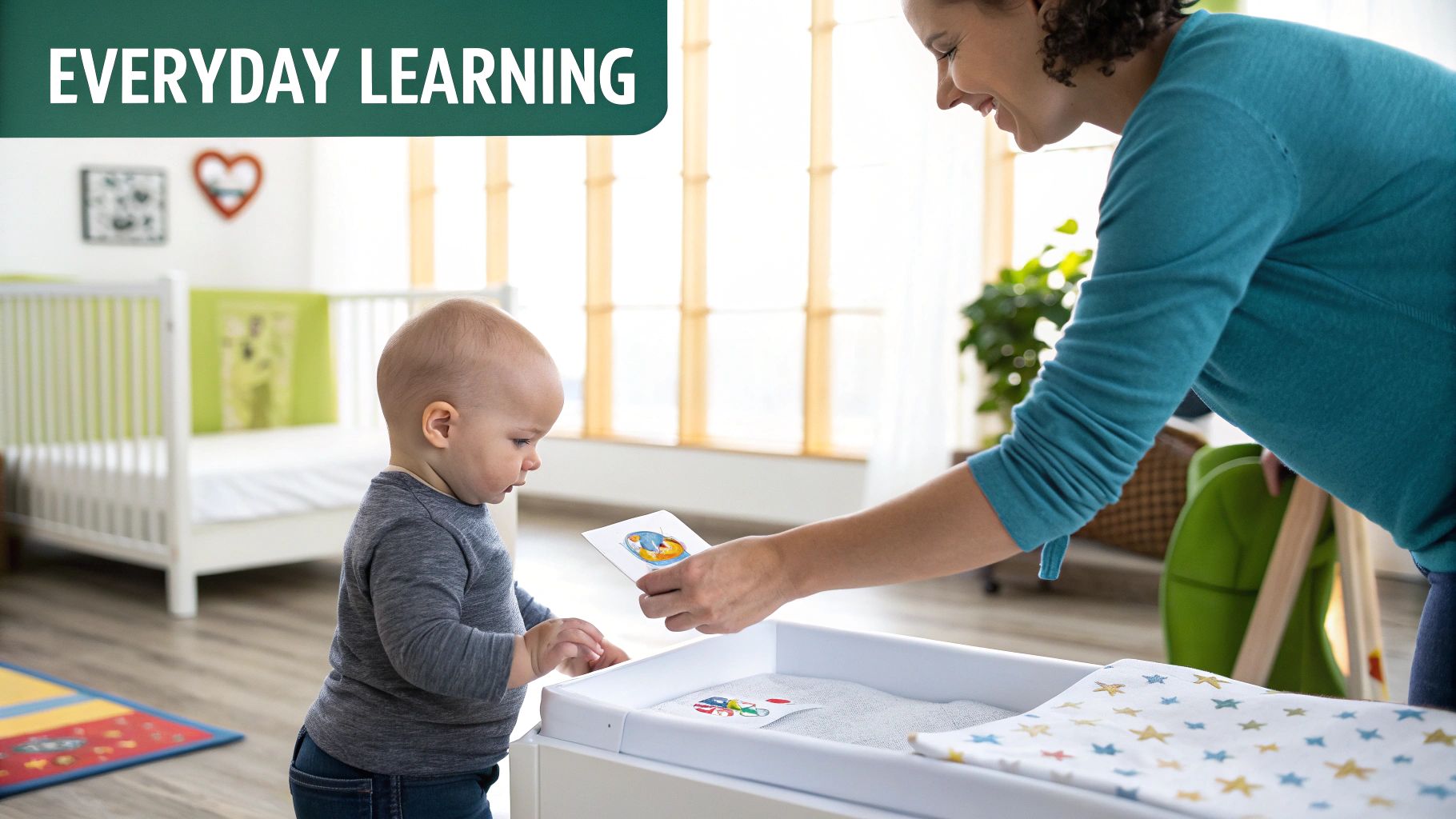
So many of your daily tasks can double up as moments for visual exploration. By placing cards strategically, you give your baby something captivating to lock their gaze onto. This can make tricky activities like nappy changes much smoother and tummy time far more productive.
Think about these simple but incredibly effective placements:
- At the Changing Table: We’ve all been there—the fussy baby during a nappy change. Taping one or two high-contrast pictures to the wall or ceiling above the changing mat gives them a fascinating focal point. This simple distraction can work wonders to calm them, making the whole process easier for you both.
- During Tummy Time: Tummy time is vital for building up that all-important neck and core strength, but let's be honest, many babies aren't fans. Propping a few high-contrast cards in front of them can be just the thing to pique their interest, encouraging them to lift their head and look around. You might find they stay in this crucial position for a little longer.
- On the Play Gym: Use some toy links to attach cards to the arches of a play gym. As your baby lies on their back, the bold images will naturally draw their eyes upwards, encouraging them to look, reach, and kick. It’s a fantastic way to support their visual tracking skills and gross motor coordination.
The key is to introduce high-contrast pictures into your baby’s existing world. By meeting them where they are, you make learning feel like a natural part of their daily discovery, rather than a separate, structured activity.
From Playtime to Bedtime
Beyond these daily routines, high-contrast visuals are brilliant for enriching playtime and winding down for sleep. You can think of them as the very first chapter in your baby’s library, introducing the idea that looking at images is a way to gather information and enjoy a quiet moment.
Bringing them into a bedtime routine is a lovely way to build an early love of reading. High-contrast board books, with their simple, bold patterns, are perfect for this. Of course, your baby won't understand the story, but the act of snuggling with you, turning the pages, and focusing on the images is a wonderfully calming and bonding experience.
If you're looking for some ideas, you can find a helpful guide on the best board books for babies to get you started.
Choosing Safe and Effective High Contrast Toys
When you start looking for high-contrast toys and books, the sheer number of options can feel a bit overwhelming. But don't worry. If you know what to look for, you can easily pick out things that are not only brilliant for your baby's development but also completely safe.
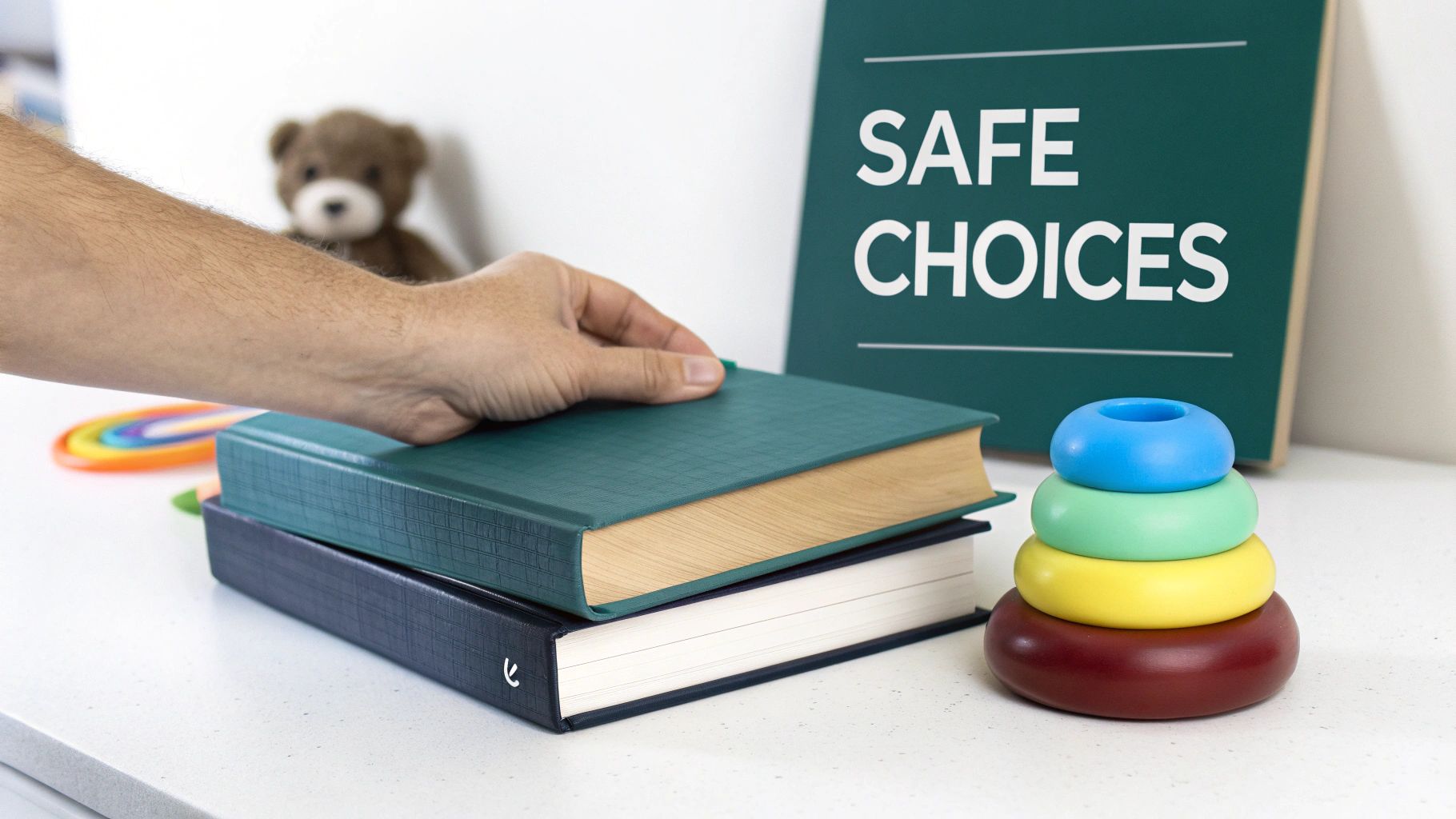
The absolute number one rule? Safety first. Anything you give your baby is likely to end up in their mouth at some point, so it’s essential to choose items made from non-toxic, baby-safe materials. You’ll want something that can stand up to a good bit of gumming and pulling without falling apart.
A Simple Safety Checklist
As you're shopping around for high-contrast pictures, board books, or toys, just keep this quick checklist in your back pocket. It makes choosing the right stuff so much easier.
- Non-Toxic Inks and Materials: Check that any prints use soy-based or other non-toxic inks. The label should confirm the product is free from nasties like BPA, phthalates, and other harmful chemicals.
- Durable and Chew-Safe: We all know babies explore the world with their mouths! The materials need to be tough enough to handle this without tearing or breaking into small, dangerous pieces. Think thick, laminated cards or sturdy board books.
- Rounded Corners: Sharp edges are a definite no. Always go for books and cards with soft, rounded corners to keep your little one safe from accidental pokes and scrapes during playtime.
Many of the safety principles for high-contrast toys overlap with those for other baby items. For instance, the guidelines for sourcing safe plush animals often touch on the same core material safety standards.
Why Physical Toys Beat Screens
It can be tempting to pull up a high-contrast video on a phone or tablet, but physical, tangible items are so much better for your baby’s brain at this early stage. Real-life objects like cards, fabric books, and wooden toys encourage them to touch and explore.
This hands-on interaction is what helps them build connections between what they see and what they feel—a massive step in developing those all-important sensory pathways. For more screen-free ideas, our guide to the best sensory toys for babies is packed with inspiration.
One final piece of advice: go slowly when you first introduce high-contrast pictures.
Start with just one or two images at a time. This helps avoid overstimulating your baby. Pay close attention to their cues—if they start looking away or getting a bit fussy, it's their way of saying they've had enough for now. A gentle approach keeps the experience positive and fun.
The Science Behind the High-Contrast Trend
You’ve probably seen them all over social media and in stylish nurseries, but high-contrast pictures are far more than just a passing trend. Their popularity is deeply rooted in developmental science, with parents and early-years experts alike embracing these simple black-and-white images as powerful tools for a baby’s first steps in cognitive growth.
This isn't just a niche interest, either. The confidence in these developmental aids is mirrored in the UK children’s book market, where high-contrast and sensory books have become a major feature. It’s reassuring to know that when you choose high-contrast pictures, you're not just following a trend; you're investing in a scientifically-backed method to support your baby’s development.
The Market Speaks Volumes
The numbers truly paint a picture of how much parents value early visual stimulation. Back in 2021, sales in the UK's Pre-school & Picture Books category hit a massive £141.2 million, actually overtaking Children’s Fiction for the first time in 20 years.
Within that, Picture Books brought in £63.8 million, and the Novelty & Activity Books category—where you’ll find many of the high-contrast visuals for the 0-3 crowd—added another £62 million. If you're curious, you can explore more about this market shift and what it means for early-years publishing.
These figures aren't just dry business statistics. They represent millions of choices made by parents who have seen first-hand how much these simple visual tools can benefit their little ones.
More Than Just a Pretty Pattern
So, what’s the big deal with a few black and white shapes? It all comes down to how a newborn's brain and eyes work together. A baby’s visual system is a work in progress, and the sharp, clean difference between black and white sends the strongest possible signal to their developing retina.
This powerful signal gets the optic nerve firing, which in turn helps build and strengthen the crucial neural connections between the eyes and the brain. Think of it as laying the groundwork for a lifetime of seeing and learning.
This simple stimulation helps to build foundational skills:
- Improving Focus: The stark clarity of high-contrast images gives babies something easy to lock onto, helping them practise focusing their eyes.
- Lengthening Attention Spans: These images are genuinely captivating for a baby, holding their gaze and gently stretching their ability to concentrate.
- Stimulating Memory: Seeing the same bold patterns repeatedly helps to forge some of the earliest memory pathways in their brand-new brain.
By introducing these simple but effective tools, you’re actively helping to build the very architecture of your baby’s brain. It's a small, easy thing to do, but it has a profound and lasting impact on how they learn to see, process, and understand the world.
Building Your Baby's First Developmental Play Kit
So, now you have a real understanding of how to use high-contrast pictures to give your baby's learning a fantastic head start. We've walked through everything from the science of a newborn's vision to simple ways you can use these images every day. It’s clear how powerful those simple black-and-white patterns can be for their developmental journey.
Putting together a great play kit doesn't mean you need a mountain of complicated toys. It’s all about starting with a few, well-chosen essentials. A set of sturdy, baby-safe high-contrast cards, a soft fabric book filled with bold patterns, and maybe a simple mobile are really all you need to create some brilliant learning moments. Think of these as the foundational tools for firing up their vision and sparking their natural curiosity.
Creating a Personalised and Lasting Kit
Why not make your kit extra special by adding a personal touch? For a truly unique keepsake that's perfectly suited to their developing eyesight, you could even learn how to make your own baby board book and fill it with your own custom high-contrast designs.
This focus on early development tools is a really solid trend in UK children's publishing. Even though total revenue for children's books saw a small dip in 2023, the picture-book category has held its ground. A big reason for this is that parents continue to see the value in buying materials that support sensory and visual development right from the very beginning.
When you focus on high-contrast pictures, you're doing so much more than just providing entertainment. You're giving your baby’s brain a targeted workout. Each time they gaze at a bold pattern, it strengthens their eyes, builds their attention span, and lays the vital groundwork for a lifetime of learning.
Got Questions About High Contrast Pictures? We've Got Answers
As you start exploring high-contrast pictures with your little one, you're bound to have some questions. It's totally normal. Getting the hang of these finer details will give you the confidence that you're doing a brilliant job supporting your baby's visual development.
We've pulled together some of the most common queries we hear from parents to give you clear, straightforward answers. Let's get any of your lingering doubts sorted.
How Long Should My Baby Look at an Image?
There's no magic number here, and honestly, you don't need one. The best approach is simply to follow your baby’s cues. A newborn might only lock eyes with a card for a few seconds before their attention wanders, and that's completely fine. As they grow, you'll notice that gaze might stretch into several minutes.
The trick is to become a bit of a baby-watching expert. When they seem captivated, looking intently at the pattern, that’s great! But if they start turning their head, getting a bit fussy, or just seem to lose interest, that's their way of saying, "Okay, I'm done for now." Keeping these little sessions short and sweet makes sure it's always a positive and fun experience for both of you.
Your baby is the best guide. A few focused seconds are far more valuable than trying to force longer sessions. Let their natural curiosity dictate the pace.
When Should I Introduce Colours?
While black and white are the undisputed champions for newborns, you can start weaving in some colour sooner than you might think. A baby's colour vision really starts to kick in around the three-month mark, and the very first colour they can typically make out is red.
This is the perfect window to introduce high-contrast images that feature a bold splash of a single primary colour alongside the classic black and white. Imagine a striking black and white spiral with a bright red dot in the centre. This gentle, step-by-step introduction helps their developing brain learn to process new visual information without getting overwhelmed.
Are High Contrast Books a Good Idea?
They're a brilliant idea! High-contrast board books are a fantastic way to introduce your baby to the world of reading right from the very beginning. It's not just a hunch; publishers have caught on, realising that books with "bold pops of colour" and strong contrast are what catch parents' eyes. Here in the UK, where families are deeply invested in reading with their kids, children's book revenue has remained in the hundreds of millions for over a decade. You can see more on the UK's thriving children's book market here.
Snuggling up with a simple, pattern-filled book is more than just visual stimulation; it creates a lovely, calm bonding moment. It’s a wonderful way to build a soothing bedtime routine long before they can grasp the words on the page.
At Grow With Me, we're all about the power of stage-based play. Our curated kits are filled with high-quality, safe, and genuinely effective high-contrast toys and books, all designed to support your baby's development from day one.
Explore our subscription boxes and start your baby's learning journey today.