
The Best Developmental Toys for Infants to Support Growth
The very best developmental toys for infants are simply the ones that meet them where they are. Think high-contrast cards for a newborn whose vision is just coming into focus, a rattle for a baby who has just discovered they can grab things, or soft blocks for an older infant figuring out cause and effect. It’s never really about the toy itself, but how it helps your little one along their natural path of discovery.
How to Choose the Best Developmental Toys for Your Infant
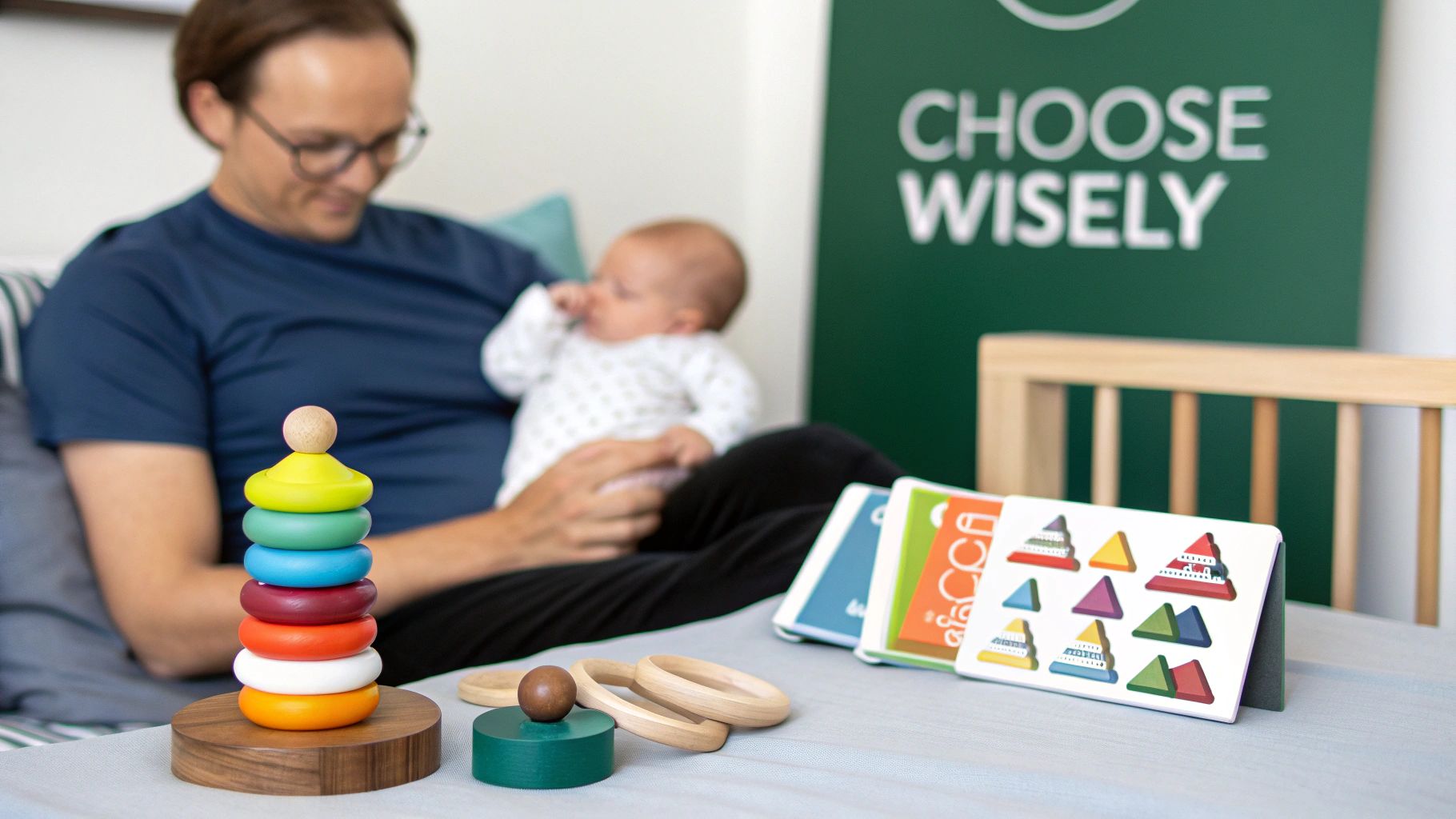
If you're a new parent, the term "developmental play" can sound a bit formal and intimidating. But here's the secret: it's not about flashcards or scheduled lessons. It’s all about tuning into the incredible journey your baby is already on and giving them fun ways to explore their growing skills.
This journey is a series of amazing little leaps called milestones. It starts with them learning to follow an object with their eyes and leads to that triumphant moment they purposefully grasp a toy for the first time. The right toy, introduced at the right time, doesn't teach them—it supports what they are naturally driven to do, turning simple play into a powerful way for them to grow.
Matching Toys to Your Baby’s Milestones
Think of a toy as a perfectly designed tool for the job at hand. A newborn's world is still a bit fuzzy, so a bold, high-contrast image is the perfect tool to help their vision sharpen and focus. A few months on, as they discover their hands are theirs to control, an easy-to-grip rattle becomes the ideal tool to build hand-eye coordination. Our guide to baby toys for fine motor skills has some brilliant ideas for this stage.
When you line up the right activity with their budding abilities, that's where the magic really happens. It builds their confidence, fuels their curiosity, and shows them that learning is a joyful adventure. If you're looking for a thoughtful present, finding the best personalized baby gifts can also give you some lovely ideas that can be treasured alongside their developmental toys.
To make things a bit easier, I've put together a quick guide to help you see how it all connects.
Infant Milestones and Ideal Developmental Toys
Here’s a simple roadmap that pairs your baby's age and typical developmental leaps with the kinds of toys that will genuinely support their growth during that phase.
| Age Range | Key Developmental Milestones | Examples of Ideal Developmental Toys |
|---|---|---|
| 0-3 Months | Developing vision, tracking objects, and discovering hands. | High-contrast cards, soft rattles, unbreakable mirrors, play gyms with hanging toys. |
| 4-6 Months | Reaching for objects, grasping, and exploring with their mouth. | Teething toys, crinkle books, balls with different textures, activity mats. |
| 7-9 Months | Sitting up, passing objects between hands, understanding cause and effect. | Soft building blocks, stacking rings, simple shape sorters, balls to roll. |
| 10-12 Months | Pulling up to stand, crawling, starting to problem-solve. | Push walkers, board books, nesting cups, simple puzzles with large knobs. |
Think of this as your starting point. It’s a great way to make sure your choices align with what your baby is working so hard to master.
Key Takeaway: The goal isn’t to hunt for one single "best" toy. It's about creating a simple, supportive play environment with a small handful of well-chosen items that match your child's current stage. This avoids overwhelming them (and you!) and encourages deeper, more meaningful engagement with each toy.
Why Matching Toys to Milestones Matters
Imagine trying to teach a child to run before they can even crawl. It wouldn't just be ineffective; it would be frustrating for everyone. The same logic applies to playtime. This is why matching the best developmental toys for infants to their current milestones is so fundamental to their growth. It’s not just about keeping them busy; it’s about giving them the right kind of fun at the right time.
A toy only truly shines when it meets your baby exactly where they are on their developmental journey. Hand a set of stacking rings to a newborn who can't yet sit up, and you’ll get frustration, not fun. On the flip side, a baby who has already mastered grasping will quickly lose interest in a toy that doesn't offer a new, exciting challenge. It's all about finding that developmental "sweet spot"—a task that's just tricky enough to be engaging without becoming overwhelming.
Finding the Developmental Sweet Spot
When a toy is perfectly in sync with your baby’s abilities, it naturally encourages them to practise and master new skills. This perfect pairing sparks their curiosity, builds their confidence, and transforms simple playtime into a powerful learning experience.
Take a simple, easy-to-grasp rattle, for example. When your baby first starts reaching for things, that rattle is so much more than just a noisemaker. It becomes a fantastic tool that helps them:
- Strengthen hand-eye coordination every time they reach out to grab it.
- Develop fine motor skills as they work on closing their little fingers around it.
- Understand cause and effect the moment they realise, "Hey, when I shake this, it makes a sound!"
This targeted kind of play supports their cognitive, motor, and sensory development all at once. To really get this right, it also helps to have a broader appreciation of areas like understanding child language development stages.
Parenting Tip: Try not to get caught up in hitting every single milestone on a strict schedule. Every baby is wonderfully different and develops at their own pace. You can get a better feel for the journey by exploring what developmental milestones are and how they act as gentle signposts.
Taking the Guesswork Out of Play
As a busy parent, figuring out which toy to introduce and when can feel like a never-ending puzzle. This is where a more thoughtful, curated approach can be a game-changer. A subscription service like Grow With Me is built to solve this exact problem, delivering precisely what your baby needs for their specific developmental window.
Each play kit is designed to arrive just as your baby is getting ready for their next big leap. It takes the pressure of endless research off your shoulders and gives you confidence that every toy has been chosen to challenge and delight your little one. Instead of second-guessing your choices, you can simply enjoy knowing you’re providing the best possible tools to support their incredible journey, one milestone at a time.
Your Guide to Toys for Each Developmental Stage
Watching your baby grow is like seeing a story unfold, one incredible chapter at a time. Each new stage brings with it fresh skills, brand-new discoveries, and different ways of seeing the world. The best developmental toys for infants are simply the ones that fit perfectly into each of these chapters, supporting the amazing work your little one is already doing.
To help you find the right props for their play, let's break down that whirlwind first year into four key stages. We’ll look at what’s really going on in your baby’s mind and body, and which toys will make playtime both joyful and genuinely purposeful.
The First Chapter: 0 to 3 Months
In these very first months, your baby’s main job is simply adjusting to life on the outside. Their vision is still a bit fuzzy, which is why they are so drawn to bold, high-contrast patterns. They’re also just starting to discover their own body, from the random flail of an arm to the sudden realisation that they can make a fist.
Play at this point is gentle, focusing on quiet sensory exploration. The aim is to give them simple, engaging things to look at and feel without overwhelming their brand-new nervous system.
- High-Contrast Cards or Books: Forget pastels for now. Simple black-and-white images are utterly captivating for a newborn’s developing eyes, helping them strengthen their vision and learn to focus.
- Unbreakable Mirrors: A baby-safe mirror is fantastic for encouraging self-discovery. They'll spend ages watching that fascinating little person whose movements mirror their own.
- Soft Rattles or Wrist Rattles: These are light enough for their early grasping reflex to handle. More importantly, they help your baby make a foundational connection: when I move, I can make a sound.
The Second Chapter: 4 to 6 Months
This is when things get much more hands-on. Your baby is gaining real control over their movements, starting to purposefully reach for and grab objects. And yes, everything they manage to get their hands on will probably end up in their mouth—this is a key way they learn about different textures, shapes, and materials.
Tummy time also gets more exciting as they start pushing up on their arms. This builds the core strength they’ll soon need for sitting and crawling.
- Textured Teething Toys: A variety of safe, chewable toys can soothe sore gums while giving their mouth and hands rich sensory information. The classic O-ball is a perfect example, as its design makes it incredibly easy for little hands to grasp.
- Crinkle Books or Sensory Balls: Toys that make interesting sounds or have varied textures provide immediate sensory feedback. This is an early lesson in cause and effect—when I squeeze this, it makes a noise!
- Activity Play Mats: A good play mat with hanging toys encourages them to reach, bat, and kick, building crucial strength and hand-eye coordination without them even realising it.
The Third Chapter: 7 to 9 Months
Welcome to the age of sitting up and getting curious! Now that their hands are free, your baby can handle objects with much more intention. You’ll see them passing a toy from one hand to the other, banging two blocks together, or taking great delight in knocking over a tower you’ve just carefully built.
This is also when a huge cognitive leap happens: they begin to understand object permanence. They're starting to realise that things still exist even when they can't see them.
Key Insight: Object permanence is a game-changer. It's why games like peek-a-boo or hiding a toy under a blanket suddenly become the most hilarious and engaging activities—they directly challenge and build this new understanding.
Toys that encourage a bit of problem-solving and fine motor skills are just right for this stage.
- Stacking Rings or Cups: These classic toys are brilliant for developing hand-eye coordination and introducing an early understanding of size and order.
- Soft Building Blocks: Large, soft blocks are safe for inevitable tumbles and help introduce concepts like balance and spatial awareness.
- Simple Shape Sorters: Start with a sorter that has just one or two basic shapes, like a circle and a square. This provides a fun but achievable challenge for their developing problem-solving skills. You can find out more about how toys build these skills in our guide to sensory toys for babies.
This infographic perfectly shows why timing is everything when matching toys to milestones.
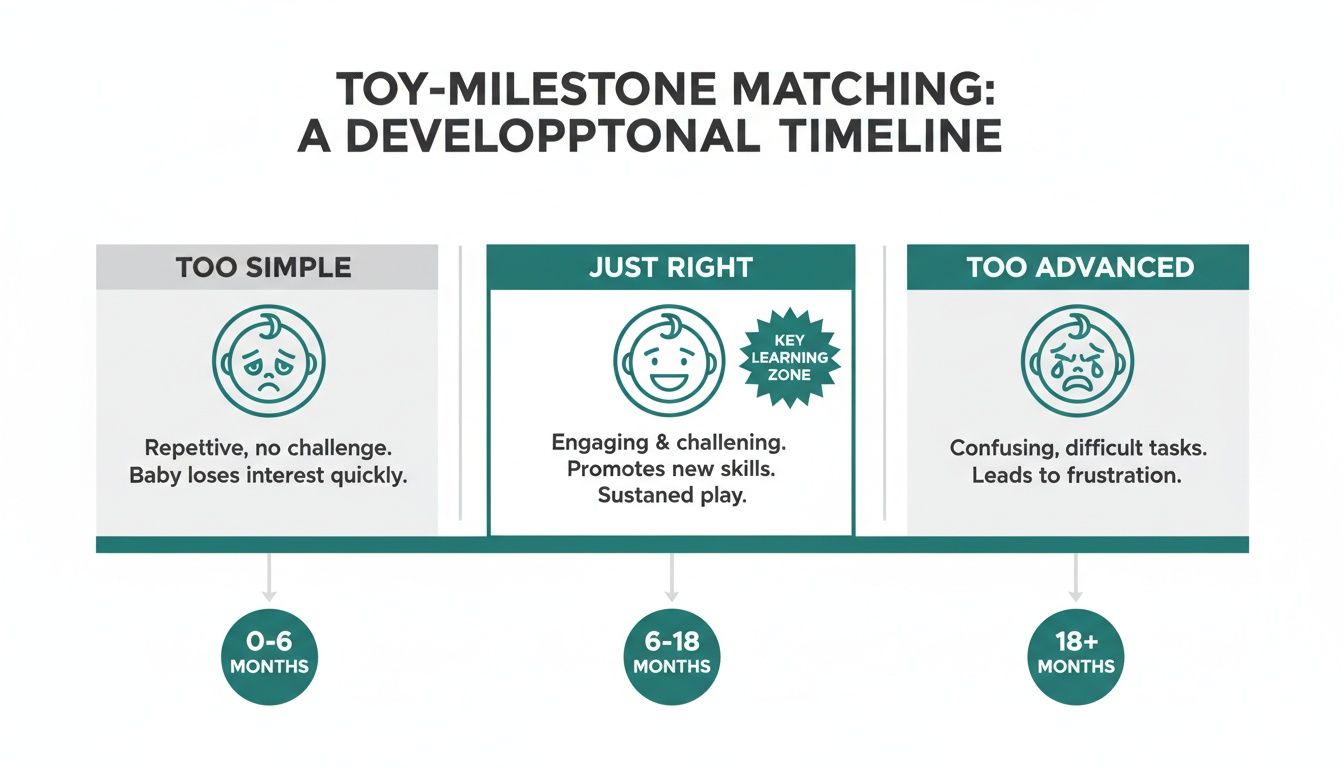
As you can see, a toy that is "just right" sparks curiosity and happy play. One that’s too simple leads to boredom, while one that’s too advanced just causes frustration.
The Final Chapter: 10 to 12 Months
Your little one is on the move! Whether they’re a master crawler, cruising along the furniture, or taking those first wobbly steps, this stage is all about mobility and exploration. They’re becoming more skilful problem-solvers, imitating your gestures, and starting to understand simple words.
Toys that support their new-found physical freedom and growing curiosity are ideal now.
- Push Walkers or Push Cars: These provide just enough stability for babies who are learning to walk, giving them the confidence they need to practise their new skill.
- Chunky Board Books: Reading together is fantastic for language skills, and sturdy board books let them practise turning the pages themselves—a surprisingly tricky fine motor task!
- Simple Puzzles with Large Knobs: Puzzles with just one or two pieces help to refine their pincer grasp (using their thumb and forefinger) and improve their spatial reasoning.
By thoughtfully choosing toys for each stage, you’re not just giving them something to do. You’re offering the perfect tools to support them on their incredible journey. A curated approach, like the one we use for the Grow With Me kits, takes out the guesswork and ensures your baby always has exactly what they need for the chapter they're in.
How to Choose Safe, High-Quality Toys for Your Baby
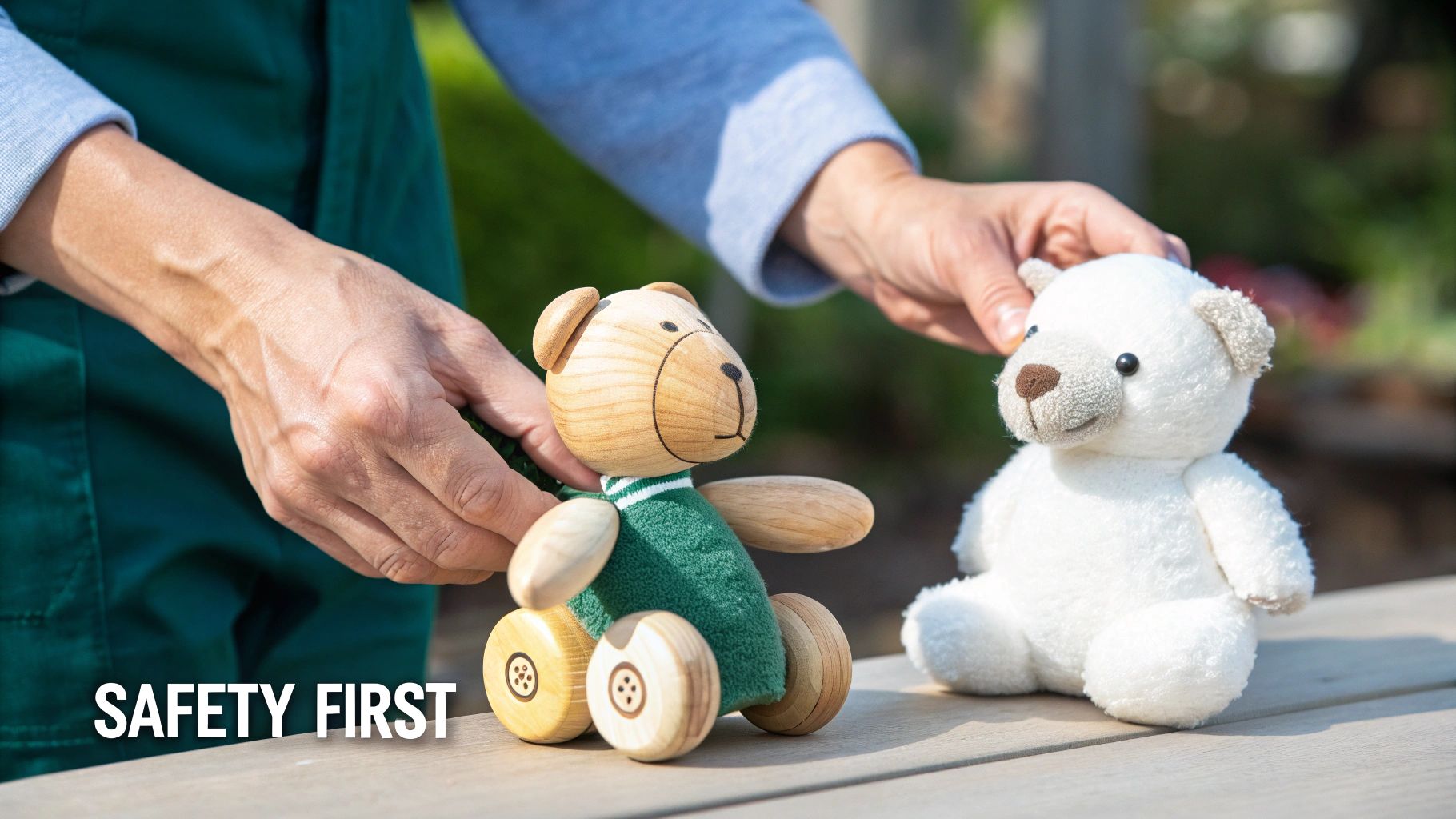
As a parent, your baby's wellbeing comes first, and that naturally extends to the toys they touch, chew, and cuddle every single day. Choosing the best developmental toys for infants goes beyond picking something that looks fun; it's about making sure every interaction is safe, healthy, and genuinely enriching. This means we need to look past the bright colours and really consider the quality of the materials.
It's no secret that babies explore the world with their mouths, so what their toys are made from really matters. Natural materials like solid wood, organic cotton, and food-grade silicone give you that much-needed peace of mind. They’re not only durable and non-toxic but also offer a lovely sensory experience that many plastics just can't match.
Making Sense of Toy Safety Standards
Thankfully, checking if a toy is safe in the UK is quite straightforward once you know what to look for. All reputable toys will carry important safety markings that act as your guide.
- The CE Mark: This marking shows that the manufacturer confirms the toy meets the EU’s strict safety, health, and environmental protection requirements.
- The UKCA Mark: After Brexit, this became the new UK-specific product mark for goods sold in Great Britain. It’s the equivalent of the CE mark for our market.
- The Lion Mark: This is a voluntary symbol developed by the British Toy & Hobby Association. Think of it as an extra promise from the toymaker that they’re committed to high safety and quality standards.
Spotting these marks is a quick, reliable first step. They tell you the toy has been properly tested for things like flammability and harmful chemicals, and that it doesn't have small parts that could be a choking hazard.
A focus on safety and sustainability is now central to how UK parents choose toys. Recent market analysis shows an "ever-increasing focus" on safe, sustainable options, with nearly 20% of UK consumers actively prioritising sustainability—a figure that grows each year. This trend favours natural materials, which is why Grow With Me ensures over 80% of our toys are crafted from high-quality, natural sources. You can read more about these evolving UK toy market trends.
Why Simple Toys Are Often the Best Choice
It's easy to get dazzled by the all-singing, all-dancing electronic toys with their flashing lights and catchy tunes. But often, they encourage babies to just watch, not play. A beautifully crafted wooden toy, however, puts your child in the driver’s seat.
Simple, open-ended toys like a set of blocks or classic stacking rings invite your baby to use their own imagination, figure things out, and practise their fine motor skills. This kind of hands-on, active engagement is what truly builds strong neural connections in their developing brains. It sparks curiosity and creativity in a way that passive entertainment simply can’t.
By choosing high-quality, simple, and safe toys, you're giving your baby the very best tools for meaningful play and healthy development—and giving yourself complete confidence every time they play.
How a Curated Approach Can Simplify Developmental Play
Knowing which toy is right for which milestone is one thing. Actually finding the time to research, choose, and swap them out as your baby grows? That’s a whole different challenge for busy parents. The sheer number of options can feel overwhelming, leaving you second-guessing if you’ve picked the best toys for your little one. It's a pressure so many new parents feel.
This is where a curated approach can be a game-changer. Imagine all that guesswork just… gone. Instead of spending your evenings scrolling through endless online shops, a perfectly timed collection of toys, designed for your baby's exact stage, arrives right when they're ready for it.
More Than Just Toys – It's a Complete Play Solution
A subscription service like Grow With Me is designed to be more of a partner in play than just a box of toys. Every few months, a new kit arrives, filled with high-quality wooden toys, engaging sensory items, and sturdy board books that are perfectly in sync with your baby's next developmental leap.
This approach doesn't just save you precious time and energy. More importantly, it gives you peace of mind. You can feel confident that every single item has been thoughtfully chosen by experts to support specific skills, whether it's grasping, problem-solving, or sensory exploration.
The Big Idea: A curated subscription shifts your focus from the endless hunt for individual toys to simply enjoying meaningful, stage-appropriate play. It ensures your baby is consistently engaged with items that challenge and delight them in just the right way.
Guidance That Empowers You
One of the best things about a curated system is the guidance that comes with it. Each Grow With Me kit includes a detailed play guide, which is a bit like having an expert on hand. These guides explain the developmental "why" behind each toy, answering that crucial question: "why this toy, and why now?"
They also give you practical, simple ideas for play that you can try straight away. This is incredibly empowering. It helps you make the most of playtime, turning simple interactions into powerful moments for connection and learning. You’re not just handed a toy; you're given the know-how to use it brilliantly.
This model taps into a major shift in UK buying habits, where parents are looking for guided experiences, not just standalone products. They want to understand how a toy helps with concepts like cause-and-effect or object permanence. For first-time mums and grandparents especially, this kind of guidance cuts through the noise of a market now worth nearly USD 13.9 billion. You can read more about this in the full United Kingdom toy market report. By providing a clear roadmap for play, a curated service helps you navigate your child's early developmental journey with confidence.
A Few Common Questions About Your Baby's First Toys
Even with all this information, you're bound to have a few lingering questions. It's completely normal! Choosing the right toys for your baby can feel like a big decision. Let's tackle some of the most common queries I hear from parents, so you can feel confident you're making the best choices for your little one.
How Many Toys Does My Baby Actually Need?
Honestly, less is almost always more. Walking into a nursery that looks like a toy shop explosion can be overwhelming for a baby. Too many choices often lead to them flitting from one thing to the next, never really settling down to explore anything properly.
A small, carefully chosen collection of versatile toys will always be more valuable. Think about things like stacking rings, soft fabric blocks, or a simple wooden rattle. These are what we call open-ended toys—they can be used in countless ways as your baby’s skills develop, giving you much more bang for your buck than a flashy, one-trick-pony toy.
A great little trick is toy rotation. Keep a small basket of about five to eight toys out at a time, and swap them with a stored collection every week or two. This simple strategy keeps things feeling fresh and exciting, and you’ll be amazed at how your baby rediscovers an old favourite with new skills.
What About All Those Electronic Toys with Lights and Sounds?
Ah, the million-dollar question. It's all about balance. While a flashing, singing toy might grab your baby’s attention for a minute, it often encourages them to be a passive audience. The toy puts on a show, and the baby just watches.
True developmental play happens when your child is in the driver's seat.
Think about it: a simple set of wooden blocks just sits there. It’s waiting for your baby to bring it to life. To build a tower, they have to use their imagination and practice fine motor skills. When it all comes tumbling down, they get a fun, hands-on lesson in cause and effect. That's the kind of active play that builds strong connections in their growing brain.
When Should I Start Introducing Developmental Toys?
Play starts from the moment they're born, long before they can even hold a toy. In those first few weeks, you are your baby's absolute favourite plaything. The sound of your voice, the shapes your face makes, and the feeling of your touch are all incredibly rich sensory experiences that are crucial for their development.
Right from birth, you can introduce simple tools like high-contrast flashcards. A newborn's vision is still developing, and holding these bold black-and-white images about 20-30 centimetres from their face is a fantastic way to help strengthen their eye muscles and focus. From there, their play will naturally become more complex as they grow.
How Can I Tell If a Toy Is Really Developmental?
Don’t get pulled in by clever marketing. A truly developmental toy isn’t necessarily the one with the fanciest packaging or the longest list of features. Instead, look for a few key things. It should be open-ended, meaning there’s no single "right" way to play with it. It needs to be age-appropriate—challenging enough to be interesting, but not so difficult that it leads to frustration.
Above all, a great developmental toy invites your baby to be an active participant. It encourages a specific skill, whether that’s grasping, problem-solving, or sensory exploration, and puts them in charge of the action.
At Grow With Me, we take all the guesswork out of finding the perfect stage-based toys. Our curated play kits deliver exactly what your baby needs to learn and grow, right when they need it.
Discover how our subscription boxes support your baby's journey.