
Top picks: baby toys for fine motor skills that spark growth
Choosing the right baby toys for fine motor skills is one of the best things you can do to support your child's early development. These aren't just simple playthings; they're the essential tools that strengthen the tiny muscles in your baby's hands, wrists, and fingers, setting them up for a future of independence.
Why Play Is the Secret to Stronger Little Hands
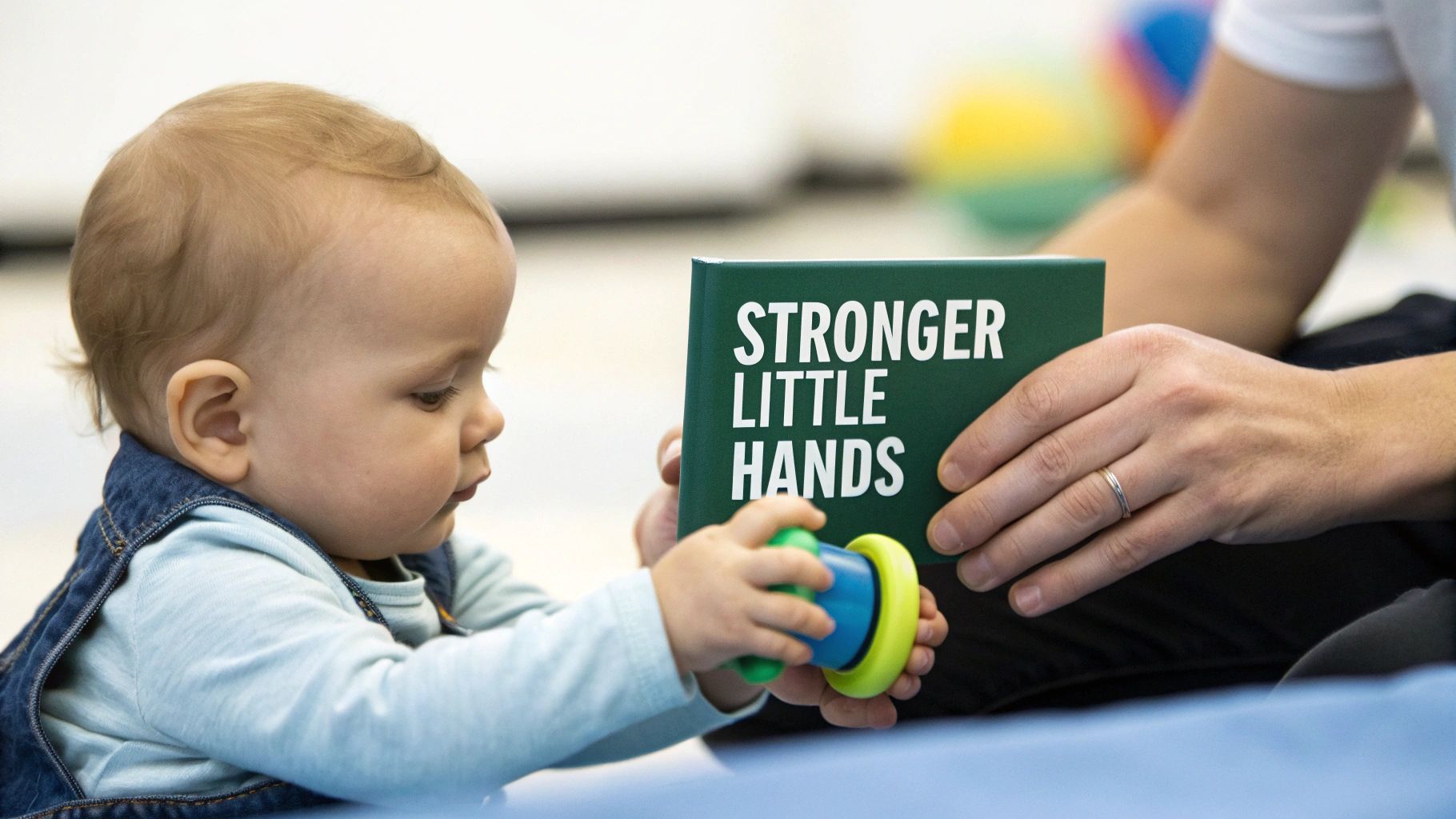
When you watch a baby play, you're seeing some serious development in action. What looks like a simple act of reaching for a colourful rattle or trying to stack a single block is actually a complex workout for their hands and brain. These movements are the very foundation of fine motor skills—the small, precise actions that will one day let them hold a crayon, button up a coat, or use a spoon.
Think of these toys as the equipment in your baby’s own little developmental gym. Every interaction, from grasping a textured ball to poking at a button, strengthens their foundation for learning and self-sufficiency. This hands-on exploration builds more than just muscle; it forges crucial neural pathways that support coordination and problem-solving.
The Building Blocks of Independence
Fine motor skills don't just appear overnight. They grow through a series of milestones, starting with a newborn's reflexive grasp and eventually leading to a toddler's deliberate pincer grip. This journey involves several key abilities that the right toys can really help nurture:
- Hand-eye coordination: The ability to see something and guide the hands to interact with it.
- Grasp development: Moving from a clumsy whole-hand grip to using the thumb and forefinger with precision.
- Bilateral integration: Using both hands together to get a job done, like holding a pot while putting a block inside it.
This focus on developmental play is a growing priority for parents. In fact, the UK market for baby toys designed to support fine motor skills was estimated at around $1.03 billion, which shows just how much we understand the power of play in shaping a child's abilities. You can discover more insights about the baby toy market on marketresearchfuture.com.
Play is the highest form of research. It’s through joyful, engaging activities that babies learn about their own capabilities and the world around them.
To make the most of this crucial period, it helps to offer a variety of fun challenges. For more inspiration, take a look at our guide on fun and effective play-based learning activities.
Of course. Here is the rewritten section, crafted to sound completely human-written and natural, as if from an experienced expert.
Charting Your Baby's Fine Motor Skill Journey
Knowing what to expect on your child’s developmental journey makes it so much easier to give them the right kind of playful support. Every baby moves at their own pace, so please don't see these stages as a strict checklist. Think of it more as a flexible roadmap, guiding you through the incredible process of how tiny, seemingly random movements gradually become coordinated, skilful actions.
Watching these milestones unfold is one of the real joys of being a parent. It all starts with the simplest reflexes and blossoms into complex, intentional skills that pave the way for future independence—everything from feeding themselves to one day writing their name.
From Birth to Six Months: The Age of Discovery
In those very first few weeks, a newborn's movements are almost entirely reflexive. You’ll notice their tiny hands are often balled up into tight fists. Pop your finger into their palm, and they’ll grasp it instinctively. That’s the palmar grasp reflex, and it’s the very first step on this amazing journey.
By around three months, you’ll start to see them batting at dangling toys. This isn't about accuracy just yet; it's all about exploring cause and effect. This swatting and batting helps them build vital connections between what their eyes see and what their hands can do. They aren't trying to grab the toy, but they are learning a fundamental lesson: "My actions can make things happen!"
- Key Skills: Reflexive grasping, opening and closing hands, batting at objects.
- Supporting Toys: Lightweight rattles they can accidentally grasp, soft play gyms with hanging toys, and textured fabric books to awaken their sense of touch.
From Six to Twelve Months: The Rise of the Grasp
This stage is a massive leap forward for fine motor development. Your baby’s actions are now driven by pure intention. They see a toy they want, and they will purposefully reach out to get it. To start with, they'll use a clumsy raking grasp, sweeping objects towards themselves with their whole hand like a little garden rake.
But as their coordination sharpens, this clumsy rake evolves into the all-important pincer grasp. This is that delicate, precise movement of using the thumb and forefinger to pick up small things. You'll spot them practising this on everything from puffs of cereal to tiny bits of fluff on the carpet. This newfound skill opens up an entirely new world of interaction and exploration for them.
Mastering the pincer grasp is a huge developmental leap. It signifies a major improvement in hand-eye coordination and is a direct precursor to skills like holding a crayon or buttoning a shirt.
From One to Two Years: The Little Builder
Welcome to the toddler years! Your child’s main mission now is to figure out how things work, and their fine motor skills are ready for more complex manipulation. They can now stack a few blocks to build a wobbly tower, showing off their emerging hand-eye coordination and a basic understanding of balance.
Turning the pages of a board book (often several at once, of course!) is another key activity that strengthens their wrists and fingers. They’re also starting to experiment with scribbling, holding a chunky crayon in a fist grip to make bold, satisfying marks on paper. This isn't just random doodling; it's the very first step towards writing. If you're curious about how these skills fit into the bigger picture, you can learn more about what developmental milestones are and why they’re so important.
From Two to Three Years: The Emerging Artist
By this age, your toddler’s hand and finger strength have come on in leaps and bounds, allowing for even more refined tasks. They might now be able to thread large, chunky beads onto a string—an activity that requires both hands to work together in a beautifully coordinated way.
Their scribbles will start to look more controlled, and you might even see them attempting circles or lines. This is a clear sign that the small muscles in their hands are getting ready for the precise movements needed for writing letters and numbers. They can also tackle more complex puzzles and build taller, more stable block towers, showcasing their growing problem-solving abilities and manual dexterity.
To help you connect the dots, here’s a quick-reference chart that matches key milestones with the kinds of toys that can offer just the right support.
Fine Motor Milestones and Toy Pairings
| Age Range | Key Fine Motor Skills | Examples of Supporting Toys |
|---|---|---|
| 0-6 Months | Reflexive grasp, batting at objects, opening and closing hands. | Soft rattles, play gyms with dangling toys, fabric books. |
| 6-12 Months | Raking grasp (sweeping with hand), developing pincer grasp (thumb and forefinger). | Stacking rings, large blocks, soft balls, textured toys. |
| 1-2 Years | Stacking blocks (2-4), scribbling with a fist grip, turning board book pages. | Chunky puzzles, shape sorters, large crayons and paper. |
| 2-3 Years | Building taller towers (6+ blocks), threading large beads, making controlled marks. | Lacing beads, beginner scissors, play-doh, sticker books. |
This table is a great starting point, but always remember to watch your child. Their interests and unique pace are the best guides for choosing activities that will feel like pure fun, not work.
Choosing the Best Toys for Every Growth Spurt
Knowing what developmental milestones are coming is one thing, but how do we connect that to the toys that will make a real difference? Choosing the right baby toys for fine motor skills isn't about buying the most expensive gadgets or filling a room with plastic. It’s all about a thoughtful match between a toy’s features and where your child is right now—and where they’re headed next.
For a brand-new baby, the world is a fascinating, fuzzy place filled with new sensations. Their main 'job' is simply to explore. The best toys for them are ones that stimulate their brand-new senses and encourage those first, clumsy attempts to reach out and touch the world.
Toys for Infants: 0-12 Months
In that incredible first year, play is driven by sensory discovery. It’s also when babies start building the foundational hand and arm strength they'll need for grasping. The best toys for this age are simple, completely safe, and captivating for their developing senses.
Think about what a newborn can actually see. High-contrast patterns, especially in black, white, and red, are brilliant because they’re much easier for their young eyes to focus on.
As they get a bit older, introducing varied textures becomes key. A single toy that’s part smooth, part bumpy, and part crinkly offers a rich sensory buffet that just begs to be explored by tiny hands. A simple, lightweight rattle is perfect; even an accidental whack produces a satisfying sound, which is a baby’s first lesson in cause and effect. It’s what encourages them to eventually hold and shake it on purpose.
Here’s a quick visual guide to see how these skills progress through the early years.
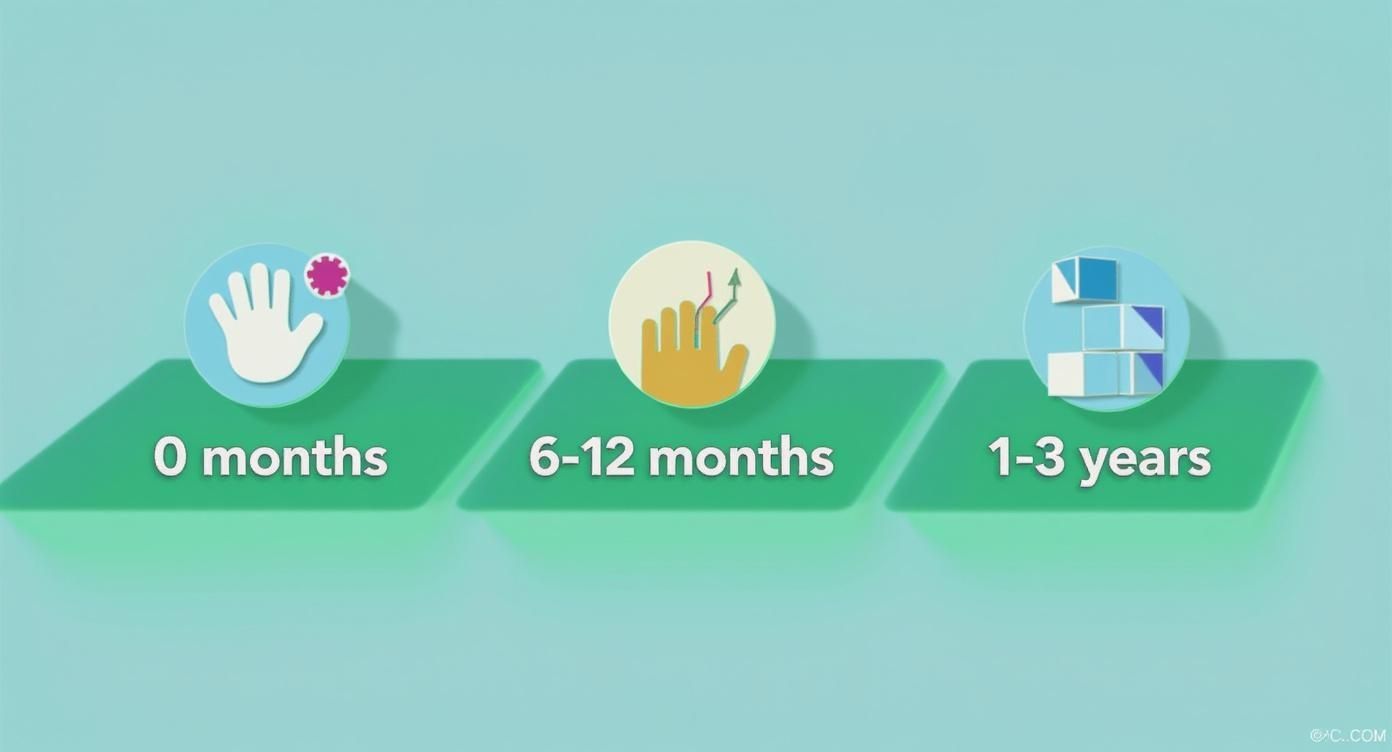
As you can see, the journey from batting at a toy to intentionally stacking blocks is a huge leap, laying down the essential wiring for all future learning.
Toys for Young Toddlers: 1-3 Years
Once your baby becomes a toddler, their play takes on a whole new level of purpose. They’re not just exploring objects anymore; they’re determined to figure out how things work. This is the perfect time for toys that challenge their manipulation skills and get their little cogs turning.
Take a classic set of stacking rings—it’s a developmental powerhouse. It teaches hand-eye coordination as they try to get the ring over the peg, and the simple act of letting go requires a deliberate release of their grasp. In the same way, a shape sorter isn’t just teaching them about circles and squares. It helps develop wrist rotation, finger strength, and spatial awareness as they twist and turn a block to make it fit through the right slot.
Choosing the right toy is about seeing its hidden developmental value. A simple puzzle isn’t just a puzzle—it’s a workout for the pincer grasp, visual scanning, and problem-solving.
Thinking this way helps you see beyond the bright packaging and understand a toy's true potential. For a closer look at this stage, our guide on selecting developmental toys for infants has even more ideas.
Of course, toys are just one part of the puzzle. If you're preparing for a new arrival, you might be looking for a complete checklist of items to support their first few months. A detailed newborn baby essentials list can be a huge help for getting everything in order.
Creative Play Ideas Beyond the Toy Box
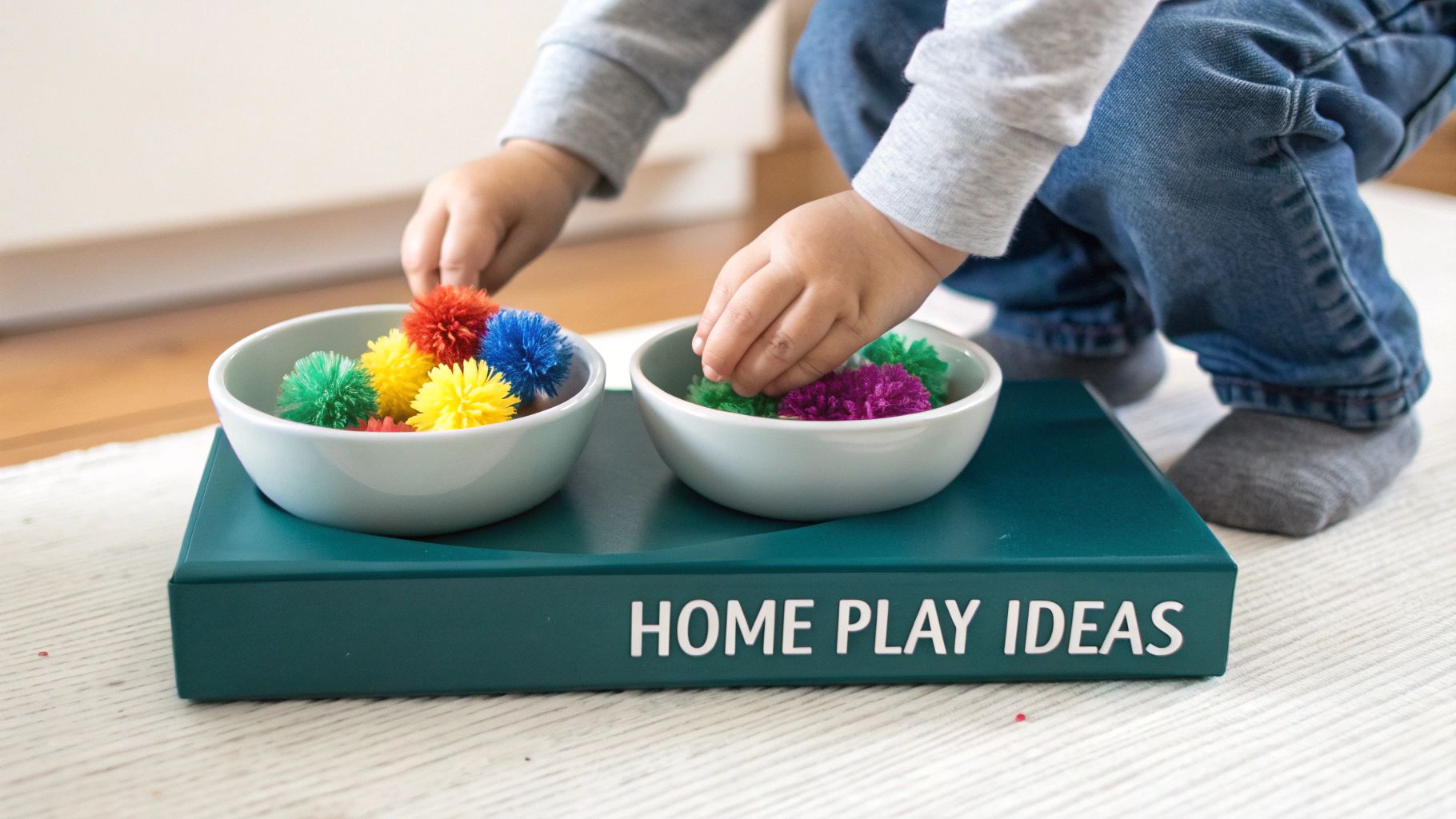
While the right baby toys for fine motor skills are brilliant tools, you don’t always need to buy something new to get those little hands working. Your home is already a goldmine of simple items that can be turned into fantastic activities for strengthening fingers, hands, and wrists.
It’s surprisingly easy to weave these playful learning moments into your daily life. This approach makes development feel natural and organic, plus it's wonderfully budget-friendly. It just goes to show that some of the best activities are born from a bit of creativity, not a big spend.
Everyday Items Turned into Skill Builders
Simple household objects can provide incredible practice for the pincer grasp and hand-eye coordination. Once you start seeing the potential in common items, you can create engaging challenges that just feel like fun to your little one.
Take a look at these simple setups:
- Pom-Pom Transfer: Grab a bowl of colourful pom-poms and an empty ice cube tray. Show your toddler how to use their thumb and forefinger to pick up one pom-pom at a time and pop it into each slot.
- Clothespin Play: Squeezing a clothespin is a surprisingly tough workout for small hands. Let your child clip them along the edge of a sturdy board book or a piece of cardboard, giving their favourite characters some funny "legs."
- Coin Posting: A classic piggy bank is perfect for this, but so is any old container with a slot cut into the lid. Picking up thin coins is a real test for the pincer grasp, and getting them into the slot hones coordination. (Just be sure to supervise closely, as coins are a choking hazard).
Meaningful fine motor practice isn't about complicated, elaborate setups. It's about repetition, manipulation, and the simple joy of using your hands to interact with the world in a focused way.
What’s great about these activities is that they often encourage a child to use both hands for different things at the same time. This skill, known as bilateral integration, is a crucial building block for more complex tasks later on, like doing up a zip.
Sensory Play for Stronger Hands
Sensory play is a fantastic—and often messy—way to build hand strength and dexterity. The hands-on, tactile feedback is incredibly engaging for children and helps them learn to control the pressure and force of their movements.
You can set up a simple sensory activity in minutes, and it can provide hours of developmental fun. It's an excellent way to prepare those little hands for trickier skills like holding a pencil.
Try these engaging ideas:
- Sponge Squeezing: Next time it's bath time, throw in a few small sponges. Soaking them up and squeezing the water out is a brilliant workout for the entire hand.
- Water 'Painting': All you need is a small pot of water and a paintbrush. Let your child "paint" on coloured construction paper or even the patio slabs outside. It strengthens their grip with zero mess.
- Drawing in Salt or Sand: Pour a thin layer of salt or sand onto a baking tray. Your child can use their finger to draw lines and shapes, which directly strengthens the exact muscles needed for writing.
Activities like these prove you don't need a dedicated playroom overflowing with toys. From the kitchen to the bathroom, every room in your house holds opportunities to turn a simple routine into a moment of growth.
A Parent's Checklist for Toy Safety and Quality
When it comes to choosing the best baby toys for fine motor skills, nothing matters more than your child's safety. Every single reach, grasp, and taste is a learning moment, so making sure their play space is secure is the first step towards happy, confident exploration. Luckily, a few simple checks are all you need for complete peace of mind.
Before you even think about how fun a toy is, check what it’s made of. For any plastic toys, make sure they’re from non-toxic, BPA-free materials—because let's be honest, they will almost certainly end up in your baby's mouth. If you're looking at wooden toys, check they’re finished with child-safe, non-toxic paints and sealants. The build quality is just as important. Give the toy a good feel all over; you're looking for any sharp edges, splinters, or rough patches.
Decoding UK Safety Labels
In the UK, a couple of key symbols on the packaging are your shortcut to knowing a toy is safe. Getting familiar with them makes choosing the right toys a whole lot easier.
- The UKCA Mark: This stands for 'UK Conformity Assessed'. It’s your guarantee that the toy meets all the necessary safety standards for sale in Great Britain.
- The CE Mark: This one shows the toy meets the health, safety, and environmental standards for the European Economic Area. You'll still see this on many toys sold in the UK.
Seeing one of these marks means the toy has passed tests for things like flammability and dangerous chemicals. It's a non-negotiable—always look for the mark before you buy.
A great little trick to check for choking hazards is the 'toilet paper roll test'. If a toy or one of its parts can fit completely inside an empty loo roll tube, it's too small for a child under three to play with safely.
The world of child development and safety is always changing, especially with technology becoming part of our lives. It's interesting to note that while most guidelines suggest no screen time for children under two, a surprising 75.2% of UK toddlers use touchscreens every day. Some research points to a complex connection, suggesting that the age a child first uses a touchscreen might link to them achieving certain fine motor milestones, like stacking blocks, a little earlier. You can learn more about the study on toddler touchscreen use on frontiersin.org. This just goes to show how both traditional toys and modern gadgets are shaping development, making safety across all of them more crucial than ever.
As a parent, wandering through the endless aisles of toys can feel like a pop quiz you didn't study for. Which one is right? Which one will they actually play with? This is exactly where stage-based toy kits, like the ones we've designed at Grow With Me, can be a game-changer.
Instead of you having to do all the research and guesswork, we do it for you. Our subscription boxes deliver a curated set of baby toys for fine motor skills that are timed perfectly to match where your child is in their development.
The Right Toy at the Right Time
Think about it: a toy that’s too easy gets boring in five minutes. One that’s too hard just leads to frustration and gets tossed aside. The magic happens when a toy offers just the right amount of challenge to keep them engaged, building their confidence and sparking a genuine love for figuring things out.
This is what a thoughtfully timed delivery system does. It's about combining the convenience of having it all done for you with the peace of mind that comes from expert-backed quality. You get to spend less time shopping and more time on the floor, actually playing and celebrating those little wins together.
Kids' abilities don't just grow; they leap forward. Research shows a massive jump in manual dexterity around the age of five, as their little hands suddenly become much more capable of assembling complex things. This just goes to show how vital it is to keep up with their progress, offering toys that meet them where they are. If you're curious about the science, you can discover more research on manual skill development on benthamopen.com.
A stage-based kit is like having a personal toy curator for your child, making sure the tools they have are not just fun, but perfectly synchronised with their growth.
Your Questions Answered: Fine Motor Skills
It's completely natural to have questions as you watch your little one grow and develop. Let's tackle some of the most common ones parents ask about fine motor skills and the toys that help them flourish.
When Should I Introduce Fine Motor Toys?
You can start right from day one! For newborns (0-3 months), a simple play gym with dangling, high-contrast toys is perfect. It encourages them to reach out and bat at objects, which is the very first step in building the hand-eye coordination they'll need later on.
As they get bigger, you can introduce toys that match what they're trying to do. Lightweight rattles are brilliant around 3-6 months when their grasp starts to become more deliberate. The secret is to offer age-appropriate challenges that feel like play, not a lesson.
Are More Expensive Toys Better for Development?
Absolutely not. A toy's real value has very little to do with its price. In fact, simple, classic baby toys for fine motor skills like stacking rings, shape sorters, and chunky wooden puzzles often do a much better job than flashy electronic gadgets.
The best toys are often those that are 90% child and 10% toy. Open-ended items that encourage imagination and hands-on manipulation will always offer more developmental benefits than toys that play for the child.
Focus on quality and purpose, not the price tag. A simple set of nesting cups or even safe household items like sponges and clothespins can provide fantastic fine motor practice without breaking the bank.
My Toddler Seems a Bit Behind. What Should I Do?
First, try not to worry. Every child truly develops at their own pace, so comparing them to others often causes unnecessary stress. Think of milestone charts as a rough guide, not a strict timetable to be followed.
However, if you notice your child is consistently struggling with certain skills—like grasping objects by 12 months or being unable to stack a few blocks by age two—it’s worth a chat.
Bringing up your concerns with your health visitor or GP is always the best first step. They can give you peace of mind and, if there is a need for it, point you towards brilliant resources that can offer a bit of extra support.
Ready to take the guesswork out of choosing the perfect toys for every stage? Let Grow With Me deliver expertly curated, stage-based play kits right to your door.