
What is imaginative play: How it fuels creativity and learning
Ever watched a child turn a simple cardboard box into a spaceship or a pile of cushions into a secret fortress? That's the magic of imaginative play. It’s the beautiful, chaotic, and profoundly important act of pretending, where children use their minds to create whole new worlds.
Unpacking the World of Imaginative Play
At its core, imaginative play is how a child starts to make sense of the world around them. It’s their first go at storytelling, problem-solving, and figuring out how things work. Far from being just a way to fill an afternoon, this kind of play is the real work of childhood. In these make-believe scenarios, they get to be the writers, directors, and main characters all at once.
You can think of it as a dress rehearsal for real life. When your toddler carefully pretends to feed their teddy bear, they're practising empathy and the basics of caring for someone else. When they stack blocks and proudly declare it a castle, they're dipping their toes into ideas about design, creativity, and purpose. It’s through these self-directed stories that big, abstract concepts start to feel real.
The Core Components of Pretend Play
Imaginative play isn't just one thing; it’s a beautiful mix of different skills all firing at once. It’s almost always spontaneous and, crucially, it's led by the child. That’s where the power lies. This freedom gives them a safe space to explore tricky emotions, try on different social roles, and see what happens without any real-world consequences.
You'll notice it looks very different from a structured game with set rules—unless, of course, they invent the rules themselves! This is closely linked to another key developmental stage, and you can learn more about how children use one object to stand for another in our guide to symbolic play.
Imaginative play isn’t about escaping from reality. It’s about practising for it. It’s a sandbox for children to test out social skills, figure out disagreements, and build the creative thinking that will serve them their entire lives.
Sadly, the hustle and bustle of modern life can sometimes crowd out these vital opportunities for play. A worrying report found that in the UK, over 68% of children between five and eight aren't getting enough time for pretend play. This really brings home how important it is for parents, grandparents, and carers to actively carve out time and space for this foundational activity.
To help see it more clearly, we can break imaginative play down into a few key building blocks.
The Building Blocks of Imaginative Play
| Element | What It Looks Like | Why It Matters for Your Child |
|---|---|---|
| Role-Playing | Pretending to be a doctor, chef, or a parent. | Helps them understand social roles and develop empathy by seeing the world from another's perspective. |
| Object Substitution | Using a banana as a telephone or a stick as a magic wand. | Fosters abstract thinking and shows they can see potential beyond an object's intended use. |
| World-Building | Creating detailed settings, like a 'shop' in the living room or a 'jungle' in the garden. | Encourages planning, organisation, and the ability to sustain a narrative over time. |
Seeing these elements in action is a sure sign that your child’s imagination is firing on all cylinders, building crucial skills one pretend game at a time.
How Imaginative Play Evolves From Baby to Toddler
Imaginative play isn't something that just switches on one day. It’s a quiet and beautiful evolution, growing and changing right alongside your child. It all starts with the simplest of interactions and slowly builds into the rich, story-filled worlds we all recognise as pretend play.
When you understand how this journey unfolds, you can spot and encourage your child's creativity every step of the way. It’s a truly magical process, turning everyday moments into the building blocks for learning.
The First Whispers of Imagination: 0 to 12 Months
During the first year, a baby’s world is all about exploring and imitating. They don't have the abstract thinking for complex make-believe just yet, but they are laying all the essential groundwork. Their play is sensory, immediate, and deeply connected to the people they love most.
You'll see these early seeds of imagination when your baby:
- Mimics your expressions. That copied smile or returned gurgle is your baby’s first go at a social back-and-forth. It’s a game!
- Babbles into a toy phone. They aren't ordering a pretend pizza, but they are absolutely copying the sounds and actions they see you make every day.
- Plays peekaboo. This classic game is huge. It introduces the idea of object permanence—that things still exist even when you can’t see them—which is a crucial first step towards pretending something is there when it isn't.
These little moments show your baby is watching, learning, and figuring out cause and effect. These are the vital skills they'll need for more structured imaginative play down the line.
Simple Pretence Takes the Stage: 12 to 24 Months
As your baby blossoms into a toddler, you’ll start to see the first proper sparks of pretend play. This is when they begin using objects for their intended purpose, but in a playful way. Their actions are still quite simple and often solitary, usually mirroring their own daily routines.
You might see a young toddler pick up a toy cup and pretend to have a drink, or carefully try to feed their dolly with an empty spoon. Maybe they’ll push a toy car while making a soft ‘vroom’ sound. This is where symbolic thinking starts to click into place; the toy car isn't just a block of wood anymore, it now represents a real vehicle. They are linking an object to an idea, which is a massive cognitive leap. To get a better sense of this milestone, you can explore the different stages of child development by age and see how these skills fit into the bigger picture.
Complex Narratives Come to Life: 2 to 4 Years
Welcome to the golden age of imaginative play. Around this time, a toddler's thinking and language skills just explode. This allows them to dream up detailed stories, assign roles, and even create rules for their make-believe worlds. A simple pile of wooden blocks is no longer just for stacking; it’s now a towering castle, a bustling city, or a vet clinic for their favourite stuffed animals.
This visual timeline shows just how storytelling, problem-solving, and social skills all grow out of this wonderful evolution of play.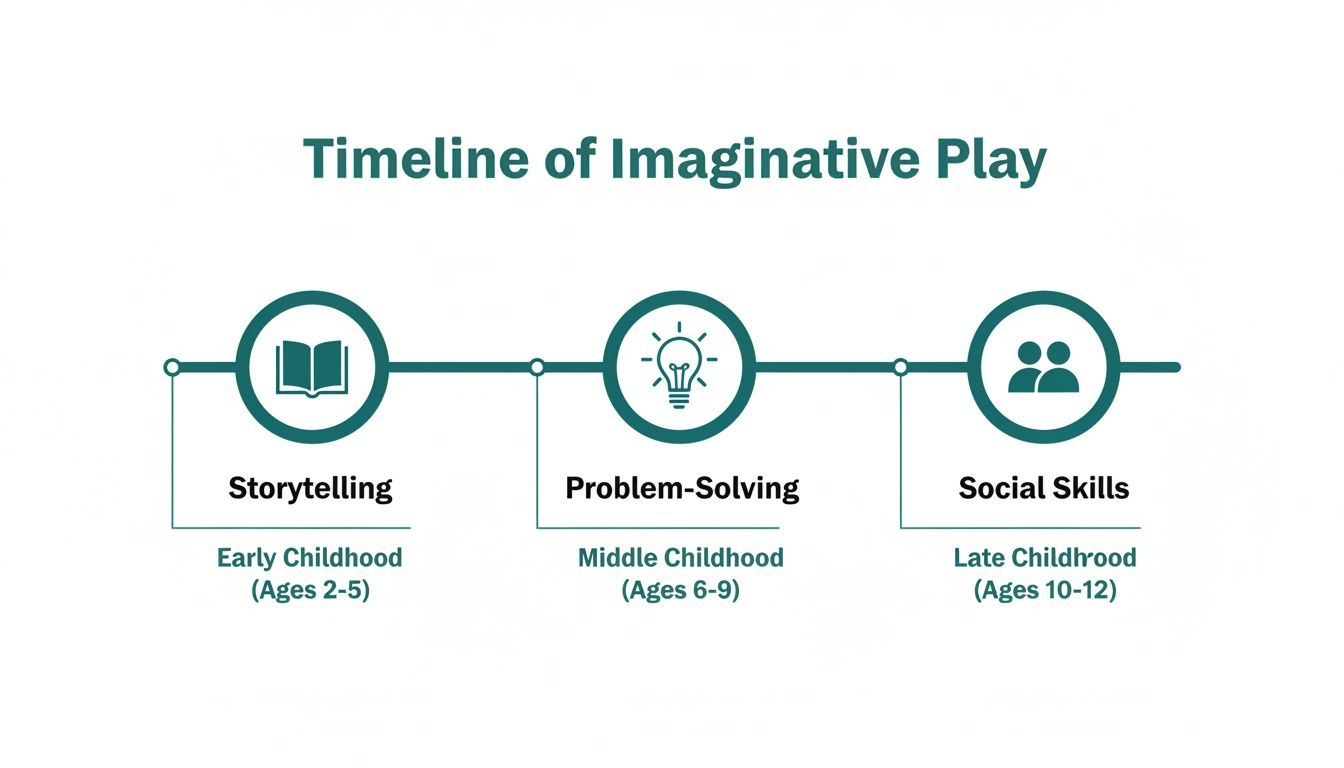
As you can see, these skills aren't separate. They're deeply connected, with each one building on the last as a child's imagination takes flight.
This is also when play becomes a social laboratory. Children start playing with each other, not just next to each other. They’ll negotiate roles—"You be the patient, I'll be the doctor"—and solve problems together, like figuring out the best way to build a blanket fort that won’t collapse.
As their play gets more complex, even simple things like food can become props in their adventures. For some great ways to fuel this creative energy, check out these healthy snack ideas for toddlers. Watching this all unfold is truly one of the great joys of being a parent, giving you a precious window into your child’s ever-expanding inner world.
The Developmental Magic of Pretend Play
Far from being just a cute way to pass the time, imaginative play is one of the most powerful engines for a child's development. When your little one is deep in a game of pretend, they're not just playing; they're actively building the cognitive, social, and emotional skills that will form the bedrock of their entire life. It’s inside these self-created worlds that some of the most crucial learning happens.
This is why the type of toy matters so much. Open-ended, natural toys act as catalysts for creativity, not commanders of a specific action. A simple wooden block can be a phone one minute, a car the next, and a slice of cake after that. It asks the child to bring the imagination, flexing creative muscles that a single-purpose electronic toy simply can't exercise in the same way.
Boosting Brainpower and Problem-Solving
Imaginative play is a workout for a child's brain. Every single pretend scenario is really just a series of little problems that need solving. How do we build this fort so it doesn't fall down? What ingredients do we need for our magical potion? This kind of thinking lays the groundwork for executive function skills like planning, organising, and thinking on your feet.
As children invent and stick to their own storylines, they're also strengthening their memory and ability to focus. Just remembering the "rules" of their game or which role their teddy bear is playing requires real concentration. This is your child’s first foray into abstract thought, a skill that's absolutely vital for grasping concepts later on in subjects like maths and science.
Nurturing Social and Emotional Intelligence
Pretend play is like a social laboratory where children can safely experiment with big, complex human emotions. By stepping into someone else's shoes—whether it’s a vet caring for a sick toy puppy or a parent soothing a baby doll—they start to build empathy. They’re literally practising how to see the world from another's point of view, which is the very heart of emotional intelligence.
Trying to navigate a shared imaginary world with a friend is a masterclass in social skills. It requires cooperation, negotiation ("Okay, you can be the pirate captain this time!"), and learning how to resolve disagreements when ideas clash. These are the absolute fundamentals for building healthy relationships.
This kind of hands-on practice is irreplaceable. It’s fascinating to see how it plays out in real life. For instance, The British Preschool Children's Play Survey found that UK children aged 2-4 play for about four hours a day, with a good chunk of that time—nearly two hours—often spent outdoors. This carves out a huge opportunity for unstructured fantasy play where social skills get honed in gardens and playrooms across the country.
How Imaginative Play Nurtures Key Skills
To see just how powerful this is, let's look at how specific play activities directly translate into real-world skills. You can see the connection between the fun and the fundamental learning taking place.
| Imaginative Play Activity | Cognitive Skills Developed | Social-Emotional Skills Developed | Language Skills Developed |
|---|---|---|---|
| Playing ‘house’ or ‘family’ | Planning daily routines, sequencing events (e.g., dinner then bath). | Empathy, understanding family roles, expressing care and affection. | Using vocabulary related to home life, practising conversational turns. |
| Building a fort or castle | Spatial reasoning, problem-solving, structural planning. | Cooperation, teamwork, negotiation of roles and design ideas. | Giving and following instructions, using descriptive language. |
| Hosting a ‘tea party’ | Following social scripts, organisation (setting the table). | Practising manners, turn-taking, sharing, hosting skills. | Asking questions, polite conversation, using imaginative vocabulary. |
| Pretending to be superheroes | Creating complex narratives, strategic thinking to 'defeat' villains. | Exploring concepts of right vs. wrong, managing big emotions. | Creating new words, storytelling, using expressive tones. |
As you can see, what looks like simple fun on the surface is actually a complex web of skill-building. Each scenario is a chance for your child to practise and master essential life skills in a low-stakes, joyful environment.
Expanding Language and Communication
The link between imaginative play and language is incredibly strong. When children are inventing stories, they are constantly trying out new words and more complex sentences. Describing their magical kingdom or giving orders to their fellow adventurers pushes their vocabulary far beyond what they use in everyday chat.
This is also where their storytelling abilities begin to blossom. They learn about narrative structure—a beginning, a middle, and an end—as they act out their own little dramas. And by listening and responding to their playmates, they sharpen their communication skills, learning the natural give-and-take that makes a good conversation flow. Exploring how different activities can spark a child's mind is a great way to support their growth, which is why ideas like experience gifts for kids can be so valuable.
Creating a Home That Inspires Imagination
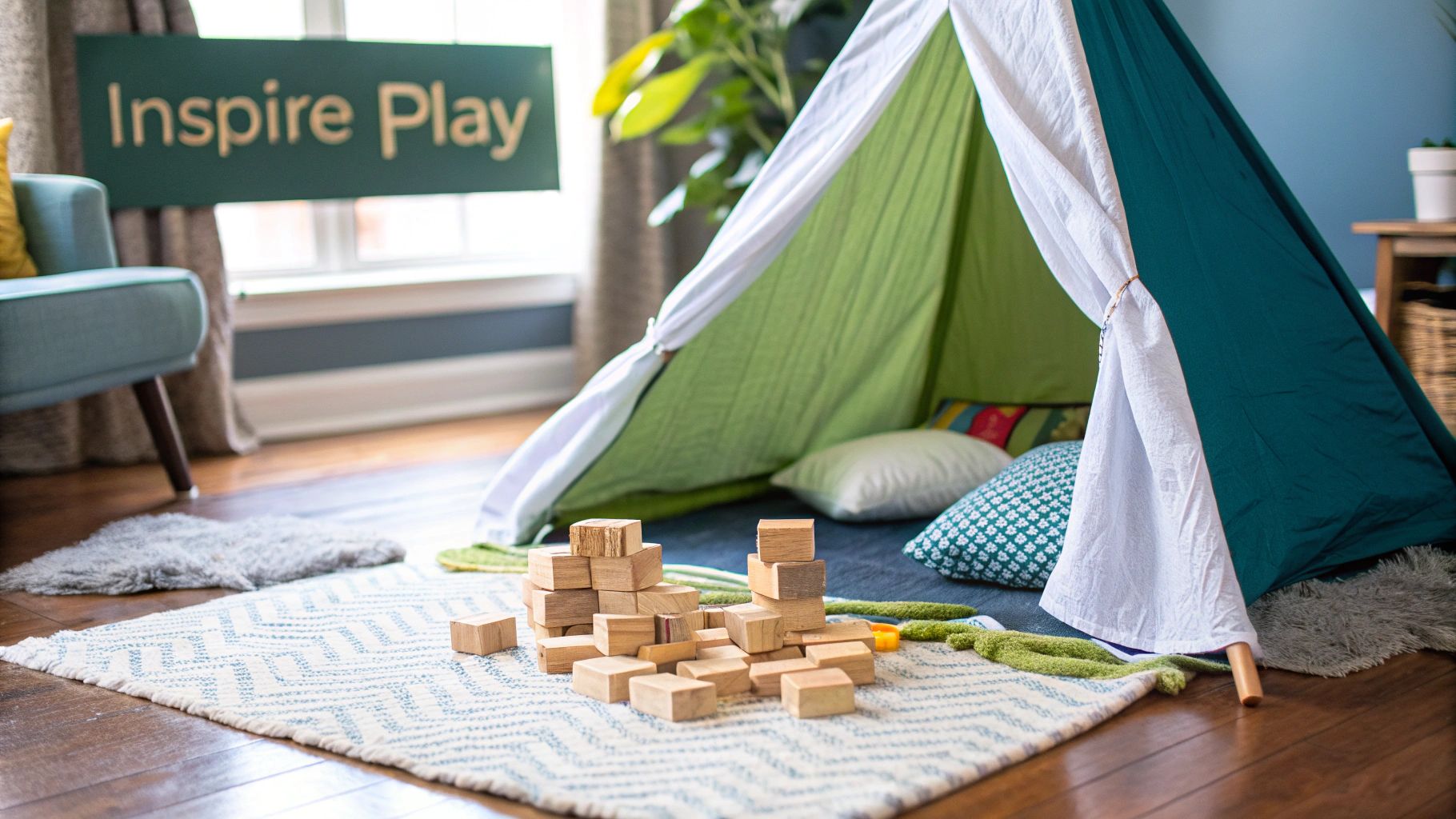
Fostering a world of imaginative play at home doesn't mean you need a playroom packed to the ceiling with the latest shiny toys. Actually, it's often the opposite. A home that genuinely sparks creativity is less about the amount of stuff and more about the quality of the space and the freedom it offers.
Think of yourself as a play facilitator, not a director. Your job is to gently guide and spark curiosity, creating an environment where your child feels safe to explore their own brilliant ideas. It’s all about stepping back just enough to let their imagination take the lead.
Setting Up a 'Yes Space'
A 'yes space' is a corner of your home, or even a whole room, where your child is free to touch, explore, and play without constantly hearing "no." It’s a game-changer for building their confidence and sense of autonomy. This space should be safe and thoughtfully stocked with a selection of open-ended toys—the kind that can be used in countless ways.
These are the toys that don't come with a rulebook. Simple, natural materials are often the most powerful tools you can offer.
- Wooden Blocks: Today they’re a castle, tomorrow they're a car, and the next day they’re food for a pretend picnic. Their versatility is their magic.
- Play Silks or Fabric Scraps: A piece of blue silk can be a flowing river, a superhero's cape, or a soft blanket for a doll.
- Cardboard Boxes: The ultimate blank canvas! A simple box can transform into a rocket ship, a secret clubhouse, or a mysterious cave.
- Natural Items: Things like pinecones, smooth stones, and seashells connect children to the outdoors and can become little characters or treasure in their games.
Unlike many electronic toys that have a single, specific function, these simple items leave room for a child’s mind to fill in the blanks, which is the very heart of imaginative play.
Your role isn't to entertain, but to empower. By providing the right tools and a supportive presence, you give your child the freedom to build their own worlds, solve their own problems, and tell their own stories.
Sparking Curiosity Without Taking Over
Once you’ve set the scene, the way you interact is what really matters. There's a real art to joining their world without accidentally taking control. Instead of giving direct instructions ("Let's build a tower!"), try using gentle questions that spark curiosity.
These subtle prompts can extend playtime and encourage deeper thinking, turning it into a more connected and joyful experience for you both.
How to Nurture Their Narrative
- Wonder Aloud: Use open-ended phrases like, "I wonder what teddy is thinking?" or "I wonder where this magical road goes?" This invites your child to think creatively without feeling put on the spot.
- Model Imaginative Thinking: Show them how it’s done in small, everyday moments. Pick up a leaf and pretend it’s a tiny boat sailing on a puddle. This simple act shows them that imagination is a fun and normal part of life.
- Follow Their Lead: If your child decides a banana is a telephone, roll with it! Ask them who they’re calling. By validating their ideas, you send a powerful message: their creativity is brilliant and valued.
By focusing on these simple techniques, you can create a home that is a true launchpad for imagination, helping your child build a rich inner world that will benefit them for years to come.
Your Partner in Play at Every Stage
Realising just how important imaginative play is can be a double-edged sword. On one hand, it's a relief to know you're supporting something so crucial. On the other, the pressure is on. How do you pick the right toys when your child is growing and changing at lightning speed? How can you be sure you're giving them the best tools for their specific stage, without overwhelming them (or your living room)?
This is exactly where a more thoughtful, curated approach can be a game-changer.
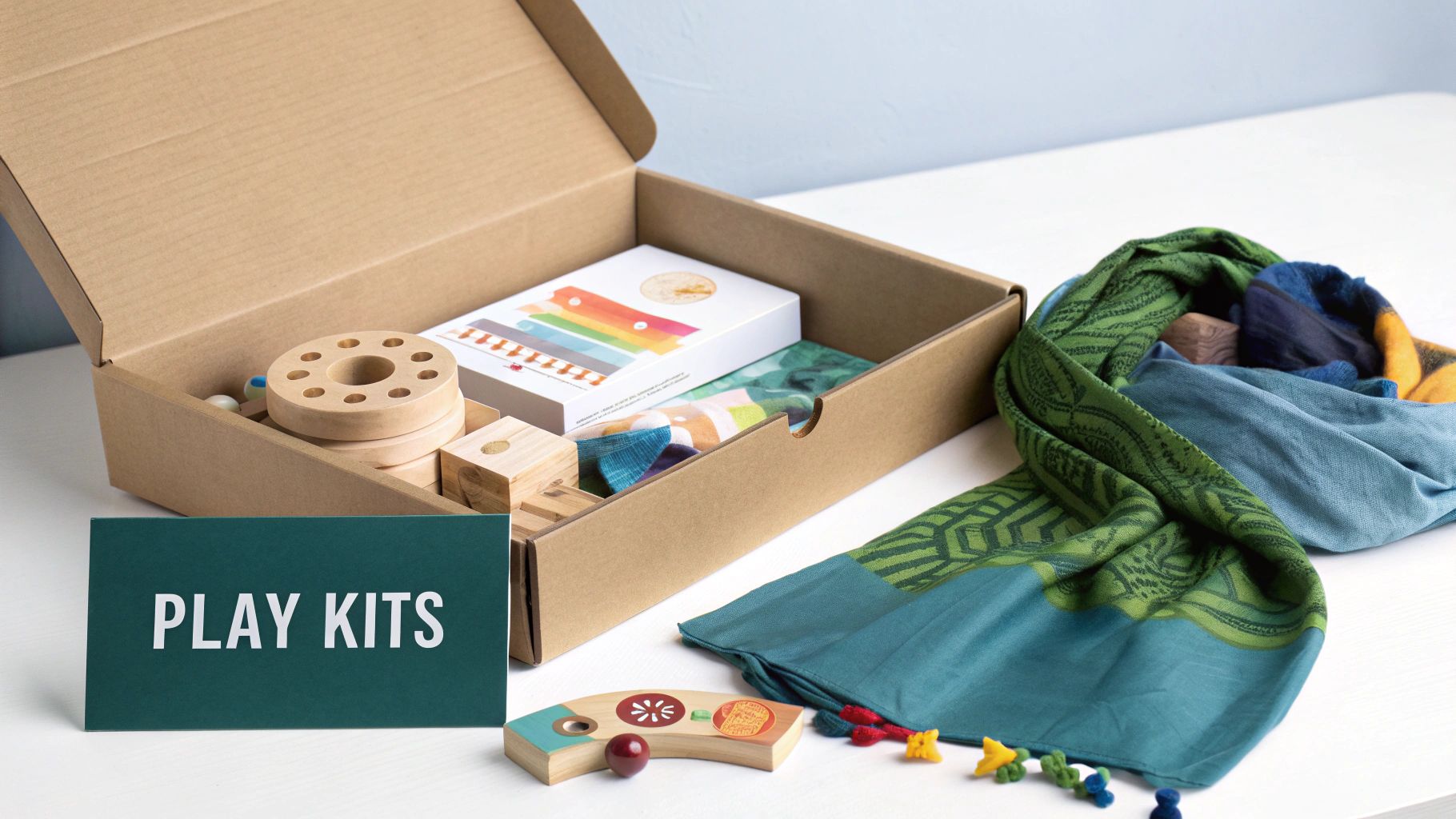
Imagine having expertly chosen, stage-based play kits delivered right to your door. All the guesswork is gone. Every single toy your child unwraps is perfectly matched to their current developmental window, meaning you never have to wonder if something is too simple or too advanced. Each item has a purpose.
Quality and Purpose in Every Box
We’ve always believed that the simplest, most well-crafted toys can spark the biggest adventures. It's why our Grow With Me kits are built around quality and longevity. In fact, over 80% of our toys are made from beautiful, natural materials like wood, giving little hands a safe and satisfying tactile experience.
These aren't just objects; they are invitations to play. Each kit is designed to provide experiences, and it comes complete with helpful guidance cards for parents. These cards explain the ‘why’ behind each toy and offer simple, practical tips on how to engage with your child. It transforms playtime into a moment of genuine connection and learning. You can explore this approach further in our article on what sustained shared thinking is.
Our goal is to empower you with confidence. We deliver not just high-quality toys, but the knowledge and support to make the most of them, helping you feel prepared and excited to foster your child’s blossoming imagination.
The Grow With Me Advantage
Choosing the right partner for your child's play journey simplifies everything. It frees you up to focus on the pure joy of discovery.
- Stage-Based for Maximum Impact: Kits are precisely tailored to your child’s age, supporting key milestones in their cognitive, motor, and creative development.
- Built to Last: We prioritise durable, natural materials, creating toys that can grow with your child and be used in new ways as their play evolves.
- Guidance for Grown-Ups: Our included cards offer clear, simple ways to introduce each toy and extend the play, making you a confident co-adventurer.
- Convenience for Busy Families: With fast delivery, you get the perfect developmental tools right when your child needs them, without the stress of endless searching.
This approach takes the process from overwhelming to effortless. It’s about receiving a box filled not just with toys, but with purpose, quality, and the promise of countless imaginative adventures you can share together.
Got Questions About Imaginative Play? We've Got Answers
As you watch your little one get lost in their own magical world, it's completely normal to have a few questions. What looks like simple fun is actually a complex and crucial part of their development, and it’s not always obvious what’s going on in their busy minds.
Let's clear up some of the most common queries parents have. Hopefully, these answers will give you even more confidence as you watch them play and grow.
Is It Normal That My Toddler Plays Alone So Much?
Absolutely. In fact, it’s not just normal—it’s brilliant. Think of solo imaginative play as your child's personal laboratory. It’s a safe space where they can experiment with ideas, process their feelings, and figure out how the world works, all on their own terms. This is where they learn to be the star of their own show.
Of course, playing with others is important too, but this independent play is a massive sign of a blossoming imagination and growing self-reliance. When you see them totally absorbed in their own world, you’re watching deep learning in action.
What Are the Best Toys for Sparking Imagination?
Honestly, the best toys are often the simplest ones. We're talking about ‘open-ended’ toys—the kind that can become anything your child dreams up. Think of classics like wooden blocks, a set of colourful scarves, animal figures, or even just a big cardboard box. These are the real heavyweights of the toy box.
The magic is that these items don't tell a child how to play. A toy with lots of buttons and sounds has a clear purpose, but a simple block can be a phone, a piece of cake, or a car. This is what puts your child in the driver’s seat of their own imagination.
How Much Imaginative Play Should My Child Be Getting?
Try not to get too hung up on the clock. It’s far more about quality over quantity. The goal is to make sure there are regular pockets of time for unstructured, child-led play every day. It's about protecting that precious time where they're free from schedules and screens, free to get a little bit bored and invent their own fun.
Even 20-30 minutes of truly deep, focused pretend play can do more for their development than hours of passively watching something. Look for those little windows of opportunity—while you're making dinner or after a bath—to just let them get lost in whatever world they’ve created.
What If I Feel Awkward or Silly Joining In?
You are not alone! Almost every parent has felt a bit self-conscious when asked to be a dinosaur or pretend to drink invisible tea. But here’s the secret: your child doesn't need an Oscar-worthy performance. They just need you to be present and willing to play along.
Your best tool is curiosity. Here are a few easy ways to get involved without feeling awkward:
- Let them be the director. Don’t try to take over the storyline.
- Ask simple, open questions. Things like, "Oh wow, what's happening over here?" or "What do you need me to do?" are perfect.
- Do small things. Just handing them the ‘medicine’ for their sick teddy or making a "vroom" sound for their toy car is all it takes to show you're in the game with them.
Your engagement, however small, shows them their ideas are important and gives them the confidence to dream even bigger.
At Grow With Me, we know that finding the right toys can feel overwhelming. Our stage-based play kits are designed to take the guesswork out of it, delivering beautiful, open-ended toys directly to you. Each box comes with guidance to help you feel confident in supporting your child’s development, one play-filled moment at a time.
Ready to get started? Explore our subscription boxes.