
What Is Constructive Play and How It Fuels Child Development
At its simplest, constructive play is all about learning by building and creating. It’s any time your child takes materials—whether they’re blocks, mud, or even cardboard boxes—and uses them with a purpose to make something totally new. This is where they get to be an engineer, an artist, and a problem-solver, all rolled into one.
The Foundations of Constructive Play
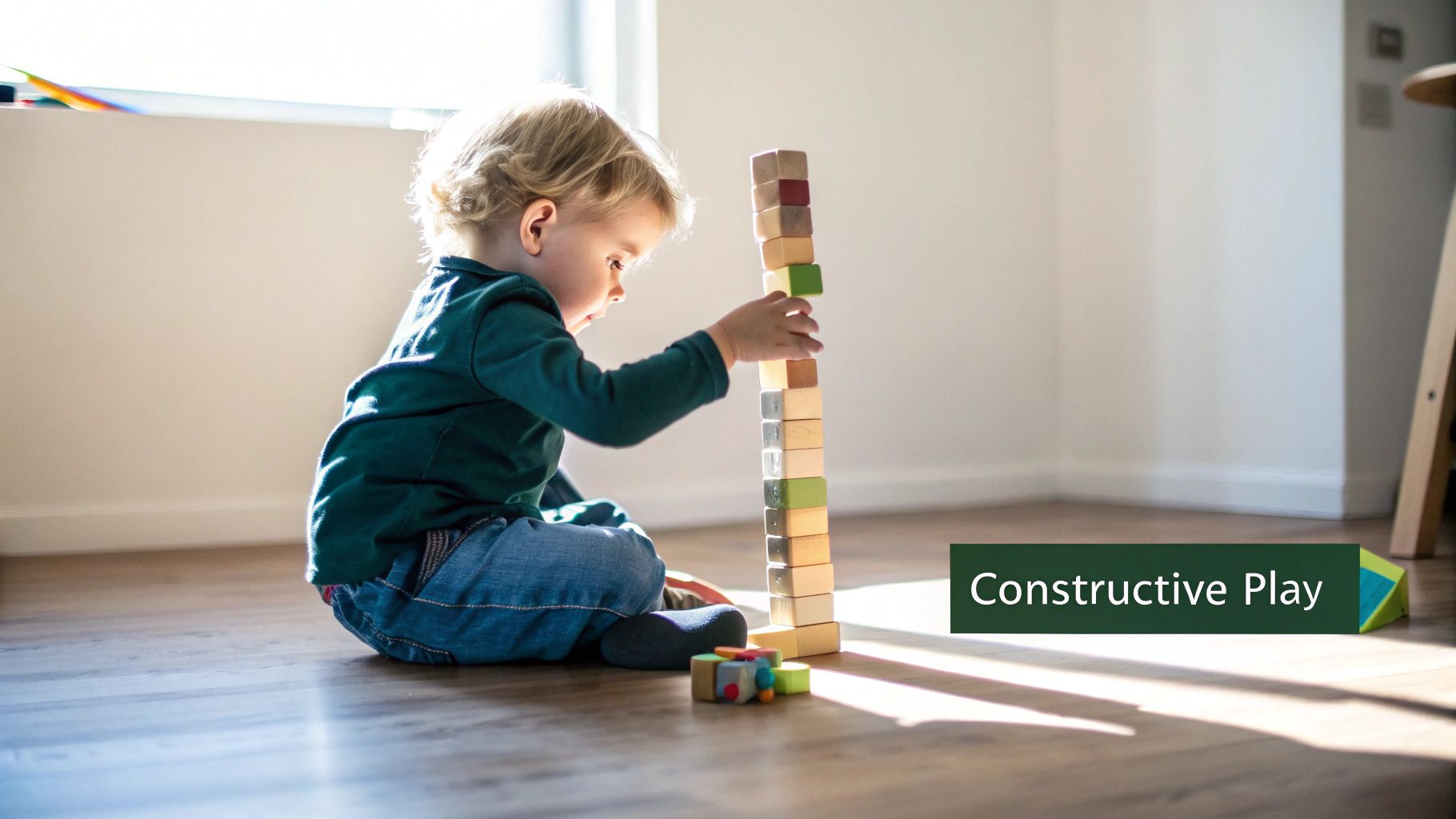
When you get right down to it, constructive play is simply the act of changing the environment to reach a goal. It’s different from other types of play that might be more free-flowing or purely based in make-believe. Constructive play has a clear purpose and, usually, a finished product you can see.
Think of it this way: pretending to be a superhero is imaginative play. But building that superhero's secret hideout from sofa cushions? That’s constructive play. Both are brilliant for development, but it's constructive play that really connects what’s in their head to what their hands can do. It's where big ideas meet the real world.
More Than Just Making a Mess
This goal-focused kind of play is a true engine for development in the early years. When a toddler carefully balances one block on top of another, they’re not just stacking—they’re running a mini-experiment with gravity, balance, and spatial awareness. They’re learning to plan, to bring their ideas to life, and to adapt when that wobbly tower eventually comes crashing down.
It’s no surprise that constructive play is a cornerstone of early learning here in the UK. Research from the British Children's Play Survey highlights how it sharpens problem-solving skills, as children figure out what works and what doesn't through good old-fashioned trial and error. You can dig deeper into the findings on constructive play's impact from this research.
The process is often more important than the final product. The critical thinking, resilience, and motor skills developed while building are the true masterpieces, not just the finished sandcastle or Lego creation.
Key Benefits at a Glance
This type of hands-on play builds a solid foundation of skills that will help children when they start more formal learning. Here’s a quick look at the main perks:
- Problem-Solving: Children learn to tackle challenges head-on, like figuring out how to build a bridge that doesn’t collapse or a tower that doesn’t lean.
- Motor Skill Refinement: Grasping small Lego bricks, fitting puzzle pieces together, and scribbling with a crayon all help to strengthen those crucial fine and gross motor skills.
- Creative Thinking: It’s a fantastic outlet for them to test out new ideas, express themselves, and see what happens when they think outside the box.
- Sense of Accomplishment: There's nothing quite like the pride of finishing a project. It gives their self-esteem a healthy boost and teaches them the value of sticking with something.
The Developmental Power of Building and Creating
Every time your child stacks a block, connects a train track, or squishes some Play-Doh into a new shape, they’re doing so much more than just keeping busy. They are quite literally building their own brain. This is the magic of constructive play—it’s a hands-on, creative process that fuels massive developmental leaps across the board.
Think of it as a workout for their mind. This type of play strengthens the neural pathways they'll need for complex thinking later on. When a toddler figures out how to balance one block on another to build a tower, they’re getting their first real lesson in physics, geometry, and spatial awareness, all without even realising it.
They're testing ideas, making predictions, and learning from what doesn't work. This cycle of trial and error is exactly how they build the critical thinking and problem-solving skills that will serve them for the rest of their lives.
Boosting Brainpower Through Building
Constructive play makes big, abstract ideas completely tangible. A child sorting coloured rings or fitting shapes into a puzzle isn’t just playing; they’re engaging in early mathematical thinking. They’re learning about categories, sequences, and how things relate to one another.
This hands-on exploration is fundamental to hitting key developmental milestones. In fact, UK government data shows that 80.4% of children reached the expected level of development across all key areas by age 2.5, a benchmark that this kind of purposeful play directly supports. You can read more about it in the official Child Development Outcomes report.
Refining Essential Motor Skills
Beyond the amazing cognitive boost, constructive play is also crucial for physical development. The simple act of picking up, grasping, and placing objects is a masterclass in motor skills.
- Fine Motor Skills: We’re talking about the small, precise movements of the hands and fingers. Things like threading beads, snapping small building blocks together, or using child-safe scissors all help refine the dexterity they’ll need for writing or doing up their own coat.
- Gross Motor Skills: This is all about the larger muscle groups. Building a big fort out of cushions or carrying buckets of sand in the garden requires coordination, strength, and balance, strengthening their entire body.
Every single action, from a delicate finger-and-thumb pinch to the steadying of their whole arm, is improving their hand-eye coordination and physical confidence. To dig a bit deeper, have a look at our guide on how building blocks for toddlers support motor development.
Nurturing Social and Emotional Growth
Constructive play is rarely a solo mission for long, which makes it a fantastic training ground for social skills. When two children decide to build a castle together, they have to navigate the complex world of sharing, taking turns, and teamwork. They learn to communicate their ideas, listen to their friend's, and work towards a shared goal.
This shared process of creation teaches invaluable emotional lessons, too. When that carefully built tower inevitably tumbles down, it provides a safe space to feel disappointment and learn how to bounce back.
They discover that setbacks aren't the end of the world but just part of the process. That's a vital lesson that builds emotional resilience and a can-do attitude towards any challenge life throws their way.
Constructive Play Milestones From Baby to Toddler
Constructive play isn’t something that just appears overnight. It’s a beautiful journey that grows and changes right alongside your child. Seeing how it evolves helps you appreciate the incredible learning taking place, even when it just looks like they're making a mess!
Think of this progression as a practical roadmap, showing you what constructive play looks like at each age. For parents, watching this journey unfold is one of the most rewarding parts of the early years. To see how these skills fit into the bigger picture, you can explore our guide on key developmental milestones.
Babies (6–12 Months): Discovering Cause and Effect
At this very first stage, constructive play is all about pure exploration. Your baby isn't trying to build a specific tower or a house; they're simply figuring out how objects work and what they can do with them. Every single action is a little experiment.
It's like watching a tiny scientist in their first lab. When they bang two blocks together, they’re learning about sound and impact. When they drop a toy into a box only to dump it out again, they’re getting their first lessons in "in" and "out" and the concept of object permanence—the amazing idea that things still exist even when hidden from view.
You’ll often see them:
- Banging objects together just to hear the sound.
- Dropping and throwing things to see where they go.
- Putting items into containers and then gleefully dumping them out.
- Mouthing and touching different textures to learn about their properties.
Young Toddlers (12–24 Months): Building With Purpose
As your baby moves into toddlerhood, their play starts to look much more intentional. The random banging and dropping slowly gives way to purposeful placement. This is where you’ll spot their very first attempts at true construction, all thanks to their improving fine motor skills and hand-eye coordination.
The goal is still simple, but it’s there. They might focus intently on stacking two or three blocks on top of one another before the whole thing tumbles down. They are beginning to realise that their actions can create a specific result, which is a massive cognitive leap forward.
This visual guide shows how these early play experiences lay the groundwork for cognitive, motor, and social development over time.
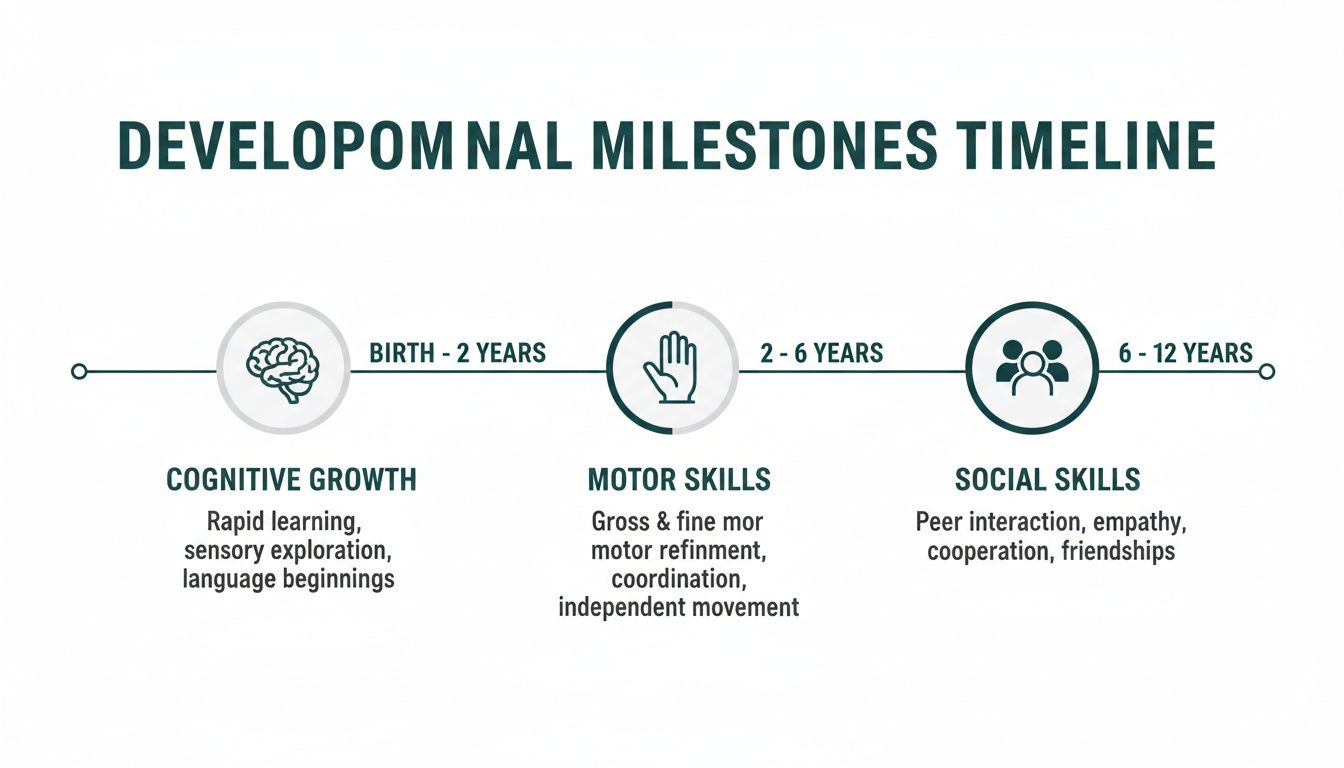
As the timeline illustrates, the foundational skills honed during early constructive play are the building blocks for more complex cognitive and social achievements later in life.
Older Toddlers (2–3 Years): Creating With Imagination
Now, this is where the magic really kicks in. An older toddler’s constructive play becomes woven into their amazing, expanding imagination. They aren’t just stacking blocks anymore; they are building a castle for a dragon or a garage for their favourite toy car.
The goal suddenly has two parts: to build something, and then to use that creation as a part of their imaginative world. The structure itself becomes a prop in a much bigger story.
You’ll notice their creations getting more complex. They might lay out a long, horizontal line of blocks and proudly announce it’s a train, or carefully place dolls inside a cardboard box "house." They are connecting their inner world of ideas with the physical world of objects—a cornerstone skill for creative thinking and problem-solving down the line. It's a clear sign they can now plan, execute, and bring their own unique ideas to life.
How to Encourage Constructive Play at Home
Nurturing constructive play at home doesn't mean you need a complete house makeover or a mountain of expensive toys. It’s far more about thoughtfully setting up spaces and moments that spark curiosity, empowering your little one to explore, build, and invent on their own terms. Your job is to be a facilitator of discovery, not a director of activities.
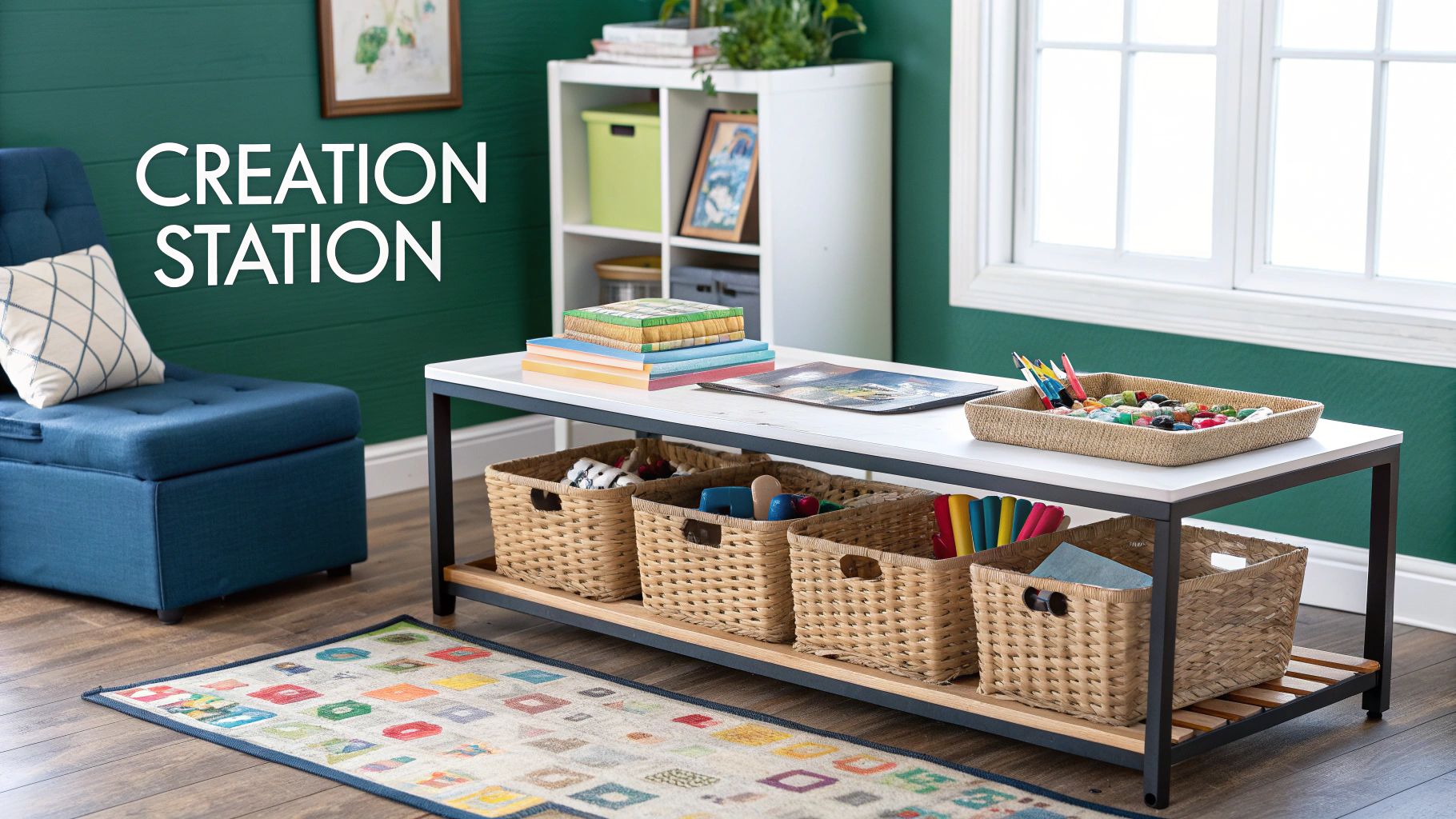
It all starts with making creative materials easy to get to. A dedicated ‘creation station’—even if it's just a small corner with a low shelf or a few baskets—can make a world of difference. When children can see and reach their own tools, they’re much more likely to start playing all by themselves.
Set the Stage for Creativity
Creating the right atmosphere is everything. This involves providing the right kinds of materials and fostering a mindset where experimentation is always celebrated.
- Offer Open-Ended Materials: Choose items that can be used in a million different ways over toys with just one purpose. Think classic wooden blocks, magnetic tiles, art supplies, and even recycled bits and bobs from around the house.
- Rotate Toys: Keep things fresh and exciting by rotating a selection of toys every week or two. This stops them from feeling overwhelmed and makes old toys feel brand new again.
- Embrace Everyday Objects: Often, the best tools for constructive play are already in your home. Cardboard boxes become forts, kitchen rolls turn into telescopes, and old blankets make the best dens.
The kitchen is a fantastic place to start; exploring some fun recipes to make with kids can transform cooking into a creative, skill-building activity. Measuring, mixing, and following steps are all brilliant forms of constructive play.
Guide With Gentle Questions
As a parent, your role is to be a curious co-explorer. Instead of telling your child what to build or how to do it, you can get their problem-solving mind whirring with gentle, open-ended questions.
The most powerful tool you have is your curiosity. Asking, "I wonder what would happen if..." is far more effective than giving direct instructions. It invites your child to think for themselves, test their own theories, and own their discoveries.
Try using prompts that encourage deeper thinking without just giving away the answers. A few simple phrases can open up a world of possibilities and show your child that you value their creative process.
Celebrate the Effort, Not Just the Outcome
With constructive play, the real learning happens in the process of building, not just in the final creation. It's so important to praise the effort, the concentration, and the clever ideas your child tries along the way. Whether their tower stands tall or comes tumbling down, the attempt itself is a victory worth celebrating.
When you focus on their persistence, you help build resilience and self-confidence. Acknowledge their hard work by saying things like, "I saw how carefully you balanced that block," or "That was a brilliant idea to use the big box as a base." This teaches them that trying is what truly matters, fostering a love for learning that will last a lifetime.
Choosing the Right Tools for Creative Building
When it comes to constructive play, not all toys are created equal. Walking down the toy aisle can feel pretty overwhelming, but the truth is, the best tools for development are often the simplest ones—the kind that invite your child to become the inventor.
The most powerful toys are open-ended. This just means they can be used in countless ways, without a rulebook or a "right way" to play. Think about it: a toy car is always a car. But a pile of wooden blocks? That can be a car, a soaring tower, a bridge for other toys, or even a spaceship. It's this flexibility that really gets those creative and problem-solving gears turning.
A toy that does all the work for the child—with its flashing lights and pre-programmed sounds—might grab their attention for a minute. But it’s the quiet, passive materials that require a child’s own imagination to bring them to life. These are the toys that build brains.
Prioritise Versatility and Imagination
A great way to approach buying toys is to look for things that are more like raw materials than a finished product. It’s a bit like cooking. A ready meal gives you one outcome, but a pantry stocked with basic ingredients offers endless culinary adventures. The same goes for playtime.
Here are a few classic examples of versatile, high-value toys:
- Classic Wooden Blocks: These are the undisputed champions of open-ended play. They're perfect for helping little ones get a hands-on feel for balance, gravity, and even basic geometry. You can find out more about the timeless magic of wooden building blocks for kids in our detailed guide.
- Magnetic Tiles: These colourful shapes connect with a satisfying click, allowing children to build intricate 2D and 3D structures. They make complex ideas like magnetism and architecture feel like pure magic.
- Simple Art Supplies: A fresh pack of crayons, some paper, child-safe scissors, or a tub of modelling dough are fantastic tools for letting children turn their ideas into something they can see and touch.
- Loose Parts: This is a catch-all for treasures like pebbles, shells, buttons, or even old cardboard tubes. They’re brilliant for sorting, counting, and creating completely unique patterns and designs.
When you're looking at a toy, ask yourself a simple question: "Does this put my child in the driver's seat, or are they just a passenger?" The best tools for constructive play always make your child the creator.
Quality and Safety First
Beyond how a toy is used, it’s also important to think about the practical stuff, like quality and safety. Well-made toys, especially those made from natural materials like wood, are not only safer but also provide a much richer sensory experience. Plus, they're durable enough to withstand years of enthusiastic play.
Investing in high-quality, open-ended toys is an investment that grows right alongside your child. The same set of blocks a toddler uses for a wobbly tower will be used by a five-year-old to construct an entire city. This kind of longevity offers far more value than a single-use toy they’ll outgrow in a few months, providing endless opportunities for discovery rather than just momentary distraction.
Your Questions Answered
When it comes to our children's development, it's natural to have questions. Let's look at some of the most common ones parents ask about constructive play, with clear answers to help you feel confident as you guide your little one's journey.
My Toddler Only Seems to Want to Knock Things Down. Is That Normal?
Oh, absolutely! In fact, it's a vital part of the process. That moment of glee when a tower comes crashing down is actually a mini-physics experiment in action.
They're not just making a mess; they're learning about cause and effect, gravity, and how objects interact. Think of it as 'deconstruction' – the first step to understanding construction. Applaud their efforts! As their skills grow, you'll see them find just as much joy in the building up as they do in the knocking down.
What’s the Difference Between Constructive and Creative Play?
They're definitely related and often happen at the same time, but there's a neat way to tell them apart. Constructive play is all about making something tangible – the focus is on building a block tower, a sandcastle, or a Play-Doh sausage.
Creative or imaginative play is more about the story. It's pretending that block tower is a castle for a knight, or that the Play-Doh sausage is a worm wiggling through the garden. Often, the construction part comes first, setting the stage for the imaginative story to unfold.
It's clear that parents in the UK really value this kind of hands-on engagement. An NSPCC survey recently found that 86% of UK parents see in-person play as having a positive effect on their child's wellbeing. You can read more about what parents think on the benefits of play for children.
How Much Should I Step In and Guide Their Play?
Less is often more. Your role is more of a facilitator than a director. The goal is to create a safe space with interesting materials and then step back.
Your job is to be the guide on the side, not the sage on the stage. The most powerful learning moments happen when children are free to experiment, fail, and figure things out on their own terms.
Of course, you can show them how something works or ask a gentle, open-ended question like, "That's a tall tower! I wonder what might happen if we add another block?" But always let them take the lead.
Do Digital Building Games Count As Constructive Play?
This is a great question. Digital games, like those with virtual building blocks, can definitely flex those problem-solving and planning muscles. They're a great way to explore design ideas without the physical mess.
But they can never fully replace the real thing. There’s a special kind of learning that only happens when a child feels the weight of a block, the texture of the wood, and the real-world consequences of gravity. This hands-on experience is crucial for developing fine motor skills and a deep, intuitive sense of how the world works. Digital games can be a fun supplement, but they shouldn't be the main course.
Ready to give your child the right tools for constructive play at every stage, without any of the guesswork? The Grow With Me subscription box delivers beautiful, high-quality toys curated by experts, straight to your door. Explore our play kits today and start building a brilliant future.