
A Parent's Guide to Puzzles for One Year Olds
Puzzles for one-year-olds are so much more than just a way to pass the time. They are, in fact, powerful tools that kick-start early brain development. The best puzzles for this age have big, easy-to-hold pieces – think chunky shapes or knobs – making them safe and perfectly designed for little hands just learning to explore the world.
Why Puzzles Are Such Powerful Tools for Toddler Development
At first glance, a puzzle might just look like a simple matching game. But for a one-year-old, the effort of picking up a piece, turning it around, and figuring out where it fits is a full-on cognitive workout. It's one of the best ways to nurture essential skills during this incredible period of growth.
You can think of your child as a little detective. Each puzzle piece is a clue, and the board is the mystery they're trying to solve. This process strengthens vital connections in their brain, building a solid foundation for more complex learning down the road.
Building the Brain, Piece by Piece
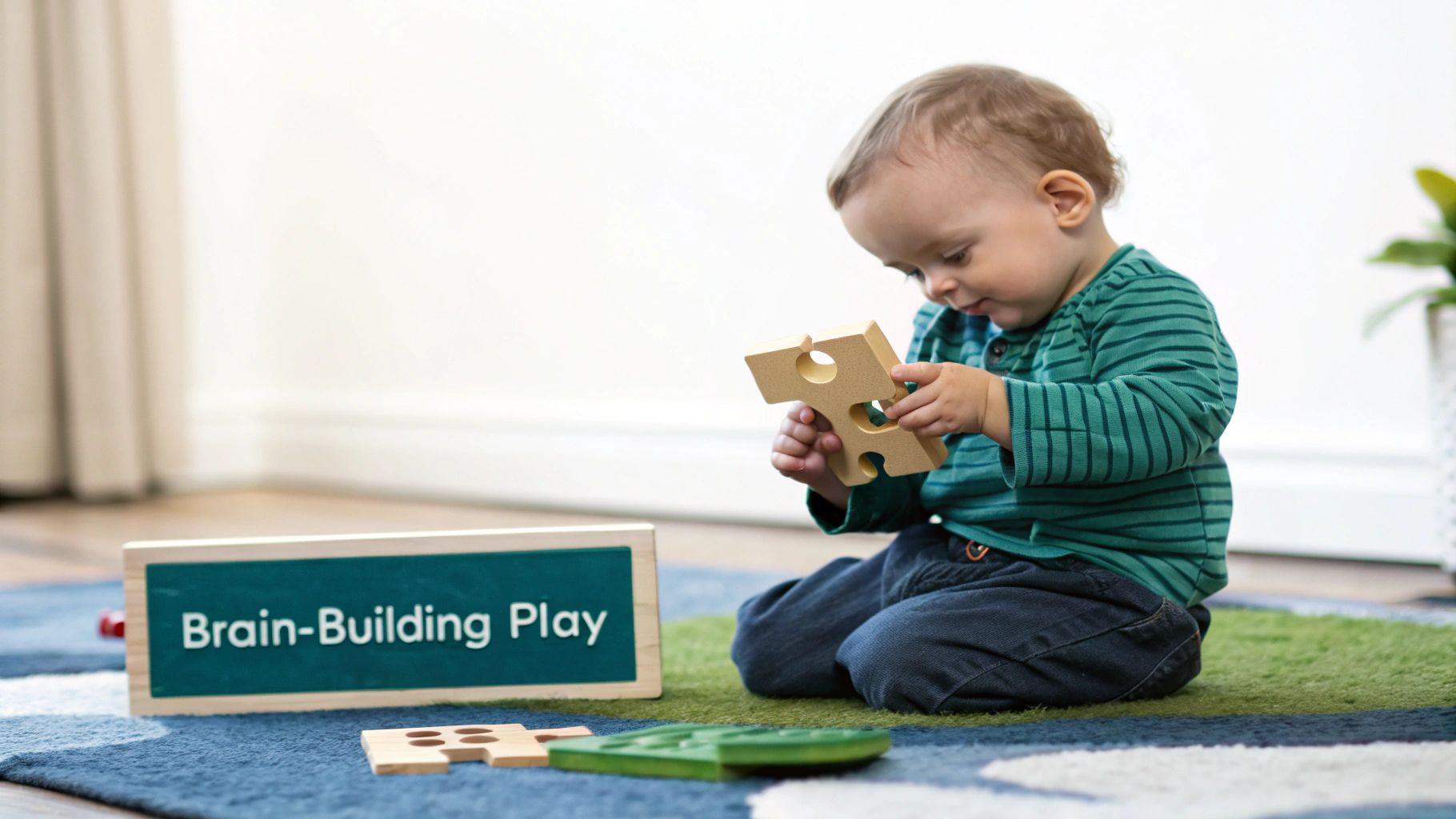
Every single time your toddler interacts with a puzzle, they are forging new developmental pathways. That simple action of grabbing a wooden knob or a chunky animal shape isn't just play; it’s practice for skills they'll use for the rest of their lives.
These early experiences are incredibly important. Research from top UK universities, including Birkbeck and King's College London, has found that cognitive abilities measured as early as 12 months can be linked to developmental outcomes later in childhood.
What this means is that the focused playtime you're encouraging right now has a real, tangible impact on their future ability to learn. For parents wanting to give their child a brilliant start, puzzles are one of the best places to begin.
Core Skills Your Toddler Develops With Puzzles
The benefits of bringing puzzles into your home at this young age are huge, touching on physical, cognitive, and even emotional development. You can dive deeper into the key stages of cognitive development in early childhood in our detailed guide.
Let's take a look at the core developmental benefits puzzle play offers your one-year-old.
Key Developmental Benefits of Puzzle Play
| Skill Area | How Puzzles Help | Real-World Example |
|---|---|---|
| Fine Motor Skills | The 'pincer grasp' – using the thumb and forefinger – gets a great workout, strengthening hand and finger muscles. | This is the same grip they’ll eventually use to hold a pencil or button up a coat. |
| Hand-Eye Coordination | Their brain, eyes, and hands have to team up to guide a piece into its correct space. | It's the foundation for catching a ball, stacking blocks, or using a spoon. |
| Problem-Solving | When a piece doesn't fit, they learn to turn it or try another spot. This is their first lesson in trial and error. | They start to understand that if one approach doesn’t work, they can try another. |
| Shape & Colour Recognition | Puzzles introduce basic shapes (circles, squares) and colours in a fun, hands-on way. | They begin to categorise the world around them – "the red car," "the round ball." |
| Patience & Focus | Completing a puzzle requires concentration and persistence, building their attention span over time. | This focus helps them sit and listen to a story or finish a meal. |
Essentially, puzzles are a fantastic, screen-free way to help your little one build a whole range of foundational skills that will serve them well as they grow.
- Fine Motor Skills: Using that pincer grasp to pick up a peg or knob is brilliant for strengthening the small muscles in their hands and fingers. This is exactly what they need to get ready for tasks like holding a crayon.
- Hand-Eye Coordination: Your child's brain, eyes, and hands all have to work together to guide a puzzle piece into the right slot. This coordination is fundamental for just about everything, from stacking blocks to eating with a spoon.
- Problem-Solving: What happens when a piece doesn’t fit? Your toddler learns to rotate it, flip it, or try a different one. This is their very first introduction to logical thinking and the concept of trial and error.
Puzzles teach cause and effect in a very tangible way. When a piece finally clicks into place, it gives immediate, positive feedback. That simple success builds confidence and encourages them to keep trying, teaching them that putting in the effort leads to a rewarding result.
If you’re looking for more great gift ideas that support this kind of learning, you can find some excellent toddler birthday present ideas that delight and develop.
Choosing Your Toddler's First Puzzles
Picking out the very first puzzles for your one-year-old might feel like a big deal, but it’s actually simpler than you think. The trick is to match the puzzle to where they are right now in their development. You're not looking for a brain-teaser; you're looking for a toy that builds their confidence and helps them practise their newest skills.
Think of it like choosing their first pair of shoes. You want a perfect fit that supports them as they learn to walk, not one they have to struggle with. In the same way, the right puzzle gives just enough support to help them master new physical and cognitive steps. For a young toddler, that feeling of success is the best motivator there is.
Start with Simple, Graspable Pieces
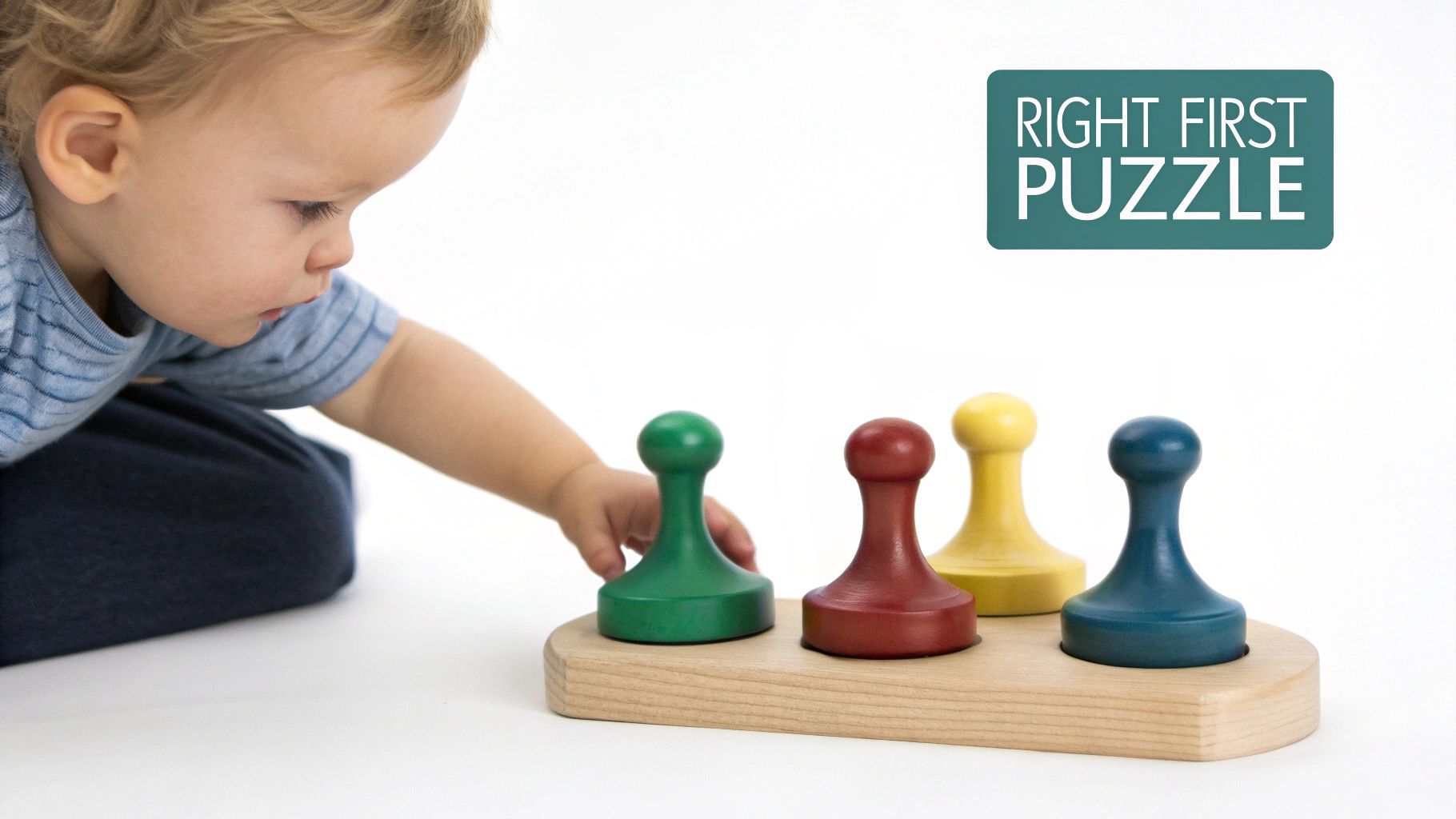
The best puzzles for one-year-olds have big, easy-to-handle pieces. Their little hands are still working on building the strength and coordination needed for precise movements. That’s why puzzles with knobs, pegs, or chunky pieces are the perfect place to start—they’re designed for the way a toddler naturally grabs things.
These simple puzzles are more than just a bit of fun. They’re built to encourage the pincer grasp, which is the ability to pick up an object between the thumb and forefinger. Believe it or not, this is a monumental step in their fine motor development.
Here are the most common and effective types of first puzzles for this age:
- Knob Puzzles: These have large wooden knobs on each piece, making them incredibly easy for tiny hands to pick up and place. They are absolutely brilliant for developing that crucial pincer grasp.
- Peg Puzzles: Very similar to knob puzzles, but these have smaller, peg-like handles. They ask for a bit more precision, offering a gentle step up in difficulty once your child has mastered the knobs.
- Chunky Puzzles: The pieces here are thick enough to stand on their own and fit into a matching recessed space. Their solid, substantial size is great for building hand strength and early spatial awareness.
The goal for a first puzzle isn't about getting it right; it's about exploration. Success is your child simply picking up the pieces, trying to fit them into the slots, and learning through touch and a bit of trial and error. Every single attempt is building valuable connections in their brain.
Matching Puzzle Types to Skills
Each type of puzzle offers a slightly different developmental nudge. Knowing the difference helps you pick something that aligns perfectly with what your little one is working on right now. A knob puzzle, for instance, is fantastic for refining their finger control, while a chunky puzzle is brilliant for learning about shapes in a more three-dimensional, hands-on way.
The best way forward? Just watch your child. Can they already pick up small snacks with their thumb and finger? A knob or peg puzzle would be a great fit. Do they love stacking blocks? A chunky puzzle would really appeal to their desire to build and handle solid objects.
This approach fits into a wider strategy for picking truly valuable developmental toys. It helps to think of puzzles as just one tool in a bigger learning toolkit. If you’re curious, you can explore more ideas on finding the best educational toys for 1-year-olds.
Thinking beyond just puzzles can create a really well-rounded play experience for them. For more insights, check out our guide on the best educational toys for a 1-year-old. By starting with simple, single-shape puzzles, you set your child up for a positive, rewarding experience that will make them excited to take on more complex challenges down the road.
What to Look for in Safe Toddler Puzzles
When you're choosing puzzles for a one-year-old, safety is the number one priority. It's an absolute non-negotiable. At this age, everything—and I mean everything—goes straight into their mouths, so every toy has to be ready for some serious hands-on (and mouth-on) investigation. Think of it like a mini safety audit where every single detail counts.
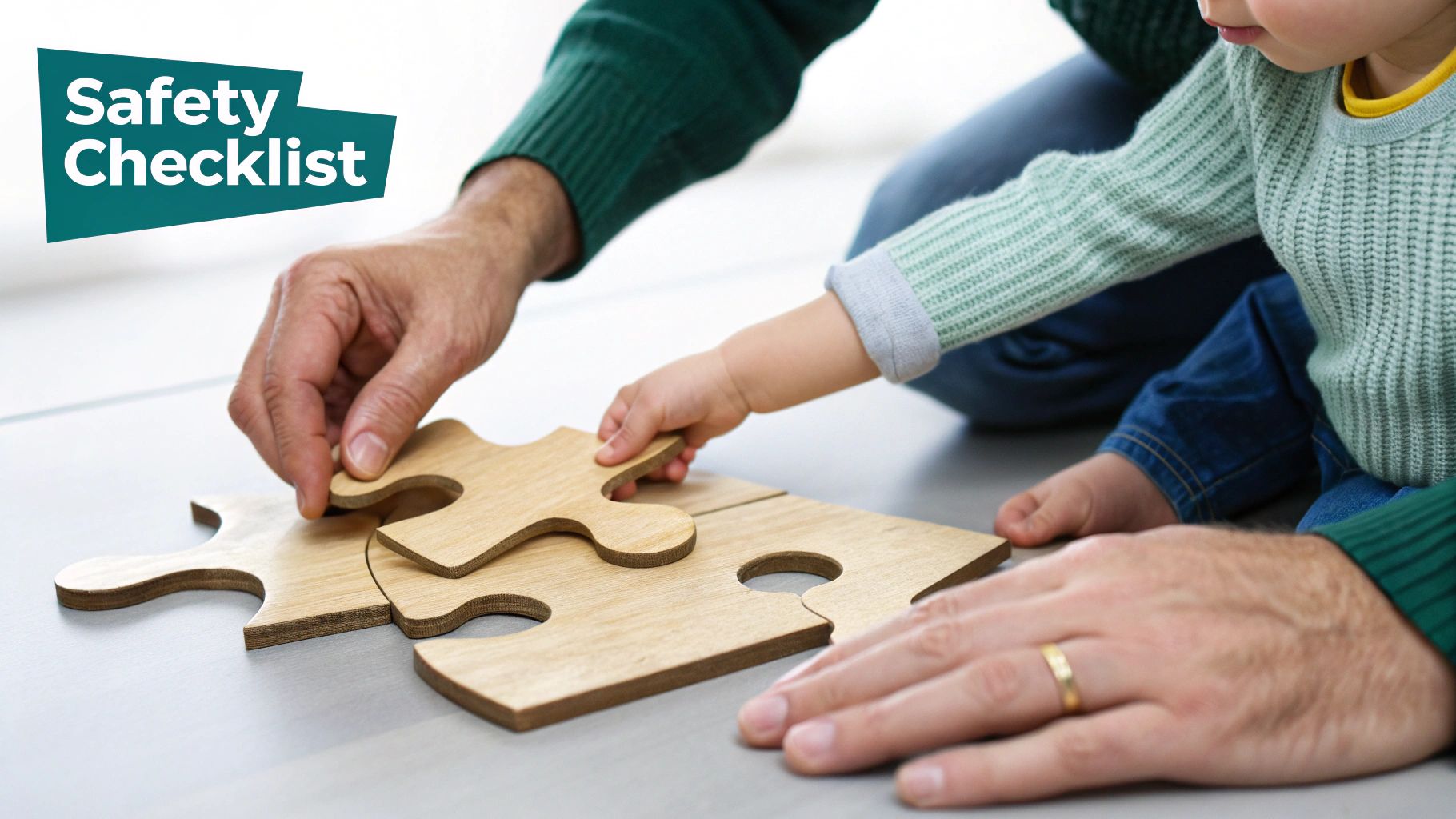
The most crucial safety check? The size of the pieces. Every single part of the puzzle must be big enough that it can't be swallowed or become a choking hazard. There's a brilliant, simple home test for this: if a piece can fit through the centre of a toilet roll tube, it's too small. It’s a quick check that gives you instant peace of mind.
You'll also want to pay close attention to how well the puzzle is made. Run your fingers over every edge of the board and the pieces. You're looking for a completely smooth finish, with no rough patches, sharp corners, or nasty splinters waiting to happen, especially on wooden toys.
Materials and Certifications Matter
The stuff a puzzle is made of is just as important as its size and shape. Since it's a given your toddler will try to chew on the pieces, you need to be certain they are completely non-toxic and safe.
Here's a quick checklist of what to look for on the label or product description:
- Non-Toxic Finishes: All paints, inks, and varnishes should be certified non-toxic and water-based.
- Safe Materials: Go for puzzles made from solid wood (ideally from sustainable sources) or high-quality, BPA-free plastics.
- Sturdy Construction: The puzzle should feel solid and durable. Pieces shouldn't snap easily, and if there are knobs or pegs, give them a little tug to make sure they're firmly attached.
A key thing to look for when you're shopping is the UKCA or CE mark. These symbols are your guarantee that the toy has been tested against the strict safety standards for sale in the UK and Europe. It's a clear signal that the puzzle is free from harmful chemicals and has been designed with a child's safety at its core.
Getting into the habit of running through these quick checks means puzzle time can be fun, educational, and completely worry-free. Choosing the right puzzle is a huge part of finding the best toys for a 1 year old that perfectly balance safety with developmental fun.
How to Introduce Puzzles and Encourage Play
The way you introduce a puzzle to your one-year-old can make all the difference. It can be a moment of joyful connection or a quick spiral into frustration. The secret isn't to teach them how to solve it, but to become their gentle guide and supportive play partner. Think of yourself as the narrator of their discovery, not the director of the show.
Your job is to create a warm, encouraging space where they feel safe enough to explore. Start by getting down on the floor with them, with just one puzzle. You could slowly take out a single piece, saying something simple like, “Look, a circle!” Then, guide it back into its spot, making a little sound as it fits. This shows them the goal without a hint of pressure.
Setting the Stage for Success
The right environment can make a huge difference. A quiet, calm space, away from the background noise of the TV or a mountain of other toys, helps your little one focus their full attention on the task at hand.
When you first offer the puzzle, try leaving just one or two empty slots. Having most of the pieces already in place makes the challenge feel less daunting. When they place that final piece, they get an immediate sense of accomplishment. It’s a small win that builds major confidence.
Your goal is to scaffold their learning. This just means providing just enough support to help them succeed without taking over. You might turn a piece the right way for them, then let them do the final push to pop it in. Always celebrate their effort, not just the success.
Guiding Without Taking Over
It's so tempting to jump in and show your child the "right" way, but the real learning happens when they're allowed to experiment. If they're trying to jam a piece into the wrong spot, take a breath and resist the urge to correct them straight away.
Instead, try using simple, guiding language:
- Narrate what they’re doing: "You're trying to put the star in that spot. Hmm, it doesn't seem to want to fit. What if we try turning it?"
- Offer gentle physical help: If they’re really stuck, you can lightly tap the correct slot with your finger and ask, “What about over here?”
- Model your own thinking out loud: Pick up a piece yourself and say, "Is this the right way? No. Let's try turning it this way. Ah, there it goes!"
This approach doesn't just solve the puzzle; it teaches them resilience and how to think through a problem.
Handling Frustration and Short Attention Spans
Let's be realistic: frustration is a totally normal part of learning. The same goes for a one-year-old’s famously short attention span. When you see them getting discouraged or looking away, it’s simply a signal to change things up, not to push harder.
If they're getting frustrated, acknowledge their feelings. "This puzzle is a bit tricky, isn’t it?" is all it takes. From there, you can either offer a bit more help or simply decide it’s time for a break. Forcing them to finish will only build a negative feeling around puzzles.
It also helps to keep puzzle time feeling fresh. A toy rotation system works wonders here. Keep a few puzzles out and store the rest away, swapping them every week or two. This simple trick makes an old puzzle feel brand new and exciting again.
This kind of back-and-forth, stimulating play is incredibly powerful. In fact, studies on early cognitive stimulation have found that activities like interactive play and reading are linked to significant gains in problem-solving and communication skills. You can read the complete research about infant cognitive stimulation for a deeper dive.
Matching Puzzles to Your Child's Growth
A one-year-old’s world changes at a dizzying pace. The skills a baby has at 12 months feel like a lifetime away from what they can do at 22 months, and the puzzles they play with should keep up.
It’s all about finding that sweet spot. If a puzzle is too simple, they'll get bored and wander off. If it's too difficult, frustration takes over, and the puzzle gets abandoned. The goal is to offer a “just right” challenge that builds their confidence and keeps them engaged. Think of it like a developmental roadmap; you wouldn't ask a baby to run before they can crawl, and puzzles follow the same logic. Choosing the right puzzle means meeting them exactly where they are.
This visual guide helps map out how puzzle complexity can grow with your child from 12 to 24 months.
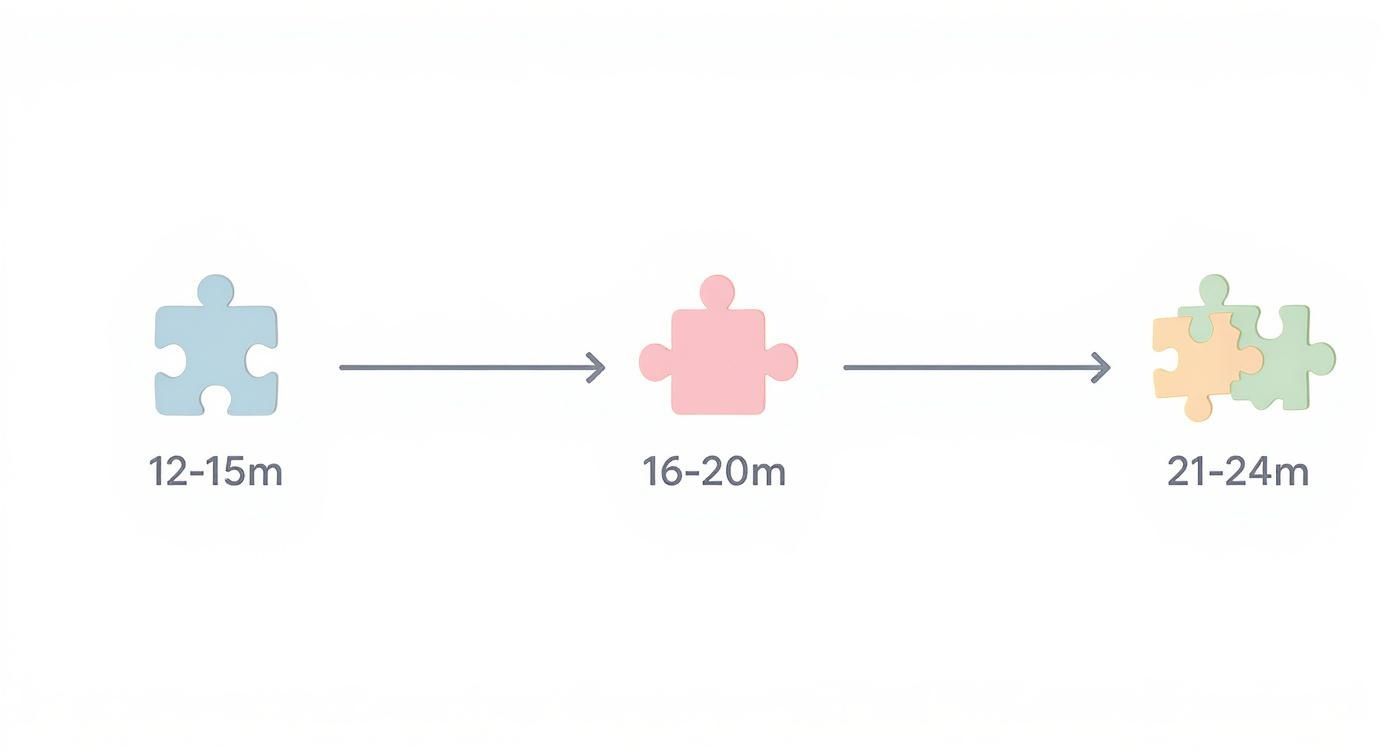
As you can see, the journey starts with simple, single-piece puzzles and gradually moves towards multi-piece jigsaws as their coordination and thinking skills blossom.
To help you find that "just right" puzzle, here’s a breakdown of what to look for at each stage of your one-year-old's development.
Puzzle Progression from 12 to 24 Months
This table provides a quick guide to matching puzzle types with the developmental leaps your child is making.
| Age Range (Months) | Typical Milestones | Recommended Puzzle Type |
|---|---|---|
| 12–15 | Mastering grasp-and-release, exploring with hands | Single-piece knob, chunky, or inset puzzles |
| 16–20 | Improving hand-eye coordination, starting to match shapes | Puzzles with 3-5 distinct chunky or knob pieces |
| 21–24 | Developing finer motor control, understanding part-whole concepts | Simple 2-3 piece jigsaws, more complex shape sorters |
This progression isn’t rigid, of course. Every child is different, but it’s a great starting point for keeping puzzle play both fun and beneficial.
The Budding Explorer: 12 to 15 Months
Right now, your little one is an expert at grabbing things and letting them go. Their main mission is to simply interact with their surroundings, making a single-shape puzzle with a big knob or a chunky piece the perfect first step.
The focus isn’t really on “solving” anything just yet. It’s all about the satisfying clunk of picking up a piece and dropping it into place. A puzzle with just one or two large, clear shapes—like a circle or a square—gives them a clear cause-and-effect win that feels fantastic.
The Developing Problem-Solver: 16 to 20 Months
By this stage, your toddler’s hand-eye coordination has come on in leaps and bounds. They’re starting to grasp the idea that different shapes belong in different slots. This is the perfect time to introduce puzzles with three to five chunky or knobbed pieces, often featuring familiar things like animals or vehicles.
You’ll see them start to use their eyes to guide their hands, matching the shape of the piece to the hole on the board. This trial-and-error process is a huge moment in their cognitive development. It’s problem-solving in its purest form.
A child’s ability to solve problems is a key indicator of their overall development. The simple act of rotating a puzzle piece until it fits is a foundational exercise in logical thinking, persistence, and spatial reasoning.
The Confident Connector: 21 to 24 Months
As they edge closer to their second birthday, many toddlers are ready for a bigger challenge. Their fine motor skills are much more refined, letting them handle pieces with greater precision. It’s the ideal window to introduce simple two or three-piece jigsaws.
These puzzles introduce a brand-new skill: seeing how separate parts click together to form a whole picture. This is a crucial step for developing visual discrimination and understanding part-whole relationships.
Problem-solving is one of five key developmental domains measured in UK children. In fact, government data from 2023-2024 showed that 80.4% of children achieved a good level of development by age two. Manipulative play, like puzzles, is a direct contributor to these positive outcomes. You can explore more about these child development findings on GOV.UK. By offering puzzles that grow with them, you’re actively supporting this critical area of learning.
Got Questions About Toddler Puzzles? We’ve Got Answers.
As you start exploring the world of puzzles with your little one, it's completely normal for questions to pop up. You might be wondering about everything from safety to managing those inevitable toddler frustrations. Let's walk through some of the most common queries we hear from parents just like you.
"My Toddler Keeps Putting Puzzle Pieces in Their Mouth!"
Yep, this is one we see all the time. It’s not just normal; it’s a crucial part of how they learn. For a one-year-old, their mouth is a primary tool for discovery. It’s how they figure out an object's texture, shape, and even its density.
Your job here is all about safety. This is exactly why it’s so important to choose puzzles made from non-toxic, baby-safe materials. And, of course, make sure every piece is large enough that it can’t possibly be a choking hazard.
Instead of a firm "no," try gently redirecting their focus. You could say, "That piece feels interesting, doesn't it?" while guiding their hand back towards the puzzle board. Show them where it fits. This positive approach helps them understand what the puzzle is for without turning it into a battle.
"How Many Puzzles Should My Toddler Actually Have?"
With puzzles, especially for this age group, less is almost always more. Staring at a huge mountain of toys can be overwhelming for a toddler and makes it hard for them to focus on anything for long.
We’ve found that a small, thoughtful selection of three to five puzzles is the sweet spot. The key to keeping them interested is a simple toy rotation.
- Keep a Stash: Store the rest of their puzzles away, out of sight.
- Swap Them Out: Every week or so, bring out a "new" set from storage and put the old ones away.
- Watch What They Love: You'll start to notice which types of puzzles really capture their attention.
This simple system prevents boredom and gives your child the space to really master the puzzles in front of them, which builds concentration and gives them a real sense of pride.
"Are Digital Puzzle Apps a Good Substitute?"
While there are some lovely apps out there, they just can’t replace the real thing for a one-year-old. The real developmental magic happens when their little hands are physically moving and manipulating objects. A flat screen simply can't offer that vital, hands-on experience.
Think about it: the feeling of a chunky wooden piece, its weight, its edges, and the physical act of turning it to slot it into place... that’s what builds real-world skills. This hands-on process is what strengthens fine motor control, develops spatial awareness, and hones hand-eye coordination.
Swiping a finger across glass doesn't engage the same muscles or provide the same rich sensory feedback. For toddlers, the physical interaction is where the most important learning happens.
"What if My Toddler Gets Frustrated and Gives Up?"
First off, frustration is a totally normal—and even healthy—part of learning. How you respond in these moments can teach your child incredible lessons about resilience. The best first step is to simply acknowledge their feelings in a calm voice.
Rather than jumping in to solve it for them, try offering just enough of a helping hand to get them over the hump. We call this scaffolding.
Here’s How to Gently Scaffold Their Play:
- Validate the Struggle: Say something like, "Wow, this is a tricky one, isn't it?" It shows you're on their team.
- Give a Clue: You could turn the piece the right way around in their hand and say, "What if we try it this way? Now you can push it in."
- Make it Easier: If they're really struggling, do most of the puzzle yourself but leave one or two easy pieces for them to place. This lets them end on a successful, confidence-boosting note.
And if they’re truly over it? It’s absolutely fine to say, "Let's take a break and we can try again later." Pushing them will only create a negative feeling around puzzles. The real goal is to foster a love of trying, not to force them to finish every single time.
Ready to find the perfect, developmentally-appropriate puzzles for your little one? The Grow With Me subscription box delivers beautiful, stage-based play kits right to your door, taking the guesswork out of choosing the right toys. Each box is curated by experts to support your child’s growth. Explore our play kits and start your journey today.