
UK Guide to the Best Toys for 1 Year Olds
When it comes to the best toys for a one-year-old, you really can't beat the classics. Things like wooden blocks, stacking rings, and shape sorters have stood the test of time for a reason. They're fantastic tools for building crucial skills like problem-solving and motor control, proving that simple, engaging toys often do far more for development than flashy, single-purpose gadgets.
Finding the Perfect Toy for Your 1 Year Old
Welcome to the wonderfully chaotic world of toddler playtime! Your little one’s first birthday is more than just a party; it’s a huge developmental leap. They’re officially moving out of babyhood and into a whirlwind phase of curiosity, movement, and discovery. During this time of incredible growth, play isn't just for fun—it’s how they learn.
The right toys are powerful tools that help your one-year-old figure out the world around them. Think of them as the building blocks for life skills, from the fine motor control they need to eventually hold a crayon to the cognitive jumps required to solve their first simple puzzle. This guide is here to help you choose toys that are not only fun but also perfectly suited to their developmental stage.
Why Thoughtful Toy Selection Matters
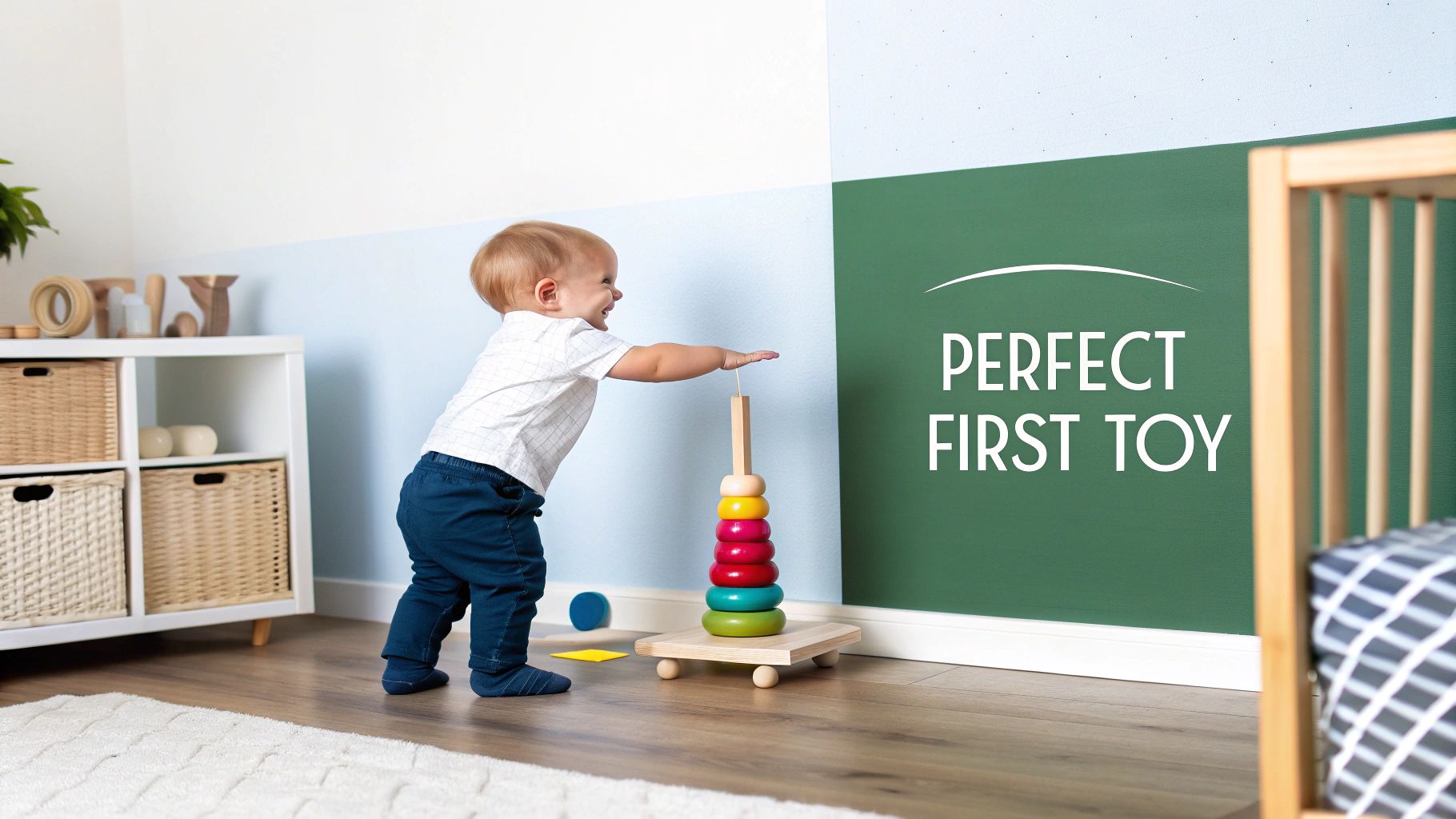
Picking the best toys for a one-year-old is about more than just grabbing something bright and colourful off the shelf. It’s about understanding what they’re trying to learn and how different kinds of play can support that journey.
A thoughtfully chosen toy can make a real difference:
- Boost Motor Skills: Toys like push-along walkers and chunky blocks are brilliant for building strength and coordination in their larger muscles (gross motor skills). Meanwhile, shape sorters and stacking toys help them master the delicate movements of their hands and fingers (fine motor skills).
- Encourage Problem-Solving: Simple puzzles and nesting cups introduce early concepts like size, space, and cause-and-effect. These are the very first steps on their path to becoming a little problem-solver.
- Spark Imagination: Believe it or not, pretend play is already starting to blossom. A simple toy phone or a set of soft animals can be the launchpad for their first forays into imaginative worlds.
- Support Language Development: Toys that encourage you to interact together, like picture books or a basic musical instrument, create wonderful opportunities to chat, introduce new words, and make sounds together.
The most effective toys are those that require your child to be an active participant. Instead of entertaining passively, these toys invite exploration, experimentation, and creativity, allowing your child to be in control of their play.
To give you a head start, the table below provides a quick snapshot of some of the most beneficial toy categories for one-year-olds and the primary skills they help foster. You can use this as a handy reference before we dive deeper into each type, making sure your next toy purchase is a meaningful one.
Top Toy Categories for 1-Year-Olds and Their Developmental Benefits
This table quickly summarises the most effective toy types for one-year-olds and the primary skills each category helps to develop.
| Toy Category | Primary Skill Development | Example Toy |
|---|---|---|
| Building & Stacking | Fine Motor Skills, Spatial Awareness, Problem-Solving | Wooden Blocks, Stacking Rings |
| Push & Pull Toys | Gross Motor Skills, Balance, Coordination | Push-Along Walker, Toy Wagon |
| Puzzles & Sorters | Problem-Solving, Hand-Eye Coordination, Shape Recognition | Shape Sorter, Knob Puzzles |
| Sensory Toys | Tactile Exploration, Cause-and-Effect, Auditory Skills | Textured Balls, Simple Xylophone |
| Pretend Play | Social-Emotional Skills, Imagination, Language | Soft Dolls, Toy Phone |
Now that you have a general overview, let's explore these categories in more detail to find the perfect fit for your little one.
Your 1-Year-Old’s Big Developmental Leaps
Watching a one-year-old figure out the world is one of the most amazing things you'll ever see. It might look like they're just playing, but what's really happening is a period of incredible brain growth. Every single thing they do—every shake, rattle, and roll—has a purpose. To pick the absolute best toys for your little one, it helps to understand the incredible work going on behind the scenes.
Think of it like building a house. They’re busy laying the foundations for absolutely everything that will come later. Their cognitive skills are the blueprints, motor skills build the framework, language is the wiring that connects it all, and their social skills are the welcoming front door. Each part is connected, and the right toys are the perfect tools for the job.
Cognitive Growth and Problem-Solving
Your one-year-old is basically a tiny scientist, constantly running little experiments to see how things work. This is the start of their cognitive development, which covers everything from memory and focus to their first stabs at problem-solving. They’re getting to grips with cause and effect—"If I push this button, it makes that funny noise!"
They’re also finally cracking the code on object permanence, the big idea that things still exist even when they can't see them. This is exactly why a simple game of peek-a-boo is the most exciting thing ever. They are genuinely amazed and delighted when your face pops back into view!
Key cognitive skills you’ll spot at this age include:
- Exploring objects in all sorts of new ways: Shaking, banging, and, of course, throwing.
- Finding hidden things with ease: That toy you partially hid under a blanket? No longer a mystery.
- Starting to use things correctly: You might see them try to brush their hair with a toy brush or hold a toy phone to their ear.
Mastering Motor Skills
At one, your child is taking huge strides in both their big and small movements. Gross motor skills are all about the large muscles in their arms, legs, and tummy, powering those big actions. They might be pulling themselves up to stand, cruising along the sofa, or even taking those first wobbly steps.
At the same time, they're fine-tuning their fine motor skills, which need those small, precise movements in their hands and fingers. The clumsy fist-grip from a few months back is turning into a much more controlled pincer grasp, where they can pick up a tiny crumb between their thumb and forefinger.
This hand-eye coordination is a massive achievement. When your little one successfully places a single ring onto a stacking post, they're practising focus, control, and spatial awareness all in one go.
This is a really important time for them to build physical confidence. For a closer look at these crucial steps, you can explore our guide on what developmental milestones are and what they really mean for your child's journey.
The First Words and Conversations
While they might only have a few words like "mama" or "dada," your one-year-old's language skills are developing at a lightning pace. They understand so much more than they can say and are constantly soaking up the sounds, rhythms, and tones of your voice.
Long before the words start flowing, they use gestures to get their point across. Pointing at what they want, waving "bye-bye," and shaking their head for "no" are all huge communication milestones. When you respond to these gestures, you’re teaching them their actions have meaning, which just encourages them to communicate even more.
Social and Emotional Beginnings
Your little one is also starting to make sense of the social world around them. They’re becoming more aware of themselves and others, which is the very foundation for their social and emotional development. One of the main ways they learn is by copying you. They'll imitate your gestures, sounds, and actions, whether it’s clapping when you clap or babbling into a toy phone right after you've been on a call.
This is also when they begin to show clear preferences for certain people and toys. When they hand you a book or a favourite teddy, it's their first go at shared play—a simple but profound way of connecting with you. By encouraging these early social signals, you're nurturing their ability to form relationships and understand feelings.
Your Essential Checklist for Safe and Durable Toys
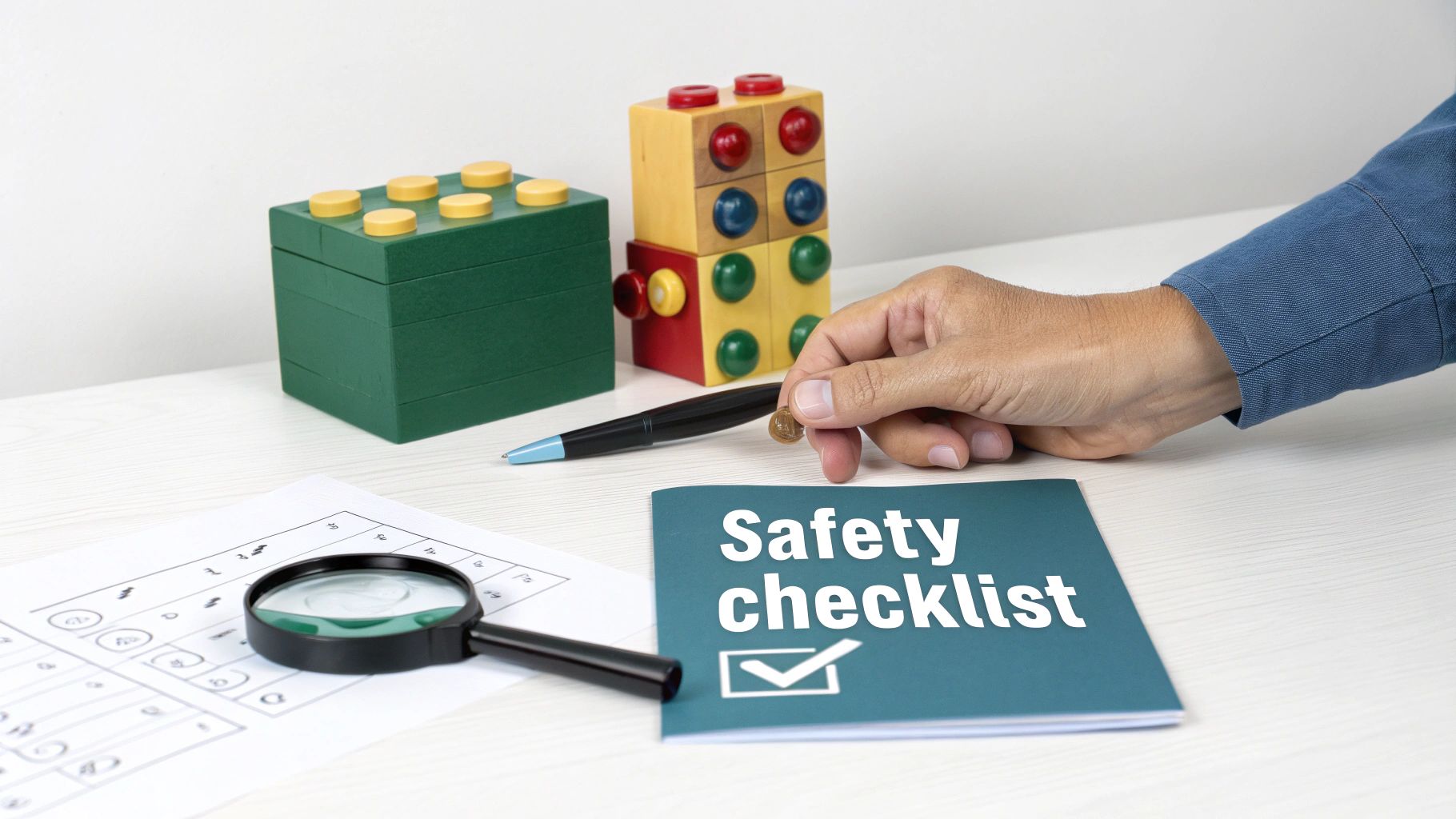
When you're on the hunt for the perfect toy for a one-year-old, nothing matters more than safety. Absolutely nothing. At this age, their primary tool for exploration is their mouth, which means every toy that crosses your threshold needs a thorough inspection. It's not just about how fun it is, but how fundamentally safe and sturdy it is.
Think of yourself as a friendly toy detective. Your job is to spot any potential trouble before it even has a chance to become a problem. This simple checklist will give you the confidence to know exactly what makes a toy truly safe and ready to withstand hours of enthusiastic (and let's be honest, often clumsy) play.
Decoding UK Toy Safety Standards
Thankfully, here in the UK, there are big clues to look for right on the packaging: the safety marks. These little symbols are your guarantee that a toy has met strict legal safety standards.
- The CE Mark: This shows the toy meets the essential safety requirements set out across the European Union.
- The UKCA Mark: After Brexit, the UK introduced its own UK Conformity Assessed (UKCA) mark. It confirms the toy complies with the specific safety rules for Great Britain.
For the time being, you might see either or both marks on a toy. Spotting at least one is your first green light. It’s the manufacturer’s declaration that the product is safe for its intended age group.
A safety mark is a complete non-negotiable. If you can't find a genuine CE or UKCA mark, it’s best to leave that toy on the shelf. This is especially important when you’re shopping on online marketplaces where sellers might not be following UK regulations.
This focus on safety is a massive driver in the UK's £3.9 billion toy market. Industry guidance always highlights that toys for this age must be lightweight, easy for little hands to hold, and completely free of small parts that could be a choking hazard. This extends to materials, too, with a growing number of UK parents—about 20% at last count—making sustainability a priority. You can dig deeper into these trends and more by checking out these insights on UK toy market growth.
Your Hands-On Inspection Checklist
Beyond the official marks, a quick physical check tells you so much. Before you buy a toy or hand it over to your little one, run through this mental checklist:
-
The Small Parts Test: Choking is the biggest risk for one-year-olds. An easy rule of thumb is the toilet paper tube test. If any part of the toy, or any piece that could potentially break off, fits inside a standard loo roll tube, it's too small and poses a danger.
-
Check for Sharp Edges and Points: Run your hands all over the toy. Can you feel any sharp points, rough patches, or splinters? This is particularly important for wooden toys. A quality toy will always be smooth and well-finished.
-
Confirm Non-Toxic Materials: Babies put everything in their mouths. Check that any paints or finishes are clearly labelled as non-toxic and child-safe. For plastic toys, look for a BPA-free label to be sure you're avoiding unwanted chemicals.
-
Assess Durability and Construction: Give the toy a gentle tug and a little twist. Does it feel solid? Check that parts are securely attached—think wheels on a toy car or the eyes on a teddy bear. For soft toys, the seams should be stitched tightly to keep the stuffing safely inside.
-
Beware of Cords and Strings: Any strings or cords on a toy need to be very short to avoid any risk of strangulation. A good guideline is that anything longer than 15cm (about 6 inches) is a potential hazard for a child this young.
Making this checklist second nature means you can create a truly safe play space where your little one can explore and learn without you having to hover and worry. It’s peace of mind, ensuring every new toy is a secure and reliable friend on their big adventure.
Top Toy Categories That Fuel Your Child's Growth
You don't need a mountain of toys to help your one-year-old learn and grow. In fact, it's quite the opposite. Focusing on a handful of key categories gives them a brilliant, well-rounded toolkit for development. Think of each type of toy as a different key, unlocking specific skills and new ways of thinking.
It’s a bit like stocking a kitchen. You don't need every single gadget under the sun, but a good knife, a sturdy pan, and a reliable mixing bowl will see you through most recipes. In the same way, a thoughtfully chosen collection from these core categories will support almost every aspect of your child’s growth, from their first wobbly steps to their earliest problem-solving wins.
Building Blocks and Stacking Toys
At the heart of any great toy box, you’ll find building blocks. These simple, open-ended toys are the absolute foundation for learning. When your little one picks up a chunky wooden block, they're not just playing; they're practising their fine motor skills. When they try to stack one on top of another, they're running their own mini-physics experiment in balance and gravity.
This simple act of stacking and building teaches some big concepts:
- Spatial Awareness: They start to get a real feel for how objects fit together in space.
- Problem-Solving: "Why does my tower keep falling over?" is one of their very first engineering challenges.
- Cause and Effect: And let's be honest, pushing the tower over to watch it crash is a brilliant lesson in action and reaction!
Classic stacking rings and nesting cups work in a similar way. They introduce early maths concepts like size, order, and sequence in a hands-on, intuitive fashion that just makes sense to a toddler.
Push and Pull Toys
Just as your one-year-old is getting more mobile, push and pull toys become their perfect partners in crime. A sturdy wooden walker or a simple pull-along duck isn't just making a fun noise; it’s giving them crucial support and motivation as they get determined to stay on their feet.
These toys are absolute champions for gross motor development. They encourage cruising, walking, and balancing, giving your child the physical confidence they need to explore their world. Pushing a walker builds their core strength and coordination, while pulling a toy on a string challenges their balance and teaches them how to navigate around the sofa leg.
A push-along toy is like a trusted sidekick on their quest for independence. It offers just enough stability to turn tentative shuffles into confident strides, transforming the living room into an exciting new landscape to conquer.
Shape Sorters and Simple Puzzles
Shape sorters are a fantastic, hands-on introduction to problem-solving. The task seems so straightforward to us: fit a shape into its matching hole. But for a one-year-old, this is a complex mental puzzle involving trial and error, shape recognition, and hand-eye coordination.
They learn to twist and turn a star block until it finally aligns with the star-shaped hole, a process that builds persistence and logical thinking from the ground up. Early puzzles, especially those with chunky knobs, help refine the pincer grasp and teach them how to match an object to its picture. These are some of the first toys where your child has to really think before they act, laying the groundwork for more complex challenges ahead.
Sensory and Musical Toys
A one-year-old’s brain is wired to learn through its senses. That’s why toys that engage touch, sight, and hearing are so incredibly powerful. This can be as simple as a set of textured balls with different bumps and ridges, or a board book with tactile fuzzy patches. Exploring these different textures helps build new neural pathways in their rapidly developing brain.
Musical toys, like a simple xylophone or a set of shakers, introduce cause and effect in the most joyful way. They quickly discover that banging a key creates a sound, teaching them that their actions can make things happen in their environment. Our guide on sensory toys for babies dives deeper into why these experiences are so fundamental to early learning.
This growing appreciation for high-quality developmental toys is something we're seeing across the UK. The toy retailing industry now includes approximately 1,595 specialised businesses, a number that has grown by 7.4% annually in recent years. This shift is driven by parents looking for age-appropriate toys that do more than just entertain, with items like walkers and activity toys consistently topping sales charts. Discover more insights about the growth of the UK toy sector at IBISWorld. For a comprehensive look at products designed specifically for little ones, exploring a specialised kids' collection can offer some wonderful ideas.
How to Structure Simple and Engaging Play Sessions
So you've gathered some great toys for your one-year-old. That's a brilliant start. But the real magic happens when you know how to weave them into your daily rhythm. Structuring playtime doesn't mean creating a rigid, minute-by-minute schedule. Far from it. It's about creating a simple, flexible framework that your toddler can rely on, helping them feel secure enough to explore.
Think of it like planning meals. You wouldn't serve the same thing every day. You mix it up to provide balanced nutrition. Play is the same. Some sessions are for burning off energy, others are for quiet focus. This way, you can tailor playtime to your child's mood and energy levels, giving them a well-rounded "diet" of playful learning.
This diagram shows just how different types of play connect and branch out, all starting from that one central point: your child's curiosity.
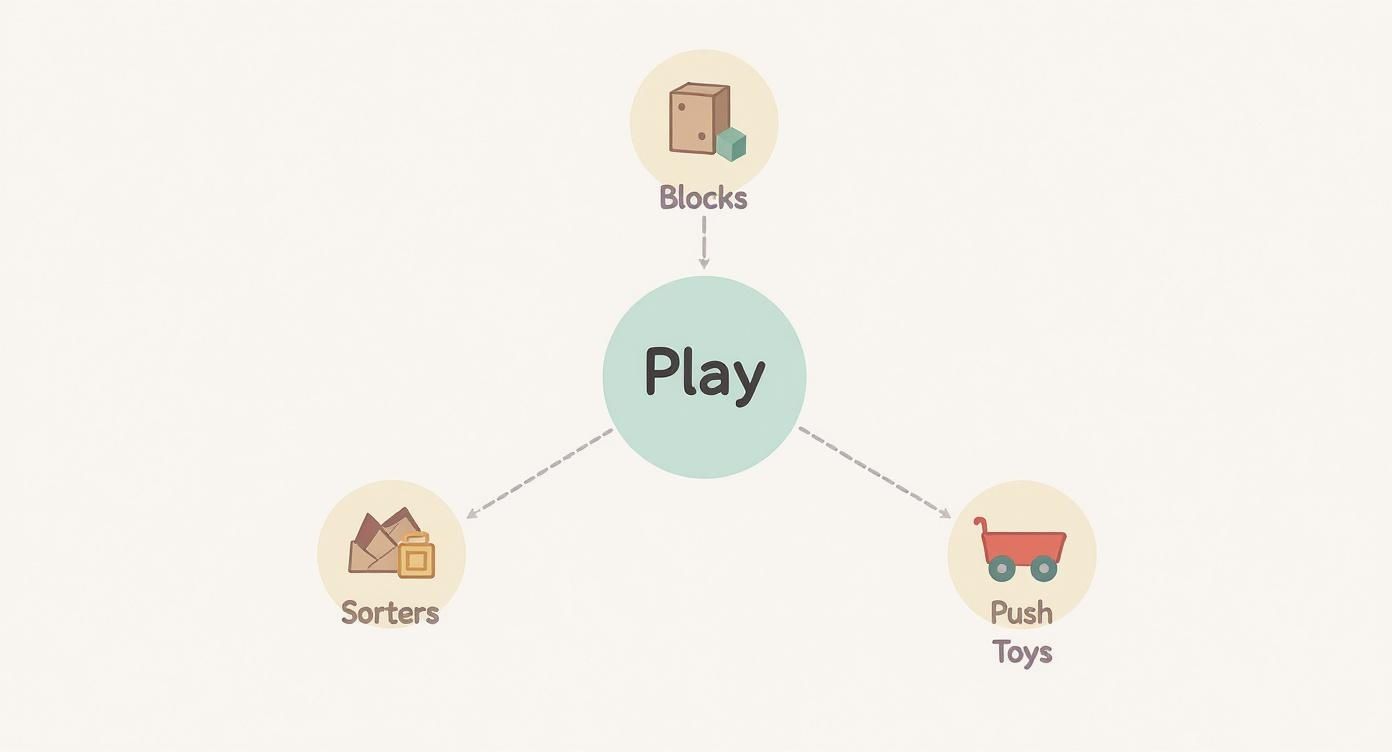
From stacking blocks to pushing a walker, each activity offers a unique pathway for them to learn about their world and what their body can do.
To help you get started, here are a few simple session plans you can adapt. Think of them as recipes—you can follow them exactly or swap out ingredients based on what you have and what your little one enjoys.
Sample Play Session Plans for a 1-Year-Old
| Session Type | Objective | Example Toys | Activity Ideas |
|---|---|---|---|
| Active & Energetic | Encourage gross motor skills, balance, and coordination. | Push-along walker, soft ball, pull-along toy. | Clear a safe space and encourage them to push their walker to "deliver" a teddy to the sofa. Sit on the floor and roll a ball back and forth. |
| Quiet & Focused | Develop fine motor skills, hand-eye coordination, and problem-solving. | Shape sorter, chunky knob puzzle, stacking rings. | Sit together and hand them one shape at a time. Talk about its colour and feel. Guide their hand toward the matching slot and let them feel the success of fitting it in. |
| Creative & Sensory | Stimulate auditory and tactile senses and spark early imagination. | Simple xylophone, shakers, tactile board books. | Tap out a simple rhythm on a xylophone and see if they copy you. Read a board book with different textures, running their fingers over the fuzzy or bumpy patches. |
These are just starting points, of course. The best play sessions are the ones that follow your child’s lead.
A Blueprint for Active Play
When your little one has the zoomies and is ready to move, it's the perfect time for an active play session. This is all about building those crucial gross motor skills—the big movements—strengthening their muscles and burning off some of that incredible toddler energy in a fun, productive way.
- Suggested Duration: 15-20 minutes
- Objective: To encourage movement, balance, and coordination.
- Example Toys: A push-along walker, a soft ball, or a pull-along toy.
- Activity Idea: Clear a safe space in the living room and place a favourite teddy bear on the sofa. Encourage your child to push their walker over to "give the bear a ride." This simple goal gives their walking practice a fun purpose. Afterwards, sit on the floor and roll a soft ball back and forth to practise coordination.
A Plan for Quiet Time Exploration
After a busy morning or as you're winding down for a nap, a quiet time session is perfect. It helps your child focus their attention and practise those delicate fine motor skills. This is a chance for calm, concentrated play that nurtures their budding problem-solving abilities and patience.
Quiet, focused play is just as important as active play. It's during these moments that your one-year-old learns to concentrate, manipulate objects with precision, and work through their very first mental challenges.
This kind of focused activity is a cornerstone of early learning. For more inspiration, you can discover a variety of engaging play-based learning activities that support this crucial development.
- Suggested Duration: 10-15 minutes
- Objective: To develop fine motor skills, hand-eye coordination, and problem-solving.
- Example Toys: A shape sorter, a chunky knob puzzle, or a set of stacking rings.
- Activity Idea: Sit with your child and hand them one shape from the sorter at a time. Talk about its colour and name ("This is the round, blue circle!"). Gently guide their hand towards the correct hole without doing it for them, letting them feel that little spark of satisfaction when they get it right themselves.
A Session for Creative and Sensory Fun
Creative sessions are all about engaging the senses and sparking early imagination. These activities often involve sound, texture, and simple cause-and-effect, providing rich sensory feedback that helps build new connections in their developing brain. It's less about a specific outcome and much more about the pure joy of exploration.
- Suggested Duration: 10-15 minutes
- Objective: To stimulate auditory and tactile senses and encourage self-expression.
- Example Toys: A simple xylophone, a set of shakers, or tactile board books.
- Activity Idea: Use a xylophone to tap out a simple rhythm and encourage your child to copy you—or just let them bash away! You can sing a simple song while you play. Then, switch to a board book with different textures, guiding their fingers over the fuzzy, bumpy, and smooth patches while you describe how they feel.
Your Top Questions About Toys for 1-Year-Olds Answered
Stepping into the world of toddler toys can feel a bit overwhelming. With so many options and so much advice floating around, it's natural to have questions. We’ve gathered some of the most common queries from parents just like you to give you clear, straightforward answers and help you feel confident in your choices.
How Many Toys Does a 1-Year-Old Actually Need?
It's so easy to get carried away and shower your little one with every toy imaginable, but when it comes to toddlers, less is definitely more. Too many choices can actually overwhelm a one-year-old, causing them to jump from one thing to the next without ever really getting stuck into proper play.
The trick is to focus on quality, not quantity. A thoughtfully chosen collection of around 8-10 versatile, open-ended toys will do far more for their development than a room bursting with single-use gadgets. A great starting point would be a core set of blocks, stacking rings, a ball, a simple push toy, and a few sturdy board books.
A brilliant way to keep things interesting is to try toy rotation. Simply pack away half of their toys and swap them out every few weeks. It’s amazing how this makes old toys feel brand new again, reigniting their curiosity without you having to constantly buy more.
Are Electronic Toys Good for a 1-Year-Old?
You’ll see plenty of electronic toys claiming to be educational, promising to teach your baby the alphabet, numbers, and colours. While the intention is good, they often lead to more passive play, where your child is just watching and listening rather than actively doing. The best toys for this age are the ones that fire up their imagination and encourage hands-on discovery.
That's not to say all electronic toys are off-limits, but it pays to choose them carefully. If you do opt for one, look for something with a simple cause-and-effect feature – like a button that makes a light pop on or plays a quick, gentle sound. The key is to find toys that let your child be in control of the action, rather than ones that just put on a show for them.
Should I Be Concerned About Plastics in Toys?
This is a very real and valid concern, especially since one-year-olds seem to have a knack for exploring absolutely everything with their mouths. When you're looking at plastic toys, always take a moment to check the packaging and labels. You want to see that they are explicitly marked as BPA-free, phthalate-free, and non-toxic.
In the UK, reputable toy makers have to follow strict safety standards, so seeing the UKCA or CE mark on a toy offers a good deal of reassurance. Even so, many parents are finding extra peace of mind by choosing toys made from natural materials. Things like solid wood with non-toxic finishes, food-grade silicone, or organic cotton are all fantastic, worry-free alternatives.
What Is the Best Way to Clean My 1-Year-Old's Toys?
Given that most toys will spend some time being chewed on, regular cleaning is a must. The good news is that keeping them hygienic doesn’t have to be a huge chore.
- Hard plastic or wooden toys: A quick wipe with a cloth using mild soap and water usually does the trick. For a natural disinfectant, a simple mix of equal parts white vinegar and water works wonders. Just be sure to let them air dry completely before they go back into the toy box.
- Soft, fabric toys: Always check the care label first, but most plush toys can be popped into a mesh laundry bag and washed on a gentle cycle in the machine.
- Teething toys: Silicone teethers can often be sterilised in boiling water or a steam steriliser, ensuring they are perfectly clean and safe for your little one’s gums.
Feeling like you're spending too much time searching for the perfect developmental toys? The Grow With Me subscription box offers a simpler way. We deliver thoughtfully curated, age-appropriate play kits right to your door. Each box is designed by experts to support your child's learning at exactly the right stage with beautiful, high-quality toys.
Explore the Grow With Me play kits today and make playtime meaningful and effortless.