
A Parent’s Guide to Montessori Toys for 3 Year Olds
The best Montessori toys for 3-year-olds are beautifully simple tools that spark curiosity and build real skills. Forget flashy electronic gadgets; think more along the lines of wooden stackers, child-sized practical tools, and straightforward puzzles that invite your child to focus, explore, and solve problems on their own terms.
What Makes Montessori Toys Different for a 3-Year-Old?
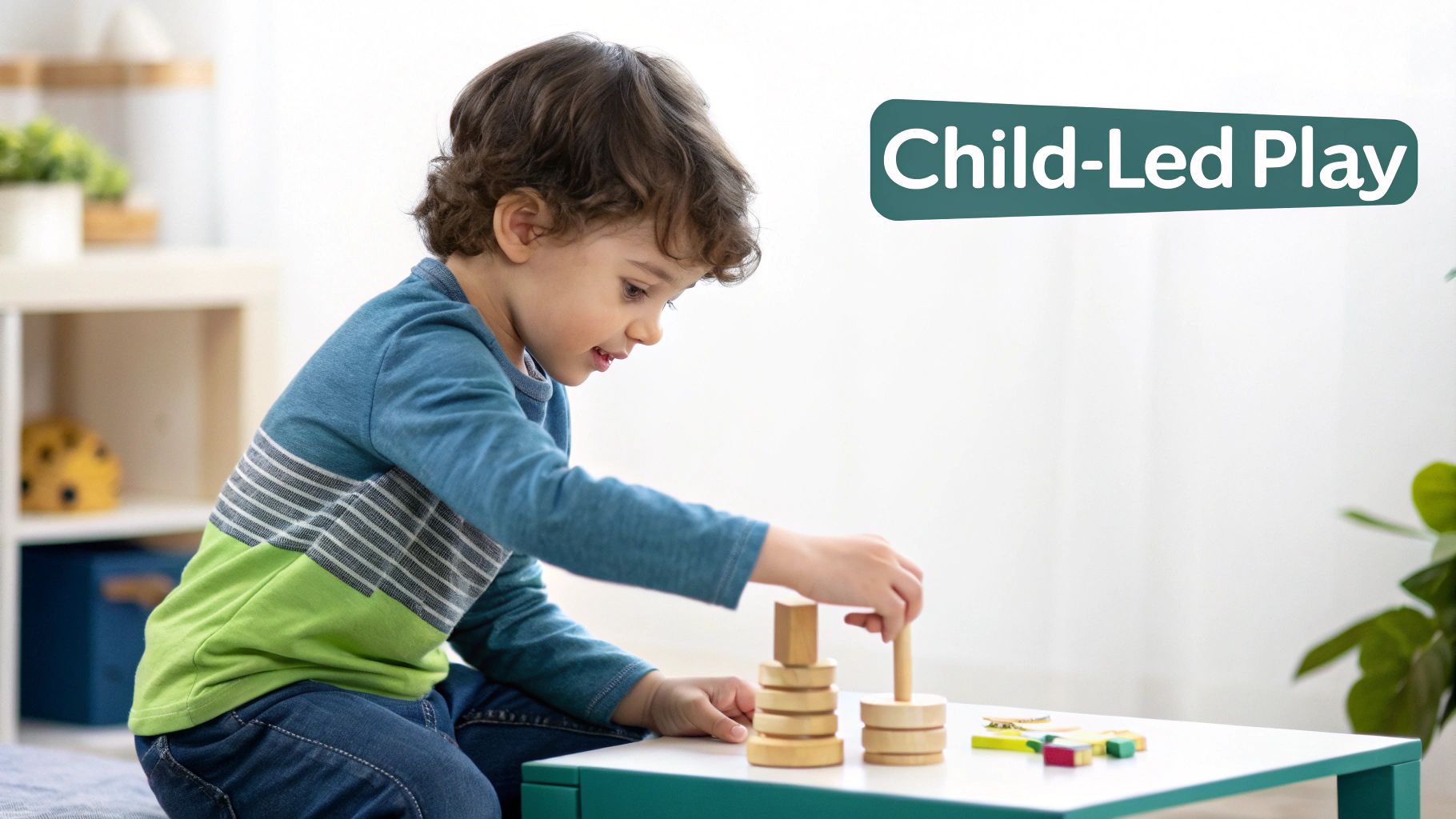
Have you ever watched a three-year-old become utterly fascinated by the cardboard box, completely ignoring the noisy, flashy toy that came inside it? That’s because their natural instinct is to explore and create, not just be entertained. The Montessori approach gets this completely.
In a Montessori world, toys aren’t just for fun; they are considered tools for a child’s “work”—the incredibly important job of figuring out how the world operates.
Unlike so many conventional toys that try to do everything for the child with their buttons, lights, and sounds, Montessori toys for 3-year-olds are intentionally simple. They are passive, which means the child has to be the active one. This small shift in design makes a world of difference.
The Power of Purposeful Play
Dr. Maria Montessori described the mind of a young child as the “absorbent mind.” At age three, they are like little sponges, soaking up absolutely everything from their surroundings to build a mental map of reality. Montessori toys are crafted to support this incredible phase of development.
Each toy is designed to introduce one single, clear concept at a time, cutting out all the distracting clutter.
Take a classic wooden ring stacker. Its purpose is immediately obvious: place the rings on the post, usually in order of size. It has a built-in “control of error,” a wonderfully simple concept meaning the child can see for themselves if a ring is in the wrong place. They don't need an adult to point it out. This self-correction builds genuine independence and self-confidence.
This approach gives your child the power to:
- Build concentration by focusing on one engaging, hands-on task.
- Develop fine motor skills as they handle materials that need careful movement.
- Foster problem-solving skills by discovering solutions for themselves.
A Montessori toy is a key that unlocks a child's potential, not a script that dictates their play. It respects their innate curiosity and allows them to become the director of their own learning adventure.
From Imagination to Reality
While imaginative play is wonderful and has its place, the Montessori method for this age group focuses on grounding children in reality first. This is why you'll see so many toys that look like miniature, real-world objects—things like child-sized brooms or safe kitchen tools for preparing a snack.
These practical life toys are far from boring; they are empowering. They help a three-year-old make sense of the big, busy world around them and feel like a competent, contributing member of the family.
By focusing on reality-based, single-purpose tools, these materials help children build a strong foundation of knowledge they can rely on. As you explore different Montessori toys by age, you'll start to see the beautiful, logical progression—how each material carefully builds on the last, supporting every step of your child’s incredible journey.
The Wonderful Leap Your Child Takes at Age Three
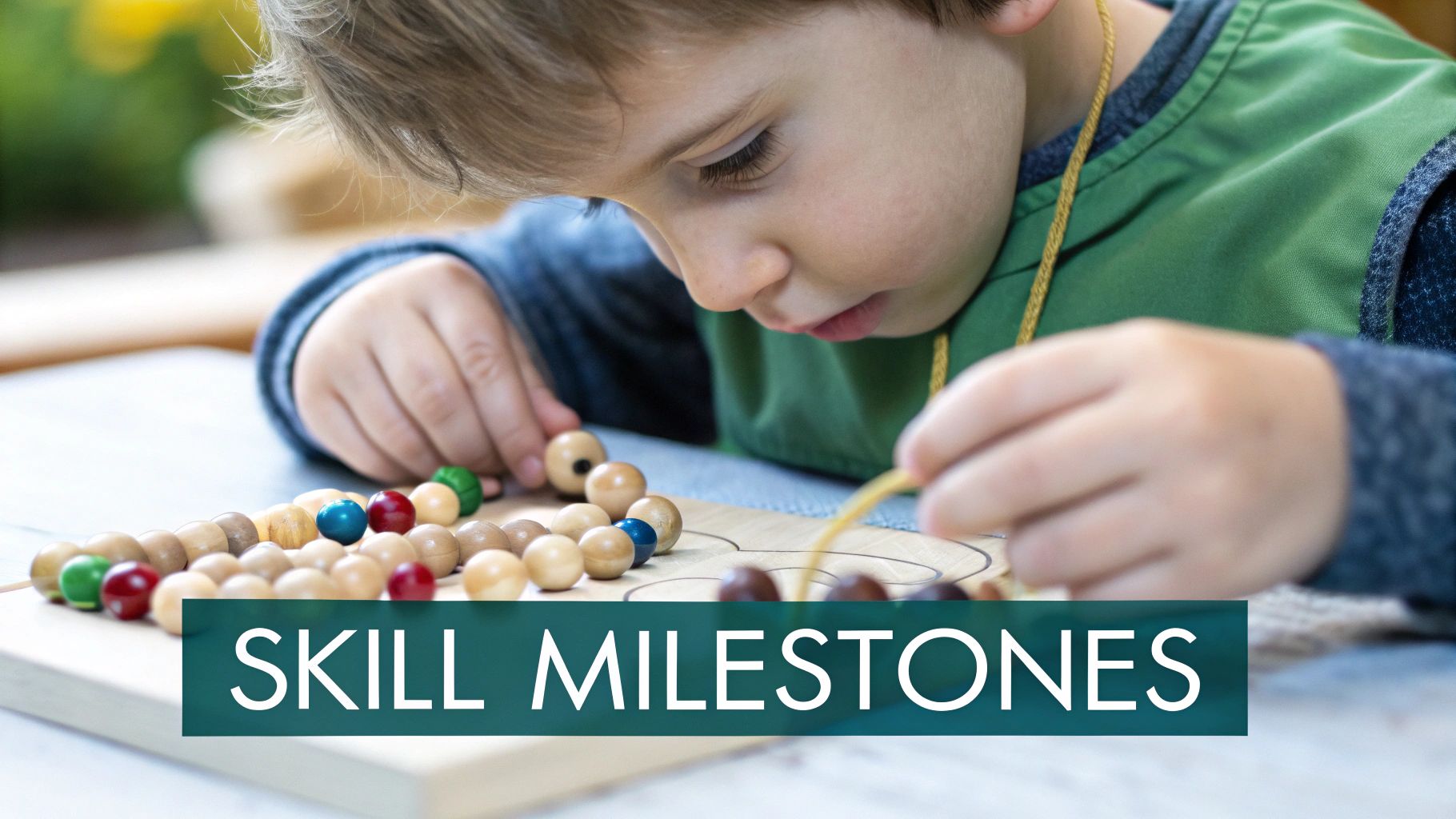
The third year is truly a period of incredible transformation. One minute you have a toddler, and the next, a capable little preschooler seems to appear, their mind fizzing with new ideas and their body eager to master more complex challenges. This isn't just about them getting bigger; it’s a fundamental shift in how they see and interact with the world.
Suddenly, their hands become remarkably skilled. The clumsy, whole-hand grasp they used to have is replaced by a surprisingly precise pincer grip. This development in their fine motor skills is the foundation for almost everything, from holding a crayon the right way to eventually buttoning their own coat.
This newfound dexterity isn't just a happy accident; it's driven by a deep-seated desire for competence. They desperately want to do things for themselves, not just watch you do them. This is the perfect moment to introduce Montessori toys for 3 year olds that challenge both their hands and their minds.
A Mind in Motion
Cognitively, a three-year-old’s brain is taking giant leaps forward. They’re moving past simple cause-and-effect and starting to grasp more complex sequences and patterns. This is where you see the first real blossoms of logic and problem-solving.
You’ll probably notice it in their play:
- Problem-Solving: They can now tackle simple puzzles with real intention, carefully turning the pieces to find the right fit.
- Early Logic: They start to understand sorting by colour, shape, or size, which lays the essential groundwork for mathematical thinking.
- Growing Independence: Their keenness to pour their own drink or "help" with chores shows they're beginning to understand real-world processes.
Their language skills are also exploding. They’re stringing together longer sentences, asking endless "why?" questions, and using words to express surprisingly complex feelings. That's why toys that encourage storytelling and build vocabulary are so valuable at this stage. If you're navigating this transition, our guide on learning toys for children transitioning from two to three can be a huge help.
At three, play becomes purposeful work. A child isn’t just stacking blocks; they are testing the laws of physics. They aren't just threading beads; they are training their hands and eyes to work in perfect harmony.
Supporting Their Journey to Independence
This developmental surge creates a powerful window of opportunity. By providing the right tools, you can support their natural, unstoppable drive towards independence and self-discovery. Montessori toys are designed specifically for this purpose.
It's no surprise that the market for educational toys reflects just how crucial this age is. The 3–5 years preschool group is a significant and fast-growing segment for toy retailers in the UK and globally. This is because parents and educators alike recognise the immense value of supporting cognitive and motor skills during this vital period.
Purposeful play with the right materials gives them a safe space to practise these emerging skills, building everything from the fine motor control needed for beading to the logical thinking required for sorting activities.
How to Spot an Authentic Montessori Toy
With so many toys slapped with an ‘educational’ label, it can be tough to figure out which ones are genuinely Montessori-aligned. The truth is, authentic Montessori toys aren't just about learning; they're about how a child learns. They have a certain character that sets them worlds apart from the average plastic plaything.
When you know what to look for, you can see past the clever marketing and choose tools that will actually support your three-year-old’s development. A real Montessori toy feels different in your hands because its very purpose is different.
Made from Natural Materials
Walk into any Montessori playroom, and the first thing you’ll probably notice is the warmth and texture of natural materials. The toys are almost always made from things like wood, metal, cotton, or wool, and that’s entirely on purpose.
These materials offer a rich sensory experience that plastic just can't match. A simple wooden block has a noticeable weight, a distinct texture, and even a faint, earthy scent that helps connect a child to the natural world. This emphasis on natural composition is a big reason why many UK families prefer them. In fact, European market reports consistently show a strong preference for wooden Montessori toys, with parents pointing to their durability and eco-friendly appeal. You can see more on these market trends at Dataintelo.com.
Rooted in Reality
Authentic Montessori toys are firmly grounded in the real world. You won’t find any talking dragons or fantastical gadgets that don't have a real-world counterpart.
Instead, you’ll discover beautifully crafted, functional items like:
- Child-sized cleaning sets that actually work.
- Realistic animal figurines that represent real species.
- Kitchen tools that are safe for little hands to help with real food prep.
This connection to reality helps a three-year-old make sense of the world around them. It gives them the tools to understand and interact with their environment, building practical, real-life skills and a powerful sense of competence along the way.
Isolates a Single Skill
Perhaps the most important feature of a true Montessori toy is its laser focus on isolating one specific skill or concept at a time. The classic Pink Tower, for example, is designed to teach just one thing: how to grade size in three dimensions. That’s it.
A genuine Montessori material doesn't try to be a jack-of-all-trades. It is a master of one, allowing the child to achieve deep concentration and true mastery without distraction.
This deliberate simplicity is key. It prevents a child from feeling overwhelmed by too many things happening at once. When a toy has a clear, singular purpose, your child can pour all their attention into the task, repeating it over and over until they feel a sense of satisfaction. This process is absolutely crucial for building their ability to concentrate.
The differences really stand out when you compare these purposeful tools with more conventional toys.
Comparing Montessori Toys with Conventional Plastic Toys
This table breaks down the core distinctions between a Montessori-style toy and the typical battery-operated ones you see everywhere.
| Feature | Montessori Toy (e.g., Wooden Stacker) | Conventional Plastic Toy (e.g., Light-Up Music Toy) |
|---|---|---|
| Material | Natural wood, offering varied texture and weight. | Bright plastic, uniform and lightweight. |
| Purpose | Teaches a single, clear skill like sizing or sorting. | Aims to entertain with multiple lights and sounds. |
| Child's Role | Active participant, problem-solving and exploring. | Passive observer, reacting to the toy's actions. |
| Pace | Child-led, allowing for focus and repetition. | Fast-paced and directed by the toy's programming. |
As you can see, the design philosophy is fundamentally different. One empowers the child to lead, while the other directs the play.
By keeping an eye out for these simple, purposeful, and reality-based qualities, you can confidently spot authentic Montessori toys for 3 year olds that will become treasured and valuable tools in your child’s growth.
Top Montessori Toys That Build Essential Skills
Now that we have a feel for what makes a Montessori toy so unique, let's get into the good stuff—the best kinds of Montessori toys for 3-year-olds. Think of these less as playthings and more as carefully crafted tools that meet your child exactly where they are in their developmental journey.
At three, a child's world is all about refining their movements, soaking up sensory information like a sponge, growing their vocabulary, and getting to grips with the very first ideas of numbers. The right materials can make this "work" feel like the most engaging and joyful play imaginable.
This diagram breaks down the essence of an authentic Montessori toy: it’s built on a foundation of being natural, realistic, and simple.
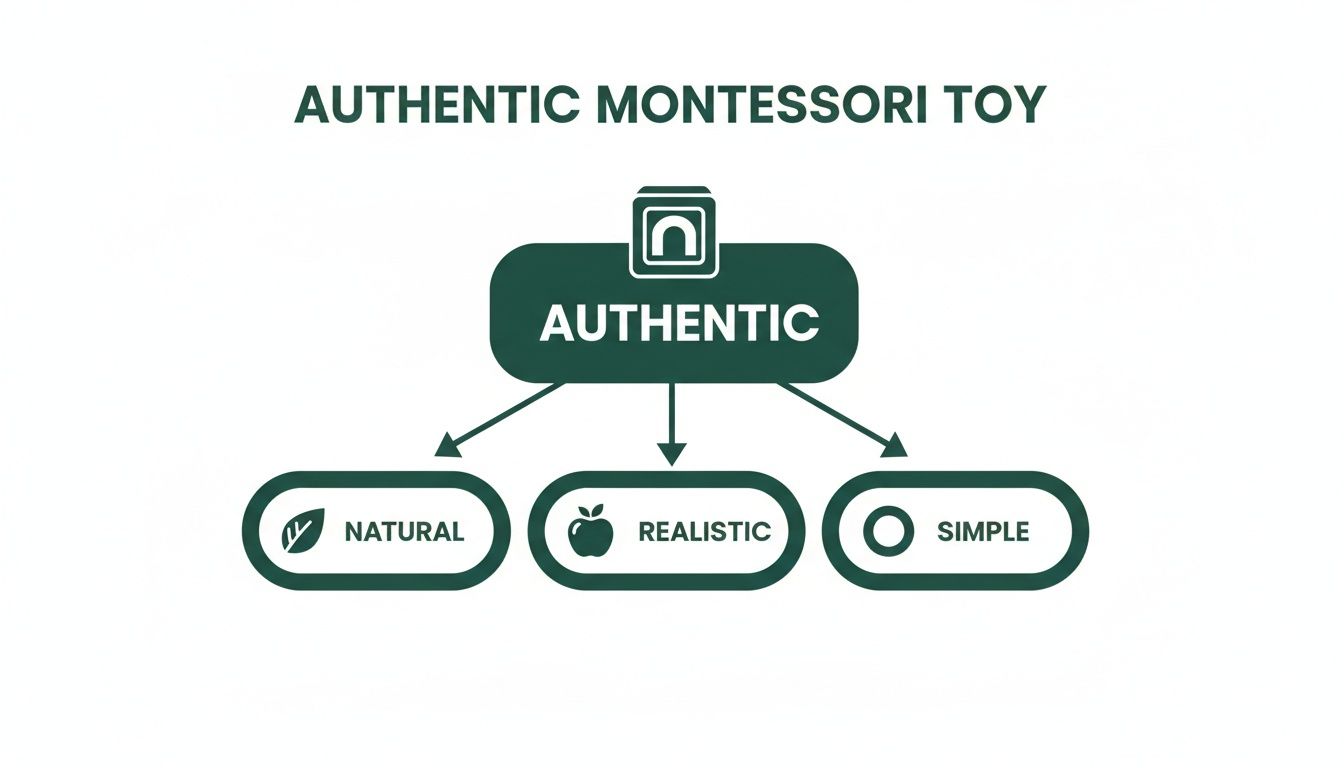
As you can see, a toy's value comes from how it connects to the real world through natural materials and a simple, focused design that doesn't overwhelm the child.
Practical Life Skills
This is the real heart of Montessori for this age. Practical life activities tap into a three-year-old’s powerful urge to copy adults and be a part of everyday family life. These "toys" are often just beautifully made, child-sized versions of real tools.
- Pouring Sets: A small jug, a couple of cups, and a little tray are all you need. A child can spend ages practising pouring water (or something less messy, like rice!) which builds fantastic hand-eye coordination, concentration, and fine motor control.
- Dressing Frames: These are brilliant. They’re simple wooden frames with big buttons, zips, or buckles. By isolating the skill, a child can practise and master fastening their own clothes without the frustration of it being on their own body.
These activities are about more than just skills. They send your child a powerful message: "You are capable, and your work is important."
Sensorial Development
Sensorial materials are designed to help children sort and classify the information they gather through their senses. It's about taking their understanding of the world—size, colour, texture, sound—and making it organised and clear.
Dr. Montessori believed the senses were the gateways to the mind. Sensorial toys are designed to sharpen these senses, creating a more organised and intelligent understanding of the environment.
The famous Pink Tower is a perfect example. It's just ten pink cubes that get progressively larger. The only thing that changes is their size, so the child can focus entirely on discriminating between dimensions. In the same way, Sound Cylinders come in pairs that make identical sounds when shaken, inviting a child to listen carefully and match them, refining their sense of hearing.
Language and Vocabulary Building
At three, a child's vocabulary is absolutely exploding. Montessori language materials are designed to make the abstract world of letters and words something they can touch and feel.
- Sandpaper Letters: These are cards with letters cut from fine sandpaper. As the child traces the shape with their finger, they say its sound. This creates a powerful multi-sensory link that really helps with letter recognition.
- Realistic Miniature Objects: A collection of high-quality, realistic little animal figures or household objects is fantastic for vocabulary games. You can play matching games, "I-spy," or simply name the objects together to build their word bank.
Exploring other types of educational toys for 3-4 year olds can be a great way to enrich this stage, too. While Montessori toys offer very specific benefits, branching out to include things like puzzles can boost problem-solving and fine motor skills even further. For anyone interested, finding the best puzzles for young children is a really helpful place to start.
Early Mathematics Concepts
Montessori maths materials have a kind of genius to them—they make really big ideas feel simple and physical. A three-year-old isn't ready for sums on a page, but they can absolutely understand quantity when they can hold it in their hands.
The Number Rods, for instance, are a set of ten rods that get longer and longer, with alternating red and blue sections showing the units. By handling them, a child physically feels the difference between "one" and "ten." A Spindle Box brilliantly introduces the idea of zero by having a special compartment where no spindles go, making a completely abstract concept visible and clear. These materials lay an incredibly strong, concrete foundation for all the maths that will come later.
Designing a Play Space That Inspires Independence
In Montessori circles, there’s a lovely idea that the environment itself is the "third teacher." It works right alongside parents and carers to guide a child’s journey. Creating this kind of thoughtful space isn’t about splashing out on expensive furniture or having everything perfectly organised. It’s about shaping your home into a place where your three-year-old feels competent, capable, and wonderfully independent.Think about how a cluttered playroom with overflowing toy chests must feel to a little one. It can be surprisingly overwhelming. Just like we might feel stressed in a messy office, a child can find it hard to focus when faced with a mountain of choices. The whole point of a Montessori play space is to cultivate a calm, orderly environment that invites deep concentration and meaningful play.
Setting the Stage for Success
The first step is beautifully simple: see the world from their height. Get down on the floor and take a good look around. Can they reach the things they need? The absolute cornerstone of this approach is a set of low, open shelves. Unlike a deep toy box where everything gets lost and jumbled, shelves let a child see all their options clearly.
This simple change empowers them to make their own choices, take out an activity, and—just as importantly—put it away when they’re finished. When you're putting together an engaging play area, understanding the principles of effective space planning can make a world of difference, helping you create a space that’s both beautiful and functional.
Another brilliant tool is the humble tray. By placing all the pieces of a single activity on a small tray, you visually define the workspace. It makes the task feel manageable and sends a clear message to your child: "Everything you need is right here."
The Magic of Toy Rotation
One of the most powerful strategies for keeping your child engaged is toy rotation. Instead of having every single toy out at once, you choose a small, carefully selected collection to display on the shelves. This "less is more" approach works wonders for a three-year-old’s ability to focus.
By limiting the choices available, you increase the value of each one. A child who has access to a few thoughtfully chosen toys is far more likely to explore them deeply and master the skills they offer.
So, what’s the magic number? While every child is different, a fantastic starting point is to offer just 8–10 activities at a time. It’s a number often recommended here in the UK to encourage independent choice without causing overwhelm, and it’s a principle many Montessori-inspired retailers now follow.
When you notice your child’s interest in a particular toy starting to wane, simply swap it for something you have stored away. This keeps their environment feeling fresh and exciting. It encourages them to revisit old favourites with new eyes and dive into new challenges with real curiosity. This simple routine makes your montessori toys for 3 year olds go so much further.
Answering Your Questions About Montessori Toys
It’s completely normal to have questions when you’re thinking about a new way of doing things. Bringing these purposeful materials into your home is a shift, and it’s natural to wonder how it all works in practice. We’ve gathered some of the most common queries we hear from parents about Montessori toys for 3 year olds.
Think of this as a friendly chat to help you find the confidence and clarity to build an approach that feels just right for your family.
Are Montessori Toys Really Worth the High Price Tag?
Let's be honest, the price of high-quality wooden toys can make you pause, especially when compared to plastic alternatives. It helps to shift your mindset from seeing it as a cost to seeing it as a long-term investment in your child’s development.
These toys aren’t just built to last; they’re designed to withstand years of curious hands and active learning. Many become family heirlooms, passed down from one child to the next. Their simple, focused design also means they don't go out of style, unlike trendy gadgets that are often forgotten after a few weeks.
If you're working with a budget, you can absolutely embrace the Montessori spirit without a huge outlay:
- Start small: You don't need everything at once. Begin with one or two brilliant, open-ended toys, like a good set of wooden blocks.
- Look for pre-loved: Many families sell their Montessori materials online once their children have outgrown them. It's a great way to find quality items for less.
- Get creative with DIY: So much of the philosophy is about practical life skills. Simple activities using things you already have, like pouring beans between jugs or sorting colourful buttons, are pure Montessori.
Will My Child Get Bored Without All the Noisy, Flashing Toys?
This is probably the number one concern for parents, and it’s a fair one. We're all so used to toys that beep, light up, and basically do the entertaining for the child. Montessori materials flip that on its head—they invite the child to do the playing. It's a different, more profound kind of fun.
What we might see as "boredom" is often a moment of intense concentration. When a child is quietly working on a wooden puzzle, they aren't just passing time; they're problem-solving, building neural connections, and stretching their attention span. The noisy electronic toy demands attention; the Montessori toy rewards it.
A Montessori toy invites a child into a world of discovery. An electronic toy often just performs for them. The first builds creativity and focus; the second can encourage passive consumption.
The best way to make the switch is gradually. Introduce one or two new materials alongside their current toys. Show them how to use it, using slow, deliberate movements, and then step back. You might be surprised at how naturally they gravitate towards the satisfying, hands-on challenge of these simpler tools.
So, How Many Toys Does a 3-Year-Old Actually Need?
In a Montessori-inspired home, less is truly more. The guiding principle is always quality over quantity. When a child is surrounded by a mountain of toys, they can become overwhelmed and find it impossible to focus on anything for more than a few moments.
Instead of a toy box overflowing with plastic, picture a calm, orderly space. A small, curated selection of around 8-10 toys or activities, thoughtfully arranged on low, open shelves, is the ideal. This practice, often called toy rotation, sidesteps that feeling of overwhelm and encourages your child to engage more deeply with each item. When they have fewer choices, they learn to appreciate and master the ones they have.
Ready to bring purposeful play into your home? Discover the perfect, stage-based play kits at Grow With Me. Each box is thoughtfully curated with high-quality, developmentally appropriate toys to support your child’s learning journey. Explore our subscription boxes today!