
A Parent's Guide to Educational Toys for 3-4 Year Olds
The best educational toys for 3-4 year olds are the ones that perfectly align with the incredible developmental leaps they're making. It’s all about turning their natural curiosity into core skills. Think of classics like building blocks, imaginative pretend play sets, and simple puzzles—these are fantastic for encouraging problem-solving, creativity, and social skills in a fun, hands-on way.
Why Play Is Your Preschooler's Superpower
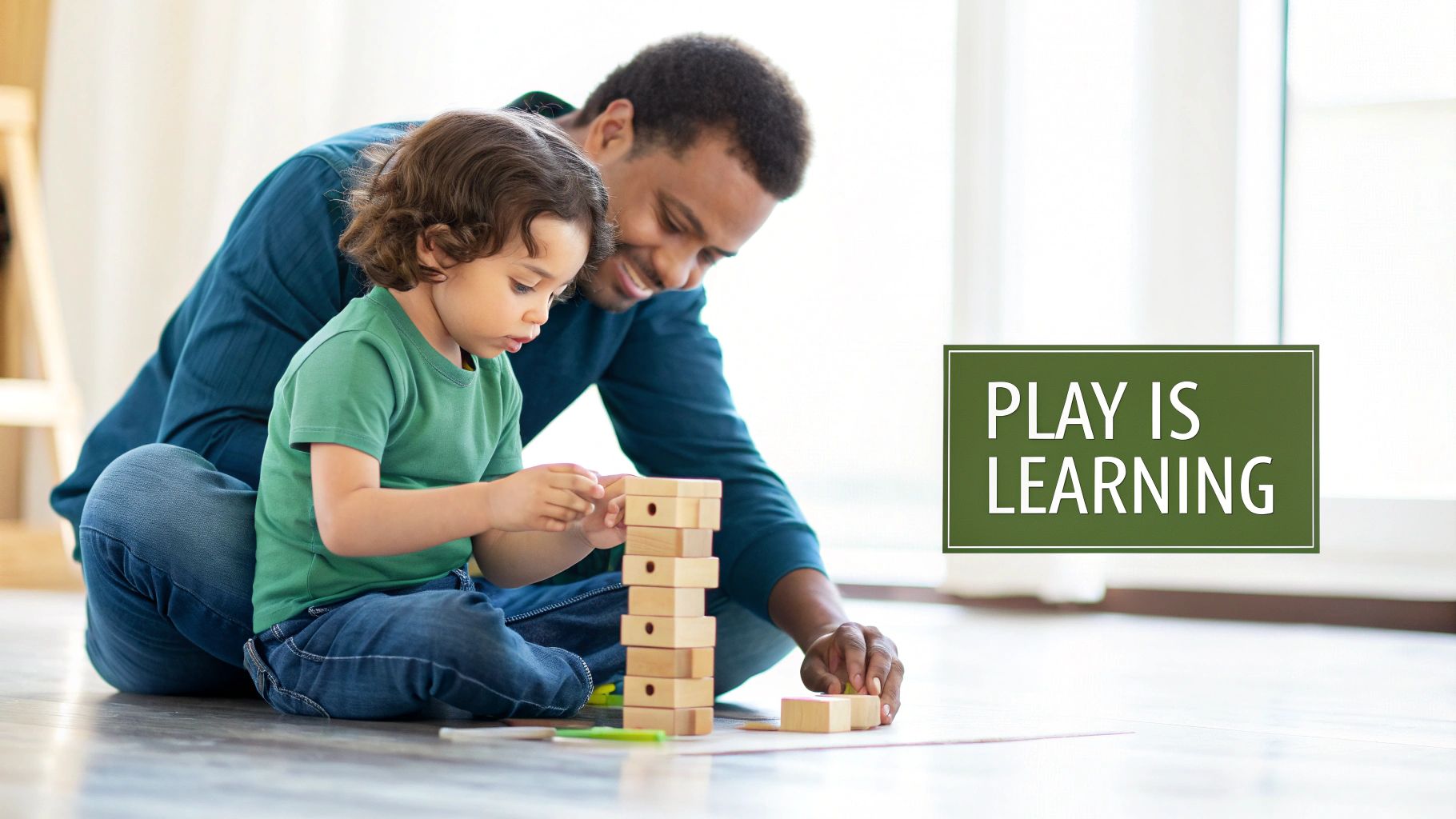
That magical window between ages three and four isn't just about mucking about and having fun—it’s learning in its purest, most powerful form. This is when simple, everyday play lays the groundwork for their entire future. The right educational toys for 3-4 year olds act as the perfect tools for this adventure, helping to channel a child’s boundless curiosity into real, tangible skills.
It helps to think of these toys not as simple distractions, but as keys that unlock your child’s understanding of the world around them. Every single playful moment is a huge step toward school readiness and, ultimately, a love of lifelong learning.
Bridging Play and Development
When your little one stacks a set of blocks, they aren’t just building a tower. They're actually running tiny experiments with balance, gravity, and spatial awareness. And when they decide to host a teddy bear tea party, they're practising empathy, honing their language skills, and learning the ropes of social etiquette. Every interaction is a lesson in disguise.
This connection is so important because a child's brain develops at an incredible pace during these years. The right toys support this growth by offering challenges that are genuinely engaging without being overwhelming. They help them refine:
- Problem-Solving Skills: Figuring out how puzzle pieces fit together or which block should go where.
- Fine Motor Control: Developing dexterity by manipulating small objects, drawing, or threading beads.
- Language and Social Skills: Chatting through pretend scenarios and learning to take turns and share.
The goal is to choose toys that grow with your child, offering different ways to play as their abilities advance. An open-ended toy, like a good set of magnetic tiles, can be used for simple colour sorting at age three and for building complex, imaginative structures just a year later.
Realising this link helps you see that 'educational' and 'fun' really are one and the same. To dive a bit deeper, you can learn more about the stages of cognitive development in early childhood and see just how powerfully play fuels their learning journey.
What's Happening in Your 3–4 Year Old's World
Trying to keep up with a three-year-old can feel like watching a puzzle solve itself at lightning speed. This stage is a whirlwind of growth, with their little brains firing on all cylinders and making incredible connections every single day. When you know what milestones to look for, you can pick out educational toys for 3–4 year olds that really click with where they're at.
Think of them as little sponges, soaking it all in. They’re making the leap from simple, toddler-like actions to more complex thoughts, and play is how they make sense of it all. The right toys don't just entertain; they turn that natural curiosity into real, lasting skills.
The Big Cognitive Leap
At this age, a child’s thinking becomes much more layered. They’re starting to properly grasp cause and effect, work through simple problems, and invent entire imaginary worlds right in your living room. Their memory is getting stronger too, which means they can remember bits of a story or even follow a two- or three-step command.
You’ll see this jump happen right in the middle of their playtime:
- From Scribbles to Shapes: Their drawings start to look less like random scribbles and more like intentional circles, squares, and even the first attempts at drawing people (stick figures are a masterpiece!).
- Problem-Solving in Action: They can suddenly tackle puzzles with more pieces and have the patience for games with simple rules.
- A Flourishing Imagination: Pretend play gets wonderfully complex. Suddenly, there are detailed backstories for their dolls, elaborate rescue missions for their action figures, or five-course meals being served from their play kitchen.
Mastering Movement, Big and Small
Physically, your child is making huge strides as well. They're building confidence in their large muscle groups (their gross motor skills) while also fine-tuning the delicate movements in their hands and fingers (their fine motor skills).
This two-track development is so important. One minute they're learning to run without tripping over their own feet, the next they're concentrating intently on holding a crayon the right way or threading chunky beads onto a string. As you support them through these milestones, it can be helpful to look at the whole picture of their development, including understanding child sleep patterns to ensure they're well-rested for all this learning.
The Social and Emotional Awakening
Maybe the biggest shift of all is happening in their social and emotional world. They are moving from parallel play (playing next to other children) to true cooperative play (playing with other children). This is where they learn the really important stuff, like how to share, take turns, and sort out little disagreements.
It's no wonder parents are focusing more on toys that help with these skills. After the last few years, a huge 73% of parents say they now prioritise toys that help build social-emotional skills, which is absolutely vital for this age group.
"At three and four, children are learning to see the world through other people's eyes. Pretend play is their training ground for empathy, cooperation, and understanding feelings—both their own and others'."
Seeing how far they've come is part of the fun. If you're curious about the previous stage, take a look at our guide on choosing the best learning toys for 2-3 year olds.
How to Choose Toys That Truly Teach
Walking down the toy aisle can feel like a sensory overload. Bright boxes and loud promises all scream for your attention, but picking out a toy that actually helps your child learn is easier than you might think. It’s all about looking beyond the flashy packaging and focusing on three simple things: safety, how long it will last, and what it can teach.
First up, and most importantly, is safety and durability. A toy isn't much use if it falls apart after a bit of enthusiastic play or, worse, isn't safe. Here in the UK, always look for the CE or UKCA mark. This little symbol is your assurance that the toy meets tough safety standards like EN71, meaning it’s free from nasty chemicals and doesn't have tiny parts that could be a choking hazard.
A well-made toy can take a few knocks—and we all know they will be dropped, thrown, and hugged with serious intensity. This kind of durability means it’s built to last, becoming a well-loved friend rather than just another piece of plastic, and that’s real value for money.
Look for Open-Ended Potential
You'll find that the best educational toys rarely have a long list of instructions. They're what we call open-ended, which just means your child can play with them in countless different ways, powered purely by their own imagination. Picture a simple set of wooden blocks compared to a flashy electronic toy that does just one thing.
Those blocks could be a towering castle one minute and a zoo for toy animals the next. That single-function gadget? It might be thrilling for a day, but once your child has figured out its one trick, the novelty wears off fast. Open-ended toys are the real heroes when it comes to sparking creativity and keeping children engaged for the long haul.
An open-ended toy doesn't tell a child what to think; it gives them the tools and space to think. This freedom is where deep learning and problem-solving skills are born.
Match Toys to Milestones
This is where the magic really happens—connecting the toy you choose directly to the developmental leaps your little one is making right now. This is how you turn a simple gift into a powerful learning tool. Instead of just grabbing something that looks fun, take a moment to think about the specific skills you'd love to support.
Here’s a simple way to think about it:
-
For fine motor skills: Look for toys that need careful hand and finger movements. Think lacing beads, threading cards, or even chunky construction sets with nuts and bolts they can twist and turn.
-
For problem-solving: Puzzles, shape sorters, and simple board games are brilliant for this. They encourage children to think logically, recognise patterns, and feel that amazing rush of satisfaction when they figure something out for themselves.
-
For social and emotional skills: Nothing beats pretend play. A play kitchen, a doctor's kit, or a collection of animal figures gives them a stage to practise empathy, learn about sharing, and explore different roles and feelings.
-
For language and literacy: Any toy that gets them telling stories is a winner. Puppet theatres, character figures, and even a good set of crayons and paper encourage them to describe what they’re doing and creating.
When you start seeing toys not just for what they are, but for what they can help your child become, every playtime turns into a meaningful chance to grow. For some more specific ideas, it’s worth checking out guides on educational gifts that spark learning for toddlers.
The Best Toy Categories for Sparking Growth
Now that we've covered what makes a great educational toy, let's get into the specifics. Walking down the toy aisle can feel overwhelming, but it's much easier when you focus on a few key categories that target essential skills. Think of these as the "food groups" of play—each one nourishes a different, vital part of your child's development.
The right toys do so much more than just keep a child busy; they build the very foundation for future learning. Whether you've got a budding engineer or a future storyteller on your hands, there’s a perfect category to spark their imagination and build real confidence.
This guide simplifies the core ideas to keep in mind when you're choosing any toy for your child.
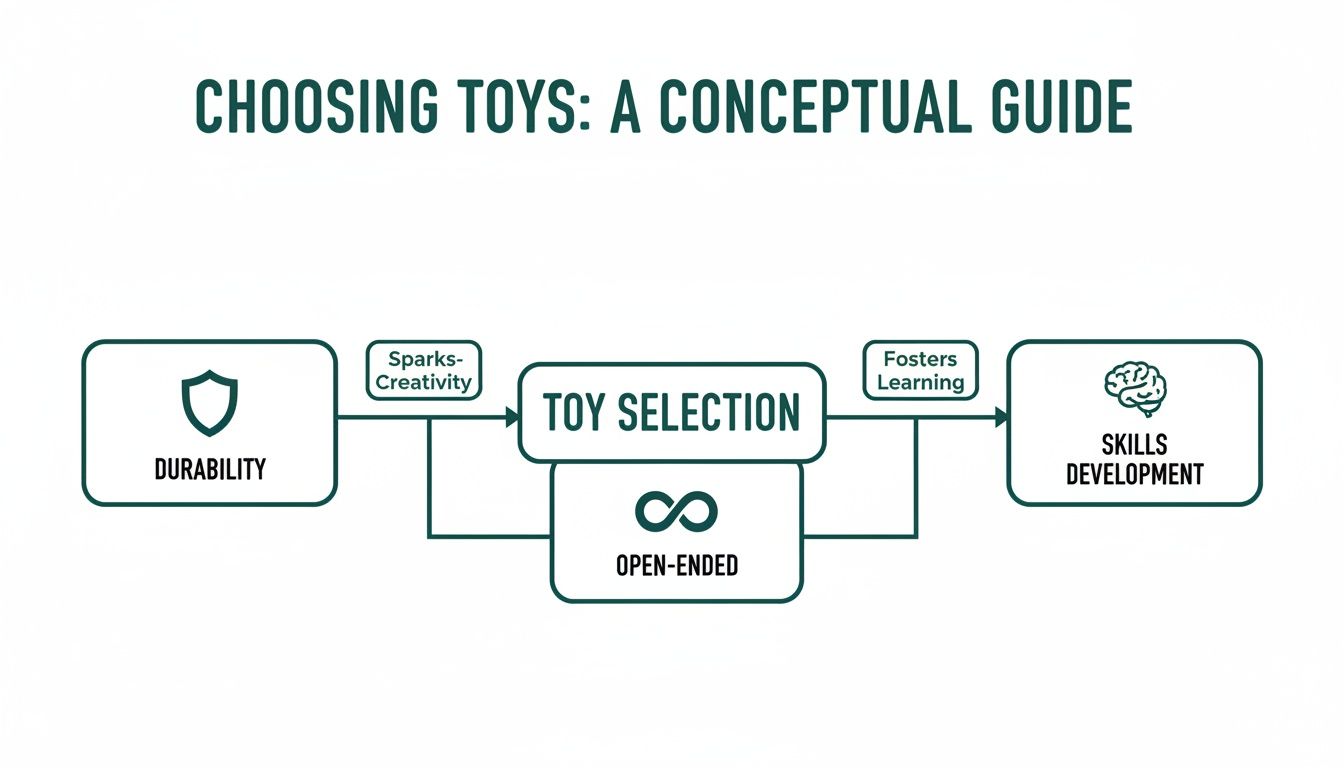
As you can see, the most direct path to meaningful skill development comes from toys that are durable and invite open-ended, creative play.
Building Sets for Future Engineers
Blocks, magnetic tiles, and simple construction sets are absolute powerhouses of learning. They are the quintessential open-ended toy, giving children the freedom to create anything they can imagine, from a simple wall to an elaborate spaceship.
As they build, they’re getting a hands-on lesson in physics, geometry, and spatial awareness. Every tower that wobbles and tumbles over teaches them about balance and gravity in a way no textbook ever could. It’s no wonder this category is a major driver in the UK's educational toy market, a real testament to its developmental value.
In fact, the growing educational toys market in the UK generated USD 4,050.1 million in 2023, with building sets claiming the biggest share of revenue. Their popularity makes sense, as some studies even show these toys can improve a toddler's vocabulary by up to 20% through descriptive play alone.
Puzzles and Games for Patient Problem-Solvers
Puzzles are brilliant for teaching patience, persistence, and that sweet feeling of victory when a challenge is finally overcome. For a 3 or 4-year-old, completing a 24-piece floor puzzle is a massive achievement that really builds their self-esteem.
Board games add another layer by introducing crucial social skills in a fun, structured way:
- Taking turns: Learning to wait for your go is a tough but essential lesson in self-control.
- Following rules: Understanding that games have a structure helps develop executive function.
- Winning and losing gracefully: These early games are a safe space to experience and manage feelings of excitement and disappointment.
Play Prompt: With a simple puzzle, try turning a few pieces upside down. Ask, "Uh oh, what's wrong with this piece?" This encourages them to analyse and correct errors—a core problem-solving skill.
Art Supplies for Budding Creators
Crayons, chalk, paint, and modelling clay are so much more than just messy fun. They are fundamental tools for self-expression and fine motor development. The simple act of holding a paintbrush or rolling out clay strengthens the small muscles in their hands, preparing them for writing down the line.
Art is also a fantastic way to explore concepts like colour mixing, shapes, and textures. It gives children a voice before they can fully articulate their big feelings with words, allowing them to process emotions and share their unique view of the world.
Pretend Play for Social Butterflies
A play kitchen, a doctor's kit, or a simple box of dress-up clothes are all portals to other worlds. During pretend play, children experiment with different social roles, practise empathy by imagining how others feel, and develop rich, complex storytelling skills.
When your child "cooks" you a meal, they are sequencing steps, using descriptive language ("This soup is very hot!"), and engaging in the natural give-and-take of conversation. It’s here that they rehearse for real-life social situations in a safe, wonderfully imaginative setting.
Early STEM Toys for Curious Experimenters
STEM (Science, Technology, Engineering, and Maths) toys for this age group are all about hands-on exploration. Think gear sets that click together, simple coding robots, or a magnifying glass for garden discoveries.
These toys introduce foundational concepts in a completely accessible, play-based way. They nurture a child’s natural curiosity and encourage them to constantly ask that all-important question: "What happens if...?"
To make things even clearer, this table connects these toy categories directly to the developmental skills they support.
Matching Toy Categories to Developmental Skills
This table is a handy reference for quickly seeing which types of toys can help strengthen specific developmental areas for your 3 to 4-year-old.
| Developmental Skill Area | Recommended Toy Category | Example Activities |
|---|---|---|
| Fine Motor Skills | Art Supplies, Puzzles, Building | Holding crayons, fitting puzzle pieces, connecting small blocks. |
| Gross Motor Skills | Building Sets | Stacking large blocks, reaching and stretching to build tall structures. |
| Cognitive Development | Puzzles, Early STEM Toys | Sorting shapes, completing a sequence, cause-and-effect experiments with gears. |
| Social & Emotional Skills | Pretend Play, Games | Role-playing as a doctor, sharing toys, learning to take turns in a simple board game. |
| Language & Communication | Pretend Play, Building Sets | Describing a make-believe meal, explaining what they are building, telling a story. |
| Problem-Solving & Creativity | Building Sets, Art Supplies | Figuring out how to make a tower stable, mixing colours, creating stories from nothing. |
By having a mix of toys from these different categories, you create a rich, balanced "play diet" that supports your child's all-round growth and keeps them happily engaged.
Unlocking More Learning Through Guided Play
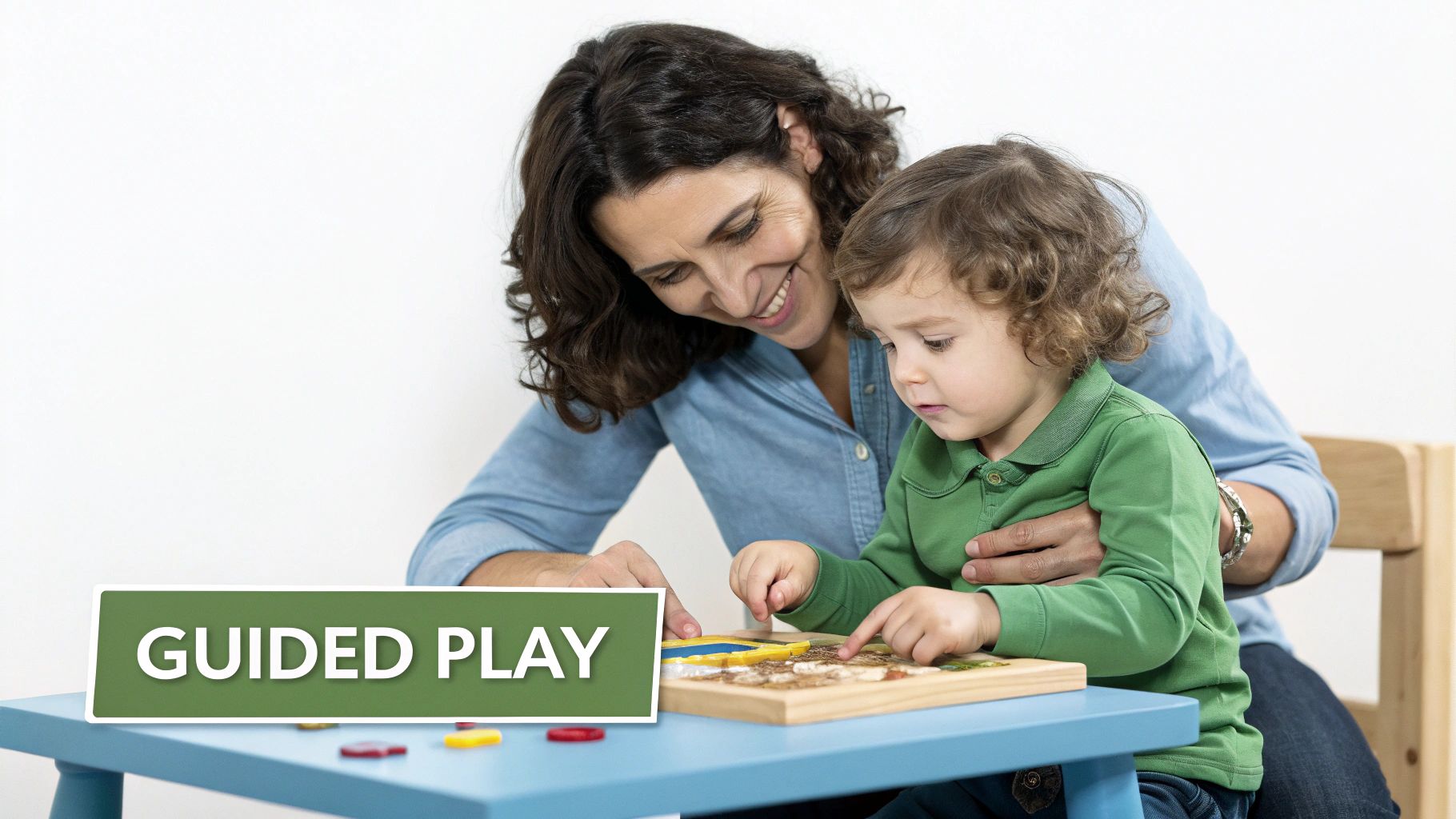
Even the most brilliant educational toys for 3–4 year olds are only half the story. The other half? An engaged play partner—and that means you. This isn’t about turning playtime into a classroom lesson or taking over. It's about stepping in as a co-explorer, a concept known as guided play. With just a little gentle involvement, you can turn a fun activity into an incredibly rich learning experience.
Think of yourself as the narrator of their adventure, not the director. Your job is to spark their curiosity, introduce new vocabulary, and help them connect the dots without ever taking away their sense of control. A simple shift in how you talk with them can make all the difference.
From Director to Co-Explorer
Instead of giving direct instructions like, "Put the blue block there," try asking open-ended questions. These are the kinds of questions that don't have a simple 'yes' or 'no' answer, encouraging your child to think more deeply and express their own ideas.
Here are a few simple swaps you can make today:
- Instead of "That's not the right piece," try, "I wonder which shape might fit in that space?"
- Instead of "Let's build a house," ask, "What do you think we could build with all these blocks?"
- Instead of "The car is fast," try making an observation: "Wow, look how that car zooms down the ramp! I wonder what would happen if the ramp was steeper?"
This approach gently nudges them towards discovery. It’s a brilliant way to model how to think through a problem, showing them that the process of figuring things out is just as important as getting it right. When you celebrate their effort and curiosity, you’re also building their resilience for the next time they face a tricky puzzle or a wobbly tower.
Guided play is really about creating a dialogue around the toy. Your questions and comments act as scaffolding, helping your child build higher-level thinking skills they couldn't quite reach on their own.
Creating an Environment for Discovery
Beyond how you interact, setting the stage for play can also deepen the learning. A calm, inviting space makes it much easier for your child to focus and dive deep into their imagination. One of the most effective strategies here is toy rotation. Rather than having every single toy out at once, keep a small selection available and swap them out every couple of weeks. This simple trick makes old toys feel brand new again, reigniting their interest and preventing that feeling of being overwhelmed.
Your involvement also helps them develop crucial communication skills. By simply narrating what they’re doing, you naturally introduce new vocabulary—words like "balance," "texture," or "sequence." This style of interaction is a key part of what experts call Sustained Shared Thinking, which is a powerful way to extend a child's learning. If you'd like to dive a bit deeper, you can learn more about what is Sustained Shared Thinking and how it creates those meaningful back-and-forth conversations.
Ultimately, your presence and gentle guidance are the secret ingredients that turn a good toy into a great learning tool, transforming everyday playtime into a shared adventure.
Got Questions? We’ve Got Answers
Even with the best intentions, picking out toys can bring up a lot of questions. That’s perfectly normal! Let’s tackle some of the most common worries parents have when it comes to play-based learning for their three- and four-year-olds.
How Many Toys Is Too Many?
Honestly, it’s all about quality over quantity. A room overflowing with single-use toys can actually be more overwhelming than helpful. A thoughtfully chosen collection of versatile, open-ended toys will always win.
Think classic building blocks, some good-quality art supplies, and a set of animal figures. These staples offer limitless ways to play. A great little trick is to rotate toys every few weeks—what’s old suddenly becomes new and exciting again, encouraging your child to dive deeper into play.
What’s the Deal with Electronic Toys?
They can have their place, but it pays to be selective. Look for electronic toys that get your child actively involved in solving problems or creating something, rather than just passively watching a screen. Think of them as a 'sometimes' treat, not the main course.
It’s so important to balance screen time with plenty of hands-on, traditional play. Building with blocks, scribbling with crayons, and playing make-believe are what truly builds those crucial fine motor and social skills at this age.
If a toy promises to turn your toddler into a genius overnight, be sceptical. Real, lasting learning happens through curiosity, hands-on discovery, and joyful exploration.
Help! My Child Will Only Play with One Toy!
First off, don't panic! This is incredibly common and usually a sign that they're deeply engaged and mastering a skill. Instead of trying to force a change, lean into their current passion.
Use that beloved toy as a bridge to other activities. If they’re obsessed with toy cars, why not build ramps and garages for them out of blocks? If they can’t get enough of their dinosaur figures, introduce some playdough to make fossil prints. By connecting new ideas to their favourite thing, you can gently broaden their horizons without turning playtime into a power struggle.
Ready to take the guesswork out of finding the perfect stage-based toys? The Grow With Me subscription box delivers expertly curated, age-appropriate play kits directly to your door. Discover how we support your child's development at every stage by visiting https://shop.growwithmesubscriptionbox.co.uk.