
A Parent's Guide to Montessori 2 Year Old Toys
The best Montessori 2 year old toys are often beautifully simple. They're purposeful tools, typically made from natural materials, designed to help your child master a single skill at a time, like stacking, sorting, or pouring. Instead of distracting flashing lights and sounds, these toys are all about encouraging hands-on, focused learning that matches where your toddler is right now.
What Makes a Toy Montessori for a 2 Year Old
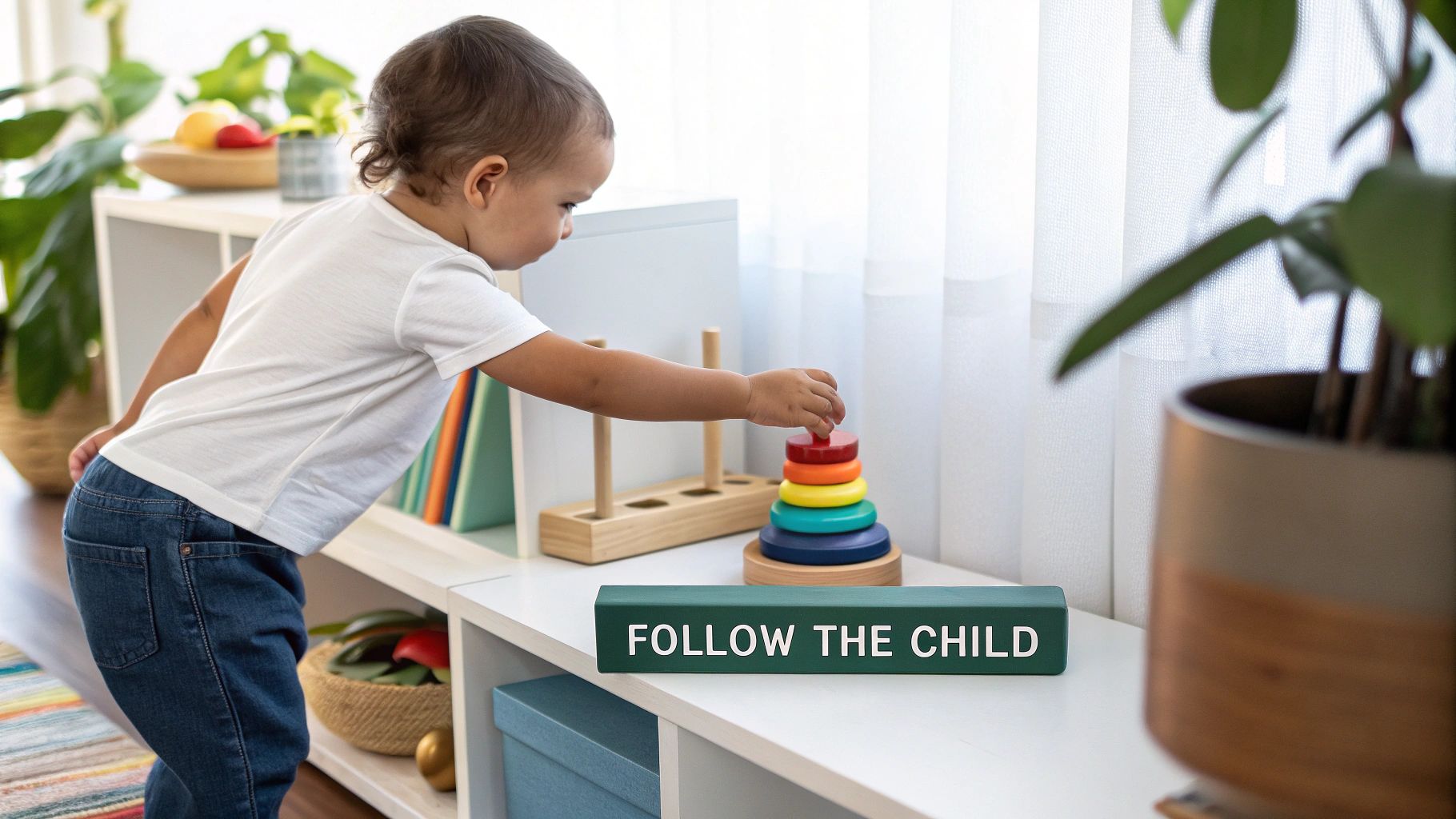
When you hear 'Montessori', it’s easy to picture those perfectly organised shelves lined with specific wooden toys. But at its heart, the approach isn't really about the items themselves. It’s about a deep respect for a child's natural, inbuilt drive to learn and explore. For a two-year-old, this time is a complete explosion of discovery.
Think of your toddler as a little explorer, and Montessori toys as their specialised toolkit for making sense of the world. The core philosophy is to "follow the child"—to watch what they're fascinated by and offer materials that support those very interests. It feels completely intuitive because it works with the behaviours you're already seeing every single day.
The Absorbent Mind at Work
Dr. Maria Montessori noticed that children from birth to age six have what she famously called an 'absorbent mind'. They're like little sponges, effortlessly soaking up everything from their environment without even trying. When your two-year-old is playing, they're not just passing the time; they are quite literally building their understanding of how reality works.
This is exactly why Montessori toys are so grounded in reality and purpose.
- They are often made of natural materials like wood, cotton, or metal. This gives a much richer sensory experience—the cool weight and smooth texture of a wooden block is worlds away from hollow plastic.
- They isolate one skill at a time. A classic shape sorter has one clear job: to teach shapes. This focus prevents a child from feeling overwhelmed and allows them to achieve a sense of mastery, which is fantastic for building their concentration.
- They are self-correcting. If a puzzle piece doesn’t fit, the child can see the error for themselves and try again. This builds independence and genuine problem-solving skills without an adult constantly needing to step in.
It's clear that this appreciation for purposeful play is growing. Across the UK, the demand for Montessori toys for 2-year-olds has surged, with a projected compound annual growth rate of about 6.8% for the region. This trend shows just how much more parents are tuning into the benefits of thoughtful early education during these crucial years.
"Play is the work of the child." — Maria Montessori
This famous quote perfectly captures the entire philosophy. That look of deep concentration on your toddler’s face as they try to thread a bead or pour water from one jug to another? That’s not just idle play. It’s their version of productive, meaningful work.
Understanding Sensitive Periods
A 'sensitive period' is a special window of time when a child is intensely, almost magnetically, drawn to learning a particular skill. This could be anything from language and movement to a fascination with tiny objects or a need for order.
Is your two-year-old suddenly obsessed with lining up their cars in a perfect row? They're likely in a sensitive period for order. The right Montessori toys for a 2 year old are designed to tap directly into these powerful internal drives. For a deeper look into how these principles apply at different ages, explore our comprehensive guide on Montessori toys by age. When you provide the right tools during these periods, you're supporting their development in the most natural and effective way possible.
How Montessori Toys Support Toddler Development
At age two, a child’s development isn't a slow, steady crawl—it's a series of incredible leaps forward. One day they’re just getting the hang of walking, and the next they seem to be running, chattering in sentences, and figuring things out you didn't even know they were thinking about. Montessori toys are designed to meet them right in the middle of this whirlwind of growth, acting less like simple distractions and more like targeted tools for building a strong foundation.
Instead of just trying to entertain, these toys invite a child to get involved. They’re built on the idea that a two-year-old learns best by doing, touching, and figuring things out for themselves. Every detail, from the materials used to the clean design, is intentional and supports a specific part of their rapidly expanding world.
Building Fine Motor Precision
Fine motor skills are all about those small, precise movements of the hands and fingers. At two, your toddler is moving from a clumsy, whole-hand grasp to much more controlled actions, and this is where so many Montessori toys really shine. What look like simple activities are actually powerful workouts for these tiny, developing muscles.
For instance, placing a wooden ring onto a peg isn't just a game. It's a surprisingly complex task that strengthens the pincer grasp—the one that uses the thumb and forefinger. This is the very same grip they'll eventually use to hold a pencil.
- Threading large beads: This simple act demands incredible focus and hand-eye coordination.
- Using a knobbed puzzle: Lifting a puzzle piece by its small knob helps isolate and strengthen finger muscles.
- Stacking blocks: This classic teaches balance, control, and an early understanding of spatial relationships.
These repeated, purposeful movements build muscle memory and dexterity, laying the groundwork for practical life skills like doing up buttons on a coat or using a fork properly.
Fuelling the Language Explosion
The second year is famous for the "language explosion," a time when a child's vocabulary can rocket from just a handful of words to several hundred. Montessori toys support this by being grounded in reality, giving children concrete objects to attach new words to.
Realistic animal figures are a perfect example. A stylised purple dinosaur is fun, of course, but a realistic model of a sheep gives a child a real-world concept they can label and understand. This connection between a physical object and its name is fundamental for building a solid vocabulary and making sense of the world.
A two-year-old's brain is forming connections at a truly astonishing rate—over 1 million new neural connections every single second. Providing language-rich, hands-on experiences gives this incredible process meaningful material to work with.
This approach goes far beyond just naming things. Story cards with sequential images can introduce the basics of narrative, while simply talking about the texture of a wooden block ("smooth") or the sound it makes ("clunk") enriches their descriptive language.
Nurturing Early Problem-Solving Skills
Many Montessori toys are masterfully designed to encourage logical thinking. They often have a built-in "control of error," which is a fancy way of saying the child can see for themselves if they've made a mistake. A shape sorter is the classic example here; a square peg simply will not fit into a round hole, no matter how hard you push.
This brilliant feature allows the child to problem-solve independently, without needing an adult to tell them "that's wrong." They get to analyse the problem, adjust their approach, and feel that rush of satisfaction when they find the solution on their own. This process builds resilience, concentration, and cognitive flexibility. You can explore more about how these activities shape your child's thinking in our article on cognitive development in early childhood.
By engaging with these self-correcting challenges, a two-year-old isn't just learning about shapes or sizes. They are learning how to learn—a skill that will serve them for the rest of their lives.
The Best Montessori Toys for a 2-Year-Old
When you're choosing Montessori-inspired toys for a 2-year-old, the aim isn't to fill a toy box to the brim. It’s about being thoughtful and selecting a small, purposeful collection of items that truly speak to their current developmental stage. Think of these toys as tools that feed their immense curiosity in four key areas: practical life, sensory exploration, language, and the very beginnings of maths.
The idea is that every toy has a specific job to do, helping your child master a skill through focused, hands-on play. When you curate their playthings this way, you’re creating an environment that naturally encourages their incredible journey of discovery.
Toys for Practical Life Skills
There's a reason "I can do it myself!" is the catchphrase of the two-year-old. They are bursting with a desire to be independent and to do exactly what they see you doing, from pouring a drink to trying to put on their own shoes. Practical life toys are essentially beautiful, child-sized versions of real-world tools. They allow toddlers to safely practise these everyday skills and feel like capable, important members of the family.
- Mini Pitcher and Cups: A small, easy-to-hold pitcher with a couple of tiny cups is perfect for practising pouring. You can start with dry things like pasta or beans before moving on to water. It’s a brilliant activity for building fine motor control, hand-eye coordination, and deep concentration.
- Dressing Frames: These are simple wooden frames featuring different fasteners like big buttons, zips, or velcro. They cleverly isolate the single skill of dressing, letting a child master the motion without the frustration of wrangling their own clothes.
These kinds of toys really honour your toddler’s powerful drive for independence, turning their passionate cries of "Me do it!" into successful, confidence-boosting achievements.
Toys for Sensorial Development
A two-year-old’s primary job is to learn about the world through their five senses. Sensorial toys are cleverly designed to help them refine how they see, hear, and feel differences in everything around them. These materials typically isolate one specific quality—like colour, sound, or texture—which helps children mentally sort and organise the constant stream of sensory information they're taking in.
This diagram shows just how interconnected a toddler's development is. You can see how fine motor skills, language, and problem-solving all grow together through meaningful play.
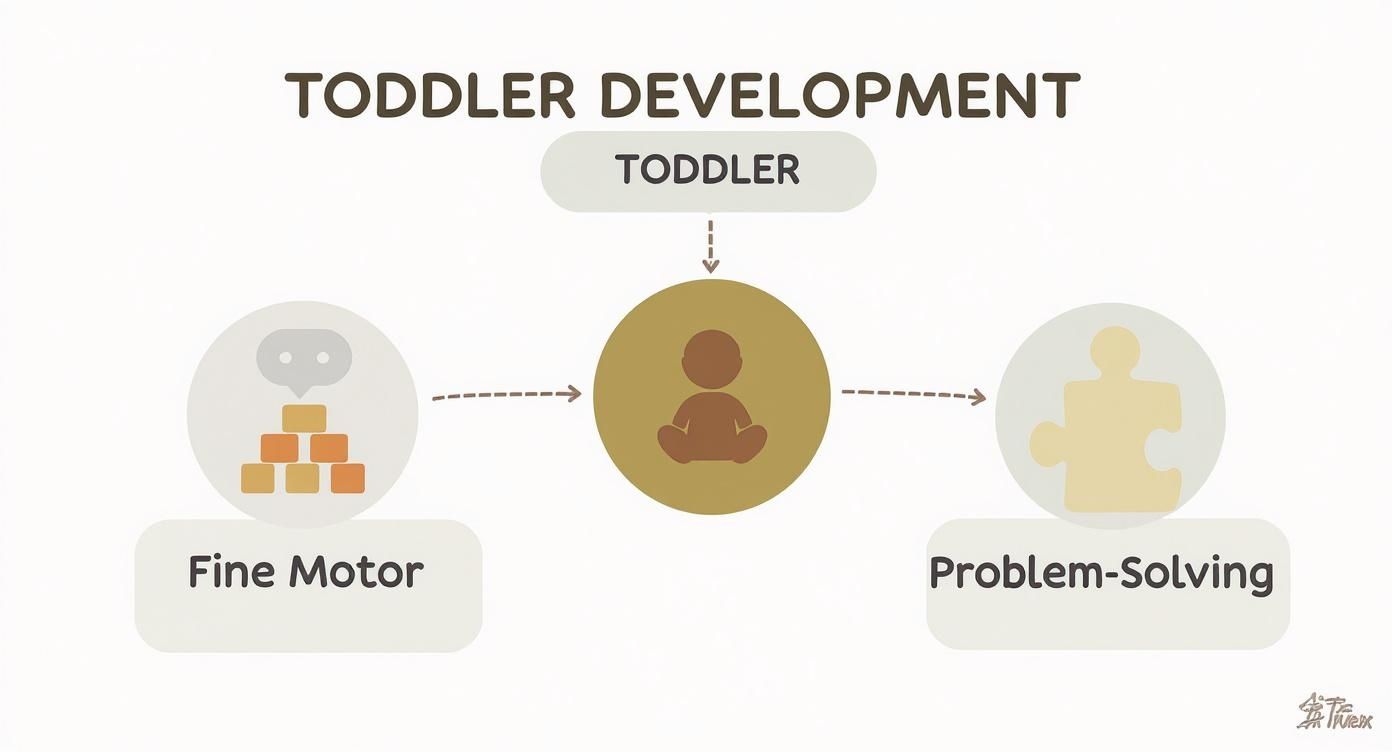
The image really highlights that purposeful play with the right toys can strengthen multiple areas of development at once, building a wonderfully well-rounded foundation for all their future learning.
Here are a couple of fantastic sensorial toys:
- Colour Tablets: Start with a box containing pairs of the primary colours (red, yellow, and blue). The task is wonderfully simple: match the pairs. This helps a child learn to visually tell the difference between colours, laying the groundwork for appreciating art and the natural world.
- Sound Cylinders: This is a set of cylinders that all look exactly the same but make different sounds when shaken. The child’s job is to listen carefully and find the matching pairs. It’s a wonderful activity for sharpening their hearing and teaching them to pay attention to subtle details.
For even more ideas on engaging your child's senses, take a look at our guide on the best sensory toys for 2-year-olds. These toys are about so much more than just play; they’re about building a more organised and detailed map of the world in your child's mind.
Toys for Language Development
That explosion of language around age two is one of parenting's most amazing milestones. Montessori toys are designed to support this by giving them concrete, realistic objects that they can attach new words to. It’s all about building a rich vocabulary that’s firmly grounded in the real world.
The Montessori approach believes in giving children the correct, precise vocabulary from the very beginning. So, instead of "doggie," we say "dog," and instead of "choo-choo," we say "train." This respect for both the language and the child's incredible "absorbent mind" is a cornerstone of the philosophy.
- Realistic Animal Figures: High-quality, true-to-life models of farm animals, sea creatures, or safari animals are fantastic for language. You can name them together, make their sounds, and eventually start sorting them by where they live. This builds vocabulary and early classification skills all at once.
- Story Cards: These are simple sets of cards that show a sequence of events—for example, a seed sprouting, growing, and finally becoming a plant. Laying them out in the right order helps your toddler grasp narrative structure, sequencing, and the concept of "first, next, then."
These language-focused materials give your child the words they need to describe their experiences and understand the world around them on a much deeper level.
Toys for Early Numeracy and Logic
While proper maths lessons are still years away, two-year-olds are already busy building the essential foundations for it. Montessori toys introduce big ideas like size, shape, and quantity in a tangible, hands-on way that just makes sense to them. They are specifically designed to spark logical thinking and problem-solving.
- Stacking Rings on a Vertical Dowel: A simple set of rings stacked from largest to smallest on a single peg is a classic for a reason. It gently introduces the concept of size and sequence. The toy is also "self-correcting"—if the rings are out of order, it won't look right, so the child can see the pattern and fix it themselves.
- Shape Sorters: Another classic! A simple sorter with just one or two shapes (like a cube and a sphere) helps a child understand that different objects have different properties. They learn to twist and turn the shapes to make them fit, which is brilliant for building spatial awareness and persistence.
These toys take abstract concepts and turn them into something your toddler can actually hold, feel, and manipulate. This creates a concrete understanding that will act as the bedrock for all their future mathematical learning.
Setting Up Your Montessori Play Space at Home
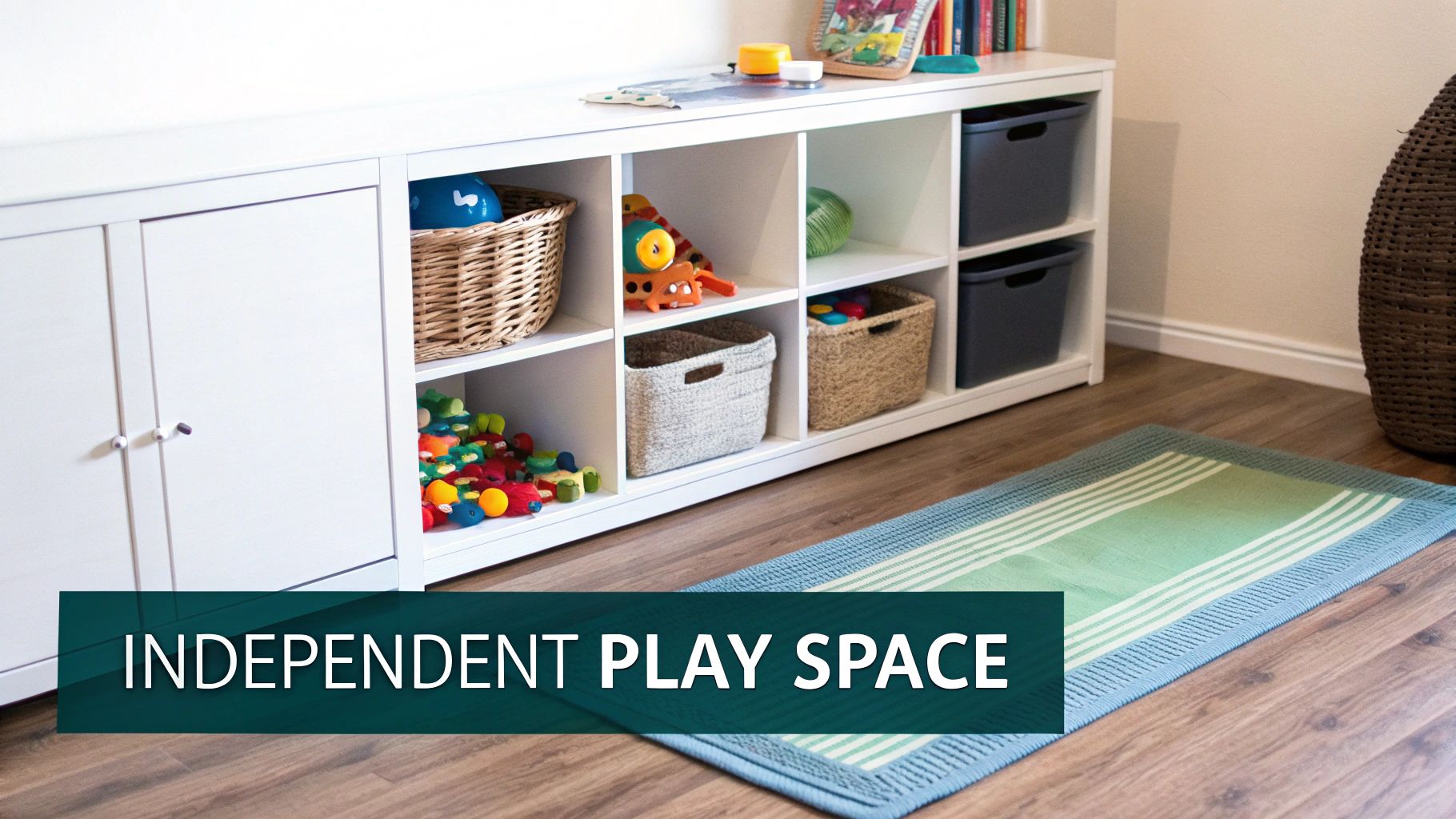
In the Montessori world, we often talk about the environment as the "third teacher," working right alongside you and your child's own curiosity. A thoughtfully prepared space does so much more than just contain toys; it actively invites your two-year-old to explore, focus, and discover their own abilities. The good news? You don’t need a huge house or a designer budget to create this kind of nurturing playspace.
The goal is wonderfully simple: create an ordered, accessible, and calm environment where your little one can truly flourish. This means stepping away from the classic, overflowing toy box and embracing a more intentional approach. When a child can see their choices clearly and reach for them without help, it’s a massive confidence boost that nurtures a natural sense of responsibility.
The Power of Low, Open Shelving
If you make just one change, let it be this: swap the deep toy chest for low, open shelves. Think about it—would you rather find a book in a jumbled pile or on a library shelf where you can see every title? For a toddler, a chaotic toy box is overwhelming. They often end up tipping the whole thing out just to find what they're looking for.
Low shelves, on the other hand, bring a sense of order and respect to their playthings. They allow you to display a small, curated selection of Montessori 2 year old toys, often presented on trays or in baskets. This simple act of presentation elevates the toys from mere clutter into purposeful activities, encouraging your child to engage on a much deeper level.
You don't need to buy special furniture, either. A low bookcase, a sturdy coffee table, or even the bottom shelf of your living room unit will work perfectly. As long as it's at your child's eye level, it empowers them with the freedom to choose their own "work" and, just as crucially, to put it away when they’re finished.
Embracing Simplicity and Order
A clutter-free space is a calm space. At two years old, your child's mind is already working overtime to make sense of the world. An overly stimulating environment can easily leave them feeling overwhelmed and unable to concentrate. By carefully choosing what to display, you’re helping them focus their incredible energy.
A key Montessori principle is "a place for everything, and everything in its place." This isn't about enforcing rigid tidiness; it's about creating a predictable environment where a child feels secure and capable. When they know exactly where their favourite puzzle belongs, they are empowered to care for their own space.
This organised approach isn’t just about aesthetics—it directly supports what we call the "sensitive period for order." Toddlers have an innate drive for consistency and logic, and a well-ordered play area meets this developmental need head-on. The result is less frustration and a more peaceful atmosphere for everyone.
Implementing a Toy Rotation System
Toy rotation is a beautifully simple idea with profound benefits. Instead of having every single toy out at once, you display a small selection—perhaps 6-8 activities—and store the rest away. Then, every week or two, you simply swap some of the toys on the shelf for ones from storage.
This system is a game-changer for several reasons:
- It Prevents Overwhelm: A limited number of choices helps a child focus and engage more deeply with each activity.
- It Keeps Things Fresh: Toys that have been packed away feel brand new when they reappear, sparking renewed interest and curiosity.
- It Encourages Mastery: Having an activity available for a week or more gives your child the time to return to it repeatedly, practising and eventually mastering the skill it teaches.
- It Makes Tidying Up a Breeze: With fewer items out, clean-up is faster and less daunting for both you and your toddler.
Setting up a toy rotation is easy. All you need are a couple of storage boxes kept out of sight. Pay attention to what your child is drawn to and what they're ignoring. The neglected toys are perfect candidates to be rotated out, making way for something that will capture their current developmental focus.
To help you visualise these changes, here’s a quick guide comparing a traditional setup to a Montessori-inspired one.
Montessori Home Setup Guide
| Element | Traditional Approach | Montessori Approach & Benefit |
|---|---|---|
| Toy Storage | A large toy box or deep bin where all toys are mixed together. | Low, open shelves. This allows children to see their choices clearly, promoting independence and making tidy-up logical and manageable. |
| Toy Selection | All toys are available at once, often leading to overstimulation. | A curated selection of 6-8 toys. This reduces overwhelm, encourages deeper focus on each activity, and makes toys feel novel. |
| Furniture | Adult-sized tables, chairs, and shelves. | Child-sized furniture. This empowers children by making the environment accessible and tailored to their physical needs, fostering autonomy. |
| Atmosphere | Often bright, loud, and cluttered with many distractions. | Calm, simple, and orderly. A neutral colour scheme and minimal clutter create a peaceful atmosphere conducive to concentration and learning. |
| Toy Presentation | Toys are often in their original packaging or loose in a pile. | Toys are displayed in baskets or on trays. This defines each activity, makes it inviting, and contains all the necessary pieces, teaching order. |
By making even a few of these small adjustments, you can create a space that not only looks more peaceful but also actively supports your two-year-old’s incredible journey of growth and discovery.
How to Choose Safe and Sustainable Montessori Toys
Picking the right Montessori toys for a 2-year-old isn't just about finding a beautiful wooden puzzle. The whole philosophy is built on a deep respect for both the child and their world. This means the safety, quality, and sustainability of a toy are just as crucial as its educational value.
When you bring a new toy home, you want to feel completely confident about it. That peace of mind comes from knowing what it's made of, how it’s built, and the values of the company behind it. It's about creating a healthy play space for your child now and supporting a healthier planet for their future.
Prioritising Natural and Non-Toxic Materials
There's a reason the Montessori approach has always favoured natural materials like wood, cotton, wool, and metal. It’s not just about looks; these materials offer a much richer and more honest sensory experience. Think about the satisfying weight of a solid wooden block, the varied texture of a cotton doll, or the cool touch of metal – they all give your child real, grounding information about the world.
Plastic, on the other hand, often feels uniform and artificial. More importantly, it can hide harmful chemicals. For a two-year-old who still loves to explore things with their mouth, safety is everything.
Look for toys made from:
- Solid wood: Hardwoods like beech or maple are great choices as they’re durable and less likely to splinter.
- Non-toxic finishes: Check that any paints, stains, or sealants are water-based and certified as child-safe.
- Natural fibres: For soft toys or fabric elements, stick to organic cotton, wool, or silk.
This mindset of choosing safer materials can extend to all parts of your child's life. It’s the same logic you might apply when looking for non-toxic school supply swaps.
Checking for Quality and Durability
A well-made Montessori toy is an investment. It’s not meant for a few minutes of play before being forgotten; it's designed to be used over and over again, eventually mastered, and maybe even passed down. Durability is a hallmark of a truly high-quality, sustainable toy.
A toy that breaks easily not only creates waste but can also become dangerous, with small or sharp parts. True Montessori materials are built to withstand the enthusiastic, hands-on exploration of a toddler.
Before buying, give the toy a good once-over. Are the edges smooth and well-sanded? Are all the small parts attached securely? Does it feel sturdy enough to handle a bit of rough and tumble? This focus on quality ties directly into the Montessori principle of having fewer, better things.
The Importance of Purposeful Design
Finally, a toy’s safety is closely linked to its design. Montessori materials are intentionally simple, with each one focusing on a single concept or skill. This purposeful approach helps prevent your child from feeling overwhelmed and reduces the chance of the toy being used improperly, which makes it inherently safer.
Many of these toys also lay the groundwork for understanding abstract ideas later on, like mathematics. For example, a simple set of stacking rings introduces concepts of size and order—the very first steps in numeracy. A report from the Every Child a Chance Trust found that 30,000 children in the UK leave primary school unable to do simple calculations, which really underscores how vital this early foundation is.
Your Top Montessori Toy Questions Answered
Diving into the world of Montessori is an exciting step, but it’s completely normal for a few questions to pop up along the way. When you're trying to create the best possible play environment for your little one, you want to get the details right. Here are some straightforward answers to the questions I hear most often from parents about Montessori toys for two-year-olds.
Remember, this isn't about sticking to a strict rulebook. It's about using these ideas to create a space that feels right for your child and your family.
How Many Toys Does My Two-Year-Old Actually Need?
This is the big one, and the answer often surprises people: far fewer than you probably imagine. The Montessori philosophy is all about quality over quantity. Instead of a room overflowing with options, the aim is to have a small, carefully chosen selection of around 6 to 8 purposeful activities out and available at any given time.
Why so few? A limited choice prevents that feeling of being overwhelmed and helps your child focus and engage more deeply with each toy. This is how they build concentration and achieve that wonderful sense of mastery, which is much more beneficial than just bouncing from one distraction to the next. A simple toy rotation system is your best friend here, keeping that small collection feeling new and engaging.
Honestly, Aren't Montessori Toys a Bit Boring?
I get it. When we're used to toys that flash, beep, and sing, a simple wooden puzzle can seem a bit plain. But it's so important to see the difference between a toy that entertains passively and one that invites active engagement. A toy that does all the work doesn't leave much for a child to do besides watch.
Montessori toys are simple on purpose. They're designed to be a starting point, a spark for your child’s own imagination and problem-solving. The toy doesn’t put on a show for the child; the child brings the toy to life. That’s where the real, satisfying play happens.
So no, they aren't boring. They’re a blank canvas for your little one's incredible, developing mind.
Can I Mix Montessori Toys with My Child's Other Toys?
Of course! Bringing Montessori principles into your home doesn't have to be an all-or-nothing commitment. Most families find a happy medium that fits their lifestyle perfectly. It’s absolutely fine to have a dedicated shelf for Montessori activities right alongside a basket for their favourite dolls, toy cars, or LEGOs.
The real secret is being intentional. Think about how your child's play area is set up. By creating a specific, accessible home for their Montessori toys, you're still offering that calm, ordered environment that helps them focus, even when other toys are part of the picture.
Ready to build a thoughtful toy collection without the stress and guesswork? The Grow With Me subscription box delivers beautiful, stage-based Montessori toys right to your doorstep, perfectly timed for your two-year-old’s development. Find your first play kit at https://shop.growwithmesubscriptionbox.co.uk.