
Your Guide to Great Learning Toys for 1 Year Old Toddlers
The best learning toys for a one year old are the ones that get all their senses buzzing, help them through those big developmental leaps, and invite them to get their hands on everything. Think of the classics: stacking rings, chunky puzzles, and a sturdy push walker. These toys have stood the test of time because they’re brilliant at sparking curiosity and building those all-important first skills.
The Power of Play for Your One Year Old
Welcome to the whirlwind world of being one! This is an age where every single interaction is a brand-new discovery, and play is the most important job your little one has. Learning at this stage isn't about flashcards or formal lessons; it's about figuring out the world by touching, hearing, and moving through it. The right toys are simply the tools that help them make sense of it all.
When we talk about “learning toys,” we’re really talking about things that feed their natural desire to explore. These toys are designed to support the huge changes happening between 12 and 18 months, from perfecting that pincer grasp to taking those first wobbly steps.
Why Play Is Serious Learning
For a toddler, stacking a tower of blocks isn't just a game. It's a mini-physics lesson in balance and gravity. Every time they try to fit a shape into a sorter, they're getting an early workout in problem-solving and spatial awareness. This kind of hands-on, active play builds critical connections in their rapidly growing brain, laying the foundation for all the learning that's yet to come.
It's this understanding that has more and more parents looking for toys with real developmental benefits. In the UK, the baby toys market hit an impressive $1030.0 million in 2024, and it's expected to climb to $1550.0 million by 2035. This boom is largely thanks to the demand for educational toys that build foundational skills. You can read the full research on the UK baby toys market to learn more.
Play is often talked about as if it were a relief from serious learning. But for children, play is serious learning. Play is really the work of childhood.
This idea is at the heart of how we choose the best toys. It’s not about hunting down the flashiest gadget with all the bells and whistles. It’s about finding simple, effective tools that invite your child to explore, experiment, and grow.
To help you get started, here’s a quick summary of the key toy categories that really shine at this amazing age.
Key Toy Categories for Your One Year Old
This table breaks down the most effective types of toys for toddlers between 12 and 18 months, highlighting the main skills each one helps to develop.
| Toy Category | Main Developmental Benefit | Classic Toy Example |
|---|---|---|
| Building & Stacking | Fine motor skills and spatial awareness | Wooden blocks or stacking rings |
| Puzzles & Sorters | Problem-solving and hand-eye coordination | Chunky knob puzzles or shape sorters |
| Push & Pull Toys | Gross motor skills and balance | Push walkers or pull-along animals |
| Sensory & Musical | Auditory and tactile exploration | Textured balls or a simple xylophone |
Having a few great options from each of these categories gives your little one a wonderfully well-rounded "play diet" to support their development from all angles.
Understanding Your One-Year-Old’s Developmental Leaps
Watching a one-year-old figure out their world is like witnessing a series of tiny, brilliant explosions of discovery. Every single day brings a new skill, a fresh connection, and a major leap forward in their journey. It's so much more than a rigid checklist of milestones; think of it as a beautiful, interconnected dance of growth.
The toys you choose can either support or sideline this incredible process. A simple set of blocks isn't just a toy; it’s a hands-on lesson in physics. A pull-along duck isn’t just a companion; it's a little coach for balance and coordination. Choosing great learning toys for a 1 year old is really about finding the tools that meet them exactly where they are at that moment.
Mastering Movement, Big and Small
One of the most obvious changes you’ll see is in how they move. This period is all about getting to grips with two very different types of motor skills, and each one is supported by different kinds of play.
-
Gross Motor Skills: These are the big, whole-body movements. Think of your little one pulling themselves up on the sofa, cruising along furniture, and eventually taking those triumphant, wobbly first steps. Push walkers and soft play blocks are perfect for building the strength and confidence they need for these huge achievements.
-
Fine Motor Skills: These are the small, precise movements of the hands and fingers. You’ll see this when they graduate from grabbing with their whole palm to delicately picking up a single pea with their thumb and forefinger—that famous pincer grasp. Chunky puzzles, stacking rings, and shape sorters are fantastic for refining this delicate control.
This visual timeline shows how a child's relationship with toys evolves, starting with curiosity and building towards more advanced motor skills and, eventually, creativity.
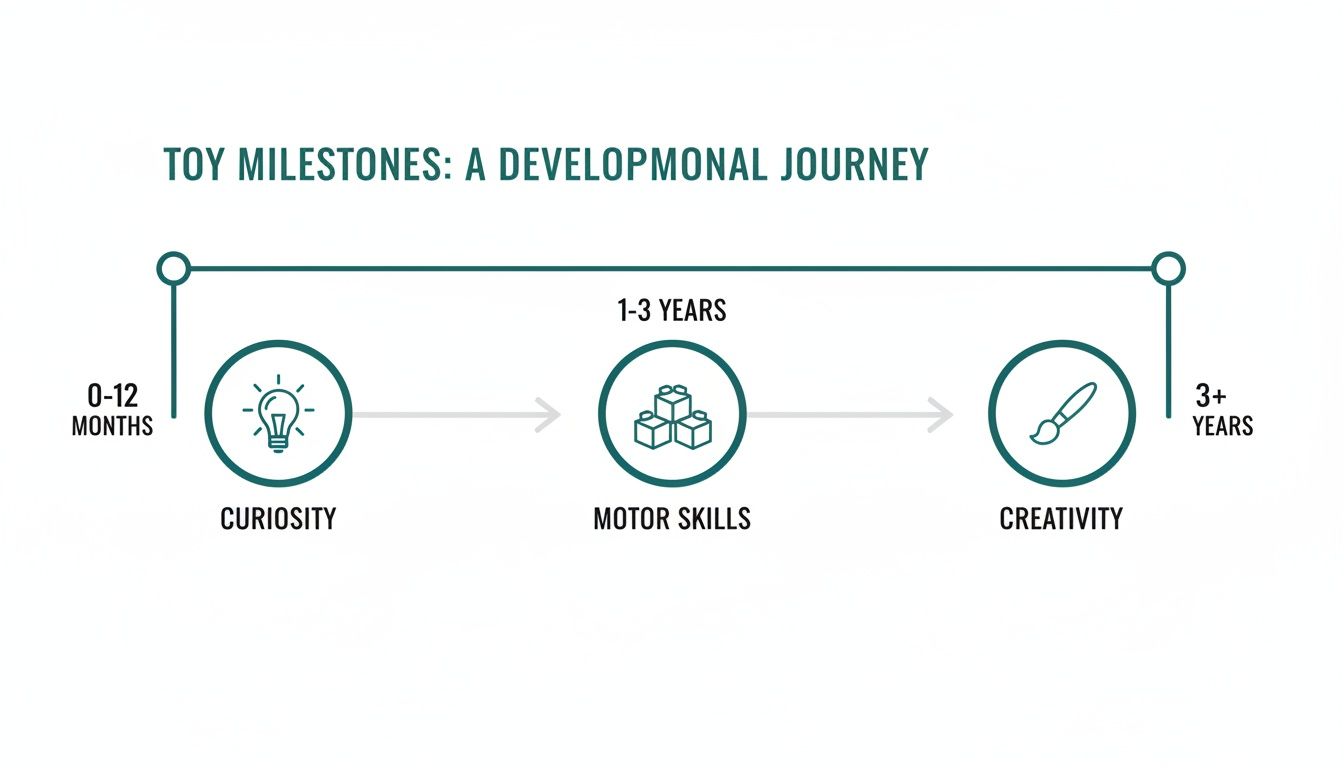
You can see how early sensory exploration really lays the groundwork for the more complex physical and imaginative play that defines the toddler years.
The Spark of Cognitive Growth
While their bodies are busy getting stronger, their brains are making connections at an astonishing rate. This is the age of cause-and-effect thinking, that "aha!" moment when they realise their actions make things happen. Pushing a button to hear a sound or dropping a block to hear it clatter isn't just them making noise—it's an experiment.
"Play is often talked about as if it were a relief from serious learning. But for children, play is serious learning. Play is really the work of childhood."
This is exactly why toys that react to what they do, like pop-up toys or simple musical instruments, are so captivating. They empower your child, teaching them that they have an impact on their environment. It might seem like a simple lesson, but it’s a cornerstone for all future problem-solving.
The Dawn of Language
Finally, communication really begins to blossom. Long before they can actually say "ball," they can point to it. Their babbling starts to take on the rhythms of real conversation, and you’ll notice they understand far more words than they can speak.
Their first words often pop up in the context of play. Simple board books with clear pictures of familiar objects, like a cat or a car, give you the perfect chance to name things. Animal sound puzzles and toy phones also encourage imitation and turn-taking, which are the fundamental building blocks of having a chat. Every little interaction you have with them during playtime is a language lesson in disguise.
How to Choose Toys for Sensory and Motor Skills
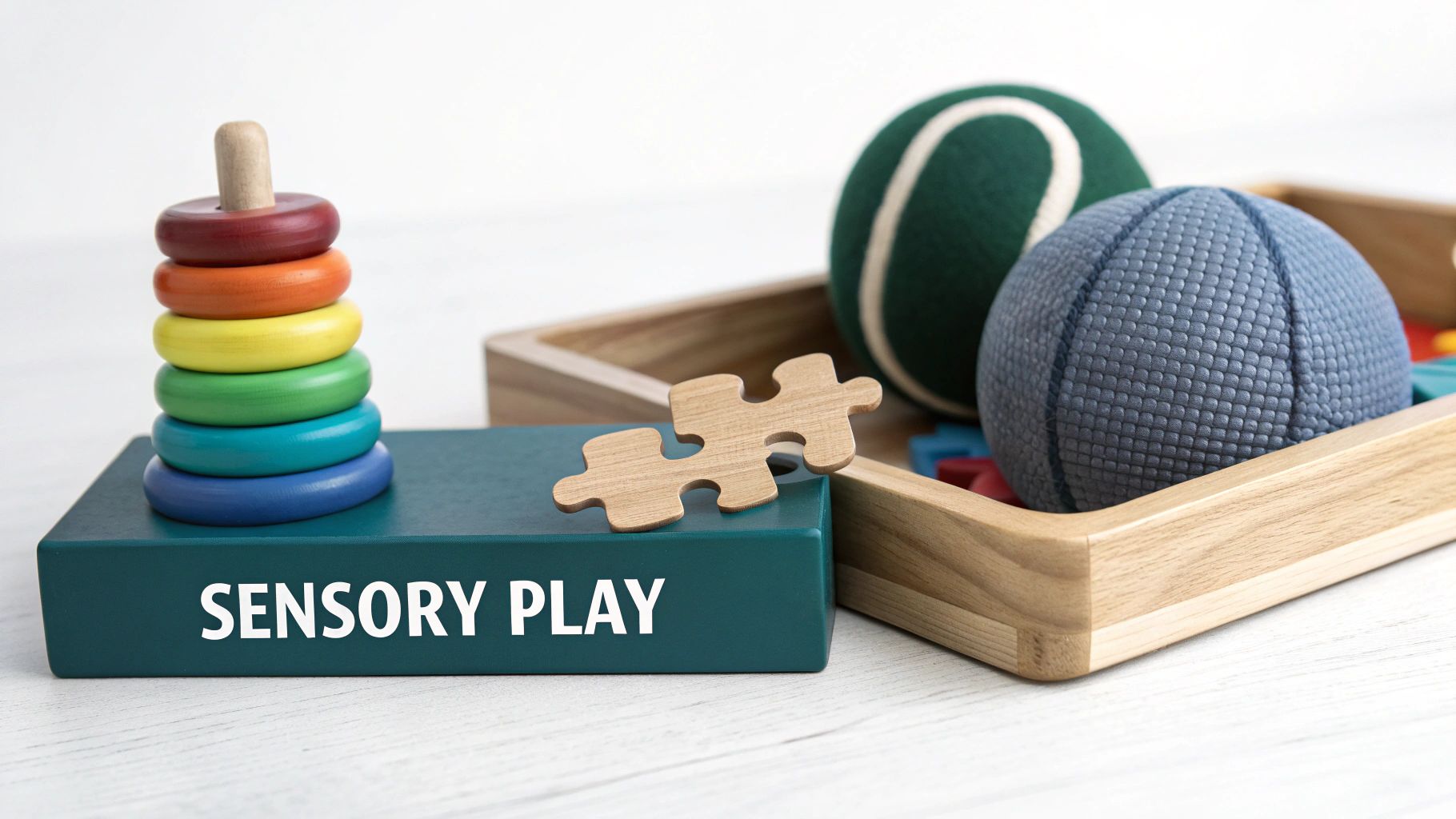
Choosing toys for a one-year-old feels a bit like being a personal trainer for their brain and body. You’re looking for just the right tools to challenge and strengthen their sensory processing and motor control—the absolute bedrock of all future learning.
Think of sensory toys as your little one’s first language. They learn about the world by touching, hearing, seeing, and even tasting it. Toys with different textures, gentle sounds, and vibrant colours feed their brain a constant stream of information, helping to build and strengthen neural pathways. Every crinkle, rattle, and bump is a new piece of data helping them figure things out.
This rich sensory input isn't just about keeping them busy; it’s about giving their brain the high-quality information it craves to grow. It’s no surprise that in the UK, parents are focusing more on this kind of foundational development. They're seeking out sensory and educational toys, which has helped the infant/preschool segment become the largest part of the £13,948.24 million toy market in 2024. This boom is all about toys like shape sorters and activity cubes that foster crucial sensory integration.
Building Strength and Precision
While sensory toys feed the brain, motor skill toys train the body. At this age, you’re supporting two different kinds of physical development, and the right great learning toys for a 1 year old will target each one perfectly.
Fine Motor Skills
These are all about the small, precise movements of the hands and fingers. You see these skills emerging when your toddler meticulously picks up a single crumb or learns to point at what they want. Toys that encourage this refinement are key.
- Chunky Puzzles: Those little knobs on puzzle pieces are brilliant for practising the pincer grasp.
- Shape Sorters: These require real hand-eye coordination to turn and fit the pieces into the right slots.
- Stacking Rings: Sliding a ring onto a post is a fantastic way to develop wrist control and precision.
"The hands are the instruments of man's intelligence." - Maria Montessori. This sums it up perfectly. When a child is manipulating an object, they aren't just playing; they are actively thinking and learning with their hands.
If you're looking for more ways to support this, there are lots of practical fine motor skills activities that can give their coordination a boost.
Gross Motor Skills
These are the big, whole-body movements—pulling up to stand, cruising along the furniture, and taking those first wobbly steps. The right toys build strength, balance, and, most importantly, confidence.
- Push Walkers: These offer stability and support as your little one finds their feet, giving them the confidence to explore.
- Soft Play Blocks: Large, lightweight blocks are great for encouraging climbing, building, and lifting, which strengthens their core and limbs.
- Ride-On Toys: Low-to-the-ground ride-ons help develop leg strength and coordination as they learn to scoot themselves forward.
By choosing a good mix of toys that hit both sensory and motor development, you create a play environment that truly supports your child’s all-round growth. For more ideas on this topic, check out our guide on sensory toys for babies. The right toys act as catalysts, turning simple playtime into powerful opportunities for learning and discovery.
Nurturing Early Problem-Solving and Language
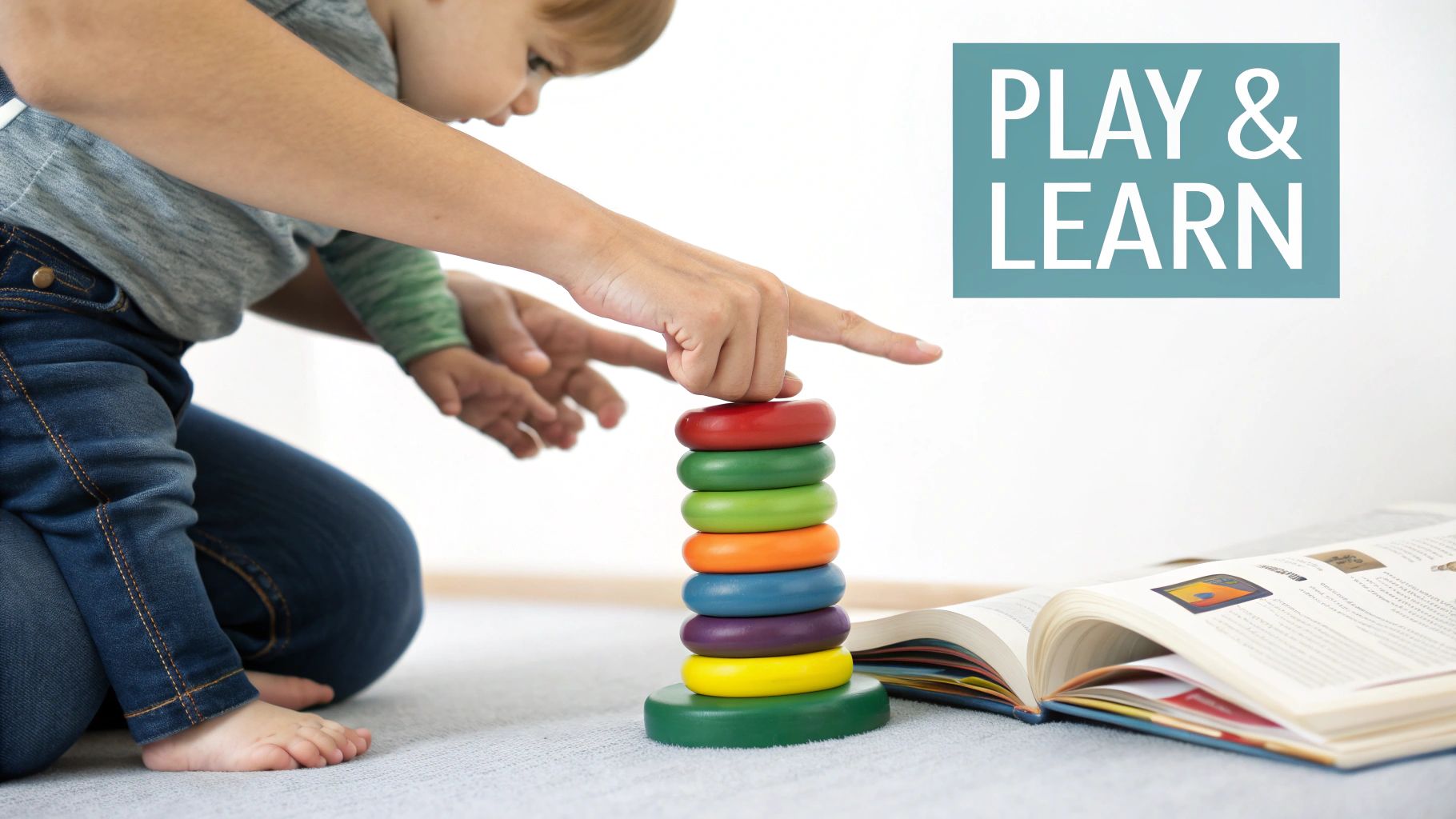
Beyond helping them get steady on their feet, the right toys can act as brilliant little tutors for your one-year-old’s rapidly developing mind. This is the age where they truly start to grasp the magic of cause and effect—that wonderfully simple but profound realisation that their actions can make things happen.
Toys that react when they’re touched are perfect for this. Think of a pop-up toy where pushing a button makes a friendly animal appear, or a simple xylophone where a tap creates a sound. These aren’t just fun; they’re powerful first lessons in logic. Every single interaction teaches them, "If I do this, then that happens," which is a bedrock skill for all future problem-solving.
From Stacking Rings to First Words
That little cognitive spark also ignites their ability to tackle simple challenges. Classic great learning toys for a 1 year old, like stacking rings and basic shape sorters, are so much more than just colourful objects. They are your child's first puzzles, encouraging them to figure out order, size, and how things fit together through lots of trial and error.
As they work to slide a ring onto a post or nudge a block into its slot, they’re building their persistence and logical thinking. Our article on puzzles for one-year-olds goes deeper into how these simple activities build such crucial cognitive skills.
The most effective toys at this age don't do the work for the child. Instead, they invite them to become an active participant, a thinker, and a problem-solver in their own right.
This hands-on approach is just as vital for their language development. While their own vocabulary is just starting to bubble up, their understanding is growing by the day. You’ll find the best language-building "toys" are often the simplest and most interactive.
Fostering Language Through Play
Board books are absolute superstars here. Look for sturdy books with large, clear pictures of familiar things—a ball, a dog, a car. Pointing to the picture and saying the word out loud creates a direct and powerful link between the image and its name.
This simple act turns reading into a conversation. You can nurture this growth with just a few easy techniques:
- Narrate Their Play: As they play, talk about what they're doing. "You're putting the red block on top!" or "You pushed the car so fast!"
- Encourage Pointing and Naming: Toys with animals or household objects are perfect for this. Ask, "Where is the cow?" and celebrate with them when they point.
- Embrace Animal Sounds: Making animal noises is a fun, low-pressure way for them to practise making different sounds and mimicking you.
To help them build emotional literacy alongside their language skills, you might want to explore books about feelings for toddlers, which use simple stories to help them make sense of big emotions. Every interaction, every shared book, and every playful moment is building that foundation for communication.
Your Guide to Toy Safety and Quality Materials
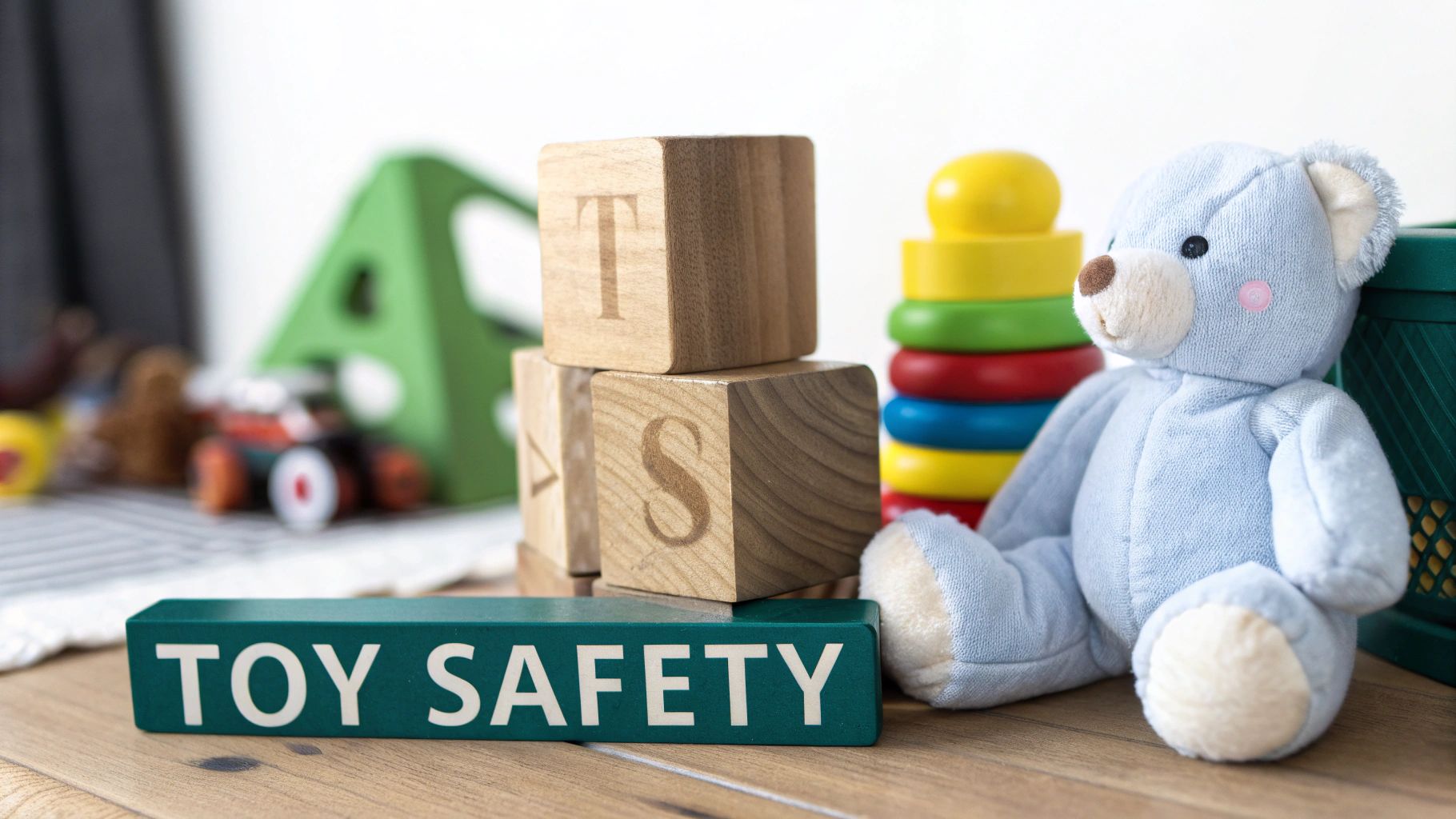
When you're choosing a toy for a one-year-old, there's one thing that trumps all else: safety. Toddlers are brilliant little explorers, and their first port of call for investigating a new object is usually their hands and, inevitably, their mouth. Every toy that crosses your threshold has to be ready for some serious, up-close inspection.
Before you even think about the colour or what it does, give it a once-over for small parts. Here's a classic trick that never fails—the toilet paper roll test. If any part of a toy can fit through the cardboard tube, it's a potential choking hazard. You should also run your hands over it to check for any sharp edges or points and make sure battery compartments are screwed tightly shut.
The Beauty of Natural Materials
There's a real shift happening among parents towards toys made from natural, sustainable materials like wood and organic cotton, and it's easy to see why. Not only are they kinder to the planet, but they also give children a sensory experience that plastic simply can't replicate. They're built to last, are a doddle to clean, and don't contain nasty chemicals.
There's a certain peace of mind that comes with high-quality, natural materials. When you hand your child a toy made from solid wood with a non-toxic finish, you know it's safe for even the most enthusiastic play.
This preference for quality isn't just a feeling; it's backed by the numbers. The UK's infant and preschool toy sector—the sweet spot for one-year-olds—is a cornerstone of the £2.0 billion toy market projected for 2025-26. Parents are deliberately seeking out learning toys, like those found in curated kits, which often favour sustainable wooden stackers and sensory toys made from natural fabrics.
Opting for well-made toys is an investment in play that lasts. If you want to dive deeper into why so many families are going back to basics, you can learn more about the benefits of wooden toys in our guide. It unpacks how these timeless classics support development while offering unbeatable safety and durability.
Ready to Take the Guesswork Out of Playtime?
Let’s be honest, keeping up with your little one’s development can feel like a full-time job. Just when you think you’ve figured out what fascinates them, they’re off on a new adventure, mastering a new skill, and leaving you scrambling to find the right toy for the right moment.
What if you had a child development expert in your corner, hand-picking the perfect great learning toys for a 1 year old and sending them straight to your door? That’s the simple, brilliant idea behind a stage-based toy subscription.
These services deliver curated play kits that are perfectly timed to align with where your child is right now. Each box is a treasure trove of high-quality, age-appropriate toys designed to nurture their latest developmental leap, from perfecting that delicate pincer grasp to building the confidence for those first triumphant steps.
For parents, a stage-based subscription is more than just a convenience. It’s like having a supportive partner on your parenting journey, ensuring every toy is purposeful, safe, and ready to spark meaningful play right when it matters most.
The benefits are huge. You get back your precious time and energy, sidestep the endless playroom clutter, and feel confident that every play session is helping your child grow. Many of these subscriptions also prioritise beautiful, natural materials and come with play guides that explain the developmental "why" behind each item.
It's a beautifully simple way to make learning through play an effortless, impactful part of your daily routine. Every moment becomes a rich opportunity for discovery, without any of the stress.
Your Questions Answered: Choosing Toys for a One-Year-Old
Stepping into the world of toddler toys can feel a bit overwhelming, and it’s completely normal to have questions. You're not alone! Here are some straightforward answers to the questions we hear most often from parents trying to find the best learning toys for their one-year-old.
How many toys does my one-year-old actually need?
When it comes to your toddler’s toy collection, it’s all about quality over quantity. In fact, child development experts often suggest keeping a core collection of just 8-10 high-quality, open-ended toys. This helps prevent your little one from feeling overwhelmed and encourages them to dive deeper and play more creatively with each item.
A brilliant way to manage this is with a toy rotation. Simply swap out a few toys every week or so. It keeps their small collection feeling new and exciting, which does wonders for their focus and imagination—far more than a huge pile of toys ever could.
Are electronic toys with all the lights and sounds good for this age?
Those flashy, noisy toys are certainly great at grabbing a child's attention, but they often put the child in a passive role. The toy does all the work, and your little one just watches. At this age, the best toys are the ones that require them to get actively involved—to push, pull, stack, and figure things out for themselves.
The most powerful toys for a one-year-old don't perform for the child. They invite the child to become an active participant, a thinker, and a problem-solver.
Classic, hands-on toys like wooden blocks or textured sensory balls inspire so much more genuine exploration and creativity. It’s best to make these the star of the show and use the electronic gadgets more sparingly.
How do I know when my child is ready for more complex toys like puzzles?
The simplest answer is to let your child be your guide. You'll start to see little signs. When they consistently master a toy—easily popping a shape into a sorter every time or stacking a few rings without any trouble—they're showing you they're ready for the next step.
That’s your cue to introduce something a little more challenging, like a simple three-piece puzzle or a set of blocks that lets them stack even higher. The trick is to introduce new things gradually, building their confidence without causing frustration. Just watch them play; they’ll tell you everything you need to know.
Ready to find toys that are perfectly matched to your child's development? Grow With Me delivers expertly curated play kits designed for your one-year-old's exact stage, taking all the guesswork out of playtime. Explore our stage-based play kits today.