
Educational Toys for 3 and 4 Year Olds A Parent Guide
The best educational toys for 3 and 4 year olds are the ones that meet them right where they are developmentally. It's about turning their natural playtime into a powerful, hands-on learning experience. Think open-ended toys like building blocks, art supplies, and role-playing sets—these are the tools that spark imagination, sharpen fine motor skills, and build real-world understanding, all through the joy of play.
The Power of Play in Early Learning
At ages three and four, a child's world is bursting with curiosity. This isn't just a phase; it's a golden age for learning, where every game becomes a lesson in disguise. Educational toys are so much more than simple playthings during this time—they're essential tools that translate fun into foundational skills for life.
Picture each toy as a unique key. A set of colourful building blocks is a key that unlocks the part of the brain responsible for spatial reasoning and even basic physics. A pretend kitchen set opens the door to social skills, communication, and storytelling. The right toy makes abstract concepts like cause-and-effect feel intuitive and exciting, not like a formal lesson.
Turning Playtime into Progress
The real magic of a good educational toy is its ability to meet a child where they are and nudge them forward, all while they're having fun. Instead of learning through rigid instruction, children discover core concepts organically. A simple jigsaw puzzle, for example, isn’t just about matching shapes. It’s a hands-on lesson in:
- Problem-Solving: Working out which piece fits where.
- Fine Motor Skills: Grasping and manipulating the small pieces.
- Persistence: Trying again and again until the picture comes together.
This kind of play builds not just knowledge, but also confidence and a healthy attitude towards challenges. We dive deeper into creating these moments in our guide on play-based learning activities. It helps shift the focus from just buying a toy to choosing a tool that really nurtures your child’s natural curiosity.
Play is the highest form of research. It’s through joyful exploration that children make their most profound discoveries about themselves and the world around them.
The impact of this approach is huge, and parents are taking notice. The UK educational toy market reached an estimated USD 4,050.1 million in 2023, which shows just how much we value these tools. Building and construction sets led the way, making up 21.26% of revenue, mainly because they are absolute masters at developing motor skills, early STEM thinking, and spatial awareness in young children.
Ultimately, the goal is to give your child toys that are catalysts for exploration. By choosing wisely, you're setting the stage for a lifelong love of learning and turning their developmental journey into a thrilling adventure.
Decoding Developmental Milestones at Ages 3 and 4
Trying to understand your child's growth can feel like navigating a complex map without a compass. It doesn't have to be that way. At ages three and four, children go through an incredible surge in development across four key areas. By recognising these milestones, you can confidently choose educational toys for 3 and 4 year olds that perfectly match where they are right now.
Think of these developmental areas as the four pillars supporting your child's growth. Each one is distinct, yet they all work together to build a strong foundation for future learning. Just as a building needs a solid base, a child needs balanced development across all pillars to truly thrive.
Cognitive Leaps and Problem-Solving Skills
This is the age where your child's inner scientist and detective really come to life. Cognitive development is all about thinking, reasoning, and figuring out how the world works. You’ll see it when your three-year-old meticulously sorts their toys by colour, or when your four-year-old can follow a simple, two-step instruction like, "Please pick up the blocks and put them in the box."
Their memory is also expanding at a remarkable pace. Suddenly, they're singing a song from nursery or recalling a tiny detail from a story you read last week. This is also when 'why?' becomes their absolute favourite question, signalling a deep curiosity and a drive to understand cause and effect.
Puzzles, simple board games, and sequencing toys are brilliant for nurturing these budding skills. They encourage children to think strategically and see a task through to the end, building crucial persistence along the way.
Physical Growth and Motor Skills
Physical milestones are often the easiest to spot. You'll see it in the big, energetic movements of running and jumping, as well as the delicate precision of their little hands. This development is split into two crucial categories.
- Gross Motor Skills: These are all about the large muscle groups. At this age, children are mastering skills like hopping on one foot, kicking a ball with real purpose, and scrambling up playground equipment with newfound confidence.
- Fine Motor Skills: These involve the small, precise movements of the hands and fingers. You’ll notice this when your child can build a surprisingly tall tower of blocks without it toppling, use child-safe scissors to snip paper, or start holding a crayon with their fingertips instead of a clenched fist.
This infographic shows how purposeful play can nurture a child's problem-solving and social abilities from a young age.

As the diagram illustrates, a well-chosen toy box provides the tools for children to develop both cognitive and interpersonal skills simultaneously.
To help you connect the dots, here’s a quick guide matching developmental areas with the kinds of toys that support them best.
Matching Toys to Developmental Skills for 3-4 Year Olds
| Developmental Area | Skills Targeted | Recommended Toy Types |
|---|---|---|
| Cognitive | Problem-solving, memory, sorting, cause & effect | Jigsaw puzzles, building blocks, shape sorters, simple board games, memory matching cards. |
| Physical (Gross Motor) | Balance, coordination, strength | Tricycles, scooters, balls of various sizes, climbing frames, tunnels. |
| Physical (Fine Motor) | Hand-eye coordination, dexterity, pincer grasp | Play-doh, lacing beads, child-safe scissors, large crayons/pencils, construction toys (e.g., Duplo). |
| Social & Emotional | Empathy, sharing, turn-taking, role-playing | Dolls, action figures, play kitchens, dress-up clothes, doctor's kits, puppets. |
| Language | Vocabulary, sentence structure, storytelling | Picture books, alphabet puzzles, magnetic letters, storytelling puppets, toy telephones. |
This table makes it easier to see how a simple toy can be a powerful tool for building foundational skills.
Social and Emotional Awareness
Between the ages of three and four, children start to navigate the wonderfully complex world of emotions and friendships. They are gradually moving from parallel play (playing alongside others) to more cooperative play, where they begin to share toys and take turns. This transition isn't always smooth, but it’s a vital part of their development.
They're also starting to understand and name their own feelings, as well as recognise emotions in others. You might see this when your child offers a spontaneous hug to a crying friend or clearly expresses that they feel "sad" or "happy." Role-playing toys like kitchen sets or doctor's kits are fantastic for exploring these social dynamics in a safe, imaginative space. For a deeper look, our guide on the stages of child development by age offers more detailed insights.
Language and Communication Explosion
The leap in language skills at this age is nothing short of amazing. Their vocabulary can explode from a few hundred words to well over a thousand. You'll also notice them speaking in longer, more complex sentences of five or six words.
They become fantastic storytellers, even if their tales joyfully blend reality and imagination. This is also when they start to grasp and use the basic rules of grammar. Educational toys that involve letters, sounds, and storytelling—like alphabet puzzles or picture cards—can make this language journey even more exciting, setting them up for a future love of reading.
Choosing the Right Types of Educational Toys
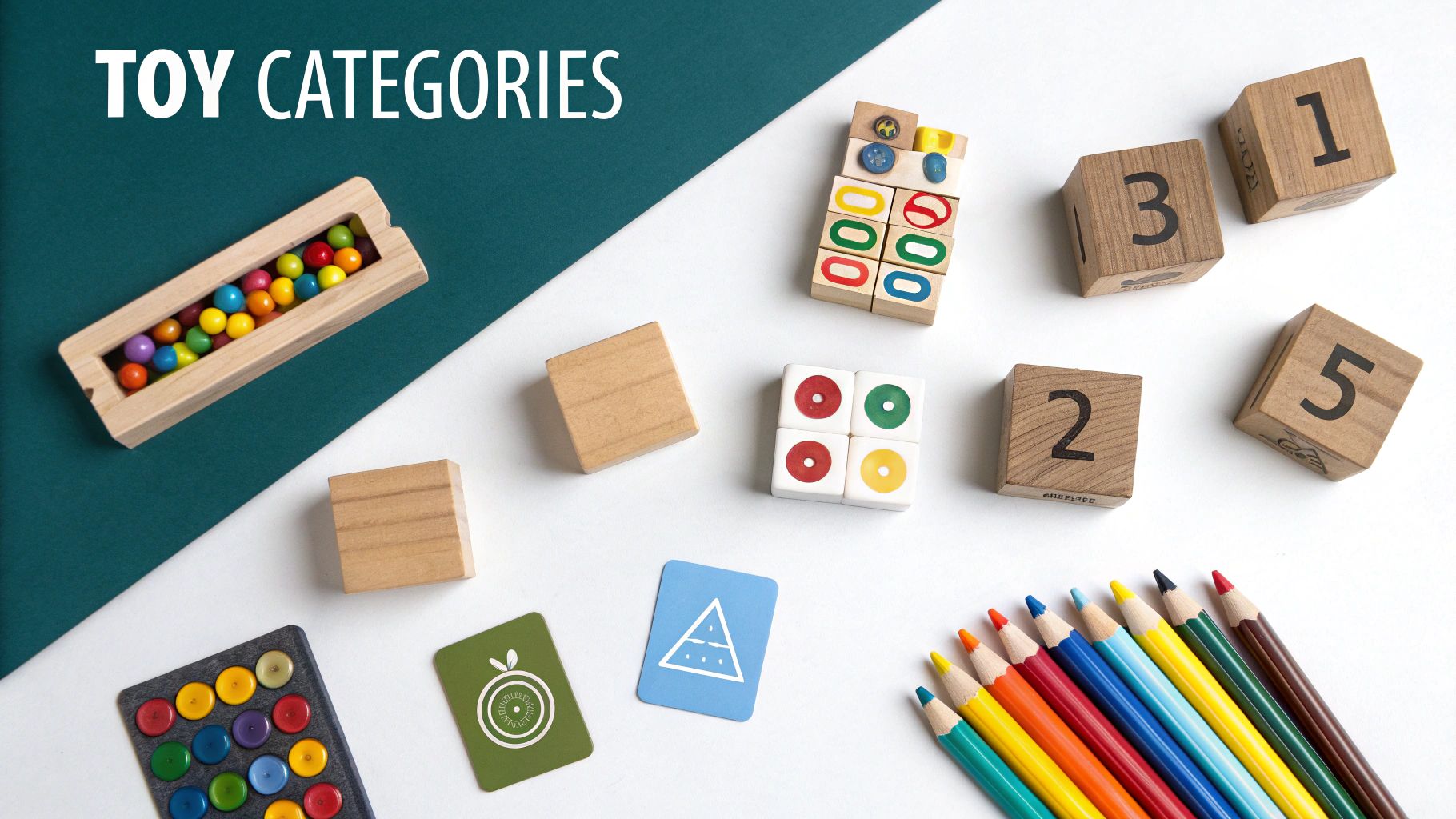
Walking into a toy shop can be overwhelming, can't it? Walls lined with colourful boxes, all promising to be the magic bullet for your child's development. The secret to cutting through the noise is to think less about the toy itself and more about the kind of play it inspires. By breaking down educational toys for 3 and 4 year olds into a few key categories, you can pick things that not only grab your child's interest but also support them as a whole person.
Think of it like planning a healthy meal. A child needs a varied "play diet" to nurture different skills, from scientific curiosity to emotional intelligence. Focusing on just one area is fine, but giving them a taste of everything is what helps build a well-rounded, capable little human.
It’s clear parents are catching on to this more thoughtful approach. Educational toys for this age group are one of the fastest-growing areas in the UK toy market. There's a huge demand for screen-free, hands-on toys that get kids thinking and doing—whether that’s through building, pretending, or just getting their hands messy.
Getting Hands-On with STEM Toys
STEM might sound a bit formal for a preschooler, but it simply stands for Science, Technology, Engineering, and Maths. The brilliant thing is that the foundations for these big ideas are often built with the most classic, simple toys. It’s all about exploring how things work, testing theories, and discovering basic principles through play.
For a three or four-year-old, a humble set of wooden blocks is a masterclass in engineering. Every time they stack a tower and watch it wobble or fall, they're getting a real-world lesson in balance, gravity, and structure. Magnetic tiles take this a step further, making concepts like magnetism and geometry feel like pure magic.
- Building Blocks: Perfect for teaching balance, symmetry, and spatial awareness.
- Magnetic Tiles: Introduce magnetism, geometry, and the basics of 3D construction.
- Simple Science Kits: Nurture curiosity with safe experiments, like planting a seed or mixing paint colours.
- Counting Toys: Make maths concrete with fun things like counting dinosaurs or colourful stacking rings.
These toys all spark that "what if...?" question in a child's mind, which is the heart of all scientific thinking.
Exploring Big Feelings with Creative Arts
Art-based toys are about so much more than making something pretty to stick on the fridge. They're fundamental for self-expression and for developing fine motor skills. Gripping a chunky crayon, guiding a paintbrush, or squishing play-doh all strengthen the tiny muscles in your child's hands and fingers, getting them ready for writing later on.
The benefits go deeper than just the physical, though. Art gives children a way to express feelings and ideas they don't yet have the words for. There’s no right or wrong way to create, which is a fantastic confidence booster that celebrates their unique way of seeing the world.
The creative adult is the child who survived. Art-based play isn't about creating a masterpiece; it's about giving your child the freedom to explore their imagination without limits.
Building Worlds with Words and Stories
Language skills are absolutely exploding at this age. The right toys can turn the journey towards literacy into a brilliant game rather than a chore. The goal isn’t to formally teach them to read, but to foster a genuine love for words, sounds, and stories.
Alphabet puzzles, for example, let children feel and recognise the shapes of letters. Story cards or puppets encourage them to make up their own tales, building vocabulary and sentence structure as they go. Even a simple toy telephone can lead to hours of chatter and conversational practice. While these are brilliant for three and four-year-olds, our guide on learning toys for 2-3 year olds can also be helpful for seeing how these skills start.
Making Sense of the World Through Role-Play
Pretend play is where children process everything they see in the world around them. When a child puts on a doctor's coat or starts "cooking" dinner in a play kitchen, they're stepping into someone else's shoes. This is absolutely crucial for developing empathy and social skills.
A play kitchen, for instance, becomes a stage for countless social lessons. Kids practise sharing, taking turns, and communicating as they work together. A doctor's kit can make real-life visits to the GP less scary by putting them in a position of control during play.
Through role-playing, children make sense of their world and their place in it. They act out real-life experiences, practise social rules, and explore different perspectives in a safe, creative way.
Training the Brain with Puzzles and Logic Games
Puzzles and logic games are a fantastic workout for a child’s brain. They teach patience, persistence, and that amazing feeling of satisfaction when they finally solve a problem all by themselves. A simple jigsaw puzzle challenges a child to spot patterns, match shapes, and think strategically about where each piece could fit.
Here’s a quick look at how different logic toys help:
| Toy Type | Key Skill Developed | Example |
|---|---|---|
| Jigsaw Puzzles | Spatial reasoning & pattern recognition | A 24-piece wooden puzzle with a farm animal scene. |
| Shape Sorters | Shape & colour identification | A classic sorting cube with differently shaped holes. |
| Sequencing Toys | Logical thinking & pattern creation | Threading beads onto a string in a repeating colour order. |
These activities are brilliant for improving concentration. When a child successfully finishes a puzzle, it gives them a real sense of achievement that builds their confidence to tackle even bigger challenges next time.
Your Guide to Toy Safety and Durability
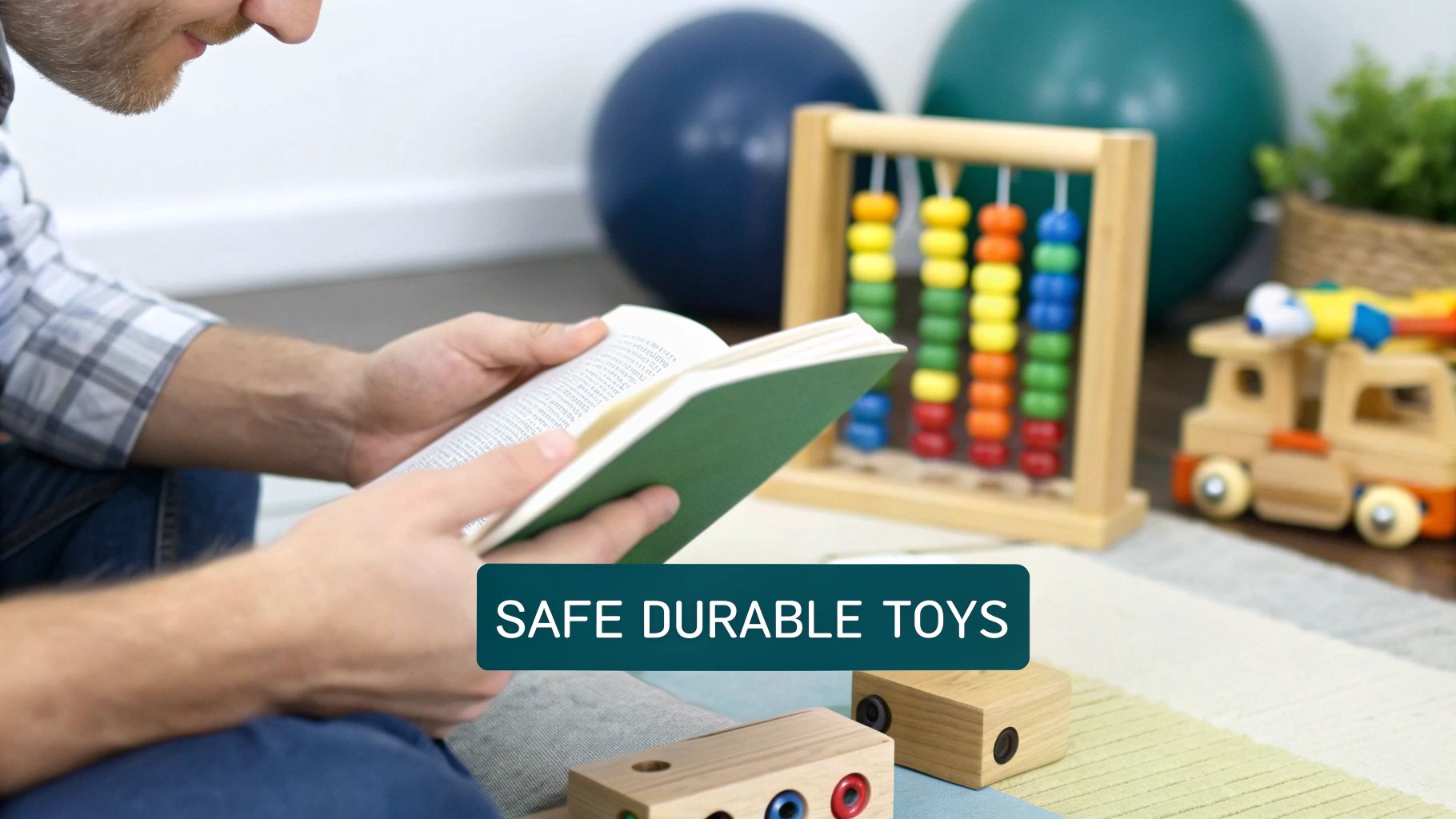
Before a toy can spark imagination, it first has to be safe. When you’re choosing educational toys for 3 and 4 year olds, safety and durability aren’t just boxes to tick—they're the absolute foundation of good play. A clever toy that breaks after a few sessions or hides a potential hazard isn't just a waste of money; it's a risk you don’t need. This guide will help you spot the good from the bad, so you can feel confident that every toy is built for enthusiastic play and your peace of mind.
Think of it like checking the depth of a swimming pool before letting your child jump in. It’s a simple, quick step that prevents problems down the line and allows everyone to relax and have fun. The same idea applies to what you bring into your playroom.
Reading the Labels: What to Look For
Toy packaging holds a goldmine of safety information, but it can feel like trying to decipher a secret code. The good news is, you only need to look for a few key symbols and phrases to know you're on the right track.
First and foremost, your eyes should hunt for the UKCA (UK Conformity Assessed) mark. This is your guarantee that the toy meets all legal safety requirements for sale in Great Britain. It tells you the manufacturer has done their homework, ensuring the product complies with standards on everything from chemical content to flammability.
The UKCA mark is a non-negotiable. If a toy is missing this symbol, it shouldn’t be in your shopping basket. This one simple check is your strongest line of defence.
Next, take the age recommendation seriously. That "3+" label isn't just about whether a child will understand the toy; it’s a critical safety warning. A toy rated for ages three and up has been specifically tested to make sure it doesn’t have small parts that could be a choking hazard for younger children.
Understanding Toy Materials
What a toy is made of matters. It impacts how long it will last and, most importantly, how safe it is. Knowing the basics of common materials helps you make choices that fit your family’s values.
- Wood: Wooden toys are loved for a reason—they're incredibly durable and have a lovely, natural feel. Look for solid wood with smooth, sanded edges and, crucially, a finish made from non-toxic, child-safe paints. They stand up to years of play and often become heirlooms.
- Plastics: Plastic toys are fantastic because they're lightweight, versatile, and a breeze to clean. The trick is to spot high-quality, safe plastics. Always check for a "BPA-free" label, as this chemical has been linked to health concerns. Steer clear of brittle-looking plastics that could shatter and create sharp, dangerous edges.
- Fabric: For soft toys, give the seams a gentle tug. They should be well-stitched and secure to keep the stuffing inside. Any features like eyes or buttons must be firmly embroidered or riveted on—glued-on parts can easily pop off and become a choking risk.
A Practical Safety Checklist
When you have a toy in your hands, whether in the shop or fresh out of the box at home, run through this quick mental checklist. It helps you catch potential issues that labels don't always cover.
- Check for Small Parts: Use a toilet roll tube as a handy tool. If a toy, or any piece that could break off, fits completely inside the tube, it’s a potential choking hazard for a child under three.
- Inspect for Sharp Edges: Run your fingers over the entire toy. Do you feel any sharp points, rough patches, or splintered areas? This is especially vital for wooden and hard plastic toys.
- Test for Durability: Give it a gentle squeeze and a pull. Does it feel flimsy? Do any parts seem like they might snap off during rough and tumble play? A sturdy toy is almost always a safer toy.
- Examine Cords and Strings: Any strings or cords on a toy for this age group should be short. Anything too long poses a risk of strangulation.
- Listen for Loud Noises: If it's a sound-making toy, hold it next to your own ear. If it sounds uncomfortably loud to you, it could be damaging to a young child's sensitive hearing.
Getting the Most Out of Your Educational Toys
Bringing a new toy home is just the beginning. The real magic happens when you turn simple playtime into a shared adventure, and you don't need a teaching degree to do it. It's less about directing the show and more about being a curious and helpful guide.
Think of yourself as a co-adventurer. Instead of telling your child what to do, you're there to ask interesting questions and offer a little help when they get stuck. This subtle shift doesn't just make playtime more educational; it makes it more fun and strengthens the bond between you. It's how you unlock the full potential of those fantastic educational toys for 3 and 4 year olds.
Guiding, Not Telling
One of the best ways to support your child’s learning is a technique called scaffolding. It sounds technical, but it’s something parents do naturally. Just like scaffolding on a building gives workers a temporary platform, you can offer just enough support to help your child master a skill that's slightly out of their reach.
For instance, imagine your four-year-old is getting frustrated with a tricky puzzle. Instead of pointing to where the piece goes, you could nudge their thinking. Try saying something like, "That piece has a really straight edge. I wonder where the straight-edged pieces usually go?" You aren't giving the answer, just a helpful clue that guides their own problem-solving.
Scaffolding is about being a partner in play. It’s the art of offering support without taking over, letting your child feel that amazing spark of figuring it out for themselves.
This approach shows you respect their efforts while giving them the tools to succeed. As they get more confident, you can step back a bit more, just like the scaffolding comes down once a building can stand on its own.
The Power of "What if?"
Another brilliant tool is the open-ended question. These are questions that can't be answered with a simple 'yes' or 'no'. They are invitations to imagine, create, and tell stories.
So, instead of asking, "Did you build a tower?" (which will probably get a "yes"), try sparking their creativity with something more.
- "That looks amazing! Tell me about the castle you've built."
- "I wonder what this dinosaur is going to do next?"
- "If we squished these two colours of play-doh together, what do you think would happen?"
- "What delicious meal are you cooking in your kitchen for me?"
Asking questions like these tells your child that their ideas matter and their imagination is limitless. It turns a solo activity into a shared story.
Keeping Playtime Fresh
Let's be honest, even the most beloved toy can lose its appeal if it's always lying around. A couple of simple tricks can keep their toy collection feeling fresh and exciting.
Toy Rotation: This is a total game-changer for many families. Don't have every toy out at once. Keep a box or two of toys tucked away in a cupboard. Every few weeks, swap them out. When an old favourite reappears after a break, it feels brand new again, sparking a whole new wave of interest.
Mix and Match: Who says you have to follow the rules on the box? Encourage a bit of creative chaos by combining different toy sets. Building blocks can become a zoo for their animal figures. Magnetic tiles can be a garage for their toy cars. The little counting bears can become shoppers in their play kitchen. This kind of cross-pollination is where truly creative, imaginative play is born.
Using these simple ideas, you can help transform everyday playtime into a rich and rewarding learning experience.
Your Questions Answered
Choosing the right toys can feel like navigating a maze. From wondering how many is too many to deciding if that flashy electronic gadget is worth the money, it's natural to have questions. This section is all about giving you clear, straightforward answers to those common concerns, so you can feel confident in every choice you make for your child's playroom.
Let's dive into some of the questions I hear most often from parents.
How Many Toys Does a 3 or 4 Year Old Actually Need?
This is the big one, isn't it? The simple truth is that quality always trumps quantity. There’s no magic number here. In fact, burying a child in too many toys can backfire, leading to overwhelm where they just jump from one thing to the next without ever getting properly stuck in.
A smaller, carefully chosen collection of open-ended toys is far more powerful. These are the classics that can be used in a million different ways, sparking fresh ideas day after day.
- Building Blocks: Today they're a castle, tomorrow a bridge for toy cars.
- Art Supplies: A blank piece of paper and some crayons offer endless possibilities.
- Small Figures: A handful of animals can star in countless imaginary stories.
A brilliant strategy is to rotate their toys. Keep some of their collection packed away and swap it out every few weeks. Old toys suddenly feel brand new, reigniting your child’s interest without you having to buy a single thing.
Are Electronic Toys Better Than Traditional Ones?
In a world full of screens, it’s easy to think that a “smart” toy must be a better toy. While some electronic toys offer genuinely great, interactive learning, they aren't automatically superior to good old-fashioned, hands-on toys. The secret is to find a healthy balance.
Toys like wooden blocks, puzzles, and dress-up clothes are champions at building skills that screens struggle to replicate. They naturally encourage creativity, deep problem-solving, and the social back-and-forth that happens when children play together. They give a child's imagination a much-needed, screen-free space to run wild.
Think of it as a healthy "play diet." The goal isn't to banish technology, but to make sure it's balanced with plenty of hands-on, imaginative, and social play—the real foundations of early development.
At the end of the day, the most incredible play often comes from the simplest things. A cardboard box is a spaceship, and a set of nesting bowls is a brilliant first maths lesson. Never underestimate the power of the classics.
Should I Choose Toys Based on My Child’s Gender?
My best advice? Completely ignore the gender labels on the box. All children benefit from a wide variety of play experiences, and sorting them into "blue" and "pink" aisles can seriously limit their potential. The only thing that matters is what sparks your child's curiosity.
Instead of gender, think about the skills being built. A boy who loves his play kitchen is learning about creativity, following steps, and nurturing others. A girl obsessed with construction toys is mastering spatial awareness, problem-solving, and the basics of engineering. These are vital skills for every single child.
The good news is that the toy industry is catching on. In the UK, educational toys are a huge slice of a toy market valued at around USD 13.95 billion. A lot of that growth is driven by parents actively looking for high-quality, STEM-focused toys for their children, regardless of gender.
My Child Gets Bored with New Toys So Quickly! What Am I Doing Wrong?
This is an incredibly common frustration, and it usually has more to do with the toy than the child. If a toy only does one thing—like a button that plays the same song over and over—a child will master it quickly. Once the novelty wears off, there's nothing left to discover, so it gets tossed aside.
The solution is to focus on open-ended toys. These are the true workhorses of the playroom because they can be used in infinite ways, growing and changing right along with your child's imagination.
Another powerful trick is to set up an "invitation to play." Instead of just handing over a box of blocks, arrange them in an interesting way to spark an idea. Maybe you could set up some animal figures around a "lake" made of blue play-doh, or start building a tower and leave it for them to finish. Your involvement is often the magic ingredient that makes any toy irresistible. Of course, play is just one part of the picture; for more general advice, you might find some further parenting tips helpful.
At Grow With Me, we believe in the power of stage-based play. Our curated subscription boxes deliver high-quality, developmentally appropriate toys right to your door, taking the guesswork out of building a brilliant playroom. Discover how our kits can support your child's learning journey at https://shop.growwithmesubscriptionbox.co.uk.