
Unlocking Potential The Benefits of Loose Parts Play for Toddlers
Welcome to the wonderfully creative world of loose parts play! It’s a simple yet incredibly powerful approach to play that truly unlocks a child's imagination. By using open-ended, movable objects, we empower children to become the architects of their own learning, laying a foundation for profound developmental benefits.
What Is Loose Parts Play and Why Does It Matter?
Imagine giving your child a box of assorted baking ingredients versus a finished cake. The ingredients invite invention and experimentation; the cake offers only one thing—to be eaten. Loose parts are those 'ingredients' for play. They are collections of simple, movable objects that can be used in countless ways, with no instructions to follow, allowing a child's curiosity to lead the way.
The concept was first brought into the spotlight by architect Simon Nicholson back in 1971. He believed that environments rich in versatile materials naturally foster more creativity and learning than static ones. Unlike a toy car that’s always a car, loose parts put the child firmly in the driver's seat of their own play.
The Philosophy Behind the Play
At its heart, loose parts play is a child-led philosophy. It’s built on respecting a child’s natural ability to innovate, problem-solve, and create, all without needing an adult to show them how. The open-ended nature of the materials is absolutely key.
This hands-on approach often overlaps with other play theories. For a closer look at a related concept, you can explore our guide on what is heuristic play, which also centres on sensory exploration with everyday objects. This freedom to explore is what makes it so different from more structured activities.
Loose parts play gives children a foundation for deep, creative thinking, encouraging problem-solving and higher-order thinking. It is a flexible form of play that allows children to build, create, and explore their environment in unique ways.
What Counts as a Loose Part?
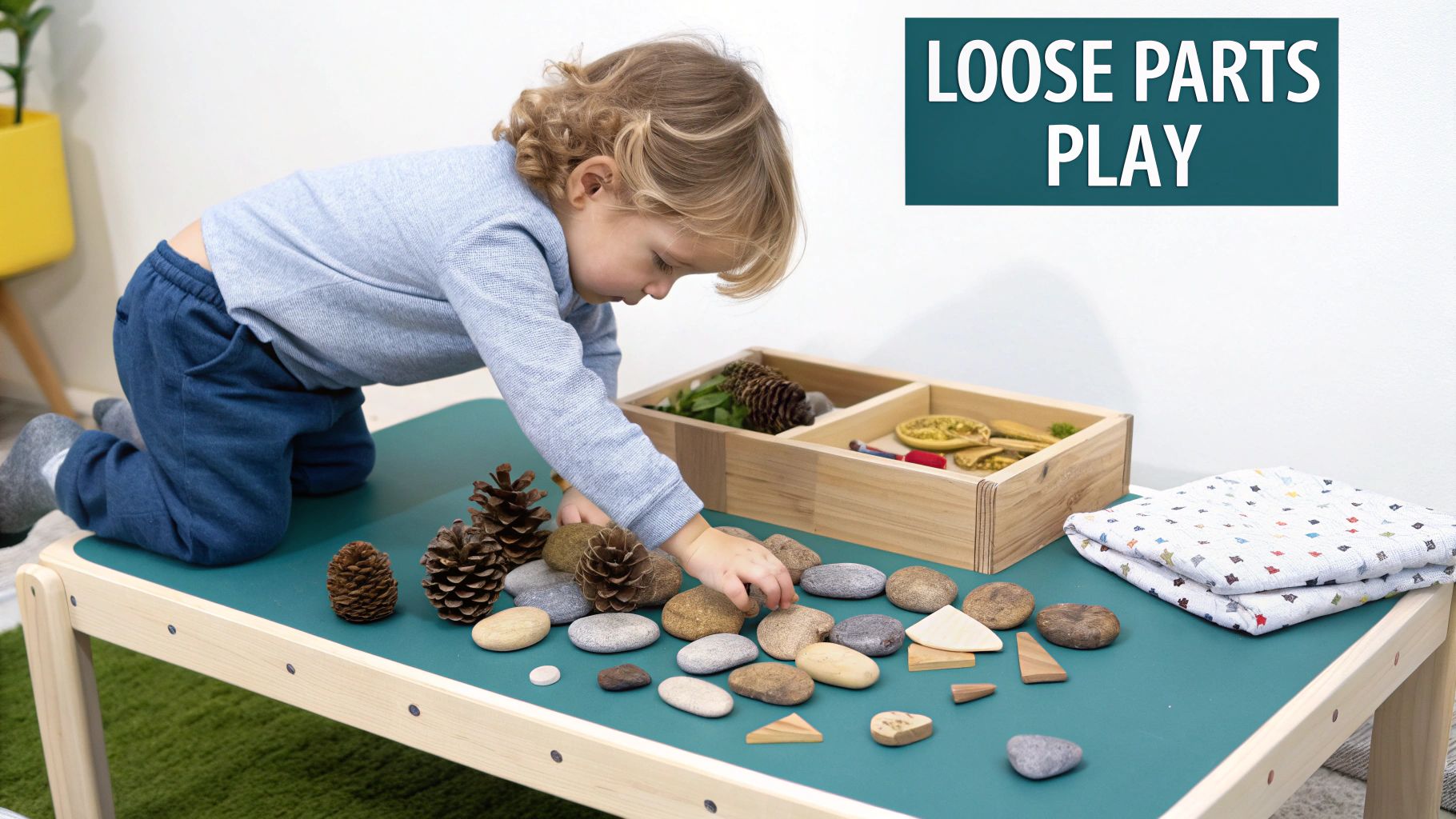
So, what exactly are these magical materials? A loose part can be almost anything, as long as it’s safe and can be moved, combined, or taken apart. They generally fall into a few different categories:
- Natural Materials: Think shells, pebbles, sticks, leaves, pinecones, and sand.
- Recycled Items: Cardboard tubes, clean bottle caps, fabric scraps, and plastic containers are perfect.
- Man-Made Objects: This includes things like buttons, beads, wooden blocks, rings, and tiles.
By offering a mix of these items, you create a rich sensory environment that sparks genuine curiosity. It’s not about buying expensive, single-purpose toys; it’s about collecting interesting objects that invite exploration. This simple shift empowers children to see the potential in the everyday world around them, setting the stage for the amazing cognitive and physical benefits we'll explore next.
Building a Smarter Brain With Loose Parts
When you see a child deeply engrossed with a collection of random objects, you’re witnessing something far more profound than simple play. They're actually giving their brain a powerful workout. The seemingly simple act of sorting shells by size, carefully stacking a wobbly tower of stones, or arranging leaves into a colourful pattern are all complex, brain-building exercises in disguise.
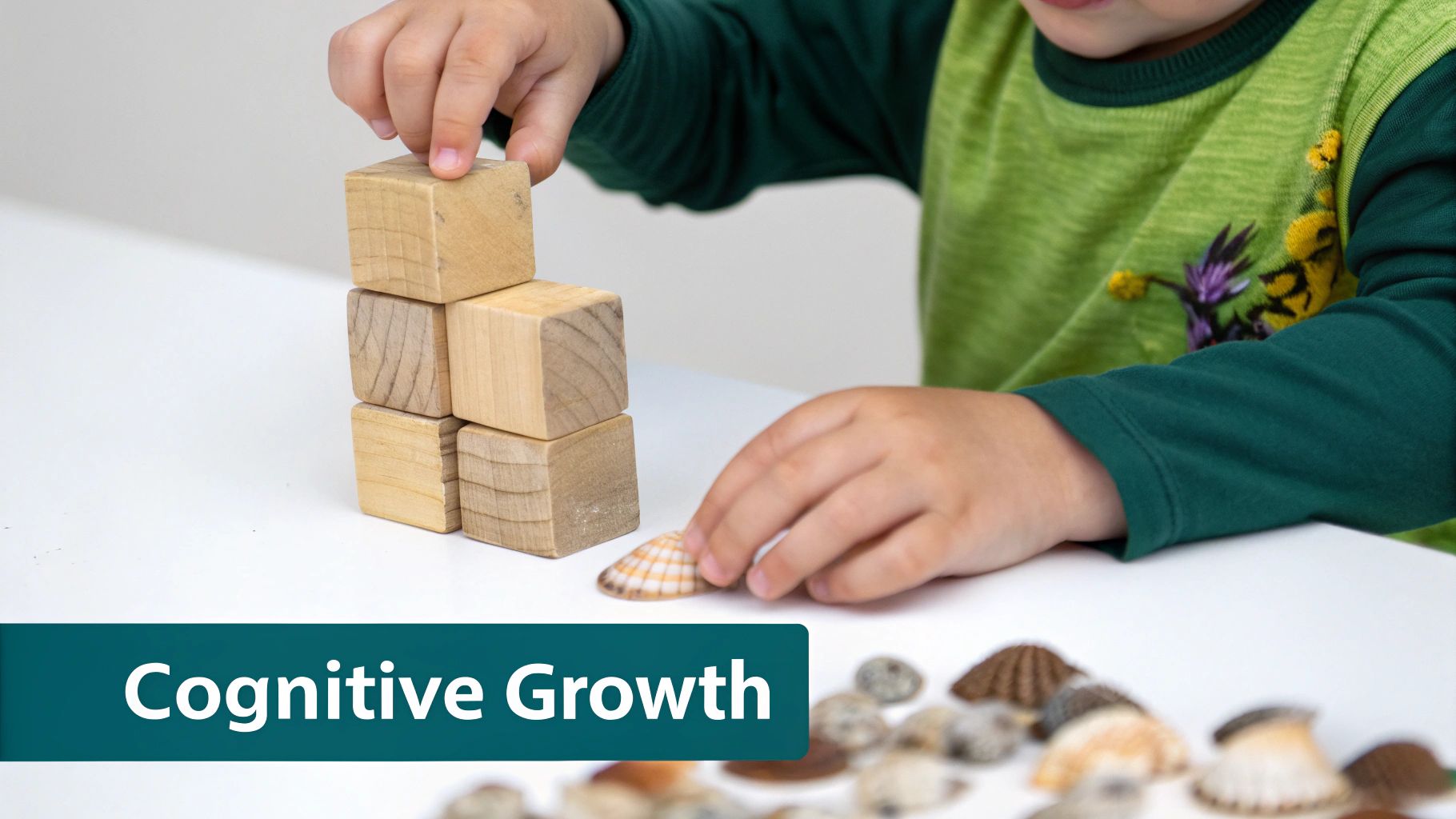
This kind of play is a child’s first, most intuitive maths lesson. Without anyone telling them to, a toddler might line up pebbles from smallest to largest, exploring the concept of sequencing. Or they might count how many buttons can fit into a small cup, getting a hands-on feel for one-to-one correspondence. These early explorations are the very bedrock of number sense and spatial awareness.
Cultivating Critical Thinkers
Perhaps one of the most incredible cognitive benefits of loose parts play is how it naturally nurtures critical thinking and problem-solving. A toy car is a toy car. But a collection of bottle caps, sticks, and cardboard tubes? That has infinite potential. This open-ended quality forces a child to become an innovator.
Think about a child trying to build a bridge between two cushions using only twigs and yarn. When their first attempt collapses, they're faced with an authentic, low-stakes problem. It’s up to them to figure out what went wrong, rethink their design, and try a new approach.
This process of trial and error is the very essence of scientific thinking. Children learn to hypothesise ("What if I put the bigger block on the bottom?"), test their ideas, and draw conclusions from the results.
This cycle builds cognitive flexibility and true resilience. It teaches children that mistakes aren't failures; they're just part of the process of figuring things out. That's a lesson that will serve them for a lifetime, far beyond the playroom floor.
Enhancing Focus and Attention
In a world buzzing with constant distractions, the ability to focus is a superpower. Loose parts play is brilliant for helping children develop that power. The endless possibilities of the materials spark their curiosity and can keep them captivated for surprisingly long stretches.
Because the play is completely child-led, kids become deeply invested in what they're doing. Whether they're meticulously creating a mosaic from lentils and seeds or designing an elaborate fairy house from bark and moss, they are practising sustained concentration. This deep engagement strengthens the neural pathways for focus, turning what looks like simple fun into a robust tool for building a smarter, more resilient brain.
How Loose Parts Nurture Physical Growth and Coordination
While we often praise loose parts for boosting brainpower, their impact on a child's physical development is just as incredible. The different shapes, weights, and textures of these simple objects create a brilliant, natural gymnasium for little hands and bodies. They help to build strength, balance, and precision right from the start.
When a toddler carefully picks up a small pebble or threads a big wooden bead onto a string, they’re doing so much more than just playing. They are meticulously training the small muscles in their hands and fingers, building what we call fine motor skills. This is the groundwork for everything from holding a crayon to buttoning a coat and, eventually, writing their name.
Even the seemingly simple act of stacking wobbly blocks or arranging smooth stones in a line requires huge focus. It's a masterclass in developing hand-eye coordination, teaching a child’s brain and hands to work together in perfect harmony.
Strengthening Fine Motor Control
Fine motor skills are all about using the small muscles in the hands, fingers, and wrists for precise, controlled movements. Loose parts play happens to be one of the most effective and enjoyable ways to build these skills, without a single worksheet or structured lesson in sight.
Just think about all the little actions involved:
- Pinching and Grasping: Picking up tiny items like buttons or seeds strengthens the all-important pincer grasp.
- Placing and Stacking: Balancing objects of different sizes and shapes builds dexterity and a steady hand.
- Pouring and Scooping: Transferring materials like sand or lentils between containers develops wrist strength and coordination.
These aren't just playful moments; they are vital practice runs for a child’s growing independence. For more great ideas, check out our guide to activities for developing fine motor skills.
Building Gross Motor Skills
But the benefits don't stop with small movements. Loose parts are also fantastic for encouraging gross motor skills – the big actions involving the large muscle groups needed for walking, lifting, and balancing. When children get their hands on larger loose parts like cardboard boxes, cushions, or planks of wood, their play naturally becomes more physical.
They might haul a log over to a den they're building, roll tyres across the garden, or team up to move a big crate. This kind of ‘heavy work’ is absolutely vital for developing core strength, spatial awareness, and overall physical confidence.
Research consistently shows that when you enrich a play area with loose parts, children's physical activity levels shoot up. It transforms a static space into a dynamic one that just begs for movement and active exploration.
In fact, a UK-based study found that introducing simple items like crates and planks led to a huge increase in children's health-enhancing physical activity. It was noted that girls, in particular, spent 20-30% more time in active play, and headteachers saw a dramatic drop in behavioural issues. You can dive deeper into the findings of the Schools Loose Parts Project to learn more. It’s clear proof that the benefits of loose parts play extend far beyond just physical skills, helping to create a healthier and more cooperative play environment for everyone.
Fuelling Imagination and Building Emotional Strength
Beyond honing cognitive skills and developing physical coordination, one of the most incredible benefits of loose parts play is its power to nurture a child's rich inner world. It gives them the raw materials to fire up their boundless creativity and build a solid emotional foundation, one playful moment at a time.
When children play with open-ended materials, they’re not just having a bit of fun; they are deep in symbolic thinking. This is the amazing ability to look at one thing and see it as something else entirely. A simple silk scarf is no longer just a piece of fabric. In your child's hands, it could be a flowing river, a superhero's cape, or a soft blanket for their favourite teddy.
This kind of imaginative play is the very bedrock of creativity and abstract thought. Loose parts hand children the freedom to bring their unique ideas to life, free from the constraints of a toy designed for just one purpose.
Building Emotional Intelligence Through Play
The emotional benefits are just as profound. Successfully building a den from cushions and blankets or arranging coloured buttons into a beautiful pattern gives a child a powerful sense of accomplishment. That feeling of "I did it!" is a massive confidence booster, proving to them that their ideas have value and that they're capable of making things happen.
What’s more, the sensory nature of many loose parts has a wonderfully calming, grounding effect. The feeling of smooth stones, soft wool, or grainy sand can be incredibly soothing, helping children to self-regulate when they feel overwhelmed or anxious. This hands-on engagement provides a healthy outlet for big emotions.
When a child is totally absorbed in their play, they're in a state of 'flow'. This focused, self-directed activity is a natural stress reliever, helping them develop emotional regulation skills that are essential for lifelong wellbeing.
Learning to Navigate Social Worlds
When children get together with a collection of loose parts, the social-emotional learning really takes off. A shared pile of blocks, sticks, and fabric scraps becomes a natural stage for practising essential social skills. There's no instruction manual, so they have to talk and work together to bring their shared vision to life.
This collaborative environment encourages children to:
- Negotiate roles and ideas: "You can be the shopkeeper, and I'll be the customer buying the special potions (which are actually pebbles)."
- Share resources: Realising there are only a few long sticks for the roof means they have to learn to take turns and share fairly.
- Solve problems together: When their joint tower topples over, they have to communicate to figure out a better, stronger way to build it.
These interactions lay the groundwork for empathy, cooperation, and resilience. If you're interested in learning more about how play supports a child's development, it can be helpful to explore resources on play therapy for children. Through these simple, playful exchanges, children are learning the complex art of getting along with others and building the framework for becoming a well-rounded, emotionally intelligent person.
Your Practical Guide to Starting With Loose Parts
Ready to jump into the wonderful world of loose parts play? The great news is, getting started is much easier than it sounds. It’s not about rushing out to buy a new set of expensive, specialised toys. It’s about shifting your perspective to see the incredible play potential hidden in the everyday objects you already have around you.
The trick is to think in simple categories. You could gather a few treasures on your next walk, pull some interesting bits and bobs from the recycling, or find a new purpose for common household items. Your goal is simply to collect a small variety of safe, open-ended materials that invite your child to touch, explore, and create in their own way, with no instructions needed.
Finding Your First Loose Parts
You really don't need a huge collection to begin. Start small. Gathering just a handful of items from a few different categories and arranging them in a simple basket or on a tray is the perfect way to start. This creates a clear and appealing invitation to play without overwhelming your little one.
Here are a few ideas to get you going:
- Natural Treasures: Think smooth pebbles, interesting leaves, pinecones, seashells, or chunky twigs. These are fantastic for connecting children with the natural world and offer a rich sensory experience.
- Household Recyclables: Clean cardboard tubes, lids from jars or milk cartons, scraps of fabric, and empty yoghurt pots are all brilliant for building, stacking, and sorting.
- Everyday Objects: Things like wooden spoons, silicone cupcake cases, old curtain rings, or large, colourful buttons can be used in the most wonderfully imaginative ways.
Loose parts play isn't just about keeping busy hands occupied; it's a powerful foundation for some of the most important areas of social-emotional growth.
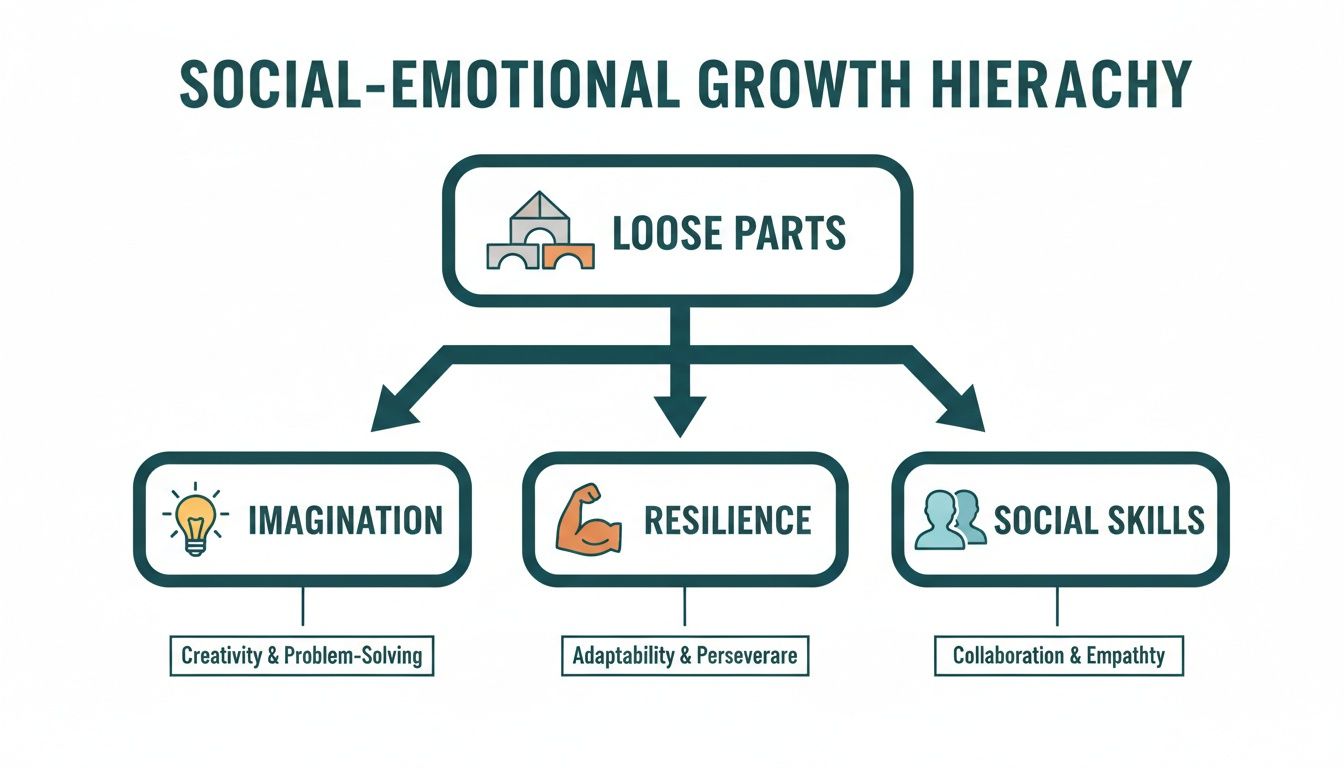
As you can see, these simple materials are the building blocks for developing a child’s imagination, resilience, and crucial social skills.
A Focus On Safety First
Of course, safety is always our number one priority, especially when it comes to babies and toddlers who explore with their mouths. The most important rule is to avoid choking hazards. A brilliant rule of thumb is to only use items that are too large to fit through the cardboard tube from a toilet roll.
Always give materials a quick check for any sharp edges or small bits that might break off. It also goes without saying that everything should be clean and non-toxic. Finally, active supervision is essential. Staying nearby lets your child explore freely while giving you total peace of mind. As you begin setting up, you can find more great tips for creating the perfect play environment for your baby or toddler.
Remember, the goal of a play invitation is to spark curiosity, not to direct the play. Just present a small selection of loose parts on a mat or in a low basket and step back. See what happens. There is no right or wrong way to play.
By starting with just a few carefully chosen, safe materials, you're opening up a whole universe of discovery. You aren’t just giving them things to play with; you’re giving them the tools to become thinkers, creators, and confident problem-solvers. If you're looking for more ways to engage your little one's senses, you might also find some inspiration in these sensory play ideas for toddlers.
Your Questions About Loose Parts Play, Answered
Jumping into the world of loose parts is exciting, but let's be honest, it can bring up a few practical questions. It’s completely normal to wonder about keeping things safe and tidy, or to question how a humble pile of pebbles can possibly be better than the latest flashing toy.
We’ve heard these questions from parents time and again. So, we've gathered them all here to give you clear, straightforward answers that will help you feel confident and ready to embrace this wonderfully creative form of play.
How Do I Keep My Child Safe With Loose Parts?
Safety is, and always will be, the top priority. This is especially true when you have little ones who are still exploring the world with their mouths. The golden rule for babies and toddlers is beautifully simple: if an item can fit through a toilet paper tube, it’s too small for unsupervised play. This is a brilliant and reliable way to check for choking hazards.
Before handing anything over, just give it a quick once-over. Are there any sharp edges? Could any small bits break off? Make sure everything is clean, non-toxic, and sturdy enough to withstand some enthusiastic handling.
The most important safety tool you have is your own presence. Active supervision is key. Staying close by gives your child the freedom to experiment and create, secure in the knowledge that you’re right there to guide them and keep their playtime happy and safe.
How Can I Manage the Inevitable Mess?
The thought of mess can be a real barrier for many of us, but a little bit of organisation goes a very long way. Using dedicated storage like baskets, cloth bags, or trays not only contains the chaos but also makes the materials look much more appealing to your child. It also makes packing away a doddle.
A great way to start is by not overwhelming them (or yourself!). You don't need to bring out everything at once. Begin with just one or two types of loose parts presented on a play mat or in a low-sided tray. This keeps the play focused, cuts down on clutter, and actually encourages your child to engage more deeply with the materials.
And remember, ‘tidy-up time’ can be part of the fun. Turning it into a collaborative game is a fantastic way to manage the aftermath while teaching your child about responsibility and looking after their belongings.
Are Loose Parts Really Better Than Electronic Toys?
This is a big one, and the truth is they serve completely different purposes. Most electronic toys are ‘closed-ended’—they're designed to be used in a specific way and usually have a single, predetermined outcome. They’re often about teaching a narrow skill.
Loose parts, by their very nature, are completely ‘open-ended’. There is absolutely no right or wrong way to play with them. This is where the magic lies. It puts your child in the driver’s seat, empowering them to be the inventor, the artist, and the problem-solver.
Think about it: a simple stick can be a wizard’s wand, a fishing rod, or a giant pencil for drawing in the mud. This limitless potential is what builds a rich foundation of creativity, critical thinking, and imagination that more passive entertainment just can't match.
Where Can I Find Loose Parts On a Budget?
One of the most wonderful things about loose parts play is that it doesn’t have to cost a penny. Seriously. Some of the most engaging and best-loved materials are completely free, waiting to be discovered right outside your door or in your recycling bin.
Here are a few ideas to get you started without spending a thing:
- From Nature: A simple walk in the park can yield a treasure trove of smooth stones, interesting leaves, pinecones, and shells.
- From Your Home: Your recycling bin is full of potential! Think cardboard tubes, clean bottle caps, fabric scraps, and plastic lids.
- From Friends: Why not organise a loose parts swap with other parents? It’s a great way to refresh your collection and share ideas.
You can easily build an incredible collection over time. Just start with what you already have and let your child’s imagination lead the way.
At Grow With Me, we believe in the power of simple, high-quality toys to support your child’s development at every stage. Our curated play kits are filled with beautiful, stage-based items designed to spark curiosity and creativity, perfectly complementing your loose parts collection. Discover your first Grow With Me kit today!