

Your Guide to Choosing the Best Baby Sensory Mat
A baby sensory mat is a special play area, purposefully designed with lots of different textures, colours, and sounds to wake up a baby's developing senses. Think of it as their very first personal playground—a safe and captivating world built to encourage them to explore and grow right from day one.
What Is a Baby Sensory Mat and Why Do You Need One?
Imagine a tiny gym where every single piece of equipment is there to help strengthen your baby's brain and body. In a nutshell, that's what a baby sensory mat does. It’s so much more than just a comfy spot to pop your little one down; it's a fundamental tool for their early development that turns ordinary playtime into a powerful learning experience.
Every feature on the mat is there for a reason. High-contrast patterns are brilliant for catching a newborn's eye, helping their vision to focus. A mix of textures—from crinkly materials and soft plush sections to silky ribbons—invites tiny hands to touch and feel, building their tactile awareness and those all-important fine motor skills.
How a Sensory Mat Supports Key Milestones
Let's take a look at how these mats directly contribute to your baby's growth. The table below breaks down the key developmental areas and shows just how a sensory mat can help your little one hit those exciting milestones.
| Developmental Area | How a Sensory Mat Helps |
|---|---|
| Gross Motor Skills | Encourages reaching, rolling, and pushing up during tummy time, which strengthens neck, back, and core muscles. |
| Fine Motor Skills | Features like ribbons, tags, and different textures invite little fingers to grasp, pinch, and explore, refining their grip. |
| Sensory Development | The variety of sounds, colours, and textures provides a rich sensory experience, helping their brain to process new information. |
| Cognitive Growth | Interactive elements like mirrors and peek-a-boo flaps introduce the concept of cause and effect and promote self-awareness. |
As you can see, it’s not just about keeping them entertained. A good sensory mat is a multi-purpose tool that actively supports their journey from lying down to sitting up and beyond.
Turning Tummy Time from a Chore into an Adventure
One of the biggest jobs a sensory mat has is making tummy time feel less like a chore and more like an adventure. We all know how important this activity is for building the neck, back, and shoulder muscles your baby needs for rolling, sitting, and eventually crawling. But let's be honest, a lot of babies aren't huge fans of it at first.
A sensory mat provides the perfect motivation. By placing intriguing toys, mirrors, and textures just within reach, you give your baby a reason to lift their head, push up on their arms, and work those core muscles.
This kind of purposeful play transforms a potentially tricky exercise into a fun journey of discovery. If you'd like to dive deeper, you can find more tips in our guide on when to start tummy time. A sensory mat really is both a play space and a developmental aid, making it a true nursery essential.
Unlocking Key Developmental Benefits Through Play
A baby sensory mat is so much more than just a colourful, comfy spot for your little one to lie on. Think of it as their very first playground – a dynamic space where simple play triggers huge developmental leaps forward. Every kick, every reach, and every little wiggle on that mat is helping to build a stronger, more coordinated body and a more connected brain.
It’s easy to miss just how much is going on. When your baby bats at a dangling toy and hears it jingle, they're not just having a bit of fun. They’re actually carrying out their first little scientific experiment in cause and effect, which is a massive cognitive milestone. This simple action teaches them a fundamental lesson: their movements make things happen. This sparks a curiosity that lays the groundwork for a lifetime of problem-solving and learning.
Boosting Gross and Fine Motor Skills
We all know how vital tummy time is for building the strength a baby needs to lift their head, roll over, and eventually start crawling. A baby sensory mat makes this crucial exercise far more interesting by providing some real motivation. The engaging textures and patterns encourage them to push up and look around, strengthening their neck, back, and core muscles in the process.
At the same time, their fine motor skills get a fantastic workout.
- Grasping and Pinching: Reaching for a crinkly leaf or holding onto a textured ring helps develop all those tiny muscles in their hands and fingers.
- Hand-Eye Coordination: As they focus on a colourful ribbon and coordinate their arm movement to grab it, they're practising a skill that’s vital for everything from feeding themselves to one day learning to write.
Every single attempt to touch and explore is another step towards mastering dexterity.
This concept map really brings to life how a sensory mat cleverly blends fun, fitness, and hitting those all-important milestones.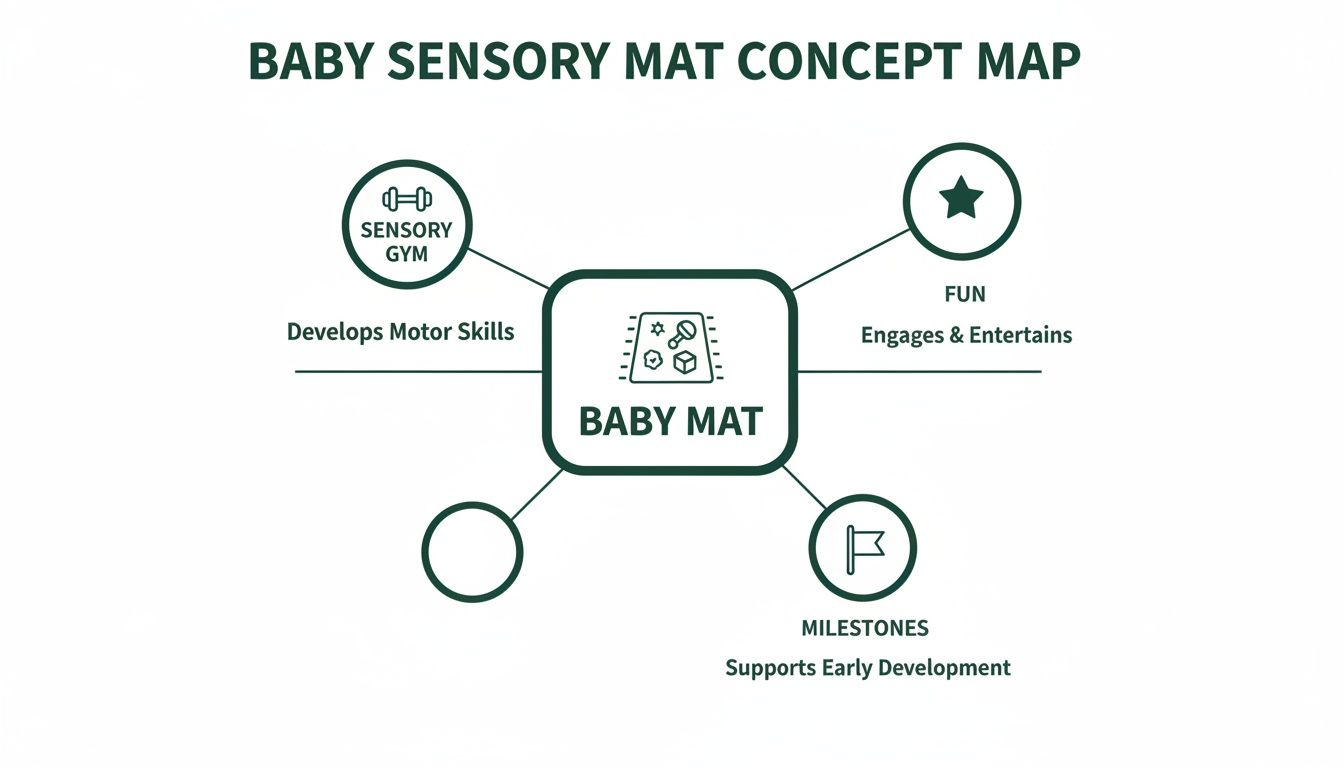
As you can see, the mat essentially acts as a sensory gym where enjoyable activities directly support key developmental stages.
Sharpening Sensory Processing
From the moment they’re born, babies are constantly learning to make sense of the world through their senses. A sensory mat offers a controlled, safe space for them to process a huge amount of information, and the variety of stimuli helps their brain build crucial neural pathways.
A baby’s brain develops at an incredible pace during the first year, forming more than a million new neural connections every second. Rich sensory experiences are the fuel for this amazing growth, helping to wire their brain for learning and understanding.
Bold, high-contrast patterns help their developing vision to focus and track objects. Different sounds, from soft rattles to crinkly noises, teach them to locate where a sound is coming from and react to it. This rich sensory feedback helps them learn to filter information and respond appropriately—a skill we call sensory processing.
It's no surprise that the demand for these developmental tools is on the rise. The UK baby toys market, which includes sensory products, is projected to grow from $1030 million in 2024 to $1069 million in 2025. Parents are increasingly looking for mats with varied textures, following expert advice on just how important sensory stimulation is for early brain development. You can dive deeper into the UK market trends for baby play mats to see how these products are viewed as a key investment in a child’s early years.
How to Choose the Right Baby Sensory Mat
Feeling a bit lost in the sea of options for a baby sensory mat? It's completely understandable. With so many different styles, materials, and clever features out there, picking the right one can feel like a mammoth task. But the good news is, it doesn't have to be.
If you focus on three key areas—material safety, practical design, and what’s right for your baby’s age—you can confidently find the perfect mat for your family. This isn't just about ticking another baby item off the list; it's about choosing a safe, engaging, and genuinely useful space for your little one to explore and grow.

Prioritise Material Safety Above All Else
It goes without saying that when your baby is exploring the world with their hands and mouth, the materials they're touching matter enormously. Always look for mats that are clearly labelled as non-toxic and BPA-free. These aren't just buzzwords; they’re your assurance that the mat is free from harmful chemicals.
This focus on safety is a huge deal for parents everywhere. In the UK, the baby play mats market is growing steadily, with a projected compound annual growth rate of 6.5% between 2025 and 2035. What’s driving this? Parents are actively seeking out products that are not only developmentally beneficial but also safe and eco-friendly, especially those made from organic cotton or certified non-toxic foam. You can dive deeper into the trends shaping the UK baby play mats market and see just how much safety standards influence what we buy.
Consider Practicality for Your Home
Let’s be honest, your lifestyle plays a massive part in finding the best mat. Take a moment to think about the day-to-day realities of clean-ups and storage. A soft fabric play gym might be a dream for its machine-washable convenience, whereas interlocking foam tiles give you a larger, wipe-clean surface that’s incredibly easy to disinfect after a spill.
Here are a few practical points to mull over:
- Cleaning: Is it machine-washable or wipe-clean only? Life with a baby is messy, so easy cleaning is non-negotiable.
- Portability: Do you need a mat that can be folded up for a trip to the grandparents' house or tucked away easily in a small flat?
- Size: Will it fit comfortably in your living room or nursery without becoming a trip hazard for everyone else?
Choosing a mat is a bit like choosing a car seat—safety and practicality have to come first. A beautiful design is a lovely bonus, but if a mat is a pain to clean or doesn't fit your space, it will quickly become more of a frustration than a joy.
Match the Design to Your Baby's Age
A mat that’s perfect for a tiny newborn won’t necessarily be the right fit for a curious six-month-old. Your baby’s developmental stage is your best guide.
For Newborns (0-3 Months)
Newborns have fuzzy vision, so they’re naturally drawn to simple, high-contrast patterns. Look for mats with bold black-and-white designs or bright primary colours to help stimulate their developing eyesight. At this early stage, a soft, flat surface for those all-important tummy time sessions is the key feature.
For Older Infants (4+ Months)
As babies get stronger and more interactive, they need more to do! This is where play gyms with overhead arches, dangling toys, little mirrors, and varied textures really shine. These elements encourage reaching, grasping, and batting – all fantastic for building those crucial fine motor skills and hand-eye coordination. For more inspiration, check out our guide on the best sensory toys for babies to add to their play space.
By keeping safety, practicality, and your baby's needs at the forefront, you can easily cut through the noise and make a choice you feel genuinely good about.
A Parent's Guide to Essential Safety Standards
When you bring a baby sensory mat into your home, you’re not just buying a toy; you're creating a tiny world for your little one to explore. Above everything else, that world needs to be a safe one. I know that looking at all the labels and jargon on baby products can feel overwhelming, but a little bit of knowledge goes a long way.
Let’s cut through the noise. Here’s what you really need to look for to make sure you’re choosing a mat that’s genuinely safe for your baby.
Decoding UK Safety Markings
Think of safety markings as your first line of defence. In the UK, they aren't just nice-to-haves; they are legal requirements for any toy or baby product sold here.
When you're checking the packaging or online description, keep an eye out for these two critical certifications:
- UKCA Mark: This is the big one for Great Britain. The UKCA (UK Conformity Assessed) mark is your guarantee that the mat has passed all the necessary health, safety, and environmental standards required to be sold here.
- CE Mark: You might still spot a CE mark, which shows the product meets the equivalent standards for the European Economic Area (EEA). While the UKCA mark is now the standard, seeing a CE mark is still a good sign of quality control.
Behind these marks is a crucial standard called EN71. This is the European technical standard for toy safety, and it's incredibly thorough. It covers everything from flammability (making sure it won't easily catch fire) to the chemical makeup, ensuring there are no nasty substances your baby could ingest.
What Do ‘Non-Toxic’ and ‘BPA-Free’ Really Mean?
You’ll see phrases like 'BPA-free' and 'non-toxic' on almost every baby product. They sound reassuring, but it helps to know what they actually promise.
A 'non-toxic' label is a promise that the materials won't release any harmful substances, even if your baby decides the mat looks delicious. Since babies explore the world with their mouths, this is non-negotiable. Labels like 'BPA-free' and 'phthalate-free' go a step further, confirming the absence of specific chemicals often used in plastics that have raised health concerns.
Your UK Baby Mat Safety Checklist
To make things even simpler, use this quick checklist. It covers the most important safety features and certifications to look for before you make a purchase.
| Safety Feature | What to Look For | Why It Matters |
|---|---|---|
| UKCA/CE Marking | The official UKCA or CE logo clearly visible on the packaging or product label. | This is a legal requirement proving it has passed mandatory UK/EU safety tests. |
| EN71 Compliance | A specific mention of "Conforms to EN71" or similar wording in the product details. | Ensures the mat is tested for chemical safety, flammability, and physical hazards. |
| Material Safety | Labels like "BPA-free," "Phthalate-free," and "Non-Toxic." | Guarantees the mat is free from common harmful chemicals unsafe for babies. |
| Physical Design | No small, detachable parts that could pose a choking hazard. Strong, durable seams. | Prevents choking risks and ensures the mat can withstand enthusiastic play. |
| Age Recommendation | A clear age guideline, such as "Suitable from birth" or "0m+." | Helps you choose a mat that is developmentally appropriate and safe for your baby. |
Running through this checklist gives you that final piece of confidence that you’re making a safe and smart choice for your little one.
Essential At-Home Safety Practices
Bringing a safe mat home is step one; creating a safe play environment is step two. A few simple habits can make all the difference and keep playtime stress-free.
Always pop the mat down on a flat, clear surface, well away from stairs, sharp corners, or other hazards. And as much as the mat is designed for independent play, you should always supervise your baby, especially when they’re just figuring out how to roll or sit up.
Give the mat a quick once-over every now and then. Look for any loose threads, tears, or small parts that might have come loose. Keeping the entire play area hygienic is just as important; for a truly clean and healthy space, you might even consider professional carpet cleaning for families with small children. A clean space means safer exploration for curious little hands and mouths.
Creative Ways to Maximise Playtime
A baby sensory mat is so much more than just a soft spot to plonk your little one down for tummy time. Think of it as their first-ever personal playground—a space for connection, discovery, and turning simple moments into brilliant learning opportunities.
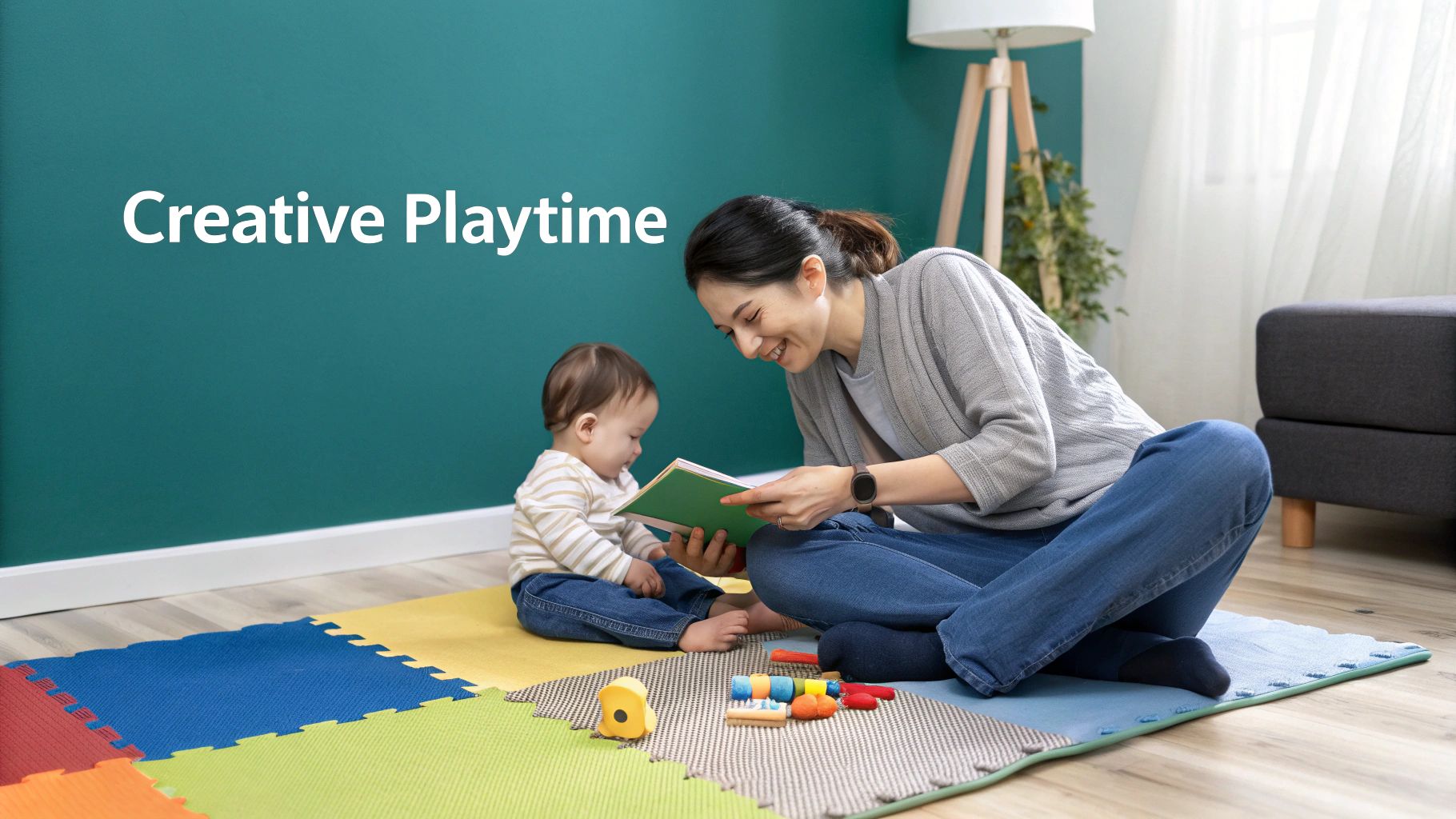
The trick is to keep things fresh and interesting by tailoring activities to their stage. The mat is the stage, and you're the director, introducing new props and ideas as your baby masters new skills. This keeps them engaged and ensures the mat remains a beloved part of their routine, well beyond the newborn haze.
Play Ideas for Every Stage
Matching activities to what your baby can actually do makes playtime feel less like a chore and more like genuine fun. As they grow, you'll notice how their interaction with the mat evolves, opening up brand-new ways to explore.
-
For Newborns (0-3 months): At this age, your baby's vision is still a bit fuzzy, so high-contrast is your best friend. Grab some simple black and white flashcards and move them slowly across their line of sight. This gentle game encourages them to track with their eyes, and the mat provides a safe, comfy spot for these short but vital sessions.
-
For Young Infants (4-7 months): Now they're getting stronger, it's all about motivating movement! Place a favourite rattle or a fascinating crinkly toy just a tiny bit out of reach. That little nudge is often all they need to attempt their first roll or stretch, building up that all-important core strength and coordination.
-
For Older Babies (8+ months): The mat transforms into a cosy home base for more ambitious play. It’s the perfect setting for story time, attempting to stack soft blocks, or playing a classic game of peek-a-boo with a muslin cloth. It’s a familiar space where they feel secure enough to try new things.
When children scoop, pour, or explore textures, it may look like simple fun, but they are building essential skills. From fine motor control to problem-solving, sensory play lays the groundwork for early literacy, numeracy, and emotional regulation.
Introducing Simple Sensory Experiences
You really don't need a mountain of expensive toys to make playtime exciting. Everyday, safe household items can turn your sensory mat into a treasure chest of new discoveries.
Why not try laying out a few different fabrics? A scrap of soft velvet, a silky scarf, or even a clean, bumpy flannel can offer a world of new sensations. Supervised, of course, let your baby explore these textures with their hands and feet. It's a brilliantly simple way to boost their tactile awareness and teach them about their world through touch.
By thinking of the mat as a versatile tool rather than a static object, you can keep adapting it to what your child needs right now. For more great tips, check out these wonderful sensory play ideas for babies. Every new game you play together strengthens your bond and supports their incredible journey.
Your Questions Answered: A Parent's Guide to Sensory Mats
Bringing something new into your baby’s world naturally comes with a few questions. A baby sensory mat is a brilliant tool, but you want to know you’re using it in the best and safest way. We’ve pulled together the queries we hear most often from parents just like you, offering clear, practical answers to give you complete peace of mind.
Think of this as your go-to guide for all the practical bits—from the right time to start, to keeping it clean. Let's make sure playtime is always safe, engaging, and a real boost for your little one's development.
When Can My Baby Start Using a Sensory Mat?
Believe it or not, you can introduce a sensory mat right from day one. In those very early weeks, your baby will likely be on their back, and a simple mat with high-contrast, bold patterns is perfect. It gives their brand-new, developing eyesight something fascinating to focus on.
As for tummy time, you can start as soon as their umbilical cord stump has healed. At first, you’re only looking at a minute or two at a time. The mat gives you a clean, comfy, and dedicated spot for these crucial little workouts, which are essential for building strength in their neck and upper body.
How Do I Properly Clean a Baby Sensory Mat?
Keeping your baby's play space hygienic is top of the list, and luckily, most sensory mats are pretty easy to clean. The exact method just comes down to what it's made of.
- Fabric Mats and Play Gyms: The majority of these are machine-washable. Double-check the care label first, of course, but a gentle cycle is usually enough to take care of the inevitable drool and spit-up.
- Foam Mats: These are even simpler. Just wipe them down with a damp cloth and a bit of mild, baby-safe soap. It’s best to steer clear of harsh chemical cleaners, since your baby will be exploring every inch of this surface with their hands and mouth.
Giving the mat a regular clean is a great habit to get into. It’s also a good moment to give it a quick once-over for any damage, like loose threads or small parts, just to be sure it’s always a completely safe zone for your child.
One of the most unexpected discoveries for many parents is how calming sensory play can be. It provides a way for young children to process big feelings without needing big words. It’s not just messy chaos; it's real, foundational learning.
Is a More Expensive Sensory Mat Actually Better?
Not always, no. A higher price tag might point to a well-known brand, fancy electronic features, or premium organic materials, but those things don't automatically make a mat 'better' for your baby’s development.
Really, the best mat is one that’s safe, engaging, and suits your baby's current age and stage. A simple but thoughtfully designed mat with a good mix of textures, bright colours, and interesting patterns can offer just as much developmental value as a pricier, high-tech version.
Your first priority should always be safety—look for things like the UKCA mark and non-toxic materials. After that, focus on the features that will genuinely capture your baby’s attention, rather than just the price.
How Much Tummy Time Should My Baby Get on the Mat?
The golden rule here is to start small and build up slowly. For newborns, UK health experts suggest starting with just a few short bursts of 1-3 minutes each day. It's best to do this when your baby is awake, alert, and seems content.
The goal is to work towards a total of 30-60 minutes of tummy time spread throughout the day by the time your baby is around three months old. A fun sensory mat can make hitting this target so much easier by keeping your little one comfortable and entertained.
And remember, always supervise tummy time. If your baby starts to get fussy or seems tired, it’s completely fine to stop for a break and try again later. The whole point is to make it a positive and happy experience for them.
Ready to create a world of wonder for your little one? The curated play kits from Grow With Me are designed to complement your baby's journey of discovery, offering age-appropriate sensory toys that make every moment of playtime meaningful. Explore our subscription boxes today and give your child the tools to learn and grow through the power of play.