

8 Developmental Activities for a 18 Month Old: Your 2026 Guide
Welcome to the incredible world of an 18-month-old! This is a magical age of blossoming independence, curious exploration, and rapid developmental leaps. Your toddler is no longer a baby but a busy little person, eager to understand how everything works. Providing the right activities for a 18 month old is key to nurturing their growth, but it doesn't need to be complicated or expensive. In fact, the most effective play is often the simplest, focusing on foundational skills that build a strong base for future learning.
This comprehensive guide offers a curated collection of purposeful activities, organised by key developmental domains. Each idea is designed to be simple to set up, highly engaging, and packed with learning opportunities. We'll explore how to foster fine and gross motor skills, stimulate sensory pathways, encourage early language, and spark the first glimmers of imaginative play. To foster a healthy environment for your 18-month-old's exploration and play, it's crucial to understand the best way to clean baby toys safely between sessions.
We will also highlight how items from thoughtfully curated kits, like those from Grow With Me, can seamlessly support this journey by providing high-quality, age-appropriate tools for discovery. Whether you're looking for five minutes of focused fun or a full afternoon of exploration, you will find practical and actionable ideas here. Let's dive into creating moments of joyful learning that celebrate this unique and exciting stage.
1. Sensory Play with Natural Materials
Sensory play is a cornerstone of early childhood development, and at 18 months, your toddler is a prime candidate for exploring the world through touch, sight, and sound. This type of play involves engaging your child's senses with a variety of textures and objects, and using natural materials like wood, cotton, silk, and stone offers a rich, calming, and authentic experience. By interacting with these items, your little one builds crucial neural pathways, learning about weight, temperature, texture, and cause-and-effect in a hands-on way.
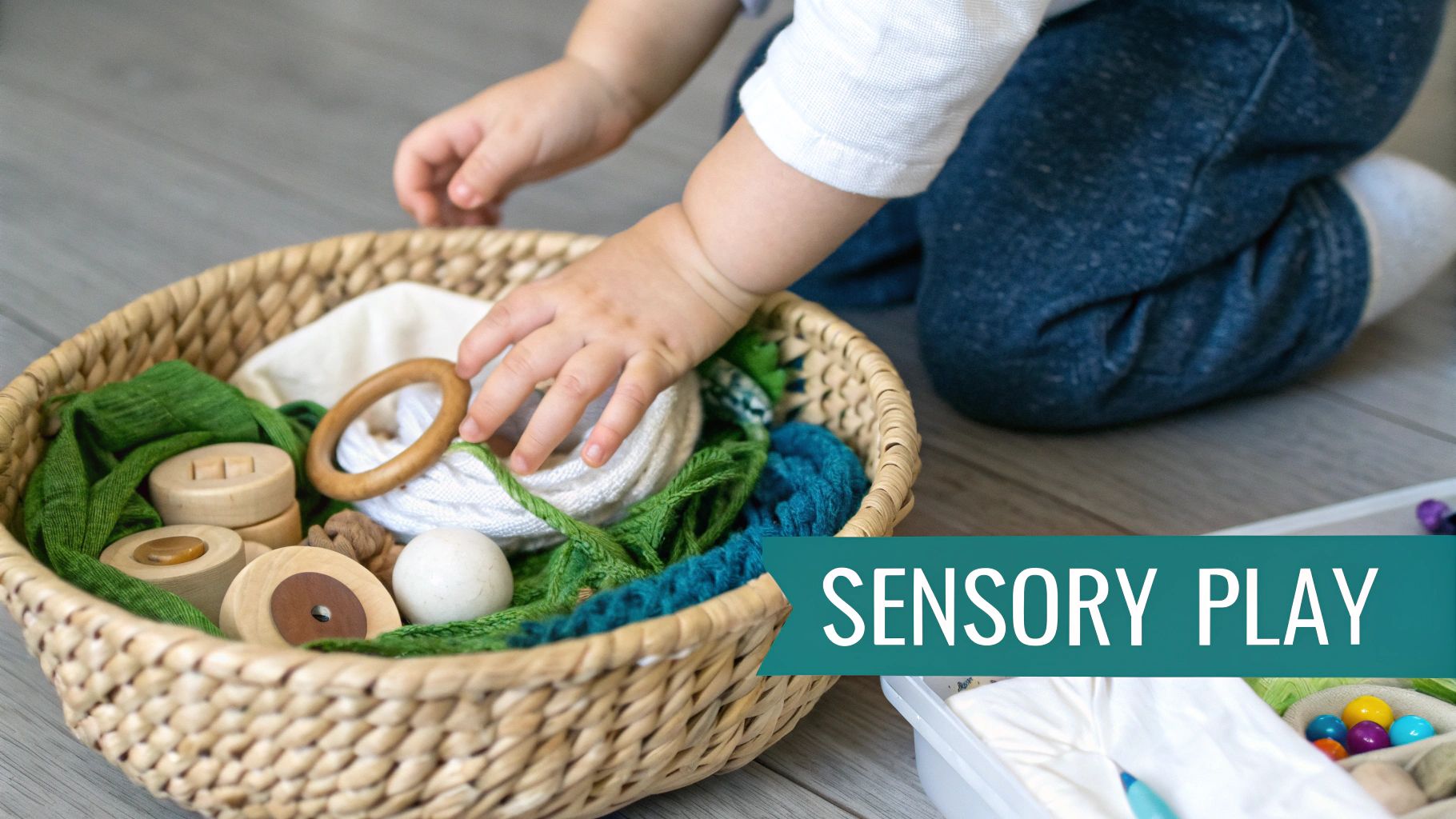
This approach, popularised by educational philosophies like Montessori and Waldorf, moves away from plastic, battery-operated toys to focus on simple, open-ended materials that encourage curiosity and imagination. It’s an ideal activity for an 18-month-old who is beginning to categorise objects and understand the properties of their environment.
Getting Started: Creating a Natural Sensory Basket
The easiest way to introduce this activity is with a "treasure basket." Simply gather a collection of safe, natural items and place them in a low, accessible basket for your child to explore freely.
- Step 1: Find a shallow, sturdy basket made from a natural fibre like wicker or seagrass.
- Step 2: Select 5-7 different items. Focus on variety in texture, shape, and weight. Good examples include a large, smooth river stone, a pinecone, a wooden scoop, a silk scarf, and a natural sponge.
- Step 3: Place the basket on the floor in a safe play area and allow your toddler to discover it on their own terms. Sit nearby, but let them lead the exploration.
- Step 4: Narrate their actions to build vocabulary: "You've found the bumpy pinecone! It feels rough. The scarf is so soft and light."
Why This Activity Is Great for Your 18-Month-Old
- Developmental Benefits: Enhances fine motor skills (grasping, pinching), stimulates multiple senses, builds concentration, and introduces descriptive language.
- Time Needed: 10-20 minutes of supervised play.
-
Materials You Might Have:
- From Home: Wooden spoons, shells (large and not sharp), pinecones, silk scarves, natural sponges.
- From a Grow With Me Kit: Wooden sensory blocks, natural fabric squares, wooden rings.
- Safety First: Always supervise this activity closely. Ensure all items are large enough not to be a choking hazard and are clean and free from sharp edges. For a deeper dive into safe and engaging setups, you can find more sensory play ideas for toddlers here.
2. Picture Book Exploration and Early Literacy
Sharing a book with your 18-month-old is far more than just a quiet activity; it's a powerful tool for building foundational language and cognitive skills. At this age, toddlers are beginning to connect words with objects, understand simple cause-and-effect, and develop a longer attention span. Picture book exploration introduces them to the magic of stories, boosts their vocabulary, and creates a cherished bonding experience between you and your child.
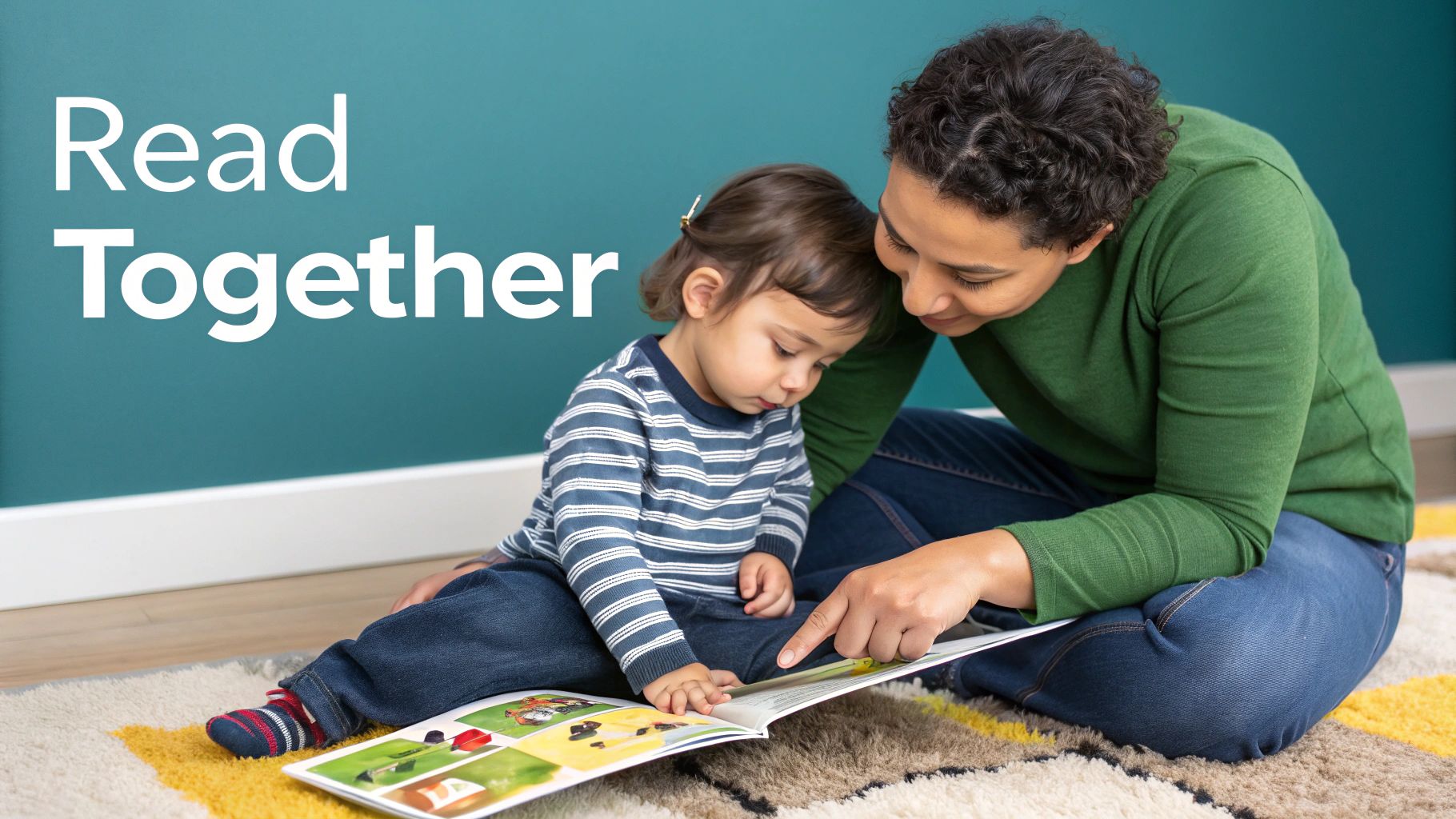
This simple yet effective activity supports pre-literacy skills that pave the way for future reading success. Engaging with sturdy board books featuring bold, clear illustrations and minimal text allows your little one to point, name objects, and even start turning the pages themselves, making them an active participant in the story. It’s an ideal way to nurture a lifelong love of reading from the very beginning.
Getting Started: Creating a Cosy Reading Ritual
The key to successful book exploration is making it a regular, enjoyable part of your day, free from pressure or expectation.
- Step 1: Choose a comfortable, well-lit spot to sit together, like a cosy armchair or a soft rug on the floor.
- Step 2: Select 2-3 sturdy board books. Books with interactive elements like lift-the-flaps ("Dear Zoo") or different textures are particularly engaging for this age group.
- Step 3: Let your child hold the book and help turn the pages. Don't worry about reading every word; instead, follow their lead. If they are fascinated by one picture, spend time talking about it.
- Step 4: Use an expressive voice and make sounds that correspond with the pictures, like animal noises or vehicle sounds. Point to objects as you name them to reinforce word-picture association.
Why This Activity Is Great for Your 18-Month-Old
- Developmental Benefits: Expands vocabulary, develops listening skills, introduces concepts like colours and shapes, enhances memory through repetition, and strengthens the parent-child bond.
- Time Needed: 5-15 minutes, repeated throughout the day.
-
Materials You Might Have:
- From Home: Any board books, especially classics like "Brown Bear, Brown Bear, What Do You See?" or "Goodnight Moon."
- From a Grow With Me Kit: Themed board books, soft fabric books, or touch-and-feel concept books.
- Safety First: Choose durable board books that can withstand chewing and rough handling. Avoid books with small, detachable parts that could become choking hazards. Always supervise to ensure your child interacts with the book safely.
3. Cause-and-Effect Toy Play
At 18 months, toddlers are beginning to grasp that their actions can create reactions, a foundational cognitive milestone. Cause-and-effect toys are designed specifically to reinforce this concept. When your child pushes a button, pulls a string, or drops a ball, something predictable happens in response, like a sound, a movement, or a character popping up. This immediate feedback loop is one of the most powerful learning activities for an 18-month-old, building problem-solving skills and a sense of agency over their environment.
This type of play, celebrated by early childhood educators and toy designers, moves beyond passive entertainment. It encourages persistence and experimentation as your toddler learns, "If I do this, then that will happen." This builds not only their understanding of physics and logic but also their confidence, showing them they can make an impact on the world around them.
Getting Started: Introducing a Cause-and-Effect Toy
Choose a simple, engaging toy with a clear action and reaction. A classic wooden pop-up toy or a ball drop tower is an excellent starting point.
- Step 1: Select one age-appropriate cause-and-effect toy. Avoid anything with too many steps or confusing actions.
- Step 2: Sit with your child on the floor and demonstrate the toy's function once. For example, press the peg on a hammer-peg board and say, "Pop! I pushed the peg down."
- Step 3: Place the toy in front of your child and let them explore. Resist the urge to correct them; allow them to experiment with pushing, tapping, and manipulating it.
- Step 4: Offer enthusiastic praise when they figure it out: "You did it! You made the ball roll down the tower!" This positive reinforcement encourages them to try again.
Why This Activity Is Great for Your 18-Month-Old
- Developmental Benefits: Strengthens cognitive skills like problem-solving and logical thinking, enhances fine motor control and hand-eye coordination, and builds confidence and persistence.
- Time Needed: 10-15 minutes of focused play.
-
Materials You Might Have:
- From Home: Light switches (with supervision), dropping toys into a metal bowl to hear the sound, pull-along toys.
- From a Grow With Me Kit: Wooden hammer and peg toy, stacking rings that slide onto a post.
- Safety First: Always check toys for small parts that could become detached and pose a choking risk. Ensure wooden toys are smooth and free of splinters. Supervise play to ensure your child is using the toy as intended and safely.
4. Stacking and Nesting Play
Stacking and nesting activities are fundamental for an 18-month-old's development, tapping into their burgeoning understanding of spatial relationships and their desire to see how things fit together. This type of play involves ordering, balancing, and fitting objects, which builds crucial fine motor skills, hand-eye coordination, and early problem-solving abilities. Through trial and error, your toddler learns foundational concepts like size, order, and balance in a deeply engaging and satisfying way.
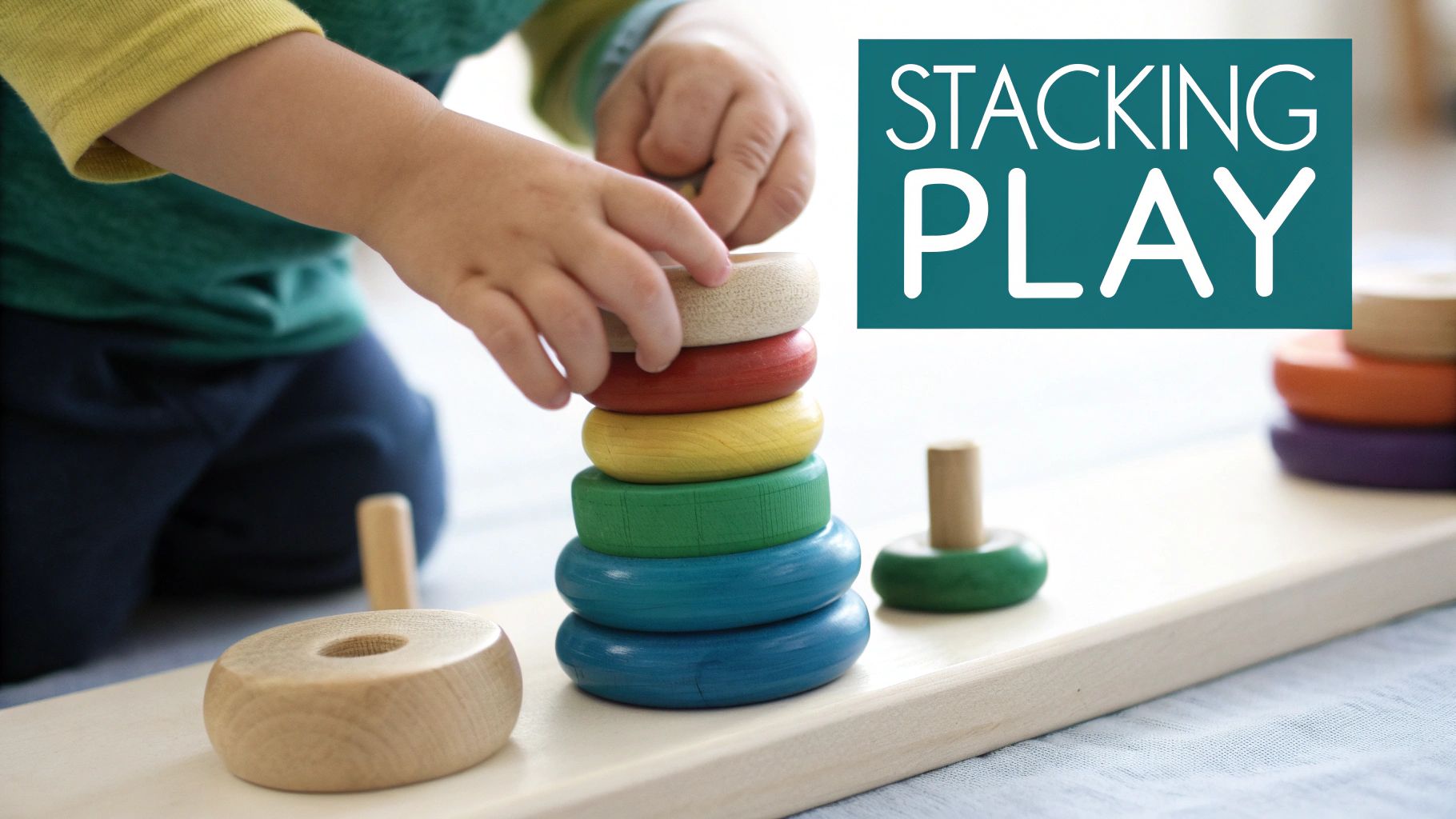
Whether they are carefully placing one block on another or discovering that smaller cups fit inside larger ones, your child is conducting their own mini physics experiments. The simple, repetitive nature of these activities for a 18 month old helps to strengthen concentration and foster a sense of accomplishment, especially when a tall tower comes crashing down, which is an essential part of the learning process!
Getting Started: Setting Up a Stacking Station
Creating an inviting setup is key to encouraging exploration. Choose a clear, flat surface and present just one type of stacking or nesting toy at a time to avoid overwhelming your child.
- Step 1: Select a classic toy like stacking rings, nesting cups, or a set of simple wooden blocks.
- Step 2: Sit with your child and model the activity once without speaking. Slowly stack two blocks or place one ring on the peg.
- Step 3: Hand a piece to your toddler and let them explore. Allow them to stack, nest, line up, or knock down the pieces as they wish.
- Step 4: Offer simple verbal encouragement for their efforts: "You put the small cup inside the big cup!" or "Look how tall your tower is!"
Why This Activity Is Great for Your 18-Month-Old
- Developmental Benefits: Improves hand-eye coordination, develops spatial awareness, teaches cause and effect, and builds problem-solving skills and persistence.
- Time Needed: 10-15 minutes of focused play.
-
Materials You Might Have:
- From Home: Plastic food containers of different sizes, cardboard boxes, chunky board books.
- From a Grow With Me Kit: Wooden stacking rings, nesting bowls, colourful wooden building blocks.
- Safety First: Always check for small parts. Ensure any wooden or plastic toys are free from splinters or sharp edges. While the "knocking down" phase is fun and important, make sure your child is a safe distance away from heavy block towers as they fall. For more insight into the benefits, explore our deep dive on the value of a quality stacking blocks toy.
5. Water Play and Sensory Exploration
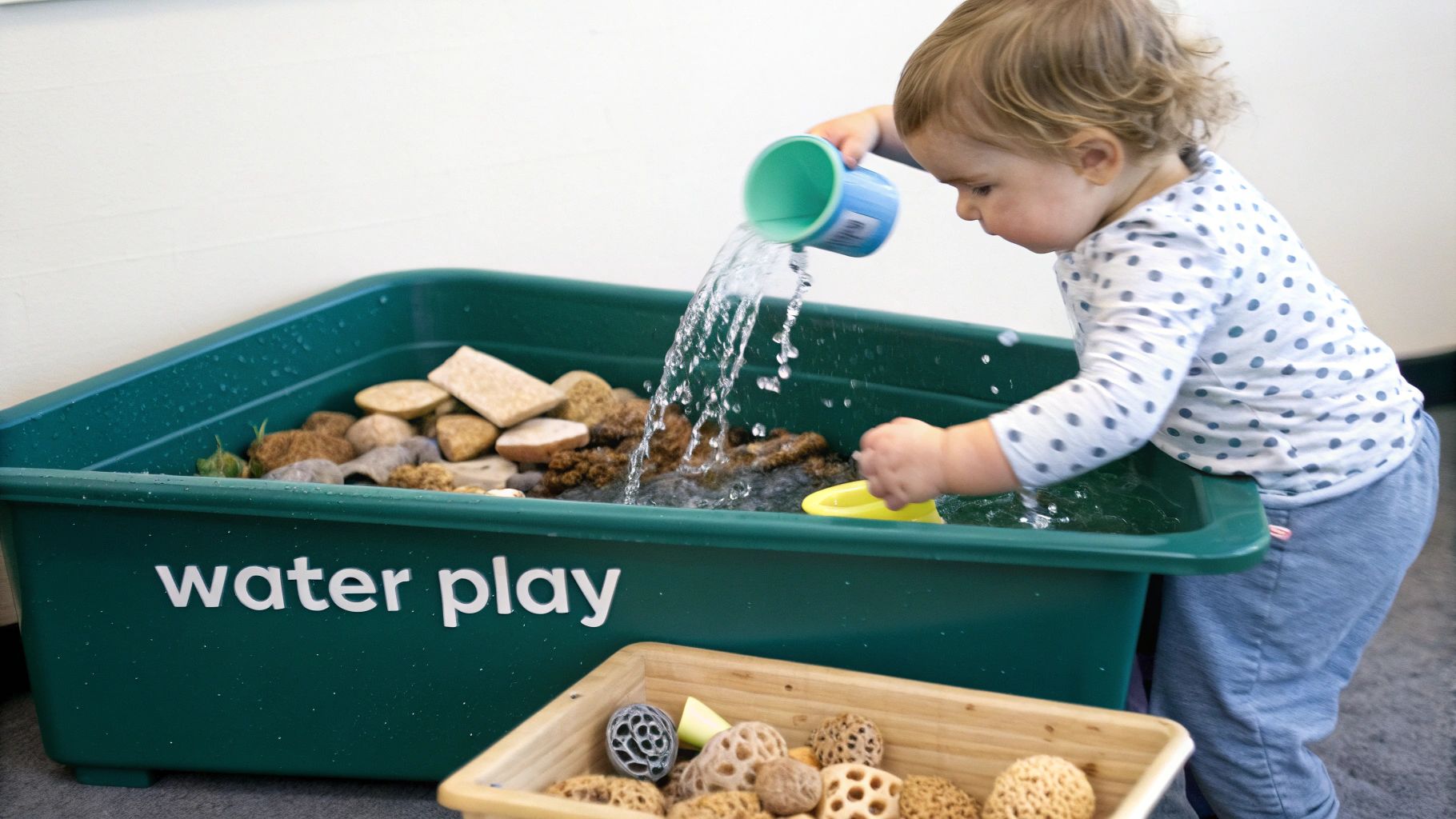
Water play is a universally loved activity that offers a fantastic multi-sensory experience for toddlers. For an 18-month-old, the simple act of splashing, pouring, and scooping is not just fun; it's a rich learning opportunity. This type of play helps them understand basic scientific concepts like cause and effect (splashing makes things wet), volume (full vs. empty), and the properties of liquids in a safe and engaging way.
Whether it’s in the bath, with a small basin in the garden, or using a dedicated water table, this activity provides a calming yet stimulating experience. The repetitive nature of pouring and filling can be very soothing for toddlers, while the introduction of new tools and objects keeps them curious and focused.
Getting Started: A Simple Basin Water Play Setup
You don’t need a large setup to enjoy water play. A simple basin or a storage container on a towel can provide endless entertainment and learning.
- Step 1: Place a large towel on the floor (either indoors or outside) to manage splashes.
- Step 2: Fill a shallow basin or tub with a few inches of warm water. Never leave your child unattended, even for a moment.
- Step 3: Add a few simple, safe items for exploration. Think about things that float, sink, or can be used for pouring. Examples include a natural sponge, wooden spoons, plastic cups, or rubber ducks.
- Step 4: Let your toddler explore freely. Sit with them and describe what they are doing to boost their language skills: "You're pouring the water! Look, the sponge is floating on top."
Why This Activity Is Great for Your 18-Month-Old
- Developmental Benefits: Strengthens hand-eye coordination and fine motor skills (pouring, squeezing), introduces early maths and science concepts, and provides a rich sensory experience that can be either calming or stimulating.
- Time Needed: 10-20 minutes of closely supervised play.
-
Materials You Might Have:
- From Home: Plastic jugs, cups, funnels, natural sponges, wooden spoons, colanders.
- From a Grow With Me Kit: Wooden scoops, sensory balls (that are safe for water), stacking cups.
- Safety First: Never, ever leave a child unattended near water, no matter how shallow. Always stay within arm's reach. Ensure the water is a comfortable, warm temperature and have a towel ready for when playtime is over to prevent your child from getting chilled.
6. Music and Rhythm Exploration
At 18 months, toddlers are naturally drawn to sounds and rhythms, making it the perfect time to introduce them to the joy of music. This activity is about more than just making noise; it’s a powerful tool for developing auditory processing, coordination, and emotional expression. By engaging with simple instruments and songs, your child explores cause-and-effect ("When I shake this, it makes a sound!"), learns about patterns, and begins to connect movement with music.
Inspired by early childhood music philosophies like Kindermusik and Montessori, this approach focuses on hands-on, free-form musical play. It nurtures a child's innate musicality and provides a fantastic outlet for their boundless energy. Music and rhythm exploration is one of the most engaging and beneficial activities for a 18 month old, supporting everything from language skills to gross motor development.
Getting Started: Creating a Simple Music Session
You don't need to be a musician to lead a fun and enriching music session. The goal is participation and exploration, not performance.
- Step 1: Gather a few child-safe instruments. Simple shakers, a small drum, or even just two wooden spoons to tap together work perfectly.
- Step 2: Put on some simple, rhythmic music or start singing a familiar nursery rhyme like 'Wheels on the Bus' or 'Twinkle, Twinkle, Little Star'.
- Step 3: Show your toddler how to use the instruments, then let them experiment freely. Tap out the beat, shake the maracas, and encourage them to join in.
- Step 4: Incorporate movement. Clap your hands, stomp your feet, sway to the music, and invite your child to dance with you. Narrate the sounds: "That's a loud bang!" or "What a fast shake!"
Why This Activity Is Great for Your 18-Month-Old
- Developmental Benefits: Boosts auditory processing skills, improves coordination and gross motor control, supports language development through rhythm and repetition, and provides a healthy outlet for emotional expression.
- Time Needed: 5-15 minutes of active engagement.
-
Materials You Might Have:
- From Home: Pots and pans with wooden spoons, plastic containers filled with rice to make shakers, clapping hands.
- From a Grow With Me Kit: Wooden maracas or egg shakers, a child-safe tambourine, or a small xylophone.
- Safety First: Always supervise musical play. Ensure all instruments are age-appropriate, with no small parts that could break off and become a choking hazard. Check for sharp edges and keep the volume at a safe level to protect your toddler's hearing.
7. Push-and-Pull Toy Play
As your 18-month-old gains confidence in their mobility, push-and-pull toys become fantastic companions for their adventures. These classic toys are specifically designed to support toddlers who are mastering walking, encouraging them to practise balance, coordination, and spatial awareness. By giving them a reason to move, these toys transform simple locomotion into a purposeful and engaging activity, building both physical strength and self-assurance.
This type of play is crucial for developing gross motor skills. Whether they are pushing a small wooden car along the floor or pulling a friendly duck on a string behind them, they are learning how to navigate their environment, control their speed, and understand cause-and-effect in motion. It’s one of the most effective and joyful activities for an 18-month-old eager to explore their world on two feet.
Getting Started: Encouraging Independent Movement
Introducing push-and-pull toys is straightforward. The key is to provide a safe space and let your toddler's natural curiosity and desire for movement take over.
- Step 1: Choose a toy appropriate for your child’s height and strength, such as a push walker with a handle or a lightweight pull-along animal.
- Step 2: Clear a spacious area in your home or garden, removing any obstacles or tripping hazards to create a safe "runway."
- Step 3: Demonstrate how the toy works by gently pushing it forward or pulling it so the wheels turn. Make it look fun and inviting.
- Step 4: Place the toy near your toddler and encourage them to take over. You can use phrases like, "Can you take the little dog for a walk?" or "Let's push the car to the other side of the room!"
Why This Activity Is Great for Your 18-Month-Old
- Developmental Benefits: Strengthens gross motor skills, improves balance and coordination, enhances spatial awareness, and builds confidence in walking.
- Time Needed: 15-25 minutes of active play.
-
Materials You Might Have:
- From Home: Toy strollers, small wagons, toy lawnmowers, any toy on a string that is safe to pull.
- From a Grow With Me Kit: A wooden pull-along animal or a classic push-along toy.
- Safety First: Always ensure the play area is free from hazards like rugs, stairs, and sharp corners. Check that pull-along toy strings are not long enough to pose an entanglement risk and always supervise your child during active play.
8. Pretend Play and Imaginative Role-Play
Around 18 months, a magical shift happens in your toddler’s play. You might notice them picking up a block and holding it to their ear like a phone, or carefully feeding their favourite teddy. This is the dawn of pretend play, a monumental leap in their cognitive development where they begin to understand that one object can symbolise another and start to reenact the world around them.
This type of play is foundational for developing social skills, emotional understanding, and language. Inspired by developmental theories from Piaget and Vygotsky, this activity for an 18-month-old uses simple, open-ended props to fuel their growing imagination. It allows them to process their experiences, practice social roles, and build complex thinking skills in a fun, child-led way.
Getting Started: A Simple Tea Party
Setting up a pretend scenario is easy and can be done with items you already have. A pretend tea party is a classic starting point that encourages turn-taking and imitation.
- Step 1: Gather a few simple props like a toy teapot, some small cups, and a few "guests" like dolls or stuffed animals.
- Step 2: Sit on the floor with your toddler and the props. Start by modelling a simple action, like pouring "tea" from the pot into a cup.
- Step 3: Offer a cup to your toddler or a teddy bear. Use simple language like, "Would teddy like some tea? Let's pour some."
- Step 4: Follow your child's lead. If they want to put a block in the cup or stir the tea with their finger, let them. Narrate their actions to reinforce the play and build vocabulary: "You're giving bunny a drink. How kind!"
Why This Activity Is Great for Your 18-Month-Old
- Developmental Benefits: Fosters creativity and imagination, develops social and emotional skills (like empathy), enhances language and communication, and improves problem-solving abilities.
- Time Needed: 10-15 minutes of interactive play.
-
Materials You Might Have:
- From Home: Plastic bowls, wooden spoons, old (and clean) mobile phones, blankets for dolls, empty and clean food containers.
- From a Grow With Me Kit: Wooden play food, a wooden tea set, fabric dolls, animal figures.
- Safety First: Ensure all props are safe and age-appropriate. Check for small parts that could be choking hazards and avoid anything with sharp edges. Supervise play, especially when using household items. For more insight into fostering this crucial skill, you can explore in detail what imaginative play is and its benefits.
8-Activity Comparison for 18-Month-Olds
| Activity | 🔄 Implementation complexity | ⚡ Resource requirements | 📊 Expected outcomes | 💡 Ideal use cases | ⭐ Key advantages |
|---|---|---|---|---|---|
| Sensory Play with Natural Materials | Moderate — needs setup and close supervision for small items | Low–Medium — natural materials, storage, cleaning supplies | Enhanced sensory awareness, fine motor control, early vocabulary | Independent discovery, calm exploration, short guided sessions | Durable, sustainable, multi-sensory engagement |
| Picture Book Exploration and Early Literacy | Low — minimal setup; short repeated sessions | Low — board books, comfortable reading spot | Vocabulary growth, pre-literacy skills, stronger bonding | Bedtime, quiet time, routine reading moments | High language impact with low material cost |
| Cause-and-Effect Toy Play | Low — simple demonstration then independent exploration | Low — a few sturdy single-action toys | Understanding of cause-and-effect, persistence, motor skills | Independent play, early problem-solving practice | Immediate feedback motivates learning |
| Stacking and Nesting Play | Low — easy to prepare; occasional adult guidance | Low — stacking/nesting sets (wooden preferred) | Spatial reasoning, fine motor precision, size concepts | Table or floor fine-motor practice, early math concepts | Teaches spatial relationships; open-ended play |
| Water Play and Sensory Exploration | Moderate — requires safety precautions and supervision | Medium — water table/bin, natural props, towels, warm water | Sensory regulation, scientific concepts (float/sink), calming effect | Bath time, outdoor warm-weather play, calming activities | Highly engaging, soothing, multi-sensory learning |
| Music and Rhythm Exploration | Low — minimal setup; keep sessions short | Low — simple instruments or recordings | Auditory processing, rhythm recognition, gross motor coordination | Transition times, group sing-alongs, short active bursts | Boosts language, movement, and emotional expression |
| Push-and-Pull Toy Play | Low — straightforward but needs clear, safe space | Low — sturdy wheeled toys or pull strings | Gross motor development, balance, walking confidence | Active indoor/outdoor practice, mobility milestones | Encourages independence and walking stability |
| Pretend Play and Imaginative Role-Play | Low–Moderate — minimal props; modeling speeds emergence | Low — simple props, dolls, household items | Symbolic thinking, language, social-emotional skills | Calm indoor play, social/emotional learning, storytelling | Fosters imagination and communication with minimal cost |
Nurturing Growth Through Simple, Joyful Play
The journey with your 18-month-old is one of constant discovery, for them and for you. As we've explored, the world of a toddler is a vibrant, hands-on laboratory where every interaction is a lesson and every object holds potential for wonder. The activities shared in this guide are far more than just ways to fill an afternoon; they are the foundational experiences that build critical neural connections, strengthen physical skills, and foster a deep, lifelong love of learning.
By focusing on simple, open-ended play, you create an environment where your child can thrive at their own unique pace. Whether you're stacking blocks, splashing in a tub of water, or sharing a favourite picture book, you are providing the rich, meaningful interactions your toddler needs to understand their world. The goal isn't perfection or performance, but connection and exploration.
Key Takeaways for Play at 18 Months
Remembering these core principles will help you make the most of this wonderfully dynamic age:
- Process Over Product: At this stage, the joy is in the doing. Your toddler is more interested in the feeling of paint on their fingers or the sound blocks make when they tumble than in creating a masterpiece. Celebrate their effort and engagement.
- Follow Their Lead: Observe what captures your child’s attention. If they are fascinated by pouring water, lean into water play. If they are trying to imitate you, introduce more pretend play. Their interests are the best guide to what their developing brain is ready to learn.
- Safety and Simplicity: You don't need complex, expensive toys. Everyday household items, natural materials, and your own engagement are often the most powerful tools for play. Prioritise a safe environment where they are free to explore without constant intervention.
- Repetition is Learning: When your 18-month-old wants to do the same puzzle or read the same book for the tenth time, they are not being difficult; they are mastering a skill. Repetition builds confidence and reinforces learning pathways in the brain.
Putting It All Into Practice
Your role as a parent or caregiver is not to be an entertainer, but a facilitator and a secure base. You are their play partner, their cheerleader, and their safe harbour. This means knowing when to step in to help and when to step back to let them figure things out for themselves. It also means creating a comfortable environment for play. For some toddlers, this includes managing skin sensitivities that can cause distraction or discomfort. If you notice your child has dry, itchy skin, understanding gentle solutions like a specialised body oil for eczema relief can be crucial for their comfort, allowing them to focus on the joy of discovery.
Ultimately, the most valuable resource you can offer is your presence. The moments you spend on the floor, fully engaged in their world, are building a foundation of security and love that will support them for years to come. The best activities for a 18 month old are the ones that bring you and your child closer together. Embrace the simplicity, celebrate the small achievements, and cherish every moment of this incredible stage of growth.
Ready to simplify playtime without sacrificing quality? Discover Grow With Me, the subscription box that delivers beautiful, Montessori-inspired toys and books directly to your door, perfectly tailored to your 18-month-old's developmental stage. Take the guesswork out of finding the right activities and let us help you nurture your child's growth through purposeful play. Explore our kits and start your journey today at Grow With Me.