
A Parent's Guide to 16 Month Milestones
Welcome to the wonderfully chaotic, utterly brilliant world of your 16-month-old. This age is a real turning point, where those tentative first steps are quickly becoming confident little stomps, and babbling is starting to sound suspiciously like actual words. The 16-month milestones are less of a checklist and more of a fascinating explosion of new skills, touching everything from how they move to how they think and feel.
Your Toddler's Journey at 16 Months
At sixteen months, you're no longer dealing with a baby. You have a proper little person on your hands—one who is determined to explore, experiment, and assert their independence at every turn. It helps to think of this stage not as a race to the finish line, but as a beautiful, interconnected map of their growth. Every new skill, whether it’s managing to stack a single block or pointing excitedly at a passing dog, is a clue to the incredible brain development happening right now.
This period is all about a captivating mix of abilities coming together. Your little one is transforming into a more confident walker, a more curious communicator, and a more complex little human being. They’re starting to properly understand simple requests, make their wants known (often very loudly!), and copy everything they see you do.
The image below gives you a bird's-eye view of the four core areas of development you'll be seeing in action.
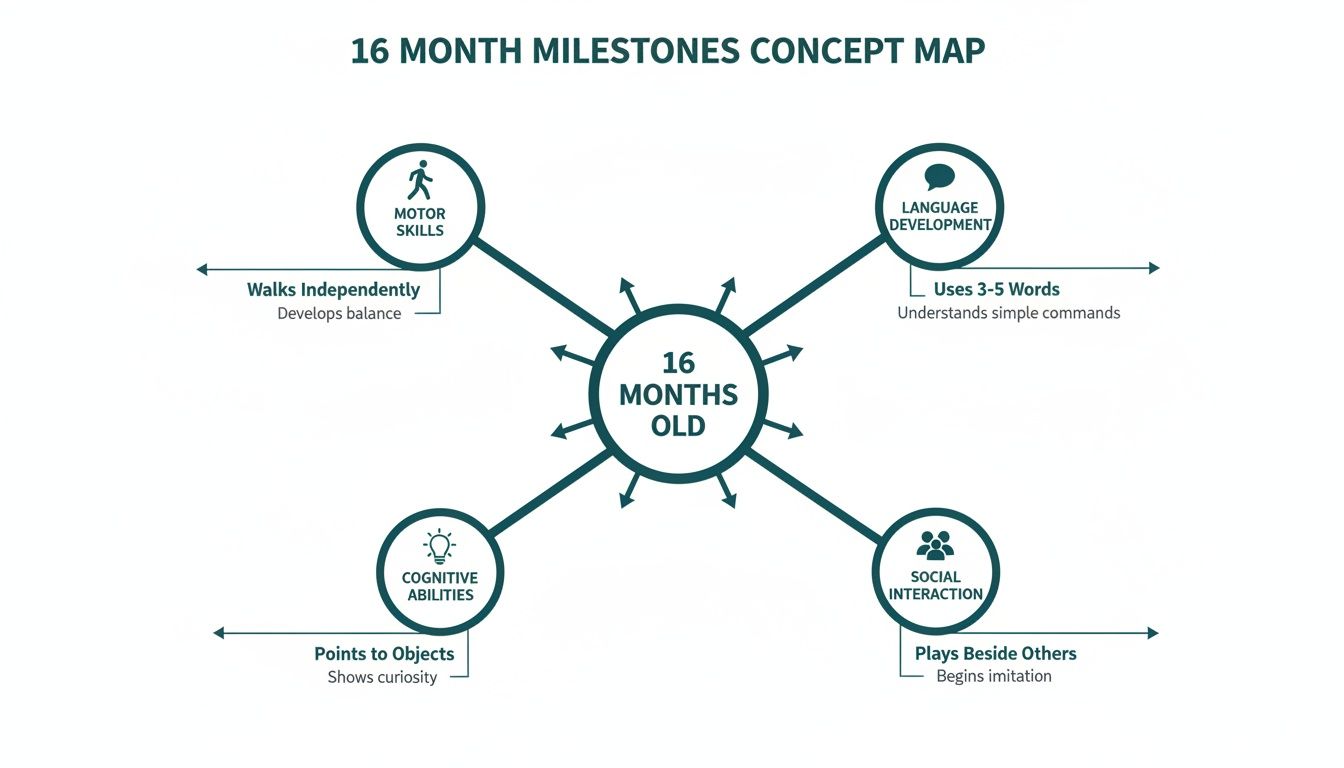
You’ll quickly realise how skills in one area fuel progress in another, creating a wonderfully holistic developmental journey. If you'd like to get back to basics, you can learn more about what developmental milestones are and why they’re so helpful for parents.
To help you get a clearer picture of what's happening, here’s a quick summary table.
16 Month Milestones at a Glance
| Developmental Area | What You Might See Your Toddler Doing |
|---|---|
| Gross Motor | Walking independently, maybe even trying to run. Can squat to pick up a toy. |
| Fine Motor | Stacking 2-3 blocks, scribbling with a crayon, turning pages in a book. |
| Language | Saying 3-10 recognisable words, pointing to what they want, shaking their head "no". |
| Cognitive | Imitating your actions (like stirring or sweeping), starting to sort shapes and colours. |
| Social/Emotional | Showing affection with hugs, having tantrums, showing signs of separation anxiety. |
This table is just a snapshot, but it gives you a good feel for the incredible progress your toddler is making every single day.
What to Expect During This Stage
During this exciting time, you’ll probably see some big leaps forward, alongside a few classic toddler challenges. To give you a heads-up, here are some of the key changes you can expect to see:
- A Surge in Independence: Your toddler will suddenly want to do everything by themselves. This could be anything from trying to feed themselves with a spoon to a determined (and often messy) attempt at putting on their own socks.
- The Vocabulary "Explosion": While they might only be saying a handful of clear words, their understanding of what you're saying is growing at a phenomenal rate. Don't be surprised if they start following simple, one-step instructions.
- Testing Every Boundary: This is classic toddler behaviour. Your 16-month-old is essentially a tiny scientist, testing cause and effect to figure out how their world works and what the rules are.
- Very Big Feelings: Tantrums often make their grand entrance around this age. Your toddler is grappling with huge emotions like frustration and anger but has a very limited toolkit for expressing them.
Knowing what's coming helps you navigate this stage with a bit more patience and perspective. It's all about celebrating every small win and offering plenty of cuddles along the way.
From Wobbly Walks to Confident Climbs
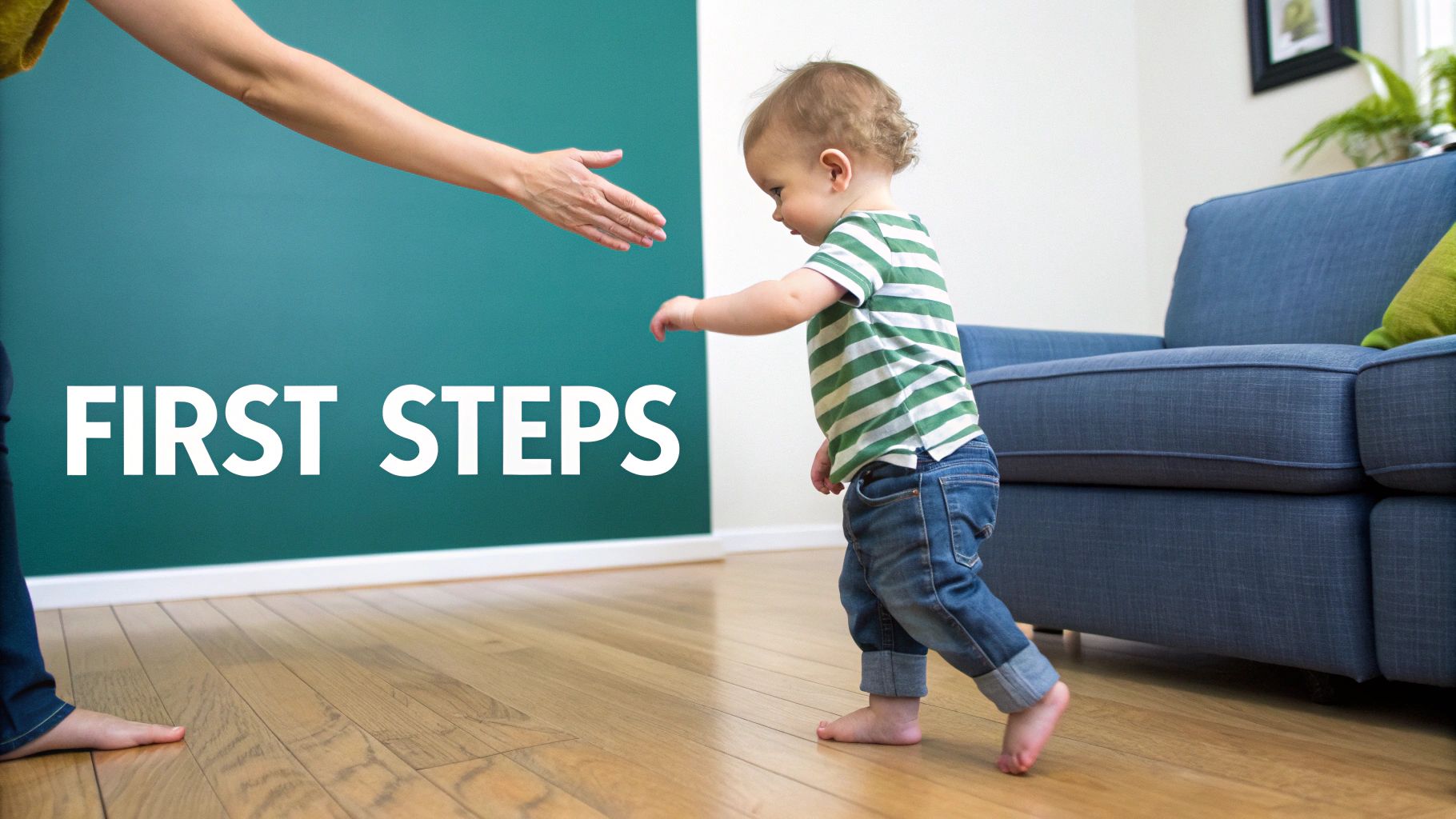
At sixteen months, your toddler's world has completely opened up. That stationary, sitting-on-the-floor viewpoint is a thing of the past. Now, they're on their feet, and life is a bustling landscape of things to touch, see, and conquer. Those wobbly first steps you celebrated just a few months back are becoming more sure-footed, launching the real adventure of toddlerhood.
Think of your little one as a tiny explorer charting new territory. The living room is no longer just a room; it’s a mountain range of sofas, a valley of rugs, and a forest of intriguing table legs. Their mission? To navigate it all. With every determined step, they’re building strength, balance, and coordination. It's a huge part of the 16-month milestones puzzle.
Mastering Movement: Gross Motor Skills
Gross motor skills are all about the big muscles—the ones in their arms, legs, and torso—and right now, they're getting a serious workout. You'll notice your toddler is moving with far more purpose and confidence, which is an absolute joy to watch.
Their walk itself is probably changing. That classic wide-legged, arms-out "toddler waddle" is slowly starting to smooth out into a more coordinated stride. This newfound stability opens up a world of possibilities. For a deeper look into this exciting phase, you might find our guide on when babies start walking helpful, as it covers the whole journey from first wobbly steps to confident strides.
This stage is such a clear shift from baby to toddler, where they build strength through the simple act of playing. At 16 months, most UK toddlers are hitting key gross motor milestones, with around 90% now walking independently. To put their physical growth into context, growth charts used in UK primary care show that boys at this age typically weigh between 9.6kg and 12.4kg, while girls range from 8.9kg to 11.7kg. You can discover more insights about toddler development from the Buckinghamshire Healthcare NHS Trust.
Here are some of the key gross motor skills you'll likely see emerging:
- Walking with more confidence: They can stop, start, and change direction without toppling over quite so often.
- Attempting to run: It might look more like a fast, slightly chaotic walk, but that forward lean shows their growing confidence and intent.
- Climbing everything: Suddenly, the sofa, low chairs, and even the stair gate have become irresistible challenges.
- Squatting to play: Notice how they can easily bend down to pick up a toy and then pop right back up without needing to hold onto anything.
Purposeful play is the engine of physical development. A simple push-along toy isn’t just a toy; it’s a walking coach, helping your toddler practise balance and forward motion in a fun, engaging way.
Developing Dexterity: Fine Motor Skills
While all the big, exciting movements are stealing the show, incredible progress is happening on a much smaller scale. Fine motor skills—those involving the small, precise muscles in the hands and fingers—are becoming much more refined. These are the skills that lay the groundwork for future tasks like writing, doing up buttons, and using a fork.
Every tiny action is forging crucial neural pathways. When your toddler concentrates on placing one block perfectly on top of another, they’re strengthening their hand-eye coordination and learning about cause and effect. It’s a workout for their brain just as much as for their hands.
You can support this development with simple, everyday play. Chunky wooden puzzles, like the ones you might find in a Grow With Me kit, are perfect for this age. They encourage the pincer grasp (using the thumb and forefinger to pick things up) and help your toddler understand how different shapes fit together.
Here’s what to look out for in their fine motor development:
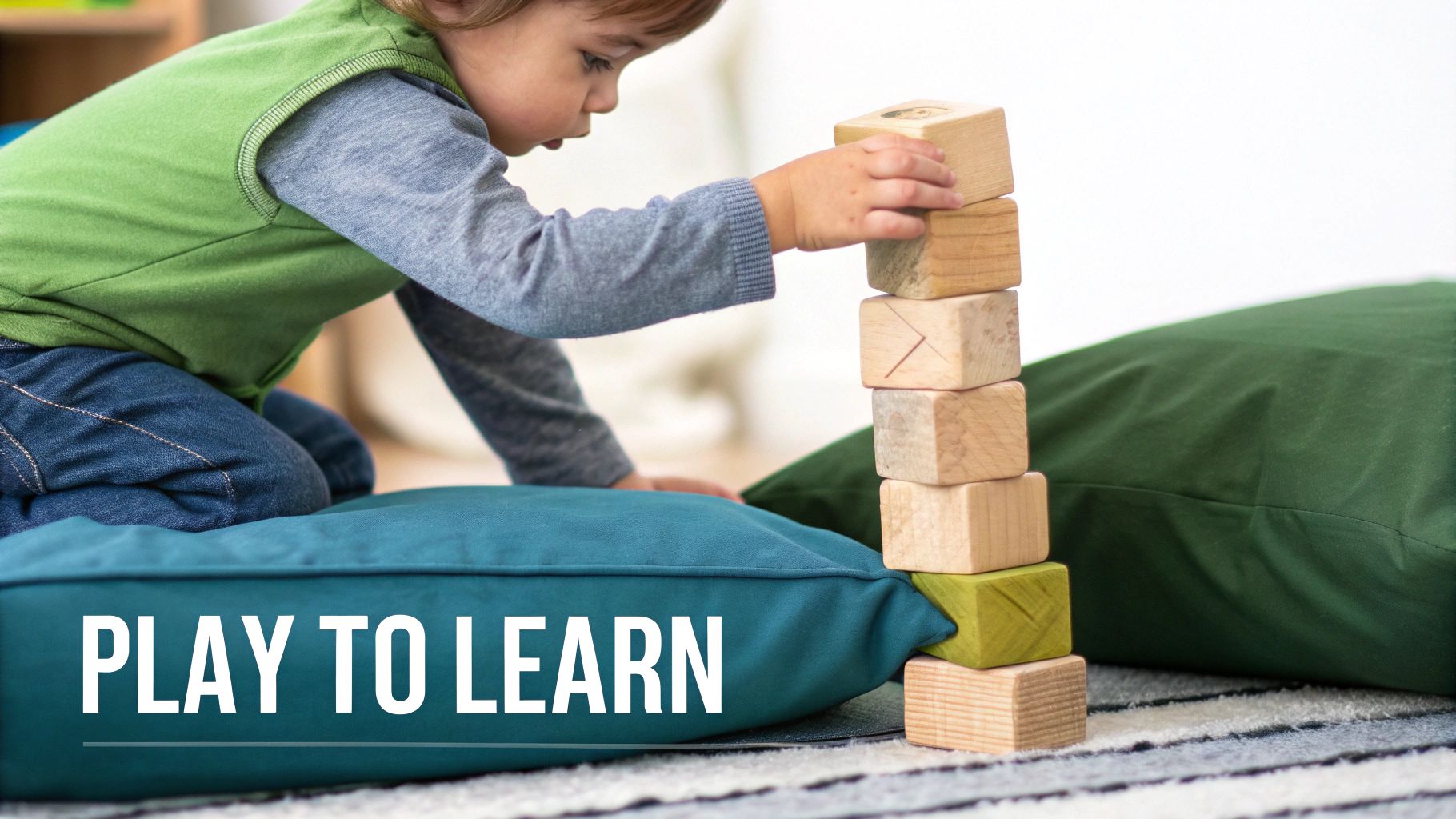
- Stacking blocks: They can probably build a tower of two or three blocks before it all comes tumbling down in a heap of giggles.
- Scribbling with enthusiasm: Give them a chunky crayon and a piece of paper, and they’ll happily make marks, exploring movement and their first flashes of creativity.
- Turning pages: They can now turn the thick pages of a board book, even if it's a few at a time.
- Using a spoon: Yes, feeding themselves is still a very messy affair! But they are getting better at scooping and bringing the spoon towards their mouth.
These physical achievements are so much more than items on a checklist. They represent your toddler's growing ability to interact with and take charge of their own little world. By providing a safe space to explore and simple tools for play, you are giving them exactly what they need to build a strong, confident body and a curious, capable mind.
How Your Toddler Is Learning to Communicate
At sixteen months, your toddler's brain is a bit like a powerful language sponge, busily soaking up every single word, tone, and conversation going on around them. They might only have a handful of actual words they can say out loud, but don't let that fool you—their understanding of language is exploding. This gap between what they comprehend and what they can say is one of the most fascinating parts of the 16-month milestones.
You are their first and most important language teacher. Every chat, every song, every silly voice you use lays the groundwork for their future communication skills. The best part? It doesn't need to be formal. Just narrate your day as you go. "I'm putting your bright red socks on now," or "Let's wash these juicy apples for our snack." This constant commentary helps them connect words to the world around them in a natural, effortless way.
Building Their Vocabulary Brick by Brick
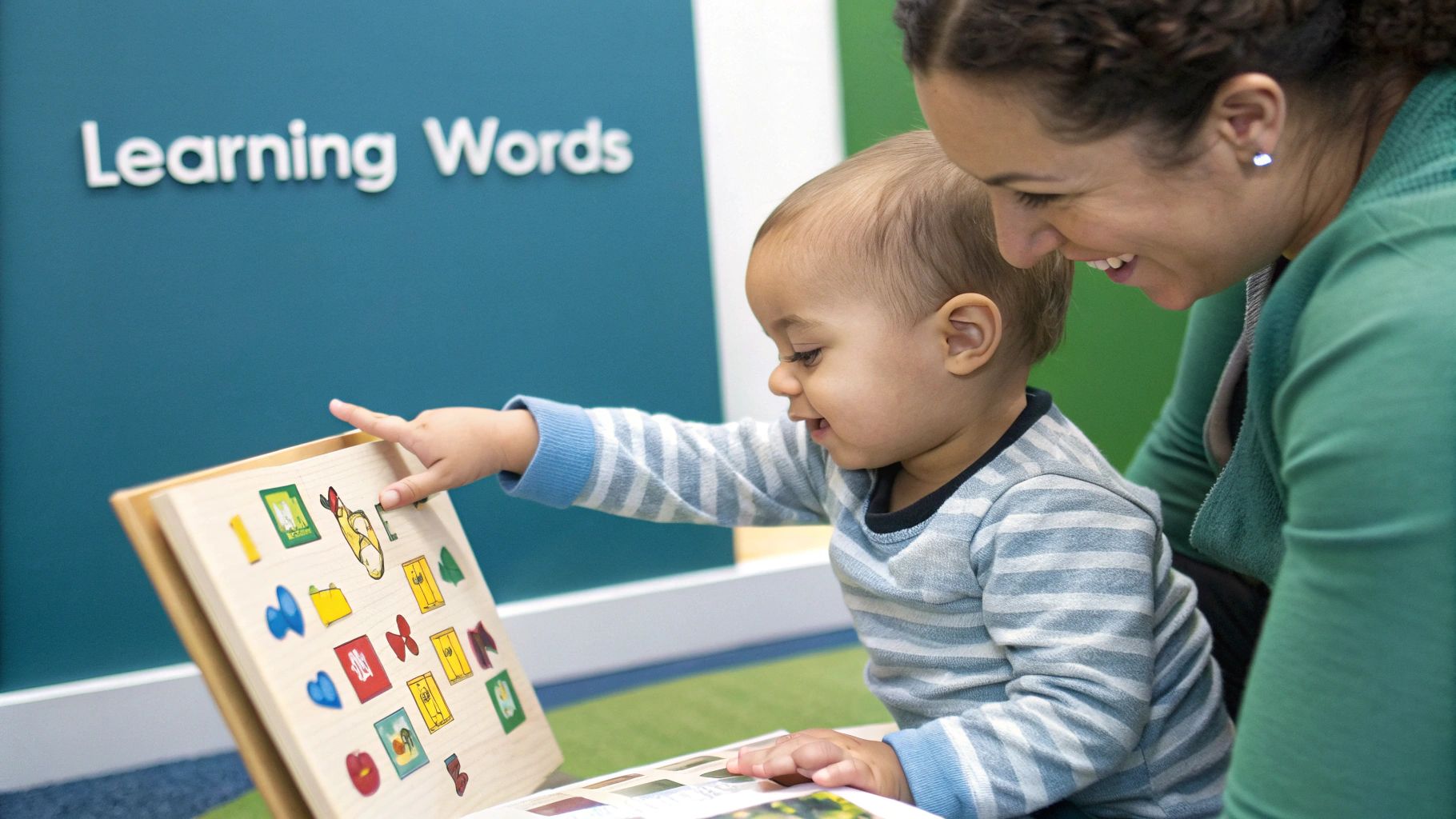
The first words to pop out are usually the most useful ones: "mama," "dada," "cup," or the ever-popular "more." These are powerful tools that get their needs met. But behind these few spoken words lies a much deeper well of what we call receptive language—all the words they truly understand.
You'll see this in action all the time. Ask, "Where are your shoes?" and watch as they toddle over to the shoe rack. That's not just a guess; it shows their amazing comprehension skills. They aren't just hearing sounds; they're processing meaning and making connections, which is a huge cognitive leap.
In fact, while most toddlers in the UK can say between 5-20 words at this age, their understanding can be up to 200 words! This incredible difference really highlights how much is going on inside their busy little minds.
From Pointing to Simple Sentences
Long before they can string words together, your little one will use a whole range of non-verbal cues and sounds to get their point across. Pointing is a massive milestone in itself. It's their way of saying, "Look at that amazing thing!" or "I want that, right now!" without needing the specific word.
When you respond by naming what they're pointing at—"Oh, you see the big, red bus!"—you're cementing that word-object connection for them.
This stage is also all about following simple instructions. Giving them little one- or two-step commands is a perfect way to build their understanding and boost their confidence. Try things like:
- "Pass me your teddy, please." This shows they can identify an object and then perform an action with it.
- "Can you put the book on the table?" This tests their understanding of objects and where they belong in space.
- "Wave bye-bye to Grandma!" This helps them link a word to a specific social gesture.
Every shared story and silly song is an active language lesson. When you pause and let them fill in a word or make an animal sound, you're not just reading—you're having their very first conversations.
The Power of Reading and Rhymes
Snuggling up with a book is genuinely one of the best things you can do to boost their language skills. Sturdy board books with simple, repetitive text and clear pictures are absolutely ideal at this age. They give you the perfect chance to point, name objects, and make the whole experience interactive. For fostering early language skills and recognition, consider exploring engaging toddler books like 'Brown Bear, Brown Bear, What Do You See?' which use that wonderful rhythm and repetition to captivate young minds.
Try to make story time a dialogue, not a monologue. Ask questions like, "Where is the duck?" and put on a big, celebratory voice when they point to the right picture. This transforms reading into a fun, rewarding game that helps build a lifelong love for books and communication. Simple, age-appropriate books and puzzles, just like the ones you find in our Grow With Me kits, are specifically designed to support this kind of interactive learning, making your playtime both fun and developmental.
Navigating Big Feelings and Budding Independence
Welcome to the beautifully messy emotional world of your 16-month-old. This is an age of enormous feelings, a fierce desire for independence, and, yes, some truly spectacular meltdowns. If it feels like your once-placid baby has been replaced by a tiny boss with very strong opinions about everything, you’re definitely not alone. This emotional rollercoaster is a perfectly normal part of hitting those 16-month milestones.
Your toddler's inner world is a whirlwind of new desires clashing with their still-developing abilities. They desperately want to put their own shoes on, but their little fingers can't quite manage it yet. They know exactly which toy they want from the other side of the room, but they don't have all the words to tell you. This gap between their strong will and their current skillset is the perfect recipe for frustration.
Why Tantrums Happen (It's Not What You Think)
Temper tantrums aren't a sign of bad behaviour—they're a raw form of communication. Imagine trying to explain something incredibly important, but you only have five or six words in your vocabulary. That’s your toddler’s reality right now. These emotional outbursts are their way of shouting, "I'm overwhelmed," "I'm frustrated," or simply, "I need your help!"
Instead of seeing tantrums as defiance, try to reframe them as a healthy, if noisy, part of their development. They are learning to navigate a world full of rules and boundaries while figuring out who they are as a separate person. It's a messy but absolutely essential process. As your toddler tests the waters, you might find some helpful strategies for supporting your toddler's self-control.
Understanding Separation Anxiety
Just when they start pushing for more independence, you might also notice a sudden surge in clinginess. Separation anxiety often peaks around this age, turning simple goodbyes into tearful ordeals. This isn't a step backwards; it's actually a sign of the strong, secure attachment they have with you. They now understand that you can leave, but they don't yet have the concept of time to fully grasp that you'll definitely be back.
Here are a few common triggers for these big feelings:
- Separation: Saying goodbye at nursery or even just popping into another room can be distressing.
- Frustration: Not being able to complete a task, like fitting a shape into a sorter.
- Transitions: Moving from one activity to another, especially from playtime to something less fun, like getting in the car seat.
- Tiredness or Hunger: Basic needs can make it much harder for them to manage their emotions.
Solid sleep is absolutely foundational for emotional regulation. Most 16-month-olds in the UK need 12-15 hours of sleep over a 24-hour period, which usually includes one or two naps. Getting enough rest fuels their ability to cope with daily challenges and supports all areas of their growth.
Your role during a tantrum isn't to fix the problem, but to be their calm anchor in the storm. Stay close, offer quiet comfort, and let them know their feelings are valid, even if the behaviour isn't.
The Dawn of Social Play
On the social front, your 16-month-old is just beginning to realise that other children are people, too—not just interesting, moving objects! You’ll likely see them engage in what’s called parallel play. This is when they play alongside another child, maybe with similar toys, but without directly interacting. It might look like they're ignoring each other, but this is a crucial first step in learning how to be social.
Think of it as social research. They're watching, learning social cues, and just getting comfortable being around their peers before they're ready to share and cooperate.
During this emotionally charged phase, comforting objects can be a real lifeline. Sensory toys, like the smooth wooden items you'd find in a Grow With Me kit, can provide a calming, tactile experience. Having a special toy to hold can help your child self-soothe when they feel overwhelmed, giving them a small, comforting sense of control in their big, emotional world.
Simple Play Ideas to Boost Development
You don’t need a house full of expensive, flashing toys to support your toddler's incredible growth. Honestly, the best developmental tools are often the simplest ones, woven right into your everyday life. For a 16-month-old, play is their most important work – it’s how they figure out the world and practise all the new skills they’re collecting.
The real magic happens when you turn ordinary routines into moments of purposeful play. It’s all about spotting the potential in the things you already have. A pile of cushions becomes a mountain to scale, a cardboard box is a secret den, and a trip to the supermarket is a brilliant chance to name every fruit and vegetable you see. These simple interactions are the true building blocks of learning.
Morning Play: Gross Motor Fun
First thing in the morning is the perfect time to get those big muscles moving. Your toddler is buzzing with energy after a night's sleep, so channelling that into gross motor activities is a win-win. It helps build their strength, coordination, and confidence in what their body can do.
Why not build a quick indoor obstacle course? You don't need any special kit. A few pillows to clamber over, a blanket draped between two chairs to create a tunnel, and a cushion to jump onto at the end is all it takes. This is fantastic for encouraging climbing, crawling, and balancing in a way that feels like pure fun.
Another morning favourite in our house is a "dance party." Just pop on some music and dance together. It’s a brilliant way to practise balance and explore new movements. You’ll see them trying to copy your moves, spinning around, and maybe even attempting a little run. It’s pure, simple joy that also happens to be a great physical workout.
Midday Activities: Fine Motor and Sensory Exploration
After a busy morning, your little one might be ready for some quieter, more focused play. This is a great window to work on those all-important fine motor skills – the ones involving the small muscles in their hands and fingers. These skills lay the groundwork for everything from using a fork to one day holding a pencil.
Sensory play is a wonderful way to engage their senses while getting those little hands working. A simple washing-up bowl with a bit of water, some plastic cups, and a few spoons can keep them happily occupied for ages. As they pour, scoop, and splash, they’re strengthening their hand-eye coordination and learning early concepts like 'full' and 'empty'. For more inspiration, you can find loads of fun and easy sensory play ideas for toddlers that use things you already have at home.
Building a simple tower of three or four chunky blocks might not look like much, but it's a huge developmental win. It requires immense concentration, hand-eye coordination, and an early, intuitive understanding of balance and physics.
Here are a few other ideas for focused midday play:
- Posting Fun: Cut a slot in the lid of an old takeaway container and give your toddler large, safe items like big pasta shapes or milk bottle tops to post through. This is fantastic for their pincer grasp.
- Scribbling Station: Tape a big piece of paper to the floor or a low table and let them explore with chunky, non-toxic crayons. It’s all about the joy of making marks, not creating a masterpiece.
- Board Book Explorer: Sit with them and let them practise turning the thick pages of a board book. This simple action is a great workout for building finger strength and dexterity.
Afternoon Adventures: Language and Imagination
As the day winds on, it’s a great time to tap into their budding imagination and communication skills. Your toddler is really starting to get the hang of pretend play, imitating the things they see you do every day. This is a crucial part of how they learn about the world and their place in it.
A "let's pretend" session is so easy to set up. Hand them a toy phone and have a chat, or give them a little brush and dustpan so they can "help" you sweep. Narrating what you're both doing helps to build their vocabulary: "You're sweeping up the crumbs! Swish, swish, swish." This kind of play helps them make sense of social roles and daily routines.
This is also the perfect time for a story. Cuddling up with a book isn't just about boosting their language skills; it's a powerful way to strengthen your bond. Make it interactive by pointing to pictures, asking questions like "Where is the doggy?", and using funny voices for the characters. The repetition in toddler books is gold for helping them learn new words and sentence structures. These shared moments are what nurture a lifelong love of reading.
When to Talk to Your Health Visitor
It’s so easy to get caught up in milestone checklists, but it's important to remember they are just gentle guides, not strict rules. Every child develops on their own unique timeline, and the range of what’s considered “typical” is wonderfully broad. The 16-month milestones we’ve talked about are simply common patterns, not deadlines your toddler is meant to hit.
Honestly, your own instinct is one of the most powerful tools you have. You know your child better than anyone. If something is niggling at you, it’s always worth looking into. The point isn’t to create anxiety, but to empower you with the right information so you can confidently seek support if you feel it’s needed.
Signs That Might Warrant a Chat
Rather than fixating on what your toddler isn't doing, it’s often more helpful to watch for a few specific signs that might suggest it's a good idea to check in with a professional. These aren't immediate red flags, but they are solid reasons to get a bit of reassurance and guidance.
Consider having a chat with your health visitor if your 16-month-old:
- Is not yet attempting to walk. This includes not pulling themselves up to stand or "cruising" along the furniture.
- Doesn't make eye contact. If they consistently avoid looking at you when you’re talking or playing together.
- Shows no interest in pointing or gesturing. For instance, not pointing at things they want or waving bye-bye.
- Is not using any single words. Most toddlers at this stage have at least one or two simple words, like "mama" or "dada."
- Seems to have lost skills they once had. A good example is if they were babbling, waving, or making certain sounds and have now stopped completely.
Trusting your gut is a huge part of parenting. If something feels off, getting a professional opinion is a proactive and loving step to make sure your little one has all the support they need to thrive.
Here in the UK, your first port of call is usually your health visitor or your local GP. They are there to help with any concerns you have about your child's development, no matter how small they may seem. They can offer a proper assessment, give you valuable advice, and if needed, refer you to specialists, making sure you feel supported every step of the way.
Your Top Questions About 16-Month Milestones, Answered
As you watch your 16-month-old navigate their rapidly expanding world, it’s only natural to have a few questions. This stage is a whirlwind of new skills and big feelings, so having some clear answers can make all the difference. We’ve pulled together some of the most common queries from parents who are right there with you.
So, Should My 16-Month-Old Be Talking?
Yes, they should be! But it’s important to know what "talking" really looks like at this age. Your little one’s understanding of language is miles ahead of their ability to produce words. So while they might only have a handful of clear words—somewhere between 3 to 10, like "mama," "dada," or "cup"—they probably understand dozens more.
Don’t just listen for words; look for all the other ways they’re communicating. Are they pointing with purpose? Do they follow simple, one-step directions like "bring me your shoes"? These are fantastic signs that their language skills are developing just as they should be, even if their vocabulary feels small for now.
How Much Sleep Do They Really Need?
Sleep is absolutely vital for your 16-month-old's brain development and their ability to handle those big toddler emotions. Most children this age need a total of 13-14 hours of sleep in a 24-hour period. This usually breaks down into a solid 10-12 hours overnight, plus a daytime nap of 2-3 hours.
A well-rested toddler is often a happier, more resilient toddler. A predictable nap and bedtime routine doesn’t just help them sleep; it provides the security and structure they need to manage their feelings throughout the day.
Keep an eye out for signs that their sleep needs are shifting. This is a classic age for the big transition from two naps down to one. If you notice they’re suddenly fighting that afternoon nap or having trouble settling at night, it might be time to adjust their schedule. Just follow their lead.
Is It Normal for Them to Still Have So Many Tantrums?
Oh, absolutely. Tantrums are a classic (and completely normal) part of being a 16-month-old. It helps to reframe them: think of a tantrum less as naughty behaviour and more as a communication breakdown. Your toddler has big ideas and even bigger feelings, but they simply don't have the words to express their frustration, which leads to an emotional explosion.
Your best strategy is to be their calm anchor in the storm. Acknowledge their feelings—"I can see you're so upset that we have to leave the park"—without giving in to the demand. This helps them feel heard and understood while you gently hold the boundary.
What If My Child Isn’t Walking Yet?
While many toddlers are walking by 16 months, every child develops at their own pace. If your little one is pulling up to stand, cruising along the furniture, and seems eager to get moving, they are likely just taking their time.
The key is to look at their overall progress. However, if they aren't yet pulling themselves up to a standing position or seem unwilling to bear any weight on their legs, it's worth having a chat with your health visitor, just for your own peace of mind.
At Grow With Me, we know that every milestone is part of a much bigger journey. Our curated play kits are thoughtfully designed to support your child’s unique development at every stage, turning simple playtime into a powerful learning opportunity. Explore our stage-based boxes and find the perfect tools to nurture your little one’s growth at https://shop.growwithmesubscriptionbox.co.uk.