
Best toys 2 year olds: Top picks for growth
The best toys for 2 year olds aren't always the flashiest or most complicated. More often than not, they’re the simple, classic ones that invite little hands to explore—think sturdy building blocks, chunky shape sorters, and colourful play food. These are the toys that give toddlers the freedom to practise new skills and start figuring out the world on their own terms.
Why Play Is So Much More Than Just Fun for a Toddler
At two, your child's brain is an absolute whirlwind of activity, and play is the fuel that keeps it all going. It’s not just about keeping them busy; it’s the very way they learn, experiment, and test out big new ideas in a safe, familiar space.
Every single time they manage to stack one block on top of another, scribble with a crayon, or pretend to give a teddy a drink, they're forging vital connections in their brain.
This is an age of massive developmental leaps. You'll see their physical coordination get better almost by the day, their vocabulary will explode from single words into little phrases, and you'll catch those first, wonderful glimpses of imaginative play. The right toys act like the perfect set of tools, helping them master all these exciting new abilities.
Play really is the work of childhood. If we think of toys as the tools for that work, it becomes clear why choosing the right ones matters so much. Just like a craftsperson needs good tools, a toddler needs toys that are up to the job of fuelling their learning.
Setting the Stage for Future Learning
Choosing toys for your two-year-old is a real investment in their future. The skills they are building right now through play—like figuring out a puzzle, getting creative, and learning how to share—are the very building blocks for everything that comes next. To get a deeper sense of just how much these early experiences matter, it's worth understanding the benefits of early intervention for child development.
This shift towards purposeful play is something we're seeing across the board. The UK's infant and preschool toy market is valued at around £821.5 million, and it's expected to grow as more parents look for toys that do more than just entertain.
Our goal with this guide is to help you look at a toy and see not just a fun object, but a powerful tool for helping your toddler grow.
How Toys Shape Key Developmental Milestones
At two years old, your child's brain is a hive of activity, buzzing with new connections being made every single second. The toys 2 year olds play with aren't just for fun; they're the actual tools and materials they use to build their understanding of the world. Each toy helps them work on a specific skill, laying a solid groundwork for all the learning yet to come.
Think about a simple set of wooden blocks. To us, they're just bits of wood. To a toddler, they're a gym for strengthening tiny fingers, a first physics lesson when a tower topples over, and a blank canvas for a blossoming imagination. The right toys are catalysts, turning playtime into powerful developmental work.
This is because, as you can see below, a child's cognitive, physical, and emotional growth are all wonderfully tangled together.
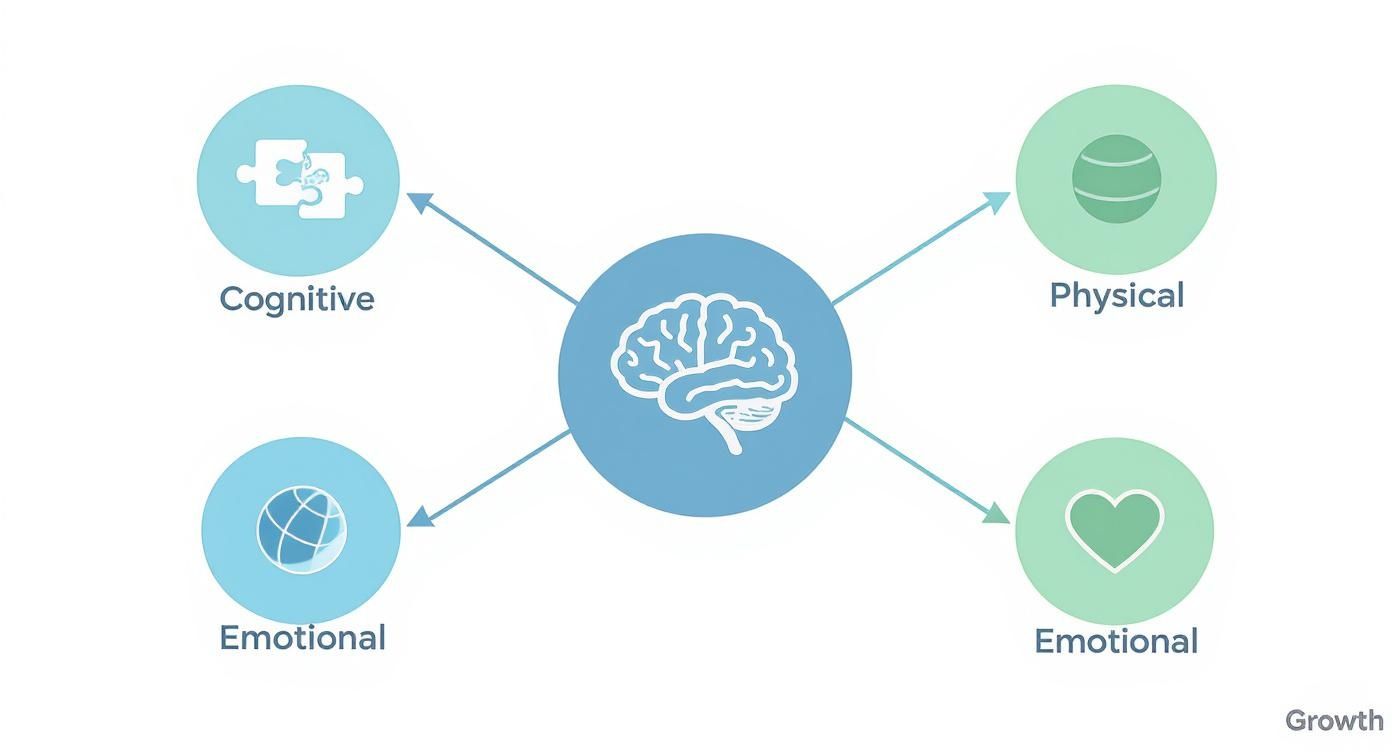
Progress in one area almost always sparks a leap in another, creating a brilliant, self-fuelling cycle of growth.
Building Strong Bodies and Minds
Physical development is probably the most obvious change you'll see at this age, and it’s split into two main areas. Gross motor skills are all about the big muscles—the ones used for running, jumping, and climbing. Fine motor skills are about the small, precise movements of the hands and fingers, essential for things like drawing or doing up a zip.
Toys are basically the perfect personal trainers for both.
- For Gross Motor Skills: Think ride-on toys, soft balls for kicking and tossing, or even just a few cushions on the floor to create a mini obstacle course. These all encourage whole-body movement and coordination.
- For Fine Motor Skills: Chunky puzzles, stacking rings, and threading large beads all demand careful hand-eye coordination, strengthening the dexterity they'll need later for writing.
These activities do more than just build physical strength; they build a toddler's confidence and give them that all-important "I can do it!" feeling. If you want to dive deeper, you can learn more about what developmental milestones are in our complete guide.
Fostering Language and Problem-Solving
Your two-year-old's world is getting bigger by the day, and their ability to communicate and understand is exploding right along with it. Toys have a huge part to play in this cognitive leap, making abstract ideas real and tangible. Often, the simplest, most open-ended toys are the best for this.
Picture books with colourful illustrations introduce new words and ideas. When you point to a picture of a dog and say "dog," you're forging a direct link between the word and its meaning. In the same way, a shape sorter isn't just about putting a square in a square hole; it’s a hands-on lesson in logic, trial-and-error, and spatial awareness.
The best cognitive toys don't give children the answers; they inspire them to ask questions. They invite a child to wonder, "What happens if I do this?"—the very foundation of critical thinking.
Nurturing Social and Emotional Skills
Play is how toddlers rehearse for real life. Through imaginative games, they explore different social roles, work through big feelings, and learn what it means to be a friend. This is where things like play kitchens, dolls, and little animal figures really come into their own.
When your little one pretends to feed a teddy or make you a cup of tea, they're copying the caring actions they see from you. They are, quite literally, stepping into someone else's shoes, which is how empathy begins to grow.
These scenarios give them a safe space to explore emotions like frustration (when the block tower falls over) or pride (when they "bake" a successful cake). This kind of play helps them make sense of the world and their place in it, building emotional intelligence one pretend game at a time.
Your Practical Toy Safety Checklist
https://www.youtube.com/embed/_lftoa19qok
When you have a two-year-old, you quickly learn that absolutely everything is an object of fascination. And more often than not, that fascination involves putting things in their mouth. Making sure the toys 2 year olds play with are truly safe gives you the peace of mind to let them explore freely. This checklist will take you beyond the obvious and give you some practical, everyday checks you can rely on.
A brilliant rule of thumb for spotting choking hazards is the toilet paper roll test. It's incredibly simple: if a toy, or any part of it, can fit through an empty toilet paper roll, it’s too small for a child under three. This is a quick and easy way to weed out risky items.
Decoding Safety Labels and Materials
When you're browsing for a new toy, the packaging holds some vital clues. In the UK, there are specific safety markings you should always keep an eye out for. These aren't just logos; they're your guarantee that a toy has passed strict safety standards.
- UKCA Mark: This is the UK’s own product mark. It shows that the toy meets health, safety, and environmental protection standards for anything sold in Great Britain.
- CE Mark: You'll still see this one around too. It's the European Union's equivalent, and it also confirms the toy meets their safety requirements. A toy should have at least one of these marks.
Beyond the labels, the materials themselves are a big deal. Both wood and plastic can be fantastic choices, as long as they're high quality. If you're going for plastic, look for toys that are clearly labelled as BPA-free. For wooden toys, you want to see non-toxic paint that isn’t going to chip off into little hands (and mouths).
A safe toy is a well-made toy. Regularly check for signs of wear and tear, like splintering wood or cracked plastic, that could create sharp edges or small, breakable pieces.
This isn't really about picking one material over the other. Durable, natural wood offers a wonderful sensory experience and tends to last for ages. At the same time, high-quality, non-toxic plastic allows for bright colours and unique shapes that can be just as engaging and perfectly safe for your little one.
Performing Hands-On Safety Checks
Before a new toy makes its way into the toy box, it's worth giving it a quick physical inspection. Honestly, your own hands are one of your best tools for spotting potential dangers. Run your fingers over all the edges and corners. Is there anything sharp or rough that could cause a cut or a splinter?
Next, give the toy a gentle tug and a twist. Do any parts feel loose or wobbly? Weak points, particularly where different components are joined together, can easily break off and become a serious choking hazard.
Finally, just take a look at the design itself. Steer clear of toys with long strings, cords, or ribbons longer than 22 cm, as they can be a strangulation risk. And check for any small holes or gaps where tiny fingers could get trapped. Making these simple, hands-on checks a habit helps you create a much safer play space for your very curious toddler.
Unlocking Creativity Beyond the Toy Box
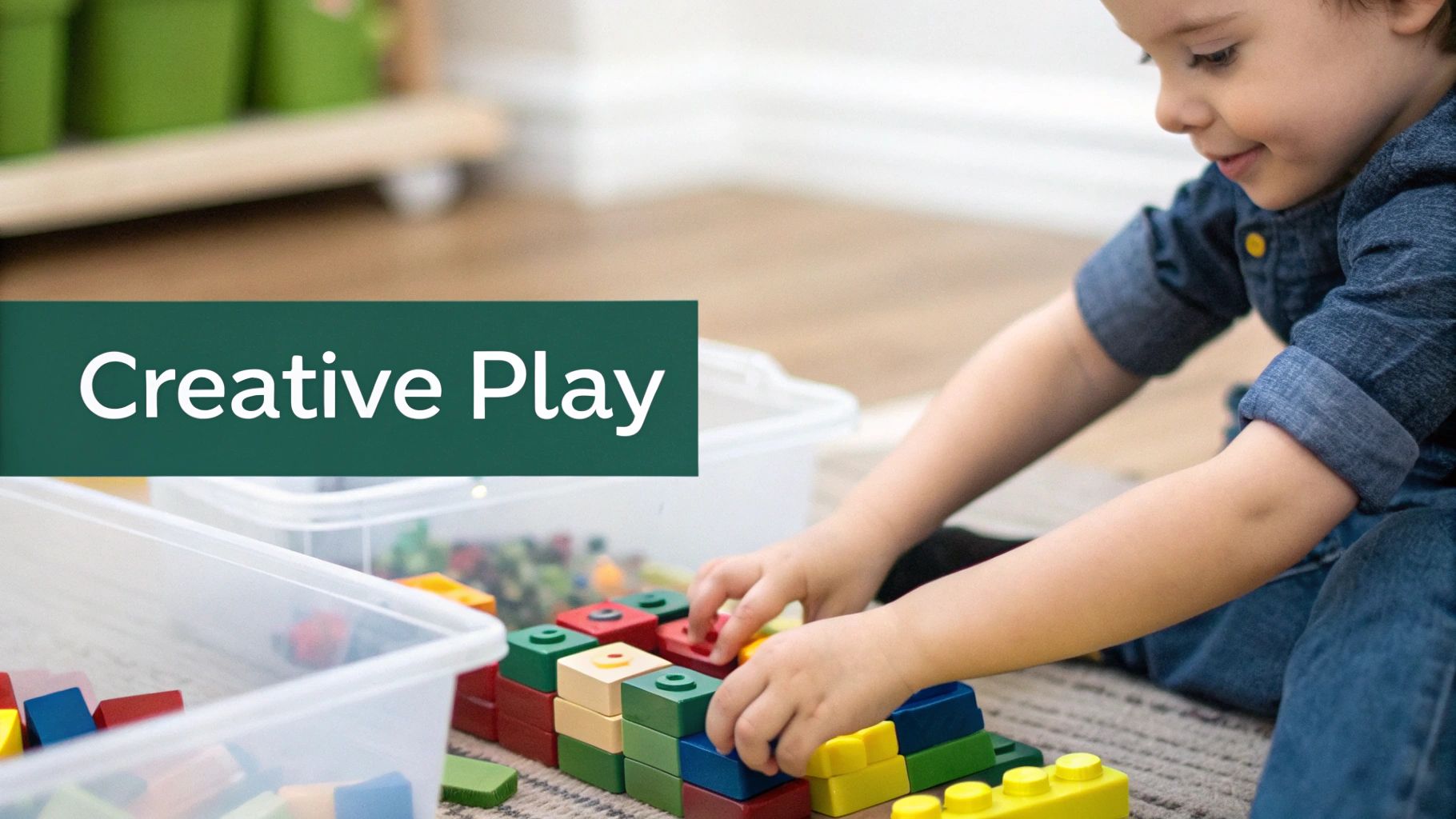
When we think about the very best toys for 2 year olds, it’s rarely the flashy, single-purpose gadgets that win. The real magic lies in simple, open-ended items that can become a hundred different things inside a toddler's incredible imagination. Your role isn't just to provide the toys, but to sometimes step in as a play guide, gently showing them the universe of possibilities hiding in plain sight.
This doesn't mean you need elaborate plans or a shopping spree. It’s all about seeing the potential in what you already have and using simple "play recipes" to spark a new adventure. A set of colourful building blocks, for instance, is for so much more than just stacking towers. With a little nudge, it becomes a powerful learning tool.
Simple Play Recipes for Everyday Toys
Transforming playtime can be surprisingly easy. By simply reframing an activity, you can introduce new ideas like colours, numbers, and sequences in a way that feels like pure fun. A bit of creativity from you can completely reignite your child’s passion for a toy they thought they knew inside and out.
Here are a few simple ideas to get you started:
- Building Blocks Colour Sort: Grab a few coloured bowls or even just sheets of construction paper. Gently encourage your toddler to sort their blocks by colour, placing them in the matching container. This turns a simple construction set into a brilliant lesson in categorisation.
- Ride-On Toy Obstacle Course: Use cushions, blankets, and a few teddy bears to create a fun, winding path through the living room. Challenge your little one to steer their ride-on toy through the course, which is fantastic for their gross motor skills and spatial awareness.
- Counting with Cars: Line up their favourite toy cars and count them together, touching each one as you go. You can take it a step further by asking, "Can you find the red car?" or "Where's the big truck?", introducing colours and sizes without any pressure.
These activities are fantastic examples of what is sometimes called heuristic play, where children learn about the properties of objects through hands-on discovery. If you're curious, you can explore this concept further in our guide on what is heuristic play and why it’s so important for toddlers.
Creating Engaging Sensory Experiences
Sensory play is an absolute cornerstone of toddler development. It's how they explore and make sense of their world. A sensory bin is a wonderful way to encourage this, and it doesn't have to be complicated or messy. All you need is a shallow container and a few safe, interesting materials.
The goal of creative play isn't to direct your child, but to provide an invitation. By setting up an interesting scenario, you spark their natural curiosity and empower them to lead the way.
Try filling a bin with dry pasta, uncooked rice, or just water with a few drops of food colouring. Add some scoops, cups, and small toys, and suddenly you’ve created a captivating miniature world for them to explore. This kind of play is not only brilliant for fine motor skills but also has a wonderfully calming effect on busy little minds.
By setting up and joining in with these creative play ideas, you're doing so much more than just keeping your child entertained. You are strengthening your bond, showing them how to solve little problems, and stretching their imagination far beyond what any instruction manual could ever hope to achieve.
How to Build a Smarter Toddler Toy Collection
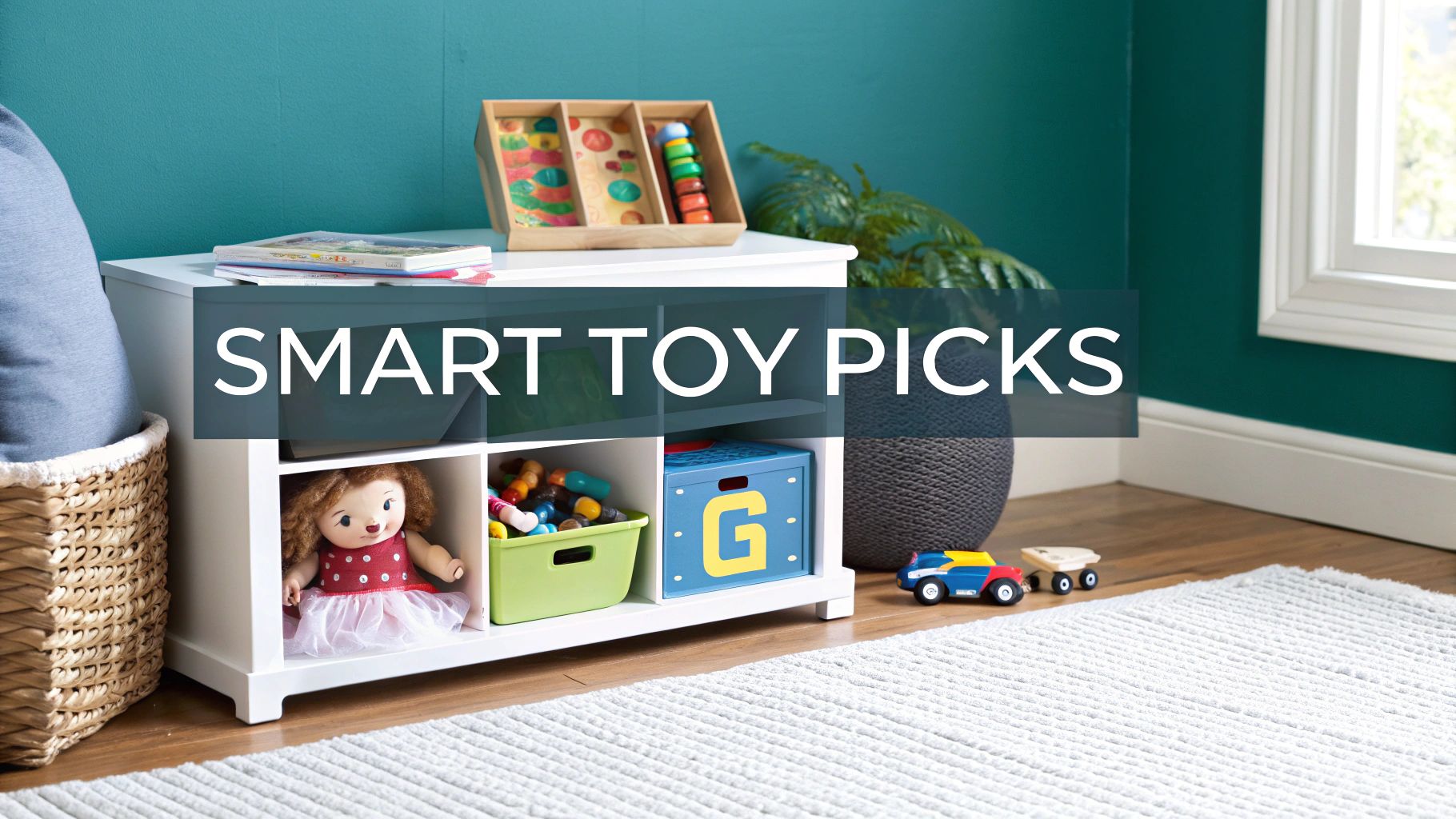
Let's be honest, building a toy collection for your toddler can feel a bit overwhelming. The secret isn't just buying more toys; it's about choosing the right ones. Think quality over quantity—toys that are built to last, versatile enough for different games, and can keep up with your child's amazing imagination.
It’s so easy to fall for the flashy, battery-operated gadgets that promise the world. They grab a toddler’s attention for a few minutes, but that novelty wears off fast. A much smarter approach is to focus on open-ended toys. These are the classics: wooden blocks, animal figures, or a simple play kitchen. They don't dictate how to play; instead, they act as a blank canvas for your child’s creativity.
One day, a set of blocks is a soaring tower. The next, it's a fence for their farm animals. The day after, it's a colourful road for their toy cars. That’s the magic of versatility, and it’s what keeps a toy engaging long after it’s been unboxed. If you're building your collection from scratch, a good guide to the best baby registry items can offer a fantastic starting point for these kinds of essential, long-lasting play tools.
Prioritising Lasting Value
Choosing durable, well-made toys is about more than just safety—it's an investment in years of meaningful play. Parents across the UK are clearly thinking this way. The average household spends around £120 annually on toys for their two-year-old, and over 60% of those toys are specifically chosen because they're 'educational' or 'developmental'.
What’s more, there's a growing awareness around materials. Today, 70% of parents actively look for non-toxic and ethically made toys. This shift towards value and conscious consumerism points to a simple strategy: choose toys that can support multiple stages of learning. You can see some brilliant examples in our guide to the best learning toys for 2-3 year olds.
The best toy collections are built with intention. They are curated, not accumulated. Each item should earn its place by offering long-term play value and supporting your child's growth.
A Modern Approach to Toy Curation
Keeping up with a toddler's developmental leaps is a real challenge. Just when you think they’ve mastered one skill, they’re onto the next three. This is where a toy subscription service like Grow With Me can be a genuine game-changer.
Instead of spending your precious time constantly researching and shopping for the 'next' perfect toy, a subscription does the curation for you. A box of age-appropriate, developmental toys arrives at your door, taking all the guesswork out of the equation. It's a simple way to make sure your child is always engaged with toys that meet them exactly where they are, preventing toy clutter and making every penny of your investment count.
Got Questions About Toys for 2-Year-Olds? We’ve Got Answers.
Walking into a toy shop (or scrolling through one online) can be completely overwhelming. As you watch your two-year-old’s unique personality begin to shine, you naturally start to wonder if you’re choosing the right things to support their amazing development. It’s a common feeling, so let's tackle some of the biggest questions parents ask about toys for 2 year olds.
Think of this as a friendly chat to build on what we’ve already covered. My hope is that these practical answers will help you feel more confident about creating a playful, enriching world for your little one.
How Many Toys Does a 2-Year-Old Really Need?
It’s tempting to think more is better, but when it comes to a toddler's toy box, less is almost always more. Quality truly trumps quantity. A well-chosen collection of around 8-12 versatile, open-ended toys will do far more for your child’s development than a room swamped with single-use gadgets that are exciting for five minutes and then forgotten.
The trick is to aim for balance. Try to have a few things that tick different boxes:
- Building and construction (like a good set of wooden blocks or magnetic tiles)
- Creativity and art (chunky crayons, chalk, or play-doh)
- Imaginative play (animal figures, a simple play kitchen)
- Physical activity (a soft ball, a push-along toy)
One of the best-kept secrets for keeping playtime fresh is toy rotation. Simply pack away half the toys for a few weeks. When you bring them out again, it's like Christmas morning all over again, sparking new interest without you having to buy a single new thing.
Are Electronic Toys with All the Lights and Sounds Any Good?
This is a big one. They’re often marketed as being educational, but many electronic toys can accidentally encourage passive play. The toy does all the whizzing and banging, and your child just sits back and watches. Real, deep learning at this age happens when a child is hands-on, solving problems, and firing up their own imagination.
This isn’t to say every electronic toy is a write-off, but it's all about balance. The very best toys for 2 year olds are the ones that put your child in the driver’s seat. Traditional toys like blocks, puzzles, and art supplies foster creativity and critical thinking in a way that most noisy, flashing gadgets simply can’t compete with. If you do go for electronic options, look for ones that ask your child to do something, rather than just passively entertain them.
My Toddler Gets Bored with New Toys Almost Instantly!
Oh, this is so normal! Welcome to the wonderfully short attention span of a two-year-old. The answer isn’t necessarily more toys; it’s toys with more possibilities. This is where open-ended toys are worth their weight in gold. A set of building blocks isn’t just for stacking towers. One day they're a fence for toy animals, the next they're little cars driving on the rug, and the day after that they're pretend food in a play kitchen.
Your involvement is also a total game-changer. Sometimes, the most exciting ‘toy’ in the room is you. Get down on the floor with them and show them a new way to play with an old favourite. When you demonstrate how a plain old cardboard box can become a car, a house, or a secret cave, you’re not just playing—you’re teaching them the very foundations of creativity.
At Grow With Me, we take all the guesswork out of finding those perfect developmental toys. Our curated play kits are designed to deliver age-appropriate, high-quality toys that grow right alongside your child, making sure they’re always engaged and challenged in just the right way. Discover how we can help you build a smarter, more meaningful toy collection by visiting Grow With Me.