
Montessori Toys for 2 Year Olds A Parent's Guide
When we talk about the best Montessori toys for a 2 year old, we’re not just talking about simple wooden playthings. These are thoughtfully designed tools that tap into a toddler's natural urge to figure things out for themselves, to concentrate, and to be independent. Think of them less as entertainment and more as instruments for learning about the real world in a hands-on, deeply engaging way.
What Makes a Toy Montessori for a 2 Year Old
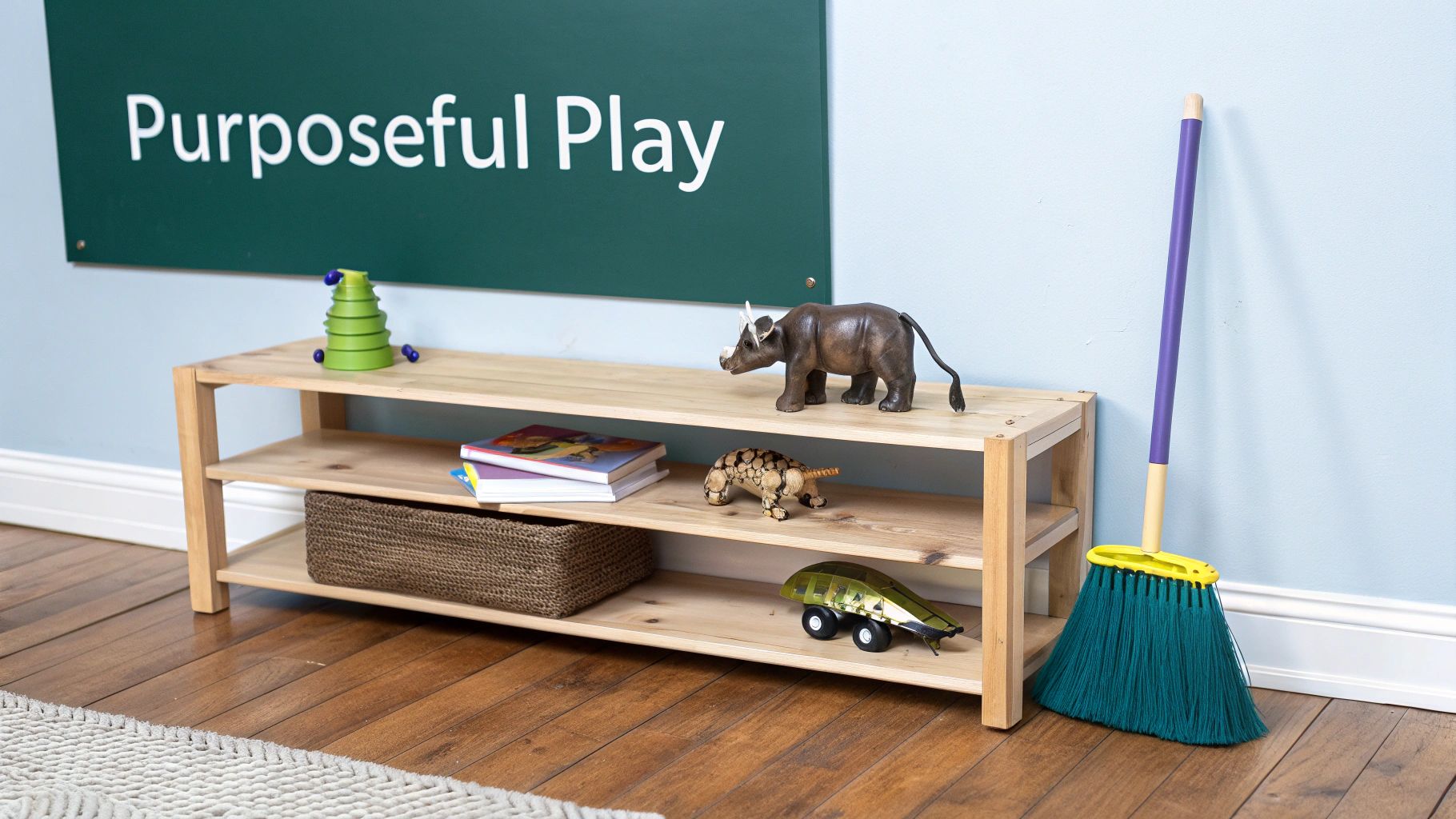
It’s easy to picture natural wood and minimalist designs when you hear "Montessori," but the philosophy goes much deeper than aesthetics. A true Montessori toy is a developmental tool disguised as play, specifically chosen to match what a two-year-old is capable of and curious about. It’s like giving a young apprentice their first toolkit, where every item has a clear purpose for building real-life skills.
These toys are firmly grounded in reality. Instead of flashing lights or cartoon characters, you’ll find realistic animal figures, child-sized cleaning tools like a small broom, or puzzles showing everyday objects. This reality-based approach helps your toddler make sense of the world they’re actually living in, building a strong, reliable foundation of knowledge.
The Power of Purposeful Play
A key idea is that each toy is designed to isolate a single skill or concept. A classic shape sorter, for example, is all about matching shapes. There are no distracting sounds or colours getting in the way. This intentional simplicity is crucial—it stops a young child from feeling overwhelmed and helps them achieve deep concentration, a skill that will be invaluable for all future learning.
In the Montessori world, this focused, engaging play is often called ‘work’. This isn’t to make it sound like a chore, but to acknowledge that it is purposeful activity the child chooses and finds deeply satisfying. It reframes play as a meaningful, constructive process.
Fostering Independence and Concentration
Montessori toys empower a two-year-old because they are completely child-led. Many are open-ended, which means there’s no single "right" way to play with them. This encourages creativity, experimentation, and problem-solving, respecting your child's intelligence and their ability to discover things for themselves.
The benefits of this philosophy build on each other through every developmental stage. To see how these principles adapt from infancy right through the toddler years, you can explore our detailed breakdown of Montessori toys by age. Once you understand the ‘why’ behind each toy, it transforms how you see your child’s playroom—it’s no longer just a collection of objects, but a curated environment for growth.
How Toys Champion Your Two-Year-Old’s Development
At two, your child’s world is expanding at an incredible rate. Every single day seems to bring new words, steadier little feet, and a growing determination to figure things out on their own. This isn't just a random burst of energy; it's a series of major developmental leaps. The right Montessori toys for a 2 year old act as the perfect partners on this journey, directly supporting these emerging skills in a very real, hands-on way.
Think about it this way: a simple threading activity is so much more than just beads and a string. It's a targeted workout for the tiny muscles in your toddler's hands, strengthening the pincer grasp and refining the hand-eye coordination they'll one day use to hold a crayon or a pencil. Each bead they successfully thread is a little victory in concentration and dexterity.
Connecting Play to Progress
It’s the same with language. When your two-year-old’s vocabulary suddenly seems to explode overnight, realistic animal figurines become powerful tools. They give a physical, three-dimensional form to the word "sheep"—something they can hold, turn over, and examine. This makes the concept stick in a way a flat picture in a book just can’t, building a much stronger foundation for language.
And a classic knobbed puzzle? It does far more than just teach shapes. As your child grabs a chunky wooden knob, they are developing wrist rotation and control. As they turn a piece, trying to figure out which slot it fits into, they are engaging in complex spatial reasoning. They’re learning about orientation and dimension through pure, hands-on trial and error.
Every carefully chosen toy is a bridge between a developing skill and a real-world ability. It isn’t about passive entertainment; it’s about providing the exact tool a child needs to master the next step in their growth. This intentional approach is what makes their playtime so incredibly effective.
Milestones and Materials: A Perfect Match
Once you understand this connection, you can start making far more meaningful choices for your child's play space. You begin to see toys not for what they do, but for what they help your child learn to do. This shift in perspective is right at the heart of the Montessori method.
To make this crystal clear, the table below breaks down exactly how specific types of toys align with the key developmental areas for a two-year-old.
If you’re curious to learn more about these crucial growth periods, our guide offers a deeper look into what developmental milestones are and why tracking them is so important during the toddler years.
Developmental Milestones and Supporting Montessori Toys for Two Year Olds
| Developmental Area | Key Milestone at Age 2 | Recommended Montessori Toy Type | How It Helps |
|---|---|---|---|
| Fine Motor Skills | Refined pincer grasp, wrist control | Lacing beads, knobbed puzzles, stacking rings | Strengthens hand muscles and improves hand-eye coordination. |
| Language Growth | Vocabulary explosion (50+ words), two-word phrases | Realistic animal figurines, classified cards | Connects spoken words to concrete, tangible objects. |
| Problem Solving | Simple cause-and-effect, shape recognition | Shape sorters, simple puzzles, nesting cups | Teaches spatial awareness, logic, and sequential thinking. |
| Gross Motor Skills | Improved balance, walking, and climbing | Small climbing triangle, balance board | Builds core strength, coordination, and physical confidence. |
Seeing it laid out like this really helps connect the dots, doesn't it? It shows how a well-equipped playroom is less of a toy box and more of a learning lab, perfectly designed for a curious two-year-old.
Choosing the Best Montessori Toys for Your Toddler
Picking out the right Montessori toys for a 2 year old can feel a bit overwhelming, but the guiding idea behind it all is beautifully simple. Think of it like this: you can give your child a ready-made meal that's eaten in a minute and then forgotten, or you can give them a basket of simple, quality ingredients. With the ingredients, they get to explore, create, and really learn something in the process.
That’s the difference between a flashy electronic gadget and a set of simple wooden blocks. One does a single thing, while the other opens up a whole world of possibilities.
What to Look for in a Montessori Toy
When you’re browsing, keep a few key things in mind. Real Montessori-inspired toys are almost always made from natural materials – think wood, cotton, wool, or even metal. These aren't just for aesthetics; they offer a rich sensory experience. The satisfying weight of a wooden block, the soft texture of a woollen ball, it all helps to ground a child in the real world.
Beyond the material, the best toys have a clear and simple purpose. The aim might be to develop fine motor skills or introduce a new word, but it does so without flashing lights or distracting noises. This focus is what helps your little one develop that amazing concentration you see when they are deeply engaged in their ‘work’.
This infographic gives a great overview of the core developmental areas that Montessori toys support in toddlers.

As you can see, things like motor skills, language, and problem-solving are all linked. Purposeful play doesn't just strengthen one area; it helps build a strong foundation for them all.
Key Toy Categories for Your Two Year Old
To create a balanced and engaging play space, it helps to think in terms of categories that match your toddler's current developmental stage. Think of each one as a different kind of "food for the brain."
-
Fine Motor Skills: These toys are all about strengthening those tiny muscles in the hands and fingers. Things like lacing beads, simple wooden puzzles with chunky knobs, and stacking rings are perfect. They build the hand-eye coordination that will one day help your child hold a pencil and write their name.
-
Practical Life Skills: Two-year-olds are desperate to copy what we do and feel like they’re helping. Toys that mimic real-life tasks—like a tiny pouring pitcher, a dressing frame with big buttons, or a child-sized dustpan and brush—are incredibly empowering for them. They build independence, coordination, and a genuine sense of purpose.
-
Language Development: Vocabulary is exploding at this age. You can support this amazing growth with reality-based language materials. Realistic animal figurines, vehicle models, and sets of classified cards (pictures showing different types of fruit, for example) help connect words to real-world objects in a way that truly sticks.
Expert Tip: When you're choosing a toy, always have a good look at the quality. Run your hand over it – is the wood smooth? Are the paints non-toxic? Does it feel sturdy? A well-made toy is not only safer but will stand up to years of enthusiastic play.
Parents are catching on. Across the UK, there's been a clear shift, with 60-70% of parents now saying educational value is a top priority when they buy toys. In fact, average spending on educational toys for this age group has climbed to between £80-£150 as of 2024, showing a real investment in quality, developmental play.
By keeping these simple ideas in mind, you can feel confident you’re choosing toys that are not just fun, but genuinely brilliant for your child’s development. For a curated selection that grows right alongside your child, take a look at our complete guide to the best Montessori toys for toddlers.
Creating a Prepared Montessori Play Environment
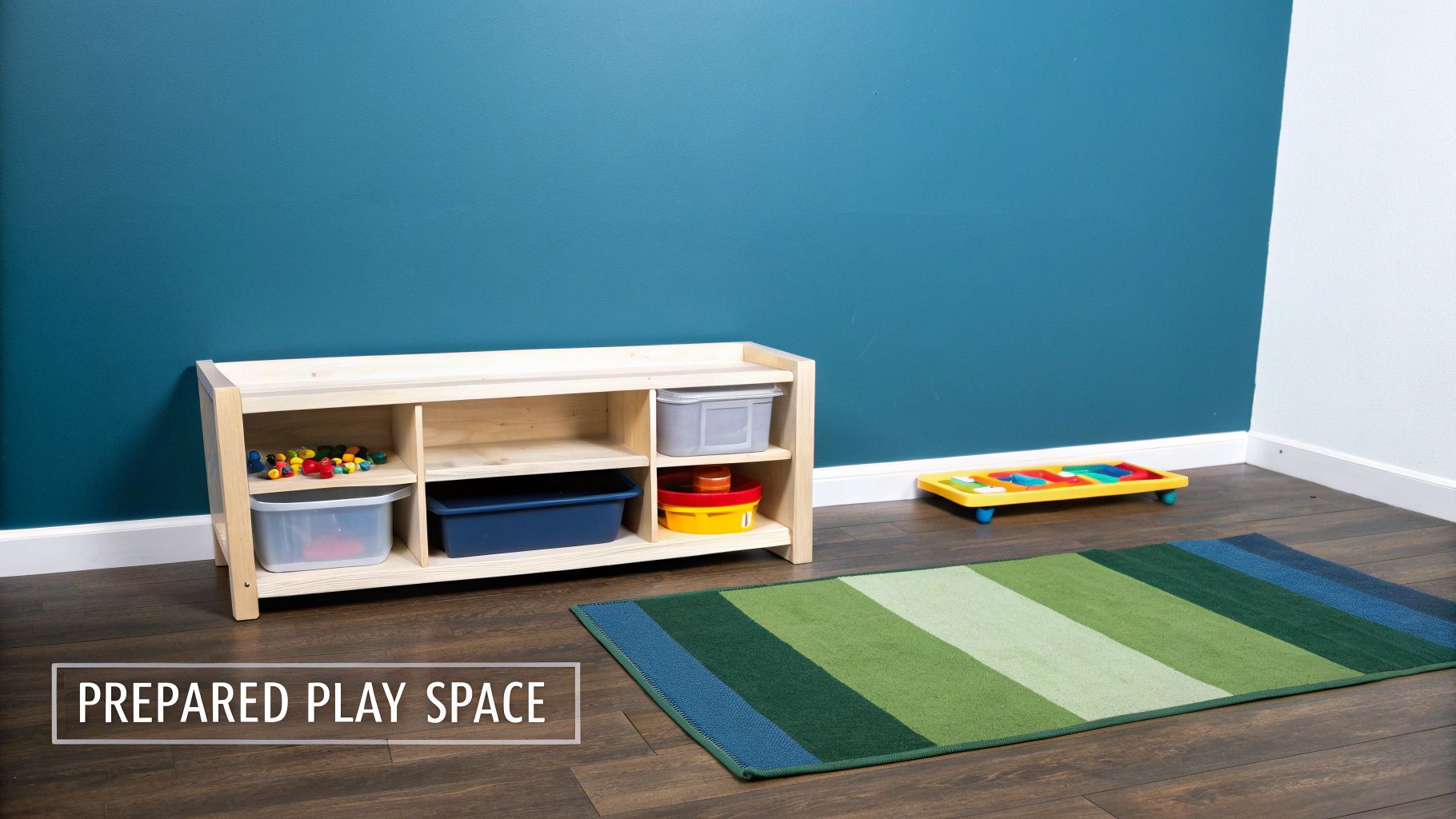
You can have the most wonderful Montessori toys for a 2 year old, but if they’re buried in a chaotic toy box, they might as well not be there. The Montessori philosophy puts a huge emphasis on the play space itself, not just the toys in it. This is what’s known as the ‘prepared environment’—a calm, orderly, and accessible space that practically begs your child to come and explore.
Think of it like setting a beautiful table before a special meal. An organised space, with everything in its place, sends a clear message to your child: their play is important, and their work is respected. This isn't about a huge home renovation; it's about being thoughtful in how you present their things.
The aim is to build a "yes" space, where your toddler can move around freely and make their own choices without you having to step in constantly. When their environment is set up for them, it naturally nurtures their independence, focus, and even their respect for their belongings.
Making the Space Work for Them
At the heart of a prepared environment is one simple idea: accessibility. Just imagine trying to cook a meal in a kitchen where all the pans and utensils are on a shelf you can’t possibly reach. For a two-year-old, a massive toy chest is pretty much the same frustrating experience.
This is where low, open shelves become your best friend. By placing a small, carefully chosen selection of toys on shelves at your child’s height, you’re giving them real power. They can see their options clearly, pick what genuinely interests them, and—crucially—learn to put it back where it belongs when they’re done.
- Low Shelving: This empowers your child to see and choose their own activities.
- Minimalist Display: Keeping it simple avoids the visual overload that leads to a short attention span.
- Defined Spaces: Using trays or small baskets for each activity helps a child understand that every item has its own home.
The Art of Toy Rotation
One of the most effective strategies for keeping this environment fresh and exciting is toy rotation. Instead of having every single toy out at once, you only display a small number (maybe 6-8 at a time) and keep the rest tucked away. Then, every week or so, you can swap a few out for something "new" from the stash.
This ‘less is more’ approach is almost magical. It instantly reignites your child’s interest, encourages them to engage more deeply with each toy, and makes tidying up a much simpler, less overwhelming task for both of you.
This practice also gives you a front-row seat to your child's developing passions, allowing you to tailor the toys on offer to what they’re curious about right now. Of course, keeping these toys clean is vital for a healthy play space. If you're looking for guidance, this simple guide to cleaning infant toys is a fantastic resource.
By thoughtfully preparing your toddler’s play space, you’re doing so much more than just tidying up. You're creating a peaceful, productive sanctuary that fosters independence and makes learning a natural, joyful part of their day.
Investing in Quality Montessori Materials
When you first start looking at Montessori toys for a two-year-old, it’s hard to miss the price tags. Let's be honest: high-quality, purpose-built wooden toys often cost more than their plastic, mass-produced counterparts. But it helps to see this not as just another expense, but as a genuine investment in your child’s development.
Think of it like buying a beautifully crafted, solid oak dining table versus a flat-pack one. The initial outlay is higher, but the solid wood piece is built to last for generations. It’s exactly the same with Montessori materials. Their price reflects the use of sustainable, durable wood, non-toxic finishes, and craftsmanship designed to withstand years of enthusiastic play. These aren’t throwaway items; they are heirloom-quality tools that can be passed down to younger siblings or even the next generation.
Making Smart Choices for Your Budget
Thankfully, investing in these wonderful materials doesn’t mean you have to buy everything at once. There are several really practical ways for UK families to build a beautiful and effective Montessori collection without breaking the bank.
One popular route is to buy from specialist brands or independent toy shops that focus on quality and educational value. But another fantastic option is a curated subscription box, like Grow With Me. This model delivers a small, targeted selection of stage-based toys right to your door, perfectly timed to match what your two-year-old is working on developmentally. It’s a brilliant way to build a collection over time without the guesswork.
The UK market for Montessori-inspired toys has grown significantly, becoming a premium segment. High-quality wooden toy sets often retail for between £25-£60 per item, while subscription kits typically average £60-£90 for each delivery every couple of months. This reflects a growing demand for sustainable materials, with a 55% rise in interest for eco-friendly wooden toys since 2018. You can find more insights about the costs and trends in educational toys on LearningBugs.co.uk.
Long-Term Value Over Short-Term Cost
Ultimately, the real value of a Montessori toy isn’t just in what it’s made of, but in its ability to be used in countless ways over a long period. A simple set of wooden blocks can become a tower, a fence for animal figures, or a tool for learning to count. This open-ended nature provides far more play value than a single-function electronic toy that quickly loses its appeal.
By choosing fewer, better things, you're not just buying a toy. You are investing in:
- Durability: Materials that will last and are completely safe for your child.
- Purpose: Tools that genuinely support concentration and skill development.
- Sustainability: Eco-friendly choices that are better for the planet your child will inherit.
This thoughtful approach allows you to provide your child with beautiful, purposeful materials that support their growth, offering a return on investment that goes far beyond the initial price tag.
Common Questions About Montessori Toys
Stepping into the world of Montessori can feel like learning a new language, and it’s perfectly normal to have questions. Many parents I’ve worked with worry if they’re “doing it right” or if they’ve somehow missed the boat. This section is here to clear up some of those common uncertainties with straightforward, practical answers, helping you feel confident as you bring these beautiful, purposeful toys into your home.
The most important thing to remember is that this is a flexible, child-led approach, not a rigid set of rules. Your journey will be unique to your family and your wonderful two-year-old.
Is It Too Late to Start Montessori with My 2-Year-Old?
Absolutely not! In many ways, two is the perfect age to jump in. Toddlers are naturally driven by an intense curiosity and a powerful desire for independence—the very cornerstones of the Montessori philosophy. They are little scientists, eager to explore the world with their hands.
You don't need a sudden, dramatic overhaul of your home. The best way to start is by simply observing your child. What are they truly interested in right now? Is it sorting things, stacking, or pouring? Introduce one or two simple Montessori toys for a 2-year-old that match that interest, like a shape sorter or a set of stacking rings, and just watch what happens.
What if My Child Ignores Their New Montessori Toys?
This is a very common concern, and it rarely means the toy is a failure. More often than not, it points to one of two things: either there's too much going on in their play area, or your child isn't quite sure what to do with the new item.
First, try paring things back. A calm, uncluttered shelf with just 6-8 well-chosen items is far more inviting than a chaotic toy box overflowing with options. This makes their choices manageable and encourages them to engage more deeply with each toy.
Next, consider a few simple strategies:
- Try Toy Rotation: Store some toys away and swap a few out each week. The novelty of a "forgotten" toy that suddenly reappears can be incredibly powerful.
- Model Silently: Sit with your child and demonstrate how to use the toy slowly and deliberately, without saying a word. Your focused actions are often a more powerful invitation than any verbal instruction.
- Step Back: After your brief demonstration, simply place the toy back on the shelf or mat. Give them the space to explore it on their own terms, without any pressure.
Do I Need to Get Rid of All Plastic or Character Toys?
The goal here is to be intentional, not to achieve some kind of rigid perfection. For most families, it’s completely unrealistic—and unnecessary—to eliminate every single plastic or character-based toy. It's all about finding a balance.
A practical approach is to designate one primary play area, like the living room, for your Montessori materials. This creates a space designed for focused, developmental "work." Other toys, like noisy electronics or favourite cartoon figures, can be kept in a separate basket or in your child's bedroom. You might be surprised to find that over time, your child naturally gravitates towards the more engaging, open-ended Montessori toys anyway.
The core principle isn't about banning certain toys. It's about thoughtfully curating an environment that prioritises activities that build concentration, independence, and real-world skills.
How Can I Do Montessori on a Budget?
This is a great question because it gets to the heart of what Montessori really is. It’s a philosophy of learning, not a brand of expensive products. The principles are far more important than the price tags on the toys. In fact, many of the most valuable activities use simple items you already have at home.
"Practical life" work is the soul of Montessori for toddlers and often costs nothing. Activities like pouring water between two small jugs in the bath, using tongs to transfer dried pasta from one bowl to another, or helping to wash vegetables for dinner are incredibly valuable. You can also find high-quality wooden toys in second-hand shops or on local online marketplaces. The focus should always be on providing purposeful, hands-on experiences—that’s where the real magic lies.
Ready to build your child's collection with beautiful, stage-based toys without the guesswork? Discover how Grow With Me delivers the perfect developmental tools right to your door. Explore our curated play kits today!