
Your Guide to Navigating milestones 16 months: A Toddler Milestone Overview
Sixteen months is less of a strict checklist and more of a fantastic, chaotic stage where your toddler's unique personality really starts to pop. It's an incredible period of growth where you'll see huge leaps in how they move, communicate, and interact with the world. Think of this guide as a reassuring friend, here to help you understand and celebrate this amazing journey.
Embracing the Journey of Your 16-Month-Old
Welcome to the whirlwind world of your 16-month-old! This stage is a beautiful mix of determined independence and those sweet, lingering baby habits. They’re not quite an infant anymore, but not a big kid either, living in that delightful in-between phase where every single day brings a new discovery.
Forget about rigid timelines. Development isn’t a race with a finish line; it’s more like a scenic country walk, with exciting new things to see around every bend. Our goal is to give you a clear map, helping you appreciate the milestones 16 months typically bring, while still celebrating your child's own personal pace. We'll explore how simple, fun play can be the most powerful tool you have, turning everyday moments into brilliant learning opportunities.
What to Expect from This Guide
We've designed this guide to build your understanding step-by-step, moving from the big picture to practical things you can do every day. We’ll cover everything you need to feel confident and supported during this dynamic stage.
You can look forward to learning about:
- Key Developmental Domains: We’ll break down the major areas of growth—physical, cognitive, language, and social-emotional—into easy-to-understand sections.
- The Power of Play: Discover simple games and activities designed to support your toddler's development, turning playtime into a fun and enriching experience.
- Understanding Variations: Learn why it's perfectly normal for children to develop at different speeds and how to spot the difference between a unique timeline and a potential concern.
- Navigating Health Checks: Get prepared for routine health visitor appointments and find out what to expect as your toddler grows.
Think of your toddler as a little explorer charting their own map. Some might spend weeks mastering the tricky terrain of walking, while others are busy discovering a whole new language. Both are making incredible progress on their unique adventure.
To give you a snapshot of what's happening, here's a quick look at the kinds of skills you might see emerging around this age.
A Quick Look at 16-Month Milestones
This table isn't a strict test but a gentle guide to the wonderful changes happening in your little one's world.
| Developmental Domain | What You Might See |
|---|---|
| Gross Motor | Walking confidently, possibly attempting to run or walk backwards. |
| Fine Motor | Stacking a tower of two blocks and scribbling with a crayon. |
| Language | Using a few single words and understanding simple instructions. |
| Cognitive | Imitating your actions and exploring how objects work through play. |
| Social-Emotional | Showing affection, expressing frustration, and testing boundaries. |
By understanding these typical milestones, you can better support your child's growth and truly enjoy every moment of this remarkable phase.
Mapping Your Toddler’s Developmental Leaps
At 16 months, your toddler's world is expanding at a dizzying pace. Every single day seems to bring a new skill, a fresh discovery, or a surprising leap forward. It’s less like ticking boxes off a checklist and more like watching a rich tapestry of skills blossoming all at once.
To really appreciate this incredible growth, it helps to know what’s happening beneath the surface. We can break down these milestones for 16 months into four key areas: physical, cognitive, language, and social-emotional development. Each one tells a part of your toddler's unique and wonderful story.
This chart gives you a quick visual snapshot of the main growth areas—movement, words, and play—that are at the heart of your 16-month-old's world right now.
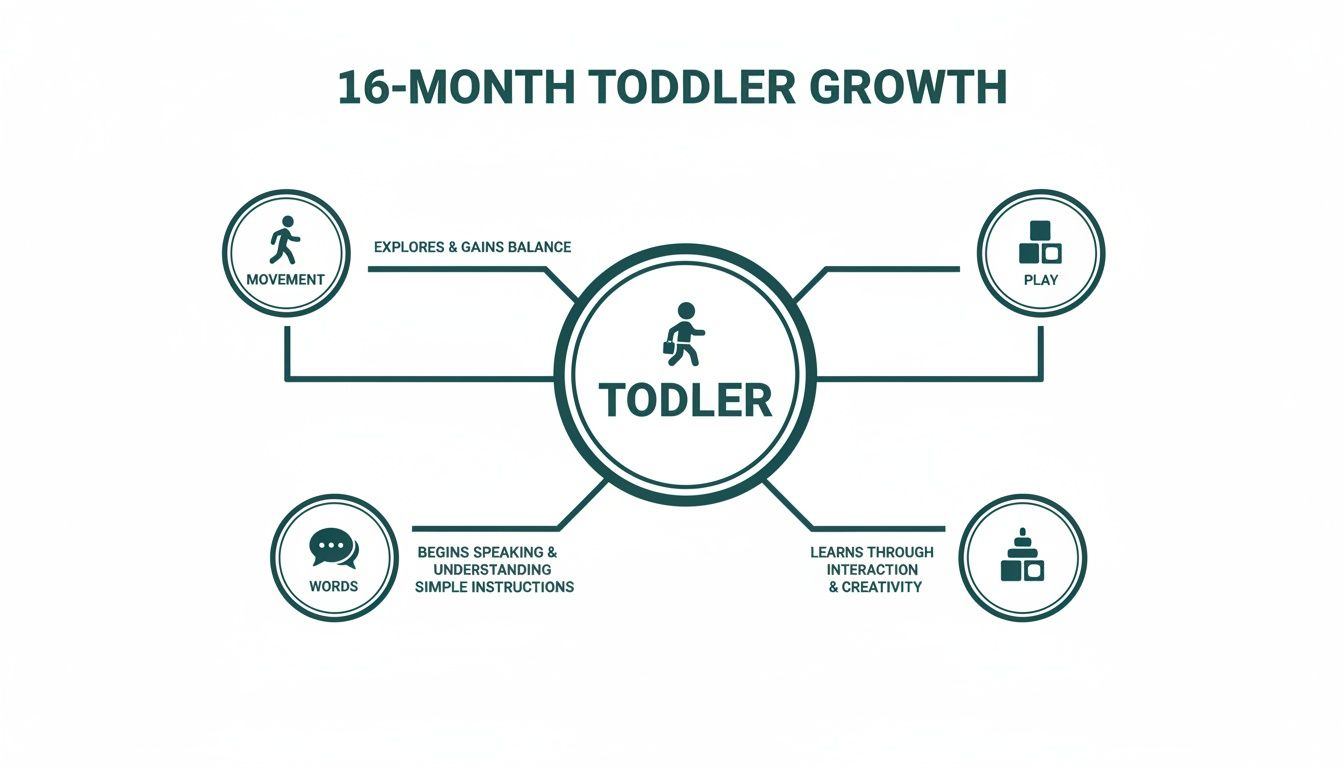
You’ll notice how interconnected these skills are. A bit of progress in one area often fuels a big jump in another.
Physical Milestones: Walking, Working, and Wondering
Physical development is often the most obvious change at this age. It’s really split into two exciting parts: gross motor skills (the big, whole-body movements) and fine motor skills (those fiddly, delicate hand movements).
Gross Motor Skills are all about exploring the world on two feet. Your little one is probably shifting from a wobbly beginner to a confident mover and shaker.
- Confident Walking: Most toddlers at this age are walking pretty independently. You might even catch them attempting a clumsy run or bravely shuffling backwards.
- Stair Exploration: They may try to clamber up the stairs while holding on, a huge step towards mastering their environment.
- Active Play: Pushing and pulling toys is a fantastic game now, and it’s brilliant for building their strength and coordination.
Fine Motor Skills involve the intricate movements of their hands and fingers. Your little one is turning into a tiny artist and engineer, figuring out how to manipulate the world around them.
- Stacking Blocks: You might see them successfully stack a tower of two or three blocks. This is a huge sign of their improving hand-eye coordination.
- First Scribbles: Give them a chunky crayon and they’ll likely scribble with pure joy, exploring cause and effect with every mark.
- Using Utensils: Mealtimes get a bit more independent (and yes, much messier!) as they attempt to use a spoon all by themselves.
Cognitive Milestones: The Little Scientist at Work
Your toddler's brain is working overtime, processing information and making new connections every second. Cognitive development is all about how they think, learn, and solve problems. You'll probably notice them imitating your actions with surprising accuracy—a clear sign they are watching and learning from everything you do.
They're also starting to properly grasp that objects still exist even when they can't see them. This concept is called object permanence, and it’s why a game of peek-a-boo is still so mind-blowingly fun for them. For a wider view of how your child's thinking skills are coming along, this guide on cognitive development milestones is a great resource.
At 16 months, your toddler is a full-time researcher. Every dropped spoon is an experiment in gravity, and every stacked block is a lesson in physics. Their play is their work, and they are learning with every single move they make.
Language Milestones: Finding Their Voice
Language development isn't just about the words they say; it's also about what they understand. At 16 months, their receptive language (what they comprehend) is often miles ahead of their expressive language (what they can actually say).
They might follow simple one-step commands like "please pass your cup" or point to their nose when you ask them to. This shows they're making those crucial connections between words and objects. While some toddlers are chattering away with 10 or more words, others might only have a few, and both are completely normal. The key is their growing desire to communicate, whether it’s through words, gestures, or a chaotic mix of both.
To see how these achievements fit into the bigger picture, you can learn more about what what are developmental milestones and why they matter for your child’s journey.
Social and Emotional Milestones: Here Come the Big Feelings
This stage is marked by an explosion of social and emotional growth. Your 16-month-old is just beginning to realise that they are a separate person from you, which brings a newfound sense of independence... and often, a whole lot of frustration.
Here are some key developments you might be seeing:
- Showing Affection: They might give spontaneous hugs and kisses, showing their deep attachment to the people they love.
- Testing Boundaries: The word "no" suddenly becomes a new and exciting power. This is a perfectly normal part of them learning about cause and effect in social situations.
- Emerging Empathy: You might see them show concern if they notice someone is upset—a very early and beautiful sign of empathy.
- Tantrums: With such big feelings and so few words to express them, frustration can easily boil over. Tantrums are a normal, albeit challenging, part of their journey toward understanding and managing emotions.
By keeping an eye on these different areas, you get a wonderfully complete picture of the amazing progress your 16-month-old is making, day by day.
Fuelling Growth and Connection Through Play
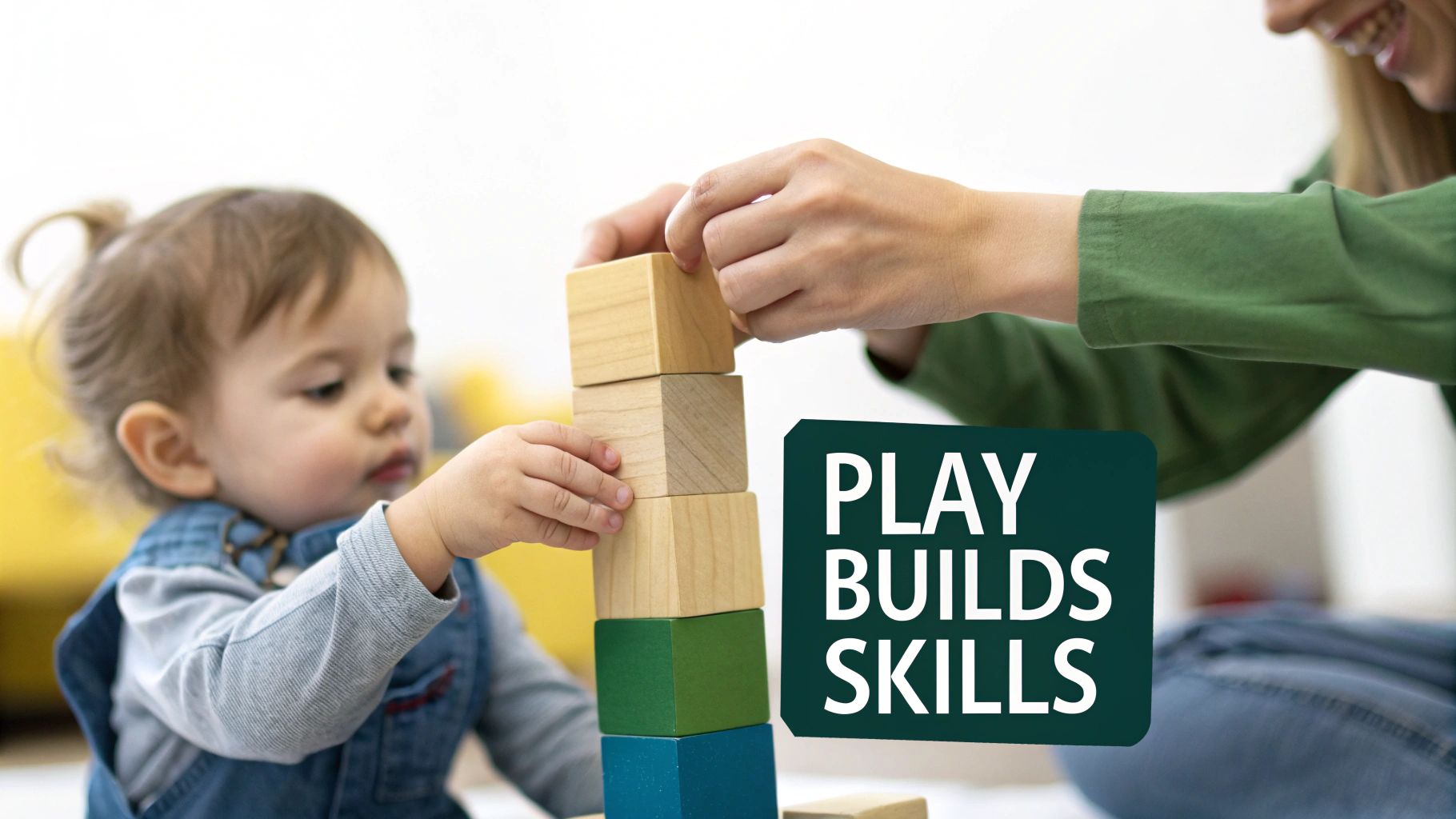
For a 16-month-old, play is everything. It’s not just a fun way to kill time; it’s their full-time job, and it’s how they make sense of the world. Every block they stack, every crayon scribble, and every game of peekaboo is busy building crucial connections in their amazing, fast-growing brain.
This is where you come in. By joining them on the floor for some simple, fun play, you can actively support all the milestones 16 months bring. You’re turning everyday moments into powerful opportunities for them to learn and for you both to connect.
Activities to Nurture Gross Motor Skills
At this age, your toddler is a little ball of energy. They have a deep-down need to move, explore, and figure out what their body can do. The whole point of gross motor play is to build their strength, balance, and coordination in a way that’s fun and safe.
- Build an Obstacle Course: This sounds more complicated than it is! Use sofa cushions to crawl over, a pop-up tunnel to wiggle through, and maybe a sturdy box to climb on and off. It’s brilliant for problem-solving and gives them a huge confidence boost each time they master a bit of it.
- Throw a Dance Party: Seriously, just put on some music and have a boogie. It’s fantastic for their balance, rhythm, and just getting to know their own body. Plus, it’s a foolproof way to burn off some of that endless toddler energy before nap time.
- Push and Pull Adventures: Toys they can push or pull, like a little trolley or a toy lawnmower, are perfect right now. This simple action helps them practise walking both forwards and backwards, all while strengthening their core and leg muscles.
Building Brainpower with Cognitive Play
Think of cognitive play as feeding your little one’s inner scientist. These kinds of activities are all about figuring out cause and effect, solving simple problems, and generally making sense of how things work.
Every toy is basically a tool for discovery. A shape sorter isn’t just about matching; it's a real-life lesson in trial and error, spatial awareness, and that satisfying little clunk when they finally get it right.
Every time your toddler successfully pops a shape in its slot or stacks one more block on their tower, they're not just playing. They're forging new pathways in their brain for problem-solving that will serve them for life.
Here are a couple of easy ideas to get you going:
- Stacking and Building: Whether you're using classic wooden blocks or chunky plastic rings, stacking is a superstar activity for developing hand-eye coordination and an early grasp of physics. How high can we go before it all comes tumbling down? (That’s half the fun!).
- Simple Puzzles: Start with puzzles that have big, chunky knobs on the pieces. This is great for their fine motor skills and teaches them to recognise shapes and patterns. Begin with just two or three pieces to build their confidence without causing frustration.
- Water Play: Fill a shallow basin with a bit of water and give them some cups, spoons, and floating toys. It’s a wonderful sensory experience that also teaches concepts like 'empty' and 'full', 'sink' and 'float'. For more inspiration, check out our guide on sensory play ideas for toddlers.
The Convenience of Curated Play
Let’s be honest, choosing the right toys can feel a bit overwhelming. That’s where services like Grow With Me can really help, taking the guesswork out of it by delivering stage-based play kits right to your door. Each box is filled with high-quality, developmentally appropriate toys—like wooden puzzles and sensory blocks—that are a perfect match for your 16-month-old's current abilities and what’s coming next.
This kind of curated convenience is becoming more and more popular with parents. In fact, the UK subscription box market is booming and is projected to reach USD 5.8 billion by 2033. It just goes to show how much families appreciate personalised experiences that make life a little easier while enriching their children's development. You can discover more insights about this growing market on the IMARC Group's website.
Fostering Language and Social Skills
Play is the number one way toddlers learn to communicate and connect with other people. Through simple, back-and-forth games, they start to grasp ideas like taking turns, reading facial expressions, and expressing their own wants and needs.
A Sample Play Session for Social Skills (15 Minutes)
Just 15 minutes of focused playtime like this can have a huge impact on their social and emotional growth.
- Warm-up with a Story (5 mins): Snuggle up with a sturdy board book. Point to the pictures and name things simply ("Look, a big, red ball!"). Encourage them to point, too. This builds their vocabulary and creates a lovely, shared experience.
- Imitation Game (5 mins): Do a simple action, like clapping your hands or tapping your nose, and say, "Can you do this?" When they copy you, give them lots of praise and a big smile. This teaches them to watch and imitate—a vital part of social learning.
- Rolling Ball (5 mins): Sit on the floor facing each other and roll a soft ball back and forth. Use simple words like "My turn!" and "Your turn!". This is one of the first and best ways to learn about turn-taking and playing with someone.
These activities don't need to be grand productions. The most important ingredient is you—your attention and your enthusiasm. By making time for play, you’re not just helping them hit their milestones for 16 months; you’re building a strong, loving bond that will last a lifetime.
Every Toddler Has Their Own Timetable
It’s almost impossible not to fall into the comparison trap. You’re at the park and you see another toddler who seems to be speaking in full sentences, while yours is still focused on mastering the art of climbing the slide. It’s natural to worry, but please remember: development isn’t a race. The range of what’s considered "typical" for milestones at 16 months is incredibly wide, and every single child carves out their own unique path.
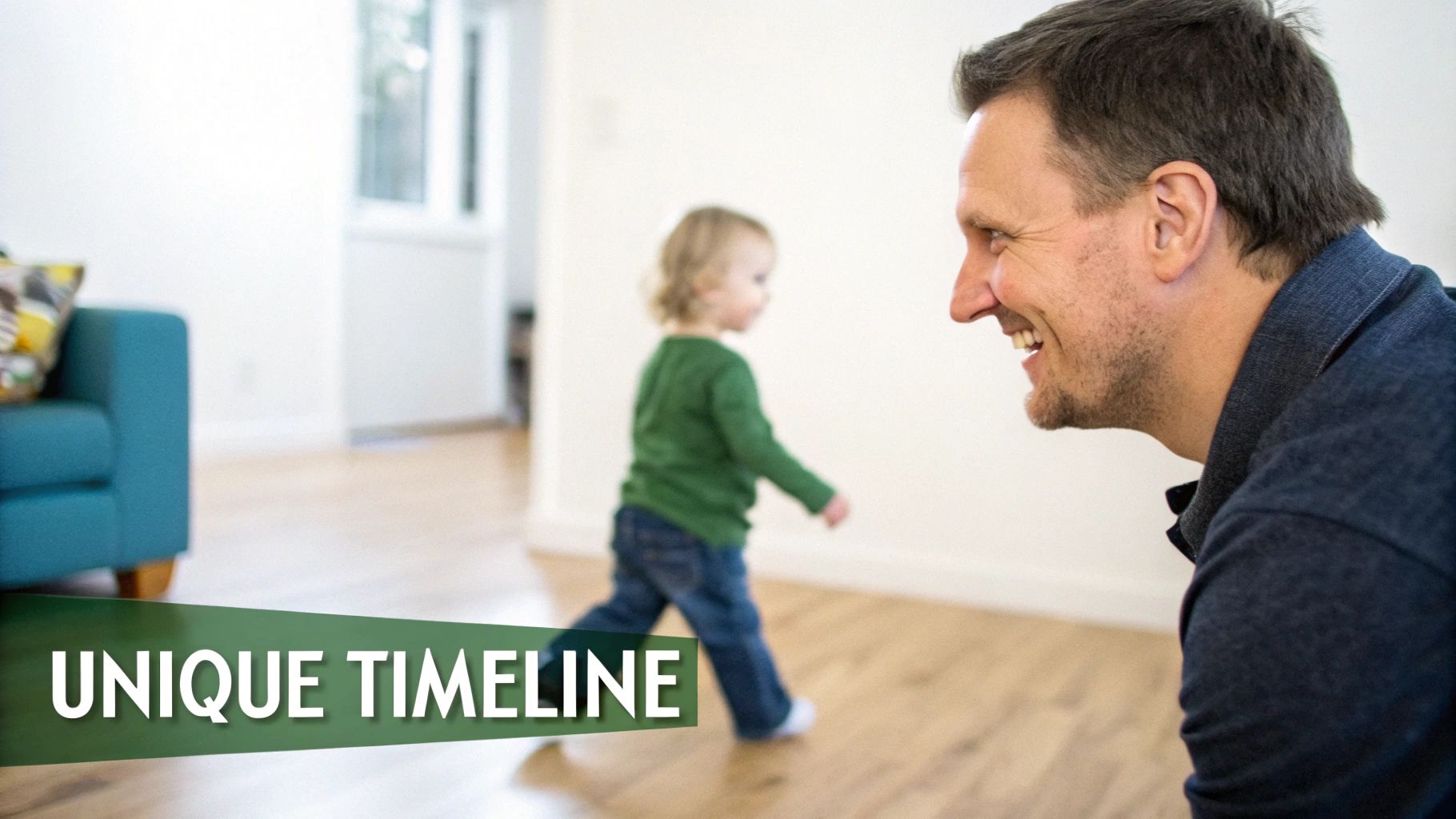
I like to think of a toddler's brain as a busy construction site. There's so much to build, but only so many workers available at one time. They simply can't build the language centre and the motor skills centre at the exact same pace. This is why you'll often see a toddler pour all their energy into perfecting walking, seemingly putting language on the back burner. Meanwhile, another is laser-focused on learning new words, happy to stick with crawling for a bit longer. Both are making fantastic progress.
The Spectrum of Development
Children will naturally gravitate towards the skills that interest them the most. A little one who is fascinated by how their body moves might be walking, running, and climbing early, but seem less interested in chatting. On the other hand, a more observant, quiet toddler might be soaking up words like a sponge while taking their sweet time with the big physical feats. This doesn't mean one is "behind" the other; it just shows where their developmental focus is right now.
It’s also completely normal for a new skill to appear, vanish for a few days, and then come back even stronger. This is all part of the process of practice and perfection.
Always trust your gut. You know your child better than anyone. If you have a nagging feeling that something isn't quite right, that's a voice worth listening to.
Remember that so many things can influence your child’s timeline, from their personality and environment to their birth order. The key isn't hitting a specific milestone on a specific day, but seeing that steady, forward momentum over time.
Gentle Flags and When to Have a Chat
While variation is the norm, it's also helpful to know what signs might warrant a conversation with your health visitor or GP. This isn't about causing panic; it's about empowering you with information. Think of these less as "red flags" and more as gentle nudges to get a professional opinion and some reassurance.
It might be a good idea to check in if, by around 16-17 months, your toddler:
- Isn't walking yet: Especially if they aren't pulling themselves up to stand or "cruising" along the furniture.
- Isn't using any single words: We're looking for consistent use of at least one or two words, like "mama," "dada," or a specific word for a toy.
- Doesn't point to things they want: Pointing is a huge communication stepping stone, showing they're trying to share their world with you.
- Doesn't seem to understand simple instructions: For example, if you say "give me the cup" and they don't seem to register the request.
- Doesn't make regular eye contact: A lack of eye contact or not responding when you call their name can sometimes be an early sign that warrants a closer look.
- Has lost skills they used to have: If your child was waving, babbling, or crawling and has now completely stopped, it's definitely worth mentioning.
Reaching out to a professional doesn't automatically mean something is wrong. More often than not, it leads to peace of mind or gives you early access to support that can make a real difference. You are your child's biggest champion, and checking in is one of the most proactive and loving things you can do.
Looking Ahead at Health Checks and Future Milestones
After sixteen months of watching your little one grow and change, it’s only natural to wonder what’s coming next. This exciting journey of development is always moving forward, and having a sense of what’s on the horizon—from routine health checks to the next big leaps—can help you feel ready and excited for what’s to come.
One of the next key touchpoints is your toddler's health visitor check, which typically happens sometime between one and two years old. It’s important to remember this isn't a test for your child; it's a supportive chat for you. Think of it as a brilliant chance to check in, talk about your child's progress, and ask any questions you have on your mind.
Preparing for Your Health Visitor Check
To get the most out of this appointment, a little bit of prep can go a long way. You might find it helpful to jot down a few notes about what you’ve been seeing in your toddler’s development lately.
Here are a few areas you could think about covering:
- Physical Skills: How are they getting around? Are they walking steadily, maybe even attempting a little run? Are they starting to climb on everything?
- Language and Communication: What words are they using? How do they use gestures, like pointing, to get your attention? Do they follow simple requests?
- Social and Emotional Growth: Tell your health visitor about their personality. How do they play with others? Are you seeing big emotions or the start of toddler tantrums?
- Diet and Sleep: Sharing a bit about their eating habits and sleep routines can give a great overall picture of their wellbeing.
It can also give parents peace of mind to be prepared for emergencies. Understanding protocols like the Pediatric Chain of Survival is a great way to feel more confident in your ability to handle unexpected situations.
The Next Chapter: The Word Explosion
Get ready for one of the most incredible stages just around the corner: the 'word explosion'. This usually kicks into high gear somewhere between 18 and 24 months. Right now, your 16-month-old might have a few words they use consistently, but you’re on the cusp of a period where their vocabulary can suddenly blossom at a truly amazing speed.
One week you might be hearing a handful of single words, and the next, it feels like they’re learning dozens. It's such a clear, wonderful sign that all the talking, reading, and singing you've been doing is clicking into place.
This is a massive leap in their cognitive and communication skills. If you're curious about the broader journey, you can get a great overview of the different stages of child development by age to see the full picture.
How Support Evolves with Your Child
As your toddler’s skills take off, the way they play will change, too. Services like Grow With Me are designed specifically to evolve right alongside them. The toys and activities that were perfect for stretching their abilities at 16 months will soon make way for more complex challenges in their next kit. It’s all about making sure they always have the right tools to support their next set of milestones.
This idea of ongoing, tailored support is really catching on. UK families are increasingly turning to subscription services, with data showing that by 2020, the proportion of consumers signed up to four or more services had risen to 55.6%. This shift shows that parents really see the value in services that adapt as their family's needs change.
Your Questions About 16-Month Milestones, Answered
As you watch your 16-month-old discover the world, it’s only natural for questions to pop up. Every day brings something new, and you might find yourself wondering about their individual pace. Let’s tackle some of the most common queries parents have at this stage.
My 16-Month-Old Isn't Walking Yet. Should I Worry?
This is, without a doubt, one of the top concerns we hear from parents. It makes sense! But the truth is, the typical window for walking is much wider than most people realise, stretching anywhere from 9 to 18 months. Development simply isn’t a race, and many toddlers are busy mastering other important skills before they take those first steps.
If your little one is pulling themselves up on furniture, cruising around the coffee table, and seems keen to get moving, they are almost certainly on their own unique timeline. The best thing you can do is offer plenty of safe, open space for them to practise. That said, if your child isn't putting any weight on their legs at all, it’s always wise to have a quick chat with your health visitor for peace of mind.
How Many Words Should My 16-Month-Old Say?
Language is another area where the variation between children is huge. At 16 months, some toddlers have a vocabulary of a dozen or more words, while others might only have a few. Both ends of that spectrum can be completely typical.
What’s often a better indicator of progress at this age is their receptive language—how much they understand. Ask yourself:
- Do they point to things they want or to show you something interesting?
- Can they follow a simple instruction, like 'get your shoes' or 'pass mummy the cup'?
- Do they babble with different tones, like they're having a proper conversation?
If you're nodding along to these, their spoken vocabulary is very likely to follow. That famous 'word explosion' everyone talks about often happens a little later, usually closer to 18-24 months.
Why Has My Toddler Suddenly Started Having Tantrums?
Ah, yes. Welcome to the world of toddler tantrums! It can feel like a switch has been flipped overnight, but this is a perfectly normal—and even healthy—part of their emotional development. Your 16-month-old is full of big, complex feelings but doesn't yet have the vocabulary or impulse control to express them in a calmer way.
A tantrum is often just a raw, unfiltered expression of frustration. Their desire for independence is surging, but their brain's ability to regulate emotions and find the right words hasn't caught up. It’s a sign of their incredible mind growing, not a reflection on you or your parenting.
The best way through it is to stay calm yourself, make sure they're in a safe spot, and acknowledge their feelings ("You feel so cross that we have to leave the park"). This phase is a crucial stepping stone towards them learning to manage their emotions as they get older.
What Are the Best Toys for a 16-Month-Old?
At this wonderfully curious age, the best toys are often the simplest ones. Forget the flashy gadgets with all the bells and whistles; what your toddler really needs are open-ended toys that spark creativity, problem-solving, and motor skills.
A few brilliant options for this age include:
- Stacking blocks or rings: These are fantastic for building hand-eye coordination and learning about cause and effect.
- Simple shape sorters: A classic for a reason! They teach problem-solving and spatial awareness.
- Sturdy board books: Reading together is a powerhouse for building language and strengthening your bond.
- Push-or-pull toys: A great way to build confidence for new walkers and strengthen those little leg muscles.
This is the exact philosophy behind our Grow With Me kits. We carefully select high-quality, beautiful toys that are perfectly matched to your child's developmental stage, taking the guesswork out of finding things that are genuinely fun and beneficial for their growth.
At Grow With Me, we believe that play is the most important work of childhood. Our stage-based play kits provide the perfect tools to support your 16-month-old's developmental journey, delivered right to your door. Discover your next play kit at https://shop.growwithmesubscriptionbox.co.uk.