
Best Picks: baby toys 8 months for Development
The best baby toys for an 8-month-old are the ones that tap directly into the incredible developmental leaps they're making right now. Playtime becomes a powerhouse for learning when you give them toys that encourage crawling, stacking, and exploring cause and effect. These aren't just for fun; they're the essential tools for building a strong foundation for all the skills to come.
Why Play Is Your 8-Month-Old's Most Important Job
Welcome to one of the most exciting stages of your baby's first year! At eight months, your little one has transformed from a passive observer into a tiny scientist, actively exploring the world one grab, shake, and taste at a time. Choosing the right toys is about so much more than just keeping them entertained.
Their brain is an incredible sponge at this age, rapidly forming millions of new neural connections with every single sensory experience. Each play session is a hands-on lesson in cause and effect, motor skills, and problem-solving. When they drop a block over and over again just to watch it fall, they aren't being naughty—they're running their very first experiment on gravity!
Play is often talked about as if it were a relief from serious learning. But for children, play is serious learning. Play is really the work of childhood. - Fred Rogers
Seeing it this way really shifts your perspective on their daily activities, doesn't it? It helps you see play through your baby’s eyes and understand that thoughtfully chosen toys are the tools of their most important trade: learning and growing. This entire approach is the heart of play-based learning, a philosophy that harnesses natural curiosity to drive developmental progress.
Turning Playtime into a Learning Opportunity
You have the power to nurture this amazing growth simply by providing the right environment and materials. This doesn't mean you need complicated setups or expensive gadgets. It’s more about being intentional with their play space. Once you get this, you’ll feel much more confident in matching toys to their developmental stage, becoming their best guide on this journey of discovery.
Here’s how you can start spotting the learning within their play:
- Observe what grabs their attention: Pay attention to what captivates them. Is it stacking cups? Banging on a toy drum? These fascinations are clues to which skills their brain is primed to develop next.
- Offer gentle challenges: Introduce toys that are just a tiny bit beyond their current ability, but not so tricky that they become frustrating. This is how you build resilience and confidence.
- Get involved: Independent play is definitely important, but joining in from time to time shows them new ways to interact with their toys and, best of all, strengthens your bond.
For more inspiration on creating these little moments of discovery, check out these fun and effective play-based learning activities that are perfect for this age.
What's Happening in Your 8-Month-Old's World?
At eight months old, your baby is right in the middle of an incredible period of growth. It can feel like they're learning something new every single day, and that's because they are! Their brain and body are firing on all cylinders, building connections and mastering skills at a breathtaking pace.
To find the perfect baby toys for 8 months, it helps to peek behind the curtain and understand what's fuelling all this change. Let's explore the key developmental milestones that are shaping how your baby plays and learns.
The Brain of a Little Scientist
Cognitively, your eight-month-old is having a major lightbulb moment. They are starting to figure out the concept of object permanence – the amazing idea that things still exist even when they can't see them. This is a huge leap forward!
It’s the reason why a simple game of peekaboo is suddenly the best thing ever. When you hide your face, their developing brain can now hold onto the memory of you, waiting with giddy anticipation for you to reappear. The same logic is at play when they repeatedly drop a toy from their highchair. It might look like they're just making a mess, but they're actually conducting a very important experiment: "If I drop this, does it disappear forever?" Nope! This foundational skill is the very beginning of memory, curiosity, and abstract thinking.
If you'd like to dive deeper, you can learn more about what object permanence is and how play can support this crucial milestone.
To give you a quick overview, here’s a snapshot of what’s happening at this stage.
8-Month-Old Developmental Snapshot
This table summarises the key changes you might be seeing and how different types of play can nurture them.
| Developmental Area | What You Might See | How Toys Can Help |
|---|---|---|
| Cognitive | Discovering cause and effect (pushing a button makes a sound), developing object permanence, showing curiosity about how things work. | Toys with simple mechanisms like pop-up pals or balls that can be dropped into a container. Stacking rings and cups are also brilliant. |
| Gross Motor | Sitting confidently without support, rocking on hands and knees, starting to crawl (or scoot!), pulling up to stand using furniture. | Soft play shapes to climb on, crawl-through tunnels, and push-along walkers encourage movement and build core strength. |
| Fine Motor | Using the pincer grasp (thumb and forefinger) to pick up smaller objects, passing toys from one hand to the other. | Textured balls, wooden blocks, and toys with knobs or large puzzle pieces help them practise and refine this new grip. |
| Social/Emotional | Babbling in "conversations," imitating gestures like waving, showing signs of separation anxiety, expressing clear emotions. | Puppets, simple picture books, and toys that encourage turn-taking help them explore social cues and emotional expression. |
These are, of course, just general guidelines. Every baby develops at their own unique pace, so just focus on providing lots of opportunities for them to explore and learn through play.
Mastering Movement, Big and Small
Physically, your baby is gaining incredible control over their body. You’ll probably spot two big areas of progress:
- Gross Motor Skills: These are the big movements that get them from A to B. Sitting up on their own is a massive win, as it frees up their hands to properly explore their toys. Many babies are now on the move, whether it's an army-style shuffle, rocking on all fours, or a full-blown crawl. Some ambitious little ones might even be using the sofa to pull themselves up to a standing position!
- Fine Motor Skills: Take a close look at their hands. That clumsy, whole-hand grasp is gradually being replaced by the much more delicate pincer grasp. This is when they start using their thumb and forefinger to pick things up, and it’s a total game-changer for how they can interact with the world around them.
This is where play really brings it all together, turning simple actions into powerful learning moments.
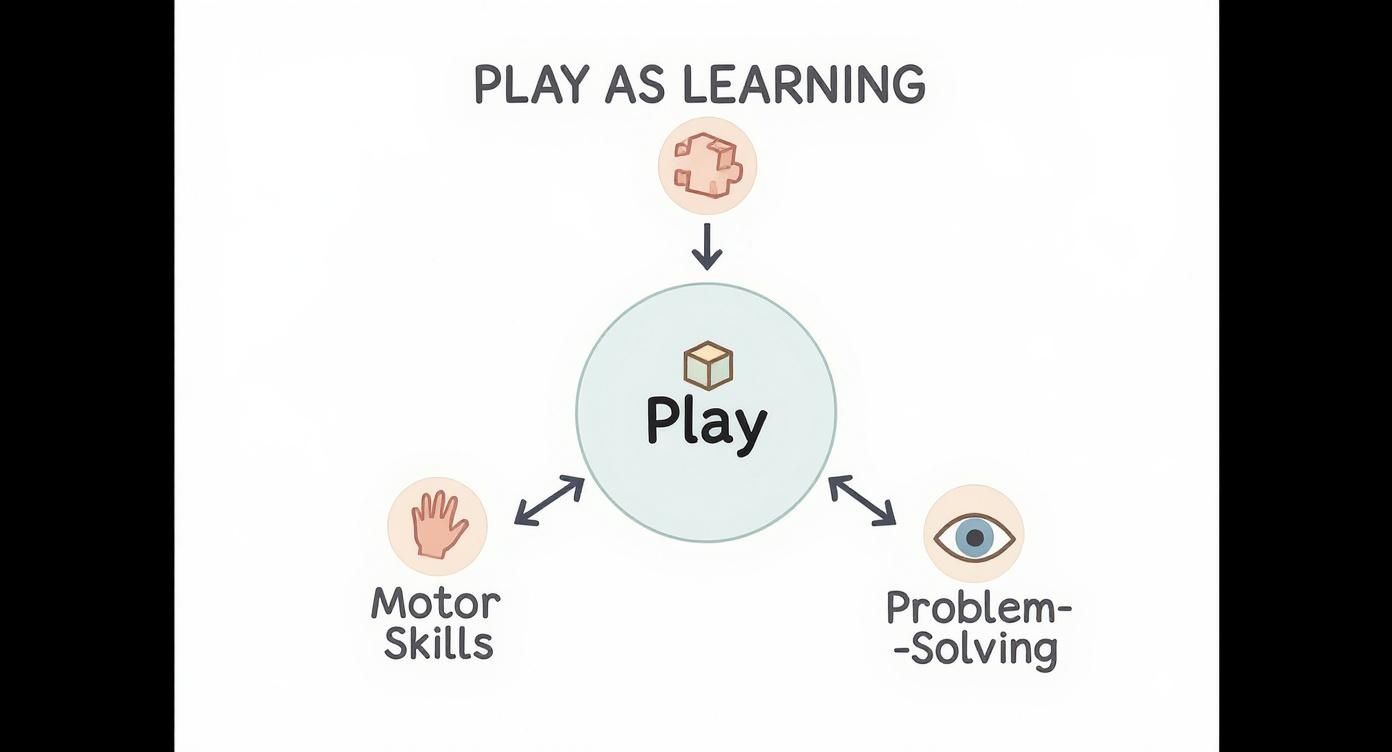
As you can see, a single interaction with a toy can simultaneously build their strength, sharpen their problem-solving skills, and engage their senses.
Finding Their Voice and Making Connections
Your little one is becoming a proper little social butterfly. Their babbling is getting more complex, and you'll start to hear them mimic the tones and rhythms of your own speech. This isn't just random noise; it's "conversational babbling," and it’s their way of joining in the chat.
At this age, imitation is a primary form of learning and social bonding. When your baby copies your wave or tries to mimic your sounds, they are actively strengthening their connection with you and learning social cues.
They are also becoming much more aware of who's who. This can sometimes lead to shyness around strangers or a bit of separation anxiety when you leave the room. It can be tough, but it’s actually a really positive sign of the strong, healthy attachment they've formed with you.
By recognising these milestones, you can turn everyday playtime into a celebration of their incredible progress, helping you choose toys that are just right for this exciting stage.
How to Choose the Best Toys for Your Baby
Knowing all about those incredible developmental leaps is one thing, but how does it translate to the toys scattered across your living room floor? Choosing the best baby toys for 8 months isn’t about chasing the latest trend. It’s about finding the right tools for the job. Think of yourself as a play coach, picking out equipment that challenges your little one just enough to build their skills and confidence, without leaving them frustrated.
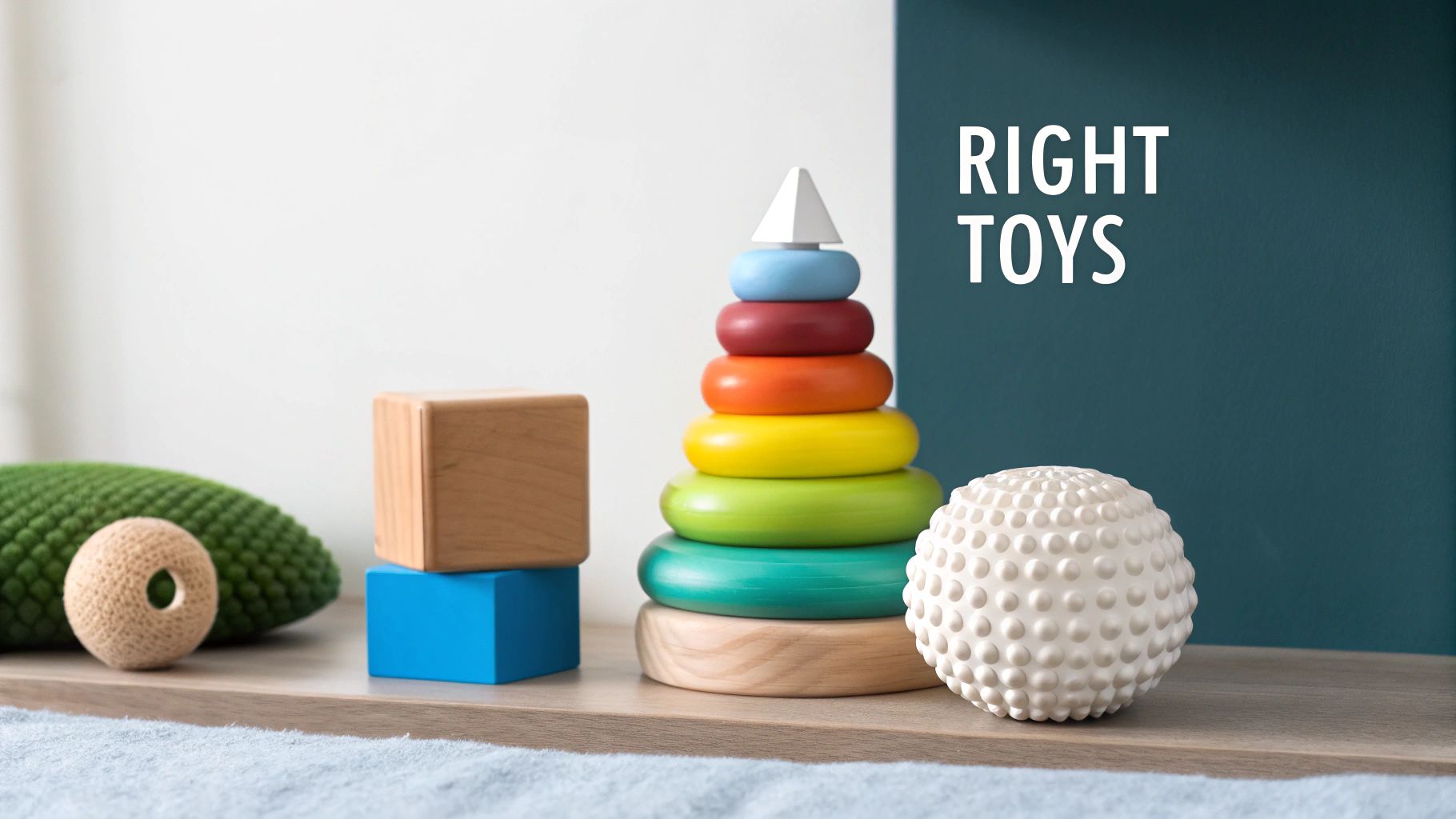
Let’s break down how to pick toys that are more than just fun—they’re powerful instruments for your baby’s growth. We’ll look at how even the simplest toy can help build complex skills.
Toys That Target Key Skills
Different types of toys act like keys, each unlocking a specific area of your baby’s development. For instance, those classic stacking rings are a true powerhouse for fine motor control and early problem-solving. As your baby fumbles to get a ring over the peg, they’re working on that pincer grasp and getting a first lesson in size and sequence. It’s a huge achievement for them!
A shape sorter takes this a step further. It introduces the big ideas of matching and spatial awareness. Your baby has to figure out that the round block simply won't fit into the square hole, which is a surprisingly tricky mental puzzle for their developing brain.
Here's a quick guide to what to look for:
-
For Gross Motor Skills: Think movement. Soft balls they can push and crawl after, or a sturdy walker they can pull up on, are perfect for building up those little muscles and improving coordination.
-
For Fine Motor Skills: Textured sensory balls, chunky wooden blocks, and toys with simple switches or buttons are fantastic. They practically beg to be explored by little hands, helping to refine dexterity.
-
For Cognitive Growth: Simple puzzles with big knobs, pop-up toys, and activity cubes are all brilliant for teaching cause and effect. They learn that their actions—pushing, pulling, or turning—make something interesting happen.
The Magic of Simple Books
Never underestimate the power of a good board book. At this age, they’re not just for telling stories; they’re a full-on sensory experience. Your baby will love the satisfaction of turning the thick pages, pointing at the bright, colourful pictures, and yes, probably having a good chew on the corners!
Reading together, even for just a few minutes each day, is one of the best things you can do. It builds a foundation for literacy, introduces new sounds and rhythms, and strengthens that all-important bond between you.
If you're feeling creative, you could even try to build your own board book for a truly personal touch.
Balancing Challenge and Success
The sweet spot for a great toy is finding something that’s engaging but not overwhelming. If a toy is too easy, your baby will get bored in a flash. But if it’s too difficult, they’re likely to get frustrated and give up. The goal is to find toys that meet them right where they are and gently nudge them towards the next step.
It’s no surprise that the most popular toys for this age group—things like sensory rattles, soft books, and activity gyms—are all designed to stimulate motor skills and cognitive growth. In fact, sales for these types of developmental toys jumped by 8% in the last year, showing that more and more parents are focusing on purposeful play. You can read the full research about these toy market trends and find more insights.
Toy Safety: Your Non-Negotiable Checklist
As your eight-month-old gets more mobile and their curiosity explodes, toy safety suddenly becomes your number one priority. Everything—and I mean everything—goes into their mouth. It’s their way of exploring the world. This means it’s our job to make sure their little world is a completely safe one. Think of this as your go-to checklist for every toy that comes through the door.
The Choking Hazard Check
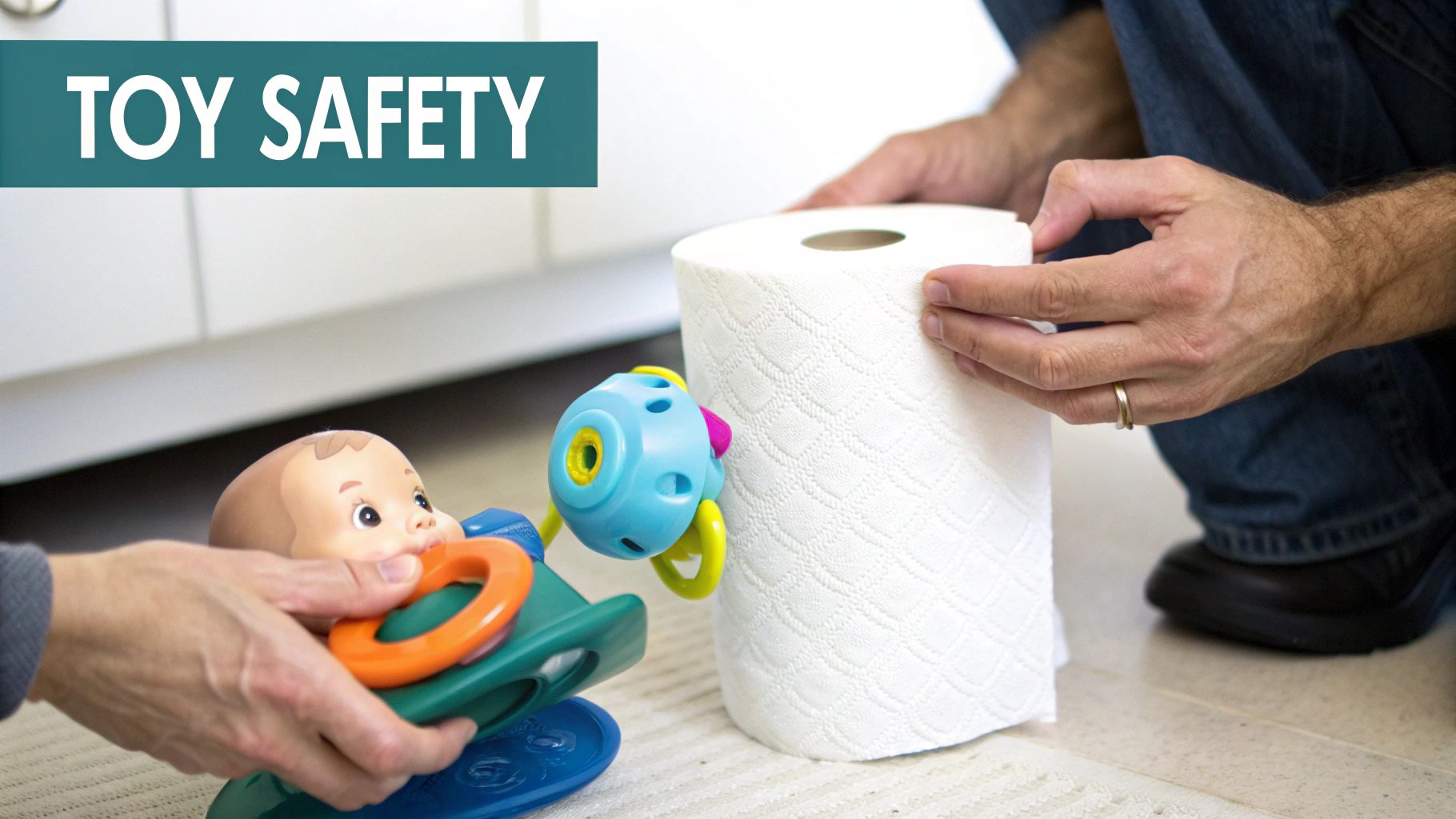
Honestly, the biggest risk at this age is choking. A baby’s airway is incredibly small, and it doesn't take much for something to get stuck. There’s a really simple, low-tech way to check any toy: the toilet paper roll test.
If any toy or a piece that could break off it fits completely inside a standard toilet paper roll, it’s a choking hazard. Simple as that. It’s not safe for your baby.
This is a hard and fast rule. Get into the habit of regularly checking your existing baby toys for an 8 month old as well. Look for anything that’s come loose, like the eyes on a stuffed animal, buttons, or wheels on a little car.
What to Look for in Materials and Build Quality
Beyond the size, the actual materials and construction of a toy matter a great deal. Since you know it’s going to be chewed on, you need to be sure it’s made from safe, non-toxic stuff.
Here’s a quick rundown of what to keep an eye out for:
- Non-Toxic and BPA-Free: Look for toys that are clearly labelled as non-toxic, BPA-free, phthalate-free, and lead-free. Good, reputable brands will make this information easy to find on the packaging.
- No Sharp Edges: Before you hand a toy over, run your own hands all over it. You're feeling for any sharp points, rough patches, or potential splinters that could scratch or cut your baby. This is especially important for wooden toys.
- Secure Battery Compartments: If a toy is battery-powered, the cover absolutely must be screwed shut. Button batteries are incredibly dangerous if a child swallows one.
- Avoid Long Strings or Cords: Any string, ribbon, or cord longer than 18 centimetres is a potential strangulation hazard. Be mindful of this on pull-along toys or even decorations hanging from an activity gym.
Making Sense of Safety Labels
The information on a toy’s packaging is there for a reason. That age recommendation isn't just a guide for whether your baby will find it interesting; it’s a crucial safety warning based on things like small parts.
You’ll also see official-looking marks. In the UK, you should look for the UKCA (UK Conformity Assessed) mark. It's also common to see the CE mark, which shows it meets EU safety standards. Seeing these symbols gives you that extra bit of reassurance that the toy has passed strict safety tests.
Making these quick checks a habit is one of the best things you can do. It helps you create a safe and fun environment where your little one can explore, learn, and play without you having to worry.
Are Stage-Based Toy Subscription Boxes Worth It?
Trying to keep up with your baby’s rapidly changing skills can feel like you’re constantly one step behind. Just when you find a toy they absolutely love, they master it and are suddenly bored, looking for the next big challenge. This is exactly where a more thoughtful approach to playtime can be a game-changer.
Stage-based toy subscriptions offer a brilliant solution to this cycle. These services deliver a hand-picked box of high-quality, developmentally spot-on toys right to your doorstep, timed perfectly to match your baby's age and current abilities.
It’s almost like having a child development expert acting as your personal toy shopper. They’ve done all the hard work and research, so you can be sure the toys arriving are perfectly suited to what your little one is learning right now.
How These Boxes Actually Help Your Baby's Development
The real beauty of these kits is that they take all the guesswork out of the equation. Instead of wandering the toy aisles wondering if something is too simple or way too advanced, you get items specifically chosen to nurture key milestones. For an 8-month-old, a box might contain toys that help them practise that all-important pincer grasp or introduce them to their very first problem-solving puzzles.
This means your baby is always engaged with playthings that are challenging, safe, and genuinely effective for learning.
A curated toy subscription box is designed to grow with your child. It introduces new concepts and skills at precisely the right moment to spark curiosity and build confidence, all without overwhelming them.
This sheer convenience is a huge part of why they’ve become so popular. In the UK, the toy retailing sector brought in £2.0 billion, and toys for infants and toddlers were the single biggest slice of that pie, largely because parents are so focused on meaningful play. You can discover more insights about the UK toy market to see just how much the trend is moving towards developmental products.
The Upside of a Curated Toy Box
Beyond just being convenient, these subscriptions offer some real benefits for both you and your baby. For one, they help cut down on the clutter from unused or outgrown toys, making it easier to create a calmer, more organised play area.
Here’s a quick look at what makes them so effective:
- Targeted Learning: Every toy has a specific job to do, whether it’s building fine motor skills with a simple shape sorter or encouraging that first crawl with a perfectly weighted ball.
- High-Quality Materials: Services like Grow With Me tend to prioritise sustainable, non-toxic materials like wood. This gives you a safer, more durable alternative to the mountain of plastic toys out there.
- Expert Guidance: The kits usually include play guides that explain the ‘why’ behind each toy. They’re full of creative ideas on how to play, which helps you better understand what’s happening in your baby’s brain.
By giving your baby the right tools at the right time, you can feel confident that you’re doing everything you can to support their incredible journey of discovery. To see how this works in practice, take a look at our guide on finding the best baby subscription box in the UK.
Got Questions About Toys for Your 8-Month-Old? Let's Talk.
Choosing toys for your rapidly growing 8-month-old can feel a bit daunting. As they become more active and curious, you naturally want to give them the best tools for learning and play. It's a common feeling, and parents often have similar questions.
Here, we'll walk through some of the most frequent queries we hear, offering straightforward advice to help you feel confident about the playthings you bring into your home.
How Many Toys Should an 8-Month-Old Have?
When it comes to baby toys, less is definitely more. You don't need a room overflowing with options; in fact, a mountain of toys can easily overwhelm a little one, making it harder for them to focus and play meaningfully.
A small, carefully chosen collection of 5 to 8 developmental toys is usually more than enough. The trick is to offer variety. Try to have something that encourages fine motor skills (like chunky stacking rings), something for gross motor skills (a soft ball to crawl after), a toy that teaches cause and effect (a simple activity cube), and something for sensory play (a touch-and-feel board book).
Here’s a brilliant little trick: try toy rotation. Keep a few toys tucked away and swap them out every week or so. When the old ones reappear, they feel exciting and new, sparking fresh interest and deeper engagement.
What’s the Verdict on Electronic Toys?
Those flashy, noisy electronic toys can certainly catch a baby's eye, but it’s best to use them sparingly. While the lights and sounds are captivating, toys that do everything for the child can sometimes encourage them to just sit and watch, rather than actively explore and create.
Often, the best toys are the simplest ones because they invite your baby to use their imagination and figure things out for themselves. If you do go for electronic toys, look for ones with a very clear cause-and-effect action – for instance, a single button that makes a specific sound when pressed. The key is to balance screen-free, open-ended play with any time spent with electronic gadgets.
Is it Weird That My Baby Prefers a Spatula to Their Toys?
Not at all—it's completely normal and actually a fantastic sign! When your baby is more interested in a wooden spoon or a cardboard box than the expensive toy you bought, it shows they have a curious, creative mind. To them, these everyday items are fascinating new objects ripe for discovery.
You can lean into this! Create a "treasure basket" filled with safe household items. Think silky scarves, a clean whisk, or smooth wooden blocks. It’s an amazing way to stimulate their senses. Just make absolutely sure anything you offer is clean, too big to be a choking hazard, and has no sharp edges or bits that could break off.
What's the Best Way to Keep Their Toys Clean?
Let's face it, pretty much every toy is going to end up in your baby's mouth. Regular cleaning is a must. For hard plastic toys, a good wipe-down with a cloth, some warm water, and a bit of soap does the trick. A diluted vinegar solution works well too.
Most fabric or plush toys can go into a mesh laundry bag and be washed on a gentle cycle. For wooden toys, avoid soaking them as it can warp the wood. Instead, just wipe them with a damp cloth and a mild soap. Always let toys dry completely before handing them back to prevent any chance of mould. It’s a simple routine that keeps playtime both safe and fun.
Ready to take the guesswork out of finding the perfect developmental toys? The Grow With Me subscription box delivers expertly curated, stage-based play kits right to your door, ensuring your baby always has the right tools for their next big leap.