
Your Guide to 21 Month Old Milestones
Welcome to the fascinating, and often frantic, world of your 21-month-old. This age is a real turning point. You're likely seeing a huge leap in their language, more confident running and climbing, and the very first signs of some serious independence. It’s a wonderful stage where their unique little personality truly begins to shine.
Your Guide to 21-Month-Old Milestones
Life with a nearly two-year-old is a beautiful whirlwind of new skills, big feelings, and constant discovery. One minute they're proudly stringing two words together, the next they're testing boundaries with a very firm "No!". Think of this guide as a friendly companion, here to give you a clear picture of what's happening during this dynamic phase.
We'll walk through the main areas of development: motor skills, language, cognitive growth, and their social and emotional world. Looking at it this way helps make sense of the incredible progress your toddler is making every single day.
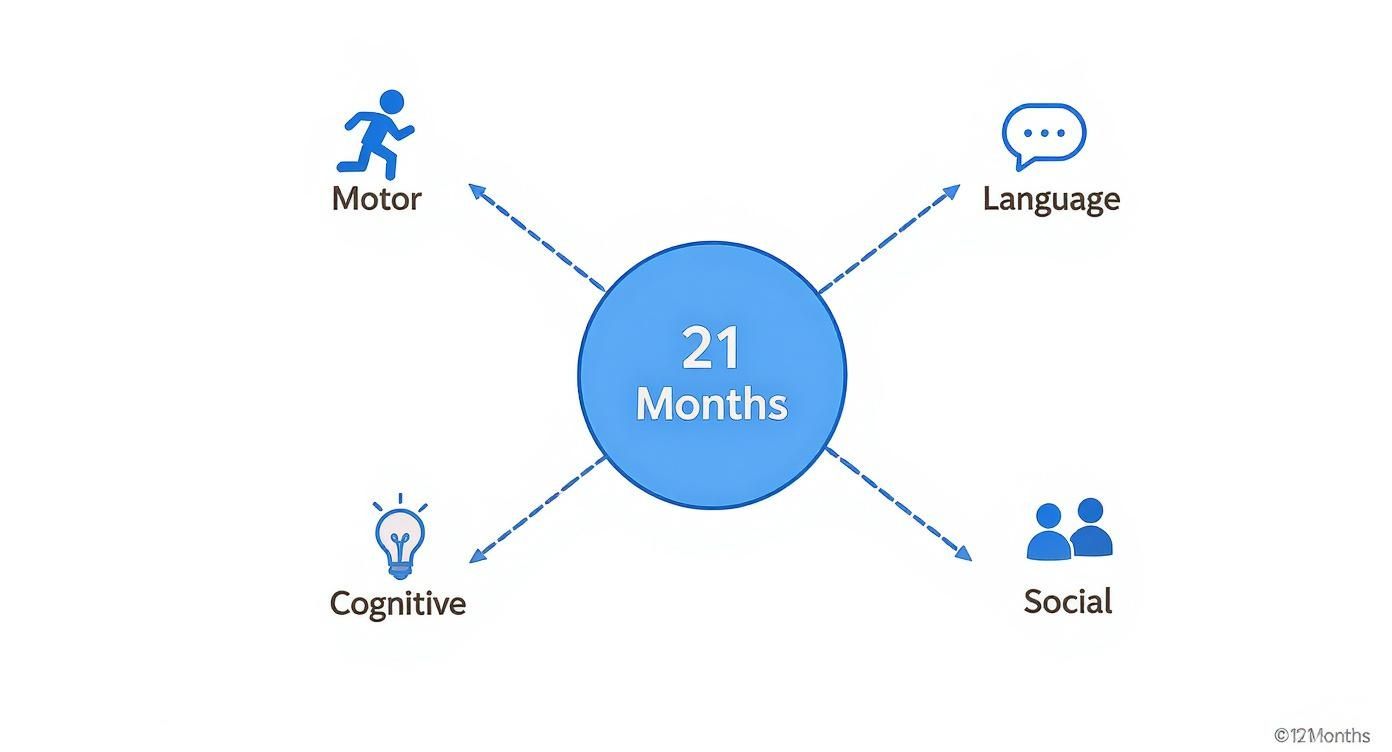
As you can see, so much is happening all at once. They're not just growing physically; their social and thinking skills are blossoming right alongside.
Embracing Your Child's Unique Pace
It’s so important to remember that every child follows their own unique timeline. Milestones aren't a rigid checklist but more of a general guide. One toddler might be an expert climber, scaling the sofa with ease, while another is focusing all their energy on forming two-word phrases. Both are exactly where they need to be.
The most important thing is to celebrate your child's individual achievements. Creating a supportive environment that lets their natural curiosity lead the way is the best thing you can do. Your encouragement is their best tool for learning with confidence.
Getting a handle on these developmental stages can offer real peace of mind. For a bigger picture, you can learn more about what developmental milestones are and why they’re helpful for parents.
We've designed this guide to give you practical knowledge and helpful tips. We want to help you spot all the small but mighty leaps your toddler is making, turning everyday moments into powerful opportunities for connection and learning. Let's get ready to celebrate every new discovery on this amazing journey.
Mastering Movement and Physical Growth
Your 21-month-old is a little dynamo, isn't it? One minute they're toddling along, and the next they're off, running with a surprising amount of speed and determination. This incredible explosion of movement is a hallmark of this age, and it’s all driven by two different, but deeply connected, types of motor skills.
Think of gross motor skills as the big, powerful movements. This is your toddler using their whole body—arms, legs, torso—to tear across the park, kick a ball, or attempt that daring climb onto the sofa for the tenth time today. These actions are all about building strength, coordination, and balance.
Then you have the fine motor skills. These are the small, delicate, and precise movements of the hands and fingers. It’s the careful work of stacking one block perfectly on top of another or using that clever pincer grasp to pick up a single pea from their dinner plate. Both sets of skills are developing in leaps and bounds right now, working together to help your little one explore their world in fascinating new ways.
Conquering Gross Motor Milestones
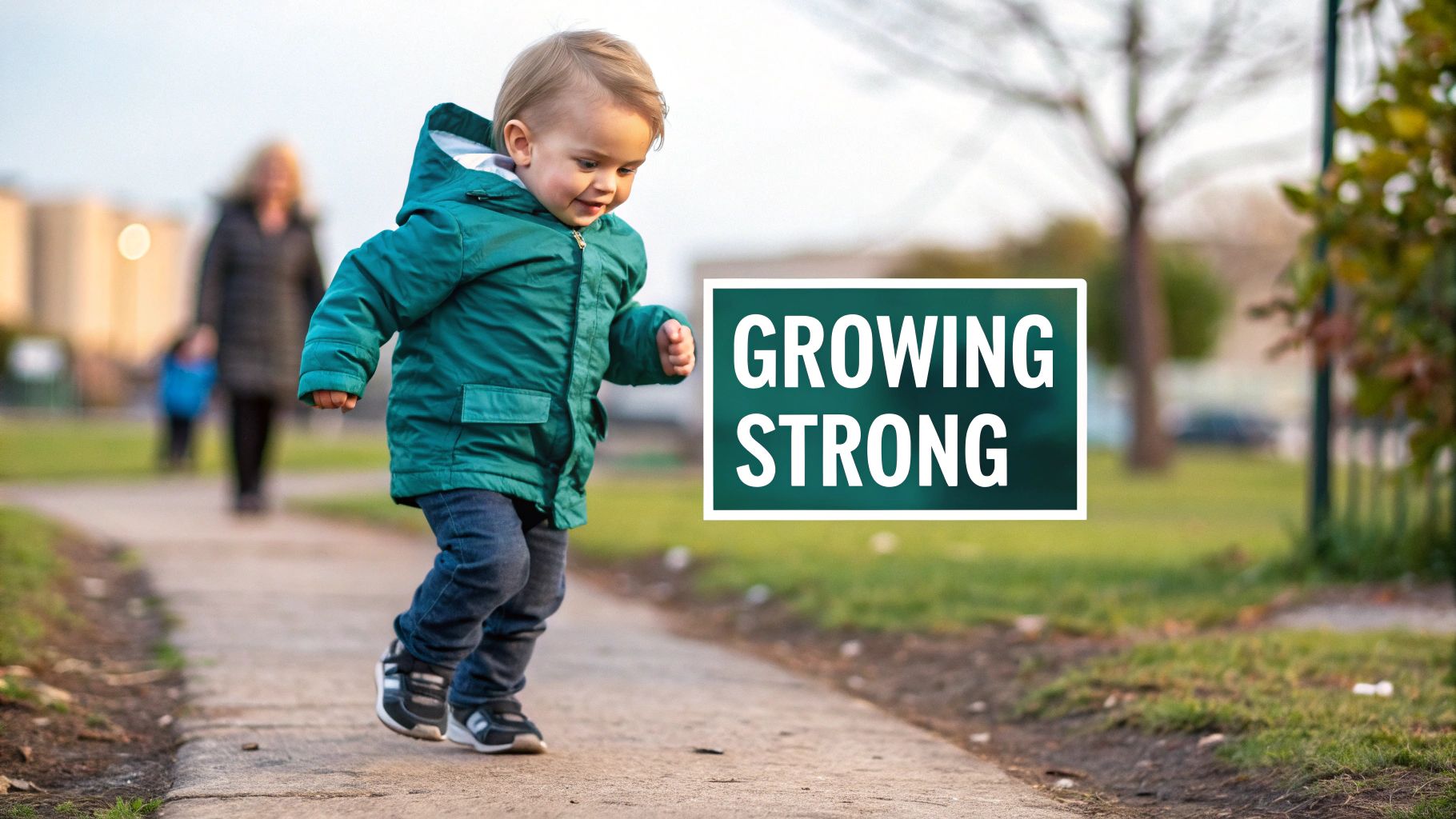
At 21 months, that once-wobbly walk is likely becoming a much more confident and stable run. Of course, tumbles are still a regular part of the learning process! You’ll start to notice them mastering new physical feats that show just how much their strength and coordination are coming along.
Keep an eye out for these common gross motor skills:
- Running with more stability: Their gait looks smoother, and they're getting much better at navigating around obstacles without constantly falling over.
- Kicking a ball: Instead of just walking into it, they can now aim a proper kick at a large ball. It’s a huge step up!
- Walking backwards: This might look like a funny party trick, but it shows a massive improvement in their balance and spatial awareness.
- Climbing everything: Low furniture, stairs, and playground equipment all become exciting new challenges as they build confidence in what their bodies can do.
- Squatting during play: Notice how easily they can squat down to pick up a toy and then pop right back up without needing to hold onto anything for support.
These skills aren’t just about burning off that boundless toddler energy; they are laying the essential groundwork for more complex physical activities in the years to come.
Developing Fine Motor Precision
While the big movements are easy to spot, the progress happening in your toddler's hands is just as remarkable. Developing fine motor skills is absolutely crucial for future tasks like learning to write, fastening buttons on a coat, or using a fork. At this stage, your toddler is like a little scientist, constantly experimenting and discovering what their hands can do.
These small, deliberate actions are a huge cognitive workout. When a toddler successfully stacks a tower of blocks, they are practising problem-solving, patience, and hand-eye coordination all at once.
You'll see this progress pop up in everyday play. For example, many 21-month-olds can now build a tower of four to six blocks high before it all comes crashing down. They might also be fascinated with scribbling, making bold, joyful marks on paper with a chunky crayon. Another key milestone is being able to turn the pages of a board book one by one—a task that requires real dexterity and control.
For more inspiration, check out our guide on activities to support fine motor skill development.
Understanding Physical Growth
Alongside all these new skills, your toddler is continuing to grow steadily. It’s only natural to wonder if your child is ‘on track’ with their physical growth, but it's so important to remember that children, just like adults, come in all shapes and sizes. Growth charts are there to provide a general guide, not a set of strict rules.
According to the growth standards used by UK healthcare providers, the average height for a 21-month-old girl is around 83.6 cm (32.9 inches), while for boys, it’s about 85.1 cm (33.5 inches). In terms of weight, the average for girls is roughly 11.3 kg (24.9 pounds), and for boys, it’s approximately 11.6 kg (25.5 pounds).
These figures are just averages. The most important thing is that your child is following their own healthy growth curve over time. If you have any concerns, your health visitor is always the best person to chat with.
Exploring Language and Cognitive Leaps
Just as your toddler's body is getting steadier on its feet, their mind is taking an equally incredible leap forward. Around 21 months, you’re right in the middle of a fascinating explosion in language and thinking skills, watching your once-quiet baby transform into a chatty, curious little person. It’s a truly dynamic time, where communication and problem-solving seem to blossom overnight.
This isn't just about learning new words, though that's a big part of it. It's about their whole world expanding. They're starting to connect words to objects, actions, and feelings in powerful new ways, laying the groundwork for all future learning.
The Great Vocabulary Boom
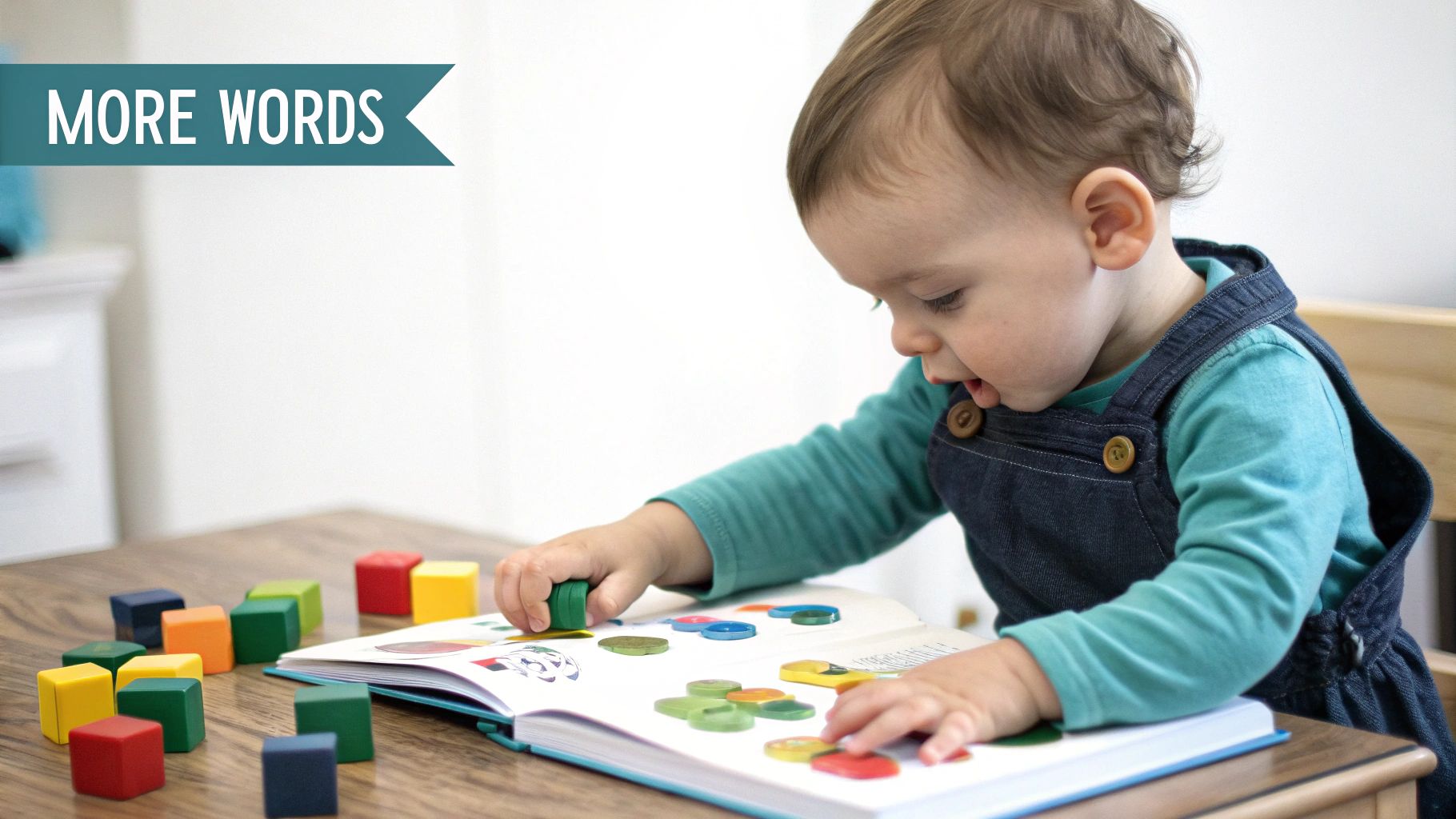
One of the most exciting 21-month-old milestones is the sheer speed at which their vocabulary grows. While every child is different, many toddlers are now using 50 words or more, and this is often when you'll hear those first, magical two-word sentences.
These little phrases are a massive developmental step. They show your child understands that you can stick words together to make bigger, more complex ideas.
- "More juice" is a crystal-clear demand.
- "Daddy go" shows they're observing the world and who's doing what.
- "All gone" is a definitive statement about the state of things (usually their dinner plate!).
This is a brilliant sign that their brain is starting to figure out the basic rules of grammar. They’re moving beyond simply labelling things and are now using language to really interact with their world.
Think of your toddler’s mind like an iceberg. The words they can say are just the tip you can see. Below the surface lies a vast understanding of language that is much, much bigger.
This difference is so important for understanding their progress. It helps to think about the two types of language that are developing at the same time:
- Receptive Language: This is everything your toddler understands. It’s their ability to follow simple directions ("Can you pass me the blue block?"), point to pictures in a book when you name them, and recognise the names of familiar people and objects.
- Expressive Language: This is what your toddler can actually say. It’s the collection of words and phrases they use to communicate their needs, feelings, and observations.
At 21 months, their receptive language is almost always way ahead of their expressive language. So, even if they aren't saying a huge amount just yet, rest assured they are absorbing and processing an incredible amount of information every single day. For more ideas on how to support this growth, you might like our guide on fun language development activities for toddlers.
A Little Problem-Solver Emerges
Alongside this language explosion, your toddler’s cognitive skills—their ability to think, learn, and solve problems—are also taking off. They are shifting from simply exploring objects to actively figuring out how they work. This is where you see the first real sparks of logical thinking.
You can see these cognitive leaps happening in their playtime every day. It’s that look of intense concentration as they try to fit a triangle into the right slot in a shape sorter, turning it over and over until it finally clicks into place. This isn't just random play; it's a scientific experiment in miniature.
Other signs of their growing brainpower include:
- Completing simple puzzles: They might now be able to manage two- or three-piece puzzles, showing they can see how different shapes fit together to make a whole.
- Imitating your actions: Early pretend play is a massive cognitive milestone. When they pick up a toy phone for a "chat" or try to feed their teddy with a spoon, they’re showing they can remember and re-enact sequences they've seen you do.
- Following two-step commands: You might now be able to ask them to "get your shoes and bring them to mummy," a task that requires them to remember and carry out two separate instructions.
Every time they solve one of these little problems, they are building vital neural pathways that support more complex thinking later on. Encouraging this kind of play is one of the very best ways to nurture their developing mind.
Getting to Grips with Social and Emotional Development
Welcome to the wonderfully chaotic, and often confusing, inner world of your 21-month-old. This age is an absolute explosion of feelings that are just as big and powerful as their boundless physical energy. You’re probably navigating a daily landscape of intense emotions, from sudden clinginess to fierce declarations of independence. It's a lot to handle, but it’s all a perfectly normal part of them figuring out who they are.
One minute, your toddler might be clinging to your leg for dear life, and the very next, they’re shouting “No!” at the top of their lungs when you try to help them. This emotional seesaw might feel exhausting, but it’s actually a healthy sign of their growing sense of self. They're just starting to realise they're a separate person from you, which is both thrilling and a little bit terrifying for them.
The Rise of Big Feelings
At the heart of this emotional rollercoaster is their budding independence. Your toddler is waking up to the fact that they have their own thoughts, wants, and opinions, and they are desperate to make them known. This often comes out in behaviours that can seriously test your patience, but are actually crucial developmental steps.
These behaviours are common social and emotional milestones you might be seeing:
- Asserting Independence: Shouts of “Mine!” and “No!” are the classics. This isn’t defiance just for the sake of it; it’s your toddler practising their newfound autonomy and working out where they end and others begin.
- Frustration and Tantrums: With a very limited vocabulary to express complex feelings like disappointment or frustration, their emotions can quickly boil over. A tantrum is often just their way of communicating that they’re completely overwhelmed.
- Separation Anxiety: Just as they push for independence, they also crave security. It’s very common for separation anxiety to peak around this time, as the realisation that you can actually leave them feels incredibly real and unsettling.
Think of it like this: your toddler is building an emotional toolkit from scratch. Right now, they don't have many tools, so when a feeling gets too big, they grab the only one they know how to use—often a tantrum. Your job is to calmly and patiently show them how to use other tools over time.
This period of possessiveness and emotional outbursts is a phase, but it’s a vital one. It means your child is developing self-awareness—the very foundation for important future skills like empathy, self-confidence, and pride.
Growing Social Awareness
While it might seem like their emotional world revolves entirely around them, your 21-month-old is also becoming more aware of the people around them. Their social skills are just beginning to blossom, and you'll see this in sweet, heartwarming moments as well as some awkward first interactions with other children.
For instance, they are now much more capable of showing affection with real purpose. You may notice them giving spontaneous hugs and kisses to family members, a beautiful sign of their growing emotional connection. They're also starting to notice the feelings of others, even if they don’t quite understand them yet. If they see someone is upset, they might pause and look concerned, showing the earliest flickers of empathy.
When it comes to playing with other kids, you’ll likely see something called parallel play.
- What is Parallel Play? This is when your toddler plays alongside another child, rather than with them. They might be in the same sandpit using similar toys, but they are each completely absorbed in their own little world. It looks disconnected, but it's a vital social milestone that acts as a bridge to more interactive play down the road.
Don’t stress if they aren't sharing toys just yet. The concept of sharing is still far too advanced for a 21-month-old, whose entire focus is on defining what belongs to them. The best approach is to gently guide them through these first social encounters. By validating their huge feelings and offering simple choices, you help them feel secure and understood as they navigate this incredible emotional journey.
Activities to Nurture Your Toddler's Growth
Knowing all the incredible developmental leaps your 21-month-old is making is one thing, but figuring out how to support them is another. The good news? You don’t need complicated lesson plans or a house full of expensive toys. The most powerful learning happens through simple, joyful play woven right into your everyday routine.
These activities are designed to be fun, easy to set up, and perfectly matched to the skills that are blossoming in your toddler right now. By making playtime a moment of purposeful connection, you become their best guide, helping them build confidence one small, wobbly step at a time.
Activities for Motor Skill Development
Your toddler’s boundless energy is their superpower for learning. Channelling it into play helps them refine both their big and small movements, building up their strength, balance, and coordination along the way.
Gross Motor Activities
These activities are all about whole-body movement and are absolutely perfect for getting the wiggles out.
- Build a Pillow Obstacle Course: Grab some cushions, pillows, and blankets and arrange them on the floor for your little one to crawl over, climb on, and navigate around. It’s a fantastic (and safe) way to improve their balance, spatial awareness, and even their problem-solving skills.
- Dance Party Freeze Game: Pop on some music and have a dance together. When the music stops, everyone freezes! This simple game is brilliant for helping them practise starting and stopping movements, a key part of gaining body control.
Fine Motor Activities
These little games strengthen the small muscles in their hands and fingers, getting them ready for future skills like writing and dressing themselves.
- Play-Dough Exploration: Squishing, rolling, and poking play-dough is an amazing workout for little hands. You can add another layer of skill by giving them a child-safe plastic knife or a small rolling pin.
- Posting and Sorting: Find an empty container, like an oats pot, and cut a slit in the lid. Give them large buttons, pasta shapes, or craft sticks to "post" through the slot. This really hones their pincer grasp and hand-eye coordination.
Boost Their Brainpower and Language
At this age, thinking and talking are deeply intertwined. As they begin to think in more complex ways, their ability to communicate those thoughts grows right alongside.
Every time you narrate your day, you're not just talking to your child; you're building a rich language library in their mind. This constant exposure to words in context is the single most effective way to grow their vocabulary.
Simple, daily chats are your most powerful tool for nurturing these 21 month old milestones.
Ideas for Cognitive and Language Growth
- Narrate Your Day: Simply talk about what you're doing as you do it. "I'm putting the red apples into the basket. Now, let's find the crunchy carrots." This connects words to objects and actions in a way that just makes sense to them.
- Interactive Reading: Choose books with flaps to lift or different textures to feel. Ask questions like, "Where is the fluffy sheep?" and encourage them to point. This turns reading from a passive activity into a two-way conversation.
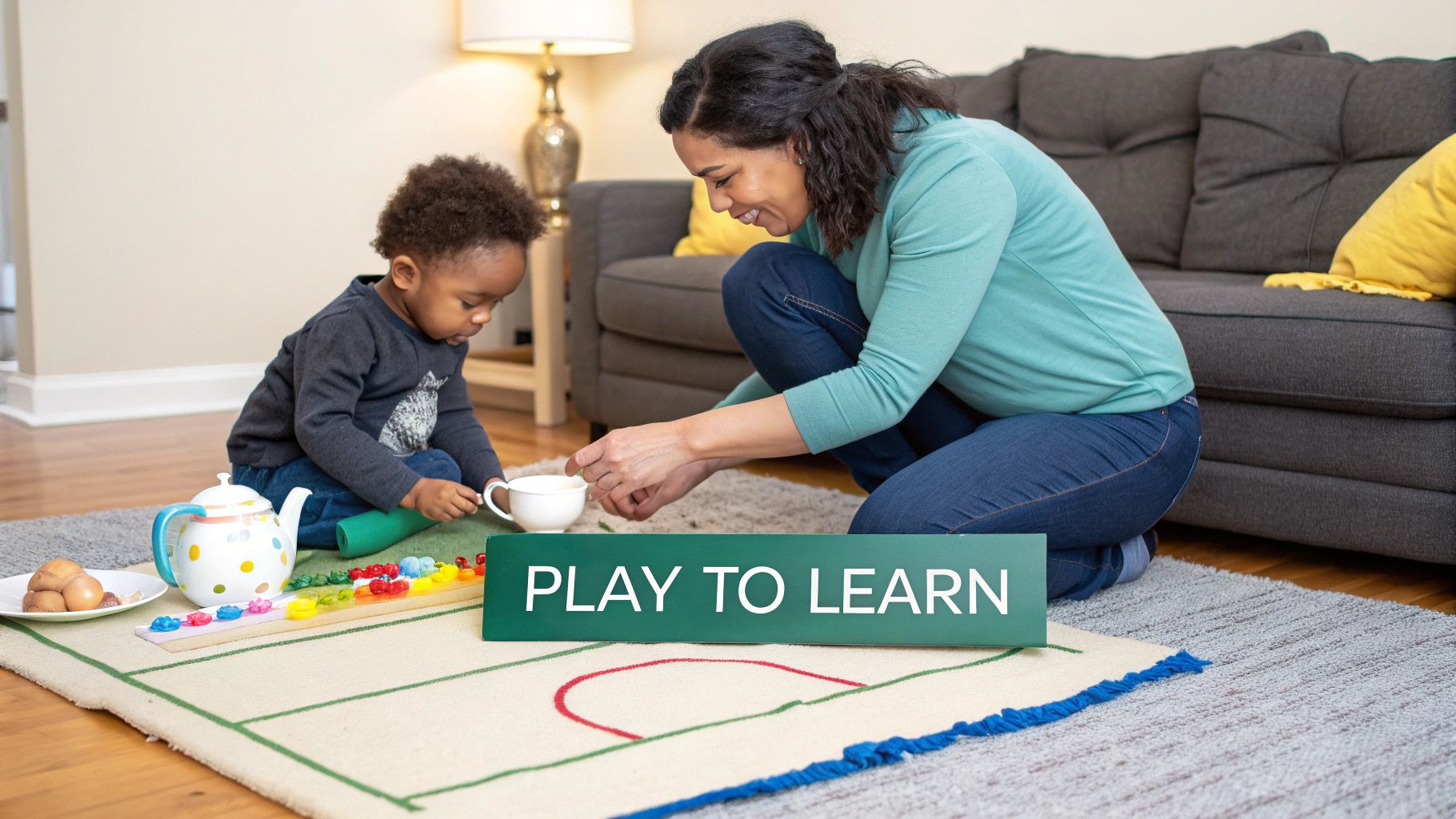
- Pretend Play Tea Party: Set up a simple tea party with their favourite stuffed animals. This encourages symbolic thinking (a block can be a biscuit!) and helps them practise social scripts and taking turns.
Supporting Growth with Grow With Me Kits
The toys inside a Grow With Me kit are carefully chosen to align with these developmental stages. For instance, the shape sorters and stacking toys are perfectly designed to challenge a 21-month-old's emerging problem-solving and fine motor skills.
The included play guides offer even more creative ideas, explaining the "why" behind each activity. This helps you use the toys in ways that directly support the 21 month old milestones we've talked about, making playtime both fun and incredibly beneficial.
Of course, all this playing requires a lot of energy! Exploring nutritious snack options is crucial for supporting their physical development. For some great inspiration, you can find many healthy snack ideas for toddlers to keep them fuelled and ready to learn. By combining purposeful play with good nutrition, you create the ideal environment for your little one to thrive.
When to Chat with a Professional About Development
It’s so important to remember that every toddler truly dances to the beat of their own drum. The 21-month-old milestones we’ve talked about are simply a general map, not a rigid itinerary. One little one might be a chatterbox but cautious on their feet, while another is a fearless climber who’s still finding their words. Both are completely normal.
Your parent gut-feeling is one of the most powerful tools you have. If that little voice inside is whispering that something might be off, it's worth listening to. The aim isn't to worry, but to make sure you have all the information you need. Seeking advice is a proactive, loving step that ensures your child gets the right support when it matters most. A little early support can make a huge difference down the line.
Recognising Potential Red Flags
While every child develops differently, some signs can be a gentle nudge to check in with a professional. Think of these less as alarm bells and more as prompts to start a conversation with your health visitor or GP.
It might be a good idea to reach out if your 21-month-old:
- Isn't walking independently or seems particularly unsteady on their feet.
- Doesn't use at least six words consistently or doesn't seem to be adding new words.
- Doesn't seem to grasp the purpose of simple, everyday objects, like a spoon, a brush, or a phone.
- Isn't pointing to things to show you what they're interested in.
- Doesn't respond to their name or seems unaware when you enter a room.
- Loses skills they once had – for example, they stop using words they previously knew.
Trusting your instincts is everything. You know your child better than anyone. If something feels not quite right, scheduling a check-in for guidance or even just for reassurance is always a positive move.
Who to Talk To and How to Approach It
Here in the UK, your health visitor is usually the best first port of call. They are experts in child development and can carry out an assessment, offer valuable advice, and point you towards other resources if they’re needed. Your GP is another great person to speak with.
When you do have the chat, try to be specific. Instead of a general worry like, "I'm concerned about their speech," you could say, "They were saying 'dada' and 'ball' a month ago but have stopped, and they don't seem to turn when I call their name." Giving clear, observable examples helps the professional get a much better picture of what's going on.
Your Top Questions About 21 Month Olds, Answered
As you watch your 21-month-old go through this whirlwind of growth, it’s only natural to have a few questions pop up. It’s a time of huge leaps and bounds, and you're definitely not alone in wondering about the day-to-day realities. Let's dive into some of the most common things parents ask.
How Much Sleep Does a 21-Month-Old Actually Need?
Most toddlers this age need around 11 to 14 hours of sleep over a 24-hour period. This usually breaks down into 10–12 hours at night and a solid afternoon nap, which can last anywhere from 1.5 to 3 hours.
Don't be surprised if they suddenly start fighting that nap—it's a classic move as they explore their independence. The best thing you can do is stick to a consistent, predictable routine. This helps manage the nap resistance and stops them from getting overtired, which, as you probably know, can make bedtime a real battle.
Is It Normal for My Toddler to Be So Fussy with Food?
Oh, absolutely. Fussy eating is practically a toddler rite of passage. It's one of the first ways they realise they have a say in their world, and food is an easy place to start asserting that newfound independence. The trick is to stay calm and keep offering a variety of healthy options without turning mealtimes into a power struggle.
A few things that can help:
- Serve small, manageable portions so their plate doesn't look so intimidating.
- Always include a 'safe' food on the plate—something you know they'll usually eat—alongside anything new.
- Look at their nutrition over a whole week, not just one meal. You’ll get a much more realistic picture.
The main thing is to keep mealtimes relaxed and positive. If you’re genuinely worried about their growth or what they're eating, having a chat with your health visitor is a great way to get some reassurance.
What Are the First Signs My Toddler is Ready for Potty Training?
While 21 months is often a little on the early side, some children do start showing signs that they’re getting there. It’s so important to remember that readiness is all about their individual development, not a date on the calendar. There is absolutely no rush.
Potty training readiness isn't just one thing—it’s a mix of physical, cognitive, and emotional cues. You're looking for a pattern of signs, like a genuine interest in the toilet, rather than just ticking one box.
Keep an eye out for clues like these:
- They’re staying dry for longer stretches, like two hours or more during the day.
- They tell you—with words or gestures—when their nappy is wet or dirty.
- They can pull their own trousers up and down.
Should I Be Worried if My 21-Month-Old Isn't Talking Much?
The spectrum for language development is incredibly wide. Some 21-month-olds are chattering away with 50+ words, while others are just starting out with a handful. What you really want to see is steady progress.
Are they adding new words, even slowly? Do they understand simple instructions like "can you get your shoes"? Are they using gestures, like pointing, to communicate what they want? If you can say yes to these, they are likely on the right track. But if your child isn't using any words at all or doesn't seem to understand you, it’s always wise to mention it to your health visitor for peace of mind.
At Grow With Me, we know that every milestone is a building block for the next. Our stage-based play kits are designed to support your toddler's development with toys that are perfectly matched to their growing skills.