
The Ultimate Guide to Toys for 3 Month Old Babies
Welcome to the magical three-month mark! This is a time of incredible transformation for your baby. The best toys for a 3 month old are the ones that tap into their rapidly developing senses. Think high-contrast books, lightweight rattles, and engaging play gyms—they're perfect for a baby’s newfound curiosity and growing physical skills.
Your Baby at Three Months: What's Happening Now?
At three months, your baby is really starting to leave that sleepy newborn phase behind. They're blossoming into a more alert, interactive, and even predictable little person. It’s a truly exciting time, filled with noticeable leaps in their physical abilities and sensory awareness.
Understanding these changes is the key to choosing toys that are not just fun, but genuinely beneficial for their growth. This period is all about discovery. Your baby's world is expanding, and their brain is working overtime to make sense of all the new sights, sounds, and textures.
Every interaction helps build crucial neural pathways. Think of their brain like a new city being built—each developmental milestone is a new road connecting different neighbourhoods of learning and skill.
The World Comes into Focus
One of the most dramatic changes you'll see is in your baby’s vision. While newborns see the world in blurry shades of grey, a three-month-old’s eyesight has improved massively. They can now see colours more vividly—especially bold primary colours like red and blue—and can track moving objects with much greater accuracy.
This visual awakening is exactly why high-contrast patterns and bright colours are so captivating for them. When you dangle a colourful toy, you’re essentially giving their eyes a workout, helping them strengthen their focus and tracking abilities.
Gaining Control and Getting Stronger
Motor skills are also taking a giant leap forward. That wobbly head is becoming much steadier, and during tummy time, you’ll likely see them pushing up on their arms with more strength and purpose. This isn't just exercise; it’s the foundation for future milestones like rolling over and sitting up.
Their hand-eye coordination is just beginning to emerge. Those once-random arm movements are becoming more intentional. Soon, they'll start to swipe at, and eventually grasp for, objects within their reach. This newfound ability to physically interact with their environment is a huge cognitive step. You can learn more about these changes in our article on what developmental milestones are and why they matter.
Here's a quick look at what's happening developmentally at this exciting stage.
Developmental Milestones at Three Months
This table gives a snapshot of the key physical, sensory, and cognitive developments you can look for as your baby hits the three-month mark.
| Developmental Area | Key Milestones and Abilities |
|---|---|
| Physical | - Holds head up with more stability and control. - Pushes up on forearms during tummy time. - Begins to open and close hands purposefully. - May bring hands to mouth. |
| Sensory | - Follows moving objects with their eyes (tracking). - Vision has improved; can see colours more clearly. - Turns head towards the source of sounds. - Starts to enjoy different textures. |
| Cognitive & Social | - Starts to babble and coo. - Begins to smile socially at people. - Shows excitement by waving arms and kicking legs. - Recognises familiar faces and voices from a distance. |
Remember, every baby develops at their own pace, but these are the general skills that are starting to blossom right about now.
A three-month-old's brain is like a sponge, absorbing information from every interaction. The right toys act as catalysts, turning simple play into powerful learning opportunities that support cognitive, sensory, and physical development.
Choosing the right toys for a 3 month old means matching them to these specific developmental stages. You’re not just buying a toy; you're providing a tool perfectly designed to help them practise their newest skills. A simple rattle isn't just a noisemaker—it’s a lesson in cause and effect and a prompt for them to practise grasping. Understanding the "why" behind the play is what makes it so rewarding.
What Kinds of Toys Are Best for a 3-Month-Old?
Okay, so you have a good grasp of what’s happening with your baby’s development. Now for the really fun part—picking out the toys! Choosing the right toys for a 3-month-old isn’t just about filling up a toy box. It’s about finding specific things that click with their brand-new skills in seeing, moving, and feeling the world around them.
Think of it like finding the right-sized puzzle pieces. Give them a piece that’s too simple, and there’s no challenge. But one that’s too complicated just leads to frustration. The best toys for this age are a perfect match for what your baby is learning to do right now, turning simple playtime into a powerful engine for growth.
This infographic breaks down the core developmental areas that the right toys can support at three months old.
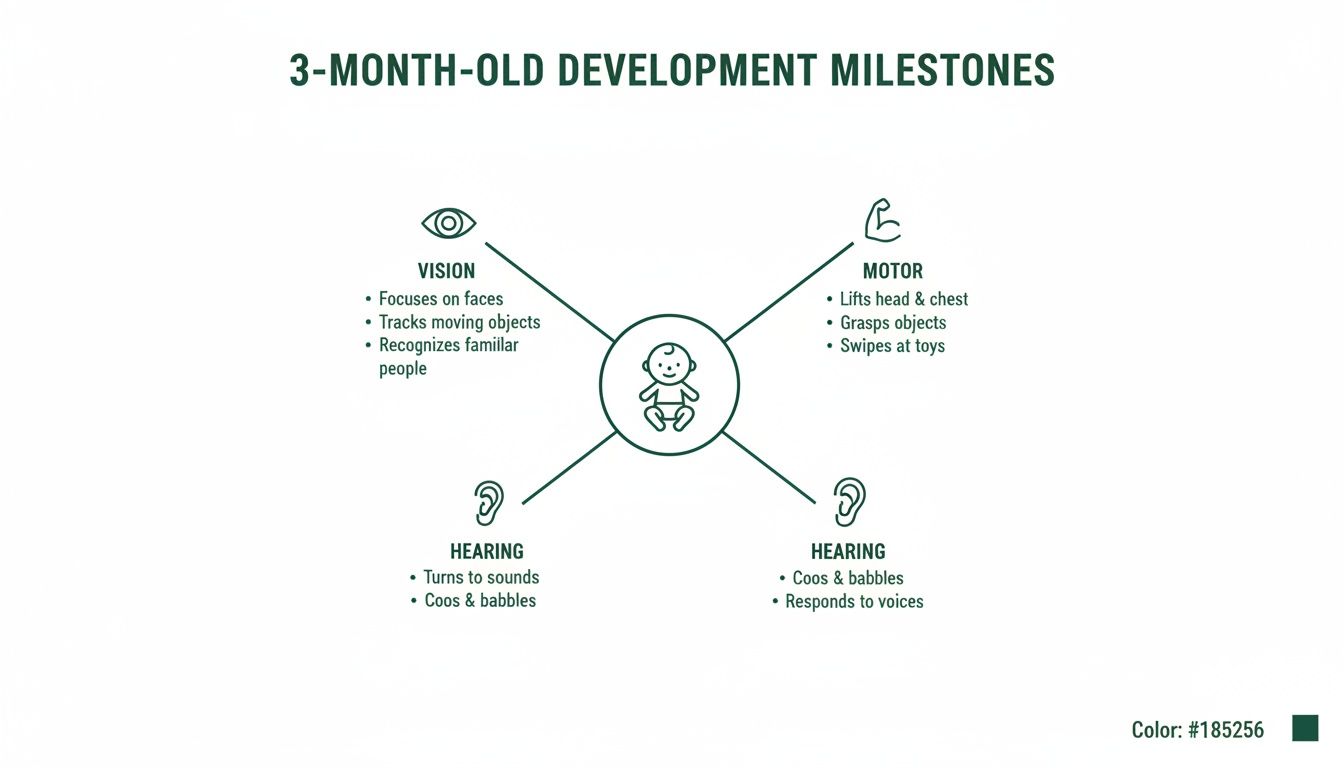
As you can see, playtime right now is all about sparking their vision, encouraging those first real movements, and tuning into new sounds. It’s all connected. Let's look at the specific types of toys that really get the job done.
Toys to Get Their Eyes Working
At three months, your baby’s eyesight is coming along in leaps and bounds, but it's still a work in progress. They’re most captivated by bold, high-contrast patterns and bright, primary colours. This is exactly why toys with simple, striking designs seem to mesmerise them.
- High-Contrast Books and Flashcards: Black, white, and red patterns are like magnets for a three-month-old's eyes. During tummy time or a quiet moment on the mat, just holding up these cards gives their eyes a clear target to focus on. It’s a great little workout for their eye muscles and helps build their concentration.
- Colourful Mobiles: A mobile hanging safely over the cot or changing mat is fantastic for encouraging visual tracking. As the little shapes gently drift and spin, your baby learns to follow them with their eyes—a foundational skill they'll one day use for reading.
Toys to Encourage Reaching and Grasping
Those tiny hands aren't always clenched in tight fists anymore, are they? You're probably seeing them start to open up, bat at things, and even try to grab onto whatever’s nearby. The trick is to give them toys that are lightweight and perfectly shaped for their little hands to hold.
When you give a baby a toy they can actually grasp, you're helping them figure out cause and effect. They learn, "When I shake this, it makes a sound!" which is a huge cognitive leap. They’re realising they can make things happen in their world.
Lightweight rattles and soft, easy-to-hold grasp toys are spot-on for this stage. When they manage to whack or hold onto a rattle, they're practising their hand-eye coordination. That satisfying sound it makes is instant feedback, rewarding their effort and making them want to try it again. You can find out more in our guide to sensory toys for babies.
Making Tummy Time Fun
We all know tummy time is crucial for building strength in their neck, shoulders, and back, but let’s be honest—not every baby is a fan at first. The right toys can completely change the game, turning it from a daily chore into a fun, engaging activity.
A well-designed playmat or play gym is a brilliant investment. They usually come packed with features designed specifically for this age.
- Built-in Mirrors: Babies are absolutely fascinated by faces, especially their own! A baby-safe mirror gives them a great reason to lift their head for a better look.
- Dangling Toys: Hanging toys just within their reach motivates your baby to push up, reach out, and swipe. These little movements are building up all that essential upper-body strength.
- Different Textures: A good mat will have crinkly sections, soft fuzzy patches, and silky ribbons. This gives them a rich tactile experience as their hands and body explore the surface.
For a fantastic piece of kit that delivers multiple developmental benefits, check out this ultimate guide to choosing the perfect baby play gym. It really breaks down what makes these toys so effective. By simply making their environment more interesting, you’ll find you can stretch out tummy time and get so much more out of every session.
Safety First: Essential Checks for Your Baby's Toys
As your baby hits the three-month mark, you'll notice something new: everything goes in their mouth. It's how they explore the world, learning about different textures, shapes, and sizes. But it also means that toy safety suddenly becomes top of mind.
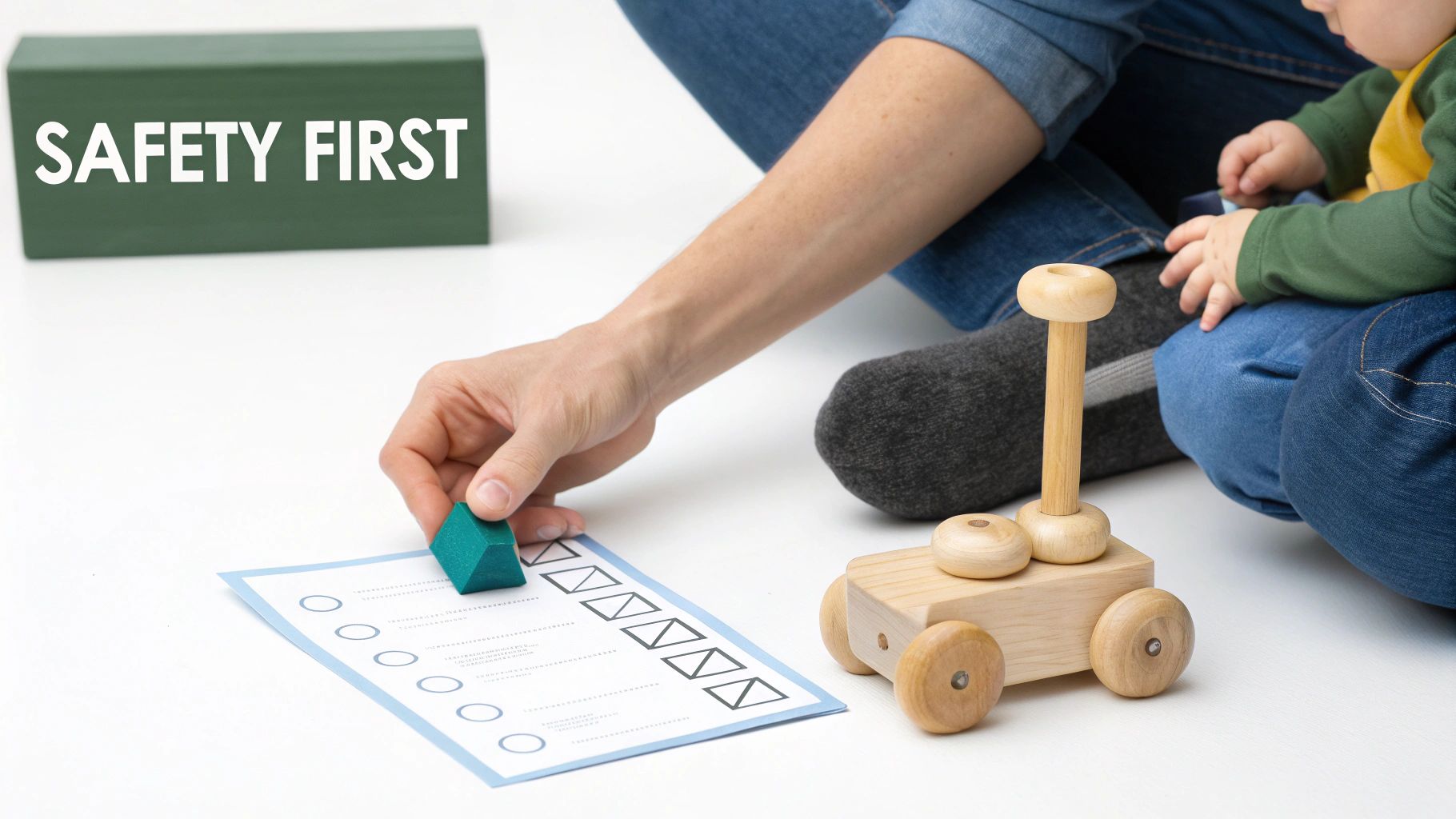
Giving a toy a quick glance just isn't enough anymore. To have real peace of mind, you need to become a bit of a detective, proactively looking for hidden risks. A thorough check ensures that playtime stays fun, safe, and full of wonderful discovery.
Sizing Up Choking Hazards
The single most important safety check for any toy for a 3-month-old is its size. Since they’ll try to mouth just about anything they can get their hands on, small objects or parts that could break off pose a very real choking risk.
There's a simple and surprisingly effective trick for this: the toilet roll tube test. If a toy, or any part of it, can fit completely inside a standard toilet roll tube, it's too small and shouldn't be given to your baby. It’s a reliable check you can do at home in seconds.
Always be on the lookout for:
- Loose Parts: Give the toy a good shake and a firm tug. Are the beads in that rattle secure? Are the eyes on that stuffed animal stitched on tightly?
- Small Components: Steer clear of toys with buttons, tiny decorative bits, or—most importantly—small batteries. Button batteries are extremely dangerous if swallowed.
- Durability: A good toy should be able to withstand being gummed, chewed, and inevitably dropped without breaking into hazardous little pieces.
Choosing Safe and Natural Materials
What a toy is made of is just as crucial as its size. Your baby’s skin is incredibly delicate, and because they'll be chewing on their toys, non-toxic materials are an absolute must.
If you're choosing plastic toys, it’s worth understanding what BPA-free plastic means and why it's so important. Always check the packaging for labels that confirm a toy is free from BPA, phthalates, and other nasty chemicals.
This focus on safety has also led many parents toward natural materials. In fact, sustainability is a big deal for UK parents, with 45% of consumers saying it's a priority when toy shopping. It's no wonder wooden toys, now holding 28% of the market share, are so popular—they’re durable, classic, and often finished with non-toxic paints.
In the UK, keep an eye out for the UKCA mark (or the CE mark on slightly older stock). This is the manufacturer's way of declaring that the toy meets national safety standards. It’s a vital sign of a responsibly made product.
Final Physical Checks
Before you hand any toy over—whether it's brand new or a hand-me-down—run through this quick final checklist. It only takes a moment and covers those last few physical risks.
- No Sharp Edges or Points: Run your hands all over the toy. Feel for any sharp plastic seams, splintered wood, or rough edges that could scratch your baby’s sensitive skin.
- No Long Cords or Ribbons: Any strings or cords on a toy should be very short to prevent any risk of strangulation. As a rule of thumb, anything longer than 22 cm is considered a potential hazard.
- Washable and Hygienic: Let's be honest, toys will end up on the floor, in the car, and all over the place before going back into your baby’s mouth. Choosing items that are easy to clean is key to keeping germs at bay.
By being a little extra careful, you can confidently choose toys for your 3-month-old that are both wonderfully engaging and completely safe. If you're looking for more ideas, you might find our guide to the best toys for newborns' development helpful.
How to Play With Your 3 Month Old to Boost Development
Having the right toys is a brilliant start, but the real magic happens when you know how to use them to connect and play with your little one. This is where simple objects transform into powerful tools for building your baby's brain and strengthening your bond. Playtime at this age isn't about setting up complex activities; it's all about short, sweet, and meaningful interactions that fit naturally into your day.
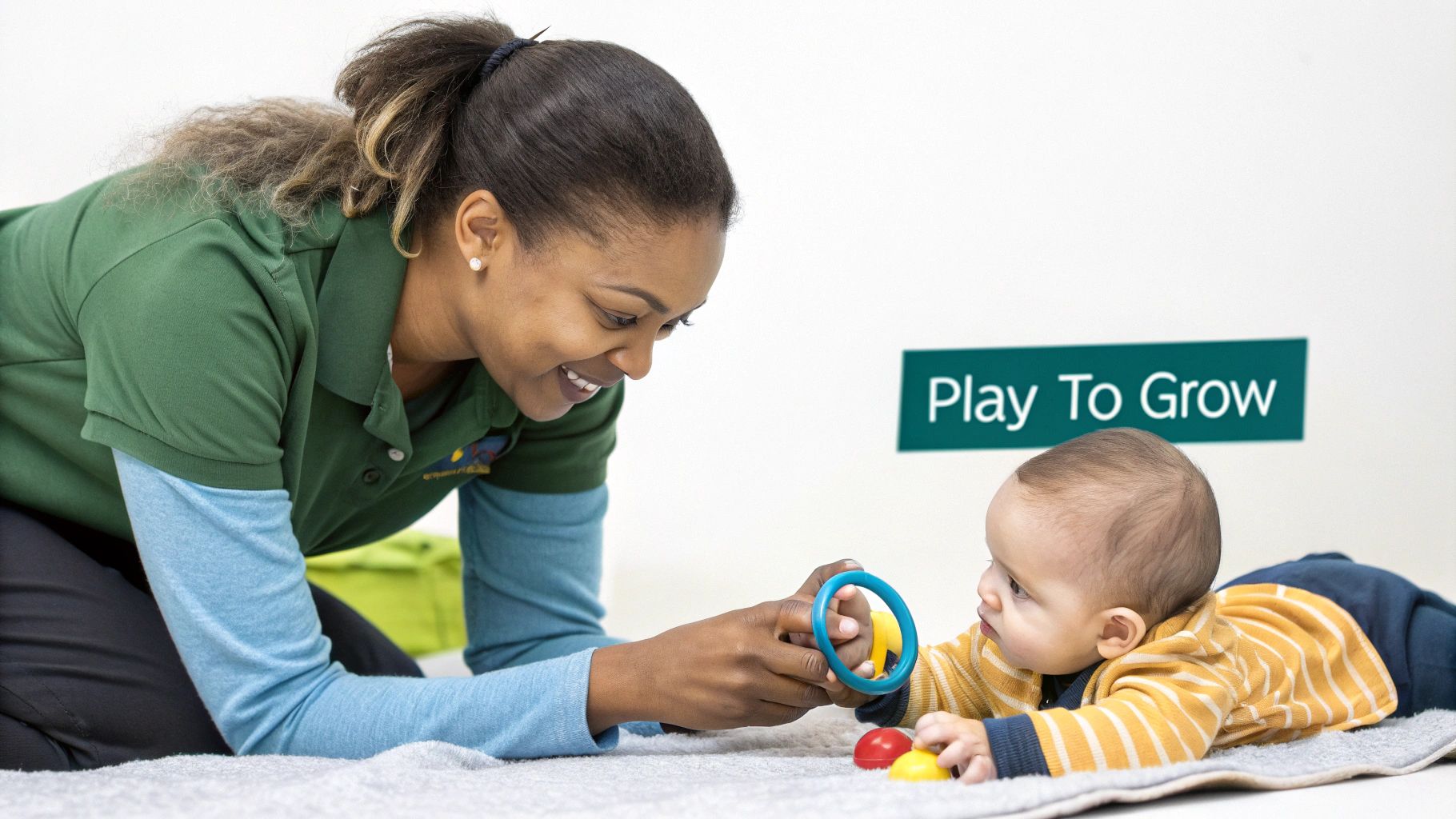
Think of yourself as your baby's first and favourite playmate. When you get down on the floor and join in, you’re not just keeping them entertained—you’re showing them how the world works. Every little game helps forge crucial connections in their brain, laying the groundwork for all the learning that's yet to come.
Creating Simple Play Routines
At three months, a baby’s attention span is fleeting, often lasting just a few minutes. The key is to aim for brief but frequent play sessions sprinkled throughout their wake windows. Forget setting aside a full hour; five-minute bursts of fun between feeds, nappy changes, and naps are perfect.
A great approach is to match the activity to your baby’s mood. A lively game with a rattle might be just the thing after a nap, while quietly looking at a high-contrast book together is a wonderful way to wind down. By paying attention to their cues, you make playtime a joy rather than a chore.
Here are a few simple ideas to get you started, using the best toys for a 3 month old:
-
Rattle and Track: Lie your baby on their back or sit them supported in your lap. Hold a lightweight rattle about 25 cm from their face. Gently shake it to get their attention, then slowly move it from side to side. You’ll see their eyes follow the movement, which is fantastic for strengthening their neck muscles and visual tracking skills.
-
Story Time Narration: Cuddle up with a high-contrast book. You don't need to read the words on the page. Just point to the bold patterns and describe what you see in an animated voice. "Look at this big, black circle!" or "Wow, so many stripes!" Your voice is the most interesting sound in the world to them, and this simple act helps build early language pathways.
-
Play Gym Motivation: Place your baby on their back under a play gym so the dangling toys are just within reach. Their natural curiosity will kick in, motivating them to reach, swipe, and kick. Each time they successfully bat a toy, it’s a mini-victory that teaches them about cause and effect and builds coordination.
Reading Your Baby’s Cues
One of the most important parts of playtime is learning to read your baby's signals. How can you tell if they're loving the interaction or if they've had enough?
Play is a dialogue. Your baby can't use words yet, so they communicate with their whole body. Learning their cues—like turning their head away or arching their back—is the key to keeping playtime positive and preventing them from becoming overwhelmed.
Signs of an Engaged Baby:
- Making eye contact with you or the toy
- Smiling, cooing, or babbling happily
- Waving their arms and kicking their legs with excitement
- Watching an object with focus and concentration
Signs of an Overstimulated Baby:
- Turning their head or gaze away from you
- Arching their back or getting fussy
- Yawning or rubbing their eyes
- Crying or looking distressed
When you spot those "I need a break" signals, it's time to switch to a calmer activity or just have a quiet cuddle. This responsive approach builds trust and shows your baby that you understand them, making your time together a truly connected experience.
Why Stage-Based Play Is So Important
Your baby’s development isn’t a slow, steady climb; it’s a series of incredible, rapid-fire leaps. A toy that has your three-month-old completely captivated one week might be totally ignored the next—or worse, become a source of real frustration. This is precisely why the idea of stage-based play is so powerful.
Think about it like this: you wouldn't try to teach a child basic sums using an advanced algebra textbook. It just wouldn’t work. The concepts would be far too complex, leading to confusion and a total lack of interest. The very same principle applies to your baby's toys. Stage-based play is simply the art of matching toys and activities to your baby's exact developmental level, making sure they always have the right "textbook" for their current chapter of learning.
This approach means that every playtime becomes a little victory. When a toy is perfectly in sync with their current abilities—like a lightweight rattle for a baby just mastering their grip—it builds their confidence and sparks their desire to keep exploring.
Preventing Playtime Frustration
A toy that’s too advanced can be really discouraging. If a three-month-old is handed a complex stacking toy designed for a nine-month-old, they simply don't have the fine motor skills or cognitive grasp to figure it out. They can't succeed, and that can lead to them just giving up.
On the flip side, a toy that’s too simple offers no challenge at all. The high-contrast flashcard that was so fascinating at two months might not hold their attention now that their vision has sharpened. Stage-based play keeps them in that perfect sweet spot: challenged, but not overwhelmed. It's the ideal state for learning.
The goal of stage-based play is to create a "just right" environment. It maximises engagement by meeting your baby exactly where they are, turning their natural curiosity into meaningful skill development without the tears.
This thoughtful way of playing is becoming more and more popular, with parents actively looking for toys that offer real developmental value. The UK baby toys market, valued at £1,030 million in 2024, is expected to grow significantly, with educational toys leading the way. This trend shows a clear desire among parents for products that support learning right from the start. You can find more data on the UK baby toys market from Market Research Future.
The Challenge of Keeping Up
While the concept itself is simple, putting it into practice can be tricky for busy parents. Babies develop at a dizzying pace, and it’s a constant mission to research and find the next perfect toy just as they’re ready for it. This is exactly the problem that a service like Grow With Me is built to solve.
Instead of spending hours searching for the next best toy for a 3 month old, a curated play kit arrives at your door at just the right moment. It takes all the guesswork out of the equation. Each box is expertly designed to line up with your child’s specific developmental stage, making sure they always have the tools they need to thrive.
The Grow With Me service offers a few key benefits for families in the UK:
- Expert Curation: The toys are hand-picked by experts who live and breathe childhood development, so you know every single item serves a purpose.
- Convenience: A new kit is delivered every few months, perfectly timed to match your baby's next developmental leap.
- High-Quality Materials: With over 80% of toys made from natural materials like wood, you can feel confident that they are safe, durable, and sustainable.
- Clear Guidance: Each box comes with handy description cards explaining what each toy is for and how to use it to support your baby's learning.
This approach completely transforms playtime. It’s no longer just about keeping your baby occupied; it's about providing enriching, purposeful experiences that build their brain, body, and confidence, one stage at a time.
Your Top Questions About Toys for 3-Month-Olds, Answered
Stepping into the world of baby gear can feel like navigating a maze, especially when you’re determined to find the very best for your little one. When it comes to picking out toys for a 3-month-old, most parents find themselves asking the same questions. Let’s clear up the confusion with some straightforward, practical answers.
Think of this as a chat with a friend who’s been there. We'll cover how many toys your baby really needs (spoiler: it's fewer than you think) and whether that expensive gadget is actually any better than a simple classic.
How Many Toys Does My 3-Month-Old Really Need?
It’s tempting to think that more toys mean more learning, but for a three-month-old, that’s not quite how it works. At this age, their entire world is a source of wonder. Your face, the sound of your voice, the texture of a muslin cloth—these are all deeply fascinating experiences.
A small, carefully chosen collection of 4-6 high-quality toys is perfect. With fewer options, your baby can properly focus and explore each one without getting overstimulated by a mountain of plastic.
The key is quality over quantity. A handful of purposeful toys that target different developmental skills—like a rattle for grasping, a high-contrast book for vision, and a tummy time mat for motor skills—is far more powerful than a room full of clutter.
A great little trick is to rotate the toys. Pack a couple away for a week, and when you bring them back out, they’ll feel brand new to your baby. It keeps playtime fresh and exciting without you having to constantly buy more.
Are Expensive Toys Better or Safer?
A hefty price tag doesn't automatically guarantee a toy is better or safer. While some premium brands use beautiful, natural materials like sustainably sourced wood, a toy's safety really comes down to its design and how well it's made, not its cost.
The most important thing to look for is the safety certification. Always check the packaging for the UKCA or CE mark. This is your proof that the toy has passed the strict safety tests required in the UK. You can find wonderfully safe and effective toys at all sorts of price points.
When you're choosing, keep these things in mind:
- Focus on Materials: Look for non-toxic, baby-safe materials, whether that’s BPA-free plastic or wood finished with non-toxic paint.
- Check the Build: Make sure the toy feels sturdy. There should be no small parts that could break off, no sharp edges, and no long cords.
- Prioritise Purpose: The best toy is one that fits what your baby is working on right now. A simple, well-made wooden rattle often provides more developmental value than a flashy, expensive electronic toy.
How Often Should I Clean My Baby's Toys?
At three months old, pretty much everything ends up in your baby's mouth—it's how they explore! This means keeping their toys clean is a top priority. How often you need to wash them depends on the toy and how much action it sees.
The easiest approach is to get into a simple cleaning routine.
- Daily Wipe-Down: For the toys that get the most mouth-time (teethers and rattles, I’m looking at you), a quick wipe with a baby-safe disinfectant wipe or a cloth with soap and water at the end of the day is a great habit.
- Weekly Deep Clean: Once a week, give all hard-surface toys a more thorough clean. A good soak in a basin of mild soap and water, followed by a rinse and a full air dry, will do the trick.
- As-Needed for Fabric Toys: Soft toys can be spot-cleaned whenever they get a bit grubby. Many can also be popped in the washing machine on a gentle cycle—just be sure to check the care label first! A mesh laundry bag is your best friend here.
When Should I Introduce Electronic or Light-Up Toys?
The shops are full of toys that flash, sing, and put on a real show, but for a three-month-old, it’s often best to hold off. Right now, their brain is busy figuring out fundamental concepts like cause and effect.
Simple, "passive" toys like a rattle or a crinkle book are fantastic because they put your baby in the driver's seat. They quickly learn, “When I shake this, it makes a sound.” That sense of agency is a huge building block for learning.
Many electronic toys, on the other hand, encourage passive observation. The baby pushes a button, and the toy performs. While it might seem entertaining, it doesn’t ask for the same kind of cognitive heavy lifting. By sticking to simpler, classic toys at this stage, you’re helping to build a much stronger foundation for creative play and problem-solving down the line.
The UK toy market is a massive industry, and toys for infants and toddlers are its biggest segment. With over £2 billion in revenue, e-commerce has become a go-to for parents looking for these kinds of quality, developmental products. You can dig deeper into these trends by checking out the UK toy retailing industry report on ibisworld.com.
Ready to take the guesswork out of playtime? The Grow With Me subscription box delivers expertly curated, stage-based play kits right to your door. Each box is filled with high-quality, natural toys perfectly matched to your baby's developmental stage, ensuring they always have the right tools to learn and grow.