
A Parent's Guide to Infant Learning Toys That Boost Development
When we talk about infant learning toys, we're not just talking about things to keep a baby busy. These are the fundamental tools that fuel their incredible brain development. Through what looks like simple play, these toys engage a baby’s senses, build up their motor skills, and introduce them to big ideas like cause and effect.
The Power of Play: How Infant Learning Toys Shape Early Development
For a baby, playtime is serious business—you could even call it their first job. The first year of life is a period of explosive growth. A baby's brain forms more than one million new neural connections every single second. Infant learning toys are the essential 'tools of the trade' for this critical work, turning fun moments into powerful growth opportunities.
Imagine your baby’s mind as a vibrant, rapidly growing garden. Just as a garden needs the right conditions to flourish, a baby's brain thrives on the right kind of stimulation. Purposeful toys provide this nourishment, enriching the ‘soil’ of their developing mind and body.
Nurturing Your Baby's Growing Mind
Every touch, every sound, and every sight helps this mental garden grow. Infant learning toys are crafted to offer focused stimulation that aligns with specific developmental milestones. What works for a 3-month-old's garden is completely different from what a 9-month-old needs. This is the whole idea behind stage-based play.
A newborn, for instance, gets a huge visual boost from high-contrast black-and-white cards. A few months on, a textured teether does more than just soothe sore gums; it gives them vital sensory information about different surfaces. Later, simple stacking rings teach them about size, order, and how to control their little hands.
Choosing the right toys isn’t about pushing your baby to hit milestones faster. It’s about offering joyful and appropriate ways for them to explore the world at their own unique pace.
The Building Blocks of Development
Getting the right toys at the right time lays the groundwork for more complex skills down the road. Think of them as the building blocks for future learning.
Here’s how they help:
- Cognitive Skills: Toys that encourage problem-solving, like a shape sorter, help build the brain pathways for logic and memory.
- Motor Skills: Grasping a rattle or reaching for a colourful block strengthens both fine and gross motor control—the same skills needed later for crawling and even writing.
- Sensory Development: Toys with different textures, sounds, and colours stimulate the senses, helping your baby make sense of the world around them.
Ultimately, knowing the ‘why’ behind each toy changes how you see playtime. It’s no longer just a way to pass the time; it becomes a meaningful way to connect. It gives parents, grandparents, and caregivers the confidence that they aren’t just entertaining their little one, but actively nurturing their amazing developmental journey.
Decoding Developmental Stages: A Toy Guide for Your Baby's First Year
A baby’s first year is an absolute whirlwind of growth. It feels like one week they're a sleepy newborn, and the next they're on the move, exploring everything. This rapid development is why matching toys to their specific stage is so crucial—it’s the secret to turning simple playtime into a powerful learning experience.
When you understand what your baby is working on at each phase, you can choose toys that are not just fun, but perfectly suited to support their next big leap.
This timeline gives you a great overview of how play evolves, from simple sensory exploration right at the start, to the more complex problem-solving that toddlers love.
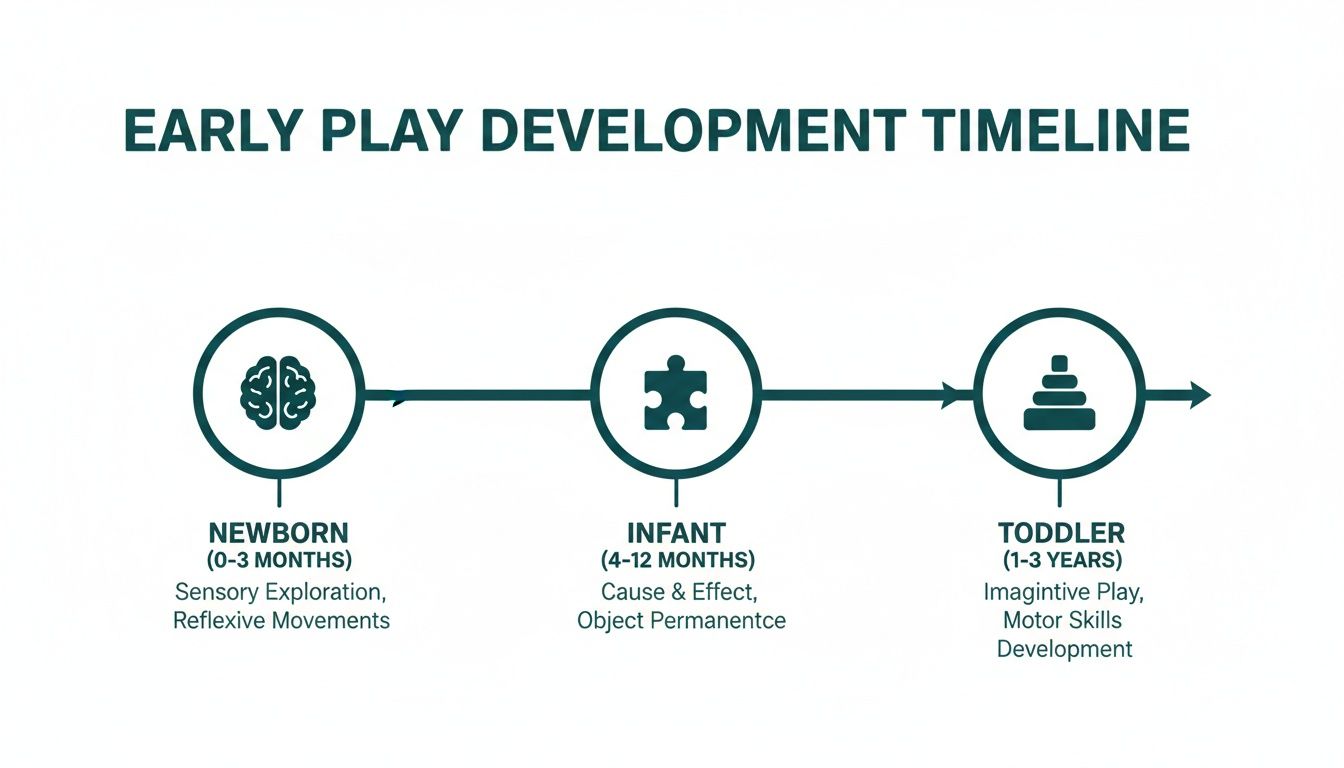
As you can see, the focus shifts naturally from basic sensory input to interactive play that builds those all-important cognitive and motor skills over time.
The First Three Months: Vision and Sensation
In the very beginning, a baby's world is a gentle, fuzzy blur of shapes and sounds. Their main job is simply to make sense of this brand-new environment through their developing senses. Their vision is still maturing, which is why they are so completely captivated by stark, high-contrast patterns.
At this point, their motor skills are purely reflexive. If you place something in their palm, they'll instinctively grasp it—a tiny but foundational skill for future coordination. The name of the game here is gentle sensory stimulation.
- High-Contrast Cards: Simple black-and-white images provide strong visual input that helps stimulate their optic nerve development.
- Soft Rattles: Lightweight rattles with gentle sounds encourage them to track with their eyes and introduce the first hint of cause and effect.
- Play Gyms: A simple playmat with dangling toys is fantastic for encouraging reaching and kicking, which builds core strength and coordination.
Four to Six Months: Grasping and Exploring
From four to six months old, babies become much more interactive little people. Their hand-eye coordination improves dramatically, allowing them to purposefully reach for and grab toys. And, as every parent knows, everything they get their hands on goes straight into their mouth! This is a completely normal—and vital—way they explore different textures and shapes.
This oral exploration isn't just about teething; it's a vital part of their sensory learning process. Providing safe, textured toys is essential for this discovery phase.
The best toys for this stage are all about tactile sensations and getting in some good fine motor practice.
- Textured Teethers: Toys made from different materials (think soft silicone, natural rubber, or smooth wood) offer varied sensory input for their mouth and hands.
- Crinkle Books: Soft fabric books with crinkly pages are a multi-sensory treat, providing both sound and touch stimulation that makes tummy time far more engaging.
- Activity Balls: Easy-to-grip balls encourage them to practise transferring objects from one hand to the other—a huge motor milestone.
To make it easier to see how toys align with each stage, here’s a quick-reference guide.
Toy Guide for Your Baby's First Year
| Age Range | Key Developmental Focus | Ideal Infant Learning Toys |
|---|---|---|
| 0-3 Months | Sensory development (vision, hearing), basic reflexes | High-contrast cards, soft rattles, mobiles, play gyms |
| 4-6 Months | Grasping, hand-eye coordination, oral exploration | Textured teethers, crinkle books, activity balls, wrist rattles |
| 7-9 Months | Sitting up, fine motor skills, object permanence, manipulation | Stacking rings, soft blocks, simple shape sorters, pop-up toys |
| 10-12 Months | Gross motor skills (crawling, standing), problem-solving | Push walkers, large building blocks, ride-on toys, chunky puzzles |
This table helps connect the dots between what your baby is learning to do and the tools that can best support them along the way.
Seven to Nine Months: Sitting and Manipulating
During this period, most babies master sitting up on their own, a game-changer that frees up their hands for more complex play. They're also starting to grasp the concept of object permanence—the idea that things still exist even when they can't see them. This is exactly why games like peek-a-boo suddenly become the most hilarious thing in the world.
Their fine motor skills are becoming more refined, too, allowing them to pick up smaller objects and manipulate toys with much greater intention. It’s a fascinating time for discovery.
Ten to Twelve Months: Moving and Problem-Solving
As they rocket towards their first birthday, many babies are on the move, whether it's crawling, cruising along furniture, or taking those wobbly first steps. Their play becomes more purposeful and they start to imitate the world around them. They are budding problem-solvers, fascinated by fitting things together and, of course, taking them apart again.
To support this exciting stage, look for toys that encourage movement, logic, and the very beginnings of imaginative play. If you're keen to know more about what's coming next, you can explore our guide on what developmental milestones to expect during this busy period.
- Stacking Rings or Cups: These classics are perfect for developing hand-eye coordination and an early understanding of size and sequence.
- Simple Shape Sorters: Figuring out how to put blocks into the correct holes is a fantastic workout for their problem-solving skills and fine motor precision.
- Push Walkers: A sturdy walker provides just the right support for babies finding their feet and encourages gross motor development.
Choosing the Right Toys: A Safety and Quality Checklist for Parents
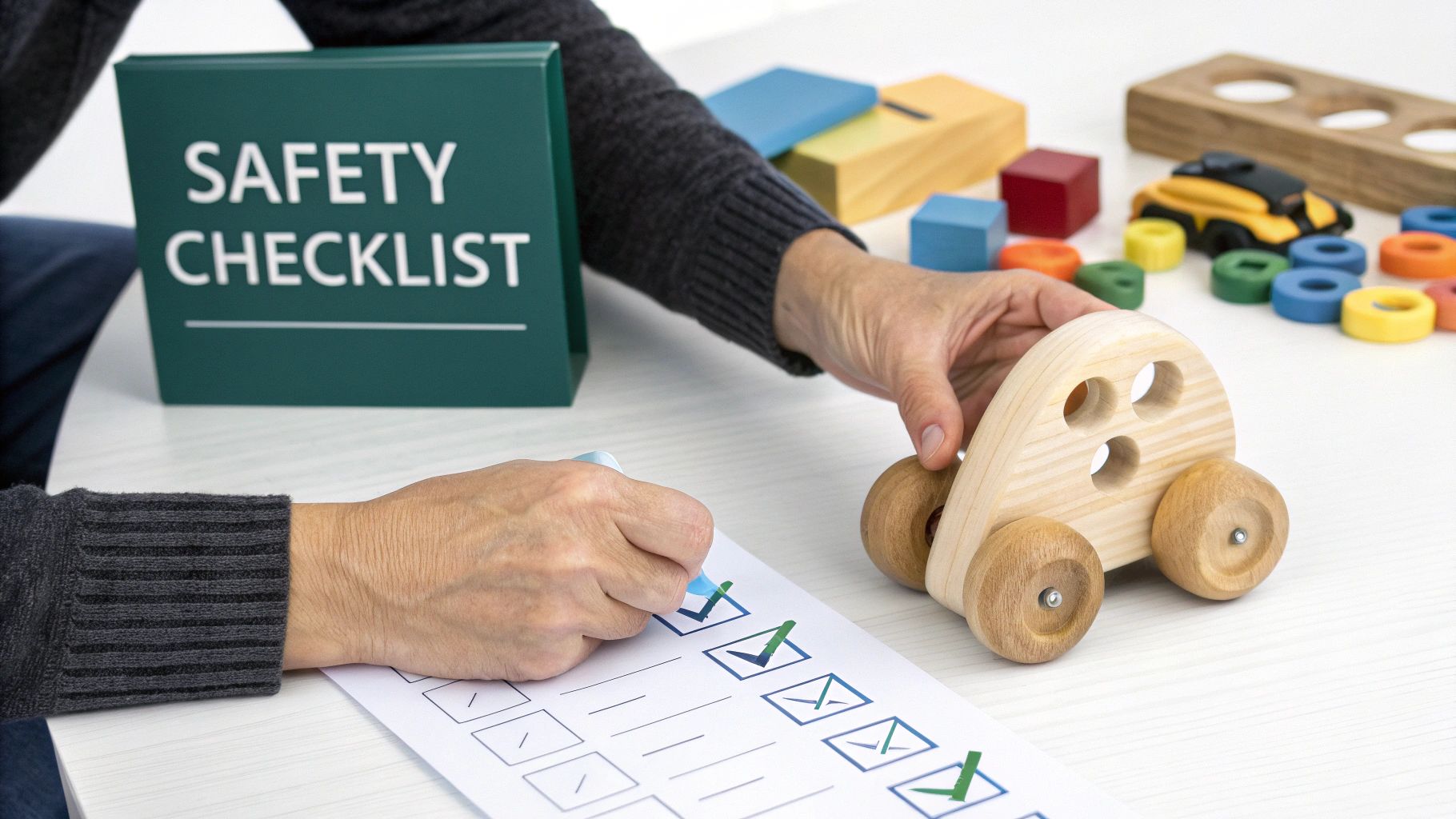
Walking into a toy shop can feel a bit daunting, can't it? With endless options, it’s easy to get overwhelmed. But when it comes to choosing toys for your baby, zeroing in on safety and quality first makes everything else fall into place. After all, babies explore the world with their hands and, most definitely, their mouths, so knowing every toy is completely safe is the number one priority.
A few quick checks can give you all the confidence you need. It’s a bit like checking the ingredients on a food label—you want to know exactly what’s coming into your home and into your baby's hands. This careful approach is more important than ever, as parents across the UK are focusing more on early learning. In fact, the educational toy market is set to grow from USD 16.8 billion in 2025 to a massive USD 27.5 billion by 2031, driven by the demand for toys that safely build those foundational skills. You can read more about the growing UK baby toys market and see just how big this trend is.
Materials and Construction Matter Most
When you're holding a potential new toy, the first thing to consider is what it’s made of. Since your baby is guaranteed to chew on it, lick it, and clutch it for hours, non-toxic materials are an absolute must.
Look for these key signs of a quality toy:
- Safe Finishes: Any paints or varnishes should be certified non-toxic, water-based, and completely lead-free.
- BPA-Free Plastics: If you’re looking at plastic toys, make sure they are clearly labelled as free from BPA, phthalates, and other nasties.
- Natural Materials: You can’t go wrong with solid wood from sustainable sources. It’s incredibly durable, naturally antibacterial, and free from the chemicals you often find in plastic alternatives.
Just as important as the materials is how the toy is put together. Simply put, a well-made toy is a safe toy.
Here’s a handy trick: If any piece of a toy can fit inside a toilet paper tube, it’s too small for a baby and presents a choking hazard.
Give the toy a good once-over. Check the joints and seams to make sure they're sturdy. Run your hand over the surface to feel for any sharp edges or splinters. All the parts should be firmly attached, and you should watch out for loose strings or ribbons longer than 15 cm, as they can be a risk. If you need more ideas on what works for the earliest stage, have a look at our guide to newborn developmental toys.
Understanding Safety Labels in the UK
When you're shopping in the UK, safety labels are your best friend. They’re a shortcut to knowing a toy has passed strict official checks.
Here’s what to keep an eye out for:
- The CE Mark: This is a familiar symbol showing the toy meets the high safety, health, and environmental standards of the EU, which the UK continues to recognise.
- The UKCA Mark: This is the UK’s own version of the CE mark and you'll be seeing it more and more.
- Age Guidance: Always, always check the age recommendation on the packaging. It’s not just a suggestion—it’s there for safety reasons based on how children at different stages play.
By keeping this simple checklist in mind, you can feel great about choosing infant learning toys that are not only fun and brilliant for your baby’s development but are also completely safe for hours of happy, worry-free play.
Beyond the Toy Box: How to Engage Your Infant in Purposeful Play
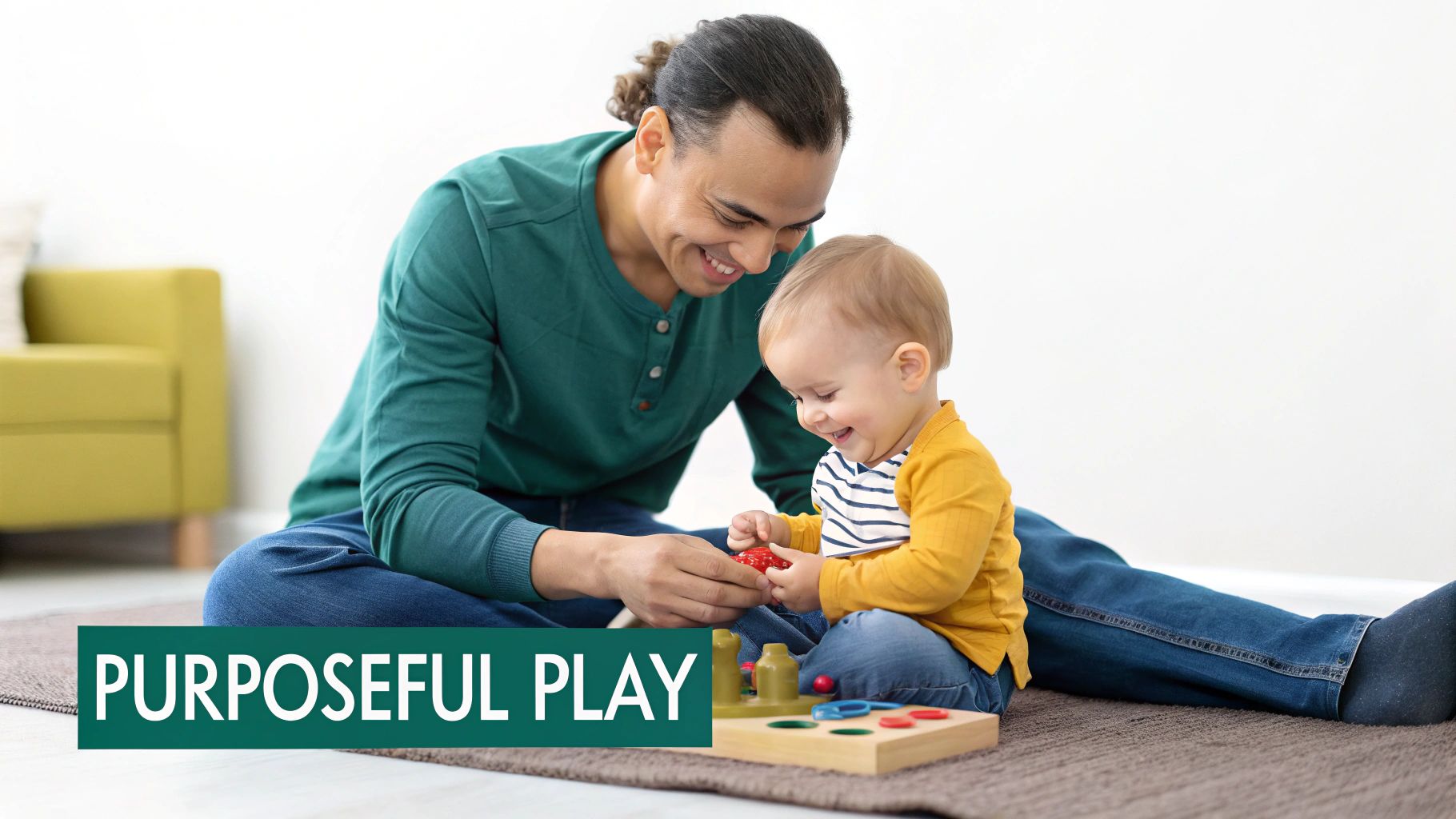
Even the most brilliant infant learning toys are only half the story. The real magic happens when you—their favourite person in the whole world—get down on the floor and join in. A toy is a fantastic tool, but it's your interaction that turns simple playtime into a rich experience that strengthens your bond and kick-starts their development.
Think of yourself as the friendly guide to your baby's world. Your involvement provides the context and connection that makes learning click. It’s how they learn that their little discoveries matter.
Turning Playtime into Connection Time
Here's a secret: you are your baby's best toy. Your face, your voice, and your touch are the most fascinating things they know. Weaving yourself into playtime doesn't have to be complicated; it’s really just about being present and responsive.
A few simple actions can make a world of difference.
- Be the Narrator: As they play with a shape sorter, talk them through it. "Ooh, a round, red circle! Let's see if it fits in the round hole… Plop! In it goes!" This helps build their vocabulary and their understanding of concepts like colours and shapes.
- Show, Don't Just Tell: Demonstrate how a toy works first. Stack a couple of rings on the post, then gently guide their little hand to try it too. This kind of modelling shows them the goal without any pressure.
- Get Expressive: Go big with your reactions! A surprised "Oh!" when the block tower tumbles or a happy "Yay!" when they get it right makes everything more exciting and teaches them about emotions.
These moments build crucial social and emotional skills right alongside the cognitive ones. They’re learning to read facial expressions, understand your tone of voice, and feel the pure joy of succeeding together.
Simple Activities for Maximum Impact
You don't need a detailed lesson plan to make playtime meaningful. Everyday moments are packed with opportunities to connect and learn together with the toys you already have.
Take a simple set of stacking cups, for example. You can:
- Build a tower just for them to knock down, teaching a fun lesson in cause and effect.
- Hide a small toy under one of the cups and play peek-a-boo, which helps reinforce object permanence.
- Talk about sizes by pointing out the "big cup" and the "little cup," introducing very early maths concepts.
The most powerful learning moments often spring from these simple, guided interactions. Your presence and enthusiasm are what ignite your baby's curiosity and turn a simple object into a world of discovery.
Beyond the toy box, you can also explore a whole world of other engaging content, like dedicated children's learning resources, to keep enriching their development.
At the end of the day, it's this relationship-first approach that makes playtime so powerful. The best infant learning toys are simply the ones that bring you and your baby closer.
Simplifying Development With a Toy Subscription Service
Keeping up with your baby's development can feel like a full-time job. One minute you've figured out the perfect toys for your three-month-old, and the next, they're sitting up, grabbing for everything, and suddenly bored with their old favourites. For busy families, this constant cycle of researching and shopping for the next right thing is just plain exhausting.
But what if you could take all that guesswork off your plate? This is exactly where a curated toy subscription service like Grow With Me comes in. Think of it as having a child development expert on your team, delivering precisely what your baby needs for their next leap, right when they need it.
The whole idea is built around making life easier, especially for modern parents who are already juggling so much. With 2-3 day delivery across the UK, there are no more long waits or last-minute panics to find an age-appropriate toy.
The Right Toys at the Right Time
The real magic of a subscription box is that the toys always arrive perfectly in sync with your baby's developmental stage. You don't have to remember when to introduce a stacking toy or a simple puzzle because the service does all that thinking for you. Each kit is expertly planned to support the skills that are just starting to emerge, whether it's strengthening their fine motor grip or encouraging their first attempts at problem-solving.
This stage-based approach has some brilliant benefits:
- It prevents overwhelm. Your baby gets a small, focused set of toys they can actually manage, which avoids the overstimulation that comes from a mountain of plastic.
- It keeps things interesting. A fresh delivery of exciting new things keeps your little one curious and genuinely engaged in their play.
- It cuts down on clutter. You stop accumulating toys your baby has already outgrown, which helps keep your play area tidy and effective.
You can see this demand for targeted play reflected in the market. Here in the UK, parents are clearly looking for more from their children's toys, with monthly searches for 'electronic learning toys' hitting 22,200. Globally, the baby toy market is set to reach an incredible USD 27.5 billion by 2031, a shift driven by parents who want high-quality, educational play for their kids.
More Than Just Toys—It's a Guided Experience
A truly great subscription service does more than just post a few items in a box. It should also empower you as a parent by explaining the why behind each toy. With Grow With Me, for example, every item comes with a handy description card. It breaks down which developmental skills the toy targets and gives you simple, practical ideas for how to play together.
This guidance turns a simple toy into a powerful tool for connection. It gives you the confidence to lead meaningful playtime, knowing that you're actively boosting your baby’s cognitive, motor, and sensory growth.
There’s also a huge focus on quality and safety, which is something every parent worries about. Grow With Me prioritises natural materials, ensuring that over 80% of the toys in their kits are made from sustainable and non-toxic materials like wood. This commitment offers real peace of mind, as you know every item is completely safe for curious little hands and mouths. You can learn more about how this all comes together by exploring the benefits of a UK baby subscription box.
By combining expert curation with parent-friendly guidance and high-quality materials, a subscription service takes the stress out of providing enriching play. It frees you up to spend less time researching and more time just enjoying those precious, playful moments with your baby.
Got Questions About Infant Learning Toys? We've Got Answers
Stepping into the world of infant learning toys can feel a bit overwhelming. With so many options and so much advice floating around, it’s easy to feel lost. We get it. That’s why we’ve gathered some of the most common questions parents ask, with clear, simple answers to help you feel confident.
Think of each question as a little guidepost on your baby’s incredible developmental journey. Let's clear things up.
How Many Toys Does My Baby Actually Need?
It’s so tempting to fill a nursery with every toy imaginable, but honestly, less is more. The key is quality over quantity. A small, thoughtfully chosen collection of 5-8 versatile toys that match your baby's current stage is far more valuable than a room overflowing with plastic.
A great little trick is to rotate toys every week or so. Tucking a few away and reintroducing them later makes them feel brand new again. This approach keeps things interesting for your baby, prevents them from feeling overwhelmed, and encourages them to explore each toy more deeply.
A stage-based subscription like Grow With Me takes care of this for you. By delivering new, relevant toys exactly when they're needed, it helps you avoid the clutter and the endless research, ensuring your baby is always perfectly challenged.
Are Fancy Electronic Toys Better for Development?
Not always. While the flashing lights and catchy tunes of some electronic toys can grab a baby’s attention, the most powerful infant learning toys are often the simplest ones. We're talking about classic wooden blocks, colourful stacking rings, or a set of sensory balls with different textures.
Why? Because these toys invite your baby to be the one in charge. They encourage imagination, trial-and-error, and the development of those crucial fine motor skills. Real learning happens when your baby is the one making the noise, stacking the block, or figuring something out for themselves, not just passively watching a toy do its thing.
When Should I Start Giving Learning Toys to My Newborn?
You can start right from day one! For a newborn (0-3 months), the whole world is a new and fascinating classroom, and learning is all about sensory discovery. They’re busy taking in all the new sights, sounds, and feelings around them.
Their first 'learning toys' can be beautifully simple. High-contrast black-and-white cards are brilliant for their developing eyesight. A soft rattle that makes a gentle sound is perfect for their hearing, and letting them feel different textures like silk or corduroy helps build their sense of touch. These simple experiences lay the vital groundwork for all the play that’s yet to come.
How Can I Tell if a Toy Is Genuinely Educational?
A truly educational toy for a baby is one that gets them doing something and helps them build a new skill. It’s not about letters or numbers at this stage. Instead, look for toys that encourage:
- Cause and effect: "If I shake this, it makes a sound!" A rattle is a classic example.
- Motor skills: Can they grasp it? Can they try to fit one shape into another?
- Sensory exploration: Does it have interesting textures, a pleasing weight, or make different sounds?
The guidance cards that come with our Grow With Me kits are designed to show you the 'why' behind each toy. They explain exactly which skills your baby is working on, turning every moment of play into a meaningful learning experience.
Ready to take the guesswork out of playtime? Discover expertly curated, stage-based play kits from Grow With Me and give your baby the perfect tools for every developmental leap. Explore the subscription boxes today at https://shop.growwithmesubscriptionbox.co.uk.