

8 Engaging Activities for 18 Month Olds to Try in 2025
Welcome to the whirlwind world of the 18-month-old! This is a magical age where curiosity is boundless, and every day brings new discoveries. Your toddler is no longer a baby but a budding explorer, eager to touch, taste, and test everything in their path. Finding engaging, safe, and developmentally appropriate activities for 18 month olds can feel like a full-time job, but it's one of the most rewarding parts of parenthood.
The right kind of play doesn't just pass the time; it builds critical neural connections, refines motor skills, and lays the foundation for language and social understanding. This guide is designed to move beyond the obvious and provide you with a curated list of eight meaningful activities that support this incredible period of growth. Each one is packed with practical tips, insights into developmental benefits, and creative twists to keep things fresh for both of you.
From sensory bins to outdoor discovery, we'll explore how simple, everyday interactions can be transformed into powerful learning opportunities. You will learn specific, actionable ways to set up engaging play that nurtures your toddler's rapidly expanding mind and body, helping you make the most of this fleeting stage.
1. Sensory Bins and Exploration Play
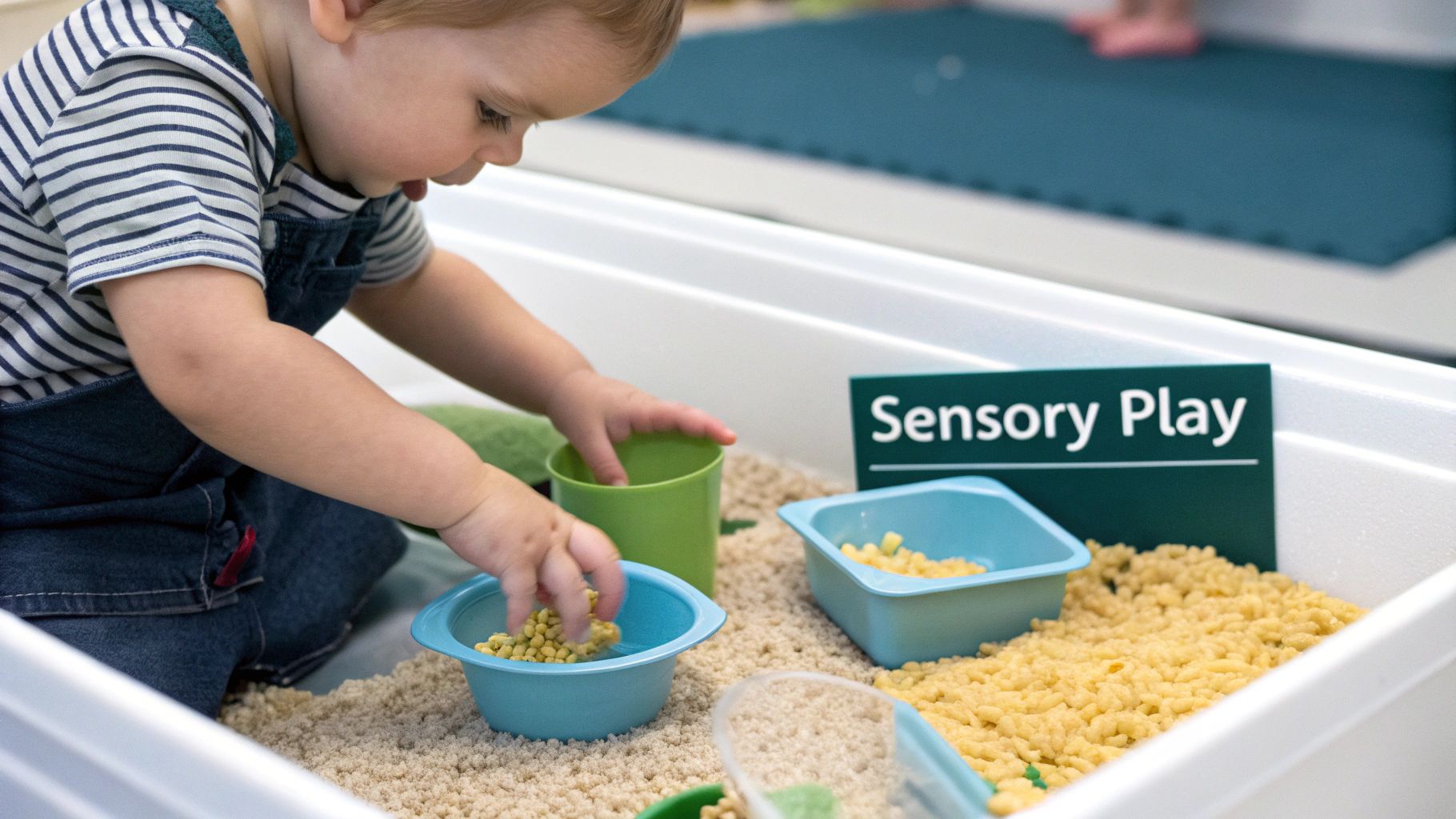
One of the most engaging and developmentally rich activities for 18 month olds is sensory bin play. A sensory bin is simply a container, like a plastic tub or tray, filled with tactile materials that encourage your toddler to explore using their senses. The open-ended nature of this play allows them to scoop, pour, and discover at their own pace, fostering curiosity and independent play without the pressure of a specific outcome.
This type of hands-on exploration is a cornerstone of early learning, popularised by educators like Maria Montessori. It helps your child make sense of the world around them by engaging with different textures, temperatures, and weights in a controlled environment.
Why It's a Great Activity
Sensory play directly supports several key areas of your toddler's development. As they manipulate small objects, scoop materials, and pour them from one container to another, they are building crucial fine motor skills and hand-eye coordination. This activity also helps them develop sensory processing abilities, which is how their brain interprets and organises sensory information. It can be a wonderfully calming and focusing activity for a busy toddler.
How to Create a Sensory Bin
Getting started is simple and doesn't require expensive toys. The goal is to provide a rich sensory experience with everyday items.
- Rice Bin: Fill a shallow container with uncooked rice. Add measuring cups, small bowls, and funnels for scooping and pouring.
- Water Play: On a warm day, a simple tub of water with floating toys, sponges, and cups can provide hours of entertainment.
- Pasta Bin: Use various shapes of dried pasta. You can even dye it with food colouring for a vibrant visual experience.
- Kinetic Sand: This mess-free sand provides a unique tactile experience. Add small moulds or toy construction vehicles for imaginative play.
Pro-Tip: Always supervise sensory bin play closely, especially with an 18-month-old who may still be exploring objects with their mouth. Choose taste-safe materials like oats or cornflour if your child is prone to this. Place the bin on a large towel or mat to make clean-up easier. For a mess-free alternative, you can also explore how to make your own sensory bottles.
2. Music and Movement Play
Combining sound, rhythm, and physical action, music and movement play is a dynamic and joyful activity for 18-month-olds. It involves responding to music through dancing, singing, and playing simple instruments, allowing toddlers to express themselves freely. This form of play taps into a child's natural inclination to move and make noise, turning learning into a fun, energetic experience.
This approach has been championed by early childhood music programmes like Kindermusik and Gymboree, which recognise the deep connection between rhythm and early brain development. It provides an outlet for big emotions and physical energy while building foundational skills in a playful, low-pressure environment.

Why It's a Great Activity
Music and movement is fantastic for developing gross motor skills as your toddler learns to jump, clap, and spin to the beat. This full-body engagement improves their coordination, balance, and spatial awareness. It also strongly supports language development, as singing nursery rhymes and repetitive songs helps them learn new words, rhythms, and sentence structures. Auditory processing and emotional expression are other key benefits.
How to Introduce Music and Movement
Getting your toddler moving and grooving is easy and can be done anywhere. The goal is to create a fun atmosphere that encourages participation.
- Action Songs: Sing familiar nursery rhymes with actions, like "The Wheels on the Bus" or "Head, Shoulders, Knees, and Toes".
- Instrument Play: Provide simple, age-appropriate instruments like toy drums, maracas, or tambourines and let them explore making different sounds.
- Freestyle Dance: Put on some upbeat children's music and simply dance together. Let your toddler lead the way with their own moves.
- Rhythm Games: Clap along to a simple beat and encourage your child to copy you. Vary the tempo from slow to fast.
Pro-Tip: Keep music and movement sessions short and sweet, around 5-15 minutes, to match your toddler's attention span. Use music to make routine tasks more fun, such as playing a "clean-up" song. Remember to demonstrate the actions yourself, as toddlers learn best through imitation. Combining music with other engaging sensory play ideas for toddlers can create an even richer developmental experience.
3. Water Play and Bath Time Activities
Water play is a wonderfully versatile and calming activity for 18 month olds, offering rich sensory experiences both in and out of the bath. It involves supervised play with water, where toddlers can pour, splash, scoop, and explore its unique properties. This type of play is foundational in early childhood development and aligns with heuristic play philosophies, which encourage discovery with real-world objects and substances.
This simple yet powerful activity taps into a toddler’s natural curiosity about their environment. By interacting with water, they begin to grasp fundamental scientific concepts like cause and effect (splashing makes things wet) and volume (a small cup holds less than a big one) in a fun, hands-on way.
Why It's a Great Activity
Water play is excellent for developing fine motor skills and hand-eye coordination as your child learns to control their movements to pour water from one container to another without spilling. It also provides significant sensory input, which can be both stimulating and incredibly soothing for a busy toddler. This activity encourages problem-solving and focus as they experiment with what floats and what sinks.
How to Set Up Water Play
Incorporating water play is easy and can be adapted for any space, indoors or out. The key is to provide simple tools for exploration.
- Bath Time Fun: Turn bath time into a learning zone with funnels, scoops, stacking cups, and floating animal toys.
- Outdoor Water Table: A dedicated water table from brands like Little Tikes or a simple washing-up bowl in the garden can provide hours of fun. Add cups, jugs, and sponges.
- Sponge Squeezing: Offer different-sized sponges and two bowls, one with water and one empty. Show your toddler how to soak up the water and squeeze it into the other bowl.
- Ice Exploration: On a warm day, add a few large ice cubes to a shallow tray of water. Your toddler will love watching them melt and trying to catch the slippery blocks.
Pro-Tip: Constant, close supervision is non-negotiable during any water play, no matter how shallow the water is. Always use a comfortable water temperature and start with just a small amount of water. Introduce a variety of cups and containers to keep the activity engaging and encourage them to explore different pouring techniques.
4. Climbing and Physical Challenge Play
Around 18 months, toddlers often become relentless climbers, eager to test their physical limits and explore their environment from new heights. Creating safe opportunities for climbing and physical challenges is a fantastic way to channel this energy constructively. This involves setting up age-appropriate obstacles using cushions, low play structures, or even just sofa pillows to encourage gross motor development in a supervised space.
This approach to play, championed by early childhood educators like Emmi Pikler, respects the child's innate drive to move and master their own body. It allows your toddler to assess risks, solve physical problems, and build confidence through movement, turning your living room into a safe and exciting adventure zone.
Why It's a Great Activity
Climbing is one of the best activities for 18 month olds because it builds foundational physical skills. As your toddler navigates an obstacle course or pulls themselves up onto a soft block, they are developing crucial gross motor skills, including strength, balance, and coordination. This type of play also enhances spatial awareness and body control, helping them understand where their body is in relation to the objects around them. Successfully navigating a small climb is a huge confidence booster, fostering a sense of independence and accomplishment.
How to Create Physical Challenges
You can easily create engaging climbing setups at home with items you already have, or with simple play equipment. The key is to start low and slow.
- Pillow and Cushion Mountain: Pile sturdy sofa cushions and pillows on the floor to create a soft, low "mountain" for your toddler to crawl and climb over.
- Indoor Soft Play: Invest in a few foam climbing blocks or a small wedge ramp. These can be reconfigured in endless ways to keep the challenge fresh.
- Playground Fun: Visit a local park with a toddler-specific playground. Look for low slides, small steps, and gentle ramps designed for little explorers.
- DIY Obstacle Course: Arrange cushions to step on, a tunnel to crawl through, and a low stool to climb onto and off of.
Pro-Tip: Always supervise climbing activities closely and ensure the landing area is soft with mats or rugs. Check that any equipment is stable before play begins. Let your child lead the way and celebrate their attempts, not just their successes, to build a positive relationship with physical activity and risk-taking.
5. Stacking, Sorting, and Object Manipulation Play
A classic yet profoundly effective set of activities for 18 month olds involves stacking, sorting, and manipulating objects. These hands-on tasks engage your toddler’s natural curiosity about how things fit together, come apart, and can be organised. From building a wobbly tower of blocks to figuring out which lid fits which pot, these simple challenges are fundamental brain-building exercises.
This type of focused play is central to early learning philosophies like Montessori, which emphasises practical life skills and sensorial exploration. It allows children to experiment with cause and effect, develop persistence, and understand basic concepts like size, colour, and shape in a tangible, satisfying way.
Why It's a Great Activity
Stacking and sorting activities are powerhouse builders of essential developmental skills. When your toddler carefully places one block on another, they are refining their fine motor skills and hand-eye coordination. For fine motor skill development and cognitive growth, incorporating activities with shape toys like sorters and puzzles can be incredibly beneficial for 18-month-olds.
These activities also lay the groundwork for cognitive abilities like problem-solving and early mathematical thinking. Sorting objects by colour or shape introduces the concept of classification, while nesting cups helps them understand spatial relationships and size discrimination.
How to Get Started with Stacking and Sorting
You can easily facilitate this play with both toys and common household items. The key is to provide a variety of objects that can be stacked, nested, sorted, or fitted together.
- Block Towers: Use large, chunky wooden or plastic blocks (like Duplo) to build towers. Show your toddler how to place them on top of each other and celebrate when they tumble down.
- Nesting Cups: A set of nesting cups or bowls is perfect for teaching size and spatial awareness. They can be stacked into a tower or nested inside one another.
- Colour Sorting: Gather a few colourful items (like large pom-poms or blocks) and provide coloured bowls. Encourage your toddler to place the red items in the red bowl, blue in the blue, and so on.
- Container Matching: Pull out various Tupperware containers and their lids. Let your toddler try to find which lid fits on which container for a simple and practical puzzle.
Pro-Tip: Start with larger items like stacking rings or big blocks to build confidence and reduce frustration. Model the activity first, then let your toddler explore freely. Remember to praise their effort and the process of discovery, not just the successful outcome. Rotating the toys and materials will keep these activities engaging. For more ideas, you can learn about fine motor skills development activities.
6. Pretend Play and Role-Playing Activities
Around 18 months, your toddler's imagination begins to blossom, making it the perfect time to introduce pretend play. This involves activities where your child uses objects and actions to represent real-life situations, from mimicking your daily routines to caring for a favourite toy. This simple form of role-playing is a huge cognitive leap, showing their growing understanding of the world.
This type of imaginative engagement is a key component of developmental theories from experts like Jean Piaget, who recognised it as a critical stage in a child's cognitive growth. It allows toddlers to process their experiences, practice social roles, and develop creativity in a safe and playful context.
Why It's a Great Activity
Pretend play is a powerhouse for development. When your toddler mimics talking on a phone or feeding a doll, they are practising crucial social and emotional skills, like empathy and communication. Narrating their actions and creating simple scenarios also provides a massive boost to their language development and vocabulary.
Furthermore, these imaginative activities for 18 month olds help build problem-solving skills and cognitive flexibility as they decide how to use props and what should happen next in their make-believe world.
How to Encourage Pretend Play
Getting started is as simple as providing a few familiar props and modelling the behaviour. The goal is to spark their imagination with relatable scenarios.
- Toy Kitchen: Provide a toy kitchen with plastic food and utensils. Pretend to cook a meal together, stir a pot, and serve food on a plate.
- Baby Doll Care: Offer a doll, a small blanket, and a bottle. Show your toddler how to gently rock the baby, tuck it in, or pretend to feed it.
- Pretend Phone Calls: Hand your toddler a toy phone (or a clean, old remote) and have a simple "conversation" with them, saying "hello" and "goodbye".
- Cleaning Fun: Toddlers love to imitate household chores. A child-sized broom, duster, or toy vacuum can inspire lots of role-playing fun.
Pro-Tip: You don't need elaborate toys; everyday items work wonderfully. A cardboard box can become a car, and a few bowls can be a drum kit. Join in their play but let them lead the narrative. Gently narrate what they are doing ("You are feeding the teddy bear!") to reinforce their actions and introduce new words.
7. Book Reading and Storytelling Activities
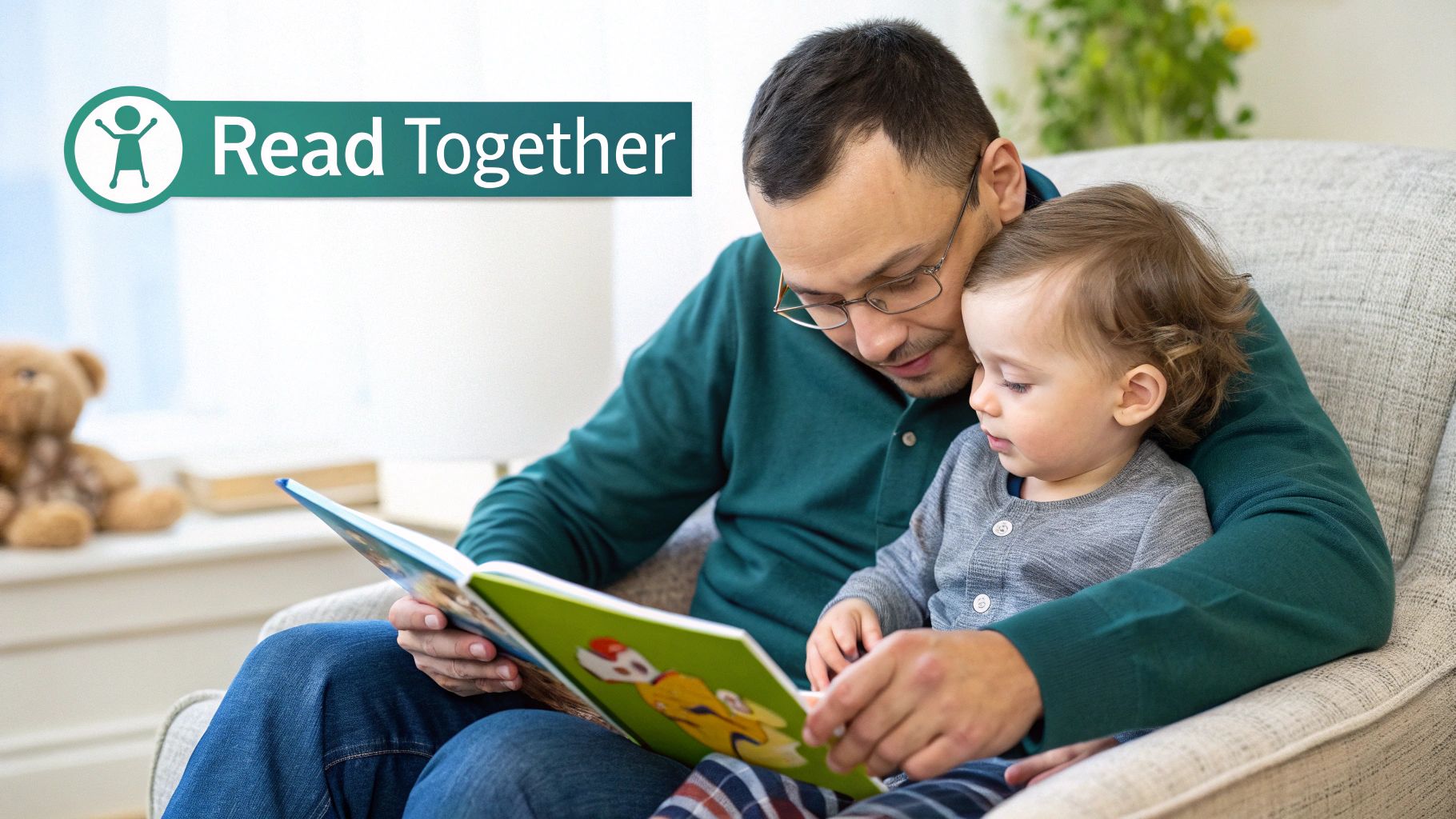
Sharing books and stories with your 18 month old is one of the most powerful and bonding activities you can do. At this age, reading isn't about following a plot but about the shared experience of looking at pictures, hearing your voice, and physically interacting with a book. This daily ritual builds a strong foundation for future literacy and creates a positive association with learning that can last a lifetime.
The concept of reading to very young children has been championed by reading specialists and organisations like Scholastic for decades. It taps into a toddler's natural curiosity and rapidly expanding vocabulary, turning a simple activity into a significant developmental opportunity.
Why It's a Great Activity
Reading aloud is a cornerstone of early language development. It introduces your toddler to new words, sentence structures, and the rhythm of language. Pointing to and naming pictures helps build their vocabulary and object recognition skills. Cuddling up with a book also strengthens your emotional bond and can become a calming part of your daily routine, especially before naps or bedtime.
How to Make Story Time Engaging
The key is to make reading an interactive and fun experience, not a passive one. Choose books that invite participation and can withstand a toddler's enthusiastic handling.
- Touch-and-Feel Books: Books with different textures (like the "That's not my..." series) provide a wonderful sensory experience.
- Lift-the-Flap Books: The element of surprise in books like Dear Zoo captivates toddlers and teaches them about object permanence.
- Repetitive Stories: Books with predictable rhymes and phrases, like those by Julia Donaldson or Sandra Boynton, encourage your child to join in.
- Picture Books: Choose sturdy board books with large, simple illustrations of familiar things like animals, vehicles, or daily routines.
Pro-Tip: Don't worry about reading the book from start to finish. Let your toddler lead. If they want to turn the pages back and forth or just point at one picture, follow their interest. Use animated voices and sound effects to bring the story to life, and don't be afraid to read the same favourite book over and over again; repetition is how they learn.
8. Nature Exploration and Outdoor Discovery Play
Engaging your toddler with the great outdoors is one of the most enriching activities for 18 month olds. Nature exploration is simply supervised time outside where your little one can touch, see, smell, and investigate the natural world, from the texture of a leaf to the feeling of cool grass on their feet. It’s an unstructured, child-led activity that stimulates all their senses and sparks a natural curiosity about their environment.
This approach, popularised by the forest school movement and authors like Richard Louv, connects children to the world around them from a young age. It encourages them to appreciate natural phenomena and provides a calming, grounding alternative to indoor play.
Why It's a Great Activity
Outdoor discovery play is fantastic for gross motor skill development. As your toddler navigates uneven ground, climbs small mounds, and balances on different surfaces, they are building strength, coordination, and body awareness. This sensory-rich experience also supports cognitive growth by encouraging observation, questioning, and problem-solving in a real-world setting. Fresh air and natural light are also known to improve mood and sleep.
How to Explore Nature with Your Toddler
You don’t need to plan a grand expedition; nature can be found in your back garden, a local park, or even on a walk around the block.
- Barefoot Exploration: Let your child feel different natural textures like grass, sand, or smooth stones with their bare feet (in a safe, clean area).
- Puddle Splashing: After a rain shower, put on some wellies and let them experience the simple joy of splashing in puddles.
- Nature Collection: Bring a small bucket or bag and help your toddler collect interesting items like fallen leaves, smooth pebbles, or twigs.
- Insect Watching: Lie on the grass together and watch ants march by or look for ladybirds on leaves. Narrate what you see to build their vocabulary.
Pro-Tip: Always prioritise safety. Dress your toddler appropriately for the weather with sunscreen and a hat on sunny days. Supervise them closely, especially near water or unfamiliar plants. Allow your child to lead the way and explore what interests them, even if it’s just one fascinating stick for ten minutes. This freedom is key to fostering a genuine love for the outdoors.
8-Activity Comparison for 18-Month-Olds
| Activity | 🔄 Implementation Complexity | ⚡ Resource Requirements | 📊 Expected Outcomes | 💡 Ideal Use Cases & Quick Tip | ⭐ Key Advantages |
|---|---|---|---|---|---|
| Sensory Bins and Exploration Play | Low — simple setup; needs prep & cleanup | Low — household materials (rice, sand, scoops) | Fine motor, sensory integration, hand‑eye coordination | Independent exploration; tip: supervise, use mat & food‑grade items | ⭐⭐⭐ High sensory engagement; inexpensive |
| Music and Movement Play | Low — easy to lead; best with modelling | Minimal — voice, simple instruments, space | Gross motor, rhythm, language, emotional expression | Transitions or group time; tip: keep sessions 5–15 min | ⭐⭐⭐ Boosts motor+language; strong bonding |
| Water Play and Bath Time Activities | Low–Moderate — simple but safety‑critical | Low — water, bath/water table, pouring tools | Cause‑and‑effect, fine motor, calming sensory input | Bath or outdoor table; tip: shallow warm water & constant supervision | ⭐⭐⭐ Teaches basic science; naturally engaging |
| Climbing and Physical Challenge Play | Moderate–High — needs setup & safety checks | Moderate — soft mats, low structures, space | Gross motor strength, balance, spatial awareness | Active play sessions; tip: start low, use soft landings & spot child | ⭐⭐⭐ Excellent for strength, confidence, risk assessment |
| Stacking, Sorting, and Object Manipulation Play | Low — simple materials, scalable difficulty | Low — blocks, rings, containers; portable | Fine motor precision, problem‑solving, early math concepts | Table/floor play; tip: start with large pieces and rotate sets | ⭐⭐–⭐⭐⭐ Strong fine‑motor & cognitive gains; self‑correcting |
| Pretend Play and Role‑Playing Activities | Low–Moderate — requires adult scaffolding | Low — props or household items | Language growth, social‑emotional understanding, creativity | Quiet play sessions; tip: model actions and narrate | ⭐⭐⭐ Fosters language, empathy, imagination |
| Book Reading and Storytelling Activities | Low — routine‑based; needs consistency | Low — board/interactive books or library access | Vocabulary, attention, early literacy, listening skills | Calm routines (nap/bedtime); tip: 5–10 min, point & repeat | ⭐⭐⭐ Foundational literacy; bonding & routine |
| Nature Exploration and Outdoor Discovery Play | Low–Moderate — planning for safety & weather | Low — outdoor access, basic collection tools | Gross motor, observation skills, sensory integration, mood | Parks/backyard outings; tip: supervise, dress for weather | ⭐⭐⭐ Broad physical & emotional benefits; free |
Embracing Playful Learning Every Day
Navigating the whirlwind world of an 18-month-old is a journey filled with monumental leaps in development, from first full sentences to newfound physical confidence. The diverse range of activities for 18 month olds we have explored, from the tactile joy of a sensory bin to the imaginative freedom of pretend play, are far more than simple pastimes. They are the essential tools your toddler uses to understand their world, build critical neural connections, and develop a lifelong love for learning.
By thoughtfully incorporating these different types of play into your daily and weekly routines, you are providing a rich, stimulating environment where your child can truly flourish. You are the architect of their earliest learning experiences, laying a robust foundation for future academic, social, and emotional success.
Key Takeaways for Nurturing Your Toddler's Growth
As you move forward, keep these core principles at the forefront of your mind. They are the threads that connect all successful and engaging activities for 18 month olds.
- Follow Their Lead: The most impactful play happens when it is child-led. Observe what captures your toddler’s interest, whether it's stacking blocks, splashing in puddles, or turning a cardboard box into a spaceship. Your role is to facilitate and expand upon their natural curiosity, not to dictate the play.
- Embrace Repetition: It may seem monotonous to you, but repeating an action, a game, or a story is how toddlers master new skills. This repetition strengthens brain pathways and builds their confidence. Celebrate their desire to do the same puzzle for the tenth time; it is a sign of deep learning in progress.
- Focus on Process, Not Product: The goal of these activities isn’t to create a perfect piece of art or build the tallest tower. The real value lies in the process: the squeezing of the play-doh, the trial-and-error of stacking, and the joy of discovery. Praise their effort and engagement rather than the final outcome.
Ultimately, the most profound benefit of engaging in these activities together is the bond you strengthen. Play is the primary language of your toddler. When you get down on the floor to build with them, sing a silly song, or read a story with animated voices, you are communicating love, security, and value in a way that words alone cannot.
These shared moments of joy and discovery become the cherished memories that form the bedrock of your relationship. You are not just filling time; you are building a person, nurturing a spirit, and creating a powerful, lasting connection. Cherish this wonderfully chaotic and beautiful stage.
Ready to take the guesswork out of developmental play? Discover Grow With Me, the subscription box designed by experts to deliver stage-appropriate, high-quality toys and activities directly to your door. Each kit is perfectly curated to support your 18-month-old's learning journey, making it easier than ever to provide enriching experiences. Explore the play kits at Grow With Me.