
The Best 6 Months Toys for Developmental Play
The best toys for a 6-month-old are the ones that tap into their brand-new abilities and boundless curiosity. We're talking about things like textured sensory balls, chunky board books they can actually hold, and graspable teething rings that invite them to reach out, touch, and explore the world with their hands and mouth.
Your Baby's World at Six Months
Welcome to the six-month mark! It’s a truly magical time. Your baby is quickly shifting from being a little observer into an active, hands-on explorer. Suddenly, the world isn't just something to look at; it's something to grab, shake, and even taste.
Understanding the incredible developmental leaps happening right now is the secret to choosing toys that aren't just fun, but genuinely help them grow. This whole stage is a journey of discovery, and simple playtime becomes the main way they learn.
Here's a quick look at the key milestones emerging around this age. Think of this as your cheat sheet for understanding what's going on in that busy little brain and body.
Key Developmental Milestones At 6 Months
| Developmental Area | What to Look For | How Toys Can Help |
|---|---|---|
| Gross Motor Skills | Rolling both ways (tummy to back, back to tummy). Pushing up on hands and knees. Sitting with support or even briefly on their own. | Toys that encourage reaching while sitting or during tummy time, like a wobbly stacking toy or a soft ball that rolls just out of reach. |
| Fine Motor Skills | Reaching for and grabbing objects. Passing things from one hand to the other. Bringing everything to their mouth for a closer "look". | Easy-to-hold wooden rattles, teething rings, and sensory toys with different textures give them something to practise their grip on. |
| Cognitive Growth | Starting to understand cause and effect (e.g., "If I shake this, it makes a noise!"). Looking for a toy they've dropped. | A rattle, a crinkly book, or a simple cause-and-effect toy shows them their actions can make something happen. |
| Sensory Development | Exploring different textures with their hands and mouth. Showing interest in bright colours and new sounds. | Soft blocks, board books with different finishes, and toys with gentle sounds stimulate their senses without being overwhelming. |
These milestones are why the right toys matter so much at this age. They’re not just distractions; they are the tools your baby uses to make sense of everything and practise all these exciting new skills.
A New Chapter of Play and Discovery
So what does all this development actually look like during playtime?
Your baby's brain is firing on all cylinders, and their body is working hard to keep up. This growth spurt is focused on a few key areas that completely change how they interact with their toys and their environment.
Gross Motor Skills
They’re getting so much stronger! You'll likely see them mastering the art of rolling from their tummy to their back, and they're probably starting to push up on their hands, getting ready to crawl. Many babies also begin sitting up with a bit of help, which gives them a completely new perspective on the world.
Fine Motor Skills
That clumsy batting from a few months ago is evolving into much more deliberate action. Now, they can reach for and grab a toy, study it for a moment, and then pass it from one hand to the other. And yes, everything they get their hands on will probably head straight for their mouth—that’s their number one tool for sensory exploration right now.
Cognitive Growth
You’ll start to see the first little sparks of real problem-solving. If they drop a toy, they might actually look down to find it, rather than just forgetting it ever existed. They're beginning to connect the dots between cause and effect: shaking this rattle makes a fun noise, and dropping this block makes a satisfying thump.
This new, interactive stage is precisely why the right toys are more than just playthings. They are the essential tools your baby uses to practise these new skills, build confidence, and make sense of the world around them.
Choosing the Right Toys for Your Six-Month-Old
Stepping into the toy aisle can feel overwhelming. It’s a riot of bright colours, flashing lights, and bold claims. With so many options, how can you be sure you’re choosing 6 months toys that will actually captivate your baby? The secret isn't about finding the flashiest gadget; it's about matching the toy to their current developmental stage. When you get that right, simple playtime becomes a powerhouse for growth.
At this age, the best choices are those that support the skills they’re working so hard on: grasping, exploring with their senses, and figuring out basic ideas like cause and effect. Think of toys as the tools your baby uses to build new connections in their brain. A simple textured ball is so much more than a ball; it’s a lesson in touch, an invitation to reach, and a chance to practise passing an object from one hand to the other.
This mind map gives you a great visual of how different developmental areas—motor skills, senses, and cognition—are all woven together at the six-month mark.
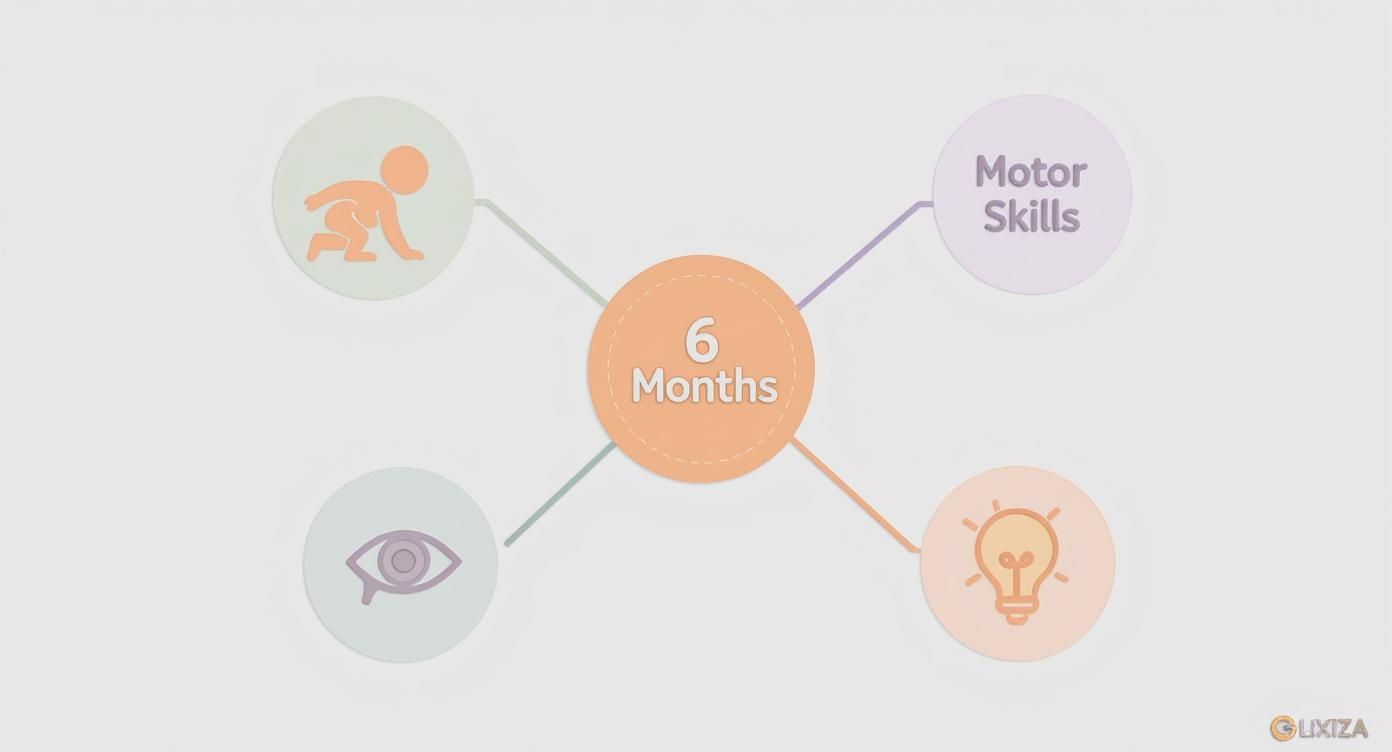
As you can see, each skill supports the others, creating a solid foundation for everything that’s still to come. Choosing the right toys is really about nurturing this entire developmental ecosystem.
Key Toy Categories for Six-Month-Olds
To cut through the noise, it helps to think in categories. We can group the most beneficial toys for this age into five essential types. Each one serves a distinct purpose, helping your little one practise their exciting new abilities in a fun, engaging way.
-
Sensory Toys: These are designed to light up your baby's senses. Look for items with interesting textures, gentle sounds like crinkles or soft rattles, and high-contrast colours that are easier for their developing vision to focus on. Soft sensory balls or fabric books with different materials are perfect examples.
-
Wooden Grasp Toys: Your baby is putting a lot of effort into those fine motor skills. Toys that are easy for tiny hands to hold, shake, and inevitably bring to their mouth are ideal. Think lightweight wooden rings, smooth rattles, or interlocking discs that encourage them to master their grip and hand-to-hand transfers.
-
Teething Toys: With sore gums often making an appearance around now, a good teether is a parent’s best friend. Opt for ones made from safe materials like BPA-free silicone or natural rubber. Different textures can provide extra relief, and shapes that are easy to hold allow your baby to self-soothe.
These categories reflect a real shift towards more purposeful play. It's no surprise that in the UK toy market, estimated to be worth £2.0 billion by 2025, the infant and preschool segment is the largest. This growth is driven by parents seeking out toys that are both educational and sustainable.
More Essential Toys for Development
Beyond those first three, two other types of toys play a vital role in building your baby’s understanding of the world.
The right toy at the right time is more than just entertainment; it's a conversation between your baby and their world. It invites curiosity and builds the foundation for a lifetime of learning through play.
Board Books are your baby's first step into the world of stories. The chunky, durable pages are perfect for little hands to try and turn, while the bright, simple images will capture their attention. Reading together is also a wonderful way to build language skills as they listen to the rhythm of your voice and start to link words with pictures.
Finally, there are Cause-and-Effect Toys. These introduce one of the most fundamental concepts a baby can learn: "When I do this, that happens!" It could be a rattle that makes a noise when shaken, or a simple activity cube with a button that triggers a sound. These toys teach babies that they have agency—that they can make an impact on their environment. That’s a massive confidence booster!
If you’d like to learn more about how different sensations fuel this learning journey, you might find our guide on sensory toys for babies really helpful.
A Parent's Guide to Toy Safety
Once your baby masters the art of bringing absolutely everything to their mouth, safety suddenly jumps to the top of your list. For a six-month-old, playtime is a very hands-on (and mouth-on!) affair, so making sure every toy is safe gives you the peace of mind to let them explore freely.
Your little one’s safety is everything. The good news is that navigating toy safety standards doesn't have to be a headache. Just knowing what to look for can help you create a secure and stimulating play space.
Choosing Non-Toxic Materials
A baby’s instinct is to explore the world with their mouth—it’s how they learn about textures, shapes, and objects. That’s why the materials their toys are made from matter so much.
Always look for toys clearly labelled as BPA-free and phthalate-free. These are chemicals you want to avoid, and any good toy manufacturer will make it a priority to exclude them. A great rule of thumb is to lean towards natural materials, like unfinished wood or food-grade silicone. They’re tough, easy to clean, and much safer for a baby who loves to chew.
Quick Physical Safety Checks
Beyond the materials, the physical build of 6 months toys is just as important. A few simple checks before you hand a new toy over can prevent common hazards and keep playtime worry-free.
Here’s a quick mental checklist to run through:
- Is it too small? The toy and any of its components should be bigger than the diameter of a toilet roll tube. It's a surprisingly effective test to check for choking hazards.
- Is it built to last? Give it a good tug and a squeeze. It should feel solid, with no wobbly parts, splintering wood, or peeling paint that could break off.
- Are there any risky attachments? Steer clear of toys with small, glued-on bits like beads or buttons. Everything should be securely fixed to withstand some serious gumming and dropping.
- Are the edges smooth? Run your hand over the entire toy. You're looking for any sharp points or rough patches that could scratch your baby’s delicate skin.
A well-made toy is designed to withstand the unique rigours of baby play—being chewed, dropped, and shaken. Durability isn't just about how long a toy will last; it's a core part of its safety.
Understanding UK Safety Marks
When you're shopping in the UK, keep an eye out for official safety marks. These are your confirmation that a toy has met strict standards.
The most important one to spot is the UKCA (UK Conformity Assessed) mark. This is the key indicator that a product is compliant with UK safety regulations. You might also still see the older CE mark on some products. Seeing one of these symbols is your assurance that the toy has been properly tested, from its design right down to its materials.
It's a simple check that lets you know you’re choosing a product you can trust. To learn more about how toys encourage safe and engaging play, check out our guide to interactive toys for babies. Making these quick checks a habit ensures every playtime is as safe as it is fun.
How to Play and Boost Your Baby's Development
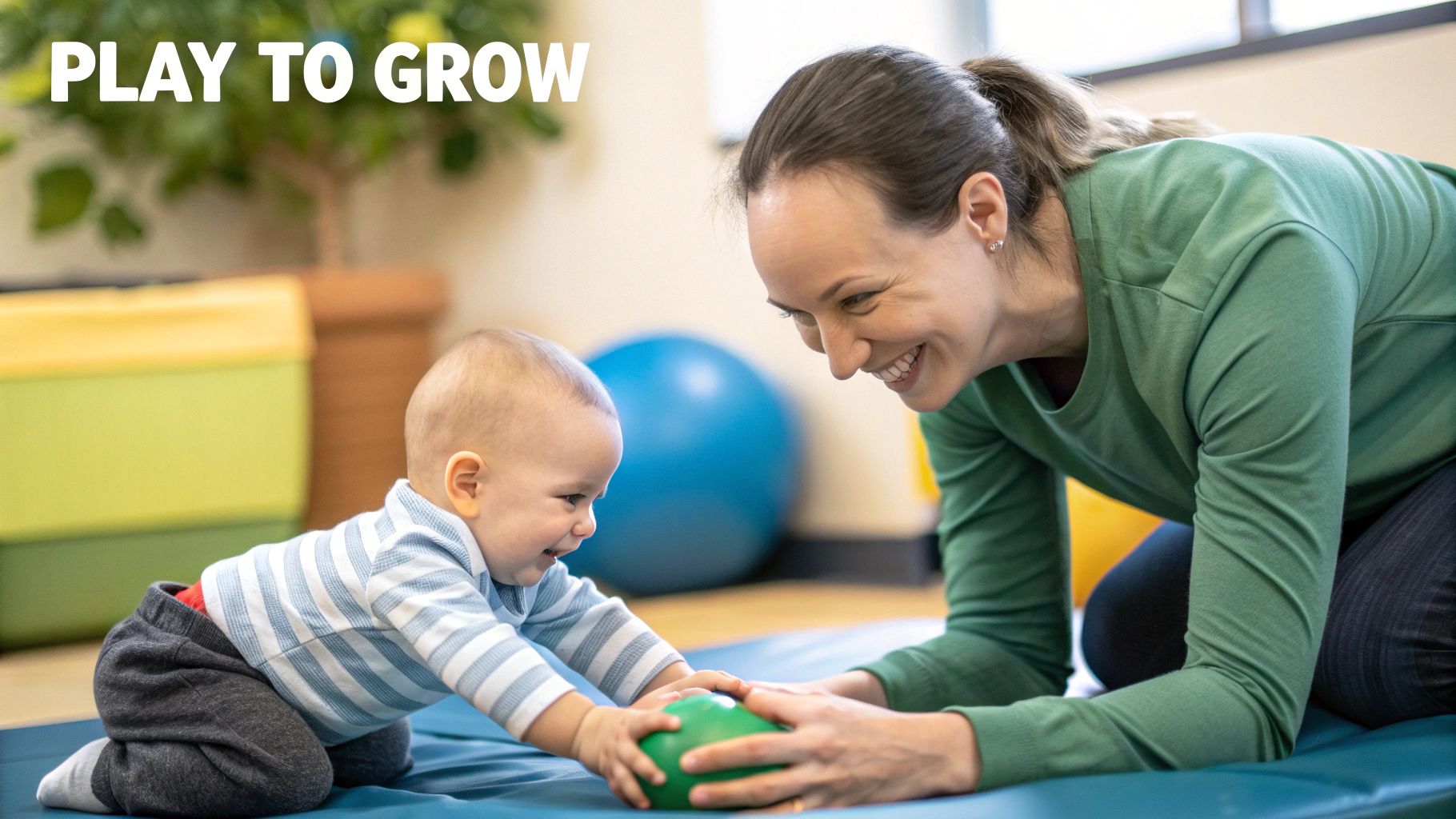
Having the right collection of 6 month toys is a fantastic starting point, but the real developmental magic happens when you get down on the floor and join in. Playing together is so much more than just passing the time; it’s one of the best ways to connect, strengthen your bond, and actively nurture all those new skills they’re working on.
Let’s be honest, you are your baby’s absolute favourite playmate. Your involvement can turn a simple toy into a brilliant learning experience. When you show them how something works, encourage their attempts, and celebrate their tiny successes, you’re helping them figure out how the world around them operates.
Turning Simple Toys into Powerful Tools
You don't need elaborate, complicated games to make a toy a developmental powerhouse. It's really just about being present and intentional with your play. By zeroing in on one skill at a time, you can give them focused support that just feels like a fun, loving game to your little one.
Think of yourself as their play guide. When you roll a ball back and forth, for instance, you're not just playing catch. You’re teaching them about taking turns and giving their eyes a great workout tracking the movement. These small, shared moments are where the biggest developmental leaps often happen.
Play is the work of infancy. Through simple, joyful interactions with you and their toys, your baby is building the neural pathways that will support a lifetime of learning.
Play Ideas To Support Key Skills
To help you get started, I’ve put together a few simple, hands-on activity ideas. These show how you can use different types of toys to support specific skills, and they’re easy to weave into your daily routine to make playtime feel a little more purposeful.
| Toy Type | Activity Idea | Skill Supported |
|---|---|---|
| Sensory Ball | Sit opposite your baby (supported if needed) and gently roll a textured ball towards them. Encourage them to reach out and push it back. Use simple words like "roll" and "stop". | This simple back-and-forth is brilliant for visual tracking as their eyes follow the ball. It also encourages reaching and introduces cause and effect. |
| Board Book | Snuggle up and "read" a book with high-contrast images or different textures. Point to the pictures, name what you see, and make fun animal or object sounds. | This nurtures early language skills by exposing them to new words and sounds. It also builds a positive, cosy feeling around books from a very young age. |
| Wooden Grasp Toy | During tummy time, place a smooth wooden ring just out of reach. Your encouragement can motivate them to pivot or even try their first little shuffle to get it. | This "reach and roll" game helps strengthen their core, neck, and arm muscles—all essential for big gross motor skills like rolling and crawling. |
These are just a few ideas to spark your imagination. For even more inspiration, check out our guide to fun and simple activities for 6-month-olds you can try at home. The most important thing is to keep it light, follow your baby’s cues, and enjoy every little milestone together.
Keeping Up With Your Growing Baby
Just when you think you’ve got the hang of this baby stage, everything changes. It feels like one minute they’re a sleepy newborn, and the next they’re reaching, grabbing, and trying to sit up all on their own. Their development moves at lightning speed, and making sure their toys keep up can feel like a constant race.
It’s a struggle so many parents face. You want to give them the very best to support their learning, but who has the time for endless research? It’s far too easy to end up with a house full of toys that were a hit last month but are now gathering dust, or ones that are still a bit too complex, leading to more frustration than fun.
This is exactly where the idea of a stage-based play kit can be a real game-changer.
A Smarter Way to Play
Picture this: just as your baby is ready for a new set of challenges, a box of perfectly selected, age-appropriate toys lands on your doorstep. That’s the simple brilliance of a stage-based toy subscription. These curated collections take all the guesswork and frantic searching out of the equation.
Instead of you having to become a child development expert overnight, actual experts have done the heavy lifting. Each kit is built around what your baby is working on right now—whether that’s perfecting their pincer grasp, figuring out that shaking a rattle makes a noise, or exploring different textures. It means playtime is always meaningful and engaging, not just a way to pass the time.
Think of a stage-based subscription as your personal play consultant. It doesn’t just deliver toys; it delivers the right experiences at precisely the right moment, freeing you from the stress of getting it wrong.
This approach also gently introduces the idea of toy rotation. When the new box arrives, it’s a natural reminder to pack away some of the older, less-used toys. This simple habit keeps their play space feeling fresh and prevents them from getting overwhelmed. A smaller, more thoughtful selection of toys often leads to deeper, more focused play.
Our Grow With Me subscription is designed around this very philosophy. Each kit is a thoughtful collection of high-quality wooden toys, sensory objects, and beautiful board books that align with your baby’s journey. We even include handy description cards that explain the developmental "why" behind each item and give you ideas for how to play together. It’s a simple, expert-backed way to nurture their growth without adding another thing to your to-do list.
Keeping Toys Clean and Organised
Let’s be honest, every single toy is going to end up in your baby's mouth. It's just a fact of life at this age! That’s why keeping everything clean is less about pristine tidiness and more about making sure their play environment is healthy and safe. A simple, consistent cleaning routine is all you need to give you peace of mind while they explore their 6 months toys.
You don't need a complicated system. Most plastic and silicone toys are happy with a quick wash in warm, soapy water or a cycle on the top rack of your dishwasher. Wooden toys are a bit different; a quick wipe with a damp cloth and a gentle solution of vinegar and water will disinfect them perfectly without soaking the wood.
Smart Storage for a Tidy Play Space
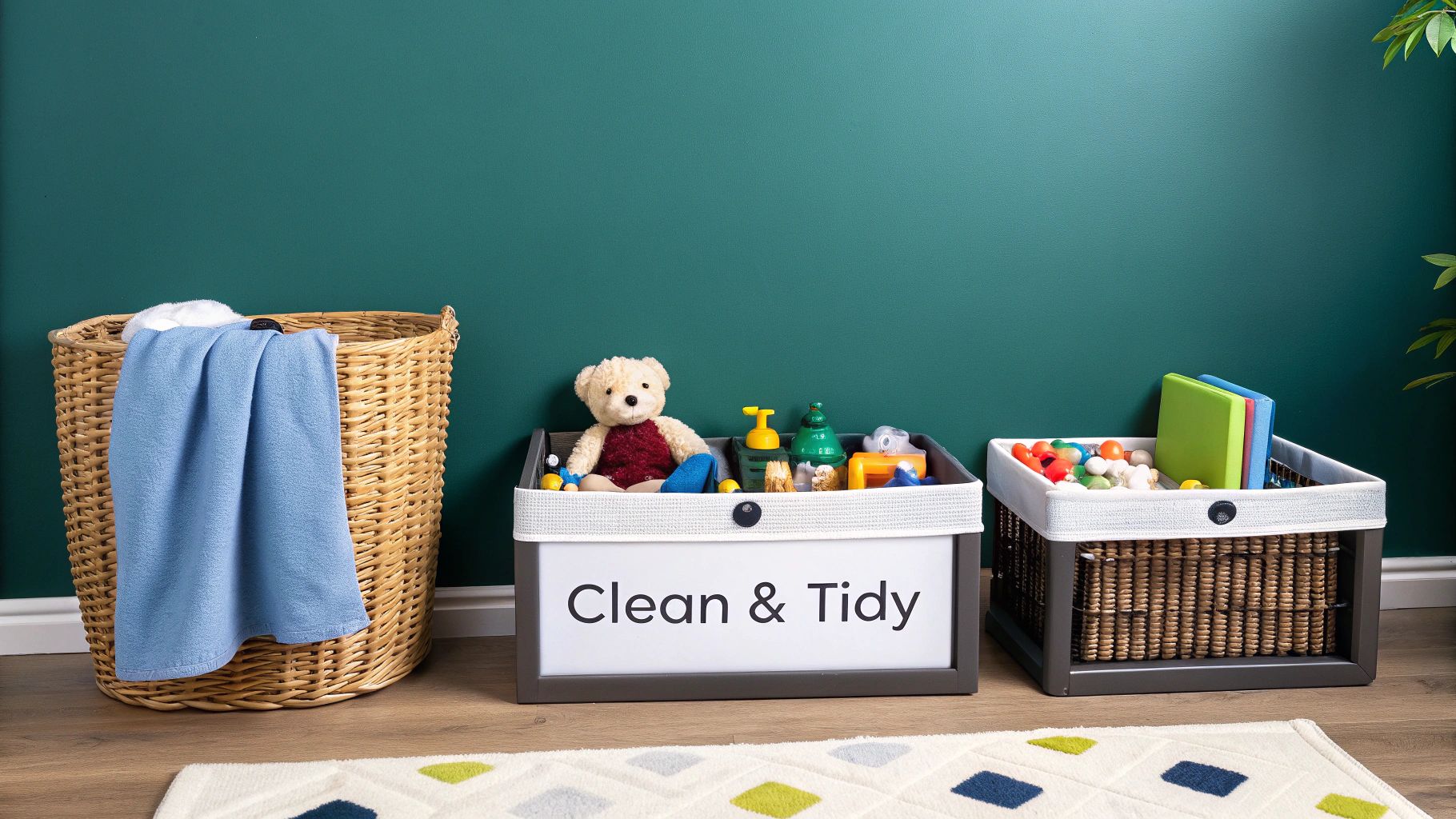
An organised play area isn't just for appearances—it creates a calmer, more inviting space for both you and your baby. The trick is to make toys easy for them to get to, and even easier for you to tidy up at the end of the day.
Low, open-topped baskets or soft fabric bins are absolutely perfect for this stage. They let your little one see what's on offer and might even encourage them to start pulling out toys on their own, which is a fantastic first step towards independent play.
Here's a little trick that works wonders: try rotating a small handful of toys every week or so. It keeps your baby curious and engaged with what's available, preventing them from getting overwhelmed and making the play space feel fresh without you having to buy a thing.
As your collection of toys inevitably starts to grow, having a few good strategies up your sleeve can be a lifesaver. Learning how to effectively organize kids' toys will help you create and keep a tidy, stress-free zone that the whole family can actually enjoy.
Your Questions About 6-Month-Old Toys, Answered
As you step into this fun new stage with your baby, it’s completely normal to have questions. You want to give them the best, but let's be honest, the world of baby gear can be overwhelming. Let’s tackle some of the most common queries parents have about toys for their 6-month-old.
How Many Toys Do They Really Need?
It’s easy to fall into the trap of thinking more toys mean more stimulation, but it’s usually the other way around. A baby faced with a mountain of toys can quickly get overstimulated and disengaged. The real magic isn't in the quantity; it's all about quality and variety.
A carefully chosen collection of about 6-8 toys that target different skills is plenty. The trick is to introduce toy rotation. Simply swap out a few toys every week to keep their play area feeling new and exciting. This encourages your baby to explore each toy more deeply and prevents that 'too much stuff' feeling. For tips on keeping everything in its place, check out this brilliant guide on how to organize kids' toys and bring some calm back to your living space.
What Are The Best Toys For Travel?
When you’re out and about, you need toys that are compact, captivating, and easy to wipe down. There's no need to pack up the entire playroom! Just focus on a few multi-sensory items that offer lots of play potential without taking up much space.
A few fantastic travel companions include:
- A set of linking rings: These are endlessly useful. You can clip them to the car seat or buggy, and your baby can practise grasping, chewing, and shaking them.
- A soft, crinkly book: A lightweight fabric book is easy to squash into a bag and provides both visual and auditory fun without making any noise that will annoy fellow travellers.
- A favourite teether: Having a familiar, easy-to-grip teether on hand is a lifesaver for soothing sore gums when you’re away from the comforts of home.
Should I Get Electronic Toys Yet?
At six months old, the simplest toys are often the most powerful. While the flashing lights and sounds of electronic toys might seem impressive, they often do all the "work" for your baby. This can accidentally turn your little one into a passive spectator rather than an active explorer.
Baby-powered toys are far more effective at this age. Think of a wooden rattle they have to shake to make a sound, or a soft ball they have to push to make it roll. These toys teach the fundamental concept of cause-and-effect in a hands-on way that fosters imagination and physical discovery.
Simple, open-ended toys encourage your baby to use their own budding strength, coordination, and curiosity. They are the true foundations of creative, meaningful play.
At Grow With Me, we take the guesswork out of finding the perfect toys. Our stage-based play kits deliver expert-curated, developmentally brilliant toys right to your door, so your baby always has the right tools for their next big leap. Explore our subscription boxes today.