

Top 8 Engaging 6 Months Old Activities (2025 Guide)
Welcome to the exciting six-month milestone! Your baby is becoming more curious, interactive, and mobile every day. They're likely sitting up with more confidence, reaching for everything in sight, and starting to babble with purpose. This explosion in development turns your home into a playground of discovery, making it the perfect time to introduce engaging new experiences.
Finding the right 6 months old activities is key to nurturing this incredible growth, but it doesn't require elaborate toys or complicated setups. This guide offers a curated collection of simple, effective, and fun activities designed to support their development at this crucial stage. We will explore how to use everyday items and specialised toys, like those found in a Grow With Me kit, to create meaningful play experiences that build essential motor, cognitive, and sensory skills.
We will cover everything from tummy time variations and cause-and-effect play to games that foster language and pre-crawling movements. Beyond focusing on developmental activities, understanding the overall well-being of your 6-month-old includes considerations like choosing safe and gentle products for their sensitive skin. Let's dive into the best ways to play, learn, and grow together during this wonderful phase.
1. Tummy Time
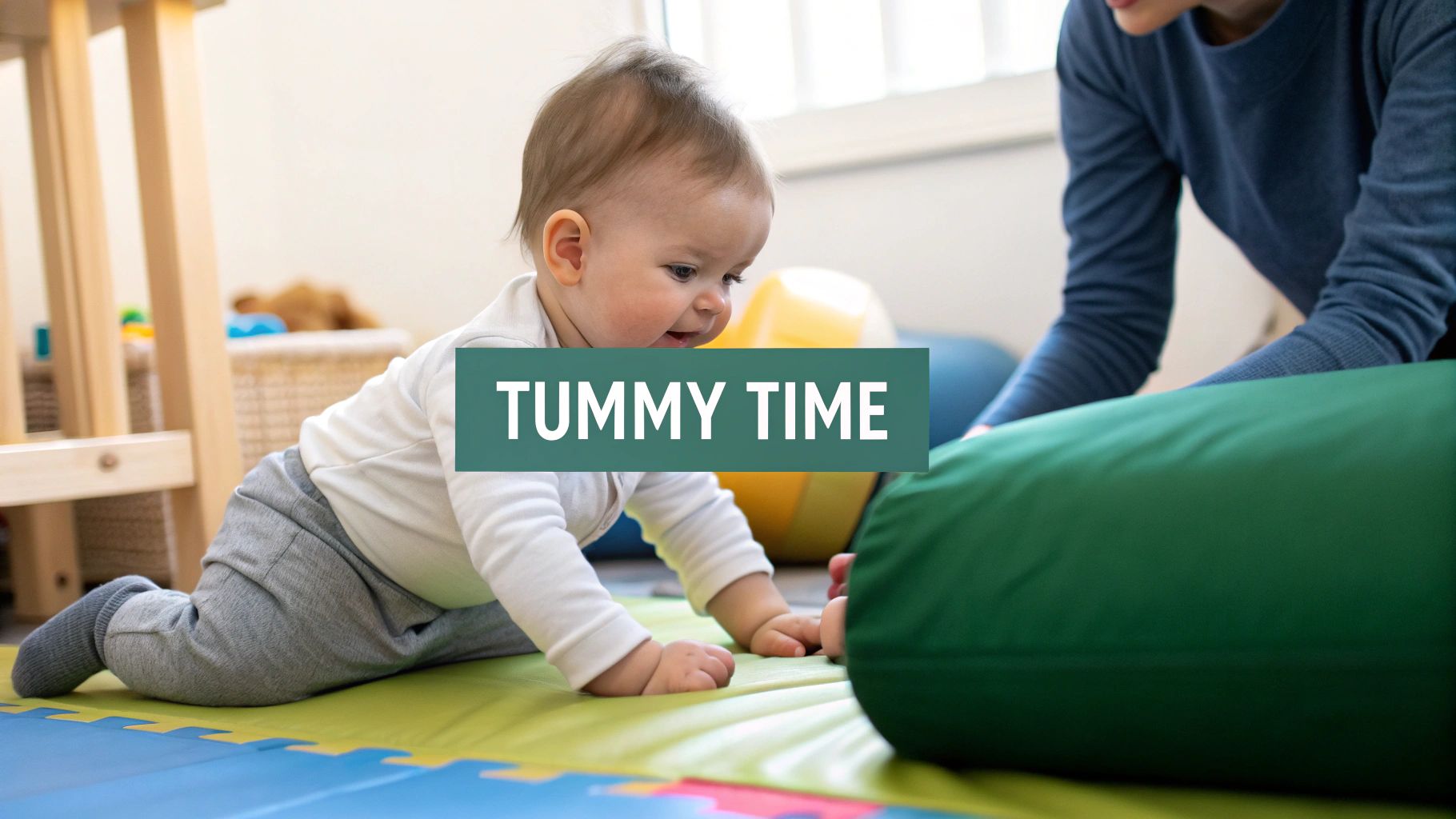
Tummy time is a foundational activity recommended by paediatricians, involving supervised periods where your baby lies on their stomach while awake. By six months, this exercise is less about introducing the concept and more about building on established strength. It's crucial for developing the neck, back, and shoulder muscles that are prerequisites for major motor milestones like sitting up, crawling, and eventually walking.
At this age, your little one can likely hold their head up steadily and may even be pushing up on their hands, pivoting to reach for toys, or rocking back and forth. These movements are the building blocks of more complex actions. For a comprehensive look at your little one's physical development, including this crucial stage, you can refer to an ultimate guide on the baby's journey from tummy time to walking.
How to Enhance Tummy Time
Engaging your 6-month-old during tummy time transforms it from a simple exercise into a stimulating play session. The goal is to make it an enjoyable part of their daily routine, aiming for a total of around 90 minutes spread throughout the day.
- Make it Interactive: Get down on the floor at eye level with your baby. Sing songs, make funny faces, or talk to them to encourage head lifting and turning.
- Use Engaging Toys: Place a baby-safe mirror or colourful, high-contrast toys just out of their reach to motivate them to pivot and push forward. The sensory toys from a Grow With Me kit are perfect for this.
- Vary the Scenery: Don't just stick to the play mat. Try supervised tummy time on your chest, across your lap, or on a different, baby-safe surface to offer a new perspective.
Top Tip: Incorporate short bursts of tummy time after every nappy change. This small, consistent practice quickly adds up and helps normalise the position for your baby, making it a routine part of their day rather than a dedicated, and sometimes dreaded, activity. If you're looking for more guidance, you can learn more about the essentials of tummy time.
2. Cause and Effect Play
Cause and effect play introduces your baby to one of life's fundamental lessons: their actions can make things happen. At six months, as their hand control and coordination improve, they are beginning to intentionally grasp, shake, and manipulate objects to see what results they can produce. This simple concept is a cornerstone of cognitive development, laying the groundwork for problem-solving, decision-making, and understanding the world around them.
As your little one discovers they can shake a rattle to make a noise or press a button to see a light, they are building crucial neural connections. They are not just playing; they are conducting their first scientific experiments. This understanding that they have agency and can influence their environment is a massive leap in their development, empowering them and sparking their curiosity.
How to Encourage Cause and Effect Play
Creating opportunities for this type of learning is easy and can be incorporated into your daily routine. The goal is to provide a responsive environment where your baby's explorations are met with immediate and interesting feedback.
- Offer Responsive Toys: Provide toys that react to your baby's touch. Think rattles that jingle, squeaky toys, or activity centres with buttons that light up or play music. The sensory toys from a Grow With Me kit are ideal for demonstrating these relationships.
- Narrate the Action: Verbally connect their action to the result. Say things like, "You kicked your feet and made the water splash!" or "When you bang the spoon, it makes a loud sound!" This reinforces their understanding.
- Embrace Simple Actions: You don't always need special toys. Splashing in the bath, dropping a safe object from their high chair and watching it fall, or crinkling a piece of paper are all powerful cause and effect lessons.
Top Tip: Repetition is key to learning at this age. Your baby will likely want to drop a toy, have you pick it up, and then drop it again and again. While it might seem tedious, this is how they confirm their hypothesis that their action (letting go) consistently causes the same outcome (the toy falls).
3. Mirror Play and Self-Recognition Activities
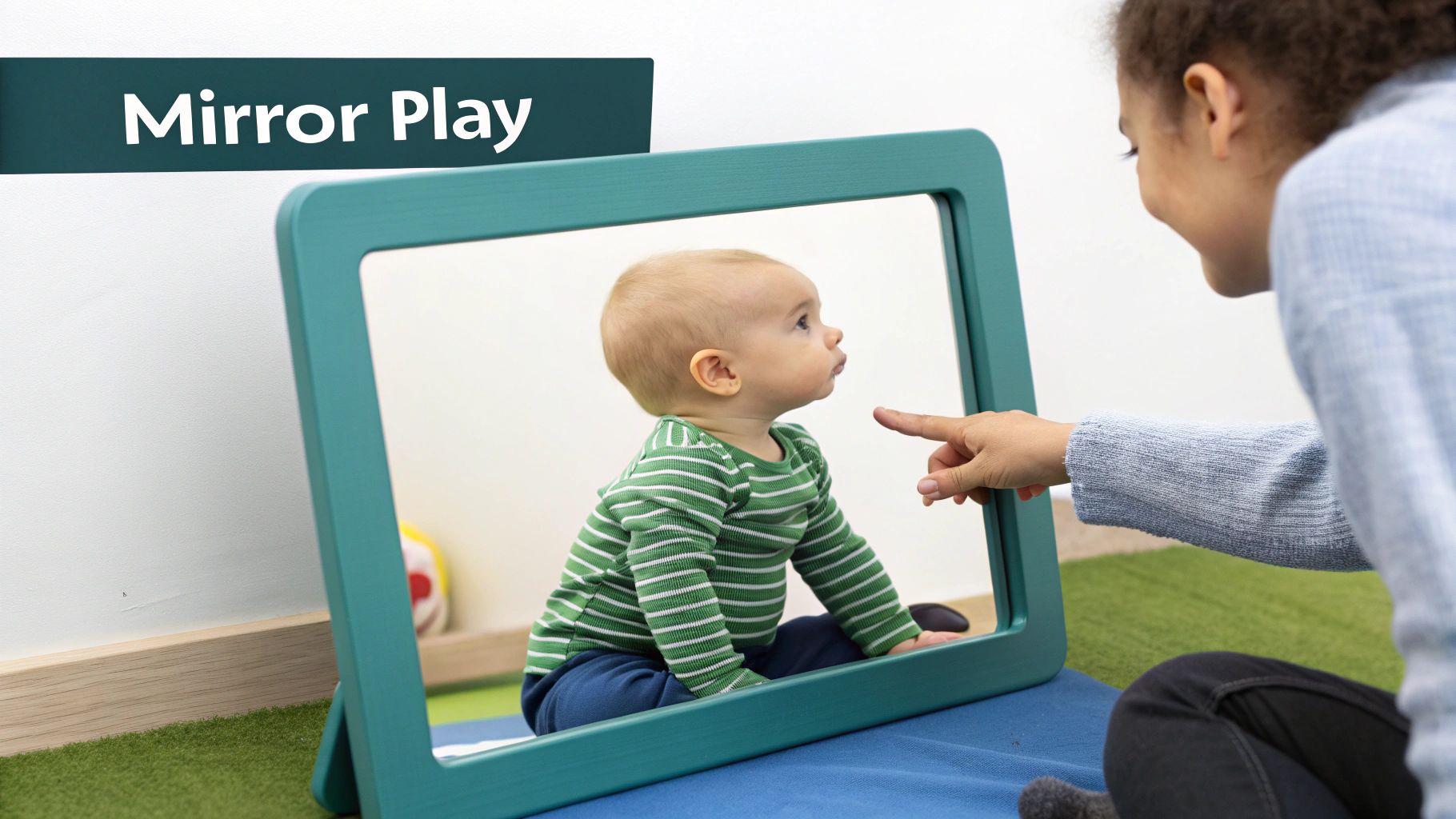
Mirror play involves providing a baby-safe mirror for your little one to gaze at their reflection, an activity that fascinates them as they begin to recognise faces. At six months, babies don't yet understand that the reflection is their own, but they are captivated by the "other baby" who mimics their every move. This interaction is a crucial early step towards developing self-awareness and visual tracking skills.
Observing their own expressions and movements provides instant visual feedback, which helps them connect their actions to what they see. This simple yet powerful activity supports cognitive development, social-emotional growth, and even motor skills as they reach out to touch their reflection. It’s one of the most engaging 6 months old activities you can introduce.
How to Enhance Mirror Play
Making mirror play interactive and safe is key to maximising its developmental benefits. The goal is to create moments of discovery and social engagement, turning a simple reflection into a tool for learning and connection.
- Narrate the Experience: Sit with your baby and point to their reflection, saying things like, "Look, there's your nose!" or "You're smiling!" This helps build their vocabulary and connect words to their own body parts and emotions.
- Use Different Mirrors: Incorporate various types of baby-safe, unbreakable mirrors into their routine. Try a wall-mounted acrylic mirror in their play area, a small handheld one during nappy changes, or toys with reflective surfaces.
- Combine with Other Activities: Place a mirror in front of your baby during tummy time to encourage them to lift their head. You can also sing songs like "Head, Shoulders, Knees, and Toes" while pointing to the corresponding body parts in the mirror.
Top Tip: Always ensure any mirror used is shatterproof and securely fastened to prevent it from falling or tipping. Supervise your baby at all times during mirror play to ensure their safety and to turn it into a shared, bonding experience. Short, frequent sessions of 10-15 minutes are most effective.
4. Object Permanence Games
Object permanence is the crucial understanding that things continue to exist even when they cannot be seen, heard, or otherwise sensed. This cognitive leap, famously studied by psychologist Jean Piaget, begins to emerge around six months. Engaging in simple hide-and-seek games helps your baby grasp this foundational concept, which is a vital step in their cognitive development and helps them understand the world as a stable, predictable place.
At this age, "out of sight, out of mind" starts to become less true. Your baby might begin to look for a toy they've dropped or show curiosity when an object is partially hidden. These are the first signs they are developing object permanence. Nurturing this skill is a fantastic way to engage their growing brain and makes for one of the most rewarding 6 months old activities.
How to Play Object Permanence Games
The key is to make these games fun, repetitive, and full of surprise. Your enthusiastic reactions will teach your baby that finding the hidden object is an exciting achievement, encouraging them to keep playing and learning.
- Play Peekaboo: This classic game is the perfect starting point. Use your hands, a soft blanket, or a colourful muslin to hide your face, then reveal it with an enthusiastic "Peekaboo!" You can also use a favourite stuffed animal to play.
- Hide and Reveal Toys: During playtime, partially cover a favourite toy with a small blanket or scarf. Encourage your baby to pull the cover off. As they get the hang of it, you can start to hide the toy completely.
- Use Everyday Objects: Simple household items work well. Place a colourful block under one of two plastic cups and encourage your baby to find it. The sensory toys from your Grow With Me kit, with their varied textures and sounds, are ideal for this.
Top Tip: Start with very simple hides where part of the object is still visible. This helps your baby make the connection. Celebrate enthusiastically every time they "find" the hidden item to build their confidence and make the game a positive experience. Repetition is key to solidifying this important cognitive skill.
5. Sensory Exploration with Safe Household Items
Sensory exploration involves offering your baby a variety of safe, everyday objects to touch, see, and mouth. At six months old, your little one is an active investigator, using their hands and mouth as primary tools to learn about the world. This type of play, often inspired by Montessori and heuristic play methods, is fundamental for building neural pathways and helping your baby understand concepts like texture, shape, and size.
By providing a curated collection of safe household items, you're creating a rich learning environment that stimulates their tactile and oral sensory systems. This hands-on discovery is a key part of cognitive development, as your baby begins to categorise and make sense of different materials. These simple yet effective 6 months old activities are excellent for fostering curiosity and independent play.
How to Enhance Sensory Exploration
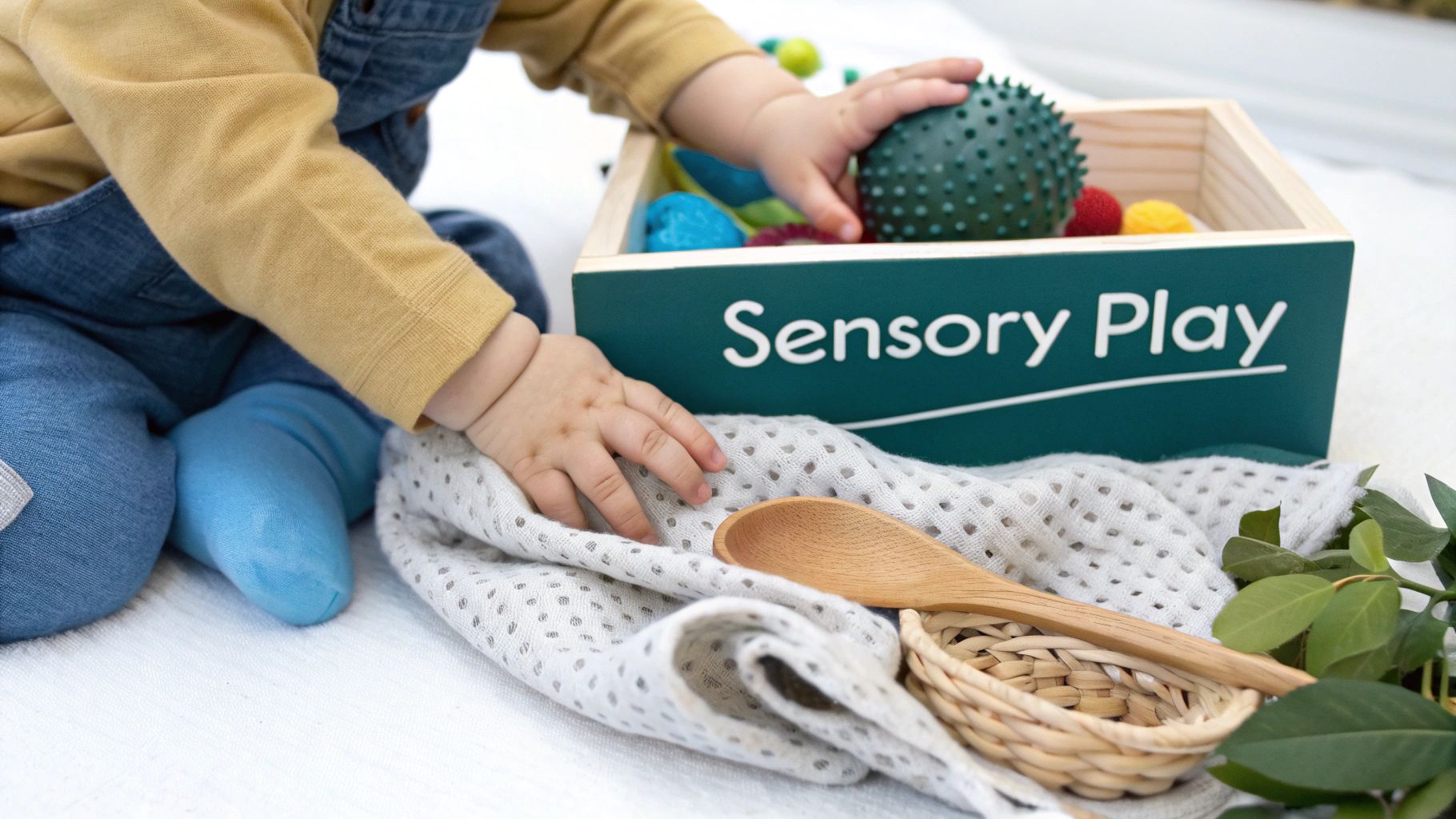
Creating a sensory basket or "treasure basket" is an easy way to introduce this activity. The goal is to offer varied textures and shapes that are safe for exploration. Always ensure direct supervision during these play sessions.
- Gather Safe Items: Collect a small assortment of baby-safe objects. Think wooden spoons, plastic measuring cups, large silicone whisks, and different fabric swatches like velvet, corduroy, or silk.
- Create a Treasure Basket: Place the items in a low, open basket or container that your baby can easily access while sitting up (with support if needed). Let them lead the exploration, picking up, feeling, and mouthing the objects as they wish.
- Narrate the Experience: Talk about what your baby is feeling. Use simple, descriptive words like, "That wooden spoon feels smooth," or "The fabric is so soft." This helps build their vocabulary and connect words to sensations.
Top Tip: Safety is paramount. Always check that items are large enough not to be a choking hazard (larger than the inside of a toilet paper roll), have no sharp edges, and are made from non-toxic materials. Regularly wash and rotate the items to keep the experience fresh and engaging. For more inspiration, you can discover more sensory play ideas for babies.
6. Reaching, Grasping, and Transfer Activities
Structured play focused on reaching, grasping, and transferring objects is a cornerstone of fine motor skill development for a 6-month-old. At this age, your baby is moving beyond involuntary reflexes to more deliberate actions. They are refining their ability to judge distances and coordinate their eyes, hands, and muscles to reach for and hold onto items of interest.
These activities are vital for building hand-eye coordination and strengthening the small muscles in their hands and fingers. The ability to grasp an object and then pass it from one hand to the other is a significant cognitive and physical milestone. This complex sequence lays the groundwork for future skills like self-feeding, dressing, and drawing. For a deeper dive into this developmental area, you can explore more about infant fine motor skills.
How to Encourage Reaching and Grasping
Making these activities a regular part of your baby’s playtime helps to strengthen their developing skills in a fun and engaging way. The key is to provide opportunities that challenge them just enough to encourage practice and improvement.
- Strategic Toy Placement: Place a favourite toy, like a soft block or teether, just within their arm's reach. This motivates them to stretch and coordinate their movements to successfully grasp it.
- Offer a Variety of Objects: Provide a range of baby-safe items with different shapes, textures, and weights. Lightweight rattles, stacking rings, and soft fabric toys from a Grow With Me kit are excellent for practising different types of grips.
- Practise Hand-to-Hand Transfer: Once your baby has grasped a toy, gently offer your hand or another toy nearby. This can encourage them to shift the object from one hand to the other, a complex skill that builds bilateral coordination.
Top Tip: Sit with your baby on the floor and place a toy directly in front of them at their midline. This encourages them to use both hands together to reach, promoting symmetrical development and coordination between the left and right sides of their brain and body.
7. Rolling and Pre-Crawling Movement Activities
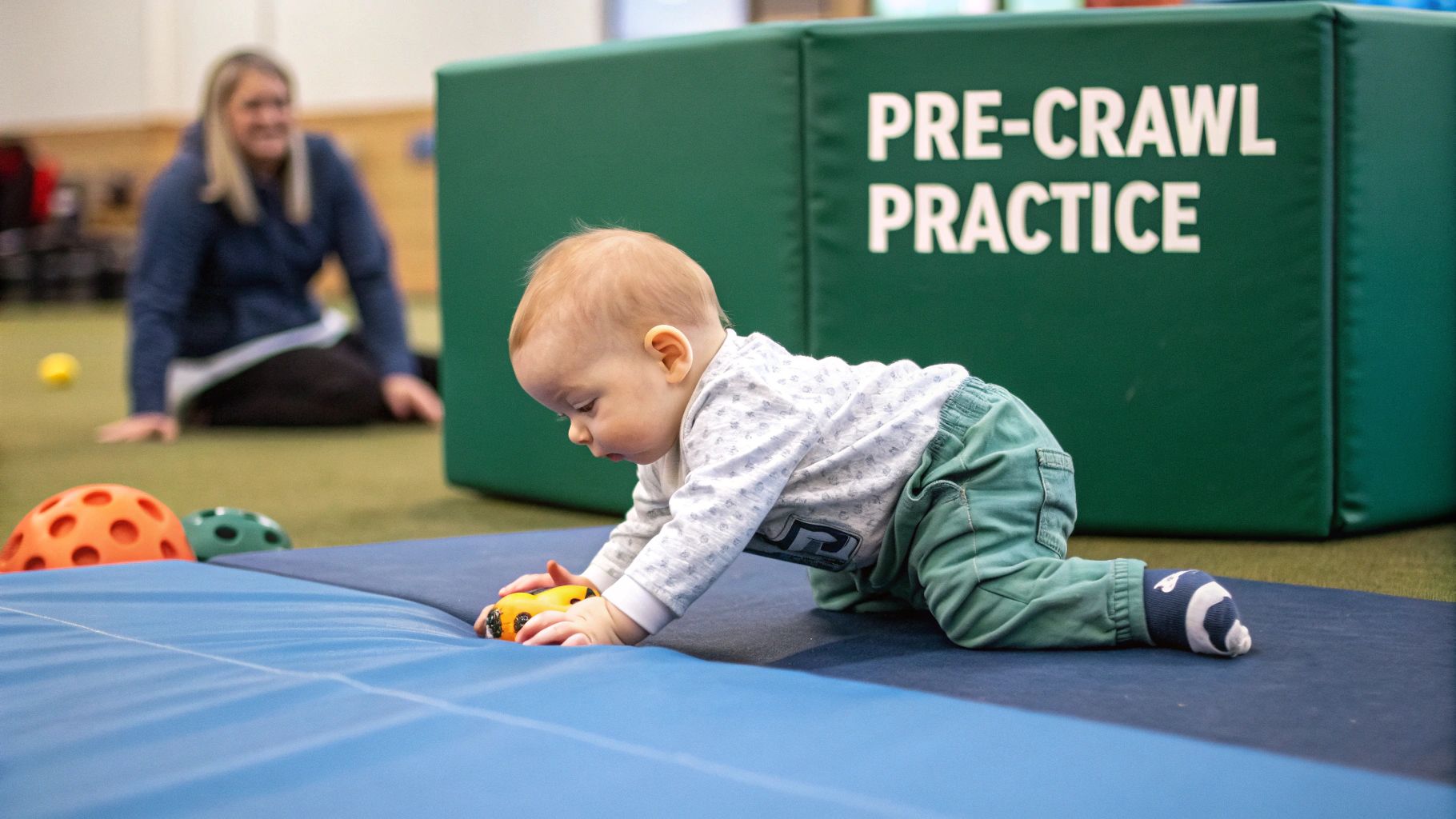
Encouraging rolling and pre-crawling movements is one of the most exciting 6 months old activities you can facilitate. Around this age, many babies have mastered rolling from their back to their tummy and vice versa. They might also begin rocking on their hands and knees during tummy time, a clear sign they are building the strength and coordination needed for crawling. These activities are fundamental for gross motor development, enhancing your baby's spatial awareness, and strengthening their core, arms, and legs.
This stage is all about exploration and building confidence in their growing physical abilities. By creating a supportive environment, you help them transition from stationary play to purposeful movement, laying the groundwork for future milestones like pulling up and walking.
How to Encourage Movement
Making movement fun and rewarding is key to motivating your little one. The goal is to create gentle encouragement without pressure, allowing them to discover their capabilities at their own pace. A safe, open space is their laboratory for learning how to move.
- Create Motivation: Place a favourite toy, like a colourful rattle from your Grow With Me kit, just out of arm's reach. This simple incentive can be the perfect motivation for them to roll over or shuffle forward.
- Play Rolling Games: Lie down with your baby and gently roll from side to side with them. Showing them the motion can make it less intimidating and more like a game you are playing together.
- Vary the Surfaces: Let your baby practise on different textures like a soft blanket, a firmer play mat, or even a patch of clean, soft grass outside (with supervision). This sensory input adds another layer to their development.
Top Tip: Once your baby starts to move, even just a little, baby-proofing becomes essential. Ensure your play area is a "yes" space, free from hazards. Cover electrical outlets, secure furniture, and remove any small objects they could put in their mouth. This allows them to explore safely and gives you peace of mind.
8. Language-Rich Interactive Play and Singing
Engaging your baby in conversation, songs, and rhymes is a powerful way to support their cognitive and communicative development. At six months, your little one is a keen listener, becoming attuned to the rhythm and tones of your voice. They are starting to understand facial expressions and may even begin to babble using consonant-vowel combinations like 'ba-ba' or 'da-da'. Language-rich interaction builds crucial neural pathways for future communication and lays the groundwork for their vocabulary.
This type of play doesn't require special equipment, just your voice and attention. By narrating your day, singing songs, and responding to their coos and babbles, you are teaching them the fundamentals of conversation. This consistent exposure helps them connect sounds with meanings, a key step in language acquisition. Incorporating these activities for 6-month-olds into your daily routine is one of the most impactful ways to bond and boost their brain development.
How to Enhance Language Play
Transforming everyday moments into learning opportunities is simple and effective. The goal is to create a constant stream of rich language that is both engaging and fun for your baby.
- Narrate Everything: Talk your baby through daily routines. Say things like, "Now we are putting on your clean nappy," or "Let's get this soft, blue jumper on." This connects words to actions and objects.
- Sing and Rhyme: Sing nursery rhymes with actions, like 'The Wheels on the Bus' or 'Twinkle, Twinkle, Little Star'. The repetitive melodies and rhythms are excellent for language pattern recognition.
- Read Daily: Use colourful board books with simple pictures. Point to the images as you name them and use an exaggerated, animated tone of voice to keep your baby captivated. The sensory books in a Grow With Me kit are perfect for this interactive reading time.
Top Tip: Treat your baby's babbles as a real conversation. When they make a sound, respond to them with words and then pause, giving them a chance to "reply". This back-and-forth teaches the turn-taking rhythm of communication and makes them feel heard and valued.
8-Item Comparison: Activities for 6-Month-Olds
| Activity | Implementation Complexity 🔄 | Resource Requirements ⚡ | Expected Outcomes 📊 | Ideal Use Cases & Tips 💡 | Key Advantages ⭐ |
|---|---|---|---|---|---|
| Tummy Time | Low — simple routine, needs consistent supervision | Minimal — padded mat, safe surface | Stronger neck/core; supports rolling/sitting/crawling | Short daily sessions (start 5–10 min, build to ~90 min); combine with parent interaction | Essential for gross-motor foundation; prevents flat spots |
| Cause and Effect Play | Low–Medium — choose safe, varied toys; supervise | Low — rattles, activity centers, household items | Improves cause–effect understanding & hand-eye coordination | Use varied sensory toys; narrate actions; rotate toys to sustain interest | Promotes early problem-solving and intentional actions |
| Mirror Play & Self-Recognition | Low — simple setup, monitor for overstimulation | Low — baby-safe acrylic/soft mirror | Visual feedback, social smiling, early face-recognition skills | Place at eye level for short 10–15 min sessions; combine with narration | Inexpensive way to boost self-awareness and engagement |
| Object Permanence Games | Low — adult-led, repetitive play | Minimal — small toys, scarves, blankets | Builds memory, searching behavior, anticipation | Play peekaboo and simple hide-reveal; keep hides obvious early | Strong cognitive milestone support and bonding activity |
| Sensory Exploration (Household Items) | Medium — careful safety screening required | Very low — common household/textured items | Enhanced tactile/oral sensory discrimination; multi-sensory learning | Create sensory baskets; rotate textures; supervise closely | Cost-effective, highly customizable multi-domain stimulation |
| Reaching, Grasping & Transfer | Low–Medium — guided placement and repetition | Minimal — graspable toys, rings, teethers | Improved fine motor control, bilateral coordination | Offer toys at arm’s length, midline placement, practice during tummy time | Foundation for self-feeding and manual dexterity |
| Rolling & Pre-Crawl Movement | Medium — needs clear, padded space and gentle encouragement | Minimal — open play area, few motivating toys | Greater core strength, spatial awareness, mobility readiness | Place toys to one side to motivate rolling; avoid forcing movements | Prepares for crawling and increased independent movement |
| Language-Rich Interactive Play & Singing | Low — time and consistent caregiver engagement | None–Minimal — voice, books, songs | Larger vocabulary, receptive language, social-emotional growth | Narrate routines, use parentese, read/sing daily (30+ min recommended) | Highly effective for language development and attachment |
Embracing Playful Growth, One Activity at a Time
Navigating the world of 6 months old activities can feel like an exciting new chapter, and as we've explored, this stage is a whirlwind of developmental leaps. From the foundational strength built during tummy time to the cognitive sparks ignited by object permanence games like peek-a-boo, each interaction is a building block for your baby’s future. The activities detailed in this guide are more than just ways to pass the time; they are purposeful, powerful tools for nurturing growth.
The key takeaway is that simple, everyday moments hold immense potential. You don't need a room full of complex toys. The most impactful play stems from connection and responsiveness. Singing a song while changing a nappy introduces rhythm and language, while exploring the texture of a soft blanket becomes a rich sensory lesson. These moments cultivate curiosity, build trust, and lay the groundwork for a lifelong love of learning.
Key Principles for Playful Parenting
Remember these core ideas as you continue this journey:
- Follow Your Baby's Lead: Pay close attention to their cues. Are they fascinated by a particular sound, or are they getting tired and overstimulated? Adapting to their unique pace and preferences makes playtime more enjoyable and effective.
- Repetition is Learning: Repeating songs, games, and activities is not boring for your baby. It’s how they strengthen neural connections and master new skills. Embrace the encore!
- Celebrate the Small Wins: Every new grasp, gurgle, and giggle is a milestone worth celebrating. Acknowledging these achievements with enthusiasm reinforces their efforts and builds their confidence.
The journey through the six-month milestone is less about a checklist of skills and more about fostering a secure and stimulating environment. It's about realising that you are your baby's favourite plaything and most important teacher. The real magic happens in the back-and-forth interactions, the shared smiles, and the simple joy of discovery. By integrating activities that support everything from motor skills like rolling to cognitive concepts like cause and effect, you are providing a holistic foundation for their development.
Ultimately, your role is to be a supportive guide, offering opportunities for exploration and celebrating the incredible progress your little one makes each day. Cherish this dynamic period of growth, stay present in your play, and watch with wonder as your baby blossoms.
Ready to take the guesswork out of developmental play? Discover how Grow With Me delivers perfectly curated, stage-based play essentials right to your door, making it easier than ever to offer the best 6 months old activities. Explore our play kits and join our community of parents today at Grow With Me.