
A Parent’s Guide to the Perfect 6 Month Old Baby Toy
The right toys for a 6-month-old baby are more than just playthings; they're powerful tools that support your little one's incredible cognitive and motor growth. By choosing toys that encourage cause-and-effect learning and fine motor practice, you help your baby explore their world with confidence and joy.
Exploring Your Baby’s New Skills
At six months, you'll notice a huge shift in how your baby plays. They're moving from being a passive observer to a hands-on explorer, discovering that their actions make things happen.
They realise that pressing a button creates a sound or that dropping a ring makes a rattle. This is the very foundation for understanding cause and effect, and it’s a thrilling time for them. Every interaction fuels their curiosity, building crucial neural connections.
Learn more about a key cognitive leap in our article on object permanence – the amazing moment babies grasp that things exist even when they can't see them.
This new-found power is fascinating to them. You'll see them:
- Mastering gravity by repeatedly watching objects fall.
- Practising hand-eye coordination by reaching for dangling toys.
- Exploring different textures with things like soft, squishy blocks.
Recognising Patterns
At this age, babies also start to notice repetition and rhythm. A toy that plays the same tune each time they squeeze it helps them predict what comes next. Believe it or not, this simple concept of sequence and pattern is an early maths skill in disguise.
Musical toys and simple stacking blocks are perfect for this. You can introduce variations, like changing the tune or the block order, which invites your baby to spot differences and strengthens their attention span.
"When babies press a button and hear a tune, they learn that their actions matter," says child development expert Jane Smith.
Between five and seven months, their fine motor skills are taking off. Babies start using their thumb and forefinger in a pincer grasp to pick up smaller items. Offering chunky rings and textured balls is a fantastic way to support this milestone.
Enhancing Sitting and Reach
Most babies can now sit with minimal support, which completely changes their perspective on the world. Sitting upright opens up a whole new angle for play.
Placing toys just slightly out of reach is a great way to encourage them to lean, stretch, and strengthen those important core muscles.
- Use cushioned floor seats to help them maintain their balance.
- Arrange toys in a semi-circle to promote gentle twists and turns.
- Swap out their toys regularly to keep things fresh and exciting.
Everything right now is about sensory exploration. From the feel of a soft fabric to the sound of a bell, these sensations are shaping their growing awareness of the world. The right toy for a 6-month-old turns every moment into an exciting lesson, sparking joyful discovery every single day.
Matching Toys to Key Developmental Milestones
Picking out the right toy for a 6-month-old isn't just about grabbing the brightest, loudest thing on the shelf. It’s about finding a tool that perfectly matches the incredible developmental work they’re doing every single day. The best toys become partners in their journey of discovery.
Think of it this way: a simple set of stacking rings isn't just a colourful distraction. For your baby, it’s a complete workout for their developing hand-eye coordination. Each wobbly attempt to grasp a ring and place it over the cone builds crucial connections between what they see and what their hands can do.
This visual guide breaks down the core developmental areas for your six-month-old, including their growing understanding of cause and effect, their improving pincer grasp, and their exciting new ability to sit up.
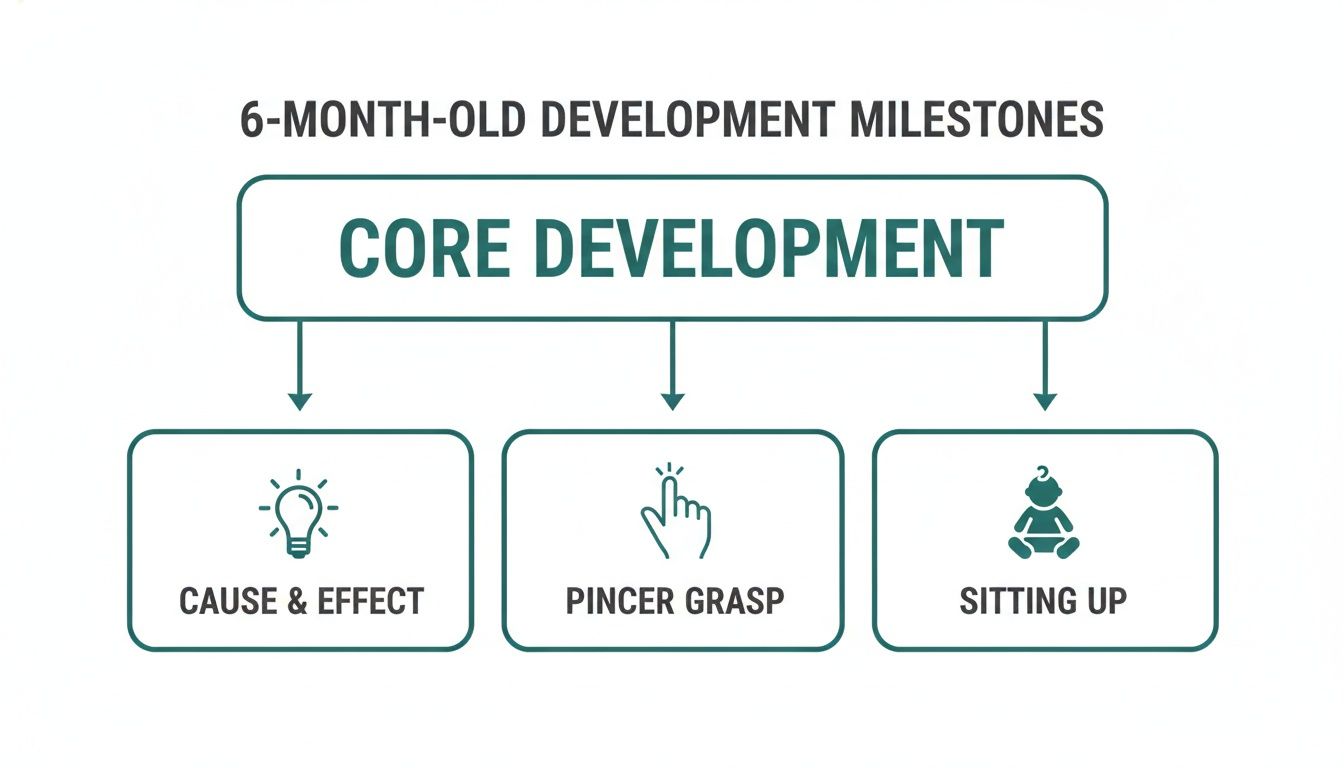
As the infographic shows, these three milestones don't happen in isolation. They all work together, paving the way for more complex, interactive play that fuels your baby's cognitive and physical growth.
Nurturing Gross And Fine Motor Skills
At six months old, a baby's body is working on two big projects at once. They're strengthening the large muscles needed for sitting and crawling (gross motor skills) while also refining the delicate hand and finger movements (fine motor skills) required for grasping and exploring objects.
An activity gym is fantastic for gross motor development. It encourages all that reaching, kicking, and rolling as your baby plays with the hanging toys. This strengthens their neck, back, and core muscles, getting them ready for the next big adventure: crawling.
For those smaller, more precise movements, toys that invite manipulation are key.
- Soft Blocks: These are perfect for grabbing, squeezing, and eventually, trying to stack. Their lightweight design makes them safe and easy for little hands to manage.
- Textured Balls: A ball with different surfaces—bumpy, smooth, or ridged—encourages exploration with both hands and mouth, refining their sense of touch and their grasp.
- Stacking Rings: As we mentioned, these are a classic for a reason. They challenge your baby to aim and place objects, which is a foundational skill for future problem-solving.
To get a better understanding of how these activities build foundational abilities, you can explore our detailed guide on developing fine motor skills in infants.
Stimulating Sensory And Cognitive Growth
A 6-month-old’s brain is like a sponge, soaking up information through every single sense. Toys that engage their sight, sound, and touch are absolutely essential for building those all-important neural pathways.
A toy's true value lies not in what it does, but in what it encourages your baby to do. Simple, open-ended toys often provide the richest learning experiences, sparking curiosity and creativity.
Crinkly fabric books are a brilliant example of a multi-sensory toy. The rustling sound captures their attention, the soft pages are easy to grasp, and the varied textures provide wonderful tactile stimulation. This simple 6 month old baby toy helps improve their auditory processing and focus.
To make things even clearer, here's a quick guide to help you match toys directly to the skills your baby is working on.
Matching Toy Types to 6-Month-Old Developmental Milestones
This table acts as a handy cheat sheet, helping you make confident and purposeful choices for your little one's toy box.
| Developmental Area | Key Milestone at 6 Months | Ideal Toy Type Examples |
|---|---|---|
| Gross Motor Skills | Sitting with support, pushing up on arms | Activity gyms, soft play mats, large, lightweight balls |
| Fine Motor Skills | Raking grasp, passing objects between hands | Stacking rings, soft blocks, easy-to-hold rattles |
| Sensory Development | Exploring textures with hands and mouth | Textured sensory balls, crinkle books, teething toys |
| Cognitive Skills | Understanding cause and effect, object permanence | Activity centres with buttons, pop-up toys, peek-a-boo toys |
Choosing toys that align with these areas ensures that playtime isn't just fun—it's a powerful engine for your baby's development.
Putting Safety and Non-Toxic Materials First
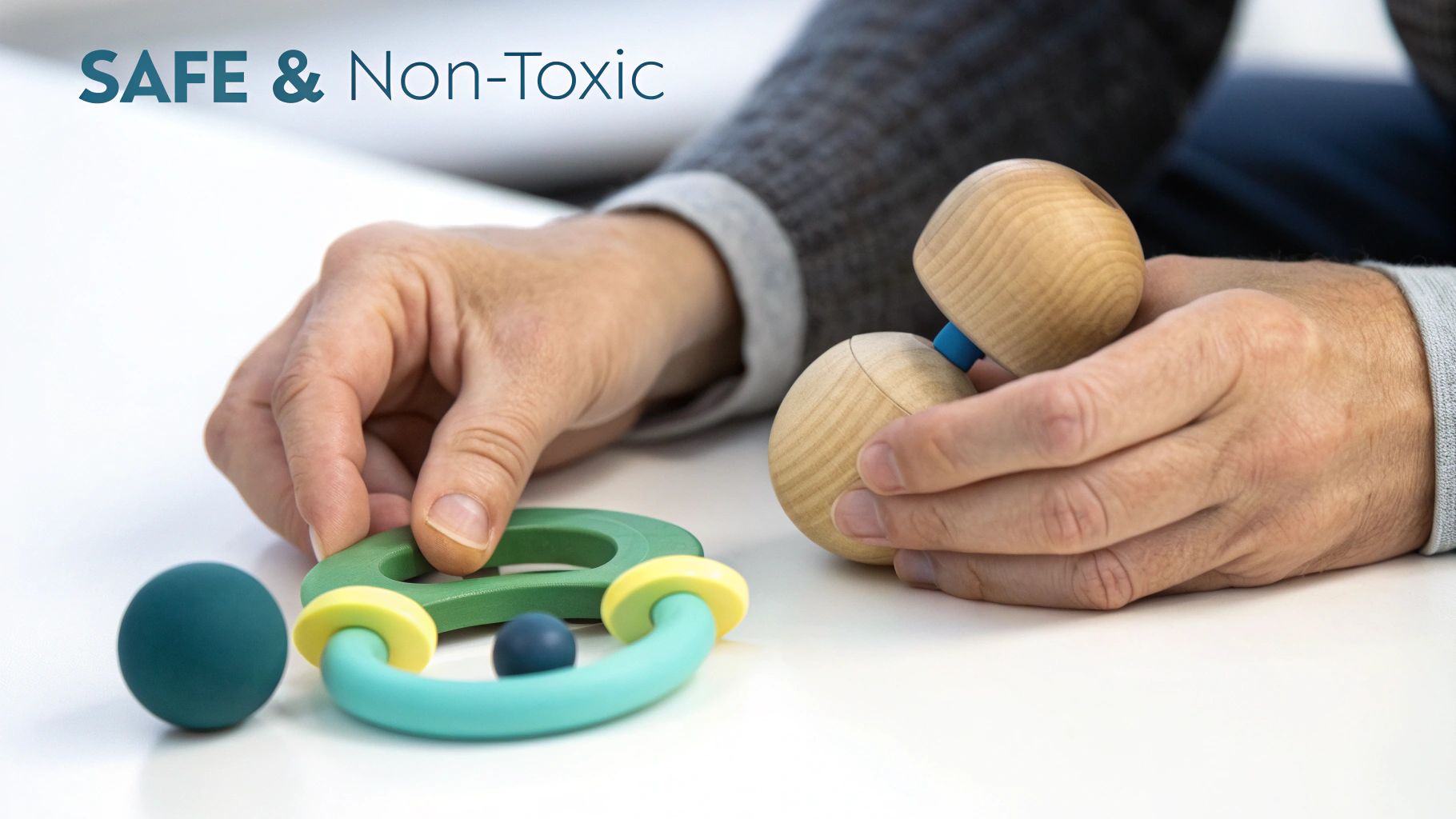
Your six-month-old is exploring the world in the most direct way possible: with their mouth. This means that toy safety isn't just a nice-to-have; it's an absolute must for any playtime activity. Every 6 month old baby toy needs to be a trusted companion, ready to stand up to endless chewing, dropping, and enthusiastic bashing.
Getting to grips with UK safety standards is your first line of defence. Keep an eye out for the UKCA (UK Conformity Assessed) mark on a toy's label. This is the manufacturer's declaration that the product meets the UK’s strict safety regulations, giving you a vital layer of reassurance.
Thankfully, these standards are having a real impact. Toy-related injuries have actually dropped by 10% since 2021, thanks in large part to stricter UKCA enforcement. You can find more on UK toy market trends on Statista.com.
Decoding Safety Labels And Materials
Working alongside the UKCA mark, you'll often see a reference to the EN71 standard. This is a detailed European safety directive that tests toys for specific hazards like flammability, toxic chemicals, and mechanical risks. Think of it as a rigorous exam the toy has to pass before it's deemed safe enough for your baby.
Beyond the official stamps of approval, the materials themselves are just as important. A six-month-old's system is still developing, so choosing non-toxic materials is a no-brainer.
- Food-Grade Silicone: An absolute star for teethers. It's tough, hypoallergenic, and completely free from nasties like BPA, PVC, and phthalates.
- Organic Cotton: For any soft toys, comforters, or fabric books, organic cotton is a wonderful choice. It’s grown without harmful pesticides, making it incredibly gentle on sensitive skin.
- Sustainably Sourced Wood: A classic for a reason. Natural wood finished with a non-toxic, water-based paint provides a fantastic sensory experience without the worry of synthetic chemicals.
The safest toys are often the simplest. Always prioritise high-quality, non-toxic materials and solid construction over flashy, complicated features. Nothing is more important than your baby’s health.
Doing Your Own Safety Checks at Home
Even with all the right labels, it’s a great habit to give any new toy a quick once-over yourself. A few moments of inspection can prevent potential accidents and give you that final piece of mind.
First, check for any small parts that could break off and become a choking hazard. A handy trick is the toilet paper roll test: if a piece can fit inside the tube, it's too small for your baby. Give any ribbons, buttons, or other attachments a firm tug to make sure they're securely fixed.
Next, run your hands over the entire toy. Feel for any sharp edges, splinters on wooden toys, or rough plastic seams that could scratch your baby’s delicate skin and gums. Finally, when it comes to cleaning, remember that what you use matters, too. Choosing gentle, non-toxic products is key, and it helps to start by understanding pH neutral cleaners to ensure every aspect of playtime stays safe.
Our Top Toy Recommendations for Six-Month-Olds
Walking down the baby aisle can feel overwhelming. You’re met with a sea of brightly coloured plastic, all promising to be the "best" for your little one. So, how do you cut through the noise?
We’ve found the best way is to think about what your baby is working on right now and choose toys that support that specific job. We’ve broken down our top picks for a 6 month old baby toy by the developmental superpowers they help build, so you can choose with confidence.
It turns out, we’re not alone in thinking this way. Purposeful, high-quality toys are what parents are looking for. In fact, the infant and preschool toy market—think things like sensory balls and activity gyms—was the biggest slice of the pie in the UK toy industry in 2024. If you’re curious, you can read more about these UK toy market insights from Spherical Insights.
This shift towards meaningful play means there are some truly brilliant options out there. Let's dive into a few of our favourites.
Best for Sensory Discovery
At six months old, your baby is a full-time detective, and their main tools are their senses. Every touch, sound, and sight is a clue that helps them piece together how the world works. Toys that feed this curiosity are absolute gold.
A simple set of textured sensory balls is one of the best investments you can make. They often come in different sizes, colours, and textures – some are bumpy, others are squishy, and some are firm. As your baby grabs, rolls, and inevitably mouths them, their brain is firing on all cylinders, processing a flood of tactile information that sharpens their sense of touch and strengthens those tiny hand muscles.
When you're choosing a set, look for balls that are:
- Made from BPA-free, non-toxic materials (since everything ends up in their mouth!).
- Light enough for them to actually pick up and hold.
- Varied enough in texture to keep them interested and exploring.
Best for Fine Motor Practice
Fine motor skills are all about those small, clever hand movements. Right now, your baby is hard at work figuring out how to pass a toy from one hand to the other and perfecting their grasp. It’s a huge developmental leap!
Soft fabric blocks are perfect for this stage. They’re safe to chew on, easy for clumsy hands to grab, and won’t cause any tears if a carefully constructed tower (or, more likely, a pile of two) tumbles over. The best ones have different textures, crinkly sounds, or bold, high-contrast patterns to add a sensory bonus to their motor-skill workout.
Another classic that has stood the test of time is a good set of stacking rings. Your six-month-old isn’t going to be neatly stacking them in size order just yet, but that’s not the point. The simple act of grabbing the chunky rings, exploring how they feel, and trying to get them onto the post is a fantastic exercise for their hand-eye coordination.
The most effective toys don't entertain the child; they empower the child to entertain themselves. By encouraging interaction and problem-solving, simple toys like blocks and rings lay the foundation for creative, independent play.
Best for Teething Relief
Ah, teething. It can be a tough time for everyone involved. A great teething toy gives your baby a safe and satisfying place to direct all that chewing, helping to soothe their sore and swollen gums.
Look for teethers made from 100% food-grade silicone. It’s the ideal material—durable, flexible, and free from any nasty chemicals. Many modern teethers are cleverly designed with lots of different textures and are easy for little hands to grip from any angle. For an extra bit of comfort, you can even pop them in the fridge for a while (just never the freezer, as it can be too harsh on their gums). A dedicated teether is a must-have to get you both through those grizzly days.
Creative Play Ideas to Maximise Learning
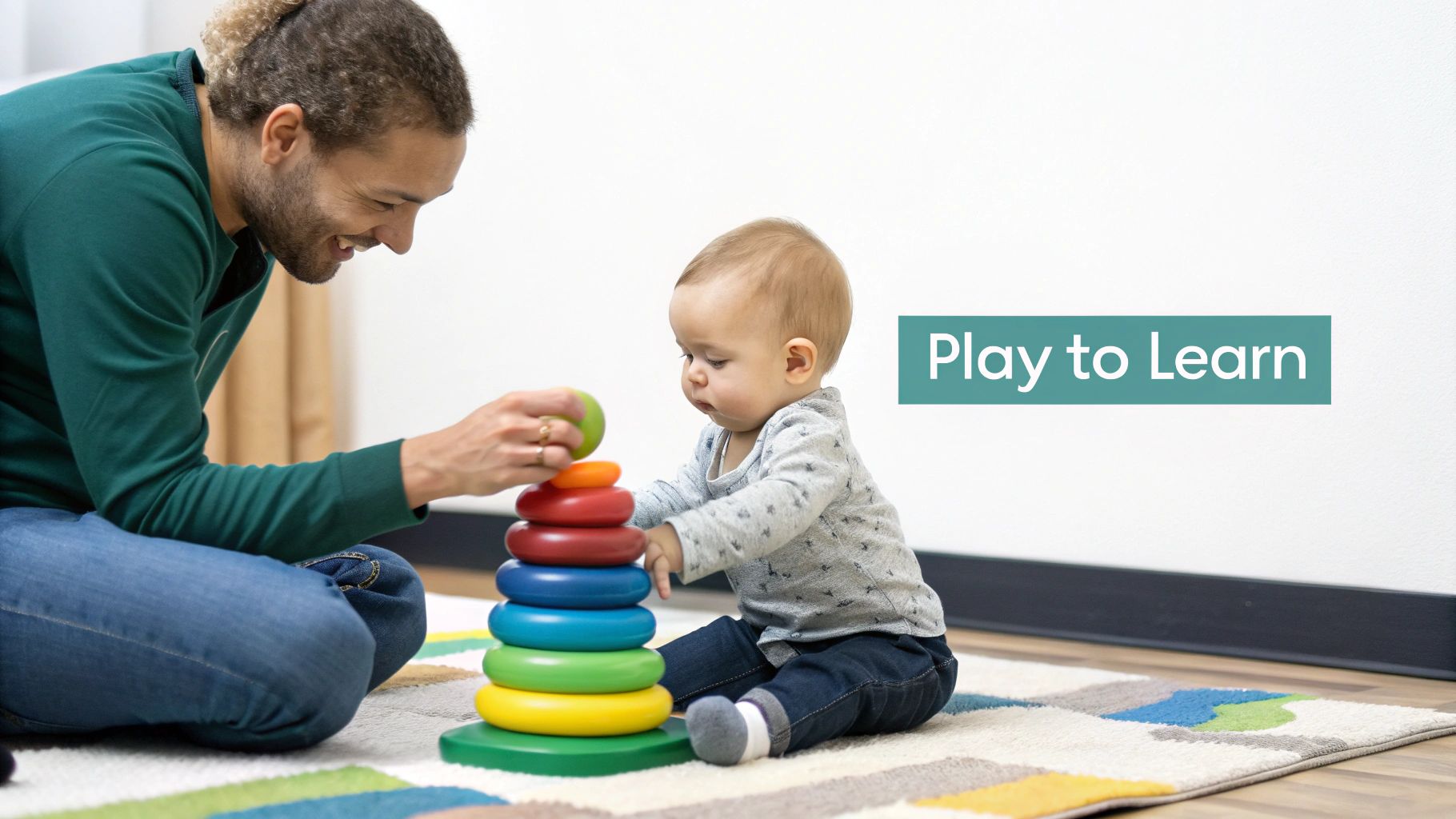
The best toys are much more than just objects; they’re a fantastic starting point for connection and learning. Having the perfect 6 month old baby toy is only half the story—it’s how you play together that truly makes the difference. Simple, engaged play is the secret to unlocking a toy's real developmental potential.
You don't need a complex plan. Play at this age is all about responsive interaction. For instance, when your baby babbles at you while holding a soft block and you babble right back, you’re taking part in what experts call "serve and return".
Think of this back-and-forth communication like a gentle game of conversational tennis. Your baby 'serves' by cooing, reaching, or making a face, and you 'return' the ball by smiling, talking, and responding to them. These little moments are incredibly powerful for building a strong, healthy brain.
Turning Simple Toys into Learning Tools
With a dash of creativity, even the simplest toys can become brilliant learning experiences. Your role is to be your baby's play guide, gently showing them new possibilities and celebrating every little discovery they make.
- Storytelling with Stacking Rings: Don't just stack them. As you place each ring, talk about its colour and size. "Here comes the big, blue ring!" or "Now for the little yellow one!" This introduces early vocabulary and the concept of order.
- The Sensory Ball Roll: Sit opposite your baby on the floor and gently roll a textured ball back and forth. This classic game encourages them to reach and lean, strengthening their core muscles while teaching the basics of taking turns.
- Narrating a Fabric Book: Instead of just letting them crinkle the pages, bring the pictures to life. Point to the "fluffy sheep" and make a "baa" sound, helping them connect objects with sounds and words.
The real goal of play isn't to teach a specific skill but to nurture curiosity and connection. When you follow your baby's lead and respond to what interests them, you create a joyful and secure space where learning just naturally happens.
Fostering Independent Exploration
While playing together is vital, it's also brilliant to give your baby chances to explore on their own. This is how they start to build confidence and early problem-solving skills.
Create a safe, "yes" space on the floor with a few interesting toys within reach. Just let them discover how a toy feels, what sound it makes when they shake it, and how it rolls away when they push it. Your quiet presence nearby gives them all the security they need to experiment freely.
By mixing guided play with independent discovery, you're giving your baby a balanced play diet that nurtures every part of their development. For more inspiration, check out our guide to fun activities for 6-month-olds.
How to Clean and Organise Your Baby's Toys
It’s no secret that just about every toy your baby owns will end up in their mouth. Keeping things clean is less about being spotless and more about making sure their favourite things are safe for all that mouthing and exploring. A simple, consistent routine is all you need.
How you clean a toy really comes down to what it's made of. For hard plastic or silicone things, like most rattles and teethers, a good wash in warm, soapy water does the trick. You can often pop them on the top rack of the dishwasher for an even easier clean.
Soft toys and fabric books usually handle the washing machine just fine. To keep them from getting battered, I'd recommend putting them in a mesh laundry bag first. A gentle, baby-safe detergent and a cool cycle will have them fresh in no time.
Caring for Natural and Sustainable Toys
Toys made from natural materials, especially wood, need a bit more care. You'll want to avoid soaking them, as the wood can swell and crack. Instead, just wipe them down with a damp cloth and a simple solution of water and a little bit of vinegar. It’s gentle but effective.
Speaking of natural materials, they're becoming more and more popular. It’s a trend I’ve noticed a lot lately; in the UK, 20% of consumers are now actively choosing eco-friendly toys for their little ones. This has led to a 12% rise in sales for things like bamboo activity centres. You can actually see more details on these UK toy market trends and forecasts on ResearchAndMarkets.com.
A simple toy rotation is a parent’s best friend. Storing half of the toys out of sight and swapping them every couple of weeks keeps playtime feeling new, reduces clutter, and prevents your baby from becoming overwhelmed.
This little trick doesn't just keep your baby engaged—it also makes tidying up so much quicker! If you're looking to bring that same sense of order to the rest of your home, you might find some great tips for ongoing home organization that work for you. A tidy space can make a world of difference, creating a calmer atmosphere for everyone.
Your Top Baby Toy Questions, Answered
Stepping into the world of baby toys can feel a bit like learning a new language. You're probably wondering what's best, what's safe, and just how many toys one tiny person really needs. Let's clear up some of the most common questions parents have.
How Many Toys Does a 6-Month-Old Actually Need?
It's tempting to fill the toy box, but at this age, less is definitely more. A curated little collection of 5 to 8 really good, high-quality toys is perfect. It’s enough to keep them curious and exploring without overwhelming their developing senses.
Think variety over volume. A great starting point would be one fantastic teether, a couple of toys that stimulate their senses (like something crinkly or a soft rattle), and something simple that builds motor skills, like a set of soft blocks. Rotating these few toys in and out of sight is a brilliant trick to make them feel brand new every time.
What About Electronic Toys with all the Lights and Sounds?
They can certainly grab a baby's attention, but it's best to use them sparingly. The most powerful 6-month-old baby toy is usually the simplest—one that invites your baby to be an active player, not just a spectator.
When a baby has to shake a rattle to make a sound or stack a block to see it tumble, they're learning cause and effect. They're making things happen, which is a huge confidence booster for their little brains. If you do go for electronic options, look for ones with adjustable volume and gentle, calming sounds to avoid overstimulation.
At six months, your baby is a master of grasping, mouthing, and exploring textures. While they won't be sorting shapes into the right holes just yet, you can absolutely introduce the shapes themselves as individual objects to hold and investigate. The real shape-sorting puzzle skills tend to click into place closer to the 12–18 month mark.
Ready to find the perfect, developmentally-appropriate toys without the guesswork? Discover how Grow With Me delivers expertly curated play kits right to your door at https://shop.growwithmesubscriptionbox.co.uk.