

8 Engaging 6 Month Old Baby Activities for 2025
Six months marks a thrilling milestone in your baby's development. They're becoming more curious, interactive, and mobile, transforming from a passive newborn into an active little explorer. This pivotal stage is the perfect time to introduce new games and interactions that support their rapidly growing skills and boundless curiosity.
But what are the best ways to play with a six-month-old? Forget generic advice that lacks practical application. This guide offers a curated roundup of eight specific, developmentally-rich 6 month old baby activities designed to be both fun and impactful. Each idea is organised not just to entertain, but to actively build crucial cognitive, motor, and sensory foundations.
From enhancing tummy time with purposeful stimulation to exploring the concept of object permanence through creative games, you'll discover practical, actionable ways to make playtime more meaningful. Let's dive into creating simple yet powerful moments of discovery that will help your little one learn, grow, and thrive during this exciting phase. You'll find everything you need to support their journey, one playful moment at a time.
1. Tummy Time with Visual Stimulation
By six months, tummy time is no longer just about lifting a wobbly head; it's a dynamic workout for your baby's entire upper body. This crucial activity strengthens their neck, shoulder, back, and core muscles, which are all essential for major upcoming milestones like sitting up, crawling, and eventually walking. Introducing visual stimulation transforms this exercise into an engaging sensory experience, encouraging longer and more productive sessions.
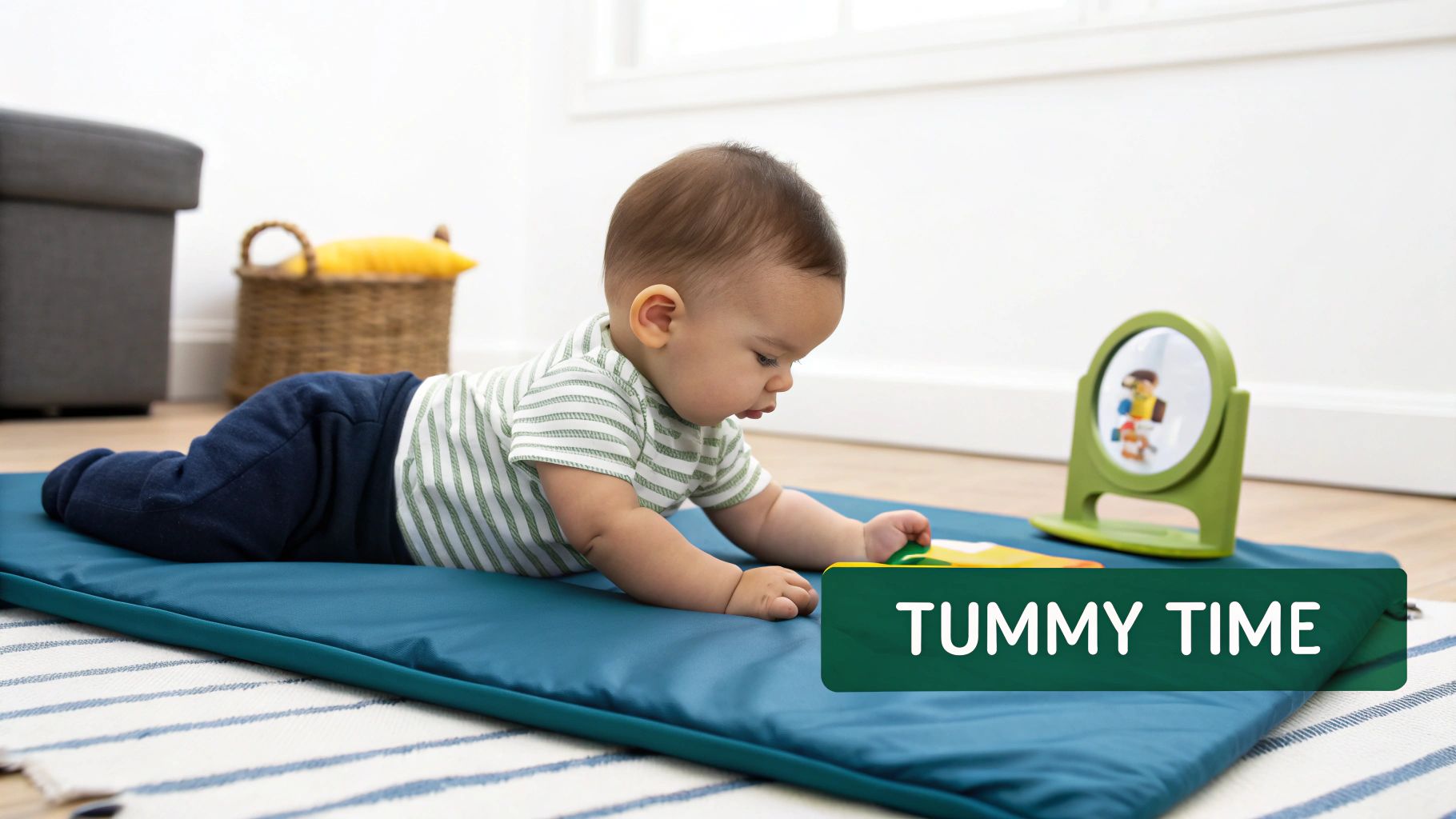
This elevated approach to a familiar activity uses captivating objects to motivate your baby to lift their head, push up on their arms, and even begin to pivot. As one of the most foundational 6 month old baby activities, it actively promotes motor skills and visual development simultaneously.
How to Implement Visually Stimulating Tummy Time
The goal is to place intriguing items within your baby's line of sight to encourage head and neck movement. Instead of just placing them on a mat, actively engage them with visual aids.
- High-Contrast Cards: Place black-and-white or brightly coloured cards in front of them. Slowly move a card from side to side to encourage them to track it with their eyes and turn their head.
- Unbreakable Mirror: A baby-safe mirror is a fantastic tool. Babies are fascinated by faces, and seeing their own reflection can motivate them to push up higher for a better look.
- Colourful Toys: Position a favourite brightly coloured rattle or sensory toy just beyond their reach. This can encourage them to shift their weight and even attempt to scoot forward.
Tips for Success
If your baby still fusses during tummy time, don't be discouraged. Consistency and a positive environment are key. For more in-depth guidance on establishing a routine, you can explore the principles of when to start and how to make tummy time effective.
Expert Tip: Try getting down on the floor at eye level with your baby. Your face is their favourite thing to look at, and your presence makes the activity feel more like social play than a chore.
Aim for several short sessions of 5-10 minutes throughout the day rather than one long one. Choose a time when your baby is happy and alert, such as after a nap but before they get hungry. This ensures they associate the activity with positive feelings, making it a cherished part of their daily routine.
2. Sensory Play with Textured Objects
At six months, your baby's world is a tactile playground. Sensory play with textured objects is a powerful way to stimulate their developing brain, encouraging them to use their hands and mouth to explore different surfaces. This activity builds crucial nerve connections, supports cognitive growth, and refines their fine motor skills as they learn to grasp, hold, and manipulate items intentionally.
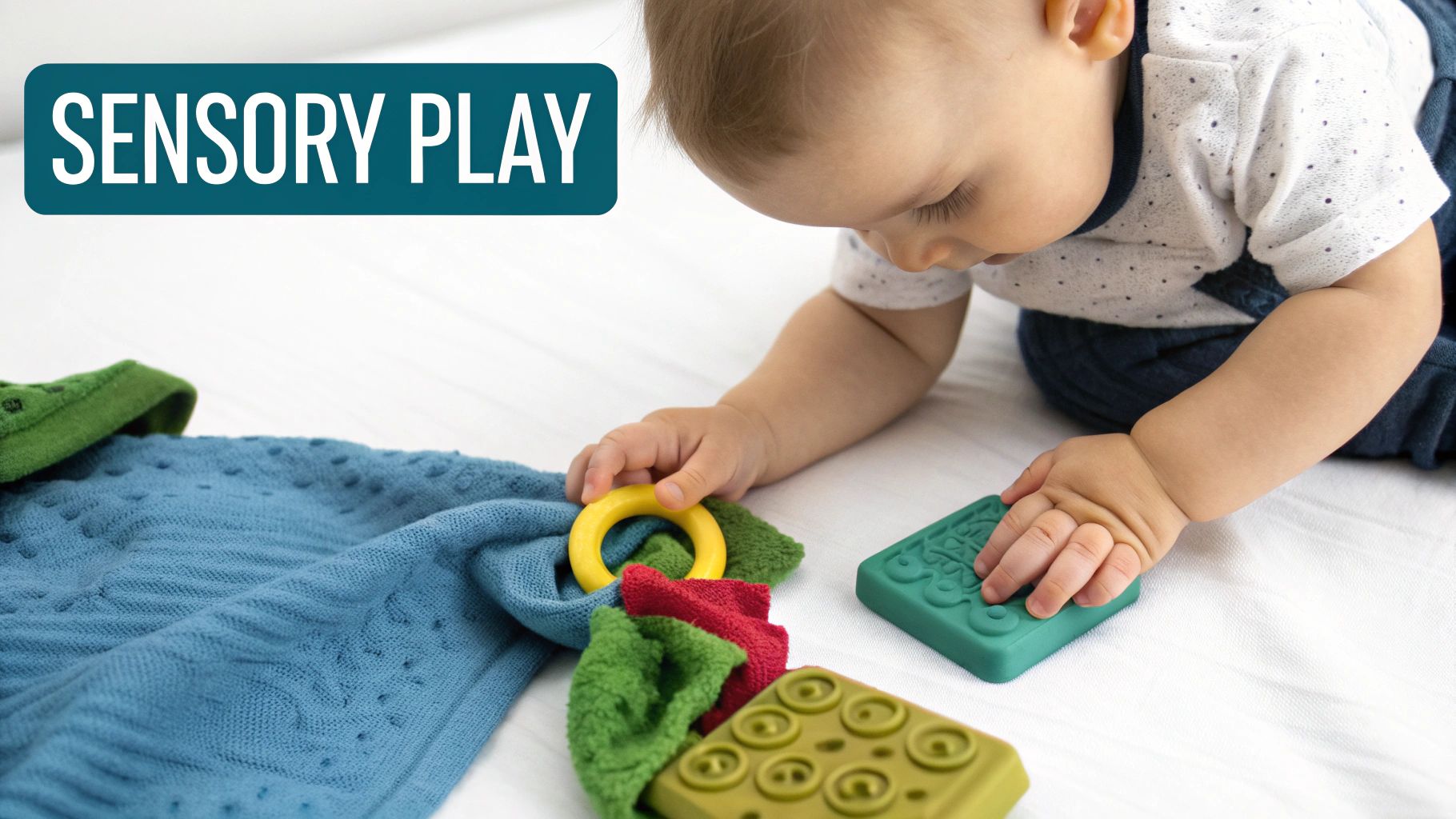
This hands-on exploration helps your baby make sense of their environment by categorising textures like soft, bumpy, smooth, and crinkly. As one of the most engaging 6 month old baby activities, it taps into their natural curiosity, enhancing their tactile awareness and hand-eye coordination every time they reach for a new object.
How to Implement Sensory Play with Textures
The key is to offer a safe and varied selection of objects for your baby to touch and mouth. Focus on items that provide distinct tactile feedback to keep them engaged.
- Fabric Books and Squares: Introduce soft books with different textures, such as crinkly pages, fluffy patches, or silky ribbons. A simple basket of fabric squares (velvet, corduroy, silk) can also be a treasure trove of sensory input.
- Textured Toys: Offer toys specifically designed for sensory development. Items like the multi-textured Sophie the Giraffe or a Lamaze toy with various fabrics, knots, and tags are excellent choices.
- DIY Sensory Bags: Securely seal a zip-top bag containing safe materials like hair gel with glitter or water with colourful beads. Tape all sides firmly to a highchair tray or the floor for supervised, mess-free squishing and exploration.
Tips for Success
To make sensory play both safe and stimulating, supervision is paramount. Regularly rotate the items you offer to maintain your baby's interest and introduce new sensations. For more creative concepts, you can explore these sensory play ideas for babies.
Expert Tip: Combine textures with sounds. Offer a toy that crinkles when squeezed or a rattle with a smooth surface. This multi-sensory approach deepens their learning experience by connecting what they feel with what they hear.
Always inspect toys for loose parts or tears, especially as your baby will likely explore them with their mouth. Include a mix of hard and soft items to provide a range of experiences, and watch for teething signs, offering appropriate textures like a cool, bumpy teether to soothe their gums.
3. Rattles and Sound Exploration
At six months old, your baby's grasp has transformed from a reflexive clutch to a deliberate action. Introducing rattles and sound-making toys at this stage capitalises on this newfound control, teaching them the fundamental concept of cause and effect. This simple act of grasping and shaking strengthens hand-eye coordination and fine motor skills, laying the groundwork for more complex actions like passing objects between hands and self-feeding.
This sensory-rich activity is a cornerstone among 6 month old baby activities because it directly stimulates auditory processing while refining motor control. As your baby intentionally creates sound, they are not just playing; they are conducting their first experiments in physics and learning that their actions can influence their environment.
How to Implement Rattles and Sound Exploration
The key is to guide your baby in discovering their ability to make noise. This isn't just about handing them a toy; it's about demonstrating the connection between their movement and the resulting sound.
- Model the Action: Gently take the rattle and shake it near your baby, showing them where the sound comes from. Then, place it in their hand and help them shake it so they can feel the motion that creates the noise.
- Vary the Toys: Introduce rattles with different sounds, textures, and shapes. An Oball rattle is easy for small hands to grip, while a wooden rattle offers a different tactile experience and sound. This variety keeps them engaged and challenges their developing senses.
- Create a Soundscape: Use different volumes and rhythms. Shake a rattle softly, then loudly. Shake it quickly, then slowly. This helps develop their auditory discrimination skills.
Tips for Success
To make sound exploration a positive and safe experience, pay attention to your baby's cues and the quality of their toys. The goal is joyful discovery, not overwhelming stimulation.
Expert Tip: Combine rattling with music or singing. Shake the rattle to the beat of a nursery rhyme. This adds another layer to the sensory experience, connecting movement, sound, and rhythm in a way that is highly engaging for their developing brain.
Choose a time when your baby is calm and ready to play, perhaps while they are sitting supported on your lap or in a high chair. Always inspect toys for loose parts or damage before each use to ensure they are safe for your little one to explore with their hands and mouth.
4. Baby Mirror Play and Self-Recognition
At six months old, a baby's world is expanding rapidly, and so is their sense of self. Mirror play is a fascinating activity that taps directly into this emerging awareness. By engaging with their own reflection, babies develop crucial visual tracking skills, social-emotional understanding, and the very first flickers of self-recognition. It transforms a simple object into a powerful tool for cognitive and personal discovery.
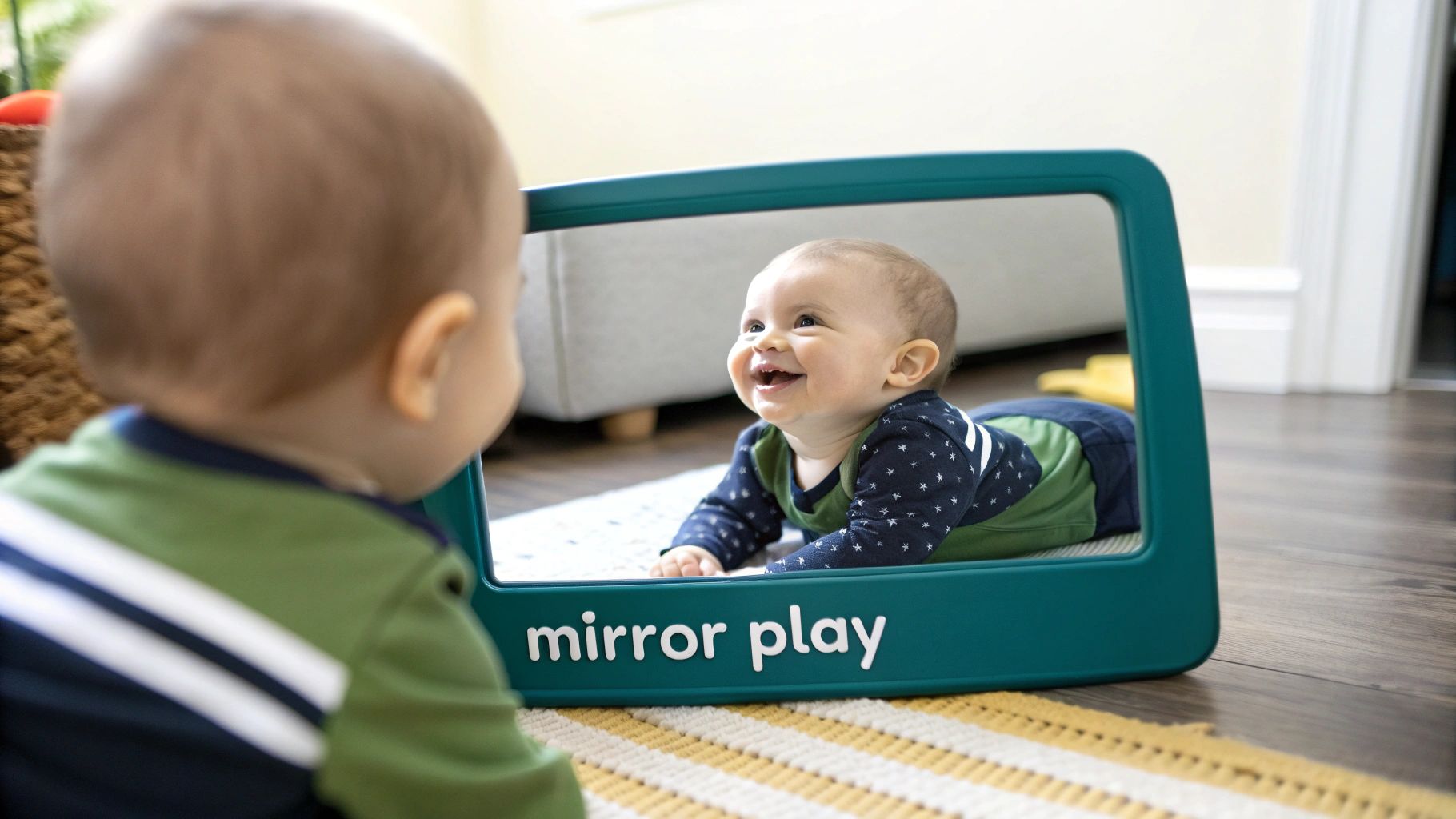
This activity leverages a baby's natural curiosity about faces. While they don't yet understand that the baby in the mirror is them, they are captivated by the responsive image that mimics their movements. This simple interaction is one of the most effective 6 month old baby activities for fostering early social skills and an understanding of cause and effect.
How to Implement Baby Mirror Play
The key is to make the mirror accessible and the experience interactive. Use only baby-safe, shatterproof mirrors made from materials like acrylic.
- Tummy Time Enhancement: Place a baby-safe mirror on the floor in front of your baby during tummy time. This encourages them to lift their head and push up on their arms for a better view, strengthening their upper body.
- Sitting Support: If your baby is beginning to sit with support, sit behind them in front of a larger mirror. They will delight in seeing both your reflection and their own, creating a shared social experience.
- Verbal Engagement: Use the mirror as a prop for communication. Point to their reflection and say, "Look at the baby!" or name their facial features: "Where is your nose?" and then gently touch their nose.
Tips for Success
Safety and interaction are paramount for making mirror play both fun and beneficial. Always ensure any mirror is securely fastened and cannot be pulled over.
Expert Tip: Engage with the reflection alongside your baby. Make funny faces, smile, and talk to the "baby in the mirror." Your interaction models social behaviour and shows them that the reflection is a source of fun and engagement.
Keep the mirror clean and free from smudges to provide a clear image. This simple act of maintenance ensures the visual feedback is sharp, holding their attention for longer. Integrating mirror play into daily routines, like after a nappy change, helps build a positive and consistent learning experience.
5. Reaching and Grasping Games
Around six months, your baby's hand-eye coordination takes a significant leap forward. They are moving from reflexive batting to purposeful reaching and grasping. Structured play that encourages this development is vital for building fine motor skills, understanding cause and effect, and exploring their environment with growing confidence. These games are a cornerstone of effective 6 month old baby activities, helping to bridge the gap between seeing an object and intentionally interacting with it.
This type of play strengthens the small muscles in their hands and fingers and teaches them about different textures, shapes, and weights. Encouraging them to reach and grasp also promotes core strength and balance, as they learn to shift their weight and stabilise their bodies to get what they want.
How to Implement Reaching and Grasping Games
The key is to create an environment that tempts your baby to explore objects with their hands. This involves strategically placing interesting items just within, and sometimes slightly beyond, their immediate reach to motivate movement.
- Toy Placement Challenge: During floor play, position a few safe, brightly coloured toys around your baby. Place one just close enough to grab easily, and another that requires them to stretch or pivot slightly.
- Play Gym Fun: A play gym is perfect for this. Adjust the hanging toys so your baby has to reach up to bat at or grab them. This encourages them to use both hands and strengthens their arm muscles.
- Soft Block Towers: Sit with your baby and build a small, simple tower of soft foam blocks. Let them reach out to knock it down. This simple action-reaction game is incredibly rewarding for them.
- Rolling Ball Play: Gently roll a colourful, textured ball towards and then just past your baby. This encourages them to reach, track a moving object with their eyes, and eventually attempt to grasp it.
Tips for Success
The goal is to provide a gentle challenge without causing frustration. Make it a fun, interactive experience that builds both their skills and their self-esteem.
Expert Tip: Notice which hand your baby favours, but always offer toys to both the left and right sides, and in the centre. This encourages bilateral coordination and helps them practise transferring objects from one hand to the other, a key developmental milestone at this age.
Celebrate every attempt, not just the successful grabs, with smiles and praise. As their skills improve, you can gradually increase the distance of the toys to encourage early crawling movements like scooting and pivoting. Always ensure the play area is safe and free from any small objects that could pose a choking hazard.
6. Baby-Friendly Music and Movement
Introducing music and movement into your baby's daily routine is a joyful way to stimulate their auditory senses, develop rhythm, and strengthen your emotional connection. At six months, babies are becoming more aware of sounds and patterns, and they can start to recognise familiar melodies. This activity supports cognitive development, language acquisition, and gross motor skills as they begin to respond to music with babbles, smiles, and body movements.
This sensory-rich experience uses sound and physical interaction to engage your baby's developing brain. As one of the most delightful 6 month old baby activities, it lays a foundation for a lifelong appreciation of music while promoting crucial developmental milestones in a fun and interactive way.
How to Implement Music and Movement
The goal is to create a playful and responsive musical environment. You don’t need to be a musician; your baby will simply love the sound of your voice and the feeling of moving with you.
- Sing Nursery Rhymes with Actions: Classic songs like "Pat-a-Cake," "If You're Happy and You Know It," and "The Wheels on the Bus" are perfect. Use hand gestures and movements that your baby can watch and eventually try to imitate.
- Dance Together: Hold your baby securely and gently sway, bounce, or dance around the room to different types of music. Vary the tempo from slow and calming to upbeat and energetic to expose them to different rhythms.
- Introduce Baby-Safe Instruments: Use simple instruments like egg shakers, colourful scarves for waving, or a small drum they can pat. This helps them explore cause and effect while engaging with the music.
Tips for Success
Focus on interaction and fun rather than performance. Your enthusiasm is the most important element in making this a positive experience for your little one.
Expert Tip: Repetition is key for learning at this age. Singing the same songs regularly helps your baby build familiarity and anticipation, which are early cognitive skills. You'll soon notice them reacting with excitement when a favourite tune begins.
Keep the volume at a comfortable, conversational level to protect your baby's sensitive hearing. Make plenty of eye contact while you sing and move, as this reinforces your bond and helps them learn social cues. Choose times when your baby is alert and content, turning music into a cherished part of your daily play.
7. Object Permanence Games (Peek-a-Boo Variations)
Around six months, your baby starts to grasp a monumental cognitive concept: object permanence. This is the understanding that objects and people continue to exist even when they can no longer be seen. Playing games that reinforce this idea is not just fun; it's a critical step in their cognitive development, helping to reduce separation anxiety later on. These activities teach your baby about cause and effect and the predictability of their world.
Engaging in these simple hiding and finding games is one of the most impactful 6 month old baby activities for building foundational cognitive skills. It turns a simple interaction into a powerful learning moment, strengthening their memory and problem-solving abilities while fostering a sense of security and trust.
How to Implement Object Permanence Games
The key is to make objects disappear and reappear in a playful, predictable way. Your enthusiastic reactions are just as important as the game itself.
- Classic Peek-a-Boo: The simplest version involves covering your own face with your hands and then revealing it with a cheerful "Peek-a-boo!" You can also use a light muslin cloth to gently cover your baby’s face for a second before whisking it away.
- Hide the Toy: Place a favourite toy on the floor and cover it with a small, lightweight blanket or a silk scarf while your baby is watching. Encourage them to find it by asking, "Where did the teddy go?"
- Pop-Up Toys: Toys where a character pops up after a button is pushed are perfect for this stage. They provide a surprising and delightful demonstration of an object reappearing.
Tips for Success
Start simple and gradually increase the complexity as your baby catches on. The goal is to create a fun challenge, not a frustrating one. For a deeper dive into the developmental science, you can read about what object permanence is and why it matters.
Expert Tip: Use exaggerated facial expressions and a surprised tone of voice when the object reappears. Saying "There it is!" with excitement reinforces the concept and makes the game more engaging and rewarding for your baby.
Repetition is your best friend here. Playing these games regularly helps solidify the concept in your baby's mind. Keep sessions short and sweet, stopping before your little one becomes tired or fussy, ensuring it remains a joyful and anticipated part of their day.
8. Water Play and Bath Time Exploration
For a six-month-old, bath time can be transformed from a simple cleaning routine into a multisensory learning adventure. This period is perfect for introducing safe, supervised water play, which supports sensory development by letting them feel different temperatures and textures. It also introduces early physics concepts like cause-and-effect as they splash, pour, and watch objects float, making it a truly valuable part of your list of 6 month old baby activities.
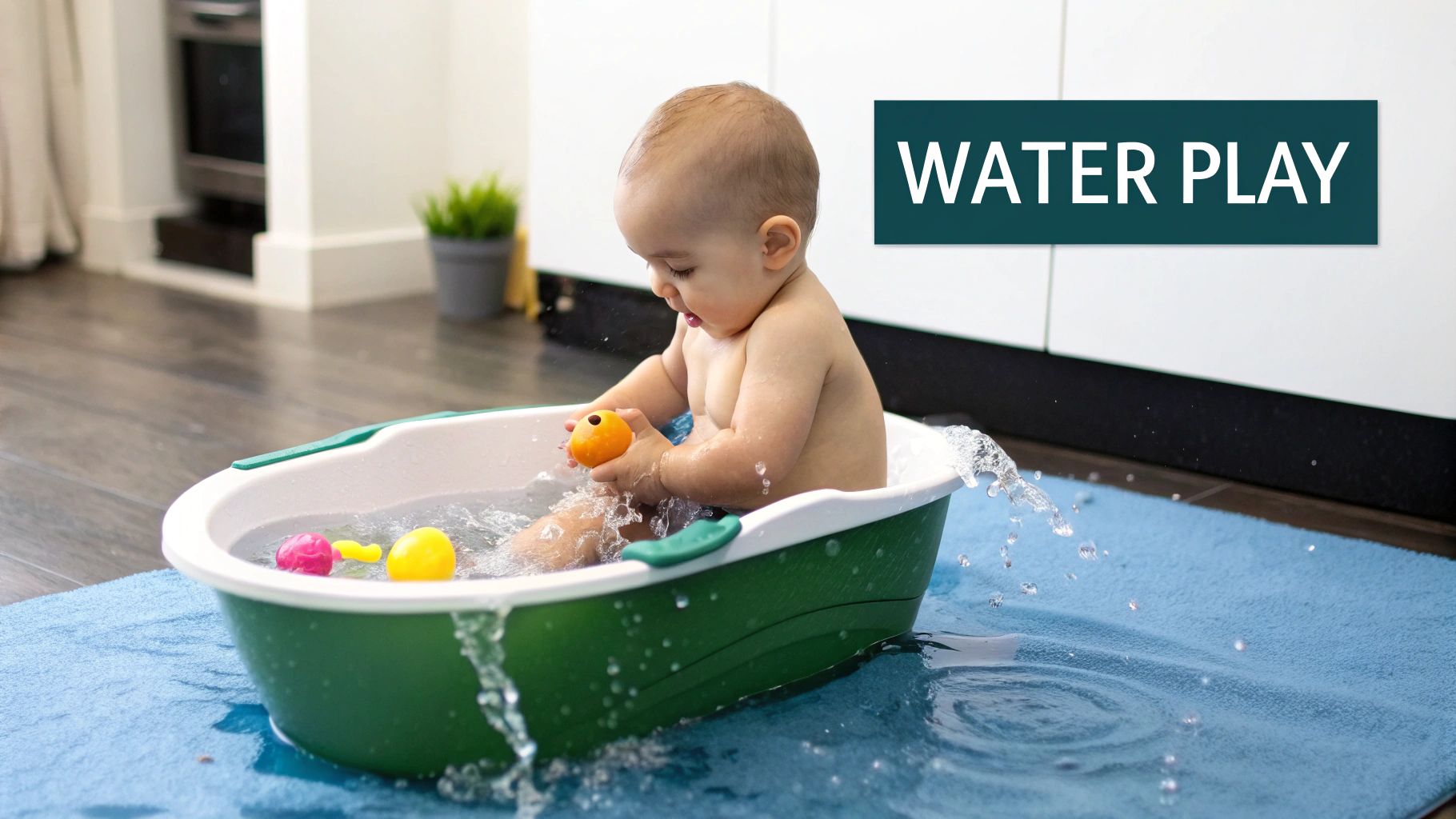
This engaging activity uses the unique properties of water to stimulate your baby’s senses and encourage exploration in a new environment. By interacting with water and bath toys, they are not only having fun but also building cognitive skills and hand-eye coordination as they learn to grasp, scoop, and pour.
How to Implement Water Play Exploration
The key is to turn the bath into a safe and stimulating miniature water park. Introduce simple, age-appropriate toys and actions that encourage interaction and discovery.
- Simple Scoops and Pours: Provide small, baby-safe cups or containers. Guide your baby’s hands to help them scoop water and pour it out, demonstrating how water moves.
- Floating Friends: Use classic rubber ducks or other floating bath toys. Gently push them under the water and let them pop back up to surprise and delight your baby.
- Splish and Splash: Let them splash with their hands and feet. This is a simple but powerful way for them to understand that their actions can create a reaction in their environment.
- Soft Squirt Toys: Introduce soft, easy-to-squeeze toys that can be filled with water. A gentle squirt can be a fun game that teaches cause and effect.
Tips for Success
Safety and comfort are paramount for making water play a positive experience. Always have everything you need within arm's reach before you begin so you never have to leave your baby unattended.
Expert Tip: Test the water temperature with your elbow or a bath thermometer before placing your baby in the tub; it should be lukewarm, around 37°C to 38°C. A warm and comfortable environment helps your baby relax and engage more freely in play.
Start with short sessions of 5-10 minutes, especially if your baby is hesitant at first. Your calm and playful attitude will show them that the bath is a fun and secure place. Keep one hand on your baby at all times to ensure their safety and build their confidence in the water.
8-Point Comparison: 6-Month Baby Activities
| Activity | Implementation Complexity 🔄 | Resources & Setup ⚡ | Expected Outcomes & Key Advantages ⭐📊 | Ideal Use Cases 💡 |
|---|---|---|---|---|
| Tummy Time with Visual Stimulation | Moderate 🔄 — requires positioning, short supervised intervals | Low ⚡ — padded mat, high-contrast cards, baby mirror | ⭐ Builds neck/core strength; prevents flat head; supports rolling/crawling milestones 📊 | Short daily sessions when baby is rested; combine with mirror or toys |
| Sensory Play with Textured Objects | Low–Moderate 🔄 — select safe textures, rotate items, supervise | Low ⚡ — textured toys or DIY items; regular cleaning | ⭐ Enhances tactile processing, fine motor skills, curiosity 📊 | Multiple short sessions daily during alert exploration and mouthing phases |
| Rattles and Sound Exploration | Low 🔄 — simple demos; monitor for overstimulation | Minimal ⚡ — safe rattles/shakers, washable materials | ⭐ Develops auditory discrimination, cause-and-effect, motor control 📊 | Short sessions several times daily; pair with songs or vocal play |
| Baby Mirror Play and Self-Recognition | Low 🔄 — position securely at eye level; keep clean | Low ⚡ — shatter‑resistant mirror (portable or mat-mounted) | ⭐ Promotes self-awareness, facial imitation, social-emotional skills 📊 | Tummy time or quiet play; use to encourage imitation and expression |
| Reaching and Grasping Games | Moderate 🔄 — arrange objects at varying distances, supervise frustration | Low ⚡ — toys/household items, safe play surface | ⭐ Builds fine motor control, hand-eye coordination, spatial awareness 📊 | Floor play sessions (15–20 min), progress distance as skills improve |
| Baby-Friendly Music and Movement | Low 🔄 — sing, sway, introduce simple instruments consistently | Minimal ⚡ — songs, safe shakers/drums, calm space | ⭐ Supports language, auditory processing, bonding and gross motor skills 📊 | Bonding times, soothing routines, short group or home sessions |
| Object Permanence Games (Peek‑a‑Boo) | Low–Moderate 🔄 — predictable repetition; adjust difficulty | Minimal ⚡ — toys, blankets, pop-up toys | ⭐ Strengthens cognitive skills, memory, social engagement 📊 | Interactive play when baby is attentive; several short repetitions weekly |
| Water Play and Bath Time Exploration | Moderate–High 🔄 — strict safety, temperature control, constant supervision | Moderate ⚡ — baby tub, non-slip surface, bath toys, thermometer | ⭐ Develops sensory awareness, cause-and-effect; calming routine 📊 | Bath time only (short 5–10 min sessions); always supervised and prepared |
Making Every Moment Count: Your Playtime Journey Forward
The six-month mark is a truly magical milestone, a gateway into a world of more interactive and purposeful play. As we have explored, the journey through tummy time, sensory discovery, and the simple joy of a peek-a-boo game is about so much more than just passing the time. Each of these carefully chosen 6 month old baby activities serves as a crucial building block for your little one’s cognitive, motor, and emotional development.
From the fine motor skills honed by grasping for a rattle to the early self-awareness sparked by a mirror, you are laying the groundwork for future learning. Remember, the goal is not to perform every activity every day but to create a rich, responsive, and playful environment. Pay close attention to your baby's unique cues and temperament. Some days they might be fascinated by the crinkle of a sensory toy, while on others, the gentle rhythm of a song and dance is all the engagement they need. The key is your presence and participation.
Key Takeaways for Playful Parenting
As you move forward, keep these core principles at the forefront of your playtime strategy:
- Observe and Adapt: Your baby is your best guide. Their interest, or lack thereof, will tell you when it is time to switch activities or simply take a break. Flexibility is your greatest asset.
- Safety First: As your baby becomes more mobile and curious, ensure their play space is completely safe. Check toys for small parts and always supervise activities, especially those involving water or small objects.
- Celebrate Small Wins: The first successful grasp, a giggle during peek-a-boo, or a splash in the bath are all significant achievements. Acknowledging and celebrating these moments reinforces your baby's efforts and strengthens your bond.
Beyond specific activities, a baby's overall health and well-being are fundamental to their development and capacity for play. A comfortable and happy baby is a curious and engaged baby. Supporting their foundational systems, like their immune and digestive health, can contribute to a more energetic playtime experience. For parents exploring holistic approaches, understanding the role of probiotics for children's gut health can offer valuable insights into supporting their overall wellness from the inside out.
Ultimately, the most profound impact of these activities comes from the connection you build. Your loving voice, your encouraging smile, and your gentle touch are the most powerful developmental tools you possess. You are your baby's first and most important playmate. Cherish this fleeting period of rapid discovery, and find joy in watching the world unfold through their eyes.
Ready to take the guesswork out of developmental play? The Grow With Me subscription box delivers expertly curated, age-appropriate toys and activity guides straight to your door. Discover the perfect tools to support your baby's next milestone at Grow With Me.