

8 Developmental 18 Months Old Activities to Try in 2025
Welcome to the exciting world of an 18-month-old, a time of incredible growth, boundless curiosity, and a rapidly expanding sense of self. At this pivotal stage, your toddler is no longer a baby but a determined explorer, actively making sense of their environment through hands-on interaction. Their days are filled with "what's this?" and "I can do it myself," marking huge developmental leaps in motor skills, language comprehension, and problem-solving abilities.
This is where purposeful play becomes so crucial. Engaging your little one in the right kinds of 18 months old activities does more than just fill the day; it provides the building blocks for cognitive, physical, and emotional development. Simple, targeted play helps strengthen fine motor coordination, encourages early language, and fosters a love of learning. It’s not about complex lesson plans or expensive toys, but about creating meaningful moments of connection and discovery.
This comprehensive guide is designed to be your go-to resource for fun, simple, and effective activities. We have organised a collection of ideas that support your toddler’s development, from sensory play with household items to outdoor adventures that build gross motor skills. Each activity includes a clear 'how-to', a list of materials (with tips for using your Grow With Me kits), and the specific developmental benefits. Our goal is to empower you with practical, actionable ideas that you can implement straight away, turning everyday moments into opportunities for joyful learning and growth. Let's dive in.
1. Sensory Play with Natural Materials
Sensory play is a cornerstone of toddler development, inviting your 18-month-old to explore the world using all their senses. It involves hands-on activities with materials that have diverse textures, temperatures, and properties, like sand, water, leaves, or even uncooked pasta. At this age, toddlers are driven by a powerful curiosity to touch, see, and understand everything around them, making this one of the most effective 18 months old activities for learning.
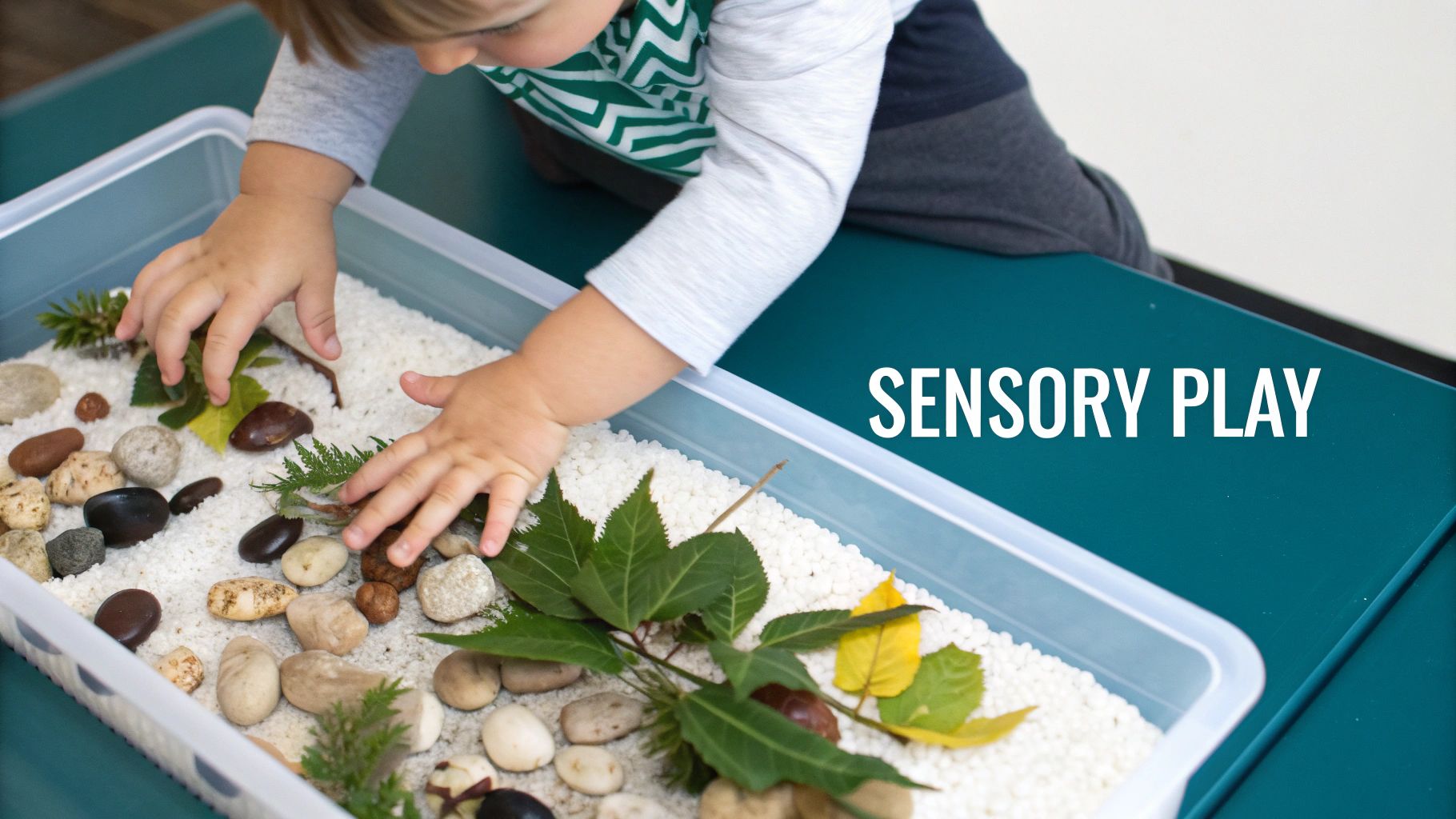
This type of play is foundational for building nerve connections in the brain, supporting everything from language development to problem-solving skills. By manipulating different materials, children learn about cause and effect (what happens when I pour water?), develop fine motor skills (picking up a single grain of rice), and expand their vocabulary (describing something as "smooth," "cold," or "rough").
How to Implement Sensory Play
A simple sensory bin is an excellent starting point. All you need is a shallow container, a filler material, and some tools for exploration.
- Step 1: Choose a Base. Fill a shallow plastic tub or a baking tray with a taste-safe material. Good options for an 18-month-old include water, cooked spaghetti, or a dry base like oats or cornmeal.
- Step 2: Add Natural Elements. Introduce items from a nature walk, such as smooth stones (large enough not to be a choking hazard), crunchy leaves, pinecones, or flower petals. This adds a fantastic layer of texture and connection to the outdoors.
- Step 3: Provide Tools. Add scoops, funnels, small cups, or even toys like the wooden scoop from your Grow With Me kit. These tools encourage pouring, measuring, and transferring, which are key for developing hand-eye coordination.
- Step 4: Supervise and Engage. Sit with your toddler and describe what they are feeling. Say things like, "The stone feels cool and smooth," or "Listen to the crunchy sound the leaves make!"
Developmental Benefits
Engaging in sensory play offers a wealth of benefits that support your toddler's growth:
- Cognitive Development: It encourages scientific thinking as toddlers experiment with materials.
- Motor Skills: Scooping, pouring, and pinching small objects strengthens fine motor control and pincer grasp.
- Language Skills: You can introduce new descriptive words like "gritty," "slimy," "warm," and "bumpy."
- Emotional Regulation: The focused, repetitive nature of sensory play can be very calming and help toddlers regulate their emotions.
For even more inspiration and ideas on how to create engaging experiences, explore these sensory play ideas for toddlers and discover new ways to stimulate your child's senses.
2. Sorting and Stacking Activities
Sorting and stacking activities are fundamental for an 18-month-old's cognitive development. These simple games involve organising objects by characteristics like colour, shape, or size, and building towers with blocks or stacking rings. At this age, toddlers are just beginning to grasp the concept of categories, making these some of the most effective 18 months old activities for nurturing early problem-solving skills.
These hands-on tasks teach toddlers about logic, spatial awareness, and cause and effect (if I stack too high, it falls over!). By manipulating chunky blocks or sorting colourful pom-poms, they strengthen their hand-eye coordination and fine motor control. It’s a playful way to introduce foundational maths concepts and build concentration.
How to Implement Sorting and Stacking
You can easily set up these activities at home with toys or household items. The key is to start simple and build complexity as your child’s skills grow.
- Step 1: Choose Your Materials. Gather items that are safe and easy for little hands to hold. This could be large wooden blocks, colourful stacking cups, or even a shape sorter toy. For a DIY approach, use different coloured laundry baskets and soft balls.
- Step 2: Start with a Simple Goal. Begin with a basic task, like sorting objects into just two colour groups (e.g., all the red balls in one tub, all the blue ones in another). For stacking, start with just a few blocks to build a small tower.
- Step 3: Demonstrate and Guide. Show your toddler how it’s done. Stack a few blocks yourself or place a red ball into the red basket. Use simple language like, "This is a blue block," or "Let’s put the big ring on first."
- Step 4: Encourage Independent Play. Once you’ve demonstrated, step back and let your toddler explore. Praise their effort and attempts, not just their successful placements. The goal is exploration and learning, not perfection.
Developmental Benefits
Sorting and stacking offer a powerful combination of physical and cognitive skill-building that is perfect for this age:
- Cognitive Development: Promotes early categorisation, problem-solving, and understanding of concepts like "same" and "different."
- Motor Skills: Stacking blocks and placing shapes develops hand-eye coordination, pincer grasp, and wrist control. These are crucial for the development of fine motor skills.
- Language Skills: Provides opportunities to name colours, shapes, and sizes, as well as introduce words like "on top," "under," "big," and "small."
- Focus and Concentration: These activities require focus, helping to lengthen your toddler's attention span over time.
For a deeper look into how these activities contribute to your child's physical development, discover more about fine motor skills development activities and find new ways to support their growth.
3. Music and Rhythm Exploration
Music and rhythm activities involve exposing your 18-month-old to various sounds, beats, and simple instruments. This includes singing, dancing, playing with shakers or drums, and listening to different musical styles. Music is a powerful tool for development, engaging multiple areas of the brain at once, making it one of the most joyful and effective 18 months old activities for learning.
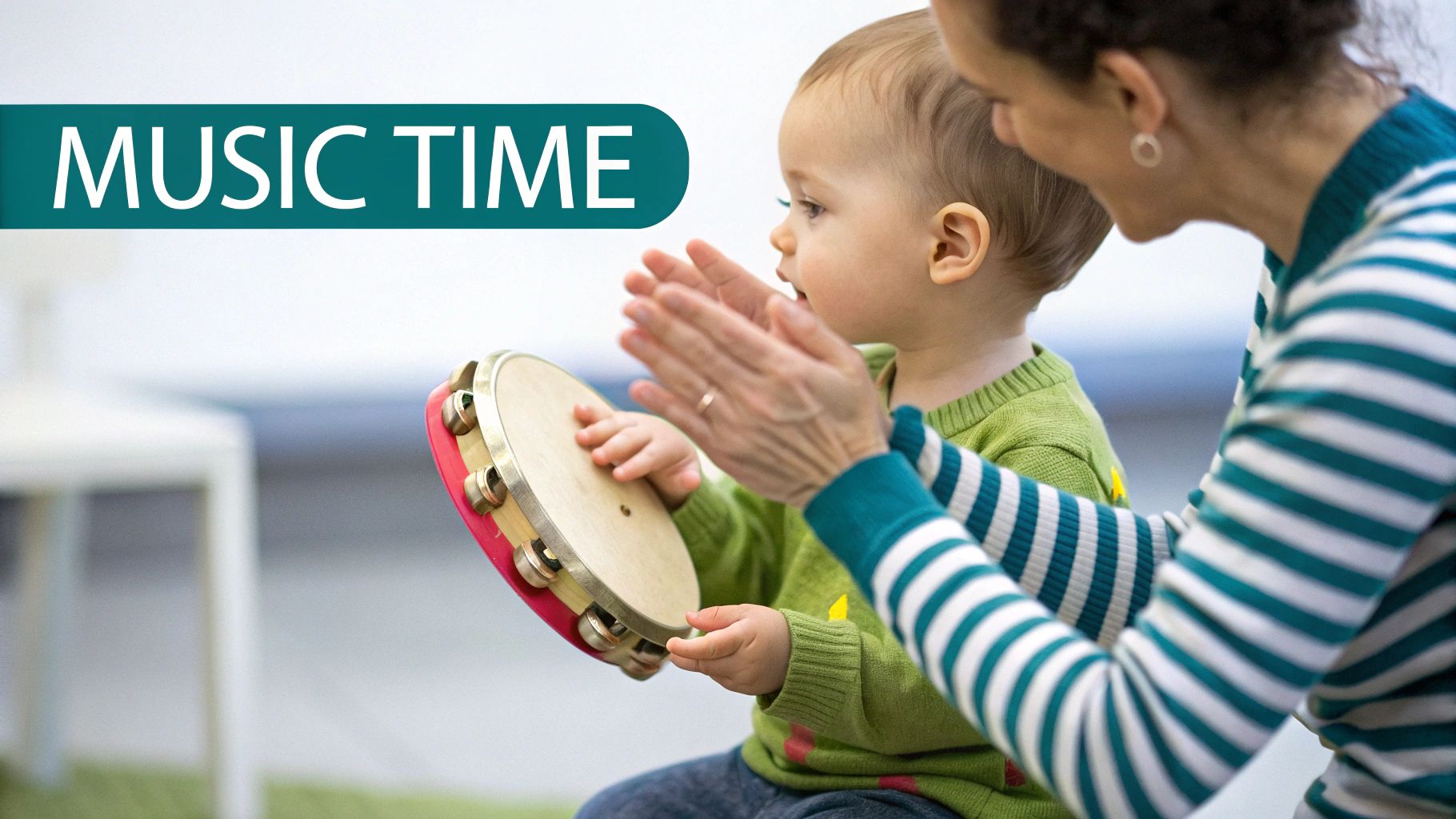
At this age, toddlers are beginning to understand patterns and repetition, which are the building blocks of music. Engaging with rhythm helps them develop coordination, while singing songs builds vocabulary and memory. It’s a holistic activity that supports everything from emotional expression to gross motor skills, all while creating a fun and positive bonding experience.
How to Implement Music and Rhythm Exploration
You don't need to be a musician to introduce your toddler to the wonders of sound. Everyday objects and simple songs are all you need to get started.
- Step 1: Create a DIY Band. Gather household items that make interesting noises. Pots and pans with wooden spoons make great drums, while a sealed container filled with rice or pasta becomes a simple shaker.
- Step 2: Sing and Move. Put on some of your favourite music and dance together. Sing classic nursery rhymes like "Wheels on the Bus" or "Old MacDonald," using hand gestures and actions to match the words. This helps your toddler connect words with movements.
- Step 3: Introduce Simple Instruments. If you have them, bring out child-safe instruments like maracas or a tambourine. The wooden maracas from your Grow With Me kit are perfect for little hands. Show your toddler how to shake them to the beat of a song.
- Step 4: Have a "Listen and Copy" Game. Clap a simple rhythm and encourage your toddler to copy you. You can also make different sounds (like "boom," "tap," "shhh") and see if they imitate them.
Developmental Benefits
Making music offers a symphony of developmental advantages for your growing toddler:
- Language Development: Singing songs introduces new words, rhyme, and rhythm, which are foundational for language acquisition.
- Motor Skills: Dancing improves balance and gross motor skills, while playing instruments refines fine motor control and hand-eye coordination.
- Cognitive Skills: Recognising patterns in music and remembering song lyrics enhances memory and early mathematical thinking.
- Emotional Expression: Music provides a healthy outlet for toddlers to express feelings like happiness, excitement, or calmness.
4. Simple Puzzle and Matching Games
Simple puzzles and matching games introduce your 18-month-old to fundamental problem-solving and cognitive skills. These activities feature large pieces, bold images, and clear matching concepts, making them perfect for tiny hands and developing minds. They are fantastic 18 months old activities for supporting spatial reasoning, hand-eye coordination, and the development of persistence, all of which are critical foundations for future learning.
This type of focused play helps toddlers learn to recognise shapes, colours, and patterns, building their visual discrimination skills. As they work to fit a piece into its correct spot or find a matching pair of cards, they are practising logic and memory. The feeling of accomplishment when they successfully complete a puzzle is also a powerful confidence booster.
How to Implement Puzzle and Matching Games
Getting started is easy. Choose age-appropriate puzzles and present them in a calm, encouraging environment.
- Step 1: Select the Right Puzzle. Begin with a simple wooden peg puzzle or a 2-4 piece chunky puzzle. The key is to have large, easy-to-grasp pieces with distinct shapes and familiar images like animals or vehicles.
- Step 2: Demonstrate and Guide. The first time you introduce a puzzle, show your toddler how to do it. Take out one piece, name the object ("Look, a cow!"), and guide it back into its slot. Then, let them try.
- Step 3: Start a Simple Matching Game. Lay out two or three pairs of picture cards face up. Point to one card, say its name ("apple"), and help your child find the other "apple." Keep it simple and engaging.
- Step 4: Supervise and Encourage. Stay close by to offer gentle help if they get frustrated, but allow them space to problem-solve. Celebrate their successes with claps and praise to keep it fun and motivating.
Developmental Benefits
Puzzles and matching games are powerhouse activities that deliver a wide range of developmental rewards:
- Cognitive Development: They directly teach problem-solving, cause and effect, and spatial awareness as children figure out how pieces fit together.
- Motor Skills: Manipulating puzzle pieces builds fine motor strength, pincer grasp, and crucial hand-eye coordination.
- Language Skills: You can name the objects, colours, and shapes on the puzzles, expanding your toddler’s vocabulary.
- Emotional Regulation: Completing a puzzle fosters a sense of achievement and teaches persistence and concentration.
To find puzzles perfectly suited for this age group, explore options from brands like Melissa & Doug or Hape, which specialise in high-quality, developmentally appropriate wooden toys.
5. Gross Motor Play and Movement Activities
Gross motor play involves using the large muscles in the arms, legs, and torso for whole-body movements like running, climbing, and jumping. For an 18-month-old who is mastering walking and exploring their physical capabilities, these activities are essential. They are not just about burning off energy; they are foundational for developing balance, coordination, and spatial awareness, making them crucial 18 months old activities for confident movement.
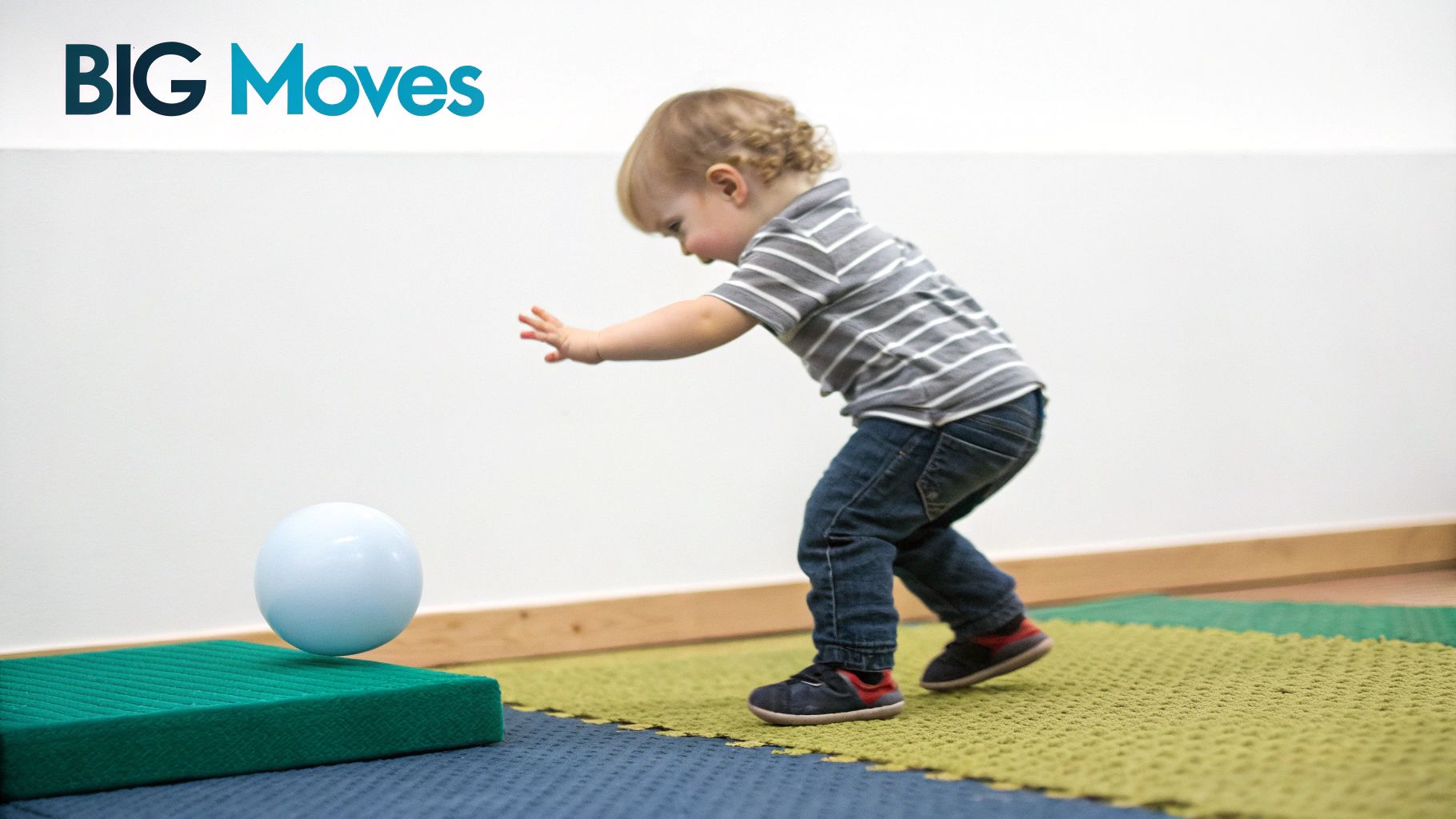
This type of play helps toddlers understand what their bodies can do and builds the physical confidence needed to tackle new challenges, like climbing a small slide or kicking a ball. By engaging in varied movements, they strengthen their core, improve their posture, and lay the groundwork for more complex athletic skills later on. It’s also a fantastic way for them to express emotions and joy through physical action.
How to Implement Gross Motor Play
Creating opportunities for large-scale movement can be simple and fun, both indoors and outdoors. The goal is to provide a safe space for exploration.
- Step 1: Create a Safe Play Area. Indoors, clear a space of hard furniture and use cushions or foam mats to create a soft obstacle course for climbing and crawling. Outdoors, find an open, grassy area away from hazards.
- Step 2: Introduce Movement Prompts. Encourage specific actions like dancing to music with different tempos, throwing soft balls into a laundry basket, or crawling through a play tunnel. Simple games like "chase" or "follow the leader" are also highly effective.
- Step 3: Offer Simple Equipment. You don’t need expensive gear. A small, lightweight ball for rolling and kicking, a low-to-the-ground ride-on toy, or even a line of masking tape on the floor to walk along can provide hours of developmental fun.
- Step 4: Model and Participate. Get involved by showing your toddler how to jump like a frog or walk backwards. Your participation makes the activity more engaging and less intimidating.
Developmental Benefits
Gross motor activities provide a wide range of benefits that are vital for your 18-month-old's development:
- Physical Strength: Builds muscle in the legs, arms, and core, improving overall strength and endurance.
- Coordination and Balance: Activities like walking on uneven surfaces or climbing help refine balance and body control.
- Cognitive Skills: Encourages problem-solving as toddlers figure out how to navigate obstacles or catch a ball.
- Confidence and Emotional Outlet: Mastering a new physical skill boosts self-esteem, and movement provides a healthy outlet for big feelings.
For toddlers ready for more structured movement, discovering the best dance classes for toddlers can provide an exciting outlet for their energy and emerging coordination skills.
6. Art and Creative Expression
Art and creative expression are fantastic ways for your 18-month-old to explore their world, communicate their feelings, and develop crucial physical skills. At this age, the focus isn't on creating a masterpiece but on the sensory experience of the process itself: the squish of paint between their fingers, the colourful mark a crayon leaves on paper, or the texture of different collage materials. These 18 months old activities are vital for nurturing creativity and building self-confidence in a fun, judgment-free environment.
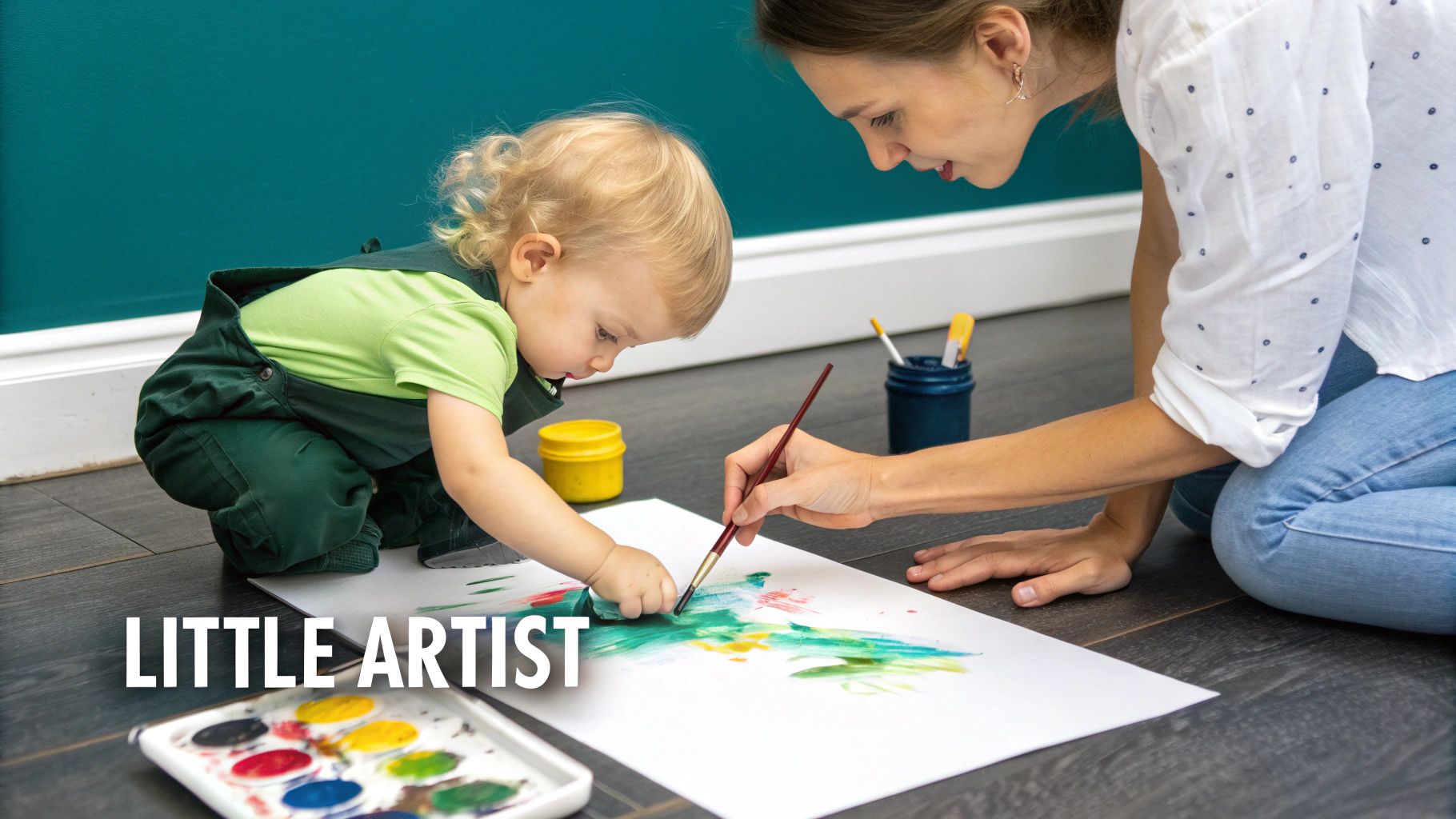
Engaging with art materials helps toddlers understand cause and effect ("When I press the crayon, a line appears!") and supports the development of fine motor skills needed for future writing. It's a powerful non-verbal outlet, allowing them to express emotions before they have all the words. This hands-on exploration builds new neural pathways and strengthens their ability to make choices and experiment with new ideas.
How to Implement Creative Expression
Setting up a creative session is simple and requires minimal supplies. The key is to embrace the mess and focus on the exploration.
- Step 1: Set Up a Safe Workspace. Cover the floor or a low table with newspaper or a plastic sheet. Dress your toddler in old clothes or an apron to protect their clothing.
- Step 2: Offer Simple, Safe Materials. Provide a large sheet of paper (an easel is great for this) and some chunky, non-toxic crayons or washable finger paints. Playdough with child-safe tools is another excellent option.
- Step 3: Let Them Lead the Way. Allow your child to explore the materials freely. Resist the urge to "correct" their technique or guide their hand. The goal is self-discovery, not a perfect product.
- Step 4: Engage and Describe. Talk about what they are doing. Use descriptive words like, "You're making a big, red circle!" or "The playdough feels soft and squishy." This helps build their vocabulary and connects words to actions.
Developmental Benefits
Art and creative activities offer a wide range of benefits that contribute to your toddler’s overall development:
- Fine Motor Skills: Gripping crayons, pinching playdough, and dabbing with a paintbrush all strengthen hand and finger muscles.
- Cognitive Development: Toddlers learn about colours, shapes, and cause and effect. It also enhances problem-solving as they figure out how to use different tools.
- Sensory Exploration: Art provides a rich sensory experience, engaging their sense of touch, sight, and even smell.
- Emotional Expression: It provides a safe and constructive outlet for expressing feelings and emotions that they may not be able to verbalise yet.
7. Nature Exploration and Outdoor Discovery
Getting outside is one of the most enriching 18 months old activities you can do, offering a full-sensory experience that is impossible to replicate indoors. Nature exploration encourages your toddler to observe, touch, and interact with the natural environment, from feeling the rough bark of a tree to watching a busy ant carry a crumb. This kind of unstructured play in nature is vital for physical and cognitive development.
At 18 months, your child is developing a keen sense of curiosity about the world. An outdoor adventure, whether in a garden, a local park, or a woodland trail, provides endless opportunities for learning. It supports motor skills as they navigate uneven ground, stimulates their senses with new smells, sights, and textures, and cultivates an early appreciation for the natural world.
How to Implement Nature Exploration
You don't need a grand plan to explore nature; often the simplest outings are the most rewarding. The key is to let your toddler lead the way within safe boundaries.
- Step 1: Choose a Safe Location. Find a nearby park, nature reserve, or even your own garden that is free from immediate hazards like busy roads or deep water.
- Step 2: Go on a "Collecting" Walk. Take a small bag or bucket and encourage your toddler to collect interesting natural treasures. This could include fallen leaves, smooth stones (large enough not to be a choking hazard), pinecones, or twigs.
- Step 3: Engage the Senses. Prompt your child to touch different textures. Feel the bumpy bark of a tree, the soft petals of a flower, or the cool surface of a puddle. Talk about what you see, hear, and smell.
- Step 4: Narrate the Experience. Build their vocabulary by naming what you discover. Say things like, "Look at the busy bee on the yellow flower," or "This leaf is so crunchy!" This connects words to real-world objects and experiences.
Developmental Benefits
Time spent in nature offers a wide array of benefits that support your toddler's holistic development:
- Gross Motor Skills: Walking on grass, climbing small inclines, and running in an open space builds strength, balance, and coordination.
- Sensory Development: Nature provides a rich variety of stimuli, from the feeling of a cool breeze to the sound of birdsong, which helps build neural pathways in the brain.
- Cognitive Growth: Observing insects, plants, and animals fosters early scientific curiosity and an understanding of cause and effect (e.g., splashing in a puddle makes a mess).
- Emotional Well-being: Spending time outdoors has a calming effect, reducing stress and improving mood for both you and your toddler.
8. Language and Book Exploration Activities
Language and book exploration are foundational 18 months old activities that nurture your toddler's rapidly expanding vocabulary and communication skills. At this age, a toddler’s brain is primed for linguistic development, making shared reading, storytelling, and interactive conversations incredibly impactful. Using books with varied textures, flaps, and engaging pictures provides a rich, multisensory experience that can accelerate word acquisition and foster a lifelong love of reading.
Engaging with books does more than just teach new words; it builds crucial pre-literacy skills. It helps your child understand narrative structure, recognise that pictures represent real-world objects, and learn to focus their attention. The bonding time created during a shared story is just as valuable, creating positive associations with learning and communication.
How to Implement Language and Book Exploration
Creating a language-rich environment is simple and can be integrated into your daily routine. The key is to make reading an interactive, enjoyable, and regular activity rather than a chore.
- Step 1: Choose Engaging Books. Select durable board books with bright, clear illustrations. Interactive elements like touch-and-feel patches, lift-the-flaps, or sound buttons are particularly captivating for this age group. Nursery rhyme collections are also excellent for introducing rhythm and repetition.
- Step 2: Create a Cozy Reading Ritual. Find a comfortable spot, like a cosy chair or a soft rug, to read together. Make it a regular part of your day, such as before naps or bedtime, to build a predictable and comforting routine.
- Step 3: Read Interactively. Don't just read the words on the page. Point to pictures and name the objects, asking questions like, "Where is the fluffy sheep?" Use animated voices and sound effects to bring the story to life. Let your toddler turn the pages, even if they skip some.
- Step 4: Expand on Their Contributions. If your child points and says "doggie," you can expand on their word by saying, "Yes, that's a big, brown doggie! Woof woof!" This models more complex sentence structures and affirms their communication attempts.
Developmental Benefits
Regularly engaging in language and book activities provides a host of developmental advantages for your toddler:
- Cognitive Development: It enhances memory, attention span, and the ability to understand cause-and-effect through simple storylines.
- Language Skills: It directly grows vocabulary, introduces grammatical structures, and develops listening comprehension.
- Fine Motor Skills: Turning the pages of a board book and lifting flaps helps to refine hand-eye coordination and finger dexterity.
- Social-Emotional Growth: Shared reading is a powerful bonding experience that strengthens your connection and fosters a sense of security and emotional warmth.
To further inspire unique narratives during storytime, consider how custom plush toys to unleash imagination can bring characters from the page to life. For more tips, check out these language development activities for toddlers and discover new ways to support your child's communication journey.
8-Activity Comparison: 18-Month Play
| Activity | 🔄 Complexity | ⚡ Resource requirements | 📊 Expected outcomes | ⭐ Key advantages & 💡 Tips |
|---|---|---|---|---|
| Sensory Play with Natural Materials | Low 🔄 — simple setup, ongoing supervision | Low ⚡ — common household/natural items, containment mats | 📊 Sensory integration, fine motor, exploratory language | ⭐ Boosts multisensory development; 💡 supervise for choking, rotate materials |
| Sorting and Stacking Activities | Low–Medium 🔄 — set up and gradual progression | Low–Medium ⚡ — stackable toys, containers, blocks | 📊 Early categorization, hand strength, pattern recognition | ⭐ Strong foundation for math/logic; 💡 start with 2–3 categories, use chunky pieces |
| Music and Rhythm Exploration | Low 🔄 — flexible routines, adult-led or child-led | Low–Medium ⚡ — simple instruments or household items | 📊 Language gains, memory, gross motor rhythm | ⭐ High language and social benefits; 💡 use rounded, safe instruments and repeat songs |
| Simple Puzzle and Matching Games | Medium 🔄 — choose level-appropriate complexity | Low ⚡ — sturdy puzzles/cards, contained storage | 📊 Spatial reasoning, problem-solving, persistence | ⭐ Improves focus and fine motor control; 💡 begin with 4-piece puzzles and rotate sets |
| Gross Motor Play and Movement Activities | Medium 🔄 — needs safe space and supervision | Medium ⚡ — soft play equipment, outdoor area | 📊 Balance, coordination, strength, emotional regulation | ⭐ Vital for physical development and confidence; 💡 provide soft surfaces and follow child's lead |
| Art and Creative Expression | Low 🔄 — open-ended with cleanup considerations | Low ⚡ — washable paints, playdough, large paper | 📊 Fine motor control, color recognition, self-expression | ⭐ Encourages creativity and emotional outlet; 💡 use washable non-toxic materials and protective clothing |
| Nature Exploration and Outdoor Discovery | Low–Medium 🔄 — planning for safety/weather | Low ⚡ — outdoor access, basic supplies (water, bag) | 📊 Vocabulary expansion, sensory and gross motor gains, curiosity | ⭐ Promotes wellbeing and environmental awareness; 💡 choose safe locations and dress for weather |
| Language and Book Exploration Activities | Low 🔄 — routine commitment for best effect | Low ⚡ — board books, library access | 📊 Rapid vocabulary growth, pre-literacy, bonding | ⭐ Highest return for language development; 💡 read daily, use interactive questioning and model language |
Embracing the Journey of Playful Growth
The journey from infancy into the whirlwind world of toddlerhood is a collection of thousands of small, precious moments of discovery. The 18-month milestone is a particularly magical period, a vibrant intersection where emerging language, newfound physical confidence, and an insatiable curiosity collide. As we have explored, the wide array of 18 months old activities is not merely about keeping your little one occupied; it is about intentionally nurturing their explosive developmental growth. You are laying the foundational stones for a lifetime of learning, one playful interaction at a time.
By engaging your toddler in the rich variety of activities detailed in this guide, you are actively building crucial neural pathways. Each sorted pom-pom, every stacked block, and each scribbled crayon mark strengthens connections in their rapidly developing brain. You are not just filling the hours between naps; you are crafting an environment ripe for exploration and intellectual expansion.
Key Takeaways for Playful Parenting
Reflecting on the activities we have covered, from sensory exploration to gross motor challenges, several core principles emerge as vital for your toddler’s development at this stage.
- Follow Their Lead: The most successful and enriching play happens when it is child-led. Notice what captures your 18-month-old's attention. Are they fascinated by the texture of leaves, the sound of a banging spoon, or the challenge of fitting a shape into its slot? Lean into their natural interests to make learning feel effortless and joyful.
- Embrace Repetition: While it might seem monotonous to an adult, repeating an activity over and over is how a toddler masters a new skill. This repetition solidifies their learning, builds confidence, and allows them to experiment with subtle variations. Celebrate their desire to post the same coin in a box ten times in a row; it is their brain at work.
- Process Over Product: At 18 months, the value of an activity lies entirely in the doing, not the final outcome. The joy of art is in the smearing of paint, not creating a recognisable picture. The benefit of a puzzle is in the trial-and-error, not just the completed image. Focus on praising their effort and engagement rather than the result.
Your Role as the Play Partner
Your most important role in these 18 months old activities is that of a supportive, present, and encouraging guide. You are their co-explorer, their safe harbour, and their biggest cheerleader. This does not mean you need to orchestrate every moment. Often, the best approach is to set up an inviting environment, or a "yes space", and then step back to observe.
Provide the tools, such as the developmentally-focused items in your Grow With Me kits, and allow them the freedom to explore. Your gentle encouragement, a shared smile when they succeed, and your calming presence when they feel frustrated are incredibly powerful. This responsive partnership builds their emotional security and strengthens the parent-child bond, which is the most critical foundation for all future learning.
This period of toddlerhood is fleeting and intense. It is filled with wobbly runs, first sentences, burgeoning independence, and a powerful drive to understand how everything works. The activities you share are the language you use to communicate, connect, and guide them through this incredible transformation. Embrace the mess, find joy in the simple moments, and trust in the profound power of play. You are not just raising a toddler; you are nurturing a curious, confident, and capable little person, ready to take on the world.
Ready to simplify your playtime preparations? The Grow With Me subscription box delivers stage-based, high-quality toys and activities designed by experts directly to your door, perfectly matched to your child's developmental needs. Discover how we can help you foster learning through play by visiting us at Grow With Me.